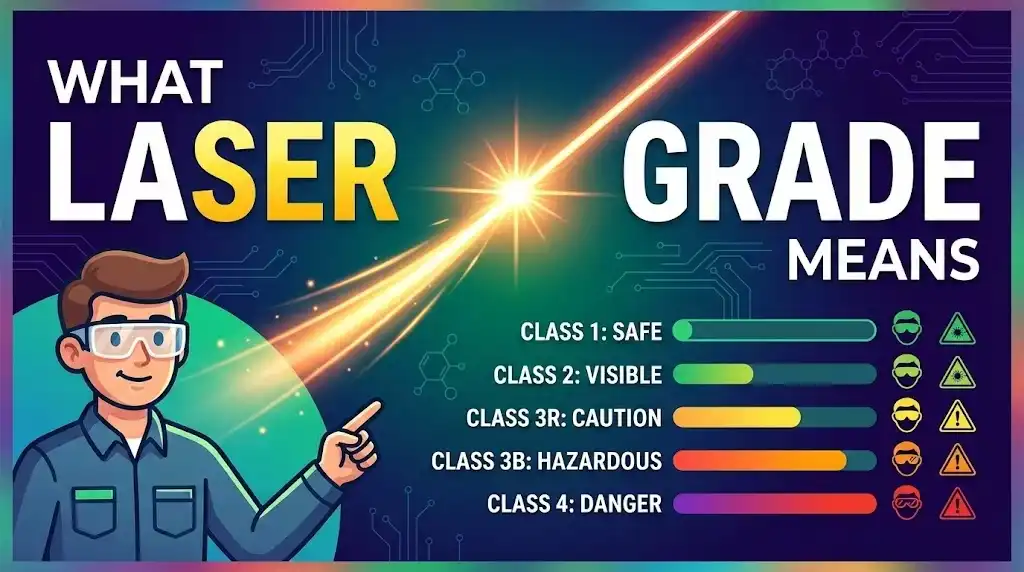
In laboratories, “laser grade” is often used loosely. In safety and compliance, it maps to one thing: laser classification. Under IEC 60825-1, every laser product is assigned a class based on its accessible emission. That printed class isn’t just a label—it signals the likely hazards and the baseline controls you’ll need.
Here’s the critical link for research environments: IEC class is a product designation, while ANSI Z136.1 governs how we actually use lasers safely in labs. Think of IEC as the label on the box and ANSI as the rulebook for the room. Together, they determine signage, interlocks, training, eyewear, and supervision—especially for Class 3B and Class 4 work.
Laser classification at a glance
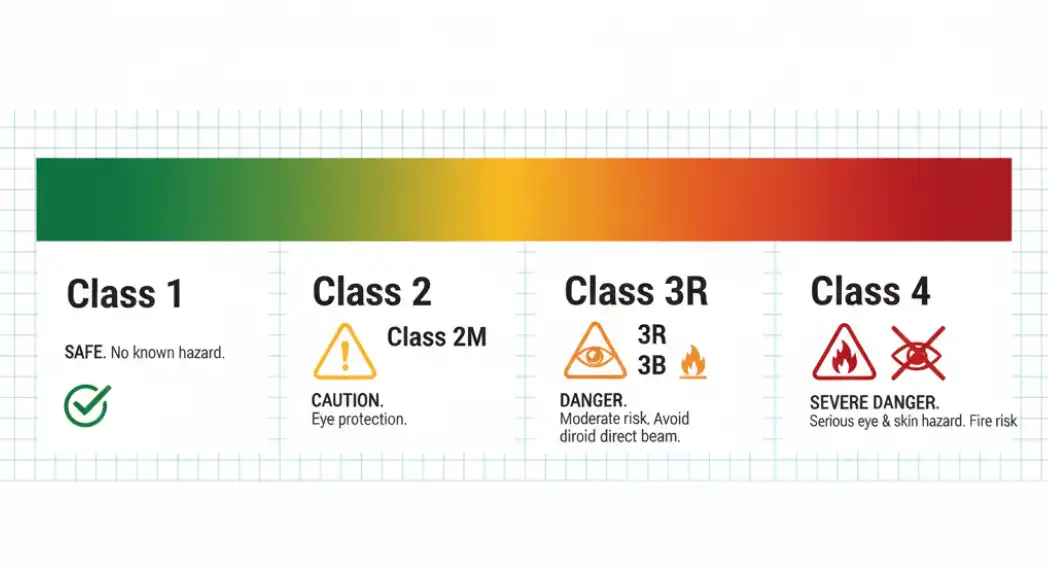
Laser classification groups products by increasing hazard potential. Summaries below align with IEC 60825-1 (visible means 400–700 nm):
- Class 1: Considered eye-safe during normal operation. Embedded higher-class sources may be fully enclosed.
- Class 1M: Safe for the unaided eye but hazardous when viewed with magnifying or collecting optics (binoculars, telescopes, fiber scopes).
- Class 1C: Intended for controlled direct-contact applications; eye safety depends on built-in engineering features.
- Class 2: Visible only; brief, unaided exposure is generally safe due to the blink or aversion reflex.
- Class 2M: Like Class 2 but hazardous when viewed with magnifying or collecting optics.
- Class 3R: Increased risk to the eye from direct exposure; managed use with basic controls.
- Class 3B: Eye injury possible from direct beams and specular reflections; diffuse reflections typically not hazardous.
- Class 4: Eye and skin hazard from direct, specular, and even diffuse reflections; fire ignition and non-beam hazards are credible.
Authoritative class explanations and scope appear in government and national standards resources, including Health Canada’s overviews of IEC classes and labeling, which reflect the 180 nm to 1 mm wavelength coverage of IEC/EN 60825-1.
IEC 60825-1 vs ANSI Z136.1 — how product class becomes lab controls
IEC 60825-1 assigns a class using Accessible Emission Limits (AELs). That class drives the product’s hazard labels, aperture warnings, and built-in safety features. In the lab, ANSI Z136.1 shifts the focus to Maximum Permissible Exposure (MPE)—the biological exposure limit for eyes and skin—so the Laser Safety Officer (LSO) can determine the actual controls required. In short: AEL sets the class on the device; MPE guides what happens in your room.
Below is a pragmatic mapping many LSOs use when communicating with principal investigators and technicians.
| Standard and focus | What it decides | Who primarily uses it | Typical artifacts |
|---|---|---|---|
| IEC 60825-1 (product safety) | Product class via AEL; required labels and instructions; certain engineering features | Manufacturers, importers, and anyone reading device labels | Class and hazard labels, aperture warnings, user information |
| ANSI Z136.1 (safe use) | Hazard evaluation via MPE; control measures, eyewear OD, training, and authorization | LSOs, EHS, PIs, lab staff | Written SOPs, Laser Controlled Areas, signage, interlocks, eyewear specifications |
For official context on IEC classes and labeling, see Health Canada’s guidance, which mirrors IEC/EN 60825-1 classification and label content. For the lab control framework and the LSO’s role, major institutional programs such as Lawrence Berkeley National Laboratory’s Laser Safety Manual align with ANSI Z136.1 and describe class-based controls.
Key concepts every LSO should align on
AEL and MPE in plain language
AEL is the classification threshold for how much radiation can be accessible from a product. It’s how IEC 60825-1 decides the laser’s class and labeling. MPE is the exposure limit that keeps people safe; ANSI Z136.1 uses it to determine controls, including eyewear optical density. You don’t need to reproduce equations in your SOPs, but you should document the inputs and conservative assumptions behind your control selections.
NOHD and NHZ as planning tools
The Nominal Ocular Hazard Distance (NOHD) is the distance within which a direct or specular beam would exceed the eye MPE. The Nominal Hazard Zone (NHZ) is the broader region where a laser exceeds applicable MPEs. In practice, we design Laser Controlled Areas so the NHZ remains inside interlocked boundaries, with beam paths enclosed or terminated before they can exit that zone.
Blink reflex limits and the “M” caveat
The blink or aversion reflex only applies to visible beams. It’s the reason unaided brief viewing of a Class 2 beam is generally considered acceptable. But that protection vanishes with infrared or ultraviolet, and it breaks down if you use magnifying or collecting optics. That’s why Class 1M and 2M devices can be hazardous when viewed through binoculars, fiber inspection scopes, or telescope objectives.
Eyewear OD basics without the math
Eyewear is specified by wavelength range and optical density (OD). OD is logarithmic attenuation: higher OD means more reduction of beam power at the eye. Selection should follow an LSO hazard evaluation considering wavelength(s), power/energy, exposure duration, and alignment practices. Most programs require eyewear for any open-beam Class 3B or Class 4 work; it’s typically not required for normal Class 2 or many Class 3R scenarios.
A quick vignette from the field: During a Class 3B alignment, a postdoc bumped a mirror and sent a near-invisible specular reflection across the bench. The beam dump caught it, but only because the LSO had insisted on fixed beam stops and an enclosure gap notched to block that axis. Lessons like this are why we assume specular paths exist and install hard stops before the first trial power-up.
From class to controls — what usually changes as hazard rises
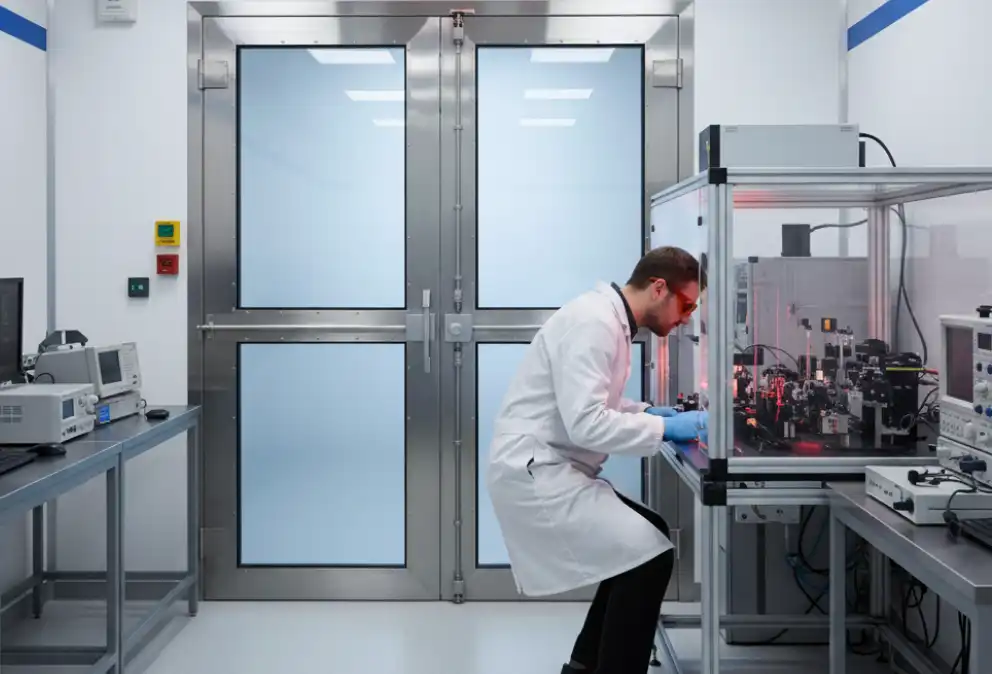
Laser classification is the starting line, not the finish. As you move from Class 3R to 3B to 4, controls intensify. The list below describes conservative defaults many Z136-aligned programs adopt for higher classes; your LSO should tailor them to wavelength, power, pulse parameters, and task.
- Authorization and training: Require LSO authorization for 3B and 4 users, documented training, and proficiency checks. Prohibit unattended open-beam work. Establish written procedures for normal operation, alignment, and service.
- Engineering controls and boundaries: Use interlocked Laser Controlled Areas for Class 4 (and many Class 3B setups). Install key-switches, shutters, beam enclosures, beam dumps, and window covers or rated viewing panels. Keep beam height away from eye level when standing or seated.
- PPE, signage, and supervision: Specify eyewear OD by wavelength for all present during open-beam 3B/4 tasks. Post room signs appropriate to class and status lights where practicable. For Class 4, assign a supervisor or buddy during hazardous tasks and plan for non-beam hazards—electrical, fumes and laser-generated airborne contaminants, and fire prevention.
Institutional EHS manuals reflecting ANSI Z136.1, such as the LBNL Laser Safety program, and national occupational safety overviews from the Canadian Centre for Occupational Health and Safety, outline these measures in depth and provide templates your program can adapt.
Eyewear quickly and conservatively
Here’s a simple way to frame eyewear selection before the LSO signs off:
- Start with wavelength: Eyewear must specify the exact wavelength band(s) you’ll use. Broadband labels can be misleading—verify the marked range covers your source and harmonics.
- Add OD for the task: For open-beam 3B and 4 work, choose conservative OD based on worst-case exposure time and beam parameters, then confirm visibility and alignment practicality. If users cannot see the work at that OD, consider engineering changes (enclosures, lower power alignment beams) rather than compromising attenuation.
- Verify labeling and condition: Eyewear must show OD and wavelength range, be free of damage, and be compatible with other PPE. Record the selection rationale in your SOP or hazard assessment.
University program appendices provide concise, ANSI-aligned eyewear guidance that LSOs can adapt—for example, UC Berkeley’s selection appendix clarifies how to match OD and wavelength in practice.
References and further reading
- Health Canada’s overview of laser product classes and labeling aligned to IEC 60825-1 provides accessible definitions and scope across 180 nm to 1 mm: Health Canada – Laser products overview
- For product classification and labeling duties under IEC/EN 60825-1, including national implementations, see the British Standards landing page: BSI – BS EN 60825-1:2014+A11:2021
- For the lab control framework, hazard evaluation using MPE, and class-based controls, consult a Z136-aligned institutional manual: Lawrence Berkeley National Laboratory – Laser Safety Manual
- A concise national overview of laser program elements and typical controls is available here: Canadian Centre for Occupational Health and Safety – Lasers
- ANSI’s summary confirms current edition years and the safe-use emphasis of Z136.1: ANSI – Z136.1 Safe Use of Lasers overview
- For eyewear selection concepts and examples of program documentation, see: UC Berkeley EH&S – Selection of Laser Safety Eyewear
Why it matters:
Laser classification tells you how hazardous a product can be; ANSI’s safe-use framework tells you how to keep people safe in your specific lab. Use both—class for the label, MPE for the room—and you’ll make better calls on interlocks, signage, eyewear, and procedures before the first beam leaves the aperture.