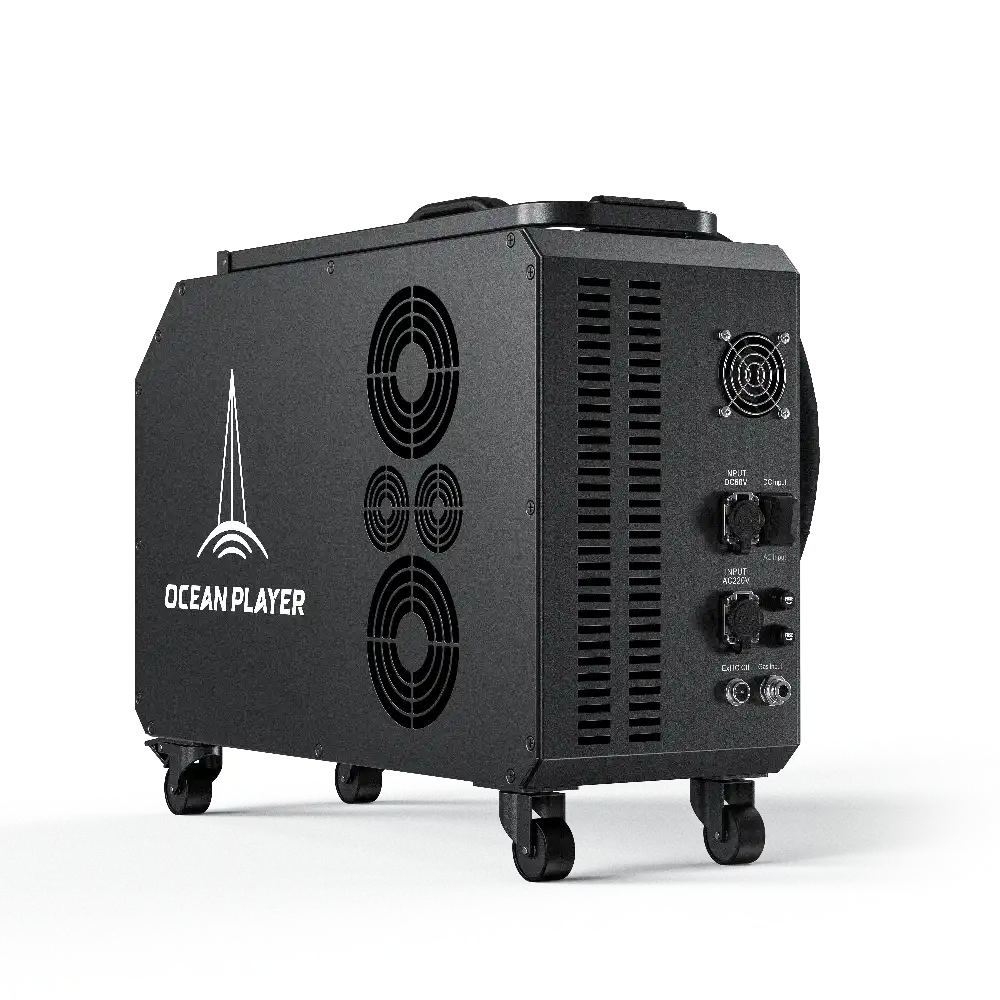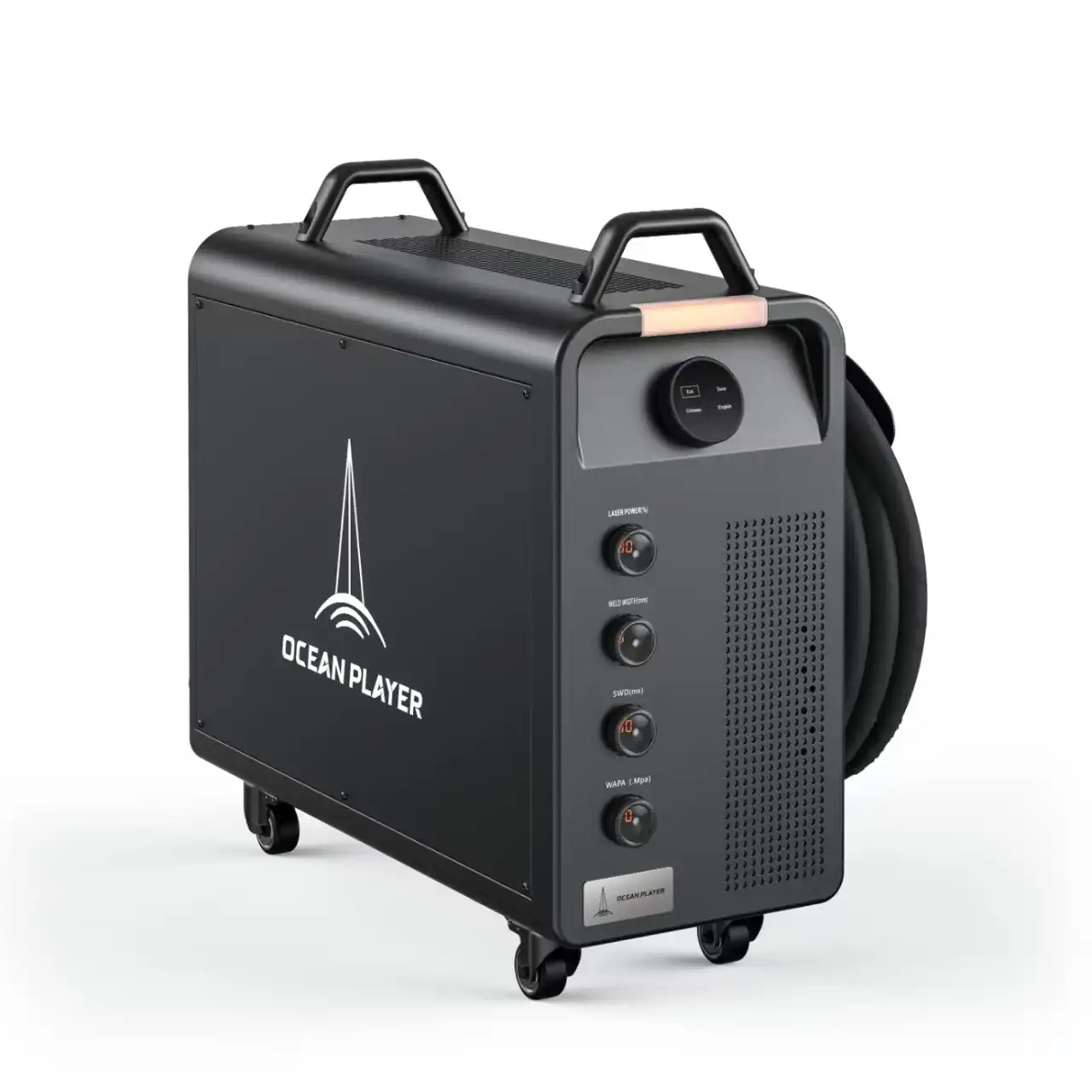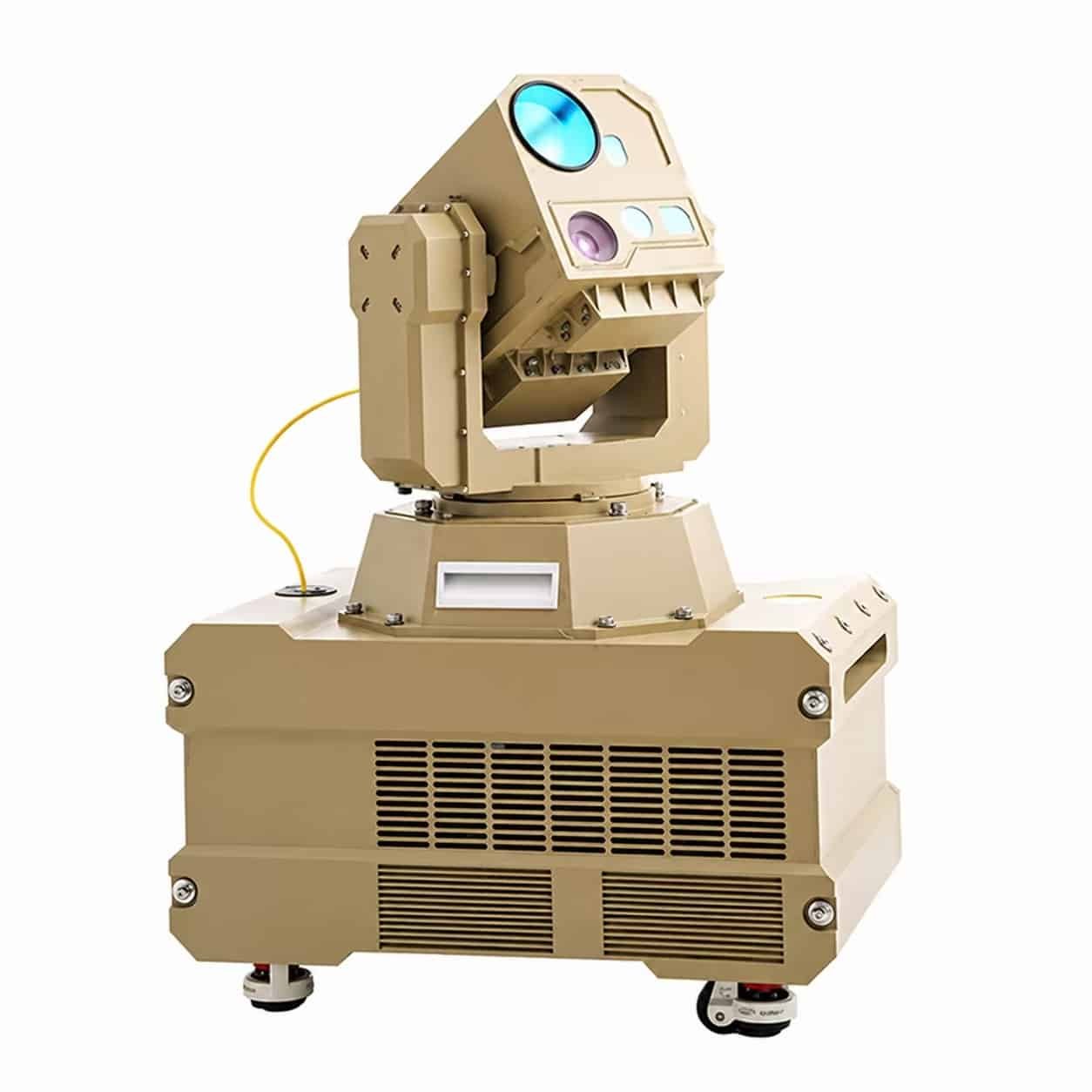
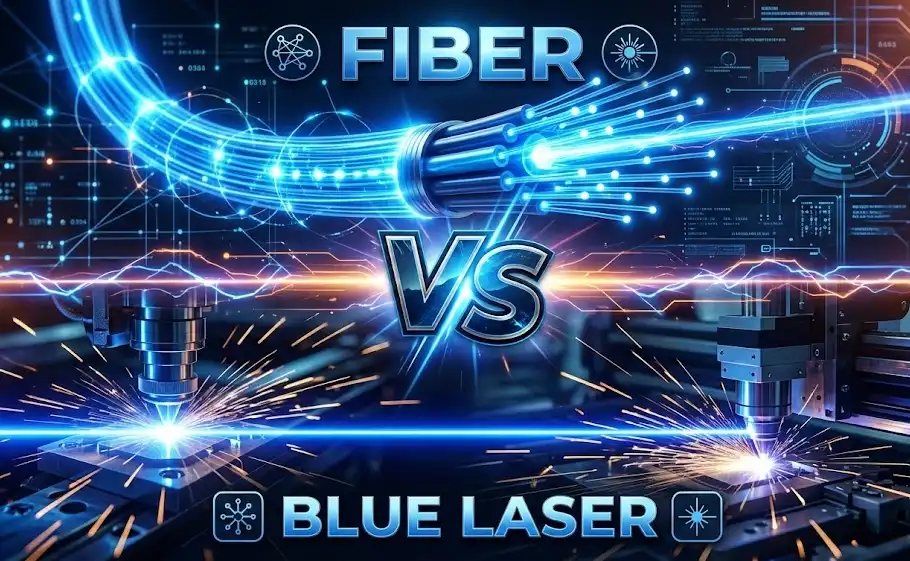
As EV lines push higher currents through ever‑thinner tabs and denser busbars, the real bottleneck often isn’t speed—it’s weld quality: spatter, porosity, and the electrical resistance of lap joints. This guide compares fiber lasers (≈1 µm) and blue diode lasers (≈445–460 nm) specifically for copper and aluminum tab/busbar welding, with an engineer‑to‑engineer focus on yield, resistance, and integration on production cells (as of 2026‑02‑14). For searchers comparing options, it squarely addresses fiber laser vs blue laser trade‑offs.
Key takeaways
- For thin, pure‑copper tabs (≈0.1–0.8 mm total stack), blue wavelength coupling typically enables steadier conduction‑mode welding with lower spatter/porosity and often lower joint resistance at matched penetration.
- For thick busbars (≥1–3 mm), fiber lasers generally retain advantages in maximum penetration and speed due to higher available power and brightness; quality can be competitive with proper beam shaping and process tuning.
- For Ni‑plated steel to copper, or Cu–Al transitions, hybrid/coaxial blue+IR configurations can reduce defects compared with IR alone, though public, matched‑metric datasets remain limited.
- The hero metric is weld quality (spatter, porosity, electrical resistance). Throughput matters, but yield‑driven TCO typically dominates ROI on battery lines.
- Specs and prices change rapidly—especially blue power/beam quality and monitoring options—so validate assumptions on your fixtures and acceptance criteria.
TL;DR verdict: If your primary goal is the lowest‑resistance, low‑defect Cu‑tab welds, start with blue or blue‑hybrid. If your top need is deep, fast penetration on thicker Cu/Al busbars, start with fiber. Mixed stacks and Ni‑plated tops often benefit from hybrid (blue+IR) spot strategies.
Fiber laser vs blue laser — how wavelength drives copper/aluminum weld quality
Copper reflects strongly at ≈1 µm, while absorption jumps at ≈450 nm. A peer‑reviewed 2025 lap‑welding study on Ni‑plated steel/Cu reports stronger coupling into copper at the blue wavelength and demonstrates integrity with a coaxial blue+IR configuration; see the authors’ open‑access article, Lap Welding of Nickel‑Plated Steel and Copper Sheets … (2025), hosted by the National Institutes of Health archive: peer‑reviewed Ni‑plated steel/Cu lap welding study showing higher copper coupling at ~450 nm.
An engineering explainer updated in 2024 summarizes that copper absorptivity at ~450 nm is often characterized around ≈60% in processing contexts, whereas it is far lower near 1 µm; surface state and power density matter, but the directional difference is clear. See Laserax’s 2024 overview of copper welding wavelengths for a concise comparison. For fundamentals on reflectivity, absorption, and conduction vs keyhole behavior, the 2024 peer‑reviewed review provides depth: Review and Analysis of Modern Laser Beam Welding Processes (2024).
What does this mean in practice? Blue lasers often stabilize initiation and steady‑state on pure copper, which is linked to lower spatter and porosity tendencies at matched penetration targets. Fiber lasers, however, bring higher maximum powers and brightness today, which favors penetration and speed on thicker Cu/Al busbars. In between, hybrid blue+IR strategies can blend the benefits: blue aids coupling into copper and stabilizes the top interface; IR supports deeper fusion when needed. A 2024 SPIE proceeding signals the power trajectory: 5 kW high‑power blue laser with near‑infrared fiber.
Head‑to‑head comparison for EV tabs and busbars
Below is a vendor‑agnostic comparison focused on EV use cases. Fields marked with “as of 2026‑02‑14” reflect public information trajectories and may change; validate on your parts and acceptance tests. This side‑by‑side captures the core fiber laser vs blue laser trade‑offs.
| Dimension | Fiber laser (≈1064–1080 nm) | Blue laser (≈445–460 nm) |
|---|---|---|
| Wavelength class | Near‑IR, ~1 µm | Visible blue, ~450 nm |
| Copper absorption (directional) | Low at room start; rises with power density and molten pool formation | High relative to 1 µm; literature reports ≈43–60% depending on conditions (as of 2024–2025) |
| Aluminum absorption | Moderate; process‑tunable | Moderate; differences vs 1 µm are smaller than for Cu |
| Spatter tendency on pure Cu | Higher risk at keyhole onset; mitigable with beam shaping/oscillation and tuned parameters | Typically lower at matched penetration due to steadier conduction‑mode coupling |
| Porosity tendency (Cu lap) | Sensitive to instability/keyhole collapse; process window exists with optimization | Typically lower when run in stable conduction mode on Cu |
| Electrical resistance (Cu lap) | Competitive with optimized parameters and geometry control | Often lower due to steadier coupling and reduced defects at the faying interface |
| Penetration & speed on thick busbars (≥1–3 mm) | Generally stronger due to higher available power/brightness and focusability | Improving, but max continuous power/brightness typically lower (as of 2026) |
| Typical continuous power availability | Broad range into multi‑kW to tens of kW classes | Rapidly rising; public reports around multi‑kW (e.g., ≈5–6 kW class reported since 2024–2025) |
| Scanner/monitoring integration | Mature ecosystem for remote welding, OCT/melt‑pool sensing | Available in growing ecosystems; confirm scanner/OCT specifics with vendors and optics |
| Safety/reflectivity management on Cu | Back‑reflection risk higher; mitigations include isolators/coatings/optics | Lower back‑reflection tendency on Cu vs 1 µm but requires standard Class 4 controls |
| Dissimilar stacks (Ni‑steel/Cu, Cu–Al) | Works; hybrids or green/blue assistance often improve stability/defects | Strong for Cu interfaces; hybrid blue+IR can further improve mixed‑stack outcomes |
| TCO notes | Strong parts availability, service base; energy use scales with power; yield depends on optimization | Potential yield gains on Cu tabs reduce scrap/rework; capex per kW may be higher; check duty cycle and service model |
Notes and sources (selected): Peer‑reviewed Ni‑plated steel/Cu lap welding study, 2025; SPIE 2024 blue+IR power development; 2024 peer‑reviewed welding review.
Scenario picks for process engineers
Thin pure copper tabs (≈0.1–0.8 mm total stack)
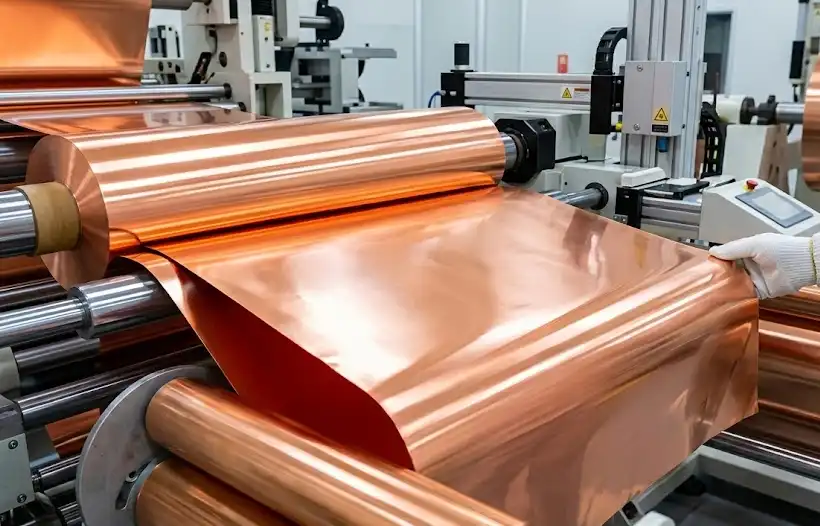
Prioritize blue wavelength for the hero metric—weld/joint quality. The significantly higher copper absorption near 450 nm usually supports conduction‑mode stability, which correlates with lower spatter/porosity and often lower joint resistance when penetration targets are matched. If you must remain in a 1 µm ecosystem, deploy beam shaping (e.g., ring/annular profiles) and scanning oscillation to suppress keyhole instability and approach the same resistance targets.
Nickel‑plated steel on copper (lap tabs)
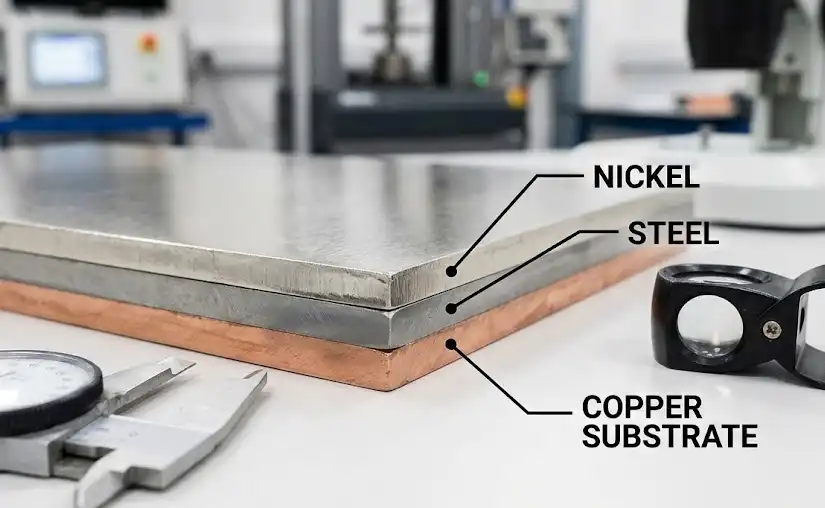
Coaxial or superposed blue+IR is a strong candidate. Blue couples into copper beneath the Ni layer, while IR supports deeper fusion. Reports from a 2025 peer‑reviewed study indicate defect‑free fusion zones with such hybrid strategies. Where hybrid isn’t feasible, optimize preheats, focus offsets, and ramp profiles to stabilize initiation with whichever wavelength you adopt.
Thick copper or aluminum busbars (≥1–3 mm)
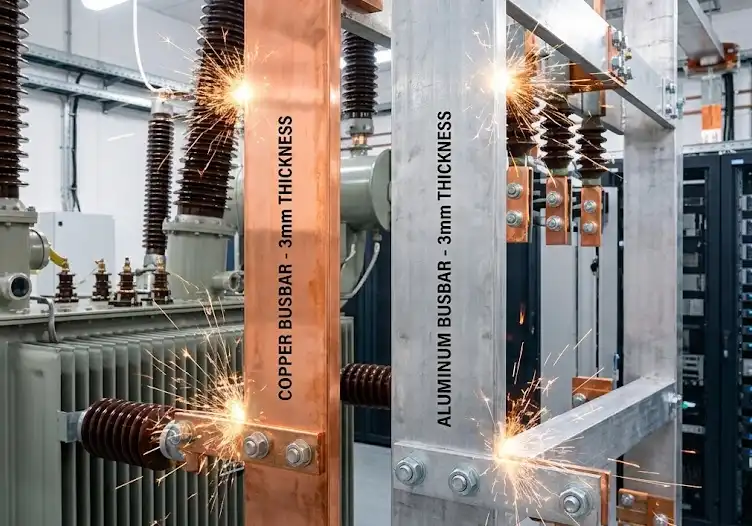
If penetration and speed dominate, fiber lasers generally lead due to higher available power and superior focusability. Blue power is rising, but for very thick Cu, 1 µm classes still tend to offer better depth/speed headroom as of 2026. Even so, quality remains the gate: leverage oscillation patterns and process windows to limit porosity and spatter, then push speed.
Copper–aluminum transitions
Control of intermetallics and electrical resistance is paramount. Blue or hybrid (blue+IR or blue+green) can help by stabilizing copper absorption while managing total heat input. Tailored spot shaping (e.g., elliptical or ring modes) and multi‑pass/step‑heat profiles can reduce brittle phase formation and keep resistance within spec.
High‑mix, rapidly changing lines
When frequent changeovers force wide process windows, start with the platform that offers the broadest stability on your dominant stack. If most joints are Cu‑rich tabs, blue (or hybrid) typically provides more forgiving coupling. If most are thick Al busbars, fiber often yields faster, deeper penetration with robust scanner ecosystems. Modular cells that accept both sources or hybrid heads protect against future mix shifts.
Decision tree
Your dominant joint and hero metric?
  ├─ Thin pure Cu tabs (≤0.8 mm total) & lowest resistance/defect rate is critical
  │    → Choose Blue or Hybrid (Blue+IR). Validate conduction‑mode parameters first.
  │
  ├─ Ni‑plated steel on Cu tabs & need stable top‑layer initiation + Cu fusion
  │    → Choose Hybrid (Blue+IR). Consider coaxial beams and tuned focus offsets.
  │
  ├─ Thick Cu/Al busbars (≥1–3 mm) & maximum penetration/speed
  │    → Choose Fiber (1 µm). Add beam shaping/oscillation to control defects.
  │
  ├─ Cu–Al transitions with strict resistance limits
  │    → Prefer Blue or Hybrid. Use tailored spot shaping to manage mixing/IMCs.
  │
  └─ High‑mix line; wide stability window needed
       → Start with the wavelength best matched to majority joints; consider modular/hybrid capability.
Pricing and TCO notes (as of 2026‑02‑14)
Treat pricing as directional and verify with vendors. Capital outlays scale with power class, beam delivery (scanner vs fixed), hybrid/combiner hardware, and inline QC (melt‑pool, OCT, vision). Operating costs hinge on uptime, scrap/rework, preventive maintenance, and energy. In many battery lines, a one‑point improvement in first‑pass yield can outweigh modest throughput differences—so model 5‑year TCO with yield deltas explicitly.
- Blue may command higher CapEx per delivered kW and require attention to duty cycle/beam‑quality specs; potential savings arrive via defect reduction on Cu tabs (scrap and rework). Fiber enjoys mature service ecosystems and broad third‑party optics; energy use rises with the higher powers used for thick busbars.
- Standards reminder: re‑qualify joints with four‑wire resistance and thermal‑cycling validation after any source or optics change.
Prices and specifications are subject to change. Validate assumptions with current quotations and on‑fixture trials (as of 2026‑02‑14).
FAQ
How does blue‑wavelength absorption on copper compare to 1 µm fiber?
- Public literature and technical explainers indicate copper absorbs dramatically more energy near 450 nm than at ~1 µm. See the peer‑reviewed 2025 lap‑welding paper on Ni‑plated steel/Cu and Laserax’s 2024 wavelength overview for representative context.
Which is better for minimizing electrical resistance in copper tab lap welds?
- In many thin Cu‑tab cases, blue (or hybrid blue+IR) tends to produce steadier conduction‑mode welds with fewer defects at the faying interface, which often correlates with lower joint resistance at matched penetration. Always confirm with four‑wire Kelvin measurements on your standardized stackups.
Can blue lasers weld 1–3 mm copper or aluminum busbars at production speeds?
- Blue power and beam quality have advanced rapidly, with multi‑kW systems reported publicly since 2024–2025, including SPIE‑reported architectures at ≈5 kW. However, for the thickest Cu/Al sections, fiber’s higher available power/brightness still generally favors maximum penetration and speed as of 2026.
When should manufacturers consider hybrid blue+IR heads?
- When stacks combine materials (e.g., Ni‑plated steel/Cu, Cu–Al) or when you need blue’s coupling into copper plus IR‑assisted depth. Peer‑reviewed 2025 results on Ni‑plated steel/Cu demonstrated defect‑free fusion using coaxial blue+IR, though more matched‑metric data (porosity%, four‑wire resistance) would strengthen the public record.
What test methods prove lower spatter and porosity claims?
- Use high‑speed video plus spatter mass collection (mg/m) under matched penetration targets, micro‑CT or cross‑sectional image analysis for porosity area %, and four‑wire resistance on standardized lap stacks. Publish parameter matrices so peers can reproduce results.
Methods appendix: how to reproduce decision‑grade data
Spatter mass and event rate
Collect ejected particle mass (mg/m of weld) using standardized traps around the seam while recording high‑speed video (≥10 kfps). Match penetration between fiber and blue (or hybrid) by adjusting power and speed so quality comparisons are fair.
Porosity quantification
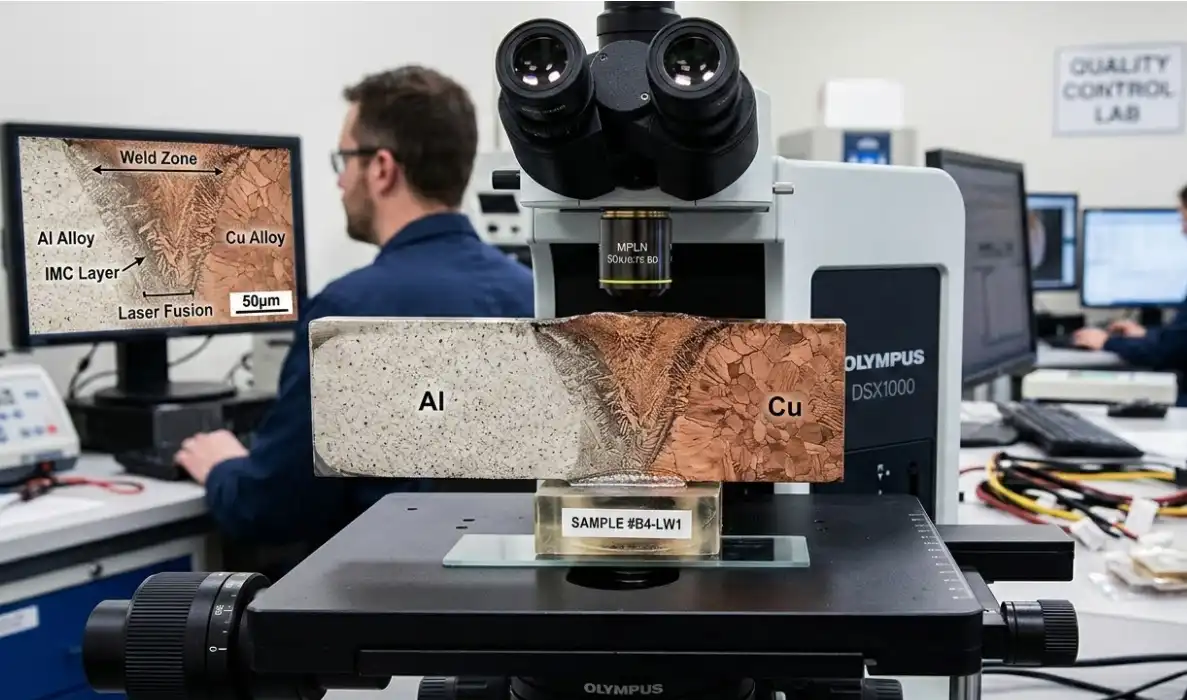
Scan representative joint lengths via micro‑CT where feasible or perform metallographic cross‑sections at multiple positions. Report percent void area and distribution across the fusion zone; include acceptance thresholds tied to resistance targets.
Electrical resistance of lap joints
Use four‑wire Kelvin measurements on standardized stacks (e.g., Cu–Cu, Ni‑plated steel/Cu, Cu–Al) after welding and post‑processing. Record contact geometry and clamp force used during testing. Include thermal‑cycle validation to capture resistance drift.
Penetration/speed DOE
Build power‑by‑speed matrices for each source/head configuration across target thicknesses (e.g., Cu tabs 0.1–0.8 mm; busbars 1–3 mm). Macro‑etch cross‑sections to confirm penetration and characterize HAZ and lack‑of‑fusion risk.
Monitoring and scanner integration checks
Validate galvanometer scanner path fidelity and spot stability at planned speeds. For inline QC, correlate melt‑pool or OCT signatures with post‑weld porosity and resistance metrics; develop control limits before ramping production.
Citations and further reading (accessed 2026)
- Peer‑reviewed lap‑welding study on Ni‑plated steel/Cu showing stronger copper coupling at blue wavelength and hybrid (blue+IR) benefits: Lap Welding of Nickel‑Plated Steel and Copper Sheets … (2025) — NIH archive
- Engineering explainer summarizing higher copper absorptivity near 450 nm and comparing fiber, blue, and green options (2024): Laser Welding Copper: Fiber, Blue, or Green Lasers? — Laserax
- Comprehensive peer‑reviewed primer on laser welding physics, reflectivity, and process modes (2024): Review and Analysis of Modern Laser Beam Welding Processes — NIH archive
- Conference proceedings signaling progress toward higher‑power blue and hybrid approaches (2024): 5 kW high‑power blue laser with near‑infrared fiber — SPIE
Closing thought
Here’s the deal: for EV tabs and busbars, there’s no single winner. If your core job is to minimize resistance and defects on thin Cu tabs, blue or hybrid usually gets you there faster. If depth and speed on thick sections rule the day, fiber often leads. Either way, plan a short, well‑instrumented DOE to validate the choice on your fixtures—and let yield, not anecdotes, decide.