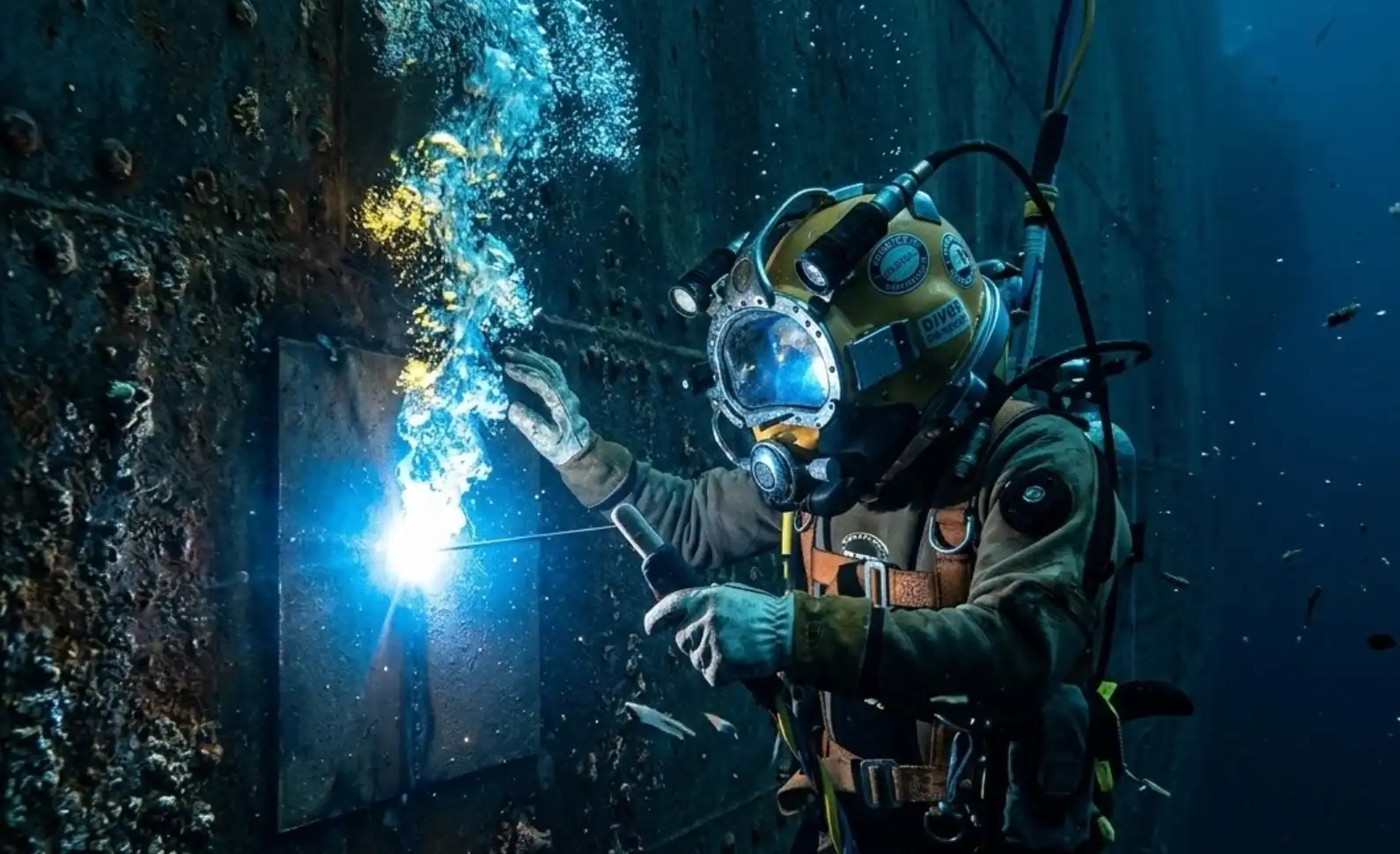
Underwater welding blends two unforgiving worlds: electric arc welding and commercial diving. The risks are not just “because it’s underwater,” but because pressure, electricity, gas chemistry, visibility, and logistics combine in ways that punish small mistakes. This guide explains why underwater welding is dangerous, how risks differ in wet versus dry/hyperbaric methods, and which standards frame safe practice.
Key Takeaways
- Underwater welding includes wet welding in open water and dry/habitat welding inside a pressurized chamber; each has distinct risk and quality profiles, per the framing from the Welding Institute.
- The big “why” behind the danger: conductive seawater and stray current paths; hydrogen–oxygen gas generation and ignition; differential pressure (Delta P) entrapment; decompression illness/barotrauma; plus harsh environmental factors.
- Wet welding is faster to mobilize but typically riskier and more defect‑prone; dry/habitat welding lowers arc‑related and visibility risks and improves quality but adds hyperbaric exposure, fire/atmosphere risks, and decompression obligations.
- Recognized authorities and codes shape safe practice: OSHA 29 CFR 1910 Subpart T (commercial diving), IMCA Code of Practice and Safety Flashes, ADCI Consensus Standards and Delta‑P Checklist, AWS D3.6M Underwater Welding Code, and the US Navy Diving Manual.
- Managers should ask for documented method choice (wet vs. habitat), electrical isolation controls, Delta‑P survey and capture‑zone calculations, atmosphere/gas management in habitats, decompression planning, and AWS D3.6M procedure/welder qualifications—with records.
Definition: What Counts as Underwater (Hyperbaric) Welding?
Underwater (hyperbaric) welding is welding performed at elevated ambient pressure in water. It occurs in two main modes:
- Wet welding: work is performed directly in the water, most commonly with shielded metal arc welding (SMAW) using waterproof electrodes.
- Dry/hyperbaric (habitat) welding: the joint is enclosed in a sealed, pressurized chamber that displaces water, creating a dry environment around the weld where topside‑style processes and better visibility/control are possible.
This framing aligns with The Welding Institute’s overview of definitions and trade‑offs in its FAQ, “What is underwater welding and how does it work?,” which also notes the practicality of wet SMAW and the quality advantages of habitat welding. See the Welding Institute’s explanation for a concise taxonomy and process notes: the FAQ clarifies wet SMAW practice and habitat benefits in control and quality. Reference: The Welding Institute’s FAQ on underwater welding.
- Source: The Welding Institute — “What is underwater welding and how does it work?” https://www.twi-global.com/technical-knowledge/faqs/what-is-underwater-welding
Wet vs Dry/Hyperbaric: Which Method Is Riskier, and When?
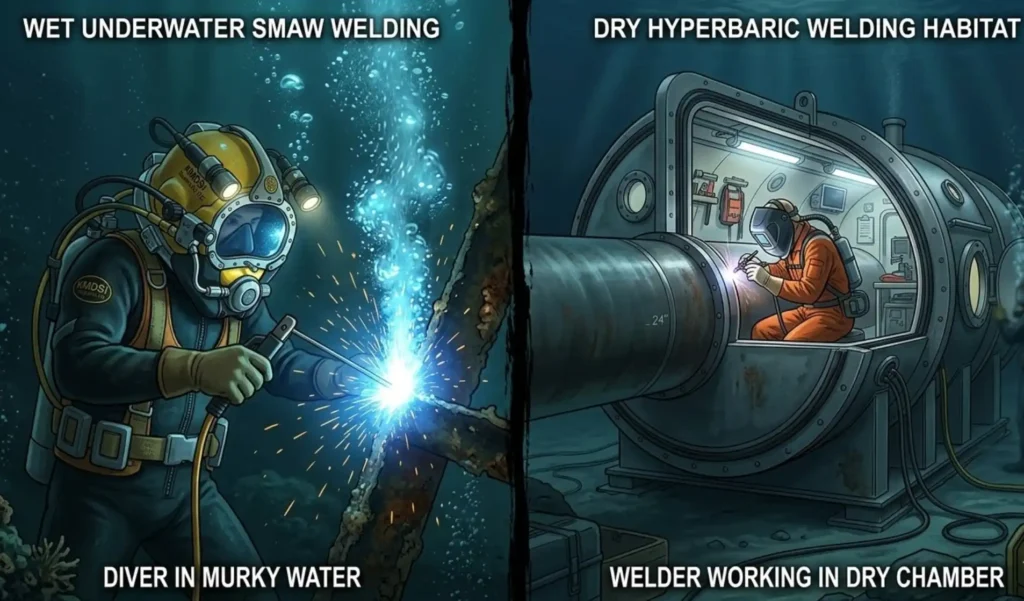
Both methods operate under pressure, but they distribute risk differently.
- Wet welding exposes the diver and equipment to a fully conductive medium, turbulent arc bubble clouds, and rapid heat extraction. These factors elevate electrical shock risk and degrade weld metallurgy (hardness, hydrogen pickup, cracking susceptibility). Mobilization can be fast for time‑critical repairs.
- Dry/hyperbaric (habitat) welding removes water around the joint, improving visibility and process control and reducing immediate arc‑related risks. However, the pressurized, confined atmosphere introduces its own hazards (oxygen management, fire risk) and typically increases time under pressure and decompression requirements.
In code and quality terms, managers should understand that the AWS D3.6M Underwater Welding Code establishes weld classes and qualification frameworks used by contractors to match method, procedure, and inspection to the criticality of the repair.
| Factor | Wet Welding | Dry/Hyperbaric (Habitat) Welding |
|---|---|---|
| Environment around weld | Directly in water; arc forms a local gas bubble | Water displaced by a sealed chamber; dry, pressurized atmosphere |
| Typical process | SMAW with waterproof electrodes | Topside‑equivalent processes possible |
| Immediate risks | Higher shock potential; poor visibility; spatter can compromise suits/umbilicals | Atmosphere management, fire/ignition control; chamber logistics |
| Metallurgy/quality | Rapid quench, hydrogen pickup, porosity and cracking more likely | Better heat control, shielding, and inspection readiness |
| Schedule/mobilization | Fast for urgent repairs | Slower; more planning and equipment |
| Hyperbaric exposure | Shorter individual weld passes but repeated dips common | Longer continuous time at pressure; decompression burden increases |
| Typical use cases | Localized ship hull, platform, or pipeline touch‑ups | Structural/critical joints requiring higher quality and documentation |
For a foundational perspective, see the Welding Institute’s FAQ (definition/process) and the AWS D3.6M Underwater Welding Code preview for qualification context: https://pubs.aws.org/Download_PDFS/D3.6M-2017PV.pdf
Why Underwater Welding Is Dangerous: The Physics
Electrical shock in conductive water
Water—especially seawater—conducts electricity efficiently. Any breach in insulation, damaged stinger, or stray current path can route energy through the diver or umbilical. That is why wet welding practice typically uses direct current (DC) with strict equipment controls and supervision. Within the United States, commercial diving work falls under OSHA’s Commercial Diving Operations framework (29 CFR 1910 Subpart T), which sets the regulatory umbrella for safe diving operations that include underwater arc‑welding and cutting tasks. For an overview of that framework and related directives, consult OSHA’s Commercial Diving Operations standards overview: https://www.osha.gov/commercial-diving/standards and enforcement directive CPL 02‑00‑151: https://www.osha.gov/enforcement/directives/cpl-02-00-151
Think of electrical leakage like a shortcut through water: if the intended path’s insulation degrades, the current “sees” an easier way—right through the surrounding water and possibly the diver. Controls include verified insulation integrity, low open‑circuit voltages per accepted practice, correct polarity, isolation/LOTO, competent supervision, and continuous communications.
Hydrogen–oxygen gas and explosion risk
Underwater arcs and thermal cutting split water (electrolysis), generating hydrogen and oxygen. In confined spaces or under structures, pockets can accumulate. Ignition—by the arc itself or another source—can produce powerful pressure pulses that damage equipment and injure divers. Inside hyperbaric habitats, atmosphere control is a central hazard: oxygen enrichment elevates fire risk, and inadequate venting can allow flammable mixtures to form. Practical guidance emphasizes maintaining spaces flooded during certain hot‑work evolutions in open water, or else continuous venting/purging and strict ignition control when in chambers, alongside gas‑free certifications where applicable.
- References: US Navy Salvors Handbook (hot‑work cautions and atmosphere concepts): https://www.navsea.navy.mil/Portals/103/Documents/SUPSALV/Salvage%20Docs/Salvors%20Handbook_Rev2.pdf and The Welding Institute’s FAQ on underwater welding: https://www.twi-global.com/technical-knowledge/faqs/what-is-underwater-welding
Differential pressure (Delta P) entrapment
Differential pressure hazards arise wherever water flows from high to low pressure—through intakes, leaks, sluices, culverts, or damaged structures. The flow creates a capture zone that can pull in a diver or snag an umbilical within seconds. Picture a “suction cone” in front of a leaking flange or an intake grate: the closer you get, the stronger the pull becomes, and beyond a certain boundary escape is unlikely without shutting the flow.
Authoritative guidance calls for identifying all potential sources, calculating capture zones and minimum stand‑off distances, verifying “no‑flow” with lockout/tagout (LOTO) and field checks, and installing barriers/exclusion zones before entry.
- References: ADCI Delta‑P Diving Checklist (planning controls): https://www.adc-int.org/files/Delta-P%20Diving%20Checklist_01_28_22_FINAL.pdf; HSE research series on differential pressure hazards in diving (RR761 series index): https://www.hse.gov.uk/research/rrhtm/701-800.htm; IMCA Safety Flash example (near‑miss from unidentified Delta P): https://www.imca-int.com/resources/safety/safety-flashes/0317-near-miss-unidentified-differential-pressure-led-to-diver-s-umbilical-getting-trapped/
Decompression illness and barotrauma
Time spent at elevated ambient pressure loads inert gases into body tissues. Ascent too fast or profiles not matched to exposure can lead to decompression sickness (DCS); pressure changes also risk barotrauma to ears, sinuses, and lungs. Dry/habitat welding, by design, often extends time under pressure and imposes more complex decompression obligations and standby arrangements. Operational frameworks for decompression, emergency recompression, and medical support are extensively documented in the US Navy Diving Manual Rev. 7.
- Reference: US Navy Diving Manual Rev. 7 (decompression frameworks and emergency considerations): https://www.navsea.navy.mil/Portals/103/Documents/SUPSALV/Diving/US%20DIVING%20MANUAL_REV7.pdf
Environmental and operational risks
Beyond physics, operations add layers of exposure: hypothermia from cold water, poor visibility from arc bubbles and silt, current and surge, entanglement on structure or umbilicals, and hazards from overhead loads or nearby vessels. Even molten spatter can compromise suits or nick umbilicals during close‑quarters work. Industry bodies routinely publish incident digests to reinforce good practice and trend awareness.
- References: The Welding Institute’s FAQ (practical risk notes): https://www.twi-global.com/technical-knowledge/faqs/what-is-underwater-welding; IMCA Safety Flashes hub (incident learning): https://www.imca-int.com/resources/safety/safety-flashes/
What the Standards and Codes Expect
Several authorities define the governance landscape. Managers should confirm contractor alignment with these documents and practices:
- OSHA 29 CFR 1910 Subpart T (Commercial Diving Operations): U.S. regulatory umbrella for diving work that includes underwater welding/cutting tasks. Overview: https://www.osha.gov/commercial-diving/standards and directive: https://www.osha.gov/enforcement/directives/cpl-02-00-151
- IMCA International Code of Practice for Offshore Diving and Safety Flashes: Offshore diving best practice and incident learning used globally; publicly hosted Code copy for context: https://www.mds.uy/media/attachments/2022/08/05/imca_international_code_of_practice_for.pdf and Safety Flashes hub: https://www.imca-int.com/resources/safety/safety-flashes/
- ADCI Consensus Standards and Delta‑P Checklist: Widely used in North America; practical planning tool for isolation, capture‑zone calculations, and exclusion distances: https://www.adc-int.org/files/Delta-P%20Diving%20Checklist_01_28_22_FINAL.pdf and https://www.adc-int.org/files/ADCI%20Consensus%20Standards%206_2_25.pdf
- AWS D3.6M Underwater Welding Code: Classes and qualification/verification framework for wet and dry environments: https://pubs.aws.org/Download_PDFS/D3.6M-2017PV.pdf
- US Navy Diving Manual Rev. 7 (NAVSEA): Decompression frameworks and operational cautions for underwater cutting and welding: https://www.navsea.navy.mil/Portals/103/Documents/SUPSALV/Diving/US%20DIVING%20MANUAL_REV7.pdf
Manager’s Due‑Diligence Checklist for Underwater Welding Jobs
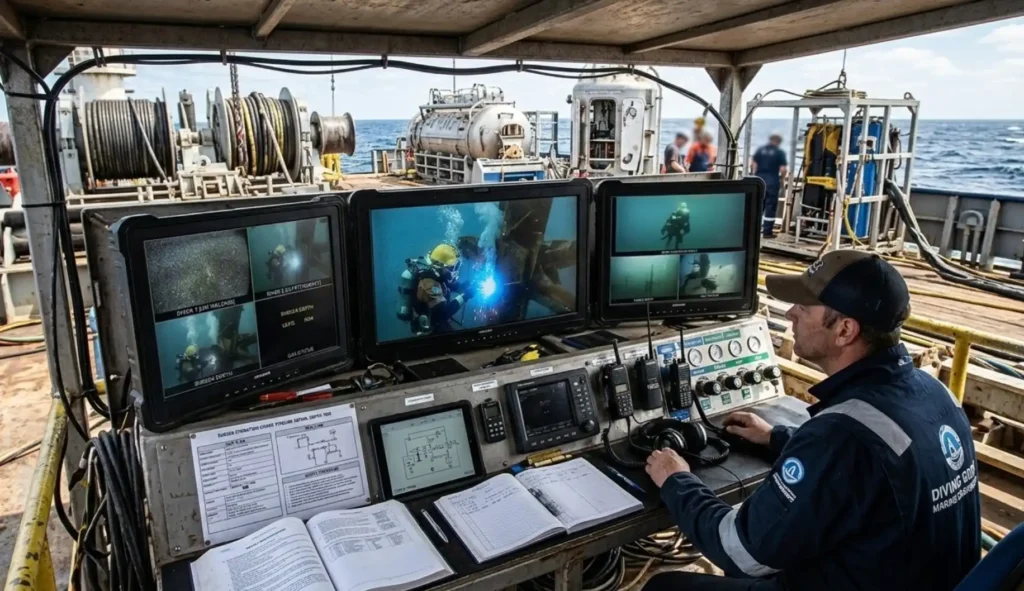
Use these prompts to pressure‑test bids, method statements, and permits. If any answer is vague, pause the job.
- Credentials: Does the contractor operate to ADCI/IMCA standards and the applicable national regulations (e.g., OSHA Subpart T in the U.S.)? Can they show current manuals and compliance records?
- AWS D3.6M alignment: Are the weld procedure(s) and welder qualifications documented for the intended weld class, with inspection/NDT plans to match?
- Method choice: Why wet versus dry/habitat here? Is there a written rationale balancing risk, quality, schedule, and decompression burden?
- Electrical safety: What is the isolation/LOTO plan? How are open‑circuit voltage, polarity, insulation integrity, and stinger/cable condition controlled and verified before each dive?
- Delta‑P survey: Have all potential differentials been mapped? What are the calculated capture zones and minimum stand‑off distances? How will no‑flow be verified (valving, LOTO, physical barriers)?
- Atmosphere and gas management (habitats): What are the oxygen setpoints, ignition controls, and continuous venting/purging arrangements? Who signs gas‑free or equivalent certificates where applicable?
- Decompression and emergency support: Is a chamber available and staffed? What are the planned ascent profiles and contingency tables? How is emergency recompression access assured?
- Communications and supervision: Is there continuous hard‑wired or reliable through‑water comms? Who is the designated supervisor, and what are abort criteria?
- Umbilical and line management: How are entanglement and exposure to suction/edges prevented? What are the drop‑object and vessel‑traffic controls?
Myth‑Check: Is Underwater Welding the “Deadliest Job”?
You may see shareable graphics claiming extreme fatality rates for underwater welders. The problem: they rarely cite an authoritative denominator. Major standards bodies and government sources do not publish a single global “underwater welding fatality rate.” Available statistics often aggregate commercial diving broadly and vary by jurisdiction, making task‑specific rates unreliable.
- For context, consult the NIOSH/CDC commercial diving topic page and its maritime summaries, which illustrate how data are grouped and why sensational percentages are misleading: https://www.cdc.gov/niosh/maritime/about/commercial-diving.html
FAQs
- Why is underwater welding so dangerous? Because it layers electrical work, pressurized environments, flammable gas generation, and limited visibility on top of ordinary welding hazards. Physics (conductivity, gas evolution, pressure differentials) and operational burdens (decompression, currents, entanglement) raise the stakes.
- How do you choose between wet and dry/hyperbaric methods? Urgency, access, and tolerance for weld quality/inspection drive wet choices; structural criticality, quality demands, and inspection/documentation typically justify habitat welding—accepting added logistics and decompression obligations. Align the decision with AWS D3.6M class requirements and contractor competence.
- Who sets the rules for safety? In the U.S., OSHA’s Commercial Diving Operations standard is the regulatory umbrella; globally, IMCA and ADCI provide consensus practice and planning tools (including a Delta‑P checklist). The AWS D3.6M code defines underwater welding qualification/verification, and the US Navy Diving Manual provides decompression frameworks used by many programs.
Further Reading (curated)
- TWI overview of underwater welding (definition and wet vs dry framing): https://www.twi-global.com/technical-knowledge/faqs/what-is-underwater-welding
- OSHA Commercial Diving Operations (umbrella standard): https://www.osha.gov/commercial-diving/standards
- ADCI Delta‑P Diving Checklist (planning tool): https://www.adc-int.org/files/Delta-P%20Diving%20Checklist_01_28_22_FINAL.pdf
- US Navy Diving Manual Rev. 7 (decompression framework): https://www.navsea.navy.mil/Portals/103/Documents/SUPSALV/Diving/US%20DIVING%20MANUAL_REV7.pdf