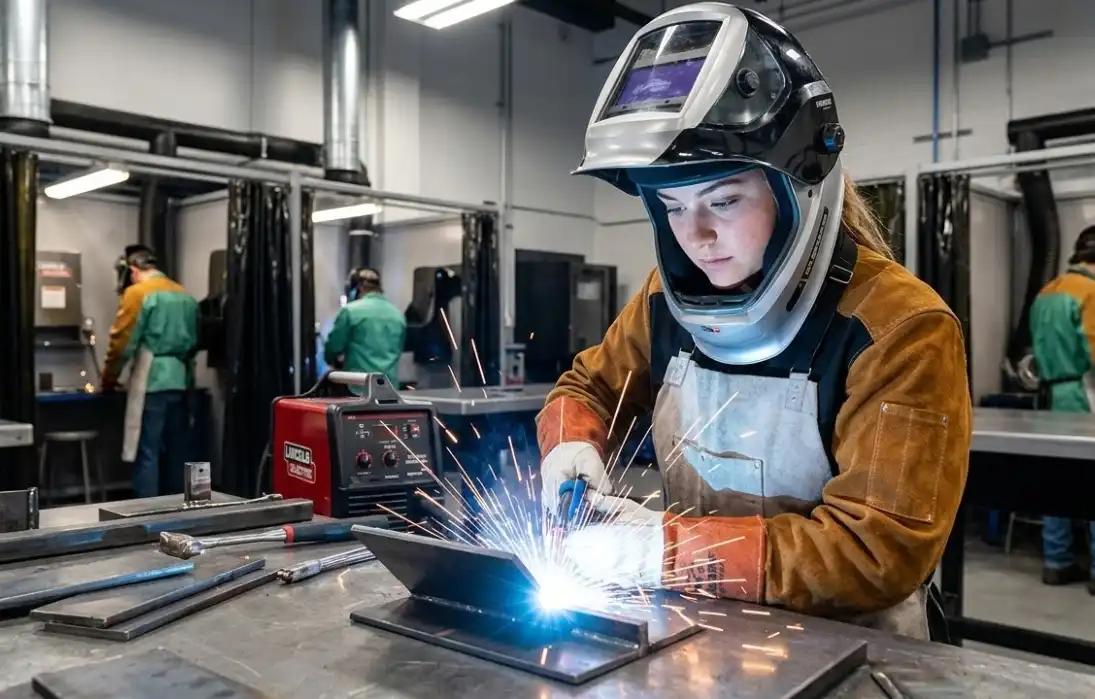
If you’re aiming to land a paid welding job fast, the path you choose matters as much as your effort. This guide lays out the quickest routes to job‑readiness, how long each typically takes, and what employers actually test for in the US, Europe/UK, and China. You’ll also see realistic timelines by process—MIG (GMAW), TIG (GTAW), SMAW, FCAW, plus a note on laser—so you can plan week by week without guesswork.
Updated for 2026 with current standards guidance and representative program examples.
Key takeaways
- The fastest path to a first job is usually an intensive, 8–12 week bootcamp focused on GMAW/FCAW basics, often paired with an internship or shop test preparation.
- Multi‑month diplomas (6–12 months) and 1–2 year community college programs build broader skill and theory—better for advancement, but slower to first paycheck.
- Apprenticeships deliver the strongest long‑term outcomes, but they’re multi‑year by design (typically ~2,000 OJT hours per year plus classroom).
- In most regions, employers rely on performance qualification to their procedure (WPS) rather than a single universal “license.” Continuity rules matter (often six‑month activity windows) to keep qualifications valid.
- Process difficulty varies: GMAW/FCAW are fastest to competence; SMAW and especially TIG typically take longer; pressure pipe roles add substantial time.
Quick answer: how long does it take to become a welder?
- Bootcamp (US example): 8–12 weeks full‑time → entry‑level fabrication jobs using MIG/FCAW; some include internships that accelerate placement. One public example is a 12‑week welding boot camp with a 144‑hour paid internship at Moraine Park Technical College, illustrating an achievable “weeks, not months” runway to basic employability; see the college’s overview and cohort announcement for structure and credits.
- Modular short courses: Stack 1–2‑week process modules (e.g., focused GMAW or GTAW) to prepare for shop tests quickly. This route fits career changers who can practice intensely and take an employer test as soon as consistent results are achieved. A large U.S. training provider lists five‑day, ~30‑hour process courses (e.g., INTRO and GTAW101), which shows how short blocks can accelerate specific skills.
- In‑plant upskilling (internal transfer): Already employed in manufacturing? With concentrated coaching and access to scrap metal and fixtures, many operators reach basic GMAW/FCAW job tasks within 4–8 weeks of targeted practice, then sit an internal performance test.
Why the spread? Two factors dominate: weekly contact hours (time in hood) and process choice. Think of it this way: MIG/FCAW can get you to clean, repeatable fillets rapidly; TIG demands more precision and tends to extend timelines.
Pathways compared: time, scope, and likely outcomes
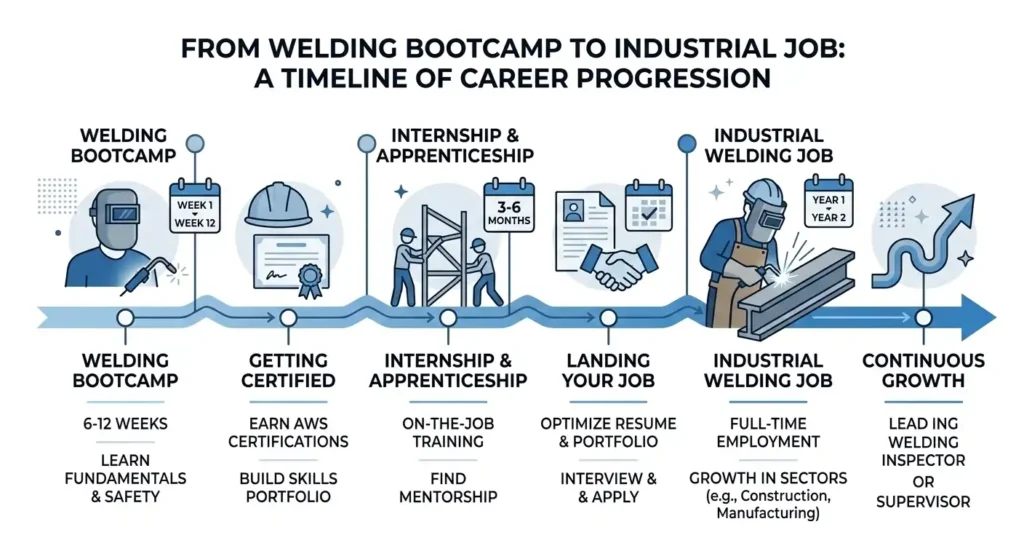
Below is a pragmatic view of how long each major route takes and what you’re usually hire‑ready for at completion. Durations are typical ranges; quality, intensity, and your practice habits change outcomes.
| Pathway | Typical duration to entry‑level job‑readiness | Scope and likely outcomes | Who it fits |
|---|---|---|---|
| Accelerated bootcamp | 8–12 weeks full‑time | Intensive GMAW/FCAW; safety, prints, joints in flat/horizontal; prep for common shop tests. Some include internships. | Career changers seeking a fast on‑ramp to fabrication roles. |
| Modular short courses | 1–2 weeks per module; 4–8 weeks if stacked | Focused process skill (e.g., GMAW 1 week + GTAW 1 week), targeted to pass a shop test quickly. | Self‑starters who can practice intensively and test early. |
| Trade school diploma (US) | 6–12 months | Multi‑process plate proficiency; broader theory; potential plate code test prep (3G/4G). | Those wanting breadth and employability beyond entry‑level. |
| Community college certificate/degree | 1–2 years | Deep lab time + theory, math, metallurgy; stackable credentials; stronger advancement runway. | Students seeking comprehensive education and credits. |
| Registered Apprenticeship | 3–4 years common | ~2,000 on‑the‑job hours/year plus related instruction; progressive wage growth; journeyman outcomes. | Long‑term career builders targeting high‑skill roles. |
Evidence anchors you can review as you plan:
- According to the Bureau of Labor Statistics’ Occupational Outlook Handbook for welders (2026 update), typical entry education is a high school diploma or equivalent, with training characterized as moderate‑term on‑the‑job training—supporting fast entry when classroom is paired with OJT: https://www.bls.gov/ooh/production/welders-cutters-solderers-and-brazers.htm
- Time‑based U.S. Registered Apprenticeships frequently organize around ≈2,000 on‑the‑job learning hours per program year plus a minimum of 144 hours of related instruction; see the Department of Labor’s Apprenticeship Sponsor Reference Guide and official guidance: https://www.apprenticeship.gov/sites/default/files/apprenticeship-requirements-reference-guide.pdf and https://www.apprenticeship.gov/about-us/legislation-regulations-guidance
- A public bootcamp example showing a 12‑week format with a 144‑hour paid internship can be found at Moraine Park Technical College: overview https://www.morainepark.edu/business-industry/manufacturing-boot-camps/welding/ and cohort announcement https://www.morainepark.edu/forge-your-future-fall-2025-welding-boot-camp-at-moraine-park/
How long each welding process takes to reach job‑readiness
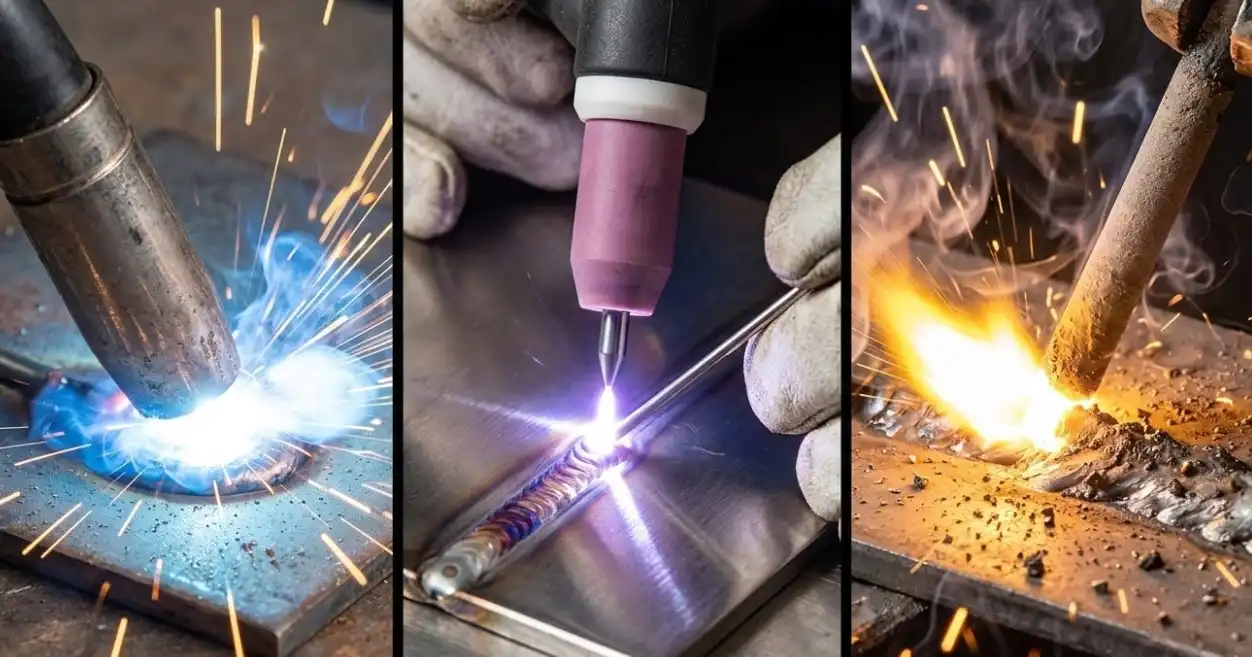
There isn’t a single code‑mandated hour count per process. Instead, employers judge your ability to make sound welds for specific joints and positions (and, when required, to pass a code‑based performance test). The timelines below synthesize common patterns from accredited curricula (e.g., NCCER Level 1 totals 365 hours aligned to AWS SENSE) and intensive program designs, paired with typical shop‑test expectations.
MIG (GMAW): the quickest on‑ramp
- Typical time to entry‑level competence: 4–8 weeks in full‑time, intensive formats for consistent fillets and flat/horizontal groove welds on carbon steel.
- Why it’s faster: Stable arc, simpler technique relative to TIG/SMAW; faster to produce repeatable beads with proper joint prep and gun angle.
- Job‑readiness threshold: Clean, uniform fillet welds (T‑joints), control of travel speed and stickout, ability to pass a basic shop test on flat/horizontal joints. Many fabrication roles start here.
- Next steps: Add vertical progression (3G) and thicker sections; cross‑train into FCAW for structural fabrication shops.
FCAW (Flux‑Cored): fast, with added slag management
- Typical time to entry‑level competence: 4–8 weeks in intensive settings when layered onto GMAW fundamentals.
- Why it’s quick: Similar gun handling to GMAW; key learning is parameter tuning and slag control, especially with FCAW‑S vs. FCAW‑G.
- Job‑readiness threshold: Consistent fillets, basic groove welds, sound slag removal practices; many shops value FCAW for productivity.
SMAW (Stick): slower hand‑skill curve, strong structural value
- Typical time to plate job‑readiness (3G/4G practice level): 6–12 weeks intensive, assuming daily hood time.
- Why it’s slower: Manual control, rod changes, arc starts, and heat input management demand practice for defect‑free results.
- Job‑readiness threshold: Produce acceptable fillets and grooves on plate in multiple positions; many employers use SMAW tests for structural roles.
TIG (GTAW): precision that takes time
- Typical time to entry‑level competence: 8–12 weeks intensive for thin‑wall/stainless basics; longer if part‑time.
- Why it takes longer: Separate control of torch, filler, and foot pedal, plus heat control for thin materials.
- Job‑readiness threshold: Consistent autogenous beads on thin materials, then filler addition with clean fit‑up; pass a basic GTAW shop test on stainless or aluminum at entry level.
Laser welding: short operator orientations, specialized advanced work
- Typical time to basic operator orientation: 2–5 days when focused on process fundamentals, safety, and QA concepts in a classroom/lab setting. For example, a major training organization publicly advertises a bespoke two‑day laser beam welding course covering technology, process, QA, and safety, illustrating how short orientations can work in practice: https://www.twi-global.com/media-and-events/press-releases/2024/bespoke-laser-beam-welding-training-with-twi
- Job‑readiness threshold: Safe operation, parameter awareness, understanding of joint prep and focus/spot size effects, and ability to follow SOPs and quality checks.
Additional reference points as you plan study time:
- NCCER Welding Level 1 totals 365 hours across Core + process modules and is sequenced to align with AWS SENSE entry‑level expectations: https://www.nccer.org/media/2024/08/2024-Welding_08-16.pdf
- Short, stackable modules are publicly listed by a major U.S. training provider (e.g., five‑day INTRO and GTAW101 at ~30 clock hours), showing how learners can accelerate specific process skills: index https://classes.lincolnelectric.com/public/category/programArea.do?method=load&selectedProgramAreaId=1050137 and sample courses https://classes.lincolnelectric.com/search/publicCourseSearchDetails.do?method=load&courseId=1055445&selectedProgramAreaId=1050137&selectedProgramStreamId= and https://classes.lincolnelectric.com/search/publicCourseSearchDetails.do?method=load&courseId=1055430&selectedProgramAreaId=1050137&selectedProgramStreamId=
Standards and qualifications by region: what to know about continuity and retesting
Employers often qualify welders to their own Welding Procedure Specification (WPS). Still, it helps to understand the regional standards that shape these tests and how long qualifications remain valid when you keep welding.
United States — AWS/ASME
- Structural plate (commonly AWS D1.1): Many organizations track welder continuity on six‑month cycles—if you haven’t welded to the applicable WPS in that window (with documentation), requalification may be required. For a plain‑language orientation on how performance qualification differs from certification and how continuity expectations work under structural practice, see the American Welding Society’s Welding Digest explainer: https://www.aws.org/magazines-and-media/welding-digest/welding-digest-welder-performance-qualification-and-welder-certification/
- AWS Certified Welder (via Accredited Test Facilities): Continuity and renewals are managed through AWS’s WeldCert Pro system, which requires online continuity log entries and foreman verification before expiration to avoid retesting: https://www.aws.org/businesses/facility-accreditation/qc47-specification/weldcert-pro/
- Pressure and pipe (ASME Section IX): Section IX QW‑322 also uses a six‑month continuity concept—if you don’t weld with the qualified process/position within six months, you must requalify for those ranges. The National Board/ASME guide references QW‑322 for this requirement: https://www.asme.org/getmedia/8d3ea47b-ff0d-4675-b262-06f50a3b124a/NB-57-BPV-National-Board-and-ASME-Guide.pdf
Europe/UK — EN ISO 9606 (plate and pipe)
- Practice widely communicated: Initial approval is commonly treated as valid for two years, with prolongation achieved by providing satisfactory evidence of welding activity at intervals (often framed around six‑month evidence windows). Freely accessible, single‑page explainers that spell out all validity/continuity details vary by body, so always check your notified body’s guidance.
- What to do in practice: Keep records of qualified welding work every six months and coordinate with your certifying body ahead of the two‑year mark for prolongation criteria.
Orientation sources: BSI’s overview of the ISO 9606 series confirms scope and structure: https://www.bsigroup.com/en-GB/products-and-services/standards/iso-9606-series-qualification-testing-of-welders/ and major certifying/training bodies (e.g., TWI) describe services under ISO 9606.
China — GB/T and NB/T (pressure equipment focus)
- Common industry understanding: For pressure equipment, NB/T 47014 governs welder qualifications. Public, English‑language summaries of validity and continuity are not always readily accessible. Employers and inspection agencies typically require documented continuity and may mandate re‑testing after inactivity.
- Practical tip: If you’re targeting pressure vessels or pipelines, coordinate early with your employer’s inspection agency to ensure your approval path, continuity documentation, and retest triggers are crystal clear.
Where to start researching: Seek official Chinese‑language abstracts or guidance from recognized bodies (e.g., SAMR, CSEI, CCS, SECRI) to confirm validity windows and continuity documentation expectations for your project scope.
What employers actually test for (and how that shapes your timeline)
Most hiring managers don’t ask for a generic “welding license.” They ask you to run the joint they use, with their filler, in the position they need, under their WPS. That typically means a shop test first: fillet welds and simple grooves for flat/horizontal MIG or FCAW; multi‑position plate tests for SMAW; or a basic GTAW test for thin stainless if that’s the role. For pressure roles, expect a code‑based performance qualification (e.g., ASME IX 6G pipe or AWS D1.1 plate) witnessed and documented.
What does that mean for your schedule? If your target job is entry‑level fabrication, an 8–12 week MIG/FCAW sprint can be enough. If your aim is structural plate in vertical/overhead, plan several more weeks to stabilize 3G/4G. If you want pipe or pressure work, budget months of focused practice or consider an apprenticeship where those hours are built in.
Two sample fast‑track study plans you can copy
Use these as templates. Adjust for the equipment you have, shop access, and local test requirements.
Plan A: 8–12 week bootcamp sprint (entry‑level fabrication)
Week 1–2: Safety, PPE, joint prep; MIG settings, gun angles; straight‑line beads and fillets on mild steel.
Week 3–4: Horizontal and tee joints; start/stop control; distortion management; introduce FCAW if available.
Week 5–6: Simple grooves (flat/horizontal); cut/fit practice; blueprint basics; visual inspection and quick macro‑etch checks.
Week 7–8: Vertical progression (3G for plate basics); troubleshoot porosity and lack‑of‑fusion; timed practice sets.
Week 9–10: Shop test simulations with witness; repeat under mild pressure; mock interviews and resume targeting.
Week 11–12: Internship or job‑shadow; refine weak points; take employer shop test.
Plan B: 12‑week TIG upskilling (for stainless/aluminum entry roles)
Week 1–2: Safety and machine setup; torch control without filler; autogenous beads on thin coupons.
Week 3–4: Add filler on butt and lap joints; foot pedal rhythm; heat‑affected zone control.
Week 5–6: Stainless practice with purging basics; aluminum AC balance and cleaning; joint fit‑up standards.
Week 7–8: Position work (horizontal/vertical); thin‑wall tube practice if available.
Week 9–10: Visual QA criteria, dye‑penetrant basics, and documentation habits.
Week 11–12: Shop test drills; mock timed tests; apply for GTAW‑focused roles.
FAQs (straight answers for faster decisions)
How quickly can a true beginner get hired? If you can train full‑time in a focused bootcamp and practice outside lab hours, 8–12 weeks is realistic for MIG/FCAW entry roles—especially if your program includes an internship or employer day. A public example of this format is a 12‑week boot camp with a 144‑hour internship at a Wisconsin technical college, which demonstrates a fast but achievable model.
Do I need “a certificate” or “license” to start? Often, no single card opens every door. Many employers qualify you with their own WPS via a witnessed test. For mobility in the U.S., some welders also pursue the AWS Certified Welder route at an Accredited Test Facility and maintain continuity online through WeldCert Pro; it’s separate from employer qualification but can help document skill.
What does “continuity” really mean, and what’s the window? Continuity is proof you’ve welded with the qualified process/position recently. In the U.S., both AWS structural practice and ASME Section IX use a six‑month concept—if you don’t weld within six months to the applicable WPS or with your qualified range, you typically requalify. Keep signed logs.
How long before I’m ready for pipe or pressure work? Add weeks to months beyond plate proficiency. Many welders build pipe skills inside apprenticeships structured around ~2,000 on‑the‑job hours per year; Section IX continuity applies to keep those approvals active between retests.
Will a community college take too long if I want speed? It’s slower to first job than a bootcamp but pays off in depth: more theory, more positions, and stronger advancement options. Some students do a fast bootcamp for first‑job speed, then return part‑time for college credentials.
Sources and further reading
- U.S. training profile for welders (entry education and moderate‑term OJT) — Bureau of Labor Statistics Occupational Outlook: https://www.bls.gov/ooh/production/welders-cutters-solderers-and-brazers.htm
- U.S. Registered Apprenticeships (≈ 2,000 OJL hours/year + related instruction) — Department of Labor Apprenticeship Sponsor Reference Guide: https://www.apprenticeship.gov/sites/default/files/apprenticeship-requirements-reference-guide.pdf and official guidance: https://www.apprenticeship.gov/about-us/legislation-regulations-guidance
- Example of a 12‑week welding boot camp with a 144‑hour paid internship — Moraine Park Technical College overview: https://www.morainepark.edu/business-industry/manufacturing-boot-camps/welding/ and program announcement: https://www.morainepark.edu/forge-your-future-fall-2025-welding-boot-camp-at-moraine-park/
- Performance qualification vs. certification and continuity concepts (AWS structural practice) — American Welding Society Welding Digest: https://www.aws.org/magazines-and-media/welding-digest/welding-digest-welder-performance-qualification-and-welder-certification/
- AWS Certified Welder continuity and online maintenance (WeldCert Pro) — AWS QC47/WeldCert Pro: https://www.aws.org/businesses/facility-accreditation/qc47-specification/weldcert-pro/
- ASME Section IX continuity (QW‑322 referenced) — National Board/ASME guide: https://www.asme.org/getmedia/8d3ea47b-ff0d-4675-b262-06f50a3b124a/NB-57-BPV-National-Board-and-ASME-Guide.pdf
- ISO 9606 series orientation — BSI overview page: https://www.bsigroup.com/en-GB/products-and-services/standards/iso-9606-series-qualification-testing-of-welders/
- NCCER Welding Level 1 total hours (365) — NCCER program sheet: https://www.nccer.org/media/2024/08/2024-Welding_08-16.pdf
- Short laser beam welding training format — TWI course information: https://www.twi-global.com/media-and-events/press-releases/2024/bespoke-laser-beam-welding-training-with-twi
Final advice: pick your lane and schedule it on a calendar
If your goal is speed to paycheck, line up an 8–12 week GMAW/FCAW sprint with maximum daily hood time, practice beyond class hours, and a real shop test on the calendar. If you want deeper technical range or long‑term mobility, add a 6–12 month diploma or a 1–2 year college path—then aim for apprenticeships or code‑tested roles once your foundations are solid. Here’s the deal: the hours you weld—consistently and deliberately—are what shrink your timeline the most.