Choosing the best color for aluminum outdoors isn’t just about looks. It’s a performance decision that affects fade resistance, corrosion behavior in rain and salt air, surface temperature under sun, readability of any laser markings, cleaning frequency, and long‑term cost.
In this guide, we compare finish+color archetypes used on façades, railings, and enclosures, ranked by real‑world durability priorities: UV stability first, then corrosion/weathering, with heat control and maintenance close behind. Think of it as a specifier’s shortcut to the right short list.
- Soft next step: Want a quick worksheet? Use a neutral “finish selection checklist” that records environment (UV, coastal, industrial), target lifespan, and acceptable maintenance cadence before you talk to applicators.
Key takeaways
- For maximum fade and chalk resistance in harsh sun, light PVDF (70%) colors that meet AAMA 2605 perform at the top tier; whites and very light grays also stay coolest.
- For abrasion resistance and high‑contrast laser readability, Class I architectural anodize (especially black or clear/silver) is a strong outdoor choice when sealed properly.
- In coastal spray, favor 70% PVDF systems; if you must use anodize, specify Class I with rigorous sealing and commit to a scheduled washdown program.
- Dark “cool” formulations using NIR‑reflective pigments help reduce heat vs conventional darks, but they’re still warmer than whites.
- Always verify solar reflectance (SR) or SRI from the exact color’s datasheet and align cleaning/maintenance expectations in the contract.
How we chose (Methodology) — best color for aluminum outdoors
We evaluated each color/finish archetype using standards and test methods commonly required in architecture and industrial enclosures. Priority weights: UV fade resistance (25), corrosion/weathering (20), heat management via solar reflectance/SRI (15), laser marking readability (15), laser‑process compatibility (10), maintenance aesthetics (10), availability/TCO (5).
- Architectural anodize durability is referenced against Class I criteria in AAMA/FGIA 611; Class I is the exterior workhorse for thickness/performance, with sealing quality crucial for long‑term results, as explained by a leading finisher in the article Class I vs II anodize. See the practical overview in the finisher explainer: Linetec on Class I vs Class II anodize (2023).
- Organic coating durability tiers reference AAMA 2604 (super‑durable polyester) and AAMA 2605 (70% PVDF, highest natural weathering benchmark). For specification context, see the standards listings at FGIA/AAMA 2605 (2022).
- European quality label context: QUALANOD architectural applications (anodize quality/sealing) and QUALICOAT specifications portal (powder coating classes by natural weathering) inform exterior suitability.
- Heat management uses the SR/SRI framework from ASTM E1980; typical values and “cool color” behavior are summarized by major coil/extrusion coating makers—see Sherwin‑Williams cool roof and wall coatings explainer (2024) and the Interpon D range and cool‑pigment overview (2024).
- For laser readability on aluminum surfaces, laser OEM tutorials consistently note high contrast on anodized substrates—see KEYENCE aluminum laser marking overview (2024).
Note: UV/chalk data often derive from long‑term Florida/Arizona exposure or accelerated QUV/UVB per ASTM G155/D2244. Always confirm final values on the exact color and finish system you intend to purchase.
Comparison table (summary)
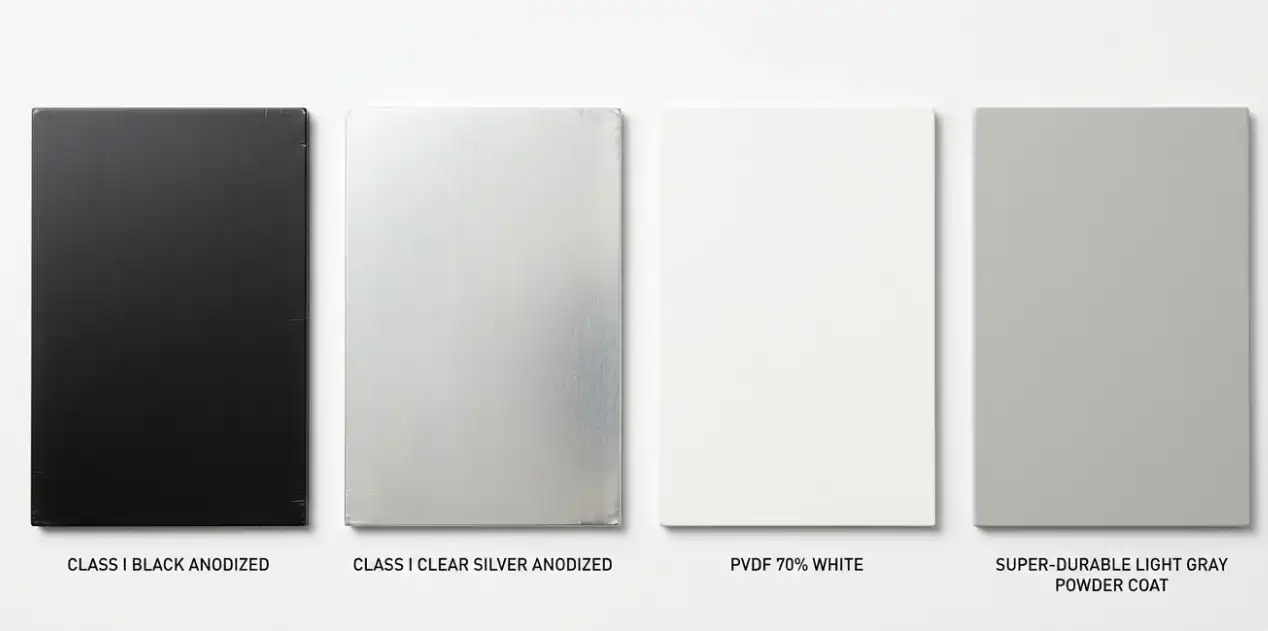
Two‑row spacing note: verify SR/SRI on the exact color datasheet. Price bands are indicative and vary by supplier, volume, and region.
| Color/Finish | Standard | UV fade | Corrosion | SR/SRI (typical) | Maintenance | Best for | Not for | Price |
|---|---|---|---|---|---|---|---|---|
| Class I Black Anodized | AAMA 611 Class I | High (inorganic electrolytic) | Good if sealed; monitor coastal | Low vs light colors | Low cleaning; hides light dust | Durable dark look; high‑contrast laser IDs | Unmaintained coastal spray | Varies; consult |
| Class I Bronze Anodized | AAMA 611 Class I | High | Good if sealed | Mid reflectance | Moderate; hides soiling | Balanced aesthetics/durability | Extreme chloride with poor upkeep | Varies; consult |
| Class I Clear/Silver Anodized | AAMA 611 Class I | High | Good if sealed | Mid‑high reflectance | Shows smudges; needs wiping | Heat control with metallic look | Scratch‑sensitive public zones | Varies; consult |
| PVDF 70% White/Light Gray | AAMA 2605 | Highest | Excellent incl. coastal | High SR/SRI (verify datasheet) | Low; resists chalking | Sun‑exposed façades/roofs | Expecting deep metallic look | Premium; consult |
| PVDF 70% Cool Dark Gray | AAMA 2605 | Highest | Excellent | Moderate SR/SRI (cool pigments) | Low‑moderate | Dark aesthetics + heat mitigation | White‑like coolness | Premium; consult |
| Super‑Durable Polyester Light | AAMA 2604 | High (5‑yr Florida tier) | Very good | Light tones better; verify | Low | Value exteriors | Harsh UV/coastal extremes | Lower than PVDF; consult |
| Type III Hard Anodize (Nat/Black) | — (ISO/AA) | High | Good with sealing | Dark: low; Nat: mid | Low | High‑wear outdoor hardware | Showpiece architectural panels | Premium; consult |
| Coastal Archetype (System) | 2605 or 611 + isolation | Highest/High | Excellent/Good | Depends on color | Scheduled washdowns | Marine/coastal projects | “No‑maintenance” expectations | System‑dependent |
The best-for list (ranked by outdoor performance priorities)
1) Class I Black Anodized (Electrolytic two‑step; AAMA 611)
- Finish standard/type: Architectural anodize, Class I thickness and sealing.
- UV fade resistance: High when colored electrolytically (inorganic), with proven outdoor stability.
- Corrosion/weathering: Strong with proper sealing; watch chloride exposure—define cleaning.
- Heat management (SR/SRI): Runs warm; pick only when dark aesthetics or laser ID contrast are priorities.
- Maintenance & soiling: Hides minor dirt; low cleaning frequency in non‑coastal settings.
- Best for / Not for: Best for high‑readability laser IDs and abrasion‑resistant dark accents. Not for unmaintained coastal spray zones.
- Price/lead time: Varies by alloy, prep, and batch; subject to change.
- Evidence: See the finisher explainer on Class I anodize durability: Linetec on Class I vs Class II (2023).
2) Class I Bronze Anodized (AAMA 611)
- Finish standard/type: Architectural anodize, Class I.
- UV fade resistance: High for electrolytic bronze colors.
- Corrosion/weathering: Solid when sealed; verify maintenance near salt.
- Heat management (SR/SRI): Mid reflectance; cooler than black, warmer than light finishes.
- Maintenance & soiling: Conceals grime better than silver/white.
- Best for / Not for: Best for warm metallic façades and railings. Not for warranty‑sensitive coastal edges without rigorous upkeep.
- Price/lead time: Varies; subject to change.
3) Class I Clear/Silver Anodized (AAMA 611)
- Finish standard/type: Architectural anodize, Class I.
- UV fade resistance: High; color comes from oxide thickness, not dyes.
- Corrosion/weathering: Good with sealing; specify controlled alloy lots for appearance.
- Heat management (SR/SRI): Mid‑to‑high reflectance; cooler to the touch than dark tones.
- Maintenance & soiling: Shows fingerprints and scuffs; plan gentle cleaning.
- Best for / Not for: Best for heat moderation while keeping a metallic look. Not for heavy abrasion public areas.
- Price/lead time: Varies; subject to change.
- Mid‑list tip: Pause and complete a neutral buyer’s checklist—environment (coastal/industrial/UV), target service life, cleaning budget, and whether you need readable laser IDs. Bring it to your finisher to validate standards and datasheets.
4) PVDF 70% White / Very Light Gray (AAMA 2605)
- Finish standard/type: Fluoropolymer coating meeting AAMA 2605 (70% PVDF).
- UV fade resistance: Highest tier with excellent chalk resistance over long exposures.
- Corrosion/weathering: Excellent, including coastal when pretreatment and primers are correct.
- Heat management (SR/SRI): Typically very high SR/SRI; verify exact color datasheet.
- Maintenance & soiling: Generally low; soil release and slow chalking in quality systems.
- Best for / Not for: Best for sun‑soaked façades and cool‑surface goals. Not for metallic‑grain aesthetics.
- Price/lead time: Premium; subject to change.
- Evidence: See the standard context at FGIA/AAMA 2605 (2022) and the SR/SRI overview from Sherwin‑Williams (2024).
5) PVDF 70% Medium Gray / “Cool Dark” (AAMA 2605, NIR‑reflective)
- Finish standard/type: Fluoropolymer 70% PVDF with cool‑pigment package.
- UV fade resistance: Highest tier; robust color/gloss retention.
- Corrosion/weathering: Excellent; good coastal track record with correct substrate prep.
- Heat management (SR/SRI): Improved vs conventional darks; still warmer than light colors.
- Maintenance & soiling: Low‑to‑moderate; chalking resistance is strong.
- Best for / Not for: Best for dark contemporary looks with moderated heat. Not for designs that demand white‑like coolness.
- Price/lead time: Premium due to specialty pigments; subject to change.
- Evidence: See cool‑pigment behavior in the Interpon D guide (2024).
6) Super‑Durable Polyester Powder Coat, Light Tones (AAMA 2604)
- Finish standard/type: Super‑durable polyester meeting AAMA 2604.
- UV fade resistance: High (5‑yr Florida tier).
- Corrosion/weathering: Very good with proper pretreatment; check warranty limits.
- Heat management (SR/SRI): Light tones better; verify datasheet for SR/SRI.
- Maintenance & soiling: Generally low; texture options can hide scuffs.
- Best for / Not for: Best for value‑focused exteriors where 5–10‑year performance targets fit. Not for extreme UV/coastal demands or ultra‑long warranties.
- Price/lead time: Typically lower than PVDF; subject to change.
7) Type III Hard Anodize (Natural/Black)
- Finish standard/type: Hard anodize (Type III), often to ISO/AA specs, with sealing for exterior.
- UV fade resistance: High; black variants rely on inorganic coloring/anodic film properties.
- Corrosion/weathering: Good when sealed; superior wear resistance.
- Heat management (SR/SRI): Black is hot; natural is mid.
- Maintenance & soiling: Low; hides wear on hardware.
- Best for / Not for: Best for high‑wear outdoor parts, brackets, or housings. Not for uniform façade showpieces.
- Price/lead time: Premium; subject to change.
8) Coastal/Marine Archetype: PVDF 70% system or sealed Class I anodize + isolation
- Finish standard/type: AAMA 2605 PVDF preferred; or AAMA 611 Class I anodize—both with rigorous pretreatment and sealing.
- UV fade resistance: Highest (PVDF) / High (Class I anodize).
- Corrosion/weathering: Excellent with PVDF; anodize requires sealing, drainage, and washdowns.
- Heat management (SR/SRI): Choose color by climate—light for cool surfaces; NIR‑dark when aesthetics demand.
- Maintenance & soiling: Formal wash schedule required in marine environment.
- Best for / Not for: Best for oceanfront façades, railings, and equipment enclosures. Not for “set‑and‑forget” expectations.
- Price/lead time: System‑dependent; subject to change.
- Evidence: Practical coastal guidance from the finisher community emphasizes PVDF preference and maintenance discipline; see Linetec coastal finishing guidance (2022).
Pricing and availability notes — best color for aluminum outdoors
Prices vary widely with alloy, surface prep, color, thickness/coat build, geometry, batch size, region, and certification requirements. Expect premiums for 70% PVDF and for dark NIR‑reflective formulations. Because authoritative per‑square‑foot ranges are inconsistent, treat any online price as directional only—confirm with licensed applicators, and state “subject to change” in your RFQs.
FAQ
Is black anodized good outdoors?
Yes—if you specify Class I architectural anodize with proper sealing and electrolytic (inorganic) coloring. You’ll get robust UV stability and excellent abrasion resistance. Plan for more heat absorption than light finishes, and define a cleaning cadence if the site is coastal or industrial.
Which colors stay coolest in sun?
Whites and very light grays in 70% PVDF systems generally achieve the highest SR/SRI, which helps keep panels and enclosures cooler. “Cool dark” pigments can raise reflectance for grays and bronzes, but they won’t match the thermal performance of light colors. Always verify SRI on the exact datasheet.
Anodized vs powder coat for coastal areas?
Applicators commonly prefer AAMA 2605 (70% PVDF) for direct marine exposure due to its chalk/color stability and corrosion performance when paired with the right pretreatments and primers. Class I anodize can work with rigorous sealing, isolation of dissimilar metals, and scheduled washdowns, but some warranties limit proximity to salt spray.
Which color gives the best laser marking contrast?
Black anodized aluminum typically yields the highest visual contrast (white marks with CO₂ or pale marks with fiber), while clear/silver anodized supports dark marks with fiber (especially MOPA). On painted/PVDF surfaces, contrast is lower and often requires labels or plaques for machine readability.
Next steps (soft CTA)
- Shortlist two or three finish+color archetypes based on environment (UV load, coastal, industrial), expected service life, and cleaning budget.
- Validate standards: reference Class I per AAMA 611 for anodize, AAMA 2604/2605 for powder/coil coats, and request Florida/Arizona exposure or QUV data.
- Confirm SR/SRI on the exact color datasheet and, where IDs are needed, test laser readability on scrap panels.
- Run a small mock‑up on site to check heat feel, dirt visibility, and neighbor color harmony—then finalize the specification.