Material selection failures cost the global manufacturing and construction industries billions of dollars annually. Choosing the wrong metal doesn’t just impact your bottom line; it compromises structural integrity, accelerates wear, and leads to catastrophic system failures. If you are an engineer, procurement specialist, or manufacturer, understanding the nuances of metallurgy is not optional—it is critical. As industry veterans in metallurgical engineering and material supply, we know that successful project execution starts with precision.
In this comprehensive guide, we will break down the Classification of Carbon Metal Content, Steel, and Alloy Steel. We will define the exact thresholds of carbon content, explore the stark differences between standard steel and alloy steel, and highlight the practical significance of these classifications in modern engineering. Whether you are navigating complex international standards or trying to balance strength with machinability, this breakdown will equip you with the exact terminology and technical frameworks needed to make fail-proof material choices.
Carbon Content-Based Classification of Steels
Low, Medium, and High Carbon Steel Definitions
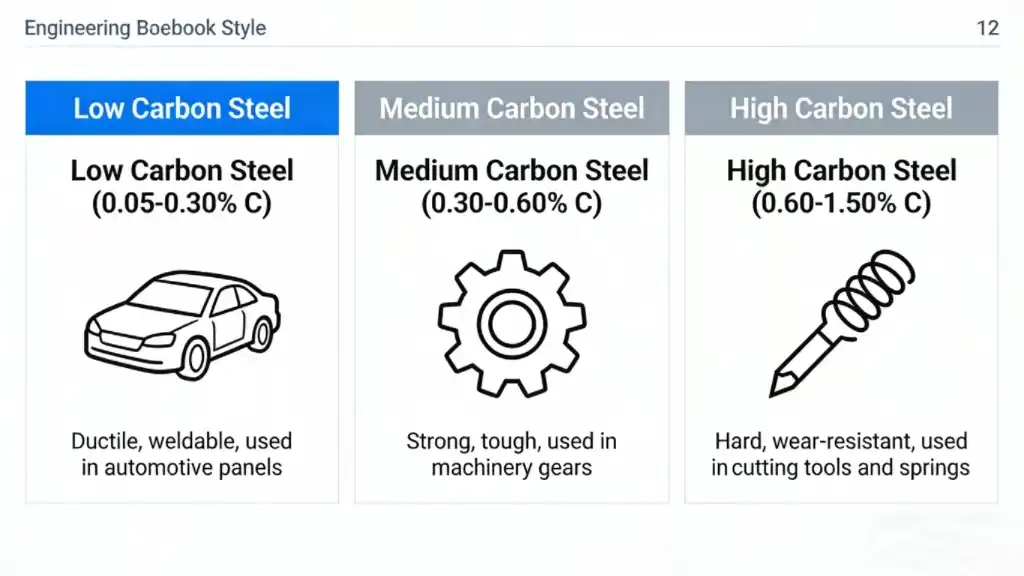
Carbon is the most critical alloying element in steel, fundamentally dictating its mechanical behavior. According to the ASM Handbook, carbon steels are broadly categorized into three tiers based on their carbon weight percentage:
- Low-Carbon Steel (Mild Steel): Contains up to 0.30% carbon. It is highly formable, weldable, and widely used in automotive body panels and structural shapes.
- Medium-Carbon Steel: Ranges from 0.31% to 0.60% carbon. It offers a balanced compromise between strength and ductility, typically used in gears, axles, and forging dies.
- High-Carbon Steel: Contains between 0.61% and 1.50% carbon. Known for extreme hardness and wear resistance, it is the go-to choice for cutting tools, springs, and high-strength wires.
Effect of Carbon on Hardenability, Strength, and Ductility
The relationship between carbon content and mechanical properties is linear but involves trade-offs. As carbon content increases, the metal’s tensile strength and hardenability (its ability to form martensite upon quenching) increase significantly. However, this comes at the direct expense of ductility and weldability. High-carbon steels are incredibly strong but brittle, requiring precise pre-heating and post-weld heat treatment (PWHT) to prevent cracking.
Common Misclassifications and Practical Testing Approaches
A common pitfall in procurement is confusing high-strength low-alloy (HSLA) steels with medium-carbon steels simply based on yield strength. To prevent costly shop-floor errors, engineers rely on techniques like Optical Emission Spectroscopy (OES) for exact chemical composition verification, or traditional spark testing—where the branching and color of the sparks grinding off the metal quickly indicate the rough carbon content.
Steel, Cast Iron, and Other Carbon-Containing Metals
Distinguishing Steels from Cast Irons
The defining boundary between steel and cast iron lies strictly in the iron-carbon phase diagram. Standard metallurgical definitions establish that steel contains less than 2.14% carbon (the maximum solubility of carbon in austenite). Metals exceeding 2.14% up to about 4.5% carbon fall into the cast iron family. While steels are malleable and can be plastically deformed, cast irons are generally brittle and designed for casting rather than forging.
The Role of Carbon in Cast Iron
In cast irons, carbon behaves differently depending on the cooling rate and the presence of silicon. It can precipitate as pure carbon flakes or nodules (graphite), giving us gray or ductile iron, which offers excellent machinability and vibration damping. Alternatively, rapid cooling forms iron carbide (cementite), creating white cast iron, which is exceptionally hard but highly abrasive.
Alloy Steels and Common Alloying Elements
Overview of Alloy Steels and Element Modifications
When carbon alone cannot achieve the desired performance, other elements are introduced. Alloy steels contain specific amounts of elements added to manipulate physical properties, governed by standards like SAE J404.
- Chromium (Cr): Increases hardness, toughness, and wear resistance.
- Nickel (Ni): Dramatically improves low-temperature toughness and impact resistance.
- Molybdenum (Mo): Enhances high-temperature strength and prevents temper embrittlement.
- Vanadium (V): Refines the grain structure, boosting overall strength and fatigue resistance.
Stainless Steels vs. Non-Stainless Alloy Steels
The critical threshold differentiating standard alloy steels from stainless steels is chromium content. A steel must contain a minimum of 10.5% chromium to be classified as stainless. This chromium forms a passive oxide layer that protects the underlying metal from corrosion. Non-stainless alloy steels (like 4140 chromoly) may contain chromium for hardenability, but not enough to prevent rusting.
Tool Steels and High-Strength Low-Alloy (HSLA) Steels
Tool steels (e.g., D2, O1) are heavily alloyed with elements like tungsten and molybdenum to retain extreme hardness at high temperatures (red hardness). HSLA steels, conversely, use micro-alloying (often less than 0.10% of elements like niobium or titanium) to significantly boost yield strength and atmospheric corrosion resistance without increasing carbon, thereby preserving excellent weldability.
Stainless Steel and Specialty Alloys
Austenitic, Ferritic, and Martensitic Stainless Steels
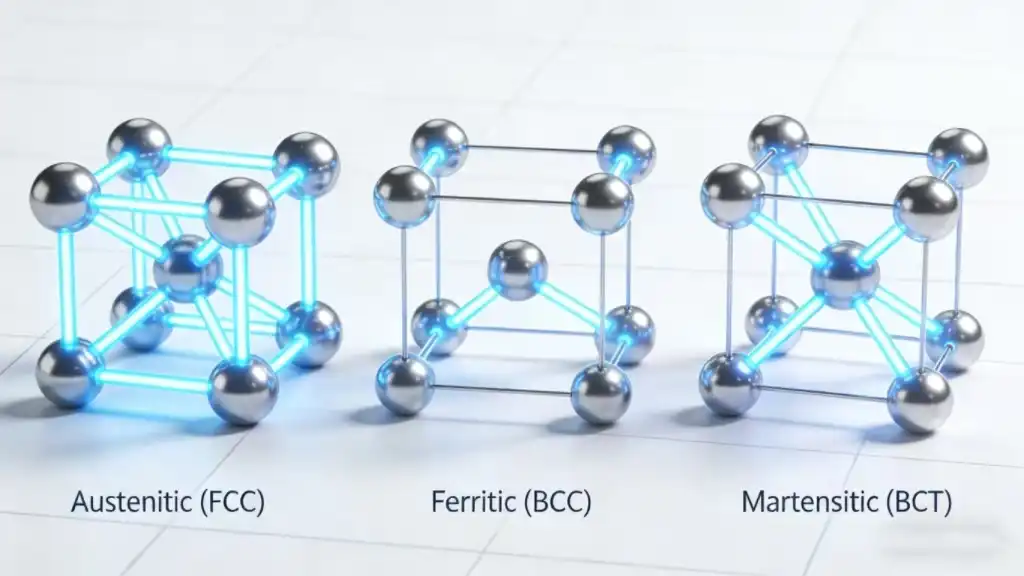
According to ASTM A240 classifications, stainless steels are grouped by their crystalline structure:
- Austenitic (300 Series): Non-magnetic, highly formable, and offers the highest corrosion resistance (e.g., 304, 316).
- Ferritic (400 Series): Magnetic, lower carbon, with good ductility and resistance to stress corrosion cracking (e.g., 430).
- Martensitic (400 Series): Magnetic, higher carbon, heat-treatable for high hardness, used in cutlery and surgical instruments (e.g., 410, 440C).
Applications and Corrosion Considerations
Selecting the right stainless grade depends heavily on the operating environment. While 304 is sufficient for standard kitchen appliances, marine environments or chemical processing plants require 316 stainless steel, which contains added molybdenum to resist pitting from chlorides.
Standards, Nomenclature, and Classification Systems
AISI/SAE, EN, and ASTM Designations
Navigating global standards is vital for accurate material sourcing:
- AISI/SAE: Uses a 4-digit system (e.g., 1020, 4140) where the first two digits indicate the alloy type, and the last two indicate the carbon content in hundredths of a percent.
- EN (European Norm): Governed by EN 10027, using alphanumeric designations (e.g., S235JR) where ‘S’ stands for structural, and ‘235’ is the minimum yield strength in MPa.
- ASTM: Focuses heavily on product form and application (e.g., ASTM A36 for structural carbon steel).
How Carbon and Alloying are Reflected in Codes
In the AISI/SAE system, a “1045” steel is a plain carbon steel (10xx series) with 0.45% carbon. A “4140” steel is a chromium-molybdenum alloy (41xx series) with 0.40% carbon. Understanding this shorthand allows engineers to instantly gauge a material’s baseline properties.
Practical Guidance for Selecting Materials
Always ensure that the standard you are specifying aligns with your regional manufacturing capabilities. A direct translation between ASTM and EN standards is rarely 1:1; engineers must cross-reference mechanical properties, not just chemical composition limits.
Applications, Selection Considerations, and Performance Trade-offs
Choosing Carbon Content for Strength vs. Ductility
The golden rule of material selection is balancing the strength required for the application against the ductility needed for manufacturing. If a part requires deep drawing or extensive bending, low carbon is mandatory. If the part is a heavy-duty wear plate, high carbon or specific alloy grades (like AR400) are required.
Processing Implications: Heat Treatment, Welding, and Forming
Welding engineers rely on the Carbon Equivalent Value (CEV), an industry-standard formula provided by the International Institute of Welding (IIW), to determine weldability. A CEV above 0.40 typically requires pre-heating to avoid hydrogen-induced cold cracking. Heat treatment protocols (annealing, quenching, tempering) must be strictly matched to the specific alloy combination to avoid distortion.
Quality Control and Material Expectations
To ensure parts meet design specifications, robust quality control is non-negotiable. This includes Mill Test Certificates (MTCs) to verify chemical composition, ultrasonic testing for internal flaws, and Rockwell/Brinell hardness testing post-heat treatment.
FAQ
What differentiates carbon steel from alloy steel in terms of carbon content thresholds?
The differentiation isn’t based on the carbon threshold, but rather the presence of other elements. Both can have identical carbon content (e.g., 0.40%). However, plain carbon steel relies almost exclusively on carbon for its properties, while alloy steel contains intentionally added elements (like >1.65% manganese, >0.60% silicon, or any minimum amount of Cr, Ni, Mo) to achieve specific mechanical characteristics.
How does alloying element selection influence steel performance for specific applications?
Alloying elements act as specialized modifiers. For example, adding Nickel (Ni) keeps steel tough at sub-zero temperatures, ideal for cryogenic applications. Adding Chromium (Cr) and Molybdenum (Mo) increases hardenability and high-temperature strength, making them perfect for automotive engine components and aerospace landing gear.
Which standards are most commonly used for automotive vs. construction steel materials?
In the automotive industry, AISI/SAE standards are heavily utilized for specifying engine and transmission components, alongside proprietary automaker standards for advanced high-strength sheet metals. In construction, ASTM standards (like ASTM A36 or A992) and EN standards (like S275 or S355) dominate, as they focus heavily on guaranteed yield strengths and structural integrity.
References
- ASM Handbook Volume 1: Properties and Selection: Irons, Steels, and High-Performance Alloys
- ASTM A240 / A240M Standard Specification
- International Institute of Welding (IIW) Carbon Equivalent Formula (CEV) / TWI Global
See also