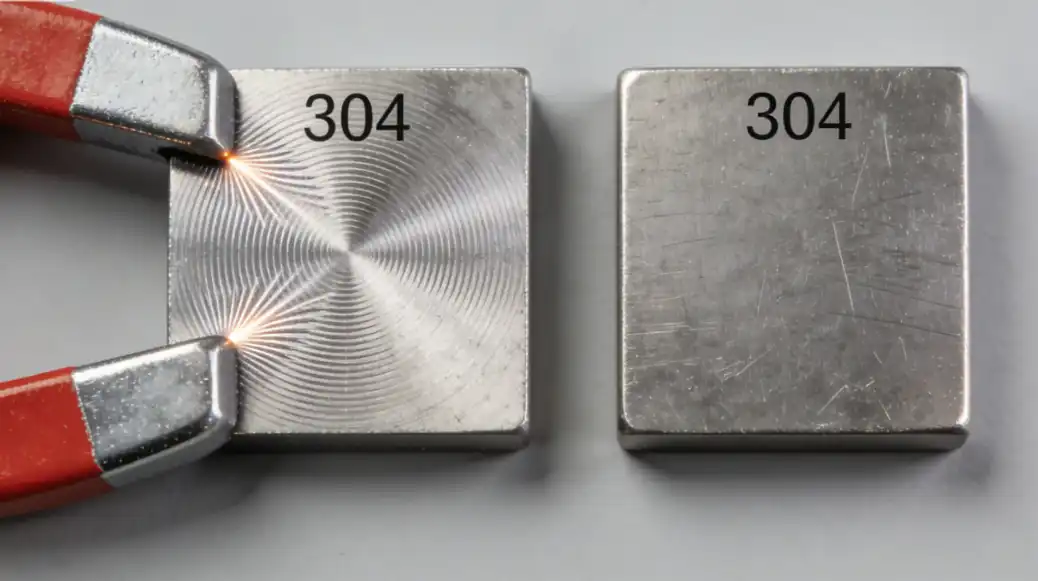
You might ask if 304 stainless steel is magnetic. Many people believe all stainless steel is not magnetic, but this is not always right. Some stainless steels are magnetic, and 304 stainless can be a little magnetic. Industry surveys show some common mistakes:
- People often mix up 304 stainless with very magnetic ferritic stainless steel.
- Using magnets to check stainless steel quality does not always work because magnetic strength changes.
- Magnetism does not mean the steel is low quality or will rust.
Crystal structure, chemical makeup, and how it is made can change the magnetism in stainless steel. This article will help you handle or lower magnetic problems in 304 stainless.
Key Takeaways
- 304 stainless steel is usually not magnetic when annealed. It can be a little magnetic sometimes.
- The crystal structure of 304 stainless steel is called austenitic. This structure helps make it less magnetic.
- Nickel is very important in 304 stainless steel. More nickel keeps the steel non-magnetic.
- Cold working can make the steel more magnetic. This happens because austenite changes into martensite, which is magnetic.
- Welding can also change how magnetic the steel is. The parts heated by welding can become more magnetic.
- Changes in temperature can affect magnetism too. If you heat the steel above the Curie temperature, it can lose magnetism for a while.
- To keep the steel less magnetic, try solution annealing after cold working or welding.
- Picking the right grade, like 316 stainless steel, can also help make the steel less magnetic.
Is 304 Stainless Steel Magnetic?
Austenitic Structure
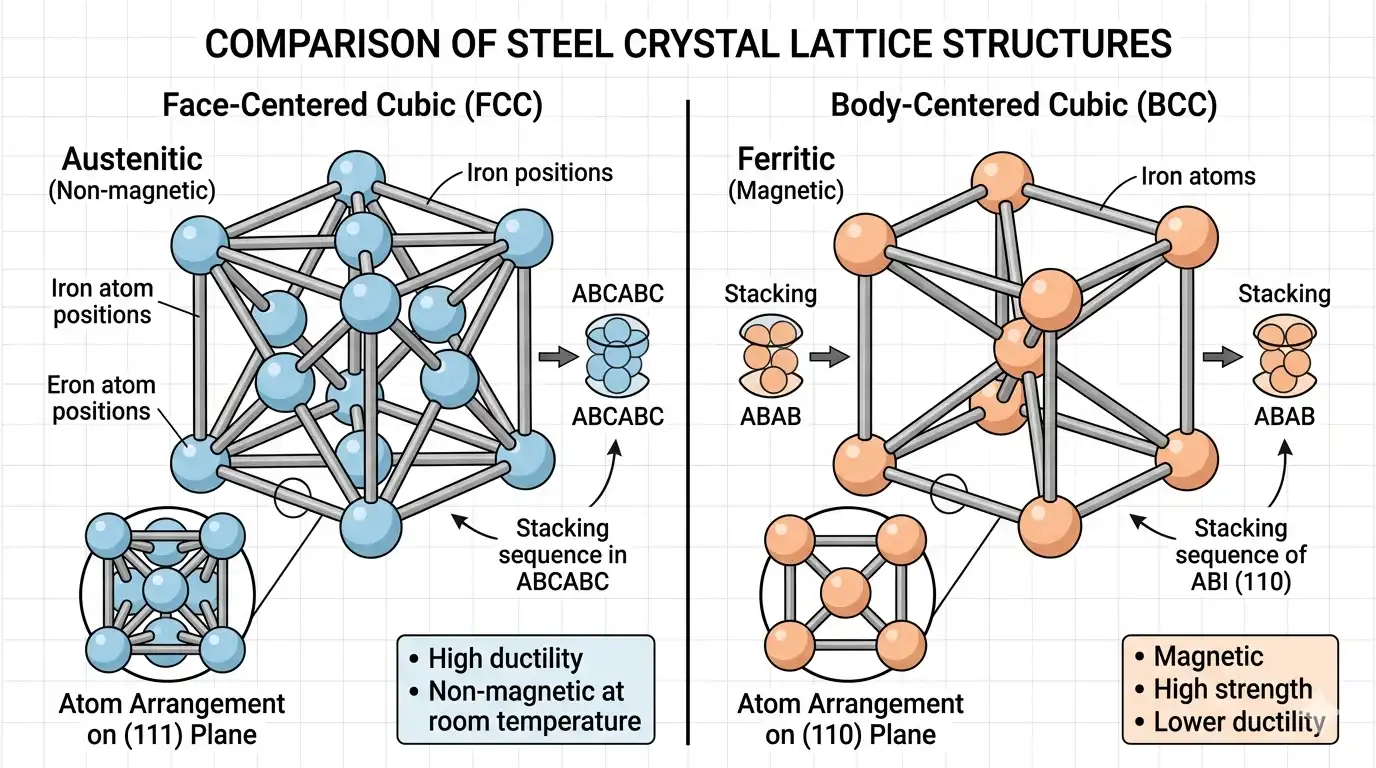
You might wonder why 304 stainless steel is not like other types. The reason is its crystal structure. 304 stainless steel is part of the austenitic stainless steel family. This means it has a face-centered cubic (FCC) structure. The FCC structure keeps the atoms in a way that does not let strong magnetism happen.
Here is a table that shows how austenitic stainless steel and ferritic stainless steel are different:
| Feature | Austenitic Stainless Steel | Ferritic Stainless Steel |
|---|---|---|
| Crystal Structure | FCC (Face-Centered Cubic) | BCC (Body-Centered Cubic) |
| Magnetism | Non-magnetic (annealed) | Magnetic |
You can see that the FCC structure in austenitic stainless steel, like 304 stainless steel, means it has very low magnetism when annealed. Ferritic stainless steel has a body-centered cubic (BCC) structure and is magnetic. This difference in structure is why 304 stainless steel does not show strong magnetism in normal conditions.
Paramagnetic Nature
If you test 304 stainless steel with a magnet, it will not stick much. This is because 304 stainless steel is paramagnetic when annealed. Paramagnetic materials only have a weak pull to magnets. They do not stay magnetized after you take the magnet away.
Scientists have measured the magnetic properties of 304 stainless steel at room temperature. They found that the magnetic properties are very low when annealed. Studies also show that carbon content can change magnetic permeability. Lower carbon means higher permeability and lower coercive force. So, even though 304 stainless steel is mostly non-magnetic, small changes in its makeup can change how it reacts to magnets a little bit.
If you look at the numbers, the usual relative magnetic permeability for annealed 304 stainless steel is about 1.00 to 1.02. This number is almost the same as air, so you will not feel much pull from a magnet. Regular steel has a much higher magnetic permeability.
Tip: If you want to check for magnetism in 304 stainless steel, you can use a pocket magnet or a permeability meter. These tools help you see how much the steel reacts to a magnet.
Role of Nickel Content
Nickel is very important for the magnetic properties of 304 stainless steel. Most commercial 304 stainless steel has about 8% to 10.5% nickel. Nickel helps keep the FCC structure stable. When the FCC structure stays stable, the steel stays mostly non-magnetic.
Let’s see how nickel changes magnetism in 304 stainless steel:
| Key Point | Explanation |
|---|---|
| Nickel’s Importance | Nickel keeps the FCC structure, which makes the steel non-magnetic. |
| Cold Working Effects | Cold working can make the steel a little magnetic, but it stays mostly non-magnetic. |
| Higher Nickel Grades | Grades with more nickel have even lower magnetic permeability after cold work. |
| Austenite Stability | The right mix of chromium and nickel keeps the austenitic structure stable. |
| Non-Magnetic Nature | The FCC structure’s electron arrangement leads to low magnetism. |
If you compare 304 stainless steel to other austenitic grades, you will see that grades with more nickel, like 316, are even less magnetic after cold working. This is why people use 304 stainless steel for things where low magnetism is needed, like food equipment, medical tools, and some electronic parts.
Magnetic Properties and Cold Working
What Is Cold Working
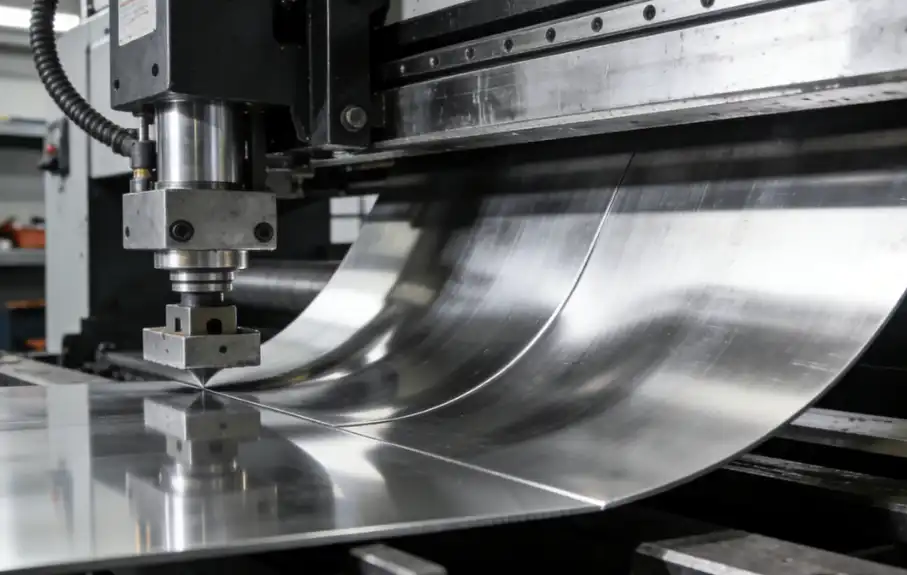
Cold working is when you shape or make stainless steel stronger without heat. You might see cold working when metal is bent, rolled, or pressed at room temperature. When you cold work 304 stainless steel, you change its shape by using force. This makes the metal harder and stronger. Many factories use cold working to make things like brackets, fasteners, or kitchen sinks.
Here is a table that shows some common cold working methods and what they do:
| Cold Working Method | Impact on Structure and Properties |
|---|---|
| Cold Rolling | Makes strain-induced martensite and work hardening. |
| Increased %CR (Cold Reduction) | Makes the steel stronger and forms more martensite. |
You can see that cold rolling and higher cold reduction both change the steel’s structure. These changes also affect how magnetic the steel is.
Structure Transformation
When you cold work 304 stainless steel, something changes inside the metal. The first structure is called austenite. Austenite is not magnetic. When you bend or roll the steel, some austenite turns into martensite. Martensite is magnetic. This means after cold working, the steel can attract a magnet more than before.
You might see that the more you bend or roll the steel, the more martensite forms. That is why parts that are bent or rolled a lot are more magnetic. The change from austenite to martensite is what gives cold worked stainless steel new magnetic properties.
Increased Magnetism After Deformation
After you cold work 304 stainless steel, it often becomes a little magnetic. This happens because martensite forms during the process. The magnetic effect is usually weak, but you can feel it with a small magnet.
You can see this in many real-life examples:
- Bent or welded parts made from 304 stainless steel often have a weak magnetic pull.
- The edges of parts that are rolled, bent, or machined may feel more magnetic than flat areas.
- Kitchen tools, fasteners, or brackets made from cold worked 304 stainless steel can attract a magnet, especially near bends or corners.
Note: The magnetic properties do not mean the steel is bad quality. The change is normal after cold working. If you need parts with very low magnetism, you can ask for annealed stainless steel or use grades with more nickel.
By knowing what happens during cold working, you can better guess and control the magnetic behavior of 304 stainless steel in your projects.
Welding Effects on Magnetism
Heat-Affected Zones
When you weld 304 stainless steel, the area near the weld changes. This area is called the heat-affected zone. The heat from welding does not melt this part, but it gets hot enough to change its structure. You may notice that the heat-affected zone often shows different properties than the rest of the metal.
The study found that welding with a magnetic field modified the distribution of chromium in the heat-affected zones of 304 stainless steel, leading to changes in its magnetic properties due to microstructural and compositional alterations.
This means that the heat from welding can move elements like chromium around inside the stainless steel. When this happens, the structure of the metal changes, and so does its magnetic behavior. You might find that the heat-affected zone becomes more magnetic than the base metal.
Structural Changes from Welding
Welding does more than just heat the metal. It can also change the way the atoms are arranged. When you weld stainless steel, the high temperature can turn some of the austenite (which is not magnetic) into ferrite or even martensite (which are magnetic). This change happens because the heat and cooling from welding cause the atoms to move and settle in new ways.
You may see these changes in the welded area:
- The weld seam and the metal next to it may attract a magnet more than the rest of the part.
- The amount of magnetic material depends on how fast the metal cools after welding.
- If the weld cools quickly, more martensite can form, making the area more magnetic.
A simple table can help you see what happens:
| Area | Structure After Welding | Magnetic? |
|---|---|---|
| Base Metal | Mostly Austenite | Weak/No |
| Heat-Affected Zone | Some Ferrite/Martensite | Weak/Moderate |
| Weld Seam | Mixed Structures | Moderate |
Practical Impact on Welded Parts
You might wonder what this means for your projects. Welded parts made from 304 stainless steel can show more magnetic pull near the welds. This can surprise you if you expect the whole part to be non-magnetic. For example, if you use a magnet to test a welded kitchen sink or a bracket, you may feel a stronger pull near the welds.
Here are some things you can do:
- Test welded areas with a small magnet to check for changes.
- If you need very low magnetism, ask for special welding methods or post-weld heat treatment.
- Remember that the magnetic change does not mean the stainless steel will rust or fail.
Tip: If you want to reduce magnetism after welding, you can use annealing. This process heats the metal and then cools it slowly, which helps return the structure to mostly austenite.
Welding changes the magnetic properties of 304 stainless steel, especially in the heat-affected zones and weld seams. Knowing what happens during welding helps you choose the right process and get the results you want.
Temperature Influence on Magnetic Properties
High and Low Temperature Effects
You might wonder what happens if you heat or cool 304 stainless steel. Changing the temperature can change how magnetic the metal is. When you heat or cool the steel, the atoms move and line up in new ways.
Here is what happens at different temperatures:
- If you cold work the steel at low temperatures, more martensite forms. Martensite is magnetic, so the steel gets more magnetic.
- If you shape the steel when it is warm or hot, less martensite forms. This means the steel stays less magnetic at higher temperatures.
- If you work with the steel near its annealing temperature, you do not make much martensite. The steel keeps its main structure and does not get very magnetic.
Scientists have done tests at very cold temperatures, like 77 K (about -196°C):
- The steel gets harder and becomes more magnetic.
- The highest permeability drops by about 8%.
- The coercive force, or the force to remove magnetism, goes up by 14%.
- The steel holds more magnetism, with residual and saturation flux densities rising by 4% and 3%.
So, both hot and cold temperatures can change how magnetic 304 stainless steel is. If you want to control magnetism, you need to watch the temperature when you work with the steel.
Reversibility of Magnetism
You may ask if these changes last forever. Most of the time, the changes in magnetism from temperature are reversible. This means the steel goes back to normal when the temperature returns to normal.
Here are some important things to know:
- Stainless steel has a Curie temperature. If you heat the steel above this point, it loses its magnetism.
- When the steel cools down, the magnetism usually comes back. This means the change is not permanent.
- In everyday use, the magnetic properties of 304 stainless steel change with temperature but go back to normal when the steel cools to room temperature.
Note: If you use 304 stainless steel where the temperature changes a lot, the magnetism will change too, but it will not hurt the steel.
Knowing how temperature affects magnetism helps you pick the right steel and process for your project.
Alloy Composition and Magnetism
Chromium and Nickel Balance
You might wonder why 304 stainless steel is not like other metals. The answer is in what it is made of. 304 stainless steel has iron, chromium, and nickel. These parts work together to give it special magnetic properties.
Nickel is very important for the structure of 304 stainless steel. It helps keep the austenitic structure stable. This structure does not let the steel become magnetic when annealed. Nickel stops the atoms from lining up in a way that causes magnetism. Because of this, 304 stainless steel does not stick to magnets in its normal state. This is helpful if you need materials that do not mess with magnetic fields.
Chromium also changes how magnetic the steel is. It helps keep some crystal structures stable. Some of these structures can be magnetic. But when you add enough nickel with chromium, the steel is mostly non-magnetic.
Here is a short list of what each part does:
- Chromium keeps some structures that can be magnetic.
- Nickel keeps the austenitic structure, which is not magnetic.
- Nickel makes it harder for the steel to turn magnetic, even after cold working.
Tip: If you want stainless steel with very low magnetism, pick grades with more nickel.
Minor Elements Impact
You may ask what happens if there are other small parts in the steel. Small amounts of manganese, nitrogen, and carbon can also change the magnetic properties of 304 stainless steel. These parts do not change things as much as chromium or nickel, but they still matter.
- Manganese can take the place of some nickel in the steel. This can make the steel a little more magnetic.
- Nitrogen helps keep the austenitic structure stable. This means the steel stays less magnetic.
- Carbon can make the steel harder. More carbon can make more martensite after cold working, which makes the steel more magnetic.
Here is a table to show what these small parts do:
| Element | Effect on Magnetism |
|---|---|
| Manganese | Can make the steel more magnetic |
| Nitrogen | Helps lower magnetic properties |
| Carbon | Can make steel more magnetic after work |
You should know that even small changes in what is in the steel can change how magnetic it is. If you need to control magnetism, always check what is in the alloy.
Note: Makers can change the mix of these parts to fit special needs. You can ask for a certain grade if you want less magnetism in your project.
Managing and Reducing Magnetism
If you use 304 stainless steel, you might want to control its magnetic properties. There are different ways to keep your parts as non-magnetic as possible. Here are some easy ways to manage magnetism in your projects.
Annealing and Heat Treatment
You can use heat to make stainless steel less magnetic. Solution annealing is the best way to do this. In this process, the steel is heated to a high temperature and then cooled quickly. The heat helps get rid of martensite that forms when you bend or shape the steel. The steel goes back to its austenitic structure, which is not magnetic.
- Solution annealing brings back the non-magnetic state.
- This process also helps remove stress from the metal.
- Annealing can make the steel weaker and may change the shape of thin or tricky parts.
Tip: If you see more magnetism after welding or cold working, ask your supplier about annealing.
Selecting Low-Magnetic Grades
You can pick the right type of stainless steel to avoid magnetism. Austenitic grades like 304 and 316 are good for low magnetism. These grades stay mostly non-magnetic if they are annealed. If you need even less magnetism, ask for steel that has been solution-annealed.
- 304 and 316 are great for low-magnetic needs.
- Ferritic and martensitic grades, like 430 or 410, are magnetic and not good for these uses.
- Tell your supplier if you need parts with no magnetism.
Here is a simple table to help you choose:
| Grade | Magnetic? (Annealed) | Best Use Case |
|---|---|---|
| 304 | No | General low-magnetic |
| 316 | No | High corrosion, low-magnetic |
| 430, 410 | Yes | Not for low-magnetic |
Practical Tips for Users
You can follow some easy steps to keep magnetism low:
- Use austenitic grades with more nickel or nitrogen if you can.
- Try not to bend, stretch, or form the steel too much.
- Ask for solution annealing after heavy work or welding.
- Use tools and holders that are not magnetic when making or handling the steel.
- Try demagnetization after welding to get rid of any leftover magnetism.
Note: If you need stainless steel with very low magnetism, always check the material and process with your supplier before you start.
By knowing what causes magnetism and how to control it, you can make better choices for your stainless steel parts. These steps help you get the results you want in your finished products.
You now know what changes the magnetic behavior of 304 stainless steel. The table below lists the main things that matter:
| Key Factor | What It Means for You |
|---|---|
| Mechanical Stress | More stress makes the steel more magnetic |
| Strain | Bending or pulling makes it more magnetic |
| Phase Changes | Martensite forms and adds magnetism |
| Temperature | Hot or cold can change magnetism |
You should always check which grade you have. Test it with a magnet to see if it is magnetic. If you want less magnetism, ask for solution annealing for your stainless steel parts.
FAQ
What makes 304 stainless steel slightly magnetic after bending or forming?
When you bend or form 304 stainless steel, you create martensite. Martensite is a magnetic phase. You will notice more magnetism in areas that have been worked or shaped.
What is the best way to reduce magnetism in 304 stainless steel?
You can use solution annealing. This heat treatment changes the structure back to austenite. Austenite is not magnetic. Ask your supplier for annealed material if you need low magnetism.
What tools help you test magnetism in stainless steel?
You can use a small handheld magnet for a quick check. For more accuracy, use a permeability meter. These tools help you measure how much the steel reacts to magnets.
What happens to magnetism after welding 304 stainless steel?
Welding can increase magnetism near the weld. The heat changes the structure and forms some magnetic phases. You may feel a stronger pull from a magnet in welded areas.
What elements in 304 stainless steel affect its magnetic properties?
Nickel and chromium control the main structure. Nickel keeps the steel non-magnetic. Small amounts of manganese, nitrogen, or carbon can also change magnetism.
What should you do if you need stainless steel with almost no magnetism?
Choose grades with higher nickel, like 316. Always ask for solution-annealed material. Avoid heavy cold working or welding when possible.
What does it mean if your 304 stainless steel attracts a magnet?
It means the steel has some martensite from cold work or welding. This is normal. The steel still resists rust and keeps its strength.
What industries use low-magnetic 304 stainless steel?
You will find low-magnetic 304 stainless steel in food processing, medical devices, and electronics. These industries need materials that do not interfere with magnetic fields.