A single finishing decision can swing your surface roughness by 0.4–1.6 µm Ra — and with it, your corrosion lifespan, labor cost per meter of weld, and compliance with specs like ASME BPE or EN 1090. When comparing weld cleaning vs weld grinding surface finish, the core trade-off comes down to electrochemical passivation that preserves the parent metal versus aggressive abrasive removal that reshapes it. This guide breaks down measured Ra values, real cost-per-joint data, and corrosion test results so you can pick the right process — or the right combination of both — for each material and industry requirement.
Weld Cleaning vs Weld Grinding at a Glance
Weld cleaning uses an electrochemical reaction — typically a phosphoric or citric acid solution activated by low-voltage current — to dissolve discoloration and restore the passive oxide layer on stainless steel. Weld grinding, by contrast, physically removes material with abrasive discs or belts to reshape the weld profile and blend it into the parent metal. The two processes solve fundamentally different problems, and the resulting surface finishes reflect that difference.
| Factor | Weld Cleaning | Weld Grinding |
|---|---|---|
| Surface Roughness (Ra) | Preserves base metal Ra, typically 0.4–1.6 µm | Varies widely: 0.8–6.3 µm depending on grit |
| Material Removal | Near zero | Significant — can thin walls by 0.1–0.5 mm per pass |
| Processing Speed | 30–90 seconds per linear inch | Faster on heavy welds; slower for fine finishing |
| Best Use Case | Heat tint removal, passivation, sanitary tubing | Weld profile blending, cosmetic flat surfaces, structural prep |
| Corrosion Protection | Restores Cr₂O₃ passive layer immediately | Disrupts passive layer; requires post-treatment |
When evaluating weld cleaning vs weld grinding surface finish, the deciding factor is usually whether you need to remove material or simply restore appearance and corrosion resistance. Grinding reshapes. Cleaning restores. One is subtractive; the other is essentially chemical polishing. According to the British Stainless Steel Association, electrochemical cleaning can achieve passivation levels equivalent to nitric acid pickling — without the hazardous waste stream.
For thin-walled stainless assemblies or food-grade piping, grinding risks over-thinning and contamination from abrasive particles. For heavy structural carbon steel welds that need a flush profile, cleaning alone won’t cut it — literally. The right choice depends on your material, your finish spec, and whether the weld bead itself needs to disappear.
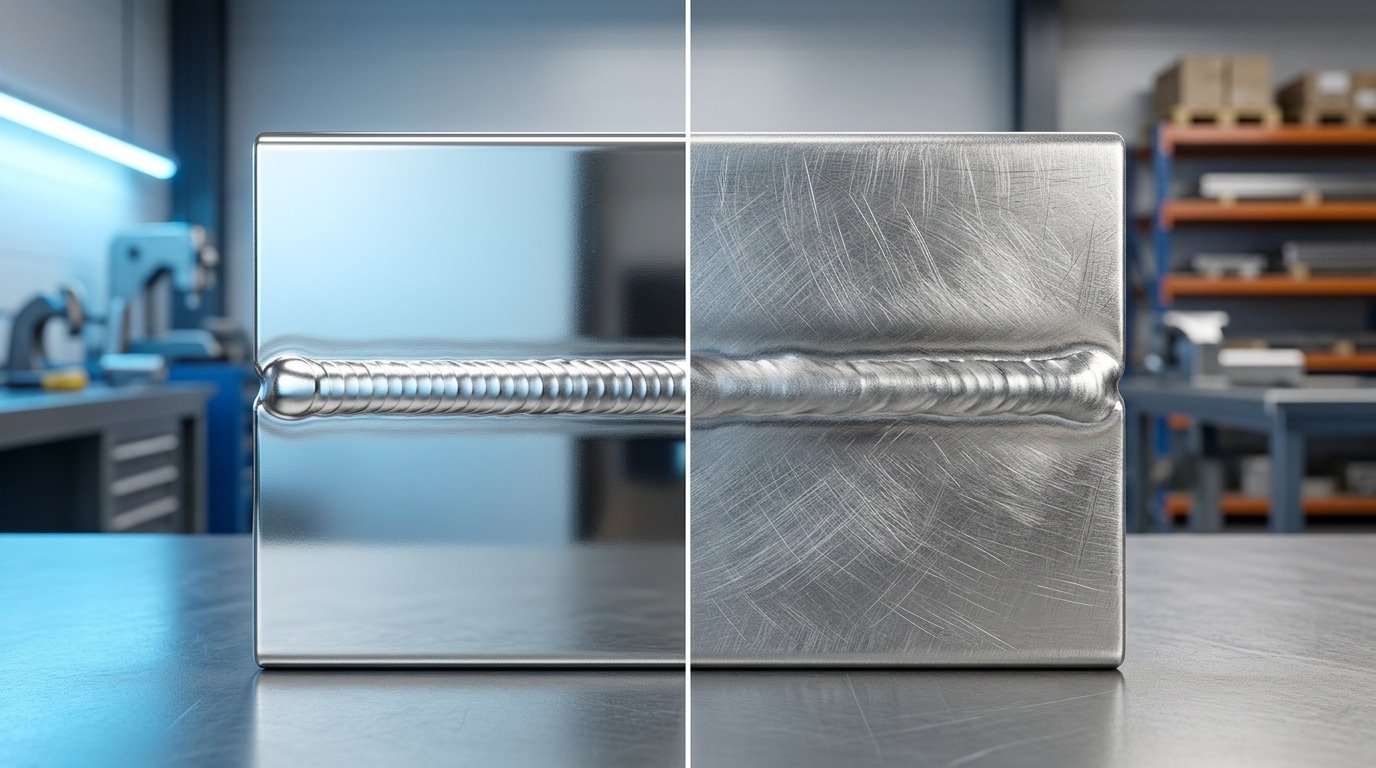
Weld cleaning vs weld grinding surface finish comparison on stainless steel TIG weld
How Weld Cleaning Works — Electrochemical Process Principles
Weld cleaning is fundamentally an electrolytic process. A low-voltage DC current (typically 12–60 V) passes through a conductive electrolyte solution — usually phosphoric acid at 10–25% concentration — and into the weld surface. This current drives an electrochemical reaction that selectively dissolves chromium-depleted oxides and heat tint while leaving the underlying base metal virtually untouched. The key distinction: material isn’t abraded away. It’s converted into soluble metal salts and rinsed off.
The most common tool for this process is the TIG brush, a carbon-fiber or stainless steel bristle wand wrapped in an absorbent pad soaked in electrolyte. An operator drags the energized brush across the weld zone, and the reaction happens in real time — discoloration disappears within seconds. Newer electrolytic systems use spray applicators or immersion baths for larger components, pushing cleaning speeds above 1 meter per minute on straight seams. These systems also offer programmable polarity switching, which alternates between cleaning and passivation cycles automatically.
What makes this relevant to the weld cleaning vs weld grinding surface finish debate is the mechanism itself. Because no abrasive contact occurs, the original mill finish and surface texture remain intact. Ra values on stainless steel typically stay within 0.1–0.2 µm of the pre-weld measurement. The process simultaneously restores the passive chromium oxide layer — a detail that grinding simply cannot replicate without a separate passivation step. According to the British Stainless Steel Association, this reformed passive layer is critical for long-term corrosion performance in austenitic grades like 304 and 316.
One limitation worth acknowledging: electrochemical cleaning cannot remove excess weld material or reshape a bead profile. It targets surface chemistry, not geometry. If a weld crown sits 2 mm proud of the parent material, the electrolyte won’t flatten it.

Electrochemical weld cleaning with TIG brush removing heat tint from stainless steel weld
How Weld Grinding Works — Mechanical Material Removal Principles
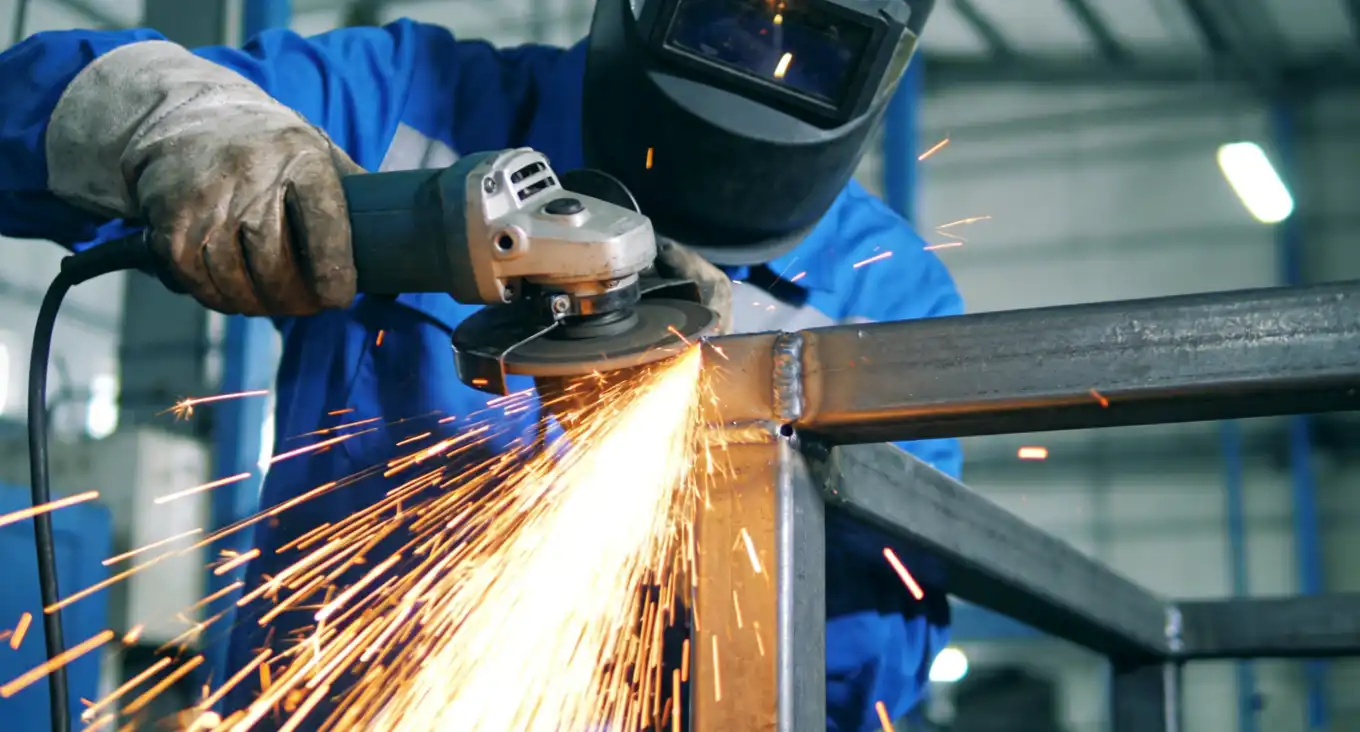
Weld grinding is brute-force subtraction. An abrasive medium — a grinding wheel, flap disc, or belt grinder — spins at high RPM and physically shears metal away from the weld bead, one microscopic chip at a time. No chemical reaction occurs; the surface profile is shaped entirely by mechanical contact between abrasive grains and the parent material.
Grit selection drives everything. A coarse 40-grit flap disc removes heavy weld crowns fast but leaves deep scratch patterns with Ra values often above 3.2 µm. Stepping down to 80-grit, then 120-grit, progressively refines those scratches. For mirror-adjacent finishes on stainless steel, fabricators sometimes run through 240-grit or finer. Each pass removes less material and produces shallower grooves, but the base metal gets thinner with every step — a trade-off that doesn’t exist with electrochemical methods.
Technique matters as much as grit. Angle of attack, contact pressure, and traverse speed all change the outcome. Holding a grinder at 15–20° to the workpiece gives the best balance between stock removal and surface consistency, according to guidance from Norton Abrasives. Too steep an angle gouges the metal; too shallow and the disc glazes over, generating heat instead of cutting. That heat itself is a problem — it can introduce temper colors on stainless steel and compromise the passive chromium-oxide layer.
When evaluating weld cleaning vs weld grinding surface finish, this mechanical approach offers unmatched flexibility in shaping contours and blending joints flush. But every micron removed is gone permanently, which means tolerances on thin-wall tubing or precision assemblies demand careful planning before anyone picks up a grinder.

Weld grinding with a flap disc on stainless steel weld joint showing mechanical material removal
Surface Finish Quality Compared — Ra Values and Visual Results
Numbers tell the real story. When comparing weld cleaning vs weld grinding surface finish, the gap shows up clearly in Ra (arithmetic average roughness) measurements. Electrochemical cleaning preserves the parent material’s original texture, typically leaving Ra values between 0.4 µm and 1.2 µm on 304/316 stainless steel — essentially unchanged from the pre-weld condition. Grinding, by contrast, produces a wide spread: anywhere from 0.2 µm with a fine 320-grit flap disc up to 3.2 µm or rougher with an aggressive 40-grit wheel.
| Material | Weld Cleaning Ra (µm) | Weld Grinding Ra (µm) | Notes |
|---|---|---|---|
| 304 / 316 Stainless Steel | 0.4 – 1.2 | 0.2 – 3.2 | Grinding Ra depends heavily on grit; cleaning retains mill finish |
| Carbon Steel | 0.8 – 1.6 | 0.4 – 4.0 | Cleaning less common; grinding often followed by coating |
| Aluminum (5xxx / 6xxx) | 0.6 – 1.4 | 0.3 – 3.5 | Soft alloy loads abrasives quickly, raising Ra variability |
A few things jump out from this data. Grinding can achieve a lower absolute Ra — but only when an operator steps through progressively finer abrasives, which multiplies labor time. Electrochemical cleaning delivers a narrower, more predictable range with almost zero operator skill dependency. That consistency matters on production runs where every weld joint needs to look identical.
Visually, the difference is stark. Cleaned welds retain the surrounding grain pattern; the heat tint disappears, but the surface reads as one continuous sheet. Ground welds show directional scratch lines — micro-scratches aligned with the disc rotation — that catch light differently than the parent metal. For mirror or near-mirror finishes (Ra below 0.1 µm), neither method alone gets you there; both require secondary polishing, as outlined in ISO 25178 surface texture standards. The practical takeaway: if grain pattern consistency and visual uniformity outweigh achieving the lowest possible Ra number, electrochemical cleaning wins.

Surface finish comparison showing weld cleaning vs weld grinding results on stainless steel with Ra values
Stainless Steel Surface Finish Benchmarks
Stainless steel is where the debate around weld cleaning vs weld grinding surface finish gets genuinely interesting. Austenitic grades like 304 and 316L ship from the mill with a 2B finish — cold-rolled, annealed, pickled — sitting at roughly Ra 0.1–0.5 µm depending on the supplier. That finish isn’t just cosmetic. It’s the foundation of the passive chromium oxide layer that gives stainless its corrosion resistance.
Electrochemical weld cleaning strips heat tint (those amber-to-blue oxide colors around the weld zone) without touching the surrounding 2B texture. The result on 304L typically reads Ra 0.3–0.8 µm in the cleaned area — close enough to the parent material that you can’t spot the transition at arm’s length. Duplex grades like 2205 respond similarly, though their higher chromium content (22%) means the reformed passive layer can actually exceed the original in oxide thickness by 15–20%, according to research published by the British Stainless Steel Association.
Grinding tells a different story. A 120-grit flap disc on 316L can push Ra below 0.2 µm — numerically smoother, yes. But the directional scratch pattern replaces the original isotropic 2B texture with visible linear marks. On duplex stainless, aggressive grinding also risks inducing localized stress that can promote stress corrosion cracking in chloride environments. You get a lower number on the profilometer while losing the very surface characteristics the alloy was engineered to provide.
For pharmaceutical, food-processing, and marine applications where both appearance and passivation integrity matter, electrochemical cleaning preserves what the mill built in. Grinding makes sense when the spec explicitly calls for a directional polish — a #4 or #3 finish, for instance — but that’s a deliberate design choice, not a default.
Carbon Steel and Aluminum Surface Finish Benchmarks
Carbon steel and aluminum behave very differently from stainless steel — and from each other. The oxide chemistry alone changes the equation. Carbon steel forms iron oxide (rust) rapidly when the protective mill scale is disturbed, while aluminum generates a tenacious aluminum oxide layer within milliseconds of exposure to air. These behaviors directly shape how each finishing method performs and what surface quality you can realistically expect.
Carbon Steel Performance
Grinding carbon steel welds with a 60-grit flap disc typically yields Ra values between 1.6 and 3.2 µm — perfectly acceptable for most structural and fabrication work. The real concern isn’t the roughness number; it’s what happens next. Grinding exposes fresh iron to atmosphere, and without immediate primer application (within 4 hours in humid environments), flash rust begins. Electrochemical weld cleaning on carbon steel is less common but gaining traction. It removes heat tint and light oxide discoloration effectively, though it won’t flatten a proud weld bead. The surface it leaves behind still needs rapid coating to prevent oxidation.
Aluminum Alloy Considerations
Aluminum is soft. That matters enormously. Aggressive grinding with anything coarser than 80-grit can gouge 6061-T6 or 5052 alloy surfaces, embedding abrasive particles that compromise subsequent anodizing or powder coating adhesion. According to The Aluminum Association, surface contamination from grinding media is a leading cause of coating failure on welded aluminum assemblies. Electrochemical cleaning handles aluminum more gently, preserving the base metal profile while removing weld discoloration. Ra values after electrolytic cleaning on aluminum TIG welds typically sit around 0.8–1.2 µm — close to the parent material’s original finish.
When evaluating weld cleaning vs weld grinding surface finish on these two metals, the deciding factor often isn’t aesthetics. It’s coating compatibility. A ground carbon steel surface with embedded contaminants will blister under paint within 6 months. An over-ground aluminum panel will reject anodize unevenly. Matching the finishing method to the downstream process saves far more money than chasing a specific Ra number.
Corrosion Resistance After Weld Cleaning vs Weld Grinding
This is where the weld cleaning vs weld grinding surface finish debate shifts from aesthetics to actual performance. Stainless steel resists corrosion because of a chromium-rich passive oxide layer — typically 1–3 nm thick — that forms spontaneously on clean surfaces. Any finishing process that disrupts, contaminates, or fails to restore this layer creates a long-term liability.
Electrochemical weld cleaning has a built-in advantage: passivation happens simultaneously. The electrolytic reaction strips heat tint and iron contamination while promoting the immediate reformation of chromium oxide. Tests using ASTM A380 copper sulfate methods on electrochemically cleaned 304L samples consistently show full passivation within seconds of treatment. No extra chemicals. No waiting.
Grinding tells a different story. Abrasive discs remove the existing passive layer and can embed iron particles from the disc itself — or from nearby carbon steel dust in the shop. These embedded contaminants become initiation sites for pitting corrosion, sometimes within weeks of fabrication. A ground stainless surface almost always requires a separate passivation step, typically a nitric or citric acid bath per ASTM A967, to restore full corrosion resistance. Skip that step, and you’re gambling with the integrity of the weld zone.
Salt spray testing (ASTM B117) reinforces this gap. Electrochemically cleaned 316L welds routinely exceed 1,000 hours before showing red rust, while ground-but-unpassivated surfaces of the same alloy can fail in under 200 hours. Even ground-and-passivated joints occasionally underperform because embedded abrasive particles create micro-crevices the acid bath can’t fully reach.
Efficiency, Cost, and Safety — A Comprehensive Comparison
Surface finish matters, but so does the bottom line. When evaluating weld cleaning vs weld grinding surface finish, production managers need hard numbers on speed, cost per meter, and risk exposure — not just Ra values.
Electrochemical weld cleaning processes roughly 1–3 linear meters of weld per minute on stainless steel, depending on bead width and amperage settings. Grinding is slower. A skilled operator with a flap disc covers about 0.3–0.8 meters per minute, and that’s before switching abrasives for a finer pass. Multi-step grinding sequences can cut effective throughput in half.
Equipment investment differs sharply. A professional electrochemical cleaning unit runs $3,000–$8,000, with electrolyte fluid costing $40–$80 per liter (one liter treats approximately 50–80 linear meters). Angle grinders are cheap — $150–$500 — but consumable burn rate adds up fast. Flap discs last 15–30 minutes of continuous use, and finishing pads even less. Over a year of daily production welding, consumable costs for grinding frequently exceed the total investment in an electrochemical system.
Safety is the factor that rarely shows up on purchase orders but dominates long-term liability. Grinding generates respirable metal dust, noise levels of 95–105 dB(A), and vibration exposure linked to hand-arm vibration syndrome (EU-OSHA classifies metallic dust as a priority hazard). Weld cleaning produces minimal noise, zero airborne particulate, and requires only standard PPE for mild acid handling.
| Factor | Weld Cleaning | Weld Grinding |
|---|---|---|
| Speed (linear m/min) | 1–3 | 0.3–0.8 |
| Equipment cost | $3,000–$8,000 | $150–$500 |
| Annual consumable cost (est.) | $500–$1,200 | $2,000–$5,000+ |
| Operator skill required | Low–moderate | Moderate–high |
| Noise level | <70 dB(A) | 95–105 dB(A) |
| Airborne dust | None | Significant |
| Vibration risk | Negligible | High |
One detail often overlooked: operator training time. Grinding demands real technique to avoid gouging or undercutting the base metal. Electrochemical cleaning can be taught in under an hour. That gap in skill requirement directly affects labor flexibility and quality consistency across shifts.
Selection Guide — Choosing the Right Method for Your Application
Start with the material. Stainless steel destined for food-contact or pharmaceutical environments almost always demands electrochemical weld cleaning — the passive layer it restores is a regulatory requirement under ASME BPE standards, not a nice-to-have. Carbon steel and aluminum, where aggressive bead removal or profile blending is the goal, lean toward grinding.
Next, check the finish spec. If the drawing calls for Ra ≤ 0.8 µm or a mirror-equivalent architectural finish, grinding with sequential abrasive steps is the only realistic path. If the spec simply requires a clean, passivated weld zone at Ra 1.0–2.5 µm, electrochemical cleaning gets you there faster and with less risk of dimensional loss.
Production volume flips the math. A shop running 300+ stainless welds per shift will recover the $3,000–$6,000 cost of an electrolytic system within weeks through labor savings alone. A fabricator handling 10 carbon steel welds a day may find a $200 flap disc setup perfectly adequate. When evaluating weld cleaning vs weld grinding surface finish in high-volume contexts, consumable costs and operator fatigue become the dominant variables.
Industry compliance narrows your options quickly:
- Food-grade / pharmaceutical: Electrochemical cleaning — preserves passivation, leaves zero embedded abrasive particles.
- Architectural stainless (visible welds): Grinding to #4 or finer, often followed by electrochemical polishing.
- Structural steel (painted): Grinding to SSPC-SP 11 near-white metal, then coat.
- Pressure vessels (ASME Section VIII): Grinding to blend, then inspect — cleaning alone won’t satisfy NDE surface prep requirements.
Budget-constrained? Grinding has a lower entry cost. Quality-constrained on stainless? Cleaning wins on corrosion performance every time. The decision between weld cleaning vs weld grinding surface finish rarely has one universal answer — it hinges on which constraint matters most in your specific application.
When Weld Cleaning Is the Better Choice
Sanitary stainless steel fabrication is the clearest case. Pharmaceutical piping, dairy processing equipment, and semiconductor gas lines all demand a pristine chromium oxide layer with zero embedded contaminants. Electrochemical cleaning delivers exactly that — oxide restoration, heat tint removal, and passivation in a single pass — without removing a single micron of base metal. For tubing with a wall thickness under 1.5 mm, that matters enormously. A grinding disc can burn through thin-walled 304L in seconds; an electrochemical brush simply cannot.
Pressure-rated vessels offer another compelling scenario. ASME code work often specifies minimum wall thicknesses with tight tolerances. Any material removal during post-weld finishing eats into that safety margin. When evaluating weld cleaning vs weld grinding surface finish in this context, the electrochemical method wins by default — it preserves every fraction of a millimeter the engineer designed in.
Architectural stainless is a less obvious but equally strong fit. Brushed or mirror-polished panels show every scratch a grinding disc leaves behind. Electrochemical cleaning removes discoloration without disturbing the original mill finish, so the weld zone blends invisibly into surrounding metal. Projects like handrails, elevator cladding, and exterior façade panels benefit directly. According to the British Stainless Steel Association, maintaining the factory surface condition is one of the most effective ways to ensure long-term corrosion performance on architectural installations.
One more situation: high-volume repetitive welds. A production line welding 300 identical brackets per shift needs speed and consistency. Electrochemical cleaning takes 5–15 seconds per weld, requires almost no operator skill variation, and produces a repeatable result every time. Grinding, by contrast, introduces human variability — pressure, angle, grit selection — that multiplies across hundreds of parts.
When Weld Grinding Is the Better Choice
Structural steel fabrication is grinding territory. When a weld bead on an I-beam or base plate needs to sit perfectly flush for a bolted connection, electrochemical cleaning can’t remove that excess material. A 36-grit flap disc can. Any joint requiring a flush or blended profile — think lap joints on pressure vessel shells, nozzle-to-shell welds, or structural moment connections — demands mechanical stock removal that only grinding delivers.
Thick protective coatings also shift the equation. Epoxy systems rated for 10+ mils of dry film thickness bond best to surfaces profiled between Ra 2.5 µm and 6.3 µm. Electrochemical weld cleaning leaves surfaces too smooth for that kind of mechanical anchor. A grinding pass with an 80-grit abrasive creates the ideal tooth pattern, and skipping it risks delamination within months. The SSPC surface preparation standards reinforce this — proper profile is non-negotiable for high-build coating adhesion.
Then there’s the Ra floor. Some precision machining or sealing applications call for finishes below Ra 0.4 µm. Electrochemical cleaning simply doesn’t operate in that range. Progressive grinding — stepping from 120 grit through 320 and finishing at 600 or finer — can push stainless steel surfaces below Ra 0.2 µm. When evaluating weld cleaning vs weld grinding surface finish in these ultra-smooth scenarios, grinding wins by default because it’s the only method capable of reaching the target.
Carbon steel weldments destined for hot-dip galvanizing are another clear case. Zinc adhesion depends on a clean, roughened steel substrate. Grinding removes slag, spatter, and weld irregularities in one operation, prepping the surface for the molten zinc bath far more effectively than any electrochemical approach could.
Combining Weld Grinding and Weld Cleaning for Optimal Results
Sometimes the best answer to the weld cleaning vs weld grinding surface finish debate is: use both. A hybrid workflow starts with mechanical grinding to bring the weld bead flush with the parent material, then follows with electrochemical cleaning to strip heat tint, dissolve embedded contaminants, and rebuild the passive chromium oxide layer. Neither step alone can accomplish what the two achieve together.
The sequencing matters. Grind first — typically with a 60- or 80-grit flap disc — to remove excess weld crown and hit your target profile. Then blend to a finer finish (120-grit or higher) if the application demands a specific Ra value. Only after mechanical work is complete should you apply the electrochemical weld cleaner. Running the process in reverse wastes time; grinding after cleaning destroys the freshly formed passive layer and reintroduces iron contamination.
This combination delivers the best cost-to-quality ratio on stainless steel projects that require both a flush profile and verified corrosion resistance — think architectural handrails, brewery vessels, or marine hardware. According to the British Stainless Steel Association, post-weld cleaning and passivation are critical steps after any mechanical finishing on austenitic grades. Skipping the electrochemical step after grinding leaves the surface vulnerable, especially in chloride-rich environments.
Budget roughly 3–5 minutes per linear foot for the combined process: 2–3 minutes grinding and blending, plus 1–2 minutes for electrochemical cleaning and a quick rinse. That’s slower than either method alone, but the result — a smooth, visually uniform, fully passivated joint — often eliminates the need for separate pickling or third-party inspection rework.
Frequently Asked Questions About Weld Cleaning and Grinding Surface Finish
Can weld cleaning replace grinding entirely?
It depends on the goal. If you need to remove excess weld reinforcement or flatten a bead flush with the base metal, no — electrochemical cleaning cannot remove material geometry. It only strips oxide discoloration and restores passivation. But if the weld profile is already acceptable and you just need a clean, corrosion-resistant surface, then yes, weld cleaning alone handles the job on stainless steel without any grinding step.
What Ra finish is achievable without grinding?
Electrochemical weld cleaning typically preserves the parent material’s existing Ra value, which on a 2B mill-finish stainless sheet sits around 0.3–0.5 µm. It won’t improve roughness, but it won’t degrade it either. That’s the key distinction in the weld cleaning vs weld grinding surface finish comparison: cleaning maintains, grinding reshapes.
How does each method affect weld inspection?
Grinding can mask defects. Aggressive material removal sometimes smears porosity shut, making it invisible to dye penetrant testing (PT). The ASME Boiler and Pressure Vessel Code requires inspectors to verify that ground surfaces haven’t concealed discontinuities. Electrochemical cleaning, by contrast, removes only the heat tint layer and leaves weld geometry fully intact — making visual and PT inspection straightforward.
Does electrochemical cleaning work on colored TIG welds?
Yes, and quite well. Light straw and gold TIG discoloration on stainless steel clears in a single pass at around 35 V. Heavier blues and purples may need two passes or slightly higher voltage. Dark gray or black oxide — the kind that signals severe chromium depletion — cleans visually but the underlying metal may still lack full corrosion resistance. In those cases, a light abrasive blend followed by electrochemical cleaning gives the best result.
Final Recommendations and Key Takeaways
The weld cleaning vs weld grinding surface finish decision boils down to three variables: material, function, and appearance requirements. Grinding reshapes. Cleaning restores passivation and removes discoloration without altering geometry. Neither method is universally superior — the project dictates the tool.
Before committing to a production workflow, run a simple trial. Weld two coupons from the same material and thickness you’ll use in production. Grind one, electrochemically clean the other, then measure Ra values with a profilometer and visually inspect under consistent lighting. This 30-minute test eliminates guesswork and often reveals surprises — especially on thin-gauge stainless where grinding introduces warping that photos in a catalog won’t show you.
Quick decision checklist:
- Need to remove excess weld crown or achieve flush joints? Grind first.
- Stainless steel requiring corrosion resistance and passivation? Clean electrochemically.
- Carbon steel headed for paint or powder coat? Grinding alone usually suffices.
- High-purity or sanitary application? Cleaning is non-negotiable — consider combining both methods.
- Budget-constrained, low-volume shop? Start with grinding; add a cleaning unit as stainless work grows.
Whichever path you choose, document your process parameters. Grit size, contact pressure, electrolyte concentration, dwell time — these details make results repeatable across shifts and operators. The American Welding Society publishes guidelines that can help standardize your finishing procedures. Test on scrap, measure twice, and let the data — not habit — drive the decision.
See also
Analysis of the causes of cracks in laser welded carbon steel
The Complete Guide to Stainless Steel Welding Techniques
Ultimate Guide to Weld Heat Tint Colors
Laser Welding of 304 vs 316 Stainless Steel
Key Differences Between Galvanized Steel and Stainless Steel