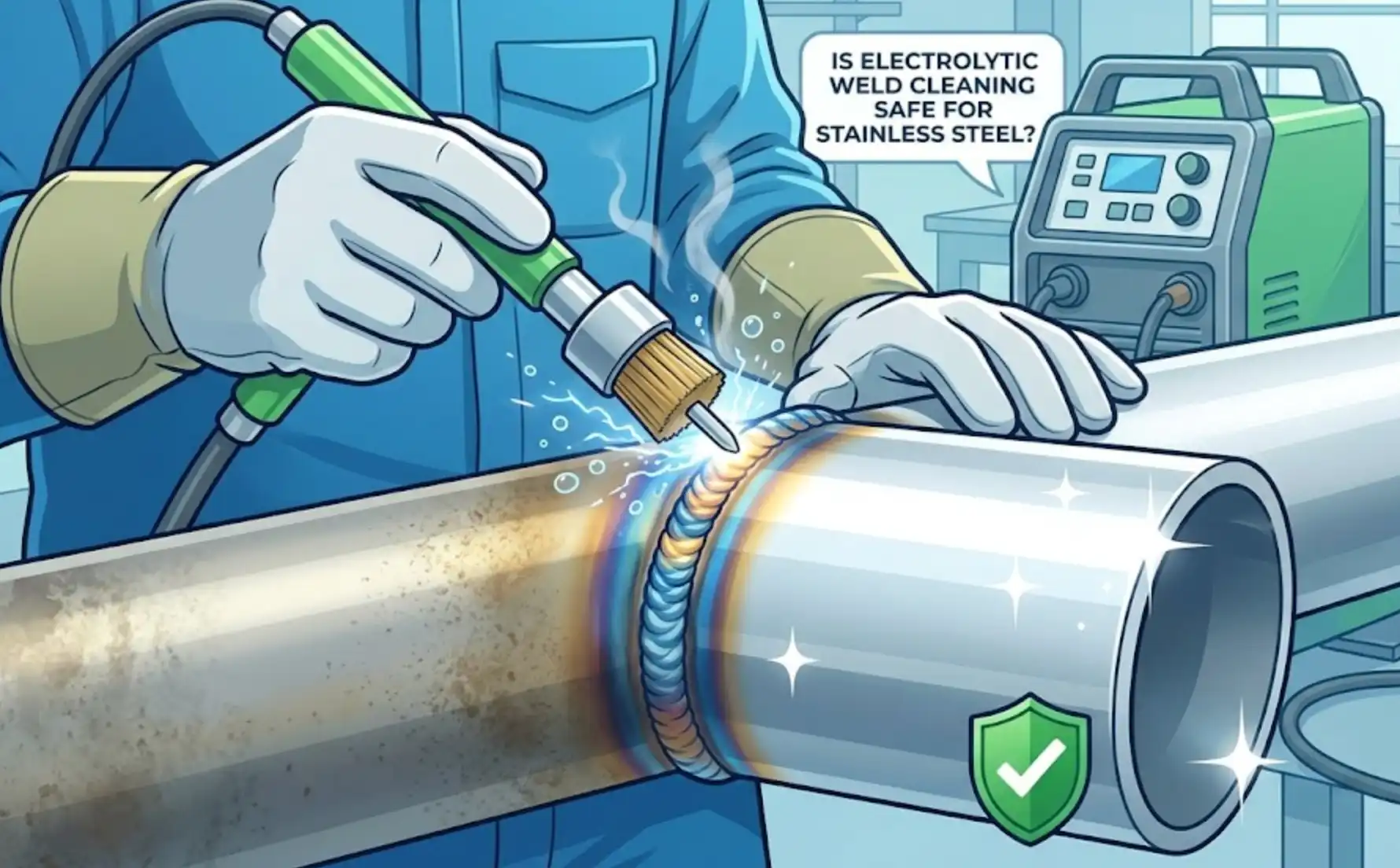
Over 60% of stainless steel fabrication shops in North America have adopted electrolytic weld cleaning as their primary post-weld treatment method in the past decade, largely replacing traditional pickling paste. So, is electrolytic weld cleaning safe for stainless steel? Yes — when performed with correct voltage settings, appropriate electrolyte solutions, and proper technique, electrolytic weld cleaning is not only safe but actually restores and strengthens the chromium oxide passive layer that gives stainless steel its corrosion resistance. This guide breaks down exactly how the process works, where the risks hide, and how to avoid the handful of mistakes that can turn a safe procedure into a surface-damaging one.
Quick Answer — Is Electrolytic Weld Cleaning Safe for Stainless Steel?
Yes. Electrolytic weld cleaning is safe for stainless steel — provided three variables stay within proper range: voltage, electrolyte concentration, and contact time. When dialed in correctly, the process removes heat tint, restores the chromium-oxide passive layer, and leaves the base metal completely intact. No material is lost. No grain structure is altered.
The real risk isn’t the method itself. It’s operator error. Running voltage above 40 V on thin-gauge 304, using an overly acidic electrolyte, or holding the carbon-fiber brush in one spot for too long — any of these can cause micro-pitting or localized etching. But the same is true of virtually every post-weld treatment, including pickling paste, which carries far greater chemical hazard.
So is electrolytic weld cleaning safe for stainless steel in everyday fabrication? Multiple independent corrosion tests, including salt-spray evaluations referenced by the British Stainless Steel Association, confirm that properly cleaned welds match or exceed the corrosion resistance of untreated parent material. The technique simultaneously cleans and passivates in a single step, which most competing methods cannot do.
The sections ahead break down exactly how the electrochemistry works, which grades respond best, what settings to use, and where things go wrong. If you only remember one thing: the process is safe — the settings make or break it.

Stainless steel weld before and after electrolytic weld cleaning showing safe oxide removal and restored passive layer
How Electrolytic Weld Cleaning Actually Works on Stainless Steel
The process is deceptively simple. A power unit pushes low-voltage DC current — typically between 9 V and 35 V — through a carbon fiber brush soaked in a phosphoric acid-based electrolyte. When the brush contacts the weld zone, an electrochemical circuit completes: the stainless steel workpiece becomes the anode, and the carbon fiber pad acts as the cathode.
At the anode surface, oxidation reactions kick in immediately. The chromium-depleted oxide scale (that rainbow heat tint you see after TIG or MIG welding) dissolves into the electrolyte solution. Simultaneously, fresh chromium atoms at the surface react with oxygen to form a new, uniform chromium oxide layer — this is passivation happening in real time. It’s why asking is electrolytic weld cleaning safe for stainless steel usually gets a confident “yes” from experienced fabricators: the process rebuilds the very layer that protects the metal.
Current density matters more than raw voltage. Most machines operate between 0.5 A/cm² and 2.0 A/cm², and the operator controls exposure by adjusting brush speed and dwell time. Too slow, and you risk localized over-etching. Too fast, and oxide removal stays incomplete. The carbon fiber brush is critical here — it’s chemically inert, won’t contaminate the surface with iron particles, and distributes current evenly across irregular weld profiles. According to TWI Global, this combination of controlled current and acid electrolyte achieves cleaning and passivation in a single pass, which mechanical methods simply cannot replicate.

Electrolytic weld cleaning brush removing heat tint from stainless steel weld
The Electrochemical Reaction Behind Oxide Removal and Passivation
Welding stainless steel creates a heat-affected zone (HAZ) where temperatures above 400°C deplete chromium from the surface layer. Chromium atoms bond with carbon, forming chromium carbides that migrate to grain boundaries. The result? A thin band of metal with chromium content below the 10.5% threshold needed for self-passivation. This is the zone most vulnerable to corrosion — and the exact zone electrolytic cleaning targets.
During the electrochemical reaction, the phosphoric acid electrolyte dissolves the discolored oxide scale (a mix of iron oxide, chromium oxide, and manganese oxide) while the DC current accelerates ion transfer at the surface. Iron ions are preferentially pulled away because iron oxidizes at a lower electrochemical potential than chromium. What remains is a chromium-enriched surface layer.
Here’s where passivation happens simultaneously. Exposed chromium atoms react with dissolved oxygen in the electrolyte and ambient moisture to form a fresh Cr₂O₃ passive film — typically 1–5 nanometers thick. According to research published by the British Stainless Steel Association, this newly formed layer can match or exceed the corrosion resistance of the original mill finish. That dual action — stripping damaged oxide while rebuilding protective chromium oxide — is central to why electrolytic weld cleaning is safe for stainless steel when parameters are correctly set.
The reaction is self-limiting to a degree. Once the passive layer stabilizes, electrical resistance at the surface increases, naturally slowing further material removal. This built-in feedback mechanism is one reason the process is harder to over-apply than chemical pickling.

Electrochemical reaction diagram showing chromium oxide passive layer forming on stainless steel during electrolytic weld cleaning
Does Electrolytic Cleaning Damage the Passive Layer or Corrosion Resistance?
This is the question that keeps engineers up at night. The short answer: no — when done correctly, electrolytic cleaning actually rebuilds the passive layer rather than destroying it. The chromium oxide film that forms naturally on stainless steel is only 1–5 nanometers thick. Welding obliterates it across the entire heat-affected zone. Electrolytic cleaning strips the damaged oxide, then immediately re-passivates the exposed chromium-rich surface in a single pass.
Hard data backs this up. Salt spray testing (per ASTM A967/A967M) on electrochemically cleaned 316L samples has shown corrosion resistance equal to or exceeding citric acid passivation benchmarks — often surviving 1,000+ hours without red rust. ASTM A380, which covers cleaning and descaling practices, explicitly recognizes electrochemical methods as acceptable for restoring surface integrity on austenitic and ferritic grades.
Metallurgical cross-sections tell the same story. Properly cleaned welds show no intergranular attack, no grain boundary sensitization, and a uniform passive film across both the weld bead and HAZ. The surface actually ends up in better condition than the as-welded state, where chromium depletion leaves the metal vulnerable. So is electrolytic weld cleaning safe for stainless steel corrosion resistance? The evidence points firmly to yes — it’s restorative, not destructive.
One caveat matters here. Dwell time and voltage still need to stay within manufacturer specs. Exceeding them can over-etch the surface, which is a human error problem, not a process flaw. We’ll cover those risks in detail later.

Metallurgical cross-section comparing passive layer on welded versus electrolytically cleaned stainless steel
Stainless Steel Grades and How They Respond to Electrolytic Cleaning
Not all stainless steels behave the same under an electrolytic pad. The answer to whether is electrolytic weld cleaning safe for stainless steel depends heavily on which grade you’re working with — and how willing you are to adjust your settings.
Austenitic grades (304, 316) are the most forgiving. Their high chromium and nickel content makes them naturally resistant to pitting during cleaning. Standard voltage settings between 20–40V with a neutral or mildly acidic electrolyte handle these grades without drama. Most equipment manufacturers calibrate their default programs around 304 and 316 for exactly this reason.
Duplex stainless steels like 2205 require more caution. The mixed austenite-ferrite microstructure responds unevenly to current flow, and dwelling too long in one spot can preferentially attack the ferrite phase. Reducing voltage by 15–20% and keeping pad movement steady typically prevents this selective etching.
Ferritic grades (430, 409) have lower chromium content and no nickel to speak of. They’re more susceptible to discoloration and surface roughening. Martensitic grades — think 410 or 420 — pose similar challenges, compounded by their hardness and the temper sensitivity of their heat-affected zones. Both families demand lower amperage, shorter dwell times, and careful electrolyte selection. According to the International Molybdenum Association, the compositional differences between these families directly influence their electrochemical behavior.
Common Mistakes That Can Cause Surface Damage During Electrolytic Cleaning
The process itself is safe. Operator error is what turns it dangerous. When someone asks “is electrolytic weld cleaning safe for stainless steel,” the honest answer depends heavily on who’s holding the brush — and what settings they’ve dialed in.
Cranking voltage above the recommended range is the single most common mistake. Anything beyond 40V on austenitic grades can cause localized pitting within seconds. The surface looks etched, almost frosted. That damage is permanent. A related problem: holding the carbon fiber brush in one spot too long. Dwell time beyond 3–4 seconds per pass concentrates current density enough to attack the grain boundaries, especially on 2B and mirror-polished finishes.
Wrong electrolyte concentration creates subtler problems. Too strong, and the acid component eats into the base metal. Too diluted, and operators compensate by increasing voltage or slowing their stroke — both of which circle back to over-etching. Contaminated brushes are another silent killer. A pad that previously touched carbon steel transfers iron particles onto the stainless surface, seeding corrosion points that won’t show up for weeks. According to the British Stainless Steel Association, cross-contamination remains one of the leading causes of premature corrosion in fabricated stainless components.
Thin-gauge material — anything under 1.5 mm — demands special attention. Running standard power settings on 0.8 mm sheet can warp the metal from heat buildup or burn through entirely. Reduce amperage by 30–40% and use faster brush strokes. Skip this adjustment, and you’ll learn the hard way.
Signs of Over-Etching, Pitting, and How to Identify Them
Catching damage early saves parts. The tricky part is that some defects look subtle — almost cosmetic — but signal serious metallurgical compromise underneath. Knowing what to look for separates a quick correction from a scrapped workpiece.
Dark Spots and Staining
A matte gray or black patch that won’t wipe away usually means localized over-etching. The electrolyte dissolved metal beyond the oxide layer, exposing grain boundaries. Run your fingernail across it. If you feel a texture change compared to the surrounding surface, chromium depletion has likely begun. This area will corrode faster than untreated steel.
Rainbow Discoloration
Faint gold, blue, or purple hues after cleaning indicate a thin thermal or chemical oxide film that wasn’t fully removed — or was re-formed by excessive current. A light rainbow isn’t always harmful, but heavy iridescence on austenitic grades like 304 suggests the passive layer reformed unevenly. According to the British Stainless Steel Association, uneven passivation can create galvanic micro-cells that accelerate pitting in chloride-rich environments.
Pitting You Can Feel
Tiny craters — sometimes barely 50 µm across — are the most dangerous sign. They’re hard to see but easy to detect with a white cotton glove drag test: snags mean pits. Metallurgically, pitting happens when current density exceeds the transpassive threshold and anodic dissolution punches through the chromium oxide layer into the base metal. Once pits nucleate, they grow autocatalytically.
So is electrolytic weld cleaning safe for stainless steel when these symptoms appear? The process didn’t fail — the parameters did. Reduce voltage by 1–2 V, slow your pad speed, and retest on scrap before returning to the actual part.
Electrolytic Cleaning vs Pickling Paste vs Mechanical Methods — Safety Comparison
Three methods dominate post-weld treatment for stainless steel. Each carries a different risk profile, and the differences are stark once you line them up side by side.
| Safety Dimension | Electrolytic Cleaning | Pickling Paste | Mechanical (Grinding/Wire Brush) |
|---|---|---|---|
| Surface integrity | Preserves grain structure; simultaneous passivation | Can over-etch if left beyond 20–60 min window | Removes base metal; embeds contaminants from carbon steel brushes |
| Operator health | Low-voltage DC, mild phosphoric acid electrolyte | Contains 2–5% hydrofluoric acid — lethal skin absorption risk from as little as 25 cm² exposure (CDC/NIOSH) | Metal dust inhalation; hexavalent chromium fume at grinding temps |
| Environmental impact | Spent electrolyte is neutralizable on-site | Generates fluoride-bearing hazardous waste requiring licensed disposal | Airborne particulate; contaminated abrasive media |
| Consistency | Repeatable with fixed voltage/speed settings | Highly operator-dependent dwell time | Varies with grit, pressure, angle |
Pickling paste delivers excellent oxide removal, but the hydrofluoric acid component makes it genuinely dangerous. A single mishandled application — no gloves, a torn suit — can cause deep tissue necrosis hours after contact. Mechanical grinding, meanwhile, risks embedding iron particles that trigger tea staining within weeks on 304-grade surfaces.
So is electrolytic weld cleaning safe for stainless steel compared to these alternatives? On every safety axis — operator exposure, surface preservation, waste handling — it carries the lowest combined risk. That doesn’t make it foolproof, but the margin is wide enough that many shops treat the comparison as settled.
Why Many Fabricators Are Moving Away from Pickling Paste
The shift is driven by one chemical: hydrofluoric acid (HF). Most pickling pastes contain 5–20% HF by weight, and this compound doesn’t just burn skin — it penetrates tissue and binds to calcium in bones and blood. The CDC/NIOSH classifies HF as an acute systemic toxin. Skin exposure over just 2.5% of body surface area can cause fatal hypocalcemia, sometimes hours after initial contact when the worker feels fine.
Disposal compounds the problem. Spent pickling paste qualifies as hazardous waste under EPA regulations, requiring licensed haulers and documented chain-of-custody disposal. A single 55-gallon drum pickup can cost $800–$1,500 depending on region. For small shops running 20–30 welds a day, those costs stack up fast.
Then there’s the inconsistency. Paste thickness, ambient temperature, and dwell time all affect results. Leave it 10 minutes too long on 304L and you get micro-pitting. Pull it off too early and the heat tint remains. This variability is exactly why fabricators asking is electrolytic weld cleaning safe for stainless steel often land on electrolytic methods — the process offers repeatable, operator-controlled results without storing a substance that can kill through accidental skin absorption. Shops that make the switch typically report lower insurance premiums and simplified OSHA compliance within the first year.
Best Practices for Safe Electrolytic Weld Cleaning on Stainless Steel
Knowing whether electrolytic weld cleaning is safe for stainless steel matters less than knowing how to keep it safe. Follow this protocol, and surface damage becomes nearly impossible.
Voltage and Electrolyte Selection
Stay between 18–36V DC for most austenitic grades. Use phosphoric acid-based electrolytes at concentrations recommended by your equipment manufacturer — typically 10–20% by volume. Avoid mixing brands. Different electrolyte chemistries react unpredictably when combined, and the resulting pH swings can etch grain boundaries.
Brush Technique and Surface Prep
Keep the carbon fiber brush moving at a steady pace — roughly 30–50 mm per second. Never let it sit stationary on the surface. Apply light, consistent pressure; the electrolyte does the work, not your arm. Before cleaning, degrease the weld zone with isopropyl alcohol or acetone. Residual oils create hotspots that concentrate current unevenly.
Rinsing and Passivation Verification
Rinse immediately with clean water after cleaning — distilled is ideal, but potable water works for most applications. Residual electrolyte left on the surface for more than 60 seconds can initiate localized corrosion. After rinsing, verify passivation using a ferroxyl test per ASTM A967 or a handheld electrochemical probe. A properly cleaned surface should show chromium-to-iron ratios above 1.5:1 within the passive film.
Document every parameter — voltage, dwell time, electrolyte batch number. Traceability turns good practice into defensible quality control.
Recommended Settings by Material Thickness and Weld Type
Dialing in the right parameters eliminates guesswork. Here’s a practical breakdown by scenario, assuming a phosphoric acid–based electrolyte and a standard carbon-fiber brush pad.
| Scenario | Voltage (V) | Amperage (A) | Pad Speed | Key Notes |
|---|---|---|---|---|
| Thin sheet (<2 mm), 304/316 | 18–24 | 3–8 | Steady, no pausing | Heat warps thin stock fast — keep contact under 2 seconds per spot |
| Standard plate (3–6 mm), TIG welds | 24–32 | 8–15 | Moderate, overlapping strokes | Two passes typical: first removes oxide, second passivates |
| Pipe welds (Schedule 10/40) | 22–30 | 6–12 | Follow the weld contour | Use a narrow brush to maintain contact on curved surfaces |
| Fillet welds, multi-pass | 28–35 | 10–18 | Slow, deliberate | Heavier discoloration needs more energy; increase voltage before amperage |
A critical pattern emerges from this table. Thinner material demands lower power and faster movement. Thicker welds tolerate — and often require — higher voltage to break through stubborn chromium oxide scale. When operators ask is electrolytic weld cleaning safe for stainless steel at these higher settings, the answer stays yes, as long as dwell time stays controlled and the electrolyte film never dries on the surface.
Fillet joints deserve extra attention. The tight inside corner traps heat and electrolyte, which accelerates the reaction in that pocket. Drop amperage by roughly 15% compared to a flat butt weld of the same thickness, and angle the brush at 45° to avoid pooling. For duplex grades like 2205, reduce voltage an additional 2–3 V across all scenarios — their dual-phase microstructure is more sensitive to localized etching, as covered in the IMOA duplex stainless steel guide.
Frequently Asked Questions About Electrolytic Weld Cleaning Safety
Does it meet food-grade and pharmaceutical hygiene standards?
Yes. Electrolytic weld cleaning produces surfaces that comply with ASME BPE (Bioprocessing Equipment) requirements when performed correctly. The process leaves no chemical residue — unlike pickling paste, which demands extensive rinsing. Pharmaceutical and dairy fabricators routinely specify it for 316L sanitary tubing where Ra ≤ 0.8 µm surface finishes are mandatory.
Can it remove discoloration in heat-affected zones?
Absolutely. HAZ discoloration — those straw-yellow to deep-blue oxide bands — is exactly what the process targets. The electrolyte dissolves chromium-depleted oxides while the current drives fresh passive film formation underneath. Heavy blue or black oxides on thicker welds may need a second pass at slightly higher voltage, but the color clears completely.
Does electrolytic cleaning replace passivation?
It depends on the spec. The electrochemical reaction simultaneously cleans and passivates, so for many applications the answer is yes. However, some ASTM A967 call-outs require a separate citric or nitric acid passivation bath with documented verification testing. Check your customer’s drawing notes before assuming one step covers both.
Does it weaken the weld itself?
No. The question of whether electrolytic weld cleaning is safe for stainless steel extends to mechanical integrity, and the data is clear. Operating at 10–40 V DC, the process affects only the outermost 1–3 µm of surface oxide. Weld tensile strength, hardness, and fatigue life remain completely unchanged.
Final Verdict — When Electrolytic Weld Cleaning Is the Safest Choice
So, is electrolytic weld cleaning safe for stainless steel? Yes — when three conditions are met: correct voltage for the grade, a phosphoric-acid-based electrolyte, and an operator who doesn’t park the pad in one spot. Hit those marks, and the process removes heat tint while simultaneously rebuilding the chromium oxide passive layer. No HF exposure. No embedded abrasive particles. No compromised corrosion resistance.
The method shines brightest on thin-wall tubing under 2 mm, sanitary welds in food and pharma environments, and visible architectural joints where surface finish matters. It also makes sense anywhere OSHA chemical exposure limits or local environmental regulations restrict the use of pickling paste — a situation growing more common every year. For heavy structural work on carbon steel or thick duplex plate, mechanical grinding still has its place. The right tool depends on the job.
If you’re evaluating the process for your shop, start with a single unit and run test coupons on your most common grade and wall thickness. Measure results with a ferroxyl test or portable XRF before committing to production work. The ASTM A967 standard provides the acceptance criteria you need to verify passivation quality objectively. Document your settings, train every operator, and the process pays for itself — in safety, speed, and surface integrity.
See also
The Complete Guide to Stainless Steel Welding Techniques
What Is Food Grade Stainless Steel and Why Does It Matter
Ultimate Guide to Weld Heat Tint Colors
Top Portable Laser Welding Machines for Stainless Steel and Their Prices