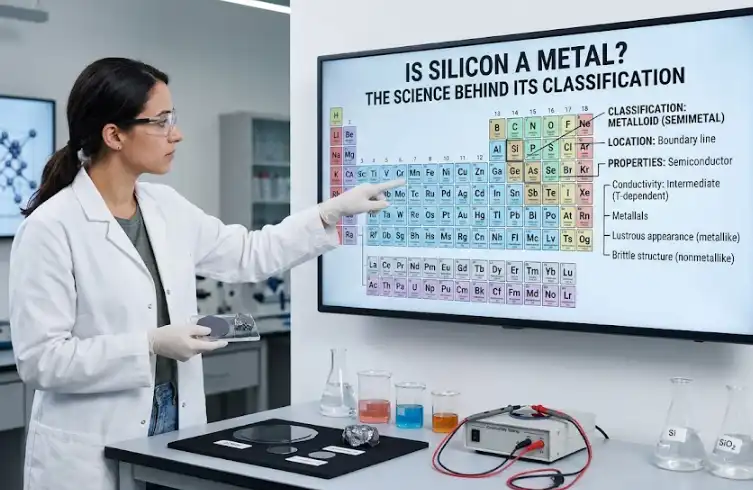
Silicon sits at position 14 on the periodic table, makes up roughly 27.7% of Earth’s crust by mass, and powers nearly every electronic device you own — yet most people can’t say whether it’s a metal or not. So, is silicon a metal? No. Silicon is officially classified as a metalloid, an element that shares properties with both metals and nonmetals but doesn’t fully belong to either category. It conducts electricity better than glass but far worse than copper, it has a metallic sheen but shatters like ceramic, and that strange in-between behavior is exactly what makes it the backbone of semiconductor technology.
The Short Answer — Silicon Is a Metalloid, Not a Metal
No. Silicon is not a metal. If you’ve been wondering “is silicon a metal,” the answer from chemistry is clear-cut: silicon is a metalloid, sometimes called a semimetal. It occupies a peculiar middle ground on the periodic table — borrowing some traits from metals, some from nonmetals, and fully committing to neither camp.
Silicon sits at atomic number 14, tucked into Group 14 (the carbon family) and Period 3. Its position places it right along the staircase-shaped line that zigzags across the periodic table, separating metals on the left from nonmetals on the right. Elements hugging that boundary tend to exhibit hybrid behavior, and silicon is the poster child for this duality.
So what exactly does “metalloid” mean? In chemistry, a metalloid is an element whose physical and chemical properties fall between those of metals and nonmetals. It might have a shiny, metallic luster — silicon does — yet conduct electricity far worse than copper or aluminum. It might form crystalline structures that look impressively metallic, yet shatter like glass under stress instead of bending. The International Union of Pure and Applied Chemistry (IUPAC) recognizes this in-between status, though the exact list of metalloids can vary slightly depending on the source. Most chemists agree on six to eight elements in the category, with silicon, germanium, boron, and arsenic appearing on virtually every list.
The metalloid label isn’t a consolation prize. It reflects genuinely distinct electronic behavior — specifically, silicon’s ability to act as a semiconductor. That single property has made it arguably the most economically important element of the past 70 years, powering everything from pocket calculators to the data centers running large-scale AI models. But we’ll get into that later. For now, the key takeaway: silicon looks metallic, sometimes acts metallic, yet falls short of full metal status by measurable, well-defined criteria.
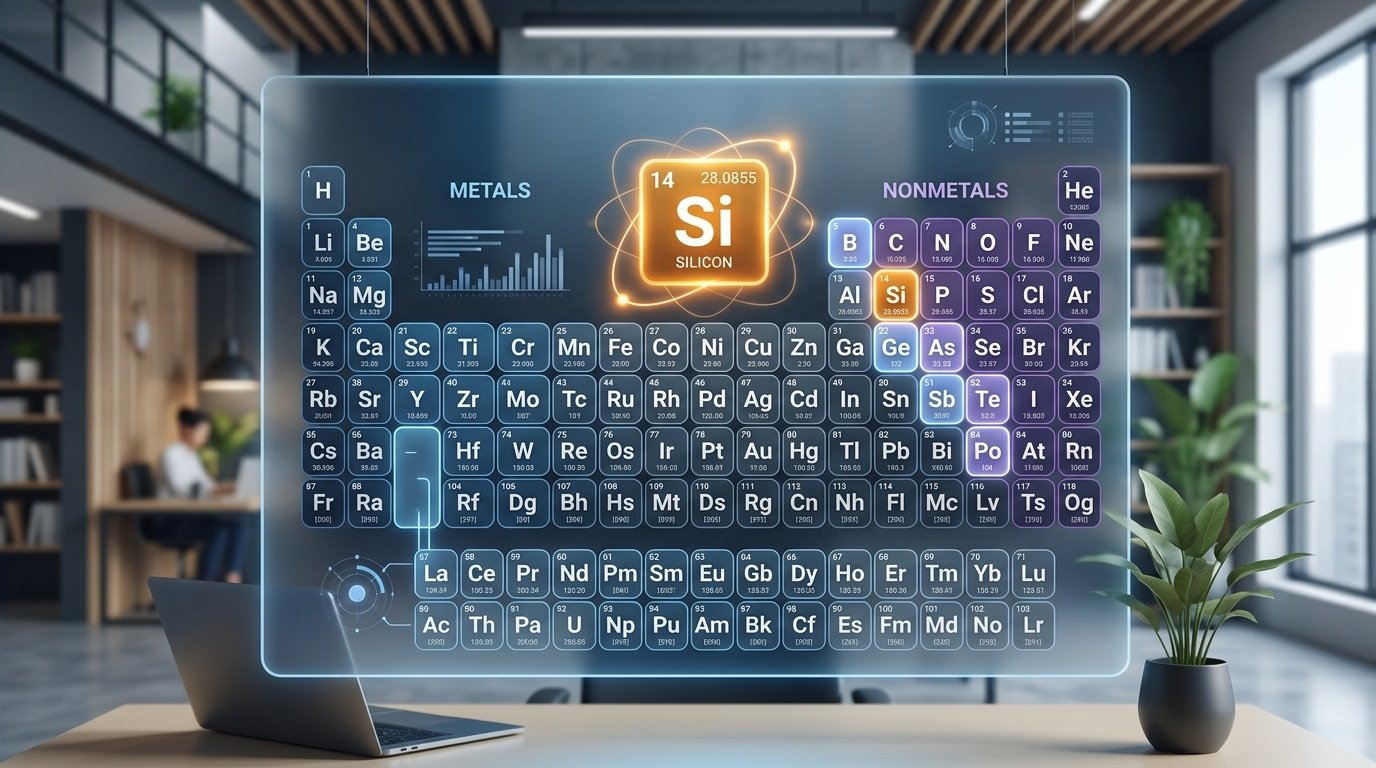
Periodic table with silicon highlighted as a metalloid on the metal-nonmetal boundary
What Makes an Element a Metal, Nonmetal, or Metalloid
Chemists don’t classify elements by guesswork. They rely on a specific set of physical and chemical properties — measurable, testable traits that sort the 118 known elements into three broad categories. Understanding these criteria is the only way to properly answer whether silicon is a metal, because the answer depends entirely on where you draw the lines.
The Key Properties That Define Metals
Metals share a recognizable cluster of behaviors. They conduct electricity well, typically with resistivity below 10⁻⁵ ohm·meters. They’re malleable — you can hammer gold into sheets just 0.1 micrometers thick without it shattering. Most metals have a characteristic luster, reflecting light due to their sea of delocalized electrons. At the atomic level, metals tend to lose electrons during chemical reactions, forming positive ions. Sodium surrenders one electron eagerly. Iron can give up two or three.
Nonmetals — The Opposite End
Nonmetals are poor conductors. Brittle in solid form. Dull surfaces. They gain or share electrons rather than donating them, which is why oxygen and chlorine form negative ions so readily. Their bonding is overwhelmingly covalent — electron pairs shared between atoms rather than pooled into a metallic “sea.”
The Staircase Line and the Border Zone
Open any periodic table and you’ll spot a zigzag line running from boron (element 5) down to astatine (element 85). This so-called staircase line separates metals on the left from nonmetals on the right. Elements hugging this boundary — boron, silicon, germanium, arsenic, antimony, tellurium — display a frustrating mix of both sets of properties. They conduct electricity, but poorly compared to copper. They have some luster, but shatter like glass under a hammer.
The IUPAC recognizes these border-zone elements as metalloids, though the term lacks a single rigid definition. What matters is the pattern: metalloids partially conduct, partially shine, and form bonds that can go either way — ionic or covalent depending on the reaction partner. This framework is exactly why asking “is silicon a metal” doesn’t yield a simple yes or no from every source. Silicon sits right on that staircase line, inheriting traits from both sides.
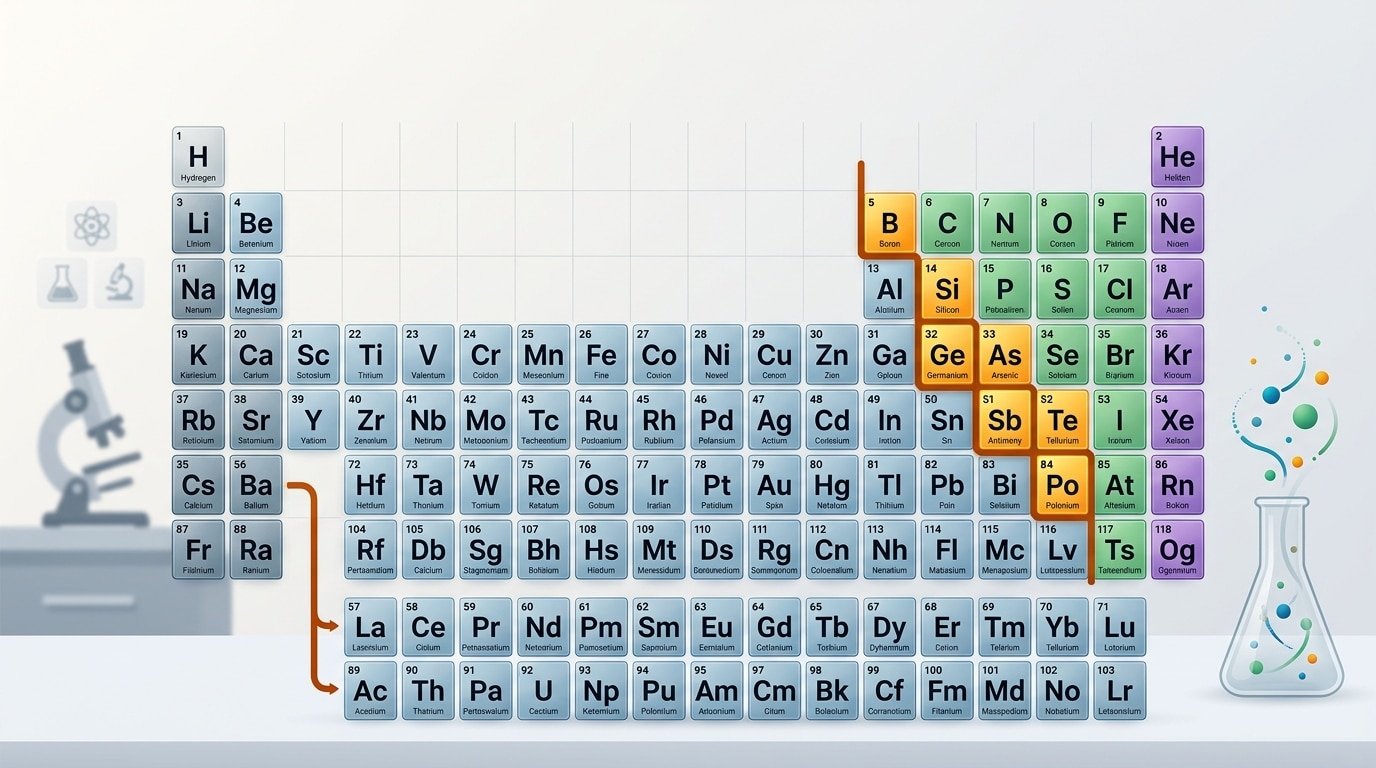
Periodic table showing the staircase line and metalloid elements including silicon along the metal-nonmetal boundary
Metallic Traits That Make Silicon Look Like a Metal
Pick up a chunk of pure silicon and your first instinct is clear: this looks metallic. Its surface has a blue-gray, almost steel-like luster that catches light the way polished chromium does. That reflective sheen isn’t a trick of processing — it’s intrinsic to silicon’s crystalline structure, which arranges atoms in a diamond-cubic lattice that reflects visible wavelengths efficiently.
Then there’s the melting point. Silicon melts at 1,414°C, which sits comfortably above aluminum (660°C) and not far below nickel (1,455°C). For context, that’s hot enough to require specialized crucibles and inert atmospheres during industrial processing. A substance that demands those conditions feels like a metal, and understandably so.
Silicon also conducts electricity — just not freely. At room temperature, its conductivity is low. Raise the temperature, though, and something interesting happens: more electrons jump into the conduction band, and current flows more readily. Metals behave oppositely, losing conductivity as they heat up. Still, the bare fact that silicon carries a current at all is enough to make someone ask, “is silicon a metal?” It’s a reasonable question when the stuff gleams like one and handles heat like one.
Its density of 2.33 g/cm³ and brittleness under stress hint at something different, but those details are easy to overlook next to the visual and thermal evidence. According to the Royal Society of Chemistry, silicon’s physical appearance is frequently described as “metallic” in reference materials — a label that reinforces the confusion. Taken together, these traits build a convincing but incomplete case for calling silicon a metal.
Nonmetallic Traits That Disqualify Silicon as a True Metal
Here’s where silicon’s metal disguise falls apart. Hit a copper sheet with a hammer and it flattens. Hit a silicon crystal the same way and it shatters. Silicon is brittle — genuinely, catastrophically brittle — which is a textbook nonmetal behavior. Metals deform because their delocalized electron “sea” lets atom layers slide past each other without breaking bonds. Silicon can’t do this; its atoms are locked in a rigid diamond-cubic lattice held together by strong covalent bonds, not metallic ones.
Conductivity seals the case. Copper conducts electricity at roughly 5.96 × 10⁷ S/m. Silicon? About 1.56 × 10⁻³ S/m in its pure, intrinsic form — a gap of ten orders of magnitude. Thermal conductivity tells a similar story: copper moves heat at 401 W/m·K while silicon manages around 150 W/m·K. Decent for a nonmetal, sure, but nowhere near true metallic performance. So when someone asks “is silicon a metal,” these raw numbers make the answer obvious.
The bonding chemistry adds another layer. Silicon forms directional covalent bonds with four neighbors, each sharing electron pairs rather than releasing them into a communal cloud. This covalent character directly explains both the brittleness and the poor electrical conductivity — there simply aren’t free-roaming electrons available to carry charge or allow plastic deformation.
Then there’s the oxide test, a classic litmus for metallic character. Silicon dioxide (SiO₂) behaves as an acidic oxide. It reacts with strong bases like NaOH to form sodium silicate, but it won’t dissolve in hydrochloric acid the way a basic metal oxide would. According to the Royal Society of Chemistry, this acidic oxide behavior aligns silicon squarely with nonmetals on that particular criterion. Metals produce basic oxides — think Na₂O dissolving in water to give NaOH. Silicon does the opposite.
The Science of Semiconductors and Silicon’s Electron Behavior
The real answer to “is silicon a metal” lives in quantum mechanics — specifically, in something called band gap theory. Every solid material has energy bands where electrons can exist. In metals, the valence band (where electrons sit at rest) overlaps with the conduction band (where electrons move freely to carry current). There’s zero gap. Electrons flow the moment you apply even a tiny voltage, which is why copper conducts so effortlessly at room temperature.
Nonmetals are the opposite extreme. Diamond, for instance, has a band gap of roughly 5.5 eV — a chasm so wide that electrons almost never jump across it under normal conditions. The material stays stubbornly insulating. Silicon sits in a fascinating middle zone with a band gap of 1.12 eV at room temperature. That gap is small enough for thermal energy or an external voltage to kick some electrons into the conduction band, yet large enough to prevent the free-flowing conductivity metals enjoy.
Silicon’s four valence electrons are central to this behavior. Each atom bonds covalently with four neighbors in a diamond cubic crystal lattice, locking all valence electrons in place. At absolute zero, pure silicon is essentially an insulator. Raise the temperature, and a fraction of electrons gain enough energy to leap the 1.12 eV gap. This is why silicon’s conductivity increases with heat — the exact opposite of metals like copper, whose resistance climbs as temperature rises.
Engineers exploit this switchable nature through doping: adding trace impurities like phosphorus (which donates extra electrons) or boron (which creates electron “holes”). Doped silicon can be tuned across a conductivity range spanning roughly ten orders of magnitude, according to HyperPhysics at Georgia State University. No true metal or nonmetal offers anything close to that tunability. This electron behavior — controllable, conditional, neither fully free nor fully locked — is precisely why asking “is silicon a metal” misses the point. It belongs to a category defined by in-between physics.
Silicon vs. Common Metals — A Side-by-Side Comparison
Numbers settle debates faster than definitions. Stacking silicon against iron, copper, and aluminum across measurable properties makes the metalloid distinction impossible to ignore.
| Property | Silicon | Iron | Copper | Aluminum |
|---|---|---|---|---|
| Electrical conductivity (S/m) | ~1.56 × 10⁻³ | 1.0 × 10⁷ | 5.96 × 10⁷ | 3.77 × 10⁷ |
| Density (g/cm³) | 2.33 | 7.87 | 8.96 | 2.70 |
| Malleability | Brittle — shatters | Highly malleable | Highly malleable | Highly malleable |
| Bonding type | Covalent network | Metallic | Metallic | Metallic |
| Oxide behavior | Amphoteric (SiO₂) | Basic (Fe₂O₃) | Basic (CuO) | Amphoteric (Al₂O₃) |
The conductivity gap is staggering. Copper conducts electricity roughly 38 billion times better than pure silicon at room temperature. That single number answers the question “is silicon a metal” more decisively than any textbook paragraph could. Metals share a delocalized electron sea that lets charge carriers flow almost effortlessly; silicon’s covalent lattice locks electrons in place unless external energy frees them.
Bonding type drives most of the other differences. Iron, copper, and aluminum all feature metallic bonds — positive ion cores floating in a shared electron cloud. Deform the lattice and those ions simply slide past each other, which is why you can hammer copper into sheets or draw aluminum into wire. Silicon’s rigid, directional covalent bonds crack under the same stress. Drop a silicon wafer onto a hard floor and it snaps cleanly, behaving more like glass than any metal you’d recognize.
Oxide chemistry adds another wrinkle. True metals typically form basic oxides that dissolve in acid. Silicon dioxide is amphoteric — it reacts with both strong acids and strong bases — placing it in a chemical gray zone that the Royal Society of Chemistry explicitly flags in its silicon profile. Aluminum’s oxide is also amphoteric, which is one reason aluminum itself sits near the metal-metalloid boundary on the periodic table.
When you line up every property side by side, silicon matches metals on exactly one front — its shiny appearance. Everywhere else, it either falls short or lands squarely between metal and nonmetal behavior. That pattern is precisely what the metalloid label was designed to capture.
Why Silicon’s Metalloid Classification Matters for Modern Technology
That ambiguous classification — metalloid, not metal — is exactly why silicon runs the modern world. A true metal would conduct electricity too freely. A true nonmetal wouldn’t conduct at all. Silicon sits in the sweet spot: its conductivity can be precisely controlled, turned up or dialed down by introducing tiny amounts of other elements. Engineers call this process doping, and it’s the foundation of every semiconductor device on the planet.
Add a trace of phosphorus (roughly 1 atom per 10 million silicon atoms) and you get n-type silicon — extra electrons roam freely, carrying negative charge. Swap phosphorus for boron, which has one fewer valence electron, and you create p-type silicon — “holes” where electrons are missing act as positive charge carriers. Stack a p-type layer against an n-type layer and you’ve built a p-n junction, the basic unit inside every transistor, LED, and solar cell. A single modern processor from Apple or AMD packs over 100 billion of these junctions onto a chip smaller than your thumbnail.
So when someone asks “is silicon a metal,” the practical answer matters as much as the chemical one. If silicon were a metal, doping wouldn’t work — metals already overflow with free electrons, leaving no room for fine-tuned control. According to the Semiconductor Industry Association, global chip sales reached $527 billion in 2023, an entire economy built on one element’s refusal to pick a side. Solar panels convert sunlight into electricity because silicon’s band gap — about 1.1 eV — aligns almost perfectly with the solar spectrum’s peak energy. That’s not a coincidence engineers designed around; it’s a physical property that exists because silicon is, fundamentally, neither metal nor nonmetal.
Being “not quite a metal” isn’t a weakness. It’s silicon’s greatest technological asset.
Other Metalloids Compared to Silicon — Where It Fits in the Group
Silicon doesn’t sit alone on the metal-nonmetal border. Six or seven elements — depending on which classification system you follow — share that same ambiguous territory. Boron, germanium, arsenic, antimony, and tellurium all exhibit a mix of metallic and nonmetallic behavior. But their individual quirks vary wildly, and understanding those differences clarifies why asking “is silicon a metal” leads to such a nuanced answer.
Boron is the lightest metalloid and arguably the most nonmetallic of the group. It’s extremely hard (9.3 on the Mohs scale), forms covalent compounds almost exclusively, and conducts electricity poorly even at elevated temperatures. Its primary commercial role — borosilicate glass and detergent additives — reflects that nonmetallic lean. Germanium, sitting directly below silicon on the periodic table, behaves like a closer sibling. It’s also a semiconductor with a band gap of 0.67 eV compared to silicon’s 1.12 eV, which made it the original transistor material in the 1940s before silicon replaced it for cost and thermal stability reasons.
Arsenic and tellurium tilt further toward metallic character. Arsenic has a steel-gray appearance and decent electrical conductivity in its most stable allotrope, yet it shatters like glass under stress. Tellurium conducts electricity better than selenium but far worse than any true metal, and it finds niche use in cadmium telluride solar cells. According to the Royal Society of Chemistry’s periodic table resource, these elements occupy a diagonal band across the table — a visual reminder that metalloid character isn’t random but follows a predictable trend in electronegativity and ionization energy.
What sets silicon apart from every other metalloid is sheer commercial dominance. Global production exceeds 8 million metric tons annually, dwarfing germanium’s roughly 130 tons. Silicon’s band gap sits in a sweet spot for room-temperature electronics, its oxide forms a naturally stable insulator, and sand — its raw material — is practically limitless. The metalloid category exists because nature doesn’t draw hard lines, but silicon is the element that made that blurry boundary worth billions.
Frequently Asked Questions About Silicon’s Classification
Is silicon a metal on the periodic table?
No. The periodic table places silicon in group 14, directly below carbon. Most periodic table color schemes mark it as a metalloid — an element straddling the boundary between metals and nonmetals. It sits right along the staircase line that divides the two categories, which is precisely why the question “is silicon a metal” comes up so often.
Is silicon a conductor or insulator?
Neither, strictly speaking. Pure silicon is a semiconductor. At room temperature its electrical conductivity sits around 1.56 × 10⁻³ S/cm — millions of times lower than copper but far higher than glass. Add trace impurities like phosphorus or boron (a process called doping), and that conductivity jumps by several orders of magnitude.
What is the difference between silicon and silicone?
Silicon (Si) is a chemical element. Silicone is a synthetic polymer made from silicon, oxygen, carbon, and hydrogen. Think of it this way: silicon is a brittle, shiny solid pulled from quartz; silicone is the rubbery, flexible material in baking molds and sealants. One letter apart, completely different substances.
Can silicon ever behave like a metal?
Under extreme pressure — roughly 12 gigapascals — silicon’s crystal structure collapses into a metallic phase with genuine electrical conductivity comparable to metals. At standard conditions, though, it stays firmly in metalloid territory. Research published through the American Physical Society has documented several of these high-pressure metallic phases.
Why is silicon used in chips instead of a real metal?
Metals conduct electricity all the time. That’s the problem. Transistors need to switch — on and off, billions of times per second. Silicon’s semiconductor band gap (1.12 eV) lets engineers control current flow with tiny voltage changes. A true metal can’t do that.
Final Verdict — Understanding Why Silicon Defies Simple Labels
So, is silicon a metal? The evidence stacks up clearly: no. Its band gap of 1.12 eV, brittle crystal structure, and poor room-temperature conductivity all disqualify it from genuine metalhood. But dismissing it as a nonmetal ignores the metallic luster, the four-coordinate covalent bonding that mirrors diamond-type lattices, and the way its conductivity climbs — not drops — when you heat it. Silicon occupies a genuine middle ground, and that middle ground has a name: metalloid.
This classification isn’t a cop-out. It reflects real physics at the atomic level. Silicon’s four valence electrons form directional sp³ bonds that lock into a rigid lattice, unlike the delocalized electron sea in copper or aluminum. Yet those same electrons can be promoted across a modest energy gap with thermal energy, photons, or trace amounts of dopant atoms measured in parts per million. That dual personality — insulator at absolute zero, tunable conductor under the right conditions — is not a flaw in our taxonomy. It’s the precise reason silicon powers roughly 95% of all semiconductor devices sold worldwide, according to data from the SEMI industry association.
Every phone screen you tap, every cloud server that loads a webpage, every solar panel converting sunlight into electricity — all of these depend on an element that refuses to pick a side. Appreciate that refusal. It’s not ambiguity. It’s versatility written into the periodic table itself, sitting right at the staircase boundary between metals and nonmetals, doing exactly what its electron configuration predicts.
See also
Rust Removal for Large Metal Objects — The Complete Guide
Stainless Steel vs Aluminum Which Is Better for Sheet Metal Work
How to Extend the Life of Metal Sheet Doors by Preventing Rust