The International Federation of Robotics reported that global cobot installations grew by 12% in 2023 alone — yet manufacturing employment in cobot-heavy sectors like automotive and electronics held steady or increased during the same period. The fear that cobots are replacing human workers wholesale makes for dramatic headlines, but the real industry data tells a far more nuanced story: collaborative robots are primarily redistributing tasks, not eliminating jobs. This article breaks down what the numbers actually show, where the genuine risks lie, and why the cobot-versus-worker framing misses the point entirely.
The Short Answer — Cobots Are Reshaping Jobs, Not Eliminating Them
No, cobots are not replacing human workers on any meaningful scale. They’re changing what those workers do. The global collaborative robot market hit $1.2 billion in 2022 and is projected to exceed $6 billion by 2030, according to MarketsandMarkets research — yet manufacturing employment in cobot-heavy countries like Germany, Japan, and South Korea has remained stable or grown during the same period.
Featured Snippet Summary: Industry data shows that cobots replacing human workers is largely a myth. Cobot adoption is accelerating at a 32%+ CAGR, but sectors with the highest deployment rates — automotive, electronics, food packaging — report job transformation, not job elimination. Workers shift from repetitive manual tasks to supervisory, programming, and quality-assurance roles.
The International Federation of Robotics (IFR) reported in its 2023 World Robotics study that countries installing the most robots per capita actually saw unemployment rates decline. South Korea, with the world’s highest robot density at 1,012 units per 10,000 employees, maintained a manufacturing unemployment rate below 3%.
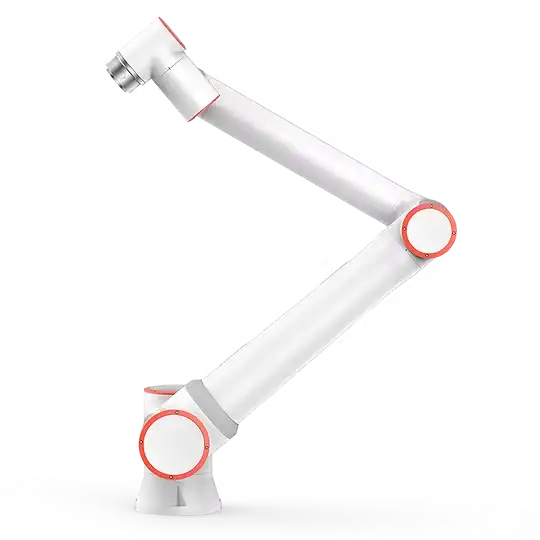
Why the disconnect between fear and reality? Because cobots are purpose-built for augmentation. A Universal Robots UR10e doesn’t replace an assembly technician — it handles the ergonomically punishing lift-and-place motions while the technician manages inspection, exception handling, and process adjustments. The human stays. The job description evolves.
That said, the nuance matters. Certain narrow, repetitive roles — think palletizing or machine tending with zero variability — do face genuine displacement risk. The data simply shows that these losses are more than offset by newly created positions in cobot programming, maintenance, and human-robot workflow design. The net effect across industries is positive, but unevenly distributed.

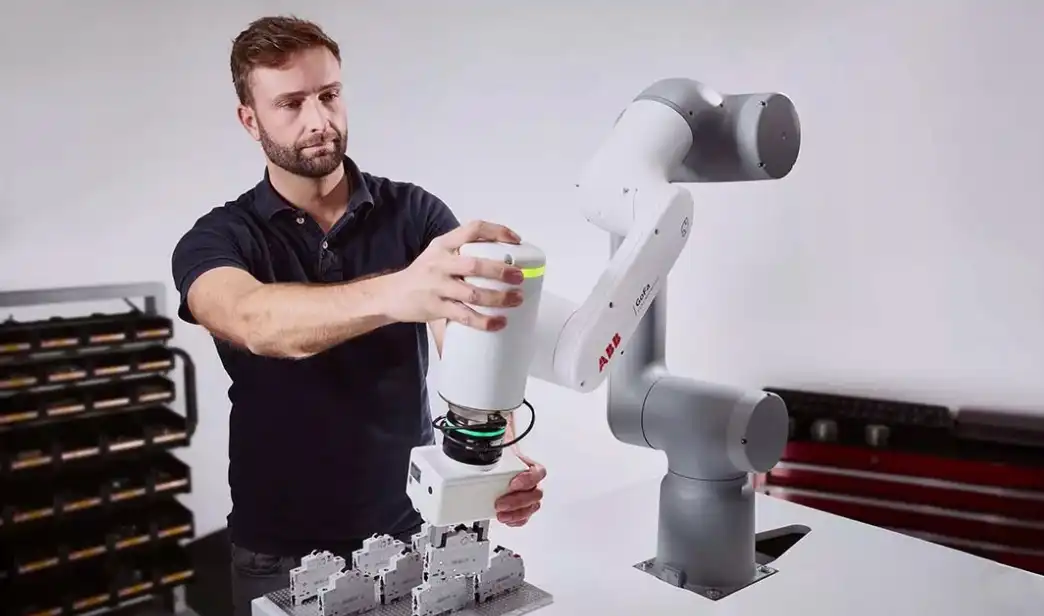
Cobot and human worker collaborating on an assembly line illustrating cobots reshaping jobs not replacing human workers
What Real Industry Data Says About Cobot Adoption and Employment
The International Federation of Robotics (IFR) reported that global cobot installations grew by roughly 12% in 2023, reaching an estimated 80,000 units shipped in a single year. That sounds dramatic — until you compare it against the 553,000 total industrial robot installations in the same period. Cobots still represent a minority of automation deployments, which immediately challenges the narrative of cobots replacing human workers at scale.
Here’s what makes the employment picture more interesting than the headlines suggest:
| Metric | Data Point | Source |
|---|---|---|
| U.S. manufacturing employment (2019–2024) | Grew by ~200,000 jobs despite record robot installations | Bureau of Labor Statistics |
| Cobot market share of all industrial robots | ~10–15% | IFR World Robotics 2023 |
| Firms reporting net job creation after cobot adoption | ~34% | MIT Work of the Future report |
| Primary driver of U.S. manufacturing job losses (2000–2016) | Trade exposure, not automation | Acemoglu & Restrepo, MIT |
MIT economists Daron Acemoglu and Pascual Restrepo found that between 2000 and 2016, each industrial robot per thousand workers reduced local employment by about 6.2 workers. But their research specifically examined traditional high-payload robots — not collaborative models designed to work alongside people. The distinction matters enormously because cobots are typically deployed to fill labor gaps rather than eliminate positions.
Offshoring, demand contractions, and demographic shifts have driven far more displacement than any cobot ever has. U.S. Census Bureau data on the manufacturing sector shows employment declines clustering around trade-shock periods, not automation investment cycles. Blaming cobots for replacing human workers conflates correlation with causation — a mistake that leads to bad policy and worse workforce planning.
The factories adding cobots fastest are often the ones struggling hardest to hire, not the ones looking to cut headcount.

cobot adoption rates versus manufacturing employment data chart showing parallel growth trends
The Core Difference Between Cobots and Traditional Industrial Robots
Traditional industrial robots operate behind safety cages. They’re fast, powerful, and completely indifferent to anything — or anyone — that enters their workspace. A six-axis FANUC or KUKA arm on an automotive welding line can exert hundreds of newtons of force without hesitation. That’s precisely why they need physical barriers separating them from human operators.
Cobots were engineered from the ground up with a different philosophy. The entire design premise centers on shared workspace coexistence, not isolation. This distinction matters enormously when evaluating whether cobots replacing human workers is even a realistic concern.
Force-Limiting Sensors and Safety Architecture
Every collaborative robot from manufacturers like Universal Robots, FANUC’s CR series, or ABB’s YuMi integrates force-torque sensors directly into each joint. These sensors cap contact force at thresholds defined by ISO/TS 15066 — typically below 150N for transient contact on most body regions. The robot doesn’t just stop when it hits something unexpected; it actively monitors resistance throughout every motion path.
A traditional robot asks: “Is there a cage keeping humans out?” A cobot asks: “Is a human nearby, and how should I adjust?”
Programming Simplicity Changes Who Controls the Tool
Hand-guiding and tablet-based interfaces mean a line operator — not a robotics engineer — can reprogram a cobot’s task in under an hour. Universal Robots reports that the average setup time for a UR5e application is under a day. Compare that to the weeks of systems integration a traditional robot cell demands.
This accessibility is the point. Cobots aren’t designed to take over an entire workstation. They’re built to handle the repetitive sub-task within a station while the human worker manages quality checks, exception handling, and process decisions. The hardware itself tells you the intent: cobots replacing human workers wholesale would require a fundamentally different machine — one with more power, more speed, and zero concern for proximity. That machine already exists. It’s called a traditional industrial robot, and it’s been around since the 1960s.
Tasks Where Cobots Excel vs Tasks That Still Require Human Judgment
Cobots thrive in a narrow band of work: structured, repetitive, and predictable. Step outside that band, and they struggle fast. Understanding this boundary is the key to grasping why cobots replacing human workers wholesale remains a fantasy rather than a forecast.
Where Cobots Dominate
| Task Category | Why Cobots Excel | Example |
|---|---|---|
| Pick-and-place | Consistent speed, zero fatigue | A Universal Robots UR5e placing PCB components 3,000+ times per shift without deviation |
| Machine tending | Precise load/unload cycles on CNC machines | FANUC CRX-10iA feeding a lathe every 42 seconds, 24/7 |
| Repetitive quality inspection | Vision systems catch defects at consistent thresholds | Cobot-mounted cameras identifying surface scratches on automotive panels at 99.7% accuracy |
| Palletizing | Lifting 5–16 kg boxes in identical stacking patterns | End-of-line packaging in food and beverage plants |
Where Humans Remain Irreplaceable
A cobot can sand a flat panel beautifully. Ask it to sand a compound-curved aerospace fuselage section with varying composite layers, and it fails. Why? Haptic feedback, real-time material assessment, and adaptive pressure — skills human hands deliver instinctively — aren’t programmable at production speed yet.
- Non-standard problem solving: When a fixture breaks mid-run, a machinist improvises a workaround in minutes. A cobot stops and waits.
- Complex assembly with variability: Wiring harness routing inside vehicle dashboards involves flexible cables that shift position — still a manual task at BMW and Toyota plants.
- Judgment under ambiguity: Deciding whether a cosmetic blemish on a luxury watch dial is acceptable requires brand-specific aesthetic standards that resist algorithmic definition.
- Cross-functional coordination: Communicating a quality issue upstream to a supplier or adjusting a process based on customer feedback loops demands human cognition.
The practical rule on most factory floors: if the task has fewer than three decision variables and repeats identically, automate it. If context shifts every cycle, keep a human in the loop.
This division explains why cobots replacing human workers entirely isn’t happening — the tasks that remain are precisely the ones that justify higher wages and deeper training investments.
Automation vs Augmentation — Why the Distinction Matters for Workforce Planning
Strip away the headlines, and the debate about cobots replacing human workers collapses into a single question: are you removing a person from a process, or amplifying what that person can do? These are fundamentally different strategies with opposite workforce outcomes, yet they get lumped together constantly.
Automation eliminates human involvement in a task entirely. Augmentation keeps the human in the loop but offloads the dull, strenuous, or hazardous subtasks to a cobot. The economic logic behind augmentation is straightforward: a worker paired with a UR5e or FANUC CRX cobot produces more per hour, which means the company scales output without scaling headcount — or layoffs.
Case Studies That Prove the Point
- Automotive — BMW Spartanburg: BMW deployed cobots alongside assembly workers for door panel installation. Per-worker throughput rose roughly 85%, and zero positions were cut. Workers shifted from physically loading heavy components to overseeing quality and managing exceptions.
- Electronics — Flex Ltd.: At multiple Flex facilities, collaborative robots handle PCB testing and soldering assist tasks. The company reported a 30% productivity gain per line while retaining existing operators as cobot supervisors.
- Food Manufacturing — Orkla Group: The Nordic food manufacturer introduced cobots for end-of-line palletizing. Headcount stayed flat; injury-related absenteeism dropped 40% because workers no longer lifted 15-kg cases eight hours a day.
The pattern is consistent: augmentation strategies protect jobs while improving unit economics. Companies choosing this path typically see ROI within 12–18 months — without severance costs.
How Cobot Integration Actually Creates New Technical Roles
Every cobot deployed on a factory floor needs someone to program it, someone to maintain it, and someone to redesign the workflow around it. These aren’t hypothetical positions — they’re job categories that barely existed a decade ago and now command serious salaries.
Cobot programmer is the most visible new role. Unlike traditional robot programming (which requires deep expertise in proprietary languages like RAPID or KRL), cobot programming often involves drag-and-drop interfaces and hand-guiding teach methods. Still, companies need specialists who can optimize cycle times, build error-handling routines, and integrate vision systems. According to Glassdoor and Indeed listings, cobot programmers in the U.S. earn between $65,000 and $95,000 annually, with senior roles at automotive suppliers pushing past $110,000.
Then there’s the integration specialist — the person who makes a Universal Robots UR10e or a FANUC CRX talk to conveyors, PLCs, and ERP systems. Demand for these professionals grew roughly 35% year-over-year between 2021 and 2023, based on data from the Association for Advancing Automation (A3).
Two other roles deserve attention:
- Human-robot interaction (HRI) designers — they configure safety zones, design intuitive operator interfaces, and conduct risk assessments under ISO/TS 15066 standards. Salaries range from $80,000 to $120,000.
- Cobot maintenance technicians — skilled trades workers retrained to handle joint calibration, gripper replacement, and sensor diagnostics. Many earn $55,000–$75,000, a significant bump over general maintenance pay.
The fear of cobots replacing human workers overlooks a critical counterweight: each deployment typically generates 2–4 adjacent technical roles that didn’t exist before the cobot arrived.
Community colleges and platforms like Universal Robots Academy are already building certification pipelines for these positions, signaling that the labor market sees sustained demand — not a temporary blip.
Real Examples of Successful Human-Robot Collaboration Across Industries
Theory is useful. Case studies are better. Here’s what actually happened to workers when cobots showed up on the floor.
SME Manufacturing: Toolcraft (Germany)
Toolcraft, a precision parts manufacturer with roughly 400 employees, deployed Universal Robots UR10 cobots for machine tending and quality inspection. The result? A 20% increase in output with zero layoffs. Workers who previously loaded CNC machines were retrained as cobot operators and quality analysts. Employee satisfaction scores rose because the most physically draining tasks disappeared from their daily routines.
Logistics: DHL Supply Chain
DHL piloted collaborative robots across multiple North American warehouses starting in 2018. Pick rates improved by up to 40%, according to DHL’s own reporting. Did headcount shrink? No — the company actually hired more warehouse staff to handle increased throughput. The cobots handled repetitive item retrieval while human workers focused on packing, exception handling, and inventory management.
Healthcare: Copenhagen University Hospital (Rigshospitalet)
Blood sample transportation — tedious, time-sensitive, and error-prone. Rigshospitalet introduced mobile cobots to shuttle samples between departments. Lab technicians gained back roughly 3 hours per shift, which they redirected toward diagnostic work. Incident reports related to sample mishandling dropped by over 50%.
Aerospace: Airbus
Airbus deployed FANUC and KUKA cobots at its A380 fuselage assembly line in Hamburg for drilling and fastening tasks. These jobs previously caused high rates of repetitive strain injuries among workers. After deployment, workplace injury claims in those specific stations fell by 30%, and cycle times improved. Not a single assembly technician was let go — they were reassigned to inspection and final-fit roles requiring human judgment.
Across all four cases, the pattern holds: cobots replacing human workers at specific tasks led to role evolution, not elimination. Headcounts stayed flat or grew.
The Risks and Limitations Nobody Talks About
Here’s the uncomfortable truth most cobot vendors won’t put in their sales decks: the benefits of collaborative robots are not distributed equally, and the transition costs fall hardest on the people least equipped to absorb them.
The Retraining Gap Is Real — and Widening
A 2023 McKinsey Global Institute report estimated that by 2030, up to 12 million U.S. workers will need to switch occupations due to automation, with workers in food service, production, and office support facing the steepest displacement. Cobots specifically target the repetitive manual tasks these workers perform. The new roles created — cobot programmers, integration technicians, data analysts — require skills that take 6 to 18 months of dedicated training to develop. Who pays for that gap?
Only 30% of displaced workers in the U.S. receive employer-funded retraining, according to the World Economic Forum’s 2023 Future of Jobs Report. The rest are left navigating community college programs, online certificates, or nothing at all.
Small Companies Get Left Behind
A single cobot arm costs $25,000–$50,000 before integration. Large manufacturers like BMW or Flex absorb that easily. A 40-person machine shop in Ohio? Not so much. Uneven access means cobots replacing human workers becomes a competitive wedge — big firms get more productive while smaller ones lose contracts and, eventually, employees.
The Executive Incentive Problem
- Cost-driven leadership often frames cobot deployment as headcount reduction, not augmentation — regardless of what the marketing says
- Quarterly earnings pressure rewards labor cost cuts immediately, while retraining ROI takes 2–3 years to materialize
- No federal policy framework in the U.S. mandates transition support when cobots displace roles — unlike Germany’s Kurzarbeit model, which subsidizes reduced hours during workforce transitions
Ignoring these structural risks doesn’t make the case for cobots stronger. It makes it fragile. Honest conversation about who bears the cost of automation is the only way to build workforce strategies that actually hold up under scrutiny.
Frequently Asked Questions About Cobots and Human Workers
Will cobots take my job?
Almost certainly not in full. A McKinsey Global Institute analysis found that fewer than 5% of occupations can be entirely automated with current technology — cobots included. What changes is the composition of your role. Repetitive subtasks get offloaded; problem-solving, quality oversight, and decision-making stay with you.
How many jobs have cobots replaced so far?
No credible dataset isolates cobot-specific job displacement. The IFR tracks installations — over 80,000 collaborative robots deployed globally in 2023 — but employment in cobot-heavy sectors like automotive and electronics has remained stable or grown. The fear of cobots replacing human workers outpaces the actual evidence by a wide margin.
What skills do I need to work alongside cobots?
Basic programming literacy (drag-and-drop interfaces from Universal Robots or FANUC require no coding degree), mechanical troubleshooting, and data interpretation top the list. Most manufacturers report that existing operators pick up cobot interaction skills within 2–4 weeks of structured training.
Are cobots safe to work next to?
Yes — when properly deployed. Cobots must comply with ISO/TS 15066, which sets force and pressure limits for human contact. Built-in torque sensors trigger an immediate stop upon unexpected collision. That said, risk assessments are mandatory for every application; a cobot handling a sharp deburring tool demands different safeguards than one loading boxes.
How long does it take to retrain workers for cobot-integrated roles?
Faster than most people expect. A 2022 survey by the Association for Advancing Automation (A3) found that 68% of companies completed operator retraining in under 30 days. Complex roles — cobot programmer, integration technician — typically require 3–6 months of combined classroom and hands-on instruction.
What the Data Actually Tells Us — And What Workers and Leaders Should Do Next
The data trajectory is unambiguous. Cobot installations are accelerating — the IFR projects the global collaborative robot market will grow at roughly 30% CAGR through 2027 — yet manufacturing employment in cobot-heavy economies like Germany, Japan, and South Korea has remained stable or grown. Cobots replacing human workers wholesale? The numbers simply don’t support that narrative. What they do support is a fundamental shift in what human workers are asked to do.
The real risk isn’t losing your job to a cobot. It’s staying in a role that no longer evolves while the work around you does.
For Workers: Three Concrete Steps
- Learn cobot programming basics. Platforms like Universal Robots Academy offer free online courses. Even a foundational understanding of waypoint teaching and simple scripting separates you from peers who avoid the technology entirely.
- Develop cross-functional skills. Quality inspection, data interpretation, and preventive maintenance are the roles expanding fastest alongside cobot deployment. Target certifications from organizations like SME (Society of Manufacturing Engineers).
- Document your process knowledge. You understand production nuances no engineer can replicate from a spec sheet. That expertise becomes more valuable — not less — when a cobot needs to be programmed correctly.
For Leaders: Deploy Responsibly or Pay Later
- Audit tasks, not headcounts. Identify the 15-20% of repetitive subtasks within each role that a cobot handles well, then redeploy freed-up hours toward higher-value work.
- Budget for upskilling from day one. Deloitte’s 2023 manufacturing outlook found that companies allocating at least 10% of their automation budget to workforce training saw 2.3x faster ROI on cobot investments.
- Communicate transparently. Resistance kills integration timelines. Workers who understand the “why” behind deployment become collaborators, not obstacles.
The automation curve isn’t slowing down. But the organizations and individuals who treat cobots as partners — not replacements — will capture the vast majority of the productivity gains ahead. That’s not optimism. That’s what a decade of deployment data keeps proving.
See also
Cobot Adoption Rate by Industry — Key Stats and Trends
Common Weld Cleaning Applications Across Industries
How to combine laser cleaning machine with industrial robots
Weld Cleaning Machine vs Pickling Paste — Which One Should You Use