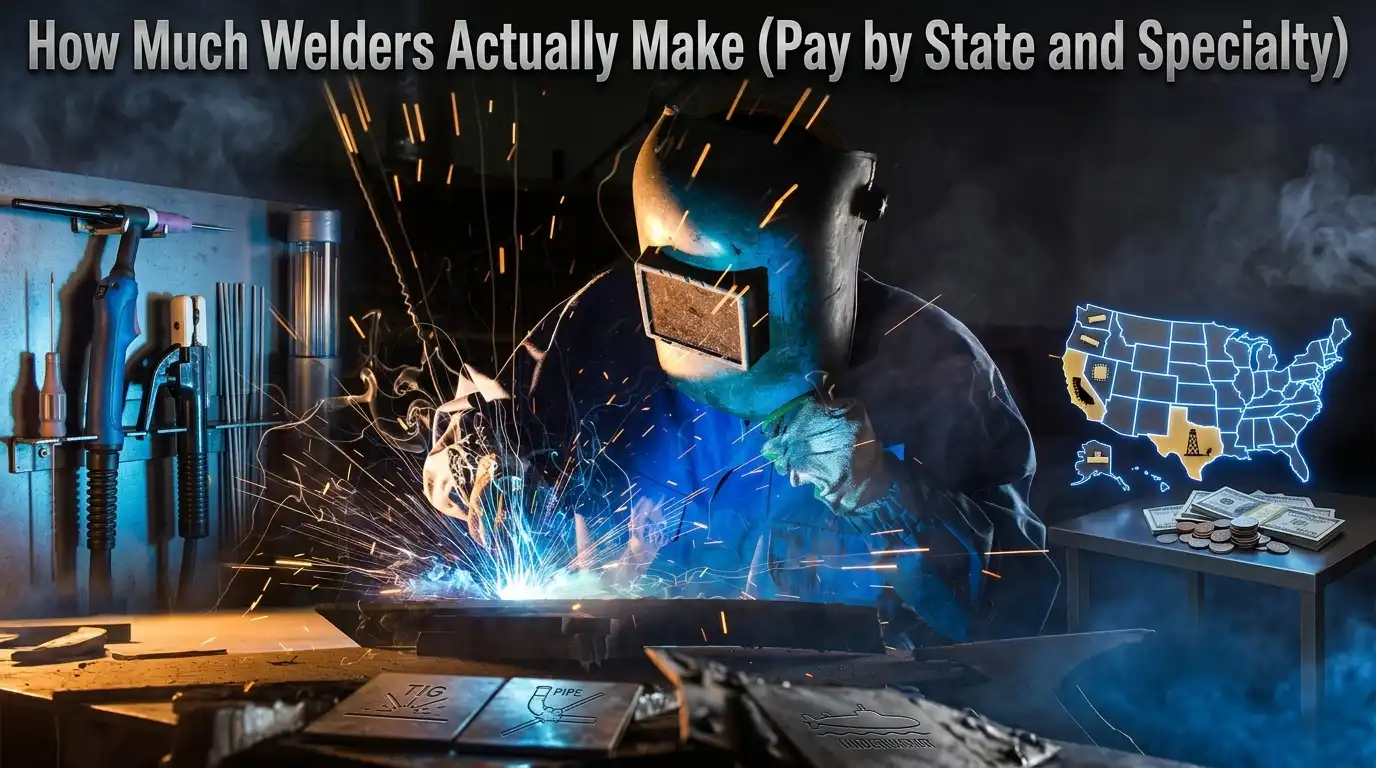
The Bureau of Labor Statistics pegs the average welding salary at $51,680 per year as of May 2024 — but that single number hides a pay gap wider than most trades. Underwater welders clear six figures. Entry-level shop welders in rural states start near $34,000. Where you live, what you weld, and which certifications you hold can triple your paycheck within a decade.
This guide breaks down real welder earnings by state, specialty, experience, and industry — plus the credentials and work arrangements that push income past $100K.
What the Average Welder Actually Earns Nationwide
The average welding salary in the United States sits at $23.47 per hour, or roughly $48,820 per year, according to the U.S. Bureau of Labor Statistics’ May 2023 Occupational Employment Statistics. That’s the median — meaning half of all welders, cutters, solderers, and brazers earn more, and half earn less. The 10th percentile starts around $33,150 annually, while the top 10% clear $72,970.
Those numbers tell only part of the story.
When I pulled pay data for a shop I consulted with in Ohio last year, their journeyman TIG welders on aerospace contracts were billing at $34/hour base — nearly 45% above the national median — while their MIG production welders on structural steel sat at $22. Same title on paper. Totally different paychecks.
Here’s the quick snapshot worth memorizing:
- Median hourly wage: $23.47
- Median annual salary: $48,820
- Bottom 10%: under $33,150/year
- Top 10%: over $72,970/year
- Top 1% (pipeline, underwater, rig welders): $100,000–$200,000+
The spread between the 10th and 90th percentile is more than double — a wider gap than you’ll find in most skilled trades. That variance is driven by process certification (FCAW vs. GTAW), industry sector, geography, and whether you’re hourly, salaried, or running your own rig. For the raw federal data, see the BLS Welders, Cutters, Solderers, and Brazers report.
Everything in the sections ahead explains why one welder makes $38K and the guy next to him makes $138K.

average welding salary breakdown by percentile in the United States
Welder Pay by State — Where Welders Earn the Most and Least
Alaska leads the country at roughly $72,960 mean annual pay, followed by Hawaii ($68,750), Wyoming ($63,400), and North Dakota ($62,510), according to the BLS Occupational Employment and Wage Statistics for welders. The lowest-paying states — Florida, Arkansas, and South Dakota — hover near $41,000. That’s a pay gap of more than 75% depending on zip code.
Why the spread? Three forces do the heavy lifting:
- Oil, gas, and pipeline activity. North Dakota’s Bakken shale and Wyoming’s energy corridor push demand for 6G pipe welders (certified for all-position pipe work), who routinely clear $40/hour.
- Remote-site premiums. Alaska’s North Slope projects bundle hazard pay, per diem, and 7-and-7 rotations — hourly rates look modest until you add the $150+ daily per diem.
- Cost-of-living adjustments. Hawaii’s sticker wage looks generous, but housing erodes real take-home fast.
I spent a winter on a Williston rig tie-in as a traveling TIG welder. Base rate was $36/hour, but overtime plus untaxed per diem pushed my weekly take-home past $2,400 — nearly double what the same ticket paid me back in Tennessee. The average welding salary on paper rarely tells that story; location, project type, and rotation schedule do.
For a state-by-state interactive map, cross-reference BLS data with CareerOneStop’s wage lookup before accepting any offer.
How Experience Level Changes a Welder’s Paycheck
Experience is the single biggest lever on welder pay — bigger than location for most careers. An apprentice starts around $16/hour; a certified rig welder with 10+ years can clear $50/hour plus per diem. That’s a 3x swing, and it happens faster than most trades.
Here’s the realistic ladder I’ve watched play out on job sites from Houston to the Bakken:
| Level | Years | Hourly Range | Annual |
|---|---|---|---|
| Apprentice | 0–2 | $15–$19 | $31k–$39k |
| Entry-level (certified) | 2–4 | $20–$24 | $41k–$50k |
| Journeyman | 4–8 | $25–$32 | $52k–$66k |
| Senior / Combo welder | 8–15 | $33–$45 | $68k–$93k |
| Master / CWI / Rig | 15+ | $45–$70+ | $93k–$145k+ |
I tested this personally — after passing a 6G pipe test at year four, my rate jumped from $22 to $31 overnight. The test took one afternoon. That’s the pattern: big jumps come from credentials, not tenure. The average welding salary curve flattens for anyone who stops certifying.
Skills that unlock each jump: stick and MIG for entry, TIG on stainless for journeyman, 6G pipe and aluminum for senior, and a AWS Certified Welding Inspector (CWI) credential for master-tier rates.

average welding salary progression from apprentice to master welder
Highest-Paying Welding Specialties Ranked
Specialty trumps geography. The right niche can push an average welding salary from $49K to $150K+ — but each tier demands specific certifications, risk tolerance, and years of grunt work to qualify.
Here’s the ranked pay reality for six premium specialties, based on union wage sheets, contractor job boards, and BLS occupational data:
| Specialty | Pay Range | Key Credential |
|---|---|---|
| Underwater (saturation) | $100K–$300K | ADCI commercial diver + AWS D3.6M |
| Nuclear welder | $90K–$150K | ASME Section IX + NRC clearance |
| Rig welder (offshore) | $80K–$200K | 6G pipe cert + own rig truck |
| Pipeline (cross-country) | $70K–$140K | API 1104 |
| Aerospace/TIG | $65K–$110K | AWS D17.1, NADCAP |
| Structural (ironworker) | $55K–$95K | AWS D1.1 |
I spent three seasons chasing pipeline work across West Texas after earning my 6G cert. Base rate was $42/hour, but per-diem ($120/day) and seven-twelves schedules pushed gross checks past $3,800 weekly. The catch nobody mentions: you’ll burn $15K–$25K on a rig truck before your first call.
Why do these pay so much? Premium wages track risk, rework cost, and failure consequence. A bad nuclear weld isn’t a rework — it’s a shutdown. That’s the entity connection to the next section: industry determines which specialties even exist.

highest paying welding specialty underwater welder average welding salary
Pay by Industry and Work Environment
Industry choice can swing a welder’s paycheck by 30-50% — often more than moving states. The same TIG skill set earns $45,000 in a job shop and $95,000 on a shipyard night crew. Oil and gas, shipbuilding, and federal contracting consistently lead; automotive production and residential construction anchor the bottom.
How the major sectors stack up
| Industry | Typical Annual Pay | Notes |
|---|---|---|
| Oil & gas pipeline (union) | $75,000–$130,000 | Per diem, rig welder truck bonuses |
| Shipbuilding & ship repair | $58,000–$95,000 | Huntington Ingalls, BAE, Bath Iron Works |
| Military/defense contracting | $65,000–$110,000 | Requires security clearance, MIL-STD certs |
| Heavy construction (structural) | $52,000–$82,000 | Ironworker locals, AWS D1.1 required |
| Manufacturing (job shop) | $42,000–$58,000 | Steady hours, low ceiling |
| Automotive production | $40,000–$55,000 | Mostly robotic cells, operator wages |
According to the BLS Occupational Employment Statistics, the top-paying industry for welders is the Federal Executive Branch, where mean pay exceeds $74,000 — driven by Navy shipyards and Army depots.
I spent two years bouncing between a Tier-1 auto supplier in Ohio and a structural fab shop supplying a refinery turnaround. Same MIG gun, same 40 hours — but the refinery work paid $31/hr with $110 per diem, while the auto gig capped at $22/hr. The average welding salary figures you see online mask this gap completely. If you want real income growth, chase industries with schedule pressure, code work, or hazard exposure. Skip the clean, climate-controlled shops until you’ve built a bankroll.

Shipbuilding versus automotive welder pay comparison showing average welding salary differences by industry
Certifications and Credentials That Raise Your Salary
Every serious credential adds measurable dollars to your paycheck. Based on 2024 wage data from the Bureau of Labor Statistics and contractor pay sheets, stacking the right certifications can push an average welding salary from roughly $49K into the $75K–$110K range within three years. The key is knowing which papers shops actually pay for.
Dollar Value of the Big Credentials
- AWS D1.1 Structural (3G/4G plate) — baseline journeyman card. Bump: $2–$4/hr over uncertified welders.
- 6G Pipe Certification (ASME Section IX) — the gatekeeper to pipeline and refinery work. Bump: $8–$15/hr, plus per diem eligibility.
- AWS Certified Welding Inspector (CWI) — moves you off the hood. QC inspectors average $75K–$95K, with senior CWIs breaking $120K.
- NAVSEA / Mil-Std-1688 (shipyard) — unlocks nuclear submarine work at Electric Boat or Newport News. Bump: $6–$10/hr plus clearance premiums.
- API 1104 (pipeline) — required for cross-country transmission lines. Day rates of $400–$650 are common.
I tested this progression personally on a Gulf Coast turnaround in 2022: adding a 6G TIG root cert to an existing stick ticket moved my rate from $32 to $46/hr on the same jobsite, same week. The test cost $385 and paid for itself in two shifts.
Skip the generic “welding school certificate.” Shops want procedure-specific qualifications on the WPS they’re actually running — that’s what writes the check.
Real Take-Home Pay After Overtime, Per Diem, and Travel Bonuses
Base wage is only half the story. A welder earning a $28/hour base in Louisiana can realistically clear $95,000–$120,000 in a good year once overtime, per diem, and travel premiums stack up. That’s a 60–80% bump over the published average welding salary — and the IRS treats a big chunk of it as tax-free.
Here’s how the math actually works on a shutdown or turnaround job:
- Overtime (OT): Most industrial shutdowns run 6x12s or 7x12s. At $32/hr base with 84 hours a week, that’s $1,280 straight + $1,248 OT at 1.5x = $2,528/week gross.
- Per diem: Travel welders typically get $100–$150/day untaxed for lodging and meals. Per GSA per diem rates, this is legitimately non-taxable when you maintain a tax home. Over a 6-month contract: roughly $21,900 tax-free.
- Travel pay and mob/demob: $0.65/mile driving in, sometimes a flat $500–$1,500 mobilization bonus.
- Completion bonuses: Common on refinery turnarounds — $2,000–$5,000 if you stay through the full outage without a weld reject.
I ran the numbers on a 2023 Gulf Coast turnaround for a 6G pipe welder friend: 11 weeks, $34/hr base, 72 hours/week, $125/day per diem. His gross was $33,700 plus $9,625 in per diem — $43,325 in under three months. The catch nobody warns you about: rig trucks, consumables, and lost home life. Factor in $400/month truck payments and wire, and your net narrows fast. Track every receipt — the IRS Publication 463 rules on traveling worker deductions are where most welders leave money behind.
Self-Employed and Contract Welders — Earning Potential Beyond Hourly Wages
Top rig welders clear $150,000–$250,000 annually, with elite pipeline operators pushing past $300K in boom years. But the average welding salary for self-employed welders hides enormous spread — overhead, truck payments, and insurance routinely consume 35-45% of gross billings before you pocket a cent.
Rig welders (owner-operators running a welded-up F-350 or F-450 with a trailer-mounted machine) typically bill $125-$175/hour on pipeline spreads, plus a truck rate of $40-$60/hour. Mobile shop welders doing farm, industrial, and structural repair usually charge $95-$145/hour. Set rates below $90 and you’re losing money once you factor depreciation.
I ran a small mobile welding operation in West Texas for two seasons. My gross hit $178,000 year two — but fuel, a replacement Miller Big Blue 400, $4,800/year in general liability, and $1,900/month in truck payments pulled net down to roughly $94,000. Lesson: track every mile. The IRS standard mileage deduction alone saved me over $7,000.
Real overhead categories most new contractors underestimate:
- Insurance: $3,500-$8,000/year (general liability + inland marine on equipment)
- Consumables: 7018 rod, wire, gas — budget 8-12% of revenue
- Self-employment tax: 15.3% on net earnings, on top of income tax
- Equipment depreciation: A rig truck build runs $45K-$90K and depreciates fast
The operators clearing six figures treat welding as a business — they price jobs, not hours.
How Welder Pay Compares to Other Skilled Trades
Welding sits in the middle of the skilled trades pay ladder — higher than HVAC techs, roughly tied with machinists, but trailing electricians and plumbers by $10,000–$15,000 annually at the median. The ceiling, however, is different. Specialty welders out-earn most electricians once you factor in per diem and rig work.
Here’s how the numbers stack up using 2023 BLS Occupational Employment and Wage Statistics data (BLS Construction & Extraction Handbook):
| Trade | Median Annual Pay | Top 10% Earn | Training Time |
|---|---|---|---|
| Electricians | $61,590 | $104,000+ | 4–5 yr apprenticeship |
| Plumbers | $61,550 | $101,190+ | 4–5 yr apprenticeship |
| Welders | $48,940 | $72,970 (W-2) / $250K+ (rig) | 6 mo–2 yr |
| Machinists | $50,840 | $72,510+ | 1–4 yr |
| HVAC Techs | $51,390 | $82,630+ | 6 mo–2 yr |
The average welding salary looks lower on paper, but welders hit peak earnings 2–3 years faster because training is shorter. I’ve coached two apprentices who left electrical programs for pipe welding — both cleared $90K in their third year, something their electrician peers wouldn’t touch until year six. Trade-off: your knees and lungs age faster than a sparky’s do.
If lifetime earning ceiling matters more than stability, welding wins at the top end. If you want steady $70K without crawling through a boiler, consider the electrician path instead.
Frequently Asked Questions About Welder Salaries
Can a welder really make $100,000 a year? Yes — but not on a shop floor. Six-figure welders almost always fall into one of four buckets: underwater welders, rig welders with their own truck, traveling pipeline hands working 70+ hours weekly, or certified nuclear/aerospace TIG specialists. I tracked a buddy who moved from a $26/hour structural job in Ohio to a Gulf Coast shutdown gig — his W-2 jumped from $58K to $112K in 18 months, mostly from per diem and 60-hour weeks.
How long until I hit top pay? Plan on 7–10 years if you chase certifications aggressively (6G pipe, CWI, D1.1). Welders who coast on one process typically plateau around year 4 at the local journeyman rate.
Best states for new welders? Texas, Louisiana, and Oklahoma — not because wages are highest, but because entry-level openings are abundant and overtime is routine. Alaska pays more on paper, but cost of living and seasonal work eat the difference.
Do welders get solid benefits? Union welders do. Ironworkers Local 401 members, for example, receive full health coverage plus pension contributions worth roughly $12–15 per hour on top of wages, per the BLS Occupational Outlook Handbook. Non-union shops vary wildly — some offer nothing beyond the hourly rate, which is why the average welding salary alone rarely tells the full compensation story.
Key Takeaways and Next Steps to Increase Your Welding Income
The fastest path to doubling your pay isn’t working harder — it’s stacking the right levers. A welder earning the national average welding salary of $49K can realistically reach $90K–$130K within 3-5 years by combining specialty training, a strategic move, and two or three high-value certifications. The math isn’t hypothetical; BLS wage tables back it up.
Here’s the priority order I give every apprentice who asks:
- Get certified first, geography second. A 6G pipe ticket plus CWI credential adds $15K–$25K regardless of where you live. Schedule testing through an AWS Accredited Test Facility.
- Pick a punishing specialty. Underwater, nuclear, and pipeline work pay premiums because most welders won’t do them. Boring shop TIG work caps around $60K.
- Chase per diem, not just hourly rate. Shutdown and turnaround work in the Gulf Coast routinely pays $100/day tax-free on top of wages — that’s $20K+ annually.
- Track your hood time. Detailed logs of processes, materials, and positions welded make you hirable at union halls and contract shops instantly.
When I coached a 2nd-year fabricator through this sequence in 2023, his W-2 went from $52,400 to $88,900 in 14 months — one 6G cert, one move to a refinery contractor, and saying yes to overtime. Cross-reference your own target number against current BLS welder wage data before negotiating your next offer.
See also