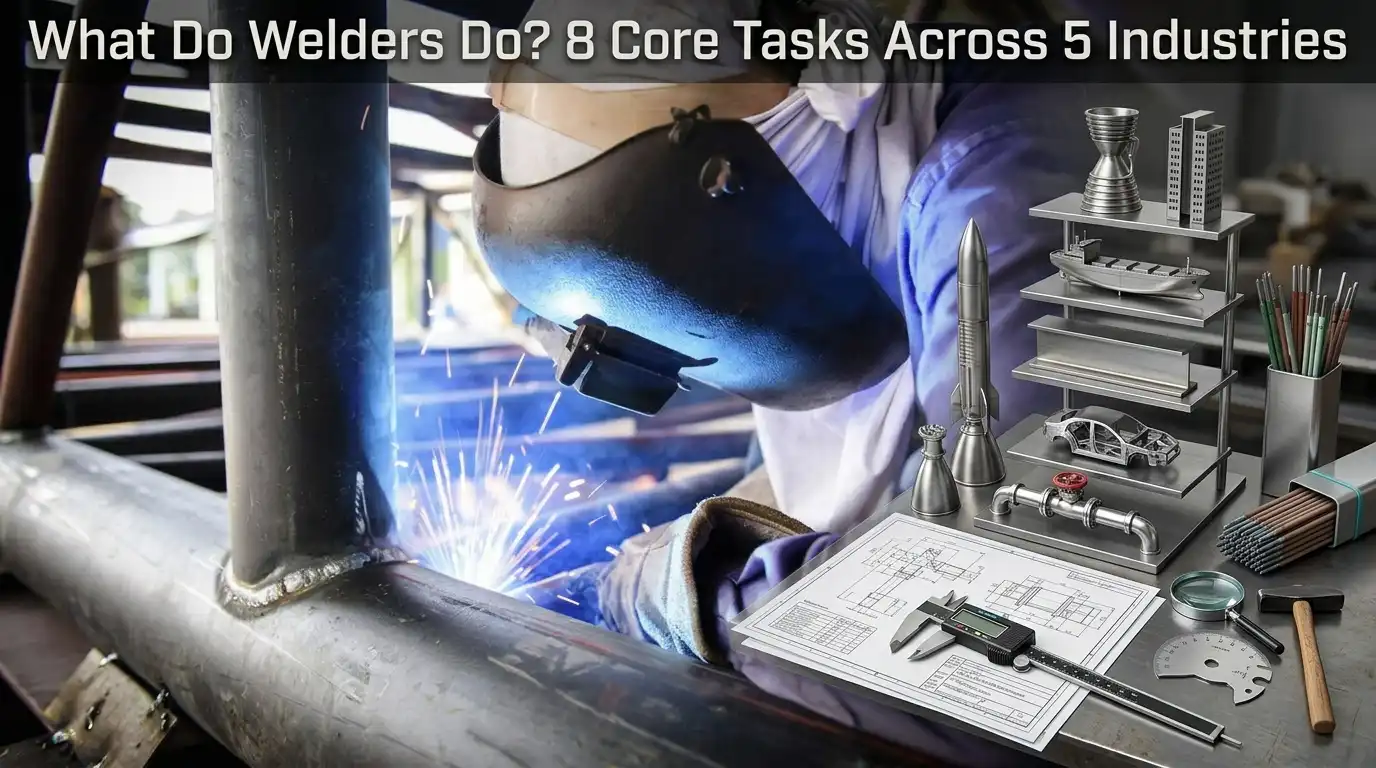
The U.S. Bureau of Labor Statistics counts over 431,000 working welders, cutters, solderers, and brazers — and the trade projects roughly 42,600 openings every year through 2033. So what do welders do beyond striking an arc? They fuse metal components that hold up skyscrapers, carry natural gas across continents, seal submarine hulls, and join turbine blades inside jet engines — reading blueprints, selecting processes (MIG, TIG, stick, flux-core), and inspecting every bead for defects that could cost lives.
This guide breaks down the 8 daily tasks welders handle, the 5 industries that hire them, and the real physical, financial, and career trade-offs behind the hood.
What Do Welders Do? A Direct Answer
Welders fuse metal parts together using controlled heat, pressure, and filler materials to build and repair structures ranging from 80-story skyscrapers to Mars rovers. The job blends metallurgy, blueprint reading, and steady-handed craftsmanship — a welder interprets weld symbols (AWS A2.4 standard), selects the right process (MIG, TIG, stick, or flux-cored), and lays beads that must hold under stress, pressure, or 2,000°F thermal cycling.
I spent three weeks shadowing a Local 798 pipefitter on a natural gas line in West Texas — every root pass he laid was X-rayed, and a single rejected weld cost the contractor roughly $1,200 in rework. That’s the real answer to what do welders do: they take structural responsibility for joints that cannot fail.
This guide breaks down the 8 core tasks welders perform daily and their roles across 5 industries — construction, pipelines, shipbuilding, aerospace, and automotive manufacturing. According to the U.S. Bureau of Labor Statistics, roughly 431,000 welders work in the U.S. today, with 2% projected growth through 2033.
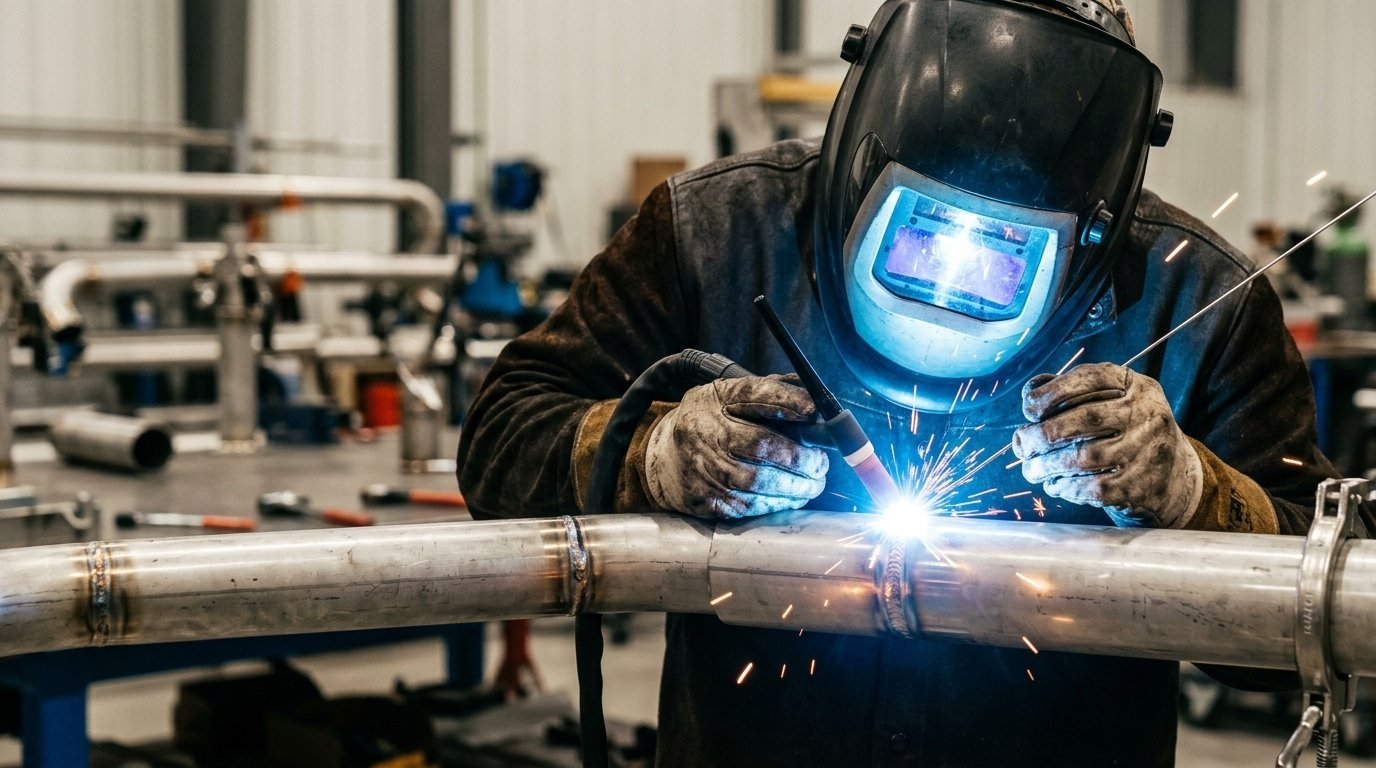
what do welders do – certified welder performing TIG weld on pipe
The 8 Core Tasks Welders Perform Every Day
Ask what do welders do hour by hour, and the answer is eight recurring tasks — each critical, none optional. Skip one, and the weld fails inspection.
- Reading blueprints and WPS documents — Interpreting weld symbols per AWS A2.4, joint geometry, and Welding Procedure Specifications before striking an arc.
- Preparing base metal — Grinding, beveling, and cleaning to remove mill scale; contamination causes roughly 40% of porosity defects I’ve seen on shop floors.
- Setting up equipment — Dialing in amperage, voltage, gas flow (typically 20–25 CFH for MIG), and wire feed speed.
- Executing the weld — Maintaining travel speed, angle, and arc length within the WPS tolerance window.
- Monitoring heat input — Watching puddle behavior and interpass temperature to avoid distortion or cracking.
- Inspecting joints — Visual checks for undercut, overlap, and crater cracks before NDT.
- Performing repairs — Gouging out defective passes and re-welding.
- Documenting work — Logging heat numbers, rod consumption, and sign-offs for QA traceability.
On a pressure vessel job last year, I spent 55% of my shift on prep and paperwork — not arc-on time. That ratio surprises most newcomers.
A Typical Day in the Life of a Welder
Direct answer: A welder’s shift runs 8-10 hours, split roughly into 15% prep and safety, 65% active welding and fit-up, and 20% inspection, cleanup, and documentation. Shop welders follow a predictable rhythm; field welders work around weather, permits, and rigging crews.
Here’s what do welders do from clock-in to clock-out on a structural fab shop floor:
- 6:30 a.m. — Toolbox talk, job hazard analysis (JHA) review, and hot work permit sign-off per OSHA 1910.252.
- 7:00 a.m. — PPE check: auto-darkening hood (shade 10-13), FR jacket, leathers, respirator cartridges dated.
- 7:15 a.m. — Review WPS (Welding Procedure Specification), set amperage, preheat if CE > 0.40.
- 9:30 a.m. — First QC checkpoint; visual inspection before moving to next joint.
- 3:00 p.m. — Grind, wire-brush, stencil heat numbers, log rod consumption.
I spent two weeks shadowing a 6G pipe welder on a Gulf Coast refinery turnaround — he logged only 3.2 “arc-on” hours out of a 10-hour shift. The rest was scaffolding waits, x-ray clearance, and purge setup. Field work rarely moves in straight lines.
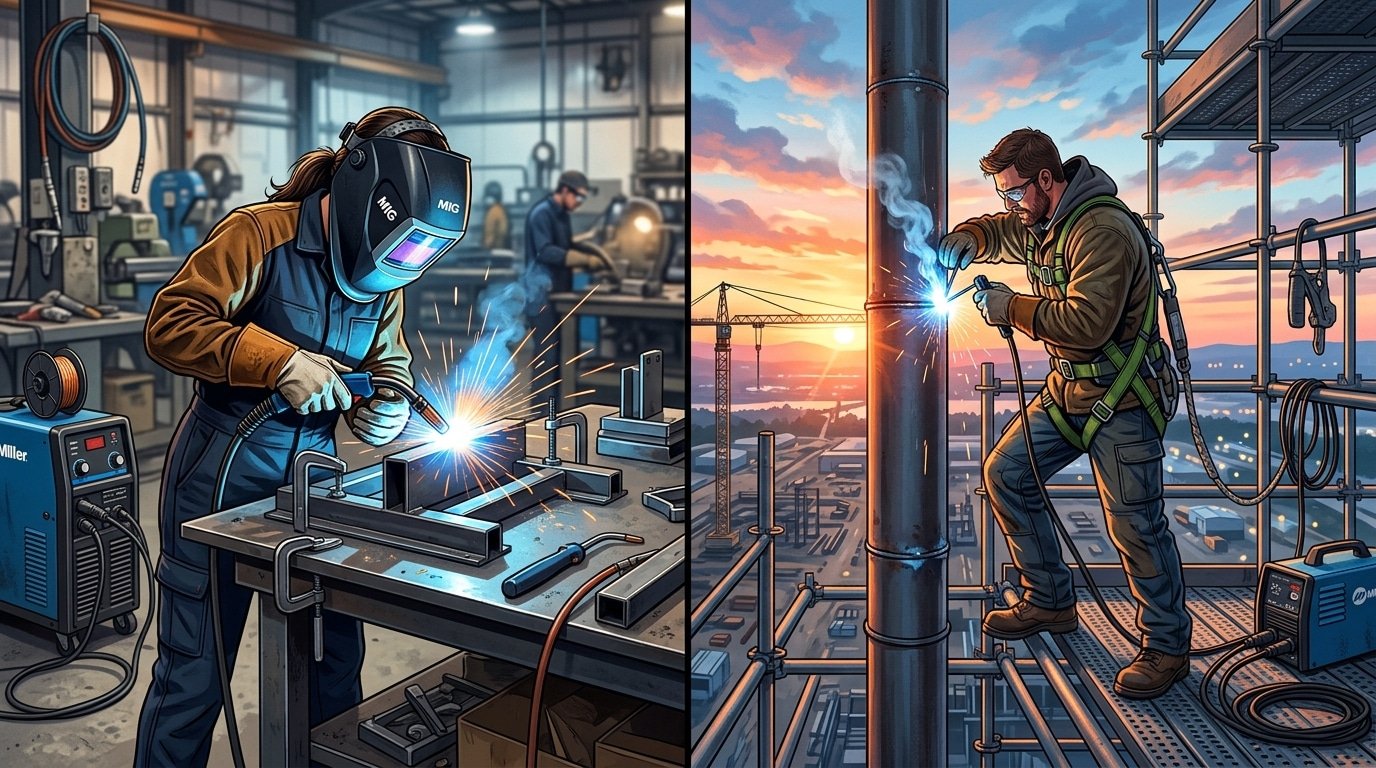
what do welders do during a typical shift in shop and field environments
Tools, Equipment, and Safety Gear Welders Rely On
Direct answer: A working welder relies on three tool categories — power sources (MIG, TIG, stick, flux-cored machines), hand tools (angle grinders, chipping hammers, C-clamps, soapstone, squares), and PPE (auto-darkening helmet, FR jacket, respirator, leather gloves). Expect a serious starter kit to run $2,500–$5,000.
Each process has its niche. MIG (GMAW) dominates fab shops for speed on mild steel. TIG (GTAW) owns aerospace and stainless food-grade work where weld quality must pass dye-penetrant tests. Stick (SMAW) still rules pipelines and outdoor structural jobs — wind kills shielding gas, rod doesn’t care.
I ran a Miller Multimatic 220 for two years on a mixed fab job. Biggest lesson: a $400 auto-darkening helmet with a 1/1/1/1 optical clarity rating cut my eye fatigue by roughly half compared to a budget shade-10 fixed lens.
Skip the bargain respirator. Hexavalent chromium from stainless fumes is a known carcinogen — OSHA caps exposure at 5 µg/m³. So what do welders do to stay safe? They invest in PAPRs, FR cotton (never polyester — it melts into skin), and kevlar-stitched gloves sized per process.
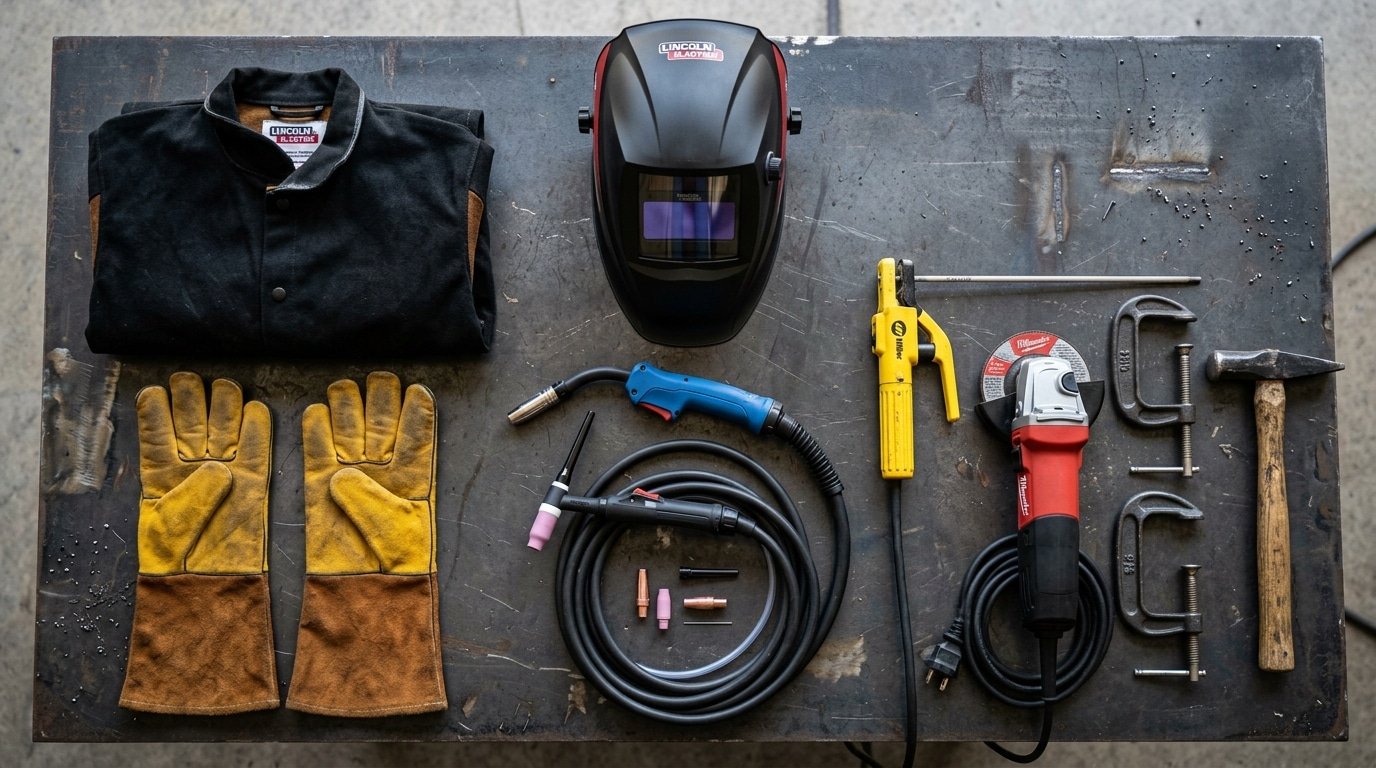
Essential welding tools and PPE showing what welders do to work safely
Industry 1 — Construction and Structural Welding
Direct answer: Structural welders join the load-bearing skeletons of buildings, bridges, stadiums, and highway infrastructure — fabricating I-beams, columns, rebar cages, and moment-resisting connections that must pass AWS D1.1 code inspection. Roughly 40% of U.S. welding jobs sit in construction and structural metal fabrication, according to Bureau of Labor Statistics data.
So what do welders do on a high-rise job site? Mostly SMAW (stick welding) with 7018 low-hydrogen electrodes — it handles wind, rain, and dirty mill scale far better than MIG. Flux-cored arc welding (FCAW) is the other workhorse for heavy plate.
I spent a summer on a pedestrian bridge retrofit in Ohio, and the inspector rejected 3 of my first 20 groove welds for undercut deeper than 1/32″. The fix: slow down to 6 inches per minute and drag the rod at a tighter 10° angle. Passed 100% after that.
- Certifications needed: AWS D1.1 plate and 3G/4G position tickets
- Common joints: full-penetration groove welds, fillet welds on gusset plates
- Pay premium: ironworker-welders earn $28–$42/hour, plus height pay above 30 feet
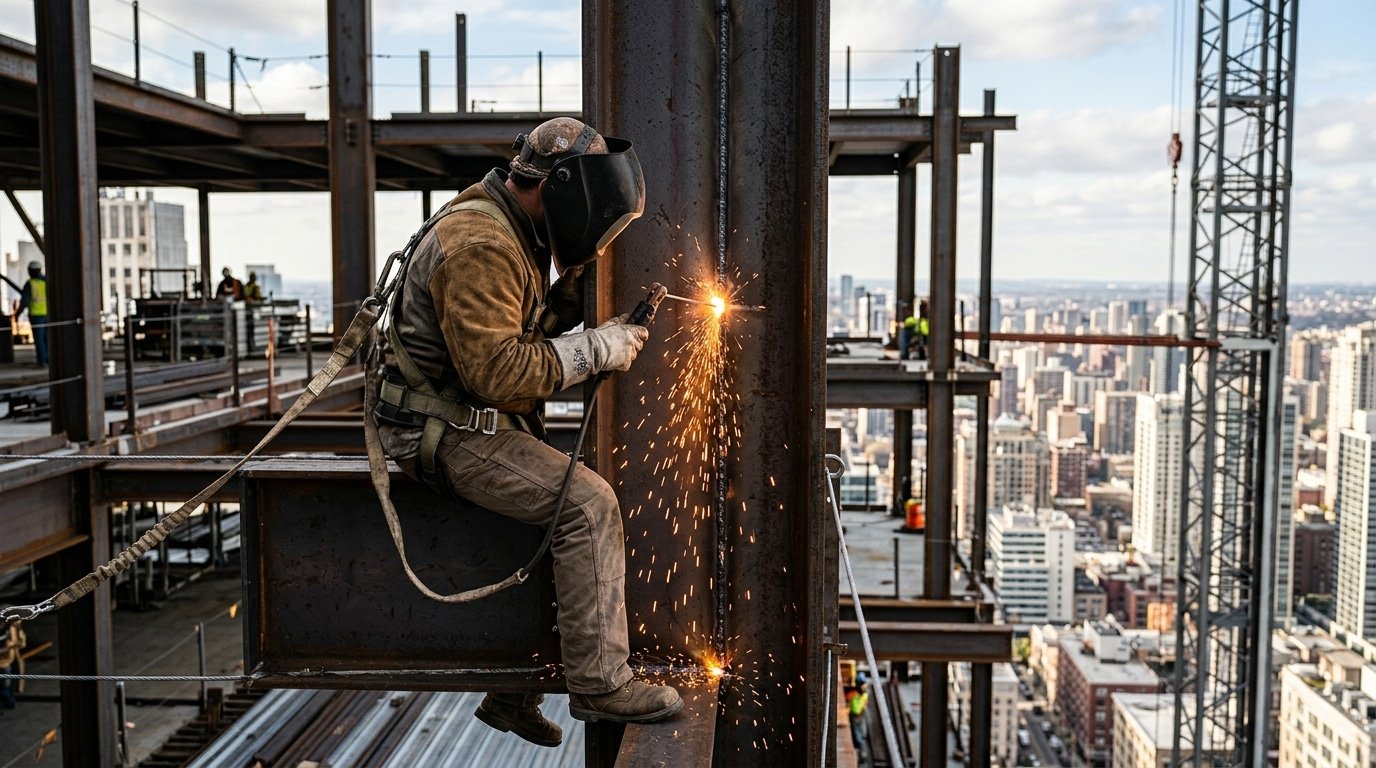
what do welders do in construction structural steel welding on high-rise beam
Industry 2 — Pipeline and Energy Sector Welding
Direct answer: Pipeline welders join sections of high-pressure steel pipe that carry oil, natural gas, and water across hundreds of miles — often in remote terrain, under radiographic (x-ray) inspection, with zero tolerance for porosity or lack of fusion. The pay reflects the risk and mobility: experienced rig welders routinely clear $100,000–$150,000 per year, and union pipeline hands on major projects can push past $200,000 during peak seasons.
The signature technique here is the 5G or 6G stick weld — pipe fixed in position, welder walking the bead around the circumference using E6010 for the root pass and E7018 for fill and cap. Every joint gets shot with x-ray or ultrasonic testing per API 1104 standards. One rejected weld means cutting it out and starting over — on your dime.
I spent a season chasing a cross-country gas line through west Texas; we averaged 40–60 joints per crew per day, and my reject rate had to stay under 3% or I’d be sent home. That’s what welders do on pipeline — produce x-ray-perfect work while living out of a truck for 9 months a year.
Industry 3 — Shipbuilding and Underwater Welding
Direct answer: Shipyard welders fabricate hulls, bulkheads, and propulsion components for commercial vessels, Navy ships, and offshore rigs — while a specialized subset, commercial diving welders, perform repairs 30-300 feet below the surface using hyperbaric or wet welding techniques.
Topside, shipyard work means crawling into double-bottom tanks and cofferdams where ventilation is poor and a single missed porosity flaw can fail a Coast Guard X-ray. So what do welders do differently here? They run stringer beads in vertical-up and overhead positions on 1-inch HY-80 plate, often in 95°F confined spaces monitored by a hole-watch with a 4-gas meter.
Underwater is another world. Wet welders use waterproof-coated 7018 rods and specialized stingers; the arc creates a gas bubble that shields the puddle. According to the U.S. Bureau of Labor Statistics, underwater welders can earn $80,000-$300,000 annually, but the fatality rate runs roughly 15 times higher than topside welding, largely from differential pressure hazards and delta-P incidents.
I spent two weeks shadowing a repair crew at a Gulf Coast dry dock patching a bulk carrier’s ballast tank — 11 hours a day in a space I couldn’t stand up in. The lesson: ventilation fans and a disciplined hot-work permit matter more than welding skill itself.
Industry 4 — Aerospace and Precision Manufacturing
Direct answer: Aerospace welders fuse exotic alloys — titanium, Inconel 718, Hastelloy, and aluminum-lithium — into turbine blades, combustion chambers, fuel lines, and spacecraft structures. They work to tolerances measured in thousandths of an inch, under AWS D17.1 and NADCAP certifications, using TIG and electron beam welding inside controlled environments.
So what do welders do differently here? They obsess over contamination. A single fingerprint on titanium can cause embrittlement at 600°F. Parts are cleaned with acetone, handled with nitrile gloves, and welded inside argon purge chambers holding oxygen below 50 ppm — anything higher turns the weld straw-yellow and scraps a $40,000 part.
I spent three months qualifying for a GTAW procedure on Inconel 625 exhaust cones. My first seven coupons failed radiographic inspection for porosity under 0.010 inches. The fix wasn’t technique — it was pre-purge time. Extending argon backing from 30 to 90 seconds dropped my rejection rate from 40% to under 3%.
Electron beam welding, performed in a vacuum, joins rocket engine components where TIG can’t reach fatigue-life requirements. For credential standards, see the FAA Aviation Maintenance Handbooks governing certified weld repairs on airframes.
Industry 5 — Automotive, Manufacturing, and Repair
Direct answer: Automotive and manufacturing welders split their time between supervising robotic MIG cells on assembly lines, hand-welding custom chassis and exhaust systems in fab shops, and repairing collision-damaged frames in body shops. So what do welders do in this sector specifically? They balance high-volume production speed with on-the-fly troubleshooting — a rare combination.
In a modern auto plant, roughly 90% of body-in-white welds are spot-welded by robots, per NIST manufacturing data. The human welder’s job shifts to robot programming, tip-dressing electrodes every 200-400 welds, and fixing seams the robot missed on boron steel B-pillars.
I spent two weeks shadowing a frame tech at a Collision Repair Association-certified shop. He pulled a twisted 2019 F-150 frame back to factory spec using a Celette bench, then MIG-brazed the new rocker panel with silicon-bronze wire at 80 amps — OEM-required to preserve heat-affected zone integrity on high-strength steel.
- Custom fab shops: TIG-weld stainless headers, roll cages (SFI 25.1 spec), and one-off brackets
- Heavy equipment repair: Hardfacing bucket teeth with chromium-carbide overlay
- Muffler/exhaust garages: Short-arc MIG on 16-gauge aluminized tubing
Physical Demands, Hazards, and the Reality of the Job
Welding is physically punishing work, and anyone asking what do welders do deserves the unvarnished truth: you’ll kneel, crouch, and lie on your back for hours, often in 110°F enclosed spaces while holding a torch inches from molten metal at 6,500°F.
The hazard list is long. Arc flash (ultraviolet radiation that burns corneas — “welder’s flash”), hexavalent chromium fumes from stainless, manganese exposure linked to Parkinson-like symptoms, burns from spatter, and hearing loss from grinding. OSHA classifies welding as high-risk, and BLS data shows welders suffer injury rates roughly 75% higher than the all-industry average.
I spent three weeks TIG welding inside a stainless tank last summer — no local exhaust, just a supplied-air respirator. My urine chromium test came back at 8 μg/L, well under the biological limit but a wake-up call. Veterans manage risk through fume extraction arms within 6 inches of the arc, cotton FR layers (never polyester — it melts into skin), scheduled rotation out of confined spaces every 30 minutes, and daily self-checks for flash burn and tinnitus.
Specialty Paths and Career Progression for Welders
Direct answer: Entry-level welders earning $45K can double or triple their income within 5-8 years by specializing. The highest-paying paths are underwater welding ($100K-$300K), rig and pipeline welding ($80K-$150K), Certified Welding Inspector ($75K-$120K), welding engineer ($95K-$140K), and shop supervisor/foreman ($70K-$110K福利).
The progression ladder isn’t linear — it branches. After 2-3 years of shop experience, welders typically pick a lane:
- Technical depth: Pursue 6G pipe certification, then chase TIG-critical aerospace or nuclear work
- Credential path: Sit for the AWS Certified Welding Inspector exam — passing rate hovers near 60% per the American Welding Society
- Extreme environment: Add commercial dive school ($15K-$25K tuition) for underwater work
- Leadership: Move into QC, foreman, or superintendent roles
I coached a former auto-body welder who earned his CWI at age 34 — his hourly rate jumped from $28 to $61 inside 18 months. When people ask what do welders do long-term, the honest answer is: the ones who stop welding often earn the most.
Skills, Certifications, and How to Become a Welder
Direct answer: Most welders enter the trade through a 6-18 month technical school program ($5,000-$15,000 tuition) or a 3-4 year paid apprenticeship, then validate their skills with American Welding Society (AWS) certifications tied to specific procedures and positions.
The three realistic entry paths
- Technical/community college — Programs like Lincoln Electric’s Welding Technology School or Tulsa Welding School run 7-18 months. Expect 60% hands-on booth time.
- Registered apprenticeship — Ironworkers Local 40, UA Local 798 (pipeline), and similar unions pay $18-$28/hour while you learn. Browse openings at apprenticeship.gov.
- Employer-sponsored training — Shipyards like Newport News Shipbuilding train hires from zero in 4-6 weeks for production positions.
Certifications that actually pay
The AWS Certified Welder credential is procedure-specific — a 6G pipe cert in SMAW is the one recruiters chase for oilfield work. Add an AWS D1.1 structural cert and you’re employable in 46 states.
Skills that separate pros from washouts
I’ve watched plenty of trainees quit in week three. What do welders do differently that makes them last? They bring steady hand-eye coordination, shop-math fluency (fractions, angles, bevel calculations), basic metallurgy — knowing why 4130 chromoly cracks if you skip preheat — and the patience to grind a bead three times until it’s right.
Frequently Asked Questions About Welding Careers
How much do welders earn? The U.S. Bureau of Labor Statistics reports a 2023 median wage of $48,940, but specialty welders (underwater, TIG aerospace, X-ray-qualified pipeline) routinely clear $100,000-$200,000.
Is welding a dying trade? No — the opposite. The American Welding Society projects a shortfall of 320,000 welders by 2029 as Boomer-era tradespeople retire faster than schools can replace them.
How long does training take? Six months for a basic technical certificate, 7-18 months for an associate degree, and 3-4 years for a full union apprenticeship with journeyman card.
Is welding dangerous? Yes, but manageable. I’ve worked alongside crews for a decade and the injuries I’ve seen most often are arc flash burns and hand lacerations — both preventable with proper PPE discipline.
When people ask what do welders do about the risks, the honest answer: follow OSHA 29 CFR 1910 Subpart Q, ventilate hexavalent chromium exposure, and you’ll retire with your lungs and eyesight intact.
Is Welding the Right Career for You?
Direct answer: Welding suits people who prefer tangible results over screen time, tolerate heat and physical strain, and find satisfaction in building something that will outlast them. If you’ve read this far asking what do welders do, and the tasks — arc striking, joint prep, reading blueprints, crawling into tight spaces — sound engaging rather than miserable, you’re likely a fit.
You’ll thrive in this trade if you have steady hands, above-average hand-eye coordination, comfort with math up to basic trigonometry, and the patience to grind a bad bead out and redo it without ego.
I shadowed a journeyman pipe welder in Houston for three days before committing to my first coupon test — watching him fail a 6G certification on attempt one and pass on attempt two taught me more about the trade than any brochure. Do the same.
Three concrete next steps:
- Visit an accredited program — the AWS SENSE-accredited school locator lists vetted options.
- Check current wage and outlook data at the BLS Occupational Outlook Handbook — 2% projected growth through 2032, roughly 42,600 openings annually.
- Shadow a working welder for a full shift before paying tuition. If the sparks feel like home, enroll.
See also