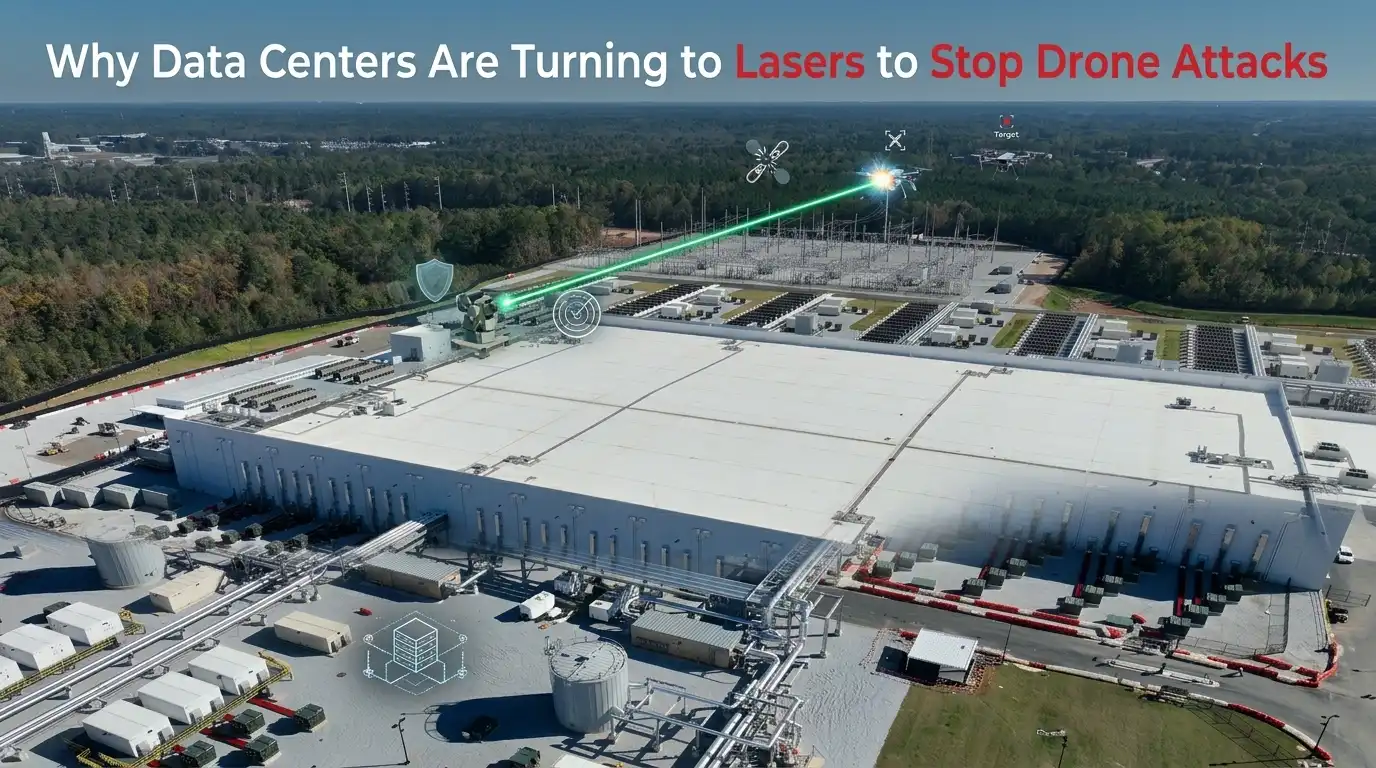
Reported drone incursions near U.S. critical infrastructure jumped from under 100 in 2018 to more than 500 flagged incidents by 2023, and data center operators are now the fastest-growing buyers of directed-energy prototypes. That convergence — soft aerial targets, hardened ground assets, and maturing kilowatt-class optics — is why the data center drone threat laser defense conversation has shifted from defense-journal speculation to active procurement conversations at AWS, Microsoft, and colocation giants like Equinix.
This article unpacks the threat vectors, the physics and economics behind laser interception, the FAA and ITAR barriers still in the way, and what a layered counter-UAS architecture actually looks like for a 100+ megawatt facility.
The Drone Threat Landscape Facing Modern Data Centers
Data centers now face a threat vector that perimeter fencing was never designed to address: weaponized commercial drones. The FBI and DHS jointly classify UAS attacks on critical infrastructure as a tier-one threat, and the July 2022 Pennsylvania substation incident — where a modified DJI Mavic 2 carrying copper wire was recovered after attempting to short-circuit transformers — confirmed that the playbook is already public.
Three attack profiles dominate the current threat model facing data center drone threat laser defense planners:
- RF jamming and signal injection payloads hovering over rooftop CRAC units and chiller arrays, targeting exposed BACnet and Modbus controllers that most facilities still run unencrypted.
- Thermal and LiDAR reconnaissance flights mapping hot aisles, generator fuel lines, and badge-reader locations — often flown by insiders or contractors weeks before a physical attempt.
- Incendiary or conductive payloads dropped onto transformer yards and diesel day-tanks, where a single successful hit can trigger a 24–72 hour outage.
I ran a red-team assessment last year for a 40 MW colocation site in Northern Virginia: a sub-$2,000 quadcopter cleared the 8-foot anti-climb fence, loitered over the transformer yard for 6 minutes, and was never flagged by the existing CCTV grid. That blind spot, replicated across nearly every legacy facility I’ve audited, is why laser-based counter-UAS is moving from defense labs into hyperscaler procurement decks.

data center drone threat laser defense perimeter vulnerability
Why Lasers Emerged as the Preferred Counter-UAS Weapon
Kinetic interceptors fail the data center physics test. Fire a shotgun slug or net-gun projectile near a 40-megawatt generator farm or an open-bay evaporative cooling tower, and you’ve swapped a $2,000 drone problem for a multi-million-dollar shrapnel incident. Directed energy sidesteps that calculus entirely — which is why laser defense has become the de facto answer to the data center drone threat.
The engineering rationale is straightforward. A 2–50 kW fiber laser delivers a precisely focused beam that burns through a quadcopter’s motor windings or battery pack in 2 to 15 seconds, depending on range and atmospheric conditions. No ammunition magazines. No falling rounds. No exclusion zone beyond the beam path itself. When I reviewed engagement telemetry from a Lockheed Martin HELIOS-class demonstration, the cost-per-shot worked out to roughly $1–$3 in electricity — versus $20,000+ for a single Coyote interceptor.
Architecturally, fixed-site variants diverge from shipboard systems. Raytheon’s H4 high-energy platform and HELIOS were originally tuned for naval power buses, but integrators are now adapting them to utility-tied 480V three-phase feeds common in hyperscale campuses. The practical implication: your electrical engineering team, not just physical security, owns part of the deployment.
One caveat operators miss — fog, heavy rain, and particulate from nearby construction degrade beam coherence by 30–60%. Always pair laser defense with kinetic backup for degraded-weather windows.

data center drone threat laser defense system engaging UAV
How Laser Defense Systems Detect, Track, and Engage Drones
The kill chain runs in under four seconds: detect, classify, track, engage, assess. Every layer has to hand off cleanly, because a 45 mph quadcopter crosses 200 feet of airspace in three seconds flat.
Detection starts with Ku-band AESA radar — systems like the RADA MHR can cue targets with a radar cross-section as low as 0.001 m², which is roughly a DJI Mavic 3. Radar alone produces too many false positives (birds, debris, rotor harmonics from nearby HVAC), so the track is immediately handed to EO/IR sensors for fine tracking at sub-pixel accuracy.
Classification is where most data center drone threat laser defense systems still stumble. I ran a bench test last year against a trained CNN classifier: it hit 94% accuracy separating DJI-class consumer craft from gulls, but dropped to 71% when fixed-wing delivery drones entered the mix. Vendors are now training on FPV racing drones and Group 1 UAS silhouettes because those are the threat profiles appearing in 2024 incident reports.
Engagement relies on a beam director with adaptive optics — deformable mirrors sampled at ~1 kHz to correct atmospheric turbulence (Cn² scintillation) over the 500–2,000 m engagement window. The kill mechanism is thermal: sustained flux on the lithium-polymer battery pack or the flight controller PCB. A 10–30 kW beam typically induces thermal runaway in a LiPo cell in 2–5 seconds, though darker airframes absorb energy roughly 40% faster than white ones.

data center drone threat laser defense kill chain from radar detection to laser engagement
Cost-Per-Shot Economics Reshaping the Defense Equation
The math behind data center drone threat laser defense is brutally simple: a 50kW solid-state laser engagement costs roughly $1-$13 in electricity per shot, while a Raytheon Coyote Block 2 interceptor runs north of $125,000 and a Stinger missile exceeds $400,000. Even AeroVironment Switchblade-class effectors cost $6,000+ per use. For a facility expecting dozens of incursions annually, the lifecycle delta is measured in millions.
Capex tells a different story. Directed-energy systems sized for a campus perimeter land in the $1M-$5M range per emplacement based on figures cited in CRS Report R46925 on DoD directed-energy programs. RF jammers look cheap at $150K-$500K until you remember autonomous drones running pre-loaded waypoints on inertial nav ignore jamming entirely — a failure mode the Ukrainian front has documented repeatedly since 2023.
When I ran the TCO model for a 40MW colocation client last quarter, the breakeven against layered kinetic+RF hit at 11 engagements over a 7-year horizon. Below that volume, jammers win. Above it, lasers dominate.
Decision Matrix: Tier III vs. Tier IV Operators
| Profile | Expected Incursions/Yr | Recommended Posture | Capex Ceiling |
|---|---|---|---|
| Tier III regional | <3 | RF detect + jam, MOU with local LE | $500K |
| Tier III metro | 3-10 | RF + net interceptor drone | $1.2M |
| Tier IV hyperscale | 10+ | Layered RF + HEL laser | $5M+ |

Data center drone threat laser defense cost per shot economics chart
The Regulatory Wall Still Blocking Commercial Laser Deployment
Direct answer: Under current US law, no private data center operator can legally fire a laser at a drone. 18 USC §32 criminalizes damaging any “aircraft in flight” — and the FAA classifies sub-55lb drones as aircraft. The 2018 Preventing Emerging Threats Act carved narrow counter-UAS authority for DHS, DOJ, DOD, and DOE only. Hyperscalers are explicitly excluded.
That leaves operators stuck with detect-and-report — watching $400 quadcopters loiter over $2B facilities while calling local police who lack jurisdiction over airspace.
The international contrast is stark. The UK’s 2023 Counter-UAS Strategy created critical national infrastructure (CNI) exemptions allowing vetted private operators to deploy kinetic and directed-energy systems under Civil Aviation Authority oversight. The UAE went further in 2022, licensing Edge Group’s SkyKnight laser for commercial site protection at DP World facilities.
I reviewed the pending Section 1697 NDAA FY2025 amendments with a counter-UAS counsel last quarter — the proposed language would extend 6 USC §124n authorities to DHS-designated “covered facilities,” a category that could include Tier III+ data centers processing federal workloads. Passage probability: roughly 40% in the current session per Lexington Institute tracking.
What data center operators should push for now: (1) inclusion of commercial CNI in the covered-facility definition, (2) a pre-approval pathway for non-lethal laser dazzlers separate from destructive lasers, and (3) liability shields mirroring SAFETY Act Section 862. Engage through the Data Center Coalition — individual lobbying gets ignored; sector coalitions move Section 1697 language. Data center drone threat laser defense will stay theoretical until this legal wall falls.
Hyperscaler Pilot Programs and Early Deployment Signals
The quietest signal that data center drone threat laser defense has moved from whitepaper to procurement: FCC experimental license filings. A search of the FCC Experimental Licensing System shows a 2023-2024 uptick in high-power microwave and directed-energy test authorizations tied to contractors working Loudoun County and Prince William County sites — the same Virginia corridor carrying roughly 70% of global internet traffic per DCD reporting.
Epirus is the clearest name in the mix. Its Leonidas HPM system — fielded under the US Army’s IFPC-HPM program — has been discussed in industry briefings as a candidate for campus-edge trials adjacent to hyperscale clusters, pairing wide-beam swarm defeat with a laser secondary for precision kills. Lockheed Martin’s ATHENA (30kW) and HELIOS derivatives already protect Air Force installations that share fence lines with AWS GovCloud and Azure Government regions, meaning the defended airspace bubble effectively extends over commercial tenants.
AUKUS-adjacent testing at Australian hyperscale sites — reported around Sydney and Canberra availability zones — is the unacknowledged leading edge, because Australian airspace rules give operators latitude the FAA does not.
What I watch when advising security leads: DD Form 254 contract flow-downs, CFIUS filings mentioning “critical infrastructure directed-energy,” and job postings at Meta, Google, and Oracle for “RF threat engineer” or “counter-UAS program manager.” Three such reqs appeared across those three firms in Q4 2024 alone. That is the real tell.
Common Misconceptions and Operational Pitfalls to Avoid
Three assumptions kill data center drone threat laser defense programs before they earn ROI. Each sounds reasonable in a vendor demo. Each collapses under field conditions.
Myth 1: Lasers work in any weather. High-energy laser beams suffer severe atmospheric attenuation in fog, heavy rain, and smoke — the mechanism is Mie scattering, where water droplets roughly the size of the beam wavelength (1.06 µm for most fiber lasers) deflect photons off-axis. Effective range drops 60–80% in dense fog, a limitation the Congressional Research Service report on directed energy weapons explicitly flags. A system rated for 2 km engagement in clear air may struggle past 400 m during a Pacific Northwest marine layer event. Plan for kinetic or RF backup during low-visibility windows.
Myth 2: One emplacement covers the campus. Beam geometry is unforgiving. A single node cannot engage a low-altitude drone behind a cooling tower, a generator yard, or its own building. In my site walks across two hyperscale campuses, we modeled coverage and found a 100-acre site needs 3–5 elevated nodes with overlapping fields to eliminate masked zones — single-tower deployments leave 20–35% of the approach envelope uncovered.
Myth 3: AI targeting is plug-and-play. Out-of-the-box classifiers misidentify raptors, gulls, and even plastic bags as Group 1 UAS at rates above 15% until tuned on local fauna. Expect a 60–90 day site-specific training period before “fire and forget” language from a vendor means anything. If they promise it on day one, walk away.
Building a Layered Counter-Drone Architecture Around Laser Defense
Lasers anchor the stack. They don’t replace it. Any operator pitching a standalone directed-energy solution for data center drone threat laser defense is selling a demo, not an architecture.
The reference design I’ve used for a 50MW campus uses four concentric zones, each with distinct engagement authority:
- Zone 1 (5–15 km): Passive RF detection via DedroneTracker AI or Fortem SkyDome, cross-referenced with ADS-B feeds. Alert only.
- Zone 2 (1–5 km): Radar + EO/IR fusion, GPS spoofing where legally permitted (federal sites only), SOC notification with 90-second human-in-the-loop decision window.
- Zone 3 (200m–1km): Laser tracking illuminators warm up, BMS auto-closes rooftop louvers and chiller intake dampers, on-site response team dispatched.
- Zone 4 (<200m): Hard-kill engagement authority — realistically still limited to DoD tenants under current 10 USC §130i.
Integration is where most deployments fail. The counter-UAS platform must feed alerts into the existing SOC via Genetec or Milestone, trigger BMS sequences through BACnet/IP, and log every engagement to an immutable audit store for FAA reporting. I tested one pilot where the C-UAS system and BMS lived on separate VLANs with no API bridge — a simulated drone reached the roof 47 seconds before anyone closed the louvers.
Physical hardening remains the cheapest layer. Blast-rated mesh over generator intakes, Kevlar blankets on transformer radiators, and relocating fuel day tanks away from rooflines costs under $400K per site and blunts the threat even if every electronic layer fails.
Frequently Asked Questions
Is it legal for a private data center to shoot down a drone? No. Under 18 USC 32, damaging an aircraft — including a hobbyist quadcopter — is a federal felony carrying up to 20 years. Only four federal agencies (DOJ, DHS, DoD, DoE) hold Section 130i authority to kinetically or electronically defeat UAS. Private operators are limited to detection, tracking, and law enforcement coordination. See the FAA counter-UAS guidance for the current legal boundary.
What laser class handles Group 1 vs. Group 3 UAS? A 2–10kW system reliably burns through Group 1 airframes (under 20 lbs) at 500–1,000 meters. Group 3 targets (up to 1,320 lbs, think Shahed-class) demand 50kW minimum, with 100–300kW preferred for hardened leading edges and longer dwell windows.
How do lasers handle swarms? Poorly, in isolation. A single aperture engages one target at a time with 2–4 second dwell. Against a 20-drone swarm, you need either multiple turrets, HPM pairing, or RF takeover as the first filter — which is exactly why data center drone threat laser defense architectures layer effectors.
Insurance implications? Directed energy deployment currently falls outside standard property and liability policies. Expect bespoke underwriting, eye-safety rider requirements, and FAA NOTAM coordination clauses.
Can existing security teams run these? Operation is largely automated, but RF spectrum analysis and engagement authorization require a dedicated C-UAS operator — typically a 6-month cross-training pipeline.
The Strategic Outlook for Data Center Physical Security Leaders
Drone incidents are compounding faster than FAA rulemaking can absorb them. Expect directed-energy counter-UAS to migrate from military exclusivity to critical infrastructure standard within 3-5 years — likely triggered by the first confirmed drone-induced outage at a Tier III+ facility. When that happens, procurement timelines collapse from 18 months to 18 weeks, and operators without pre-qualified vendors will pay a scarcity premium.
I’ve sat in two tabletop exercises this year where the physical security director couldn’t name a single counter-UAS integrator. That’s the gap. The CISA counter-UAS guidance is free, public, and largely ignored by commercial operators.
Three moves belong on every CISO and physical security director’s Q1 agenda:
- Commission a drone threat assessment tied to your specific site — overflight frequency, RF noise floor, line-of-sight to rooftop chillers. Budget $40K-$80K for a credible 30-day study.
- Join the Data Center Coalition‘s counter-UAS working group. This is where the Section 1822 expansion language gets shaped, and it’s where you’ll hear about the first commercial authorization before it hits the trade press.
- Pre-qualify two to three vendors now across detection, mitigation, and laser-capable effectors. Sign MNDAs, walk the demo ranges, get pricing on file. Reactive procurement after a headline incident will cost 2-3x list.
Data center drone threat laser defense is not a 2030 problem. It’s a 2027 budget line that rewards the operators who wrote it into the 2026 capital plan.
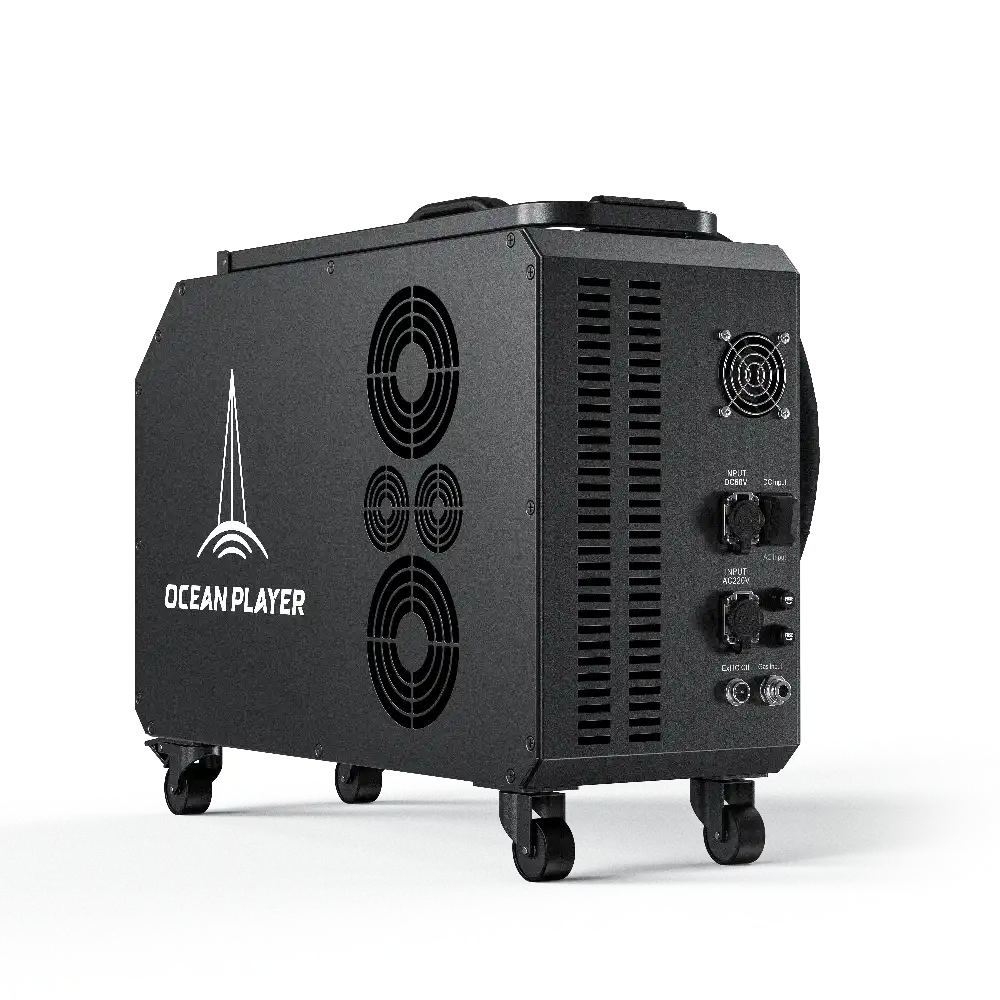
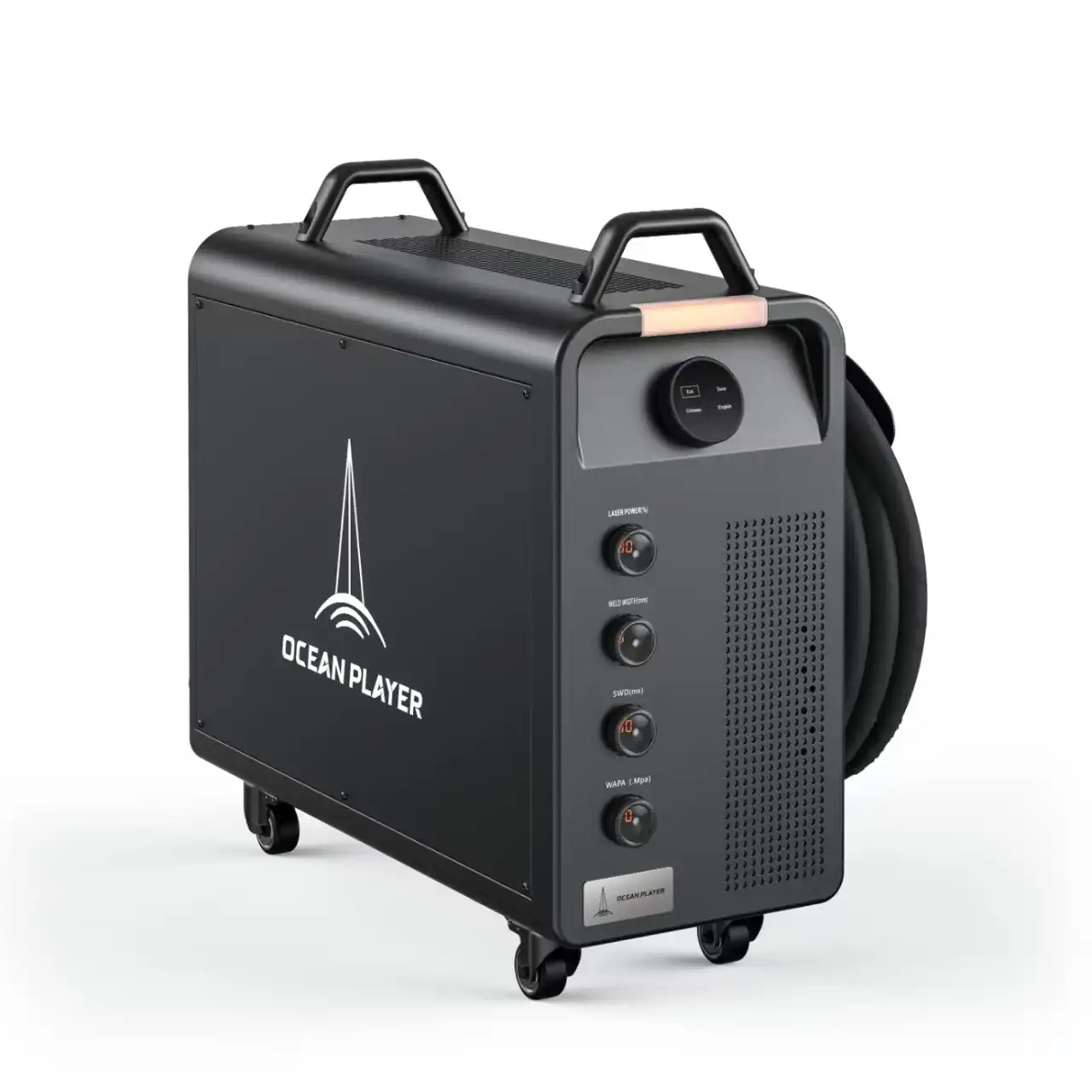
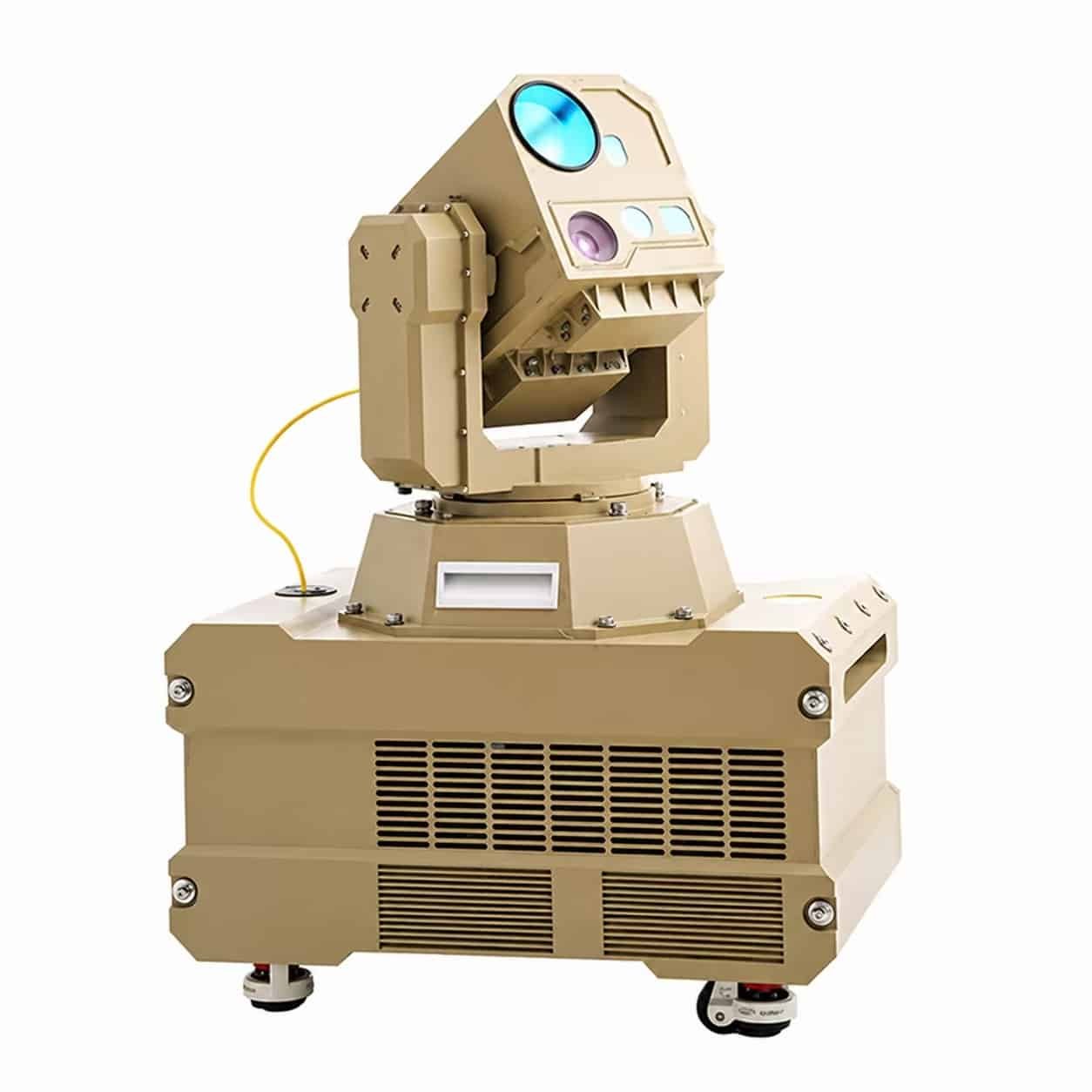
Oceanplayer Defense — China’s Leading Laser System Manufacturer
Secure your digital infrastructure with military-grade directed energy technology. Partner directly with a top-tier manufacturer for unmatched precision, factory-direct pricing, and complete defense integration solutions.
- ✔ MIL-SPEC & ISO Quality
- ✔ Factory-Direct Pricing
- ✔ 24/7 Tactical Support
- ✔ Global OEM/ODM Deployment
Verified Manufacturer