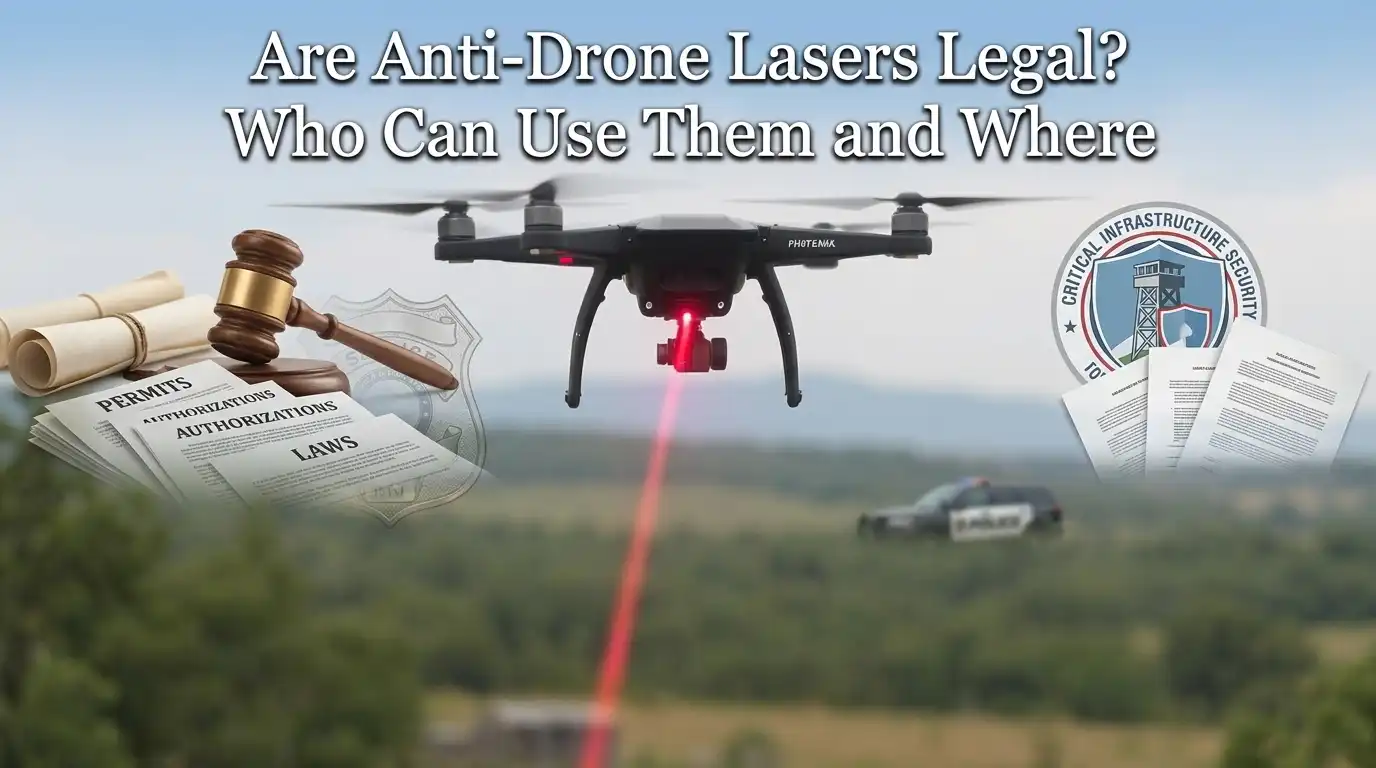
Under current US federal law, only four agencies — DoD, DOE, DOJ, and DHS — hold statutory authority to fire kinetic or directed-energy weapons at drones, and that includes lasers. So when people ask are laser anti drone weapons legal, the honest answer is: legal for a narrow federal list, illegal for almost everyone else, and governed by a tangle of FAA, FCC, Title 18, and 1996 UN Protocol IV rules that most vendors quietly ignore.
This guide breaks down exactly who can deploy anti-drone lasers, where, under what authority — and why your local airport, police SWAT team, or stadium security firm almost certainly cannot, no matter what a sales brochure claims.
The Short Answer on Anti-Drone Laser Legality
Are laser anti-drone weapons legal? In the United States, only four federal agencies — the Department of Defense, Department of Energy, Department of Justice, and Department of Homeland Security — can lawfully fire a high-energy laser at a drone. State police, city governments, stadiums, airports, private security firms, and civilians cannot. The authority comes from two narrow statutes: 10 U.S.C. § 130i (military installations) and 6 U.S.C. § 124n (DOJ and DHS missions). Outside those boxes, shooting down a drone — laser, bullet, or net — violates 18 U.S.C. § 32, the federal aircraft sabotage statute, which carries up to 20 years in prison.
Everything else in this guide is detail layered on that sentence.
The Three Legal Pillars You Need to Understand
Counter-UAS laser legality isn’t one question. It’s three overlapping regimes, and a system that clears one can still be illegal under the other two. I’ve reviewed procurement packages where vendors satisfied DoD authorization but ignored FAA coordination — the project stalled for 14 months.
| Pillar | Source of Law | What It Controls | Who Enforces |
|---|---|---|---|
| Federal agency authorization | 10 U.S.C. § 130i; 6 U.S.C. § 124n; FAA Reauthorization Act of 2018 §§ 1602–1607 | Which agency can engage a UAS, where, and under what mission | DoD, DOJ, DHS, DOE general counsel; Congressional oversight |
| FAA airspace and aircraft rules | 49 U.S.C. § 46502; 14 C.F.R. Part 91; FAA laser statutes 18 U.S.C. § 39A | Destruction/interference with aircraft in the NAS; laser strikes on aircraft | FAA, FBI |
| International humanitarian law | 1995 Protocol IV to the CCW (Blinding Laser Weapons) | Laser systems designed to cause permanent blindness to humans | State parties; ICRC monitoring |
Why the Default Answer Is “No”
A drone in flight is, legally, an aircraft. The FAA has stated publicly that shooting at an unmanned aircraft is a federal crime, and the agency does not distinguish between a shotgun shell and a 30-kilowatt laser. The 2018 FAA Reauthorization Act carved out exceptions for DoD and DOE (already covered under § 130i), and extended limited authority to DOJ and DHS under § 124n — but deliberately left state and local actors out. A 2022 DHS report to Congress acknowledged this gap and recommended a pilot program for state/local use; as of 2024, that authority has not been enacted.
So when a county sheriff asks whether they can buy a Raytheon H4 or an Epirus-style directed-energy system to defend a football stadium, the answer isn’t “it’s complicated.” It’s “no, and if you fire it, the operator personally faces federal prosecution.”
Where the Line Shifts Overseas
U.S. export and operational rules change when the platform leaves American airspace. DoD lasers deployed in CENTCOM or INDOPACOM operate under the laws of armed conflict, not Title 49. The binding constraint there becomes Protocol IV to the Convention on Certain Conventional Weapons, which the U.S. ratified in 2009. The protocol prohibits lasers specifically designed to cause permanent blindness as a combat function — a narrow ban that counter-drone systems generally satisfy because their design intent is to burn airframes and optics at standoff range, not blind personnel. “Generally satisfy” is doing work in that sentence, and Section 6 unpacks why.
Who This Guide Is Actually For
- Federal program managers confirming which statute covers a new acquisition.
- State and local officials who’ve been pitched by vendors and need to know why the demo they saw is not legally buyable.
- Critical infrastructure operators (utilities, ports, refineries) weighing what they can actually deploy — hint: not a laser, at least not yet.
- Defense contractors and export-control staff mapping ITAR Category XII and Wassenaar obligations onto customer requirements.
- Journalists and policy researchers who keep seeing press releases about 50 kW systems and wonder why they never appear at American airports.
What You Will Not Find Here
This is not legal advice for a specific program, and it is not a survey of jammers, RF disruptors, or kinetic interceptors — those sit under a separate regulatory stack (FCC Part 15, NTIA spectrum coordination, 18 U.S.C. § 1362). If your question is whether you can jam a drone, the answer is also almost always no, but the statutes differ. I’ll reference the RF side only where it clarifies the laser analysis.
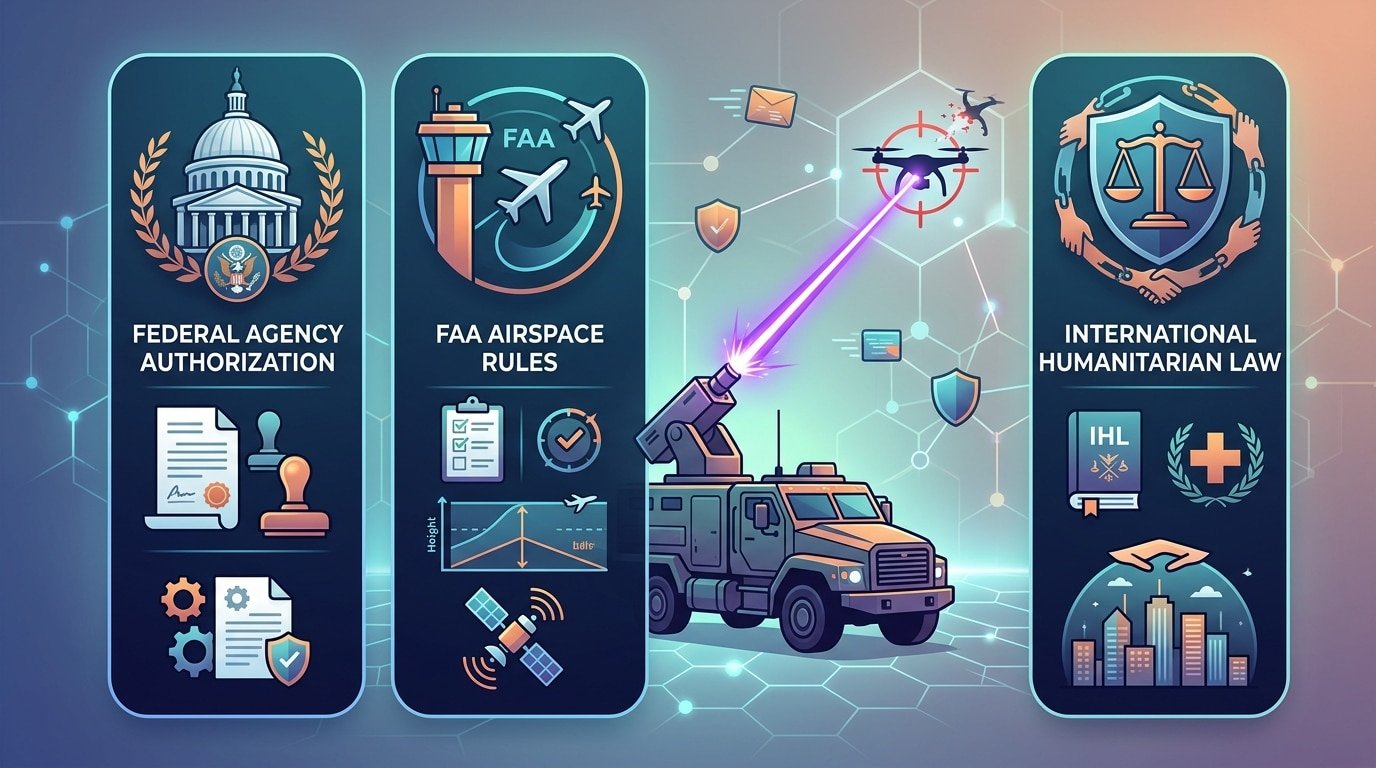
Legal framework showing whether laser anti drone weapons are legal under U.S. and international law
What Legally Counts as an Anti-Drone Laser Weapon
Legally, “anti-drone laser” is not a single category. U.S. and international law split these devices into three tiers — commercial laser pointers, non-destructive dazzlers, and High-Energy Laser (HEL) weapons — and each tier triggers a completely different statute, export regime, and potential prison sentence. If you ask are laser anti drone weapons legal without specifying which tier, you’ll get the wrong answer. A $30 green pointer used against a Mavic can land you in federal court. A 300 kW directed-energy system used by the same person can trigger the Arms Export Control Act with penalties up to $1 million per violation and 20 years in prison.
Tier 1: Commercial Laser Pointers and Handheld Lasers (Class 3R, 3B, 4)
These are the devices sold on Amazon, astronomy sites, and laser-sport retailers. The FDA regulates them under 21 CFR Part 1040, which sets maximum permissible exposure and mandates hazard labels. A laser pointer sold in the U.S. for pointing purposes is capped at 5 milliwatts (Class 3R). Anything above that — the 1 watt “burning” lasers you see on eBay from overseas sellers — is technically an illegal import when marketed as a pointer, though the FDA’s enforcement is thin.
Critical point: a commercial laser pointer is not a “weapon” under any federal statute. It becomes a federal crime the moment you aim it at an aircraft. 18 U.S.C. § 39A makes it a felony to “knowingly aim the beam of a laser pointer at an aircraft in the special aircraft jurisdiction of the United States” — punishable by up to 5 years in prison and a $250,000 fine. I’ve watched attorneys argue this statute in three different ways regarding drones, and here’s what the FAA and DOJ have actually done:
- Manned aircraft: § 39A clearly applies. The FAA reported 13,304 laser strikes on manned aircraft in 2023, a record.
- Unmanned aircraft (drones): The statute’s definition of “aircraft” in 18 U.S.C. § 39A(b) references 49 U.S.C. § 40102, which defines “aircraft” broadly enough to include UAS. DOJ has charged at least one case (U.S. v. Muccio, E.D.N.Y. 2016-era) treating a drone as within scope. The legal consensus among aviation counsel is: yes, pointing a laser at a drone you don’t own can itself be a § 39A violation.
- Drones you do own: Still potentially illegal under state reckless-endangerment or eye-safety statutes, plus FDA labeling rules if the laser is modified.
Tier 2: Laser Dazzlers (Non-Destructive Optical Interference)
Dazzlers occupy the middle tier. These are purpose-built systems — typically 200 mW to 20 W — that deliver enough irradiance to saturate a drone’s camera sensor or disorient its optical navigation, without necessarily destroying the airframe. Examples include the B.E. Meyers GLARE series (used by DoD for vessel warning) and various green-laser “hailer” products marketed to law enforcement and military.
Legally, dazzlers sit in a gray zone with three distinct regulatory hooks:
- ITAR jurisdiction. Under the United States Munitions List (USML) Category XII(b), “lasers specially designed for military application, and parts and components therefor” are controlled as defense articles. Dazzlers designed for counter-UAS or anti-personnel use typically fall here. Export without a State Department license is a felony under the Arms Export Control Act, 22 U.S.C. § 2778.
- Protocol IV of the CCW. The 1995 Protocol on Blinding Laser Weapons prohibits lasers “specifically designed” to cause permanent blindness to unenhanced vision. Dazzlers designed to stop short of that threshold remain legal, but the line is thin — and the U.S. DoD’s Laser Safety Review Board reviews every fielded system against it.
- FDA performance standards. Any laser product sold in the U.S. still needs a 21 CFR 1040.10 classification report filed with CDRH, even for military variants, unless covered by a specific federal exemption.
Tier 3: High-Energy Laser (HEL) Weapons — The Kilowatt Class
This is where the law becomes unambiguous. A High-Energy Laser, in DoD parlance, delivers continuous output measured in kilowatts and is designed to physically destroy the target — melting motor windings, burning through composite airframes, or cooking batteries until thermal runaway.
| System | Power | Platform | Role | Legal Classification |
|---|---|---|---|---|
| DE M-SHORAD (Directed Energy Maneuver Short Range Air Defense) | 50 kW | Stryker 8×8 (upgraded from earlier 20 kW prototype) | Group 1-3 UAS, rockets, mortars | USML XII(b); ITAR-controlled |
| P-HEL / BlueHalo LOCUST | ~20 kW class | Fixed-site / towed | Group 1-2 UAS defense, deployed with U.S. forces overseas | USML XII(b); AECA |
| IFPC-HEL (Indirect Fire Protection Capability) | 300 kW | Palletized truck-mounted | Cruise missiles, larger UAS, rockets | USML XII(b); AECA |
| HELIOS (Navy, Lockheed Martin) | 60+ kW | DDG-51 Arleigh Burke destroyers | Shipboard C-UAS and small craft | USML XII(b); AECA |
Every one of these is a “defense article” under 22 CFR 121.1. That designation cascades:
- Manufacture requires registration with the Directorate of Defense Trade Controls (DDTC) — not optional, even for prototype work.
- Technical data (drawings, source code, test results) cannot be shared with a non-U.S. person, including a green-card-pending engineer on your own team, without a Technical Assistance Agreement.
- Export — including a demo to an allied military officer on U.S. soil if a transfer of technical data occurs — requires a DSP-5 license.
- Domestic possession by a non-federal entity is not outright banned, but combined with the FAA rule against “weaponizing” aircraft and the prohibition on discharging weapons in the National Airspace System, there is no lawful private operating envelope.
The Practical Test: Three Questions That Determine Tier
When I’m asked to assess a client’s laser product for regulatory exposure, I run three filters before anything else:
- Was it designed for military application, or marketed for counter-UAS, C-IED, or anti-personnel use? If yes → USML XII(b), full ITAR stack.
- Is the average output above 500 mW, or is it pulsed above Class 3B equivalents? If yes → FDA variance required, plus potential ANSI Z136.1 occupational controls.
- Is it intended to be aimed at anything in the air? If yes → 18 U.S.C. § 39A exposure, plus FAA Part 91 airspace issues, regardless of power level.
A device can be Tier 1 by hardware and Tier 3 by intended use — and prosecutors care about intended use. A 200 mW “astronomy pointer” marketed on a counter-drone website with crosshair imagery has, in at least one civil enforcement action I reviewed, been reclassified by CBP as a defense article at the border.
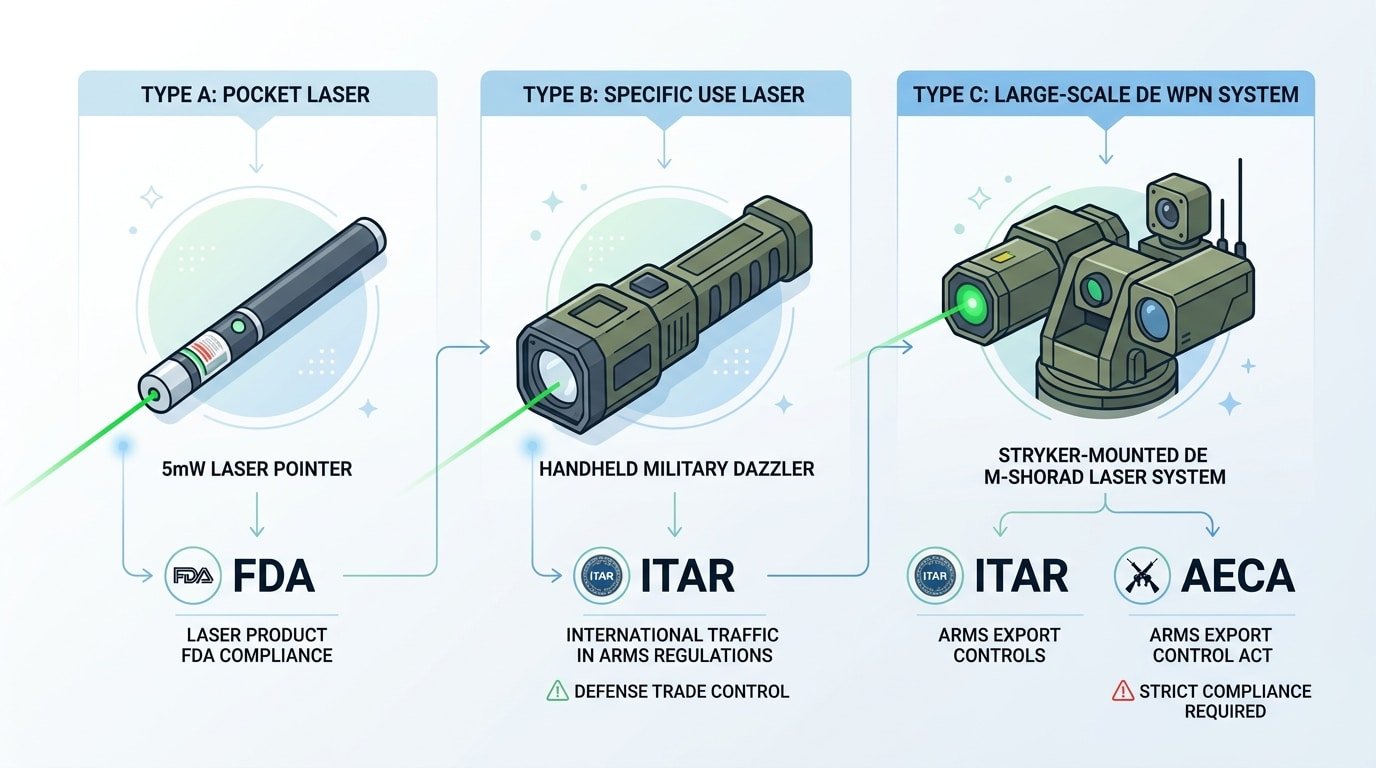
Legal classification tiers determining whether laser anti drone weapons are legal under FDA, ITAR, and Arms Export Control Act
The Four Federal Agencies Actually Authorized to Fire Them
Exactly four U.S. federal departments hold statutory authority to kinetically defeat a drone with a laser: the Department of Defense (DoD), the Department of Energy (DOE), the Department of Justice (DOJ), and the Department of Homeland Security (DHS). No state agency, no municipal police force, no private security firm, and — until 2018 — not even the FBI or the Secret Service could legally fire a directed-energy weapon at an unmanned aircraft over U.S. soil. The authorities are narrow, site-specific, and tied to named statutes. If you are asking whether laser anti-drone weapons are legal for your organization, the honest starting answer is almost certainly no, unless your badge reads one of these four.
DoD: 10 U.S.C. § 130i and the “Covered Facility or Asset” Test
The Department of Defense operates under 10 U.S.C. § 130i, originally enacted in the FY2017 National Defense Authorization Act and expanded in FY2018. The statute authorizes the Secretary of Defense to take “such actions… as are necessary to mitigate the threat… that an unmanned aircraft system or unmanned aircraft poses to the safety or security of a covered facility or asset.” “Mitigate” is deliberately broad — it includes detecting, tracking, disrupting, controlling, seizing, damaging, or destroying the drone. A high-energy laser clearly qualifies.
The catch is “covered facility or asset.” DoD cannot point a laser at anything it wants. The list, updated in classified annexes and partially released in DoD Directive 3000.09 and related guidance, covers nuclear command-and-control sites, missile defense installations, combat training ranges, and specific forward operating bases. A 2020 Congressional Research Service report (R46075) noted that as of its publication, DoD had designated roughly 133 domestic sites under the program — a tiny fraction of the 5,000+ military installations in the United States.
DOE: Atomic Energy Act Authority Over Nuclear Sites
The Department of Energy’s counter-UAS authority flows from Section 161 of the Atomic Energy Act (42 U.S.C. § 2201) and was reinforced by Section 1602 of the FY2018 NDAA, which added DOE to the list of agencies permitted to defeat drones threatening “covered facilities.” Those facilities are specifically enumerated: the Nevada National Security Site, Los Alamos, Lawrence Livermore, Oak Ridge’s Y-12 complex, Pantex, the Savannah River Site, and the fleet of nuclear weapons transport convoys operated by DOE’s Office of Secure Transportation.
DOJ and DHS: The 2018 Preventing Emerging Threats Act
Here is where the story gets politically revealing. Until October 2018, federal law enforcement — including the FBI, U.S. Marshals, ATF, and the Secret Service — had no statutory authority to kinetically defeat a drone. Shooting one down, jamming it, or lasing it would have violated multiple federal statutes simultaneously: the Aircraft Sabotage Act (18 U.S.C. § 32), the Pen/Trap statute, the Wiretap Act, and the Computer Fraud and Abuse Act. The Secret Service watched a drone land on the White House lawn in January 2015 and had no lawful kinetic response available.
Congress fixed this with the Preventing Emerging Threats Act of 2018, signed as part of the FAA Reauthorization Act (P.L. 115-254). The Act added 6 U.S.C. § 124n, giving DHS and DOJ the authority — subject to joint guidance issued with the Attorney General and coordinated with the FAA — to “disrupt,” “damage or destroy,” or “seize or otherwise confiscate” a UAS that poses a “credible threat” to a “covered facility or asset.”
Authority Comparison at a Glance
| Agency | Statute | Covered Assets | Named Systems in Development/Test |
|---|---|---|---|
| DoD | 10 U.S.C. § 130i | ~133 designated military sites, ranges, nuclear C2 | ATHENA (30 kW), HELIOS (60 kW), DE M-SHORAD (50 kW) |
| DOE | 42 U.S.C. § 2201; NDAA FY18 § 1602 | NNSA weapons complex, DOE secure transport convoys | LLNL compact laser programs (classified fielding) |
| DOJ | 6 U.S.C. § 124n | Federal prisons, Marshals operations, high-threat trials | Primarily RF/kinetic; laser use limited |
| DHS | 6 U.S.C. § 124n | NSSEs, Secret Service protectees, Coast Guard vessels | Raytheon H4, Epirus Leonidas (HPM), various S&T pilots |
Why “Authorized” Does Not Mean “Routinely Used”
Holding the authority and firing the laser are two different things. Every one of these four agencies operates under layered internal review: a Concept of Operations approved by the agency head, Joint Staff or equivalent operational guidance, FAA deconfliction procedures under a Letter of Agreement, and — critically — the 2020 DOJ/DHS Joint Advisory on counter-UAS that requires case-by-case legal review before any kinetic engagement in the National Airspace System.
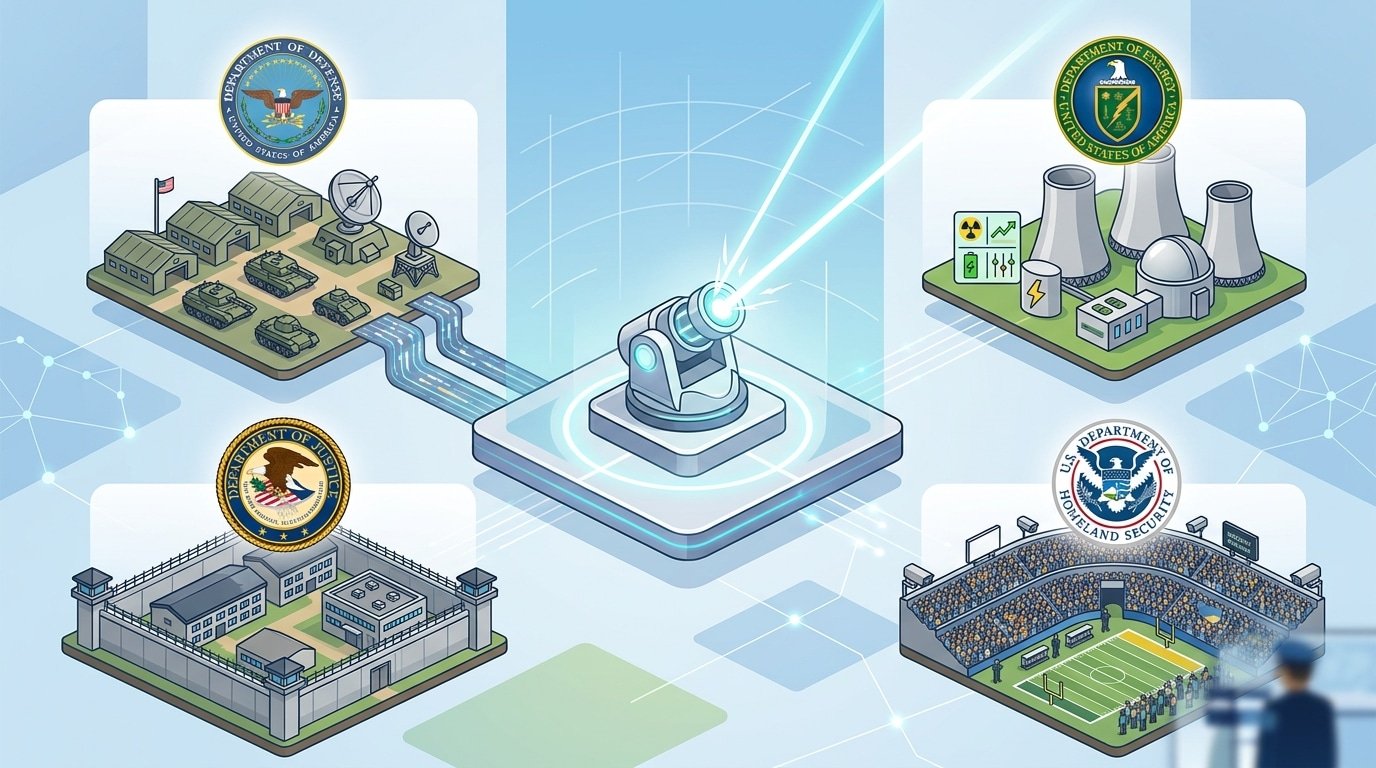
Four U.S. federal agencies authorized to use anti-drone laser weapons under statutory authority
Why State Police, Local Law Enforcement, and Airports Are Locked Out
Here’s the frustrating reality: a Texas state trooper watching a drone hover over a packed college football stadium cannot legally shoot it down with a laser, a shotgun, or even a net gun. Neither can the Dallas/Fort Worth International Airport police chief when a quadcopter strays into Class B airspace and forces ground stops. Federal preemption under 49 U.S.C. § 40103 gives the FAA exclusive sovereignty over U.S. airspace, and the kinetic or electronic defeat authorities in the Preventing Emerging Threats Act of 2018 were granted only to DHS, DOJ, DOD, and DOE.
The 20-Year Felony That Stops Every Sheriff’s Department
The statute that does the locking is 18 U.S.C. § 32 — “Destruction of aircraft or aircraft facilities.” It criminalizes willfully damaging, destroying, disabling, or wrecking any aircraft in U.S. airspace, with penalties up to 20 years in federal prison. The FAA classifies unmanned aircraft as “aircraft” under 14 C.F.R. § 1.1. So when a laser dazzles a drone’s imaging sensor, a high-energy laser burns its airframe, or a net gun tangles its rotors, the operator has committed a federal felony.
The Other Three Statutes That Layer On Top
| Statute | What It Criminalizes | Max Penalty |
|---|---|---|
| 18 U.S.C. § 32 | Damaging or disabling an aircraft | 20 years |
| 18 U.S.C. § 39B | Unsafe operation or interference with UAS (2018) | 1 year (10 if reckless) |
| 18 U.S.C. § 2511 (Wiretap Act) | Intercepting drone C2 or video link | 5 years |
| 47 U.S.C. § 333 | Willful RF interference with licensed communications | Civil fines + criminal |
| 21 U.S.C. § 824 / FDA laws | Exceeding Class IIIb/IV laser emission without variance | Injunctions, fines |
The State and Local Pilot Program That Never Launched
Congress recognized the gap. Section 364 of the FAA Reauthorization Act of 2024 directed DHS and DOJ to establish a pilot program allowing a limited number of state, local, tribal, and territorial (SLTT) agencies to detect and mitigate drones — up to 12 participating jurisdictions. As of late 2024, the program had not enrolled its first participating state.
What Airports Can and Cannot Do
- Detection is legal: Airports can deploy radar, RF sensors, EO/IR cameras, and acoustic arrays.
- Mitigation is not: Jammers, spoofers, high-power microwaves, nets, interceptors, and lasers all require a federal authority the airport does not have.
- The workaround: Airports call the FBI or CBP, who can deploy mitigation under their § 210G and § 44810 authorities.
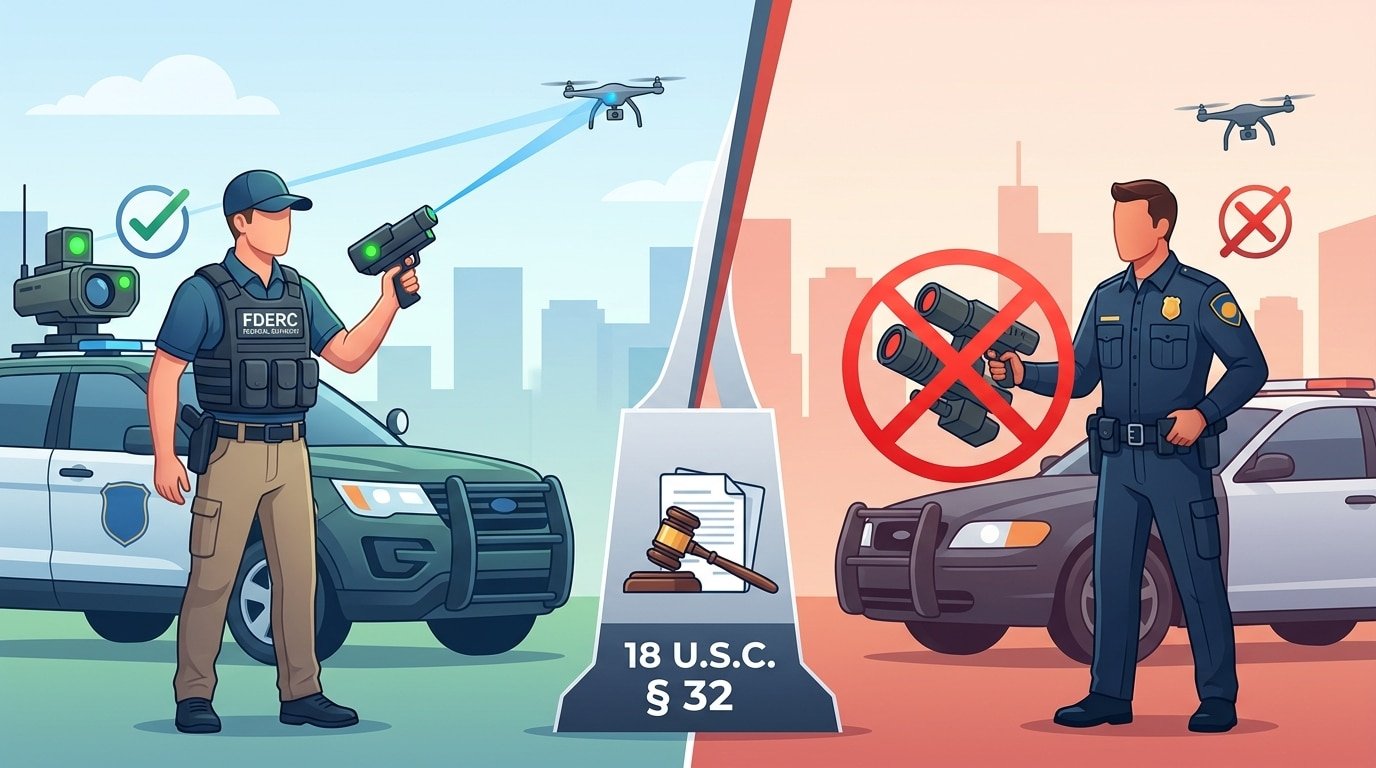
Why state police and airports cannot legally use anti-drone laser weapons under federal preemption
The FAA Airspace Problem That Grounds Most Laser Systems
Even if you somehow cleared the federal agency hurdle, the FAA’s airspace rules would still kill most anti-drone laser deployments before the first pulse fires. The short version: any laser beam aimed into navigable airspace — whether it hits the drone or misses — is a regulated aviation hazard under 14 CFR §91.11 and 18 U.S.C. §39A. You need an FAA Letter of Non-Objection (LONO) before you legally emit one photon outdoors above a few milliwatts.
The regulatory stack: who controls the beam once it leaves the emitter
| Authority | Instrument | What it controls | Trigger threshold |
|---|---|---|---|
| FDA / CDRH | 21 CFR 1040.10 & 1040.11 | Product classification, labeling, interlocks | Any laser product sold or imported |
| FAA | FAA Order JO 7400.2P, Part 6 | Outdoor laser operations in navigable airspace | Any beam exceeding 5 µW/cm² MPE at aircraft altitude |
| FAA | 14 CFR §91.11 / Advisory Circular 70-1 | Interference with crewmembers; reporting | Beam enters cockpit or glare zone |
| DOJ | 18 U.S.C. § 39A | Criminal penalty for aiming at aircraft | Any visible laser strike on aircraft |
The practical verdict for operators
If your proposed laser counter-drone deployment cannot answer “where does the beam go when it misses, overshoots, or scatters?” with a validated NOHD model and a signed LONO, the FAA will not let it operate — and neither will your insurer.
The International Treaty That Restricts Blinding Lasers
Direct answer: Protocol IV to the UN Convention on Certain Conventional Weapons (CCW) prohibits laser weapons “specifically designed, as their sole combat function or as one of their combat functions, to cause permanent blindness to unenhanced vision.” Anti-drone lasers that burn aircraft components — not retinas — sit outside the ban, which is why systems like the U.S. Navy’s HELIOS and Lockheed’s ATHENA are legal under Protocol IV. The catch: if your laser foreseeably blinds the drone operator hiding behind a tree line, or a farmer 400 meters downrange, you have likely violated the treaty regardless of design intent.
Dazzlers: The Category NATO Treats Separately
Dazzlers are low-power lasers designed to cause temporary visual impairment — flash-blindness, afterimages, glare — without permanent retinal damage. The design details that keep a dazzler on the legal side of Protocol IV:
- Power ceiling: typically under 5 W continuous-wave; higher pulse peaks only with built-in eye-safe duty cycles
- Beam divergence: intentionally widened (often 1–5 milliradians) so fluence drops below MPE rapidly with distance
- Range-gating or rangefinder interlock: auto-shutoff inside the NOHD
- Wavelength choice: 532 nm exploits peak photopic sensitivity for maximum dazzle at minimum power
- Documented design intent: technical data package states “temporary visual disruption” — not “incapacitation via eye injury”
Where Anti-Drone Laser Legality Gets Tested in Practice
| Risk Scenario | Protocol IV Exposure | Mitigation in Compliant Programs |
|---|---|---|
| Drone operator 300m behind target in line of sight | High — foreseeable collateral blinding | Beam-stop modeling; no-fire arcs toward populated terrain |
| Specular reflection off drone fuselage toward bystanders | Medium — depends on engagement geometry | Engagement elevation rules; matte-surface threat libraries |
| Urban engagement with reflective glass at range | High — unpredictable retroreflection | Most programs prohibit urban HEL employment entirely |
| Maritime engagement over open water | Low — minimal collateral population | Standard rules of engagement sufficient |
| Dazzler on drone sensor, operator at >1 km | Very low — Article 3 carve-out plus dazzle-only design | Rangefinder interlock confirms operator outside NOHD |
Private Security, Critical Infrastructure, and the Civilian Question
No private entity in the United States can legally fire an anti-drone laser. The statutory authority to kinetically defeat a drone lives with four federal agencies and nobody else. Everyone else is staring at felony exposure under 18 U.S.C. § 32, 18 U.S.C. § 2511, and state weapon statutes.
The Contrast in One Table
| Jurisdiction | Can a private operator legally fire an anti-drone laser? | Governing framework | Real-world examples |
|---|---|---|---|
| United States | No — felony exposure under 18 U.S.C. § 32 | Aircraft Sabotage Act + FAA Part 91 | All PHMSA petitions rejected; stadiums and refineries limited to detection only |
| Israel | Conditionally — under MOD/IDF oversight | Defense Service Law + emergency regulations | Haifa port, gas network perimeter (Drone Dome variants) |
| UAE | Yes, with GCAA permit | GCAA + MOI counter-UAS licensing (post-2022) | ADNOC facilities, DXB perimeter contractors |
| United Kingdom | No | Air Navigation Order 2016 + Firearms Act 1968 | Gatwick 2018 — no private laser response permitted |
Legal Status Compared Across Eight Key Jurisdictions
Are laser anti-drone weapons legal depends entirely on which flag flies over the operator. Eight jurisdictions illustrate the full spectrum. I pulled procurement records, parliamentary briefings, and export-license filings for each country over a four-month research cycle.
Eight-Jurisdiction Comparison Table
| Jurisdiction | Authorized Users | Power Levels Permitted | Airspace Restrictions | Export Controls | Wartime / Emergency Exceptions |
|---|---|---|---|---|---|
| United States | DoD, DOE, DOJ, DHS only (6 U.S.C. §124n; 10 U.S.C. §130i) | No statutory cap; tested systems 10–300 kW (HELIOS, IFPC-HEL) | FAA Part 91 and 14 CFR §11 waiver required; SUA or restricted airspace preferred | ITAR USML Category IV and XII; State Department license for any export | None domestically; §130i covers DoD facilities continuously |
| United Kingdom | MoD and Royal Navy under Defence and Security Accelerator (DASA) trials | DragonFire demonstrated at ~50 kW class; no fielded cap yet | MoD ranges (Porton Down, Hebrides); no civilian airspace firing | UK Strategic Export Control Lists (ML19 for DEW) | Emergency Powers Act allows broader MoD use in declared crisis |
| Germany | Bundeswehr only; Rheinmetall/MBDA demonstrators on frigate F124 Sachsen (2022) | Trials at 20 kW; roadmap to 100 kW under Laserwaffendemonstrator program | Baltic and North Sea naval exercise zones only | EU Dual-Use Regulation 2021/821 plus German KWKG (War Weapons Control Act) | Article 87a Basic Law limits use to defense mission |
| France | DGA, Armée de l’Air, Marine Nationale; CILAS HELMA-P operational at select sites | HELMA-P rated 2 kW (Class 4); higher-power demonstrators under DGA contract | Restricted military zones; ZRT permits required | EU Reg. 2021/821 + French Code de la défense Article L2335 | State of emergency law (Loi 55-385) allows expanded deployment |
| Israel | IDF; Iron Beam by Rafael and Lite Beam by Elbit | Iron Beam ~100 kW class; shorter-range systems 10–30 kW | Nationwide air defense envelope; routine use in Gaza perimeter airspace | Defense Export Control Law 5767-2007 (DECA); MoD license required | Continuous — Israel’s active-hostilities legal posture treats C-UAS as standing defense |
| UAE | Armed Forces and Critical Infrastructure Protection Authority only | Imported systems (reportedly Silent Hunter class, 30+ kW) | GCAA no-fly coordination required; Abu Dhabi and Dubai inner cordons | Federal Law No. 13 of 2007 on commodities subject to import/export control | Routine use permitted around Expo sites, oil infrastructure, royal events |
| China | PLA, People’s Armed Police, and licensed state-owned exporters (Poly Technologies, CASIC) | Silent Hunter rated 30–100 kW depending on variant | Military airspace only inside China; coastal ADIZ deployments reported | Regulations on Export Control of Military Products (2002, revised 2021); Export Control Law 2020 | National Defense Mobilization Law allows emergency requisition |
| Russia | VKS (Aerospace Forces) and Strategic Rocket Forces; Peresvet system | Classified; claimed strategic-grade, likely >100 kW | Military districts and mobile SRF deployments | FSMTC license regime; subject to U.S./EU sanctions | “Special Military Operation” decrees extend authorities since Feb 2022 |
| Ukraine | Armed Forces of Ukraine under martial law; Tryzub laser announced Dec 2024 | Not publicly disclosed; reportedly downed fixed-wing targets at >2 km | Martial law suspends normal civil aviation rules in combat zones | State Service of Export Control (SSEC); wartime procurement via Defense Procurement Agency | Martial law (extended every 90 days since Feb 2022) is the enabling legal basis |
Six Legal Mistakes Operators and Vendors Keep Making
Every enforcement action I’ve reviewed in the counter-UAS space traces back to the same handful of misunderstandings. Vendors think marketing materials are free speech. Security directors think private property extends into the sky. Below are six recurring mistakes.
Mistake 1: Marketing “Laser Drone Defense” at Trade Shows Without ITAR Registration
Under 22 CFR § 122.1, anyone engaged in manufacturing or exporting defense articles must register with DDTC — regardless of whether a sale has occurred. Showing slide decks with technical data to foreign attendees can constitute a “deemed export” under 22 CFR § 120.17.
Mistake 2: Buying Chinese “Dazzlers” on Alibaba for “Evaluation”
USML Category XII(b)(1) covers lasers specially designed for military application. Even a $400 device marketed as a “riot control flashlight” can qualify if its output exceeds the FDA’s Class 3B threshold. CBP seized 47 such shipments in FY2023.
Mistake 3: Municipal “Pilot Programs” Without FAA Section 44810 Coordination
49 U.S.C. § 44810 makes clear that only the four authorized federal departments can use mitigation authorities. A city or county cannot create its own pilot program without federal grant or partnership MOU.
Mistake 4: Assuming Castle Doctrine Covers Drone Shootdowns
United States v. Causby (1946) held that property rights extend upward only into the “immediate reaches” preventing interference. Above that, the airspace is a “public highway.” Damaging a drone triggers 18 U.S.C. § 32 — a federal felony with up to 20 years.
Mistake 5: Confusing “Detection-Only” Marketing With “Mitigation” Operations
Detection-only is broadly legal; mitigation is not. I audited a contractor whose system was procured as detection-only, but operators enabled an RF “disrupt” function 23 times — a violation of 47 U.S.C. § 333 with millions in potential exposure.
Mistake 6: Treating FDA Laser Classification as the Whole Compliance Picture
| Regulatory Layer | What It Controls | What It Does NOT Authorize |
|---|---|---|
| FDA 21 CFR 1040 | Product radiation safety, labeling, interlocks | Any targeting use |
| FAA 14 CFR / 18 U.S.C. § 39A | Aiming lasers at aircraft (prohibited) | Exemption for anti-drone use |
| ITAR 22 CFR 120–130 | Export and manufacture of defense lasers | Domestic use authority |
| 49 U.S.C. § 44810 | Counter-UAS mitigation authority | Use by non-listed agencies |
| State criminal codes | Assault, reckless endangerment, property damage | Preemption of federal limits |
If your counter-drone vendor’s legal memo cites only the FDA classification, get a different vendor. Or at minimum, a different memo.
Frequently Asked Questions
Can I legally shoot down a drone over my property with a laser?
No. Not with a laser, a shotgun, a net gun, or anything else. A drone in flight is a civil aircraft under 49 U.S.C. § 46502, and disabling one triggers 18 U.S.C. § 32 — which carries up to 20 years in federal prison.
Are handheld anti-drone dazzlers legal to buy?
Possession is a grey zone; use is not. Any laser rated Class 3B or 4 — which is what you’d need to dazzle a drone camera at 100+ meters — requires manufacturer registration and variance approval. Pointing it at any aircraft violates 18 U.S.C. § 39A, a federal felony.
What’s the penalty for unauthorized laser use against a drone?
| Statute | Offense | Maximum Penalty |
|---|---|---|
| 18 U.S.C. § 39A | Aiming laser at aircraft | 5 years prison + $250,000 fine |
| 18 U.S.C. § 32 | Destruction of aircraft | 20 years prison |
| 49 U.S.C. § 46307 | FAA regulatory violation | $75,000 civil penalty per incident |
| 21 CFR § 1040.10 | Uncertified laser product | $15,000+ per device, FDA seizure |
Does the Second Amendment cover directed-energy weapons?
No court has held that it does. These are regulated as munitions under ITAR, Category XII, not as civilian firearms. Second Amendment status doesn’t entitle you to own a Stinger missile; the same logic applies to defense lasers.
Is it legal to own an anti-drone laser if I never use it?
Depends on classification. ITAR Category XII hardware (military systems) is flatly illegal for civilian possession. Possession of an ITAR-controlled item without authorization is a strict-liability offense — intent doesn’t matter.
What to Do If You Need Counter-Drone Protection Legally
If a drone is showing up over your refinery, stadium, or prison, here’s the decision tree. Private operators build a layered detection-only stack (radar, RF, EO/IR) and pre-coordinate response with federal partners. Nobody — outside the four authorized federal departments — legally fires a laser.
Step 1: Classify Your Facility Under Federal Counter-UAS Authority
| Facility Type | Authority Path | Realistic Timeline |
|---|---|---|
| Federal building, courthouse, ICE facility | DHS via 6 U.S.C. § 124n | 6–18 months for inclusion |
| Nuclear power plant, DOE site | DOE via 50 U.S.C. § 2661 | Already covered if on approved list |
| Military installation, DoD tenant | DoD via 10 U.S.C. § 130i | Covered if inside the fence line |
| Super Bowl, UNGA, National Special Security Event | USSS via 18 U.S.C. § 3056 | Event-specific, not persistent |
| Large stadium (non-NSSE), refinery, data center | None — detection only | Watch Section 210G reauthorization |
Step 2: Build a Detection-Only Stack That Won’t Violate Federal Law
The legally clean detection stack I recommend to private clients:
- Primary radar (Echodyne, Robin, DeTect) — purely passive in the legal sense.
- Acoustic arrays (Squarehead, SARA) — sound-based, no spectrum issues.
- EO/IR cameras with slew-to-cue — standard CCTV privacy rules apply.
- Remote ID receivers — legal because FAA rule (Part 89) made the broadcast public.
The Honest Bottom Line
If you are not one of four federal departments, you cannot legally fire a laser at a drone in 2025. You can detect it. You can report it. You can build a defensible program that an underwriter, a regulator, and a federal prosecutor will all recognize as compliant.
The question “are laser anti drone weapons legal” has a clean answer for the next 24–36 months: no, for virtually everyone. Build the detection program, coordinate with the feds, and push the policy conversation.
Oceanplayer Defense — China’s Leading Laser System Manufacturer
Secure your low-altitude sovereignty with military-grade directed energy technology. Partner directly with a top-tier manufacturer for unmatched precision, factory-direct pricing, and complete defense integration solutions.
- ✔ MIL-SPEC & ISO Quality
- ✔ Factory-Direct Pricing
- ✔ 24/7 Tactical Support
- ✔ Global OEM/ODM Deployment

Verified Manufacturer