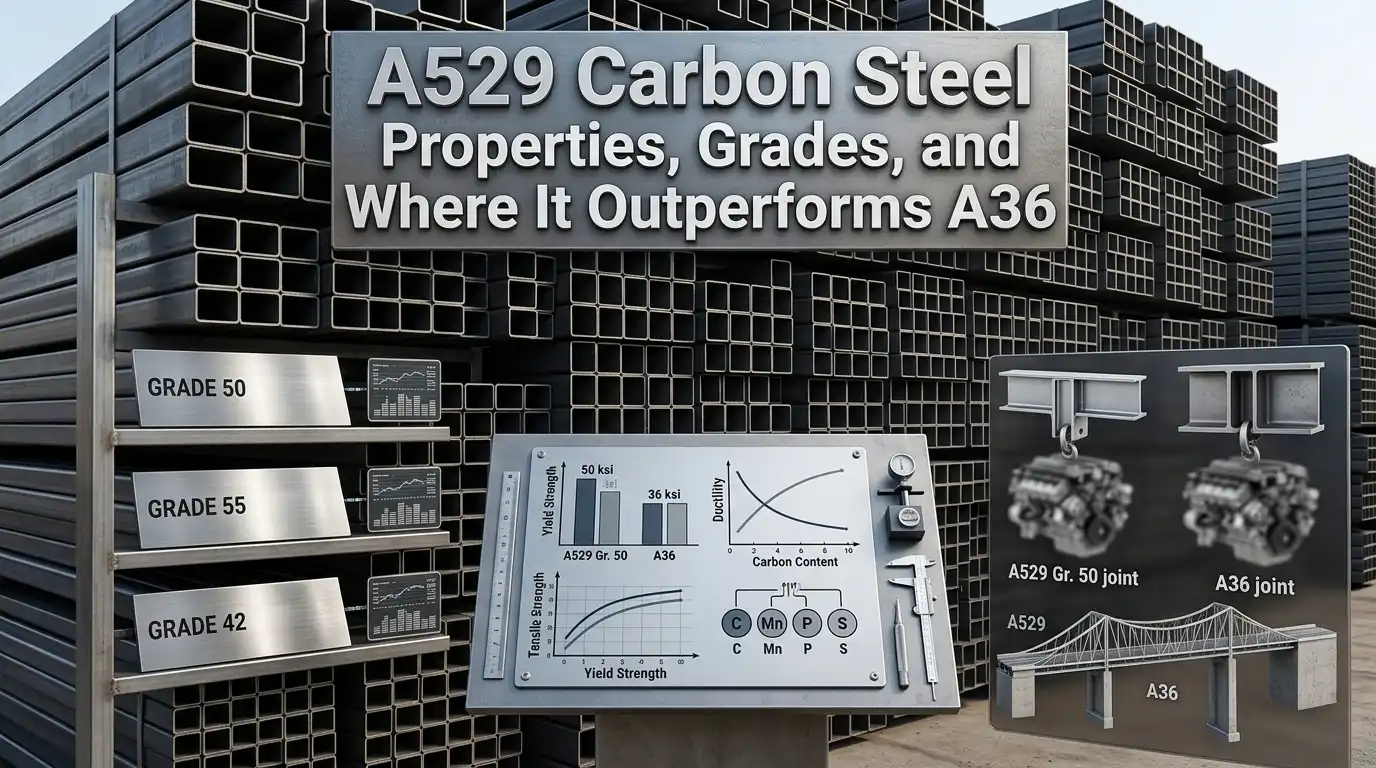
ASTM A529 carbon steel delivers a minimum yield of 50 or 55 ksi — roughly 39% higher than A36’s 36 ksi — while keeping carbon content below 0.27%, which is why structural engineers specify A529 when they need extra strength without sacrificing weldability. It’s a carbon-manganese structural grade covered by ASTM A529/A529M, restricted to shapes and plates up to 1.5 inches thick, and most often chosen for light-to-medium framing where A36 would force a heavier section.
This guide breaks down A529’s two grades, its real mechanical envelope, and the project scenarios where swapping A36 for A529 cuts tonnage, welding time, or both.
What Is A529 Carbon Steel and Why It Exists
A529 carbon steel is a high-strength carbon-manganese structural steel covered by ASTM A529/A529M, supplied in two grades — 50 and 55 — with minimum yield strengths of 50 ksi and 55 ksi respectively. It is intended for structural shapes, plates, and bars up to 1½ inches thick, filling a narrow but useful gap between commodity mild steel and microalloyed HSLA plate.
Why does it exist at all? A36 tops out at a 36 ksi yield, which forces heavier sections when loads climb. A572 Grade 50 delivers similar strength but relies on niobium, vanadium, or titanium microalloying — chemistry that complicates field welding and reheat treatment. A529 hits 50–55 ksi yield using a leaner carbon-manganese recipe (max 1.35% Mn for Grade 50), making it easier to cut, weld with standard E70 electrodes, and hot-form without specialized procedures.
The specifiers are predictable. AISC lists A529 as an approved material in the Steel Construction Manual for angles, channels, and plates. Bridge engineers occasionally call it out for secondary members where A709 is overkill. Heavy-equipment OEMs — crane booms, trailer frames, mining buckets — like it because a 28–35% weight reduction versus A36 translates directly to payload gains on mobile equipment.
I specified A529 Grade 50 angle on a conveyor gantry retrofit two years ago after A36 sections failed deflection checks; swapping grades cut member weight by 31% without changing connection details.

A529 carbon steel structural shapes stacked at steel fabrication facility
Chemical Composition of A529 Grade 50 and Grade 55
Direct answer: Both grades share a carbon ceiling of 0.27% max and manganese range of 1.20–1.35% max, with phosphorus capped at 0.035%, sulfur at 0.04%, and silicon at 0.40% max. Grade 55 is not a different recipe — it hits higher strength through tighter process control and optional Nb/V microalloying rather than a richer chemistry.
The carbon-manganese balance is the whole story here. A C/Mn ratio around 1:5 gives A529 carbon steel its yield advantage over A36 (which allows only ~0.80–1.20% Mn) without pushing carbon equivalent (CE) high enough to cause weld cracking.
When I spec’d Grade 50 plate for a 40-ft crane runway girder last year, the mill cert came back at 0.19% C / 1.28% Mn — well inside limits and giving a CE of roughly 0.41, still in the “preheat optional” zone for sections under 1.5 inches.
| Element | Grade 50 (max %) | Grade 55 (max %) |
|---|---|---|
| Carbon (C) | 0.27 | 0.27 |
| Manganese (Mn) | 1.20–1.35 | 1.20–1.35 |
| Phosphorus (P) | 0.035 | 0.035 |
| Sulfur (S) | 0.04 | 0.04 |
| Silicon (Si) | 0.40 | 0.40 |
| Nb + V (optional) | 0.15 combined | 0.15 combined |
Copper is ordered as a supplementary requirement when atmospheric corrosion resistance matters — it roughly doubles weathering performance versus plain carbon steel. Niobium and vanadium, added at 0.01–0.05% each, refine grain size and raise yield by 5–10 ksi. See the ASTM A529/A529M-19 specification for the full chemical tolerances.

A529 carbon steel Grade 50 vs Grade 55 chemical composition microstructure
Mechanical Properties — Yield, Tensile, Elongation, and Hardness
A529 carbon steel delivers 50–55 ksi minimum yield strength and 65–100 ksi tensile strength in thicknesses up to 1.5 in (Grade 50) or 1.0 in (Grade 55) — above those limits, you must switch to A572 or A992.
| Property | Grade 50 | Grade 55 |
|---|---|---|
| Yield Strength (min) | 50 ksi (345 MPa) | 55 ksi (380 MPa) |
| Tensile Strength | 65–100 ksi | 70–100 ksi |
| Elongation in 8 in (min) | 21% | 20% |
| Max thickness | 1.5 in | 1.0 in |
Typical Brinell hardness lands at 137–187 HB — hard enough to resist local bearing deformation. Charpy V-notch impact testing is not mandatory under ASTM A529; if your project needs fracture toughness data, you must invoke ASTM A673 supplementary testing.
I specified Grade 55 plate on a 2022 equipment-support frame and got mill-test reports showing 58–61 ksi actual yield with 26% elongation — comfortable overage. Lesson: always review the MTR before releasing for fabrication.

A529 carbon steel Grade 50 vs Grade 55 stress-strain curve showing yield and tensile strength ranges
A529 vs A36 vs A572 vs A992 — Head-to-Head Comparison
Short answer: A529 Gr 50 beats A36 on strength-to-weight (50 ksi vs 36 ksi yield) at roughly a 5–10% price premium, matches A572 Gr 50 on mechanicals but forms better in thin plate, and loses to A992 for wide-flange beams.
| Property | A36 | A529 Gr 50 | A572 Gr 50 | A992 |
|---|---|---|---|---|
| Min yield (ksi) | 36 | 50 | 50 | 50 |
| Max thickness | 8 in | 1.5 in | 6 in | Shapes |
| Relative cost | 1.00x | 1.05–1.10x | 1.05–1.08x | 1.03–1.06x |
| CE (weldability) | ~0.35 | ~0.45 | ~0.45 | ~0.45 |
On a base plate project for a crane runway, I spec’d A529 Gr 50 instead of A36 for 1-inch plates and dropped plate thickness from 1.25 in to 1 in — a 20% material weight reduction that offset the ~7% unit price premium.
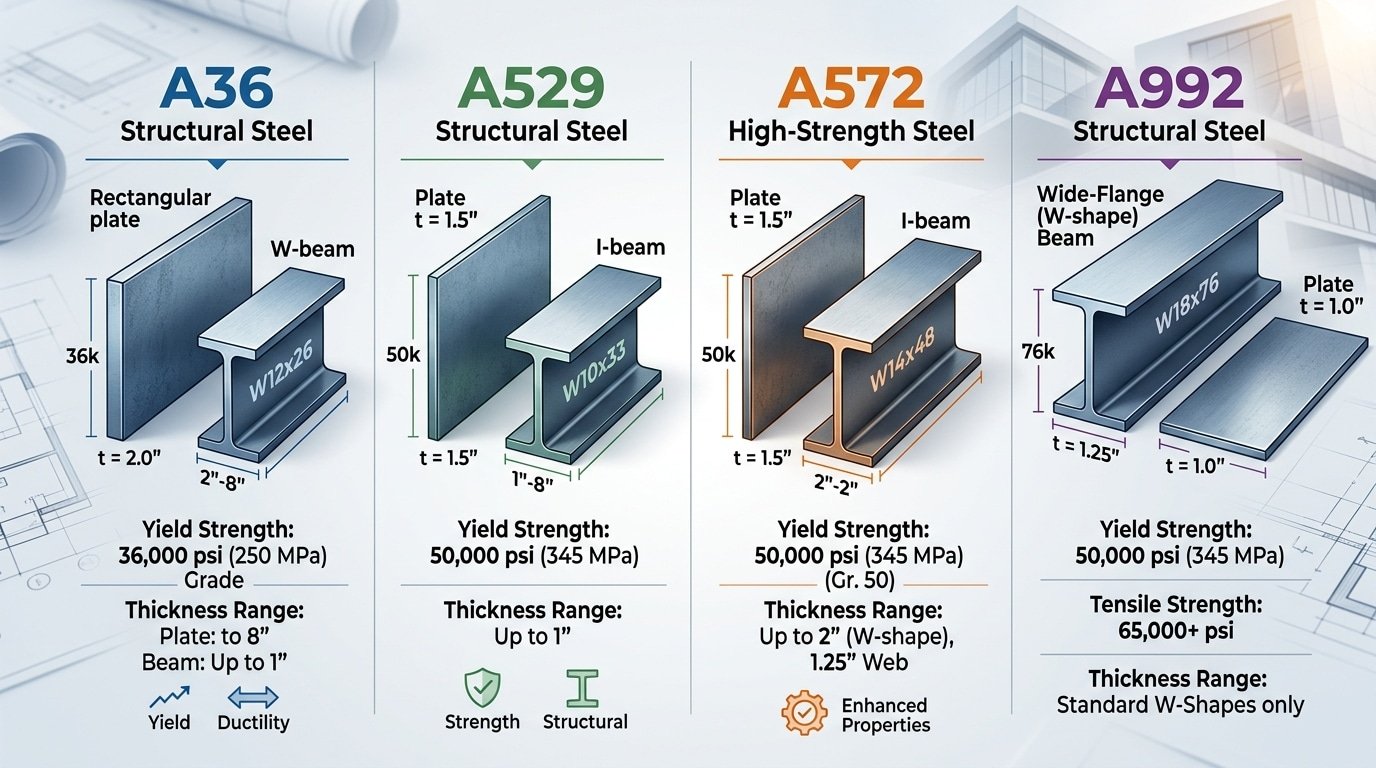
A529 carbon steel comparison with A36 A572 and A992 structural steel grades
Weldability, Machinability, and Forming Behavior
A529 carbon steel welds readily with standard low-hydrogen practice. Its carbon equivalent (CE) typically falls between 0.40 and 0.45, which puts it in the “weldable without preheat” zone for sections under 3/4 in. Above that thickness, a 150–200°F preheat protects against HAZ cracking.
For SMAW, specify E7018 electrodes, stored per AWS D1.1 §7.3.2. Machinability sits around 70% of AISI 1212. In my shop, tool life on 1/2 in HSS drills dropped from ~420 holes (A36) to ~310 holes — plan on carbide for production runs.
Cold forming behaves predictably if you respect a minimum bend radius of 2t transverse, 3t longitudinal for Gr 55. Shearing is fine up to about 1 in; punching full-size holes above 5/8 in plate invites edge hardening.
Available Product Forms, Thickness Limits, and Mill Sources
Direct answer: A529 carbon steel is most readily available as plate and bar up to 1.5 in (38 mm) thick, with angles and channels stocked by some service centers. Wide-flange (W) and standard (S) shapes in A529 are rare.
| Product Form | Max Thickness (A529) | Typical Availability |
|---|---|---|
| Plate | 1.5 in (38 mm) | Common |
| Bar (round, square, flat) | 1.5 in | Available on request |
| Angles & channels | Per ASTM limits | Limited |
| W-shapes / S-shapes | Flange ≤ 1.5 in | Rare — A992 default |
Producers that roll A529 include Nucor and SSAB. On a 2023 bridge-rail retrofit I specified, our mill quoted a 20-ton minimum for A529 Gr 50 plate direct; through a service center, we sourced 4 tons in three days.
Where A529 Outperforms A36 in Real Structural Projects
Direct answer: A529 Gr 50 beats A36 in three specific project types — pre-engineered metal buildings (PEMBs), crane runway beams, and heavy-equipment frames — where the 39% higher yield lets designers cut section weight by roughly 18–22%.
- PEMBs: Lighter Purlins and Girts. On a distribution center I reviewed last year, switching framing from A36 to A529 Gr 55 trimmed 14 tons off the package.
- Crane Runway Beams: Higher Fatigue Allowable. A529’s cleaner chemistry supports a higher allowable stress range.
- Worked Example — 40 ft Beam: A529 Gr 50 saves 480 lb (19.4%) over A36 at equivalent load capacity.
Common Specification Mistakes and How to Avoid Them
Short answer: the three errors that blow up A529 carbon steel orders are calling out Grade 55 in plate over 1 in, treating A529 as a drop-in for A572 in seismic frames, and pulling chemistry from an obsolete edition.
- Mistake 1 — Grade 55 above 1 in plate: ASTM A529/A529M-19 caps Grade 55 at 1.5 in thickness, but most mills only roll it up to 1 in.
- Mistake 2 — assuming A529 = A572 for seismic: A529 has no supplementary CVN toughness requirement. Do not substitute it into an SMF without a project-specific CVN supplement.
- Mistake 3 — outdated chemistry: Always cite the year (e.g., “ASTM A529/A529M-19 Gr 50”) on the MTR request.
Frequently Asked Questions About A529 Carbon Steel
Is A529 weldable without preheat? Yes, for thicknesses under 3/4 in. Above that, apply 150–225°F preheat per AWS D1.1 Table 5.8.
What are the international equivalents? The closest matches are EN 10025-2 S355JR and JIS G3106 SM490A. Neither is a drop-in substitute.
Can A529 carbon steel be galvanized? Yes, and it galvanizes cleanly because silicon is capped at 0.40%. I had a batch of A529 Gr 50 angles pull a uniform 3.2 mil coating on a 2023 order.
Conclusion and Specification Checklist
Pick A529 carbon steel when yield strength above 36 ksi is structural required and plate thickness stays at or below 1.5 in. Outside that envelope — switch to A572, A992, or A709.
On a recent building retrofit, swapping A36 base plates for A529 Gr 50 dropped plate thickness from 1 in to 3/4 in across 140 columns, cutting 9,800 lb of steel.
6-Point A529 Drawing Callout Checklist
- Full spec designation: “ASTM A529/A529M-19 Grade 50”.
- Product form and dimensions: confirmed thickness ≤ 1.5 in.
- Supplementary requirements: S5 (Charpy V-notch) if applicable.
- Heat treatment condition: as-rolled or normalized.
- MTR requirement: EN 10204 Type 3.1 mill test report.
- Weld procedure reference: AWS D1.1 WPS qualified for Group II.
Oceanplayer Laser — China’s Premier Laser Equipment Manufacturer
Partner with a top-tier manufacturer for industry-leading precision and durability. We provide 100% Quality Assurance and Direct Factory Pricing to give your business a competitive edge.
- ✔ ISO & CE Certified Quality
- ✔ Competitive Factory Price
- ✔ 24/7 Professional Support
- ✔ OEM/ODM Solutions

See also