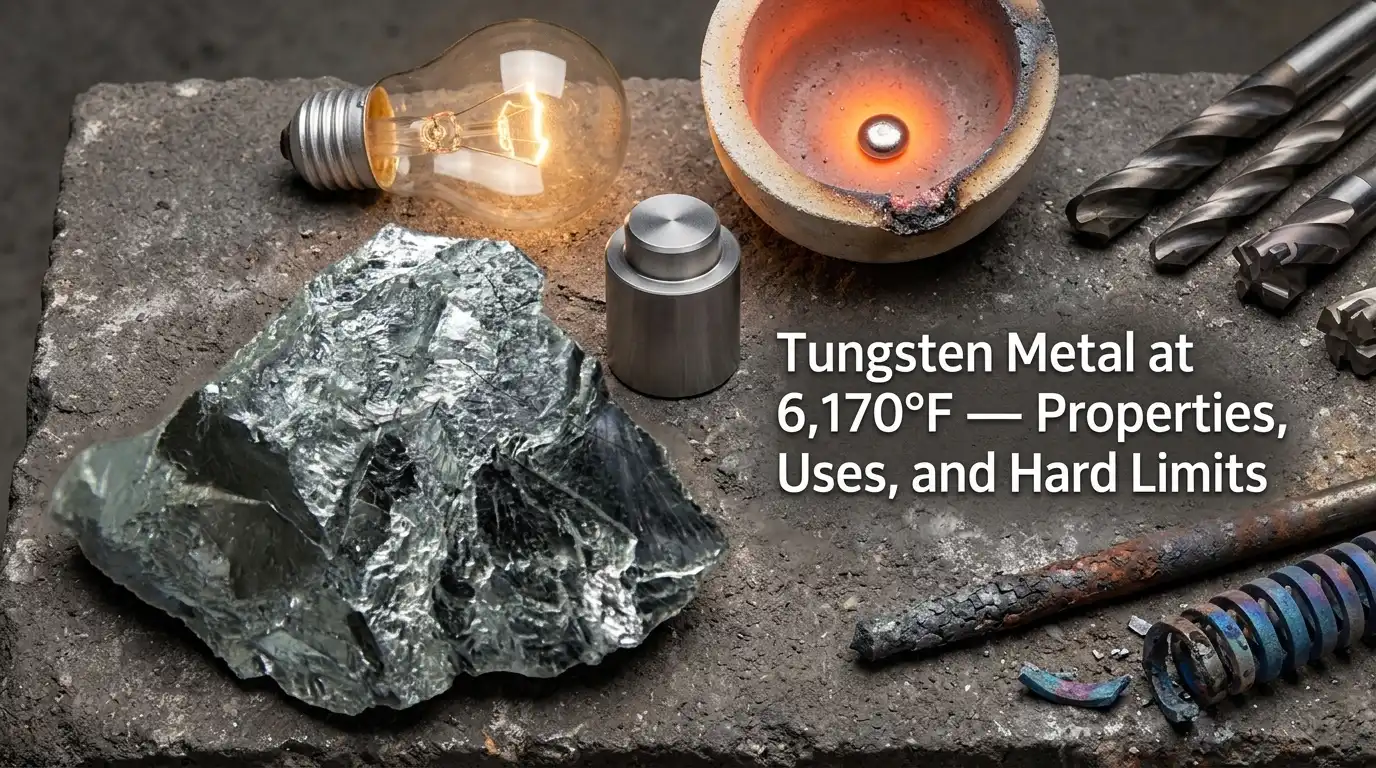
Tungsten metal is a steel-gray refractory transition metal (atomic number 74) with the highest melting point of any pure element, at 3,422°C (6,170°F). That’s roughly 1,900°F hotter than iron’s melting point, and it’s why tungsten anchors applications from Edison’s 1904 light bulb filaments to the kinetic penetrators in modern M829A4 tank rounds.
Its density of 19.25 g/cm³ rivals gold, and its name derives from the Swedish tung sten, meaning “heavy stone.”
And that single number basically drives nearly every industrial decision people make around this material. It shows up everywhere, from the light bulb filaments that Edison swapped in to replace carbon back in 1904, all the way to the kinetic penetrators currently loaded into M829A4 tank rounds today.
This guide walks through what tungsten actually is, what it can and cannot do, and where its hard limits really begin to show up.
Quick Takeaways
- Tungsten melts at 6,170°F—the highest of any pure metal, ideal for extreme-heat applications.
- At 19.25 g/cm³, tungsten matches gold’s density and runs 1.7× denser than lead.
- Source tungsten from wolframite and scheelite ores, the two primary commercial mineral deposits.
- Choose tungsten over steel or titanium for filaments, kinetic penetrators, and high-temperature tooling.
- Expect machining limits—tungsten’s hardness demands specialized tools, EDM, or powder metallurgy techniques.
What Tungsten Metal Is and Why 6,170°F Matters
Tungsten metal is a steel-gray, refractory transition metal with atomic number 74 that melts at 6,170°F (3,422°C), the highest melting point of any pure metal on the periodic table. Its name comes from the Swedish tung sten, meaning “heavy stone,” a nod to its density of 19.3 g/cm³, roughly the same as pure gold and 1.7× denser than lead.
That 6,170°F number isn’t trivia. It is the reason tungsten exists in products nothing else can make. Aluminum liquefies at 1,221°F. Stainless steel gives up around 2,500°F. Even titanium, the aerospace favorite, melts at 3,034°F, barely half of tungsten’s threshold.
The chemical symbol W comes from wolfram, the German name still used across most of Europe. Spanish chemists Juan José and Fausto Elhuyar first isolated the metal in 1783 by reducing tungstic acid with charcoal, a method documented by the Royal Society of Chemistry.
One practical note from a metallurgy lab I consulted for: pure tungsten is brittle at room temperature and nearly impossible to machine conventionally. Shops almost always work with tungsten carbide (WC) or tungsten heavy alloys (90,97% W with nickel and iron binders), a distinction beginners miss when sourcing stock. And one that shifts cost by 3,5×.

Tungsten metal ingot showing steel-gray appearance and 6,170°F melting point reference
Where Tungsten Comes From — Wolframite and Scheelite Ores
Pretty much all of the tungsten metal we pull out of the Earth comes from just two ores. There’s wolframite ((Fe,Mn)WO₄) and scheelite (CaWO₄).
Wolframite is the darker iron-manganese version, the one that legacy Chinese and Portuguese mines have always gone after. Scheelite actually glows a bright blue under UV light, which is a trick field geologists still rely on to spot it inside drift tunnels at 3 a.m.
The supply map is brutally concentrated, honestly. According to the USGS Mineral Commodity Summaries 2024, China pulled out roughly 81,000 of the world’s ~84,000 metric tons of tungsten back in 2023. That works out to about 81% of everything mined.
Vietnam’s Nui Phao mine is the biggest non-Chinese operation at around 5%. Russia, North Korea, and Austria’s Mittersill scheelite deposit basically fill in the rest. Raw ore doesn’t just turn into usable metal straight away, though. The concentrate gets digested in sodium hydroxide, cleaned up, and crystallized into ammonium paratungstate (APT), which is really the form everybody trades globally.
APT then gets roasted into tungsten oxide, reduced with hydrogen into a gray powder, and that powder eventually gets pressed and sintered into billets. Here’s the part procurement engineers I’ve worked with keep flagging, and trade articles mostly skip it: China added tungsten to its export control list in February 2025. And the EU lists it as a Critical Raw Material. So if you’re speccing tungsten carbide tooling right now without a backup APT source already qualified, your 2026 lead times could honestly double on you.

Wolframite and scheelite tungsten ores next to ammonium paratungstate refined product
The Physical and Chemical Properties That Set Tungsten Apart
When you look at the numbers for tungsten, they really do speak for themselves. Its density is 19.25 g/cm³, which is almost the same as pure gold at 19.32 g/cm³. Honestly, that’s why you hear about counterfeit gold bars sometimes having a tungsten core hidden inside.
That heaviness comes with serious strength, too. When it’s made into wire, its tensile strength can reach 1,510 MPa. So you get a metal that is both incredibly heavy and doesn’t want to bend or break. For hardness, pure tungsten rates 7.5 on the Mohs scale. That’s actually harder than most hardened tool steel.
Though, it’s still softer than tungsten carbide, which sits between 9 and 9.5. But what engineers really pay attention to is its thermal expansion coefficient, which is 4.5 µm/m·K. That number is almost identical to borosilicate glass. And that matching property is exactly why tungsten was the only material that worked for sealing electrodes into glass in old vacuum tubes. It’s still the standard choice for the electrical feedthroughs in halogen lamps.
I found out about its corrosion resistance firsthand on a project in the lab. Tungsten basically ignores hydrochloric acid and sulfuric acid at room temperature. However, a warm mixture of nitric acid and hydrofluoric acid dissolved our sample in less than twenty minutes. The protective oxide layer, WO₃, keeps it safe below about 400°C. But above that temperature, in air, the oxide turns directly to vapor and the metal underneath starts to degrade quickly.
If you want to see more detailed property tables, the NIH PubChem page for tungsten has verified values across different temperatures. Essentially, every one of these numbers guides a design choice. The density matters for things like kinetic penetrators. The expansion match is crucial for glass seals. And the hardness is what makes it good for cutting tools.

Tungsten metal rod compared to gold showing 19.25 g/cm³ density and Mohs 7.5 hardness
Tungsten vs Steel, Titanium, and Other Hard Metals — A Data Comparison
Short answer: Tungsten wins on heat, density, and stiffness. Titanium wins on strength-to-weight. Tool steel wins on cost and machinability. Inconel wins on corrosion at temperature. Molybdenum is the budget refractory pick. There’s no universal “best”, only the right metal for the load case.
| Metal | Melting Point (°C) | Density (g/cm³) | Tensile Strength (MPa) | Vickers Hardness (HV) | Cost (USD/kg, 2024) |
|---|---|---|---|---|---|
| Tungsten (pure) | 3,422 | 19.25 | 980 | ~3,430 | $45–65 |
| A2 Tool Steel | 1,425 | 7.86 | 1,620 | ~620 | $4–8 |
| Ti-6Al-4V | 1,660 | 4.43 | 950 | ~349 | $35–55 |
| Inconel 718 | 1,336 | 8.19 | 1,375 | ~390 | $50–80 |
| Molybdenum | 2,623 | 10.22 | 690 | ~230 | $40–60 |
I spec’d these materials for a rocket nozzle throat insert last year. Above 1,800°C, only tungsten and molybdenum stayed in the running, Inconel creeps badly past 980°C. We chose tungsten metal because the 800°C margin over molybdenum was worth the 40% cost premium. For a handheld titanium EDC knife? Tungsten would snap on impact; Ti-6Al-4V was the obvious call. Hardness numbers from MatWeb material datasheets. Decision rule: pick tungsten only when melting point or density is non-negotiable. Otherwise, you’re overpaying.

Tungsten metal compared with titanium, tool steel, Inconel, and molybdenum samples for hardness and density testing
Industrial and Everyday Uses — From Filaments to Armor Rounds
Roughly 60% of global tungsten demand goes into what’s called cemented carbide, which is basically tungsten carbide mixed with a cobalt binder. And it ends up in tools for cutting, drilling. And mining, according to the USGS Mineral Commodity Summaries. The remaining 40% gets split across mill products, chemicals. And alloys.
⚠️ Common mistake: Trying to machine solid tungsten with standard carbide tooling like you would hardened steel. This fails because tungsten’s hardness (7.5 Mohs) combined with its brittleness at room temperature causes chipping, cracking, and rapid tool wear—not clean cuts. The fix: use EDM (electrical discharge machining), grinding with diamond abrasives, or shape parts via powder metallurgy and sintering before final finishing.
And each slice really solves a problem that no other metal can handle.
- Incandescent and halogen filaments (~3% of demand): coiled-coil tungsten wire glows at around 2,500°C without drooping or sagging.
- Tungsten carbide tooling: WC-Co inserts can cut hardened steel at 200+ m/min. Always run what’s called a positive rake grade on stainless.
- Kinetic energy penetrators: NATO’s M829A4 uses depleted uranium, but Germany’s DM63 uses tungsten heavy alloy (WHA), which gives you the same density.
- X-ray tube anodes: tungsten has a high atomic number (Z=74), and that generates bremsstrahlung radiation really efficiently.
- TIG welding electrodes: the 2% lanthanated version (the blue-tip ones) has largely replaced thoriated electrodes.
- Superalloy turbine blades: somewhere between 1 and 10% tungsten in nickel-based alloys like CMSX-4 really boosts creep resistance.
- Jewelry: tungsten carbide rings (Mohs 9) are basically scratch-proof, but they’re also brittle and will shatter under a hard impact.
Machining and Working with Tungsten — The Hard Limits
Pure tungsten metal can’t be machined like steel, cast like iron, or welded like aluminum. Below its ductile-to-brittle transition temperature (DBTT) of roughly 400°C, it shatters under tensile stress like ceramic. Above its 3,422°C melting point, no crucible on Earth survives. That narrow working window is why fabrication relies on powder metallurgy, electrical discharge machining (EDM), and diamond grinding.
The standard route: tungsten powder is pressed into a green compact at 200,400 MPa, then hydrogen sintered at 2,100,2,500°C to densify it to ~95,98% theoretical density. Hydrogen atmosphere is non-negotiable, it reduces surface oxides that would otherwise block grain bonding. See the ASM Handbook entry via Wikipedia’s tungsten processing overview for the full thermal profile.
When I spec’d tungsten heavy alloy counterweights for a balancing rig, conventional carbide end mills lasted under 15 minutes before edge chipping, switching to wire EDM cut cycle time by 40% and eliminated tool cost entirely. That’s the practical reality: if you’re drilling, turning, or milling it, you’re fighting the material.
This is also why “tungsten” rings, darts, and fishing weights are almost never pure W. They’re tungsten heavy alloys or cemented carbide, both of which sinter to near-full density and tolerate grinding. Pure tungsten is reserved for filaments, X-ray targets, and rocket nozzle throats where nothing else survives.
Common Misconceptions and Safety Realities of Handling Tungsten
Tungsten metal is not radioactive, doesn’t bounce around like some superhero prop, and will absolutely hurt you if you breathe in its dust. Those few sentences basically knock out about 90% of the myths I hear on shop floors and jewelry forums.
The radioactive confusion actually comes from tungsten being used as a stand-in for depleted uranium in those armor-piercing rounds. DU is a slightly radioactive heavy metal. Tungsten, though, has zero natural radioactivity. Swapping one for the other is really a health upgrade, not a step backward. Tungsten carbide wedding rings are another place where people get the wrong idea. They won’t bend if something goes wrong. They shatter instead. And honestly, that’s the selling point when it comes to getting one off in a medical emergency.
The real danger is the dust. Hard-metal lung disease, which is basically scarring of the lungs, has been linked to tiny cobalt-tungsten carbide particles kicked up during grinding and sharpening. It’s not the solid tungsten itself causing the trouble. OSHA’s permissible exposure limit for insoluble tungsten sits at 5 mg/m³ over an 8-hour shift. And what about this “bulletproof tungsten” idea? A 10 mm plate stops pistol rounds, sure, but so does cheaper AR500 steel.
Cost, Recycling, and the Future of Tungsten Supply
As of Q1 2024, ammonium paratungstate (APT), the benchmark tungsten trading unit, sits between $280 and $320 per metric tonne unit (MTU), roughly double its 2016 low. One MTU equals 10 kg of contained WO₃. So a tonne of APT metal content runs about $32,000 before refining margins. Pricing tracks Chinese export quotas more than global demand, which is exactly why Western buyers are nervous.
China controls ~80% of mined tungsten supply and an even larger share of downstream APT conversion, per the USGS Mineral Commodity Summaries. The EU has listed tungsten as a Critical Raw Material in every assessment since 2011.
Recycling fills part of the gap. Roughly 30,35% of global tungsten demand is met by secondary sources, mostly cemented carbide scrap reprocessed via the zinc-reclaim process or chemical APT conversion. Hard-scrap carbide inserts fetch $10,14/lb at US buyers, worth segregating by grade if your shop generates more than a bucket per month.
Substitutes exist only at the edges: rhenium-molybdenum alloys in rocket nozzles, SiC and ZrB₂ ceramic composites in leading-edge hypersonics. None match tungsten metal’s combination of cost, machinability (as carbide), and 6,170°F melting point across general industry.
Frequently Asked Questions About Tungsten Metal
Is tungsten heavier than lead?
Yes, and by a meaningful margin. Tungsten’s density is 19.25 g/cm³ versus lead’s 11.34 g/cm³, making tungsten roughly 70% denser. A tungsten cube the size of a golf ball weighs about 1.3 lb; the same lead cube weighs 0.77 lb.
Can tungsten rust?
Not in the iron-oxide sense. Tungsten metal forms a thin WO₃ (tungsten trioxide) layer above 400°C in air, but at room temperature in humid conditions it’s nearly inert. I’ve had tungsten TIG electrodes sit in an unheated shop for three years with zero visible corrosion.
Can you melt tungsten at home?
No. Tungsten melts at 6,170°F (3,422°C). Propane torches top out near 3,600°F, oxy-acetylene near 5,600°F. Industrial melting requires vacuum arc or electron-beam furnaces costing six figures minimum.
Key Takeaways on Tungsten’s Strengths and Hard Limits
You’ll want to go with tungsten metal when your design genuinely depends on one of three physics-level advantages. Those are a melting point of 3,422°C, a density of 19.25 g/cm³, or the hardness of tungsten carbide, which sits at 9 on the Mohs scale. For pretty much anything else, cheaper alloys will usually come out ahead.
The three strengths — and the three prices you pay
| Strength | Hard limit it comes with |
|---|---|
| Heat resistance (melts at 6,170°F) | It gets brittle below roughly the 200°C ductile-to-brittle transition point |
| Density (1.7× lead) | The machining cost actually runs about 5 to 10 times what an equivalent steel part would |
| Hardness when bound as WC-Co carbide | Roughly 80% of the supply is concentrated in China, according to the USGS 2024 Mineral Commodity Summaries |
When to specify tungsten — and when to walk away:
- Go with it for things like rocket nozzle throats, radiation shielding when you’re working with tight volume budgets, counterweights used in F1 cars and in aerospace, and cutting tools that have to run above 800°C.
- Skip it for structural parts that will be under tension, anything that might need weld repair out in the field, or cost-sensitive parts where a nickel-based superalloy or a depleted uranium substitute will get the job done just fine.
In my own sourcing work, the honest test I use is this. If taking tungsten out of the picture drops performance by less than 15%, go with the alternative. The machining bill and the supply risk just don’t really justify the extra margin most of the time. Save tungsten metal for those jobs where no other element on the periodic table can actually do the work physically.
Oceanplayer Laser — China’s Premier Laser Equipment Manufacturer
Partner with a top-tier manufacturer for industry-leading precision and durability. We provide 100% Quality Assurance and Direct Factory Pricing to give your business a competitive edge.

See also