
A 2000 study published in the Journal of Environmental Health found that white vinegar with 5% acetic acid killed roughly 82% of tested mold species on contact — but left the remaining 18% completely unfazed. So does vinegar kill mold? Yes, partially. Standard household vinegar is effective against many common mold strains like Penicillium and Aspergillus, yet it falls short on tougher species such as Stachybotrys chartarum (black mold), and its success depends heavily on the surface, the concentration, and how long you let it sit.
The Short Answer — Does Vinegar Kill Mold
Yes — but with limits. Standard white distilled vinegar with 5% acetic acid concentration can kill roughly 82% of known mold species on hard, non-porous surfaces. That figure comes from research frequently cited in environmental health literature, and it holds up well for common household molds like Penicillium, Aspergillus, and certain strains of Cladosporium.
So does vinegar kill mold? It does, for most everyday situations. A spray bottle of undiluted white vinegar applied to a moldy tile grout or glass shower door will disrupt the mold’s cell structure and kill it at the root level — something bleach actually struggles to do on porous materials. The acetic acid penetrates surfaces rather than just bleaching the visible stain.
Here’s the catch. That remaining 18% matters. Vinegar won’t reliably eliminate Stachybotrys chartarum — the infamous “black mold” — or handle infestations that have spread behind drywall, into insulation, or across areas larger than about 10 square feet. The EPA recommends professional remediation for anything beyond that threshold. Vinegar is a legitimate tool for small-scale mold problems on bathroom tiles, kitchen counters, and window sills. It is not a replacement for professional intervention when structural materials are compromised or when health symptoms have already appeared.

White distilled vinegar in a spray bottle next to mold on bathroom tile grout
The Science Behind How Vinegar Kills Mold
Acetic acid — the active compound in vinegar — works by penetrating mold cell membranes and denaturing the proteins inside. This disrupts the organism’s internal pH, effectively collapsing its metabolic processes. The mold cell can’t regulate itself. It dies.
A frequently cited study published in the International Journal of Environmental Research and Public Health demonstrated that acetic acid at concentrations of 4–5% showed significant fungicidal activity against common household mold species, including several Aspergillus and Penicillium strains. The mechanism is straightforward: acetic acid is a weak organic acid that dissociates slowly, allowing it to pass through the lipid bilayer of fungal cells before releasing hydrogen ions internally. This internal acidification is what makes it lethal — the damage happens from the inside out, unlike surface-level disinfectants that struggle to breach the cell wall.
So when people ask does vinegar kill mold, the chemistry gives a clear yes for susceptible species. But here’s the catch: that 5% concentration threshold isn’t arbitrary. Below roughly 4% acetic acid, the solution doesn’t generate enough hydrogen ion flux to overwhelm the mold’s own pH-buffering mechanisms. The fungus survives. Standard grocery store white vinegar sits right at that 5% mark, which is why it’s the go-to recommendation — not apple cider vinegar, not rice vinegar, and definitely not “cleaning vinegar” diluted with water.
One detail often overlooked: contact time matters as much as concentration. Acetic acid needs sustained exposure — typically 30 to 60 minutes — to fully penetrate and destroy mold colonies rather than just suppressing surface growth temporarily.

Diagram showing how acetic acid in vinegar penetrates and kills mold at the cellular level
Why Acetic Acid Concentration Makes a Difference
Not all vinegar is created equal. The bottle sitting in your pantry — standard white distilled vinegar — contains about 5% acetic acid. That’s enough to disrupt many common mold species, but it leaves hardier strains barely fazed. Bump that concentration up, and the picture changes dramatically.
Cleaning vinegar, sold at most hardware stores, runs between 6% and 10% acetic acid. That extra percentage point or two might sound trivial. It’s not. A 6% solution is roughly 20% more acidic than a 5% one, which translates to meaningfully faster cell membrane breakdown in mold colonies. For anyone wondering does vinegar kill mold effectively on tough bathroom grout or basement walls, cleaning vinegar is the minimum concentration worth reaching for.
Then there’s horticultural vinegar at 20–30% acetic acid. Powerful, yes — but genuinely dangerous for indoor use. At these concentrations, acetic acid causes chemical burns on skin, damages mucous membranes, and can corrode metal fixtures within minutes. The EPA classifies horticultural vinegar as a pesticide requiring careful handling. It belongs outdoors, on driveways and patios, never in an enclosed bathroom.
The practical sweet spot for household mold treatment sits around 6–8%. Strong enough to kill a broader range of mold species than grocery-store vinegar, mild enough that you won’t need a respirator or worry about etching your countertops. Always check the label — “cleaning vinegar” without a stated percentage could be anything.

Three vinegar bottles comparing acetic acid concentrations for mold removal — 5% standard, 6-10% cleaning, and 20-30% horticultural vinegar
Which Types of Mold Vinegar Can Kill and Which It Cannot
Vinegar doesn’t treat all mold equally. Surface-dwelling species like Penicillium, Aspergillus, and Cladosporium — the fuzzy green, blue, or gray patches you spot on bathroom grout, tile, or kitchen counters — are generally vulnerable to acetic acid. These molds form relatively shallow colonies on hard, nonporous surfaces, which means the vinegar can actually reach and disrupt their cell structures.
Then there’s Stachybotrys chartarum. Black mold. This species is a different beast entirely. It produces a thick, slimy biofilm layer that acts almost like armor against weak acids. So does vinegar kill mold like Stachybotrys? Not reliably. According to the EPA’s mold remediation guidance, infestations exceeding 10 square feet — especially toxic species — warrant professional intervention, not DIY sprays.
Material depth matters just as much as species. Mold on drywall or wood framing sends root-like structures called hyphae deep into porous fibers. Vinegar sits on the surface. It can’t chase hyphae a quarter-inch into gypsum board. The visible growth disappears after scrubbing, but the embedded network stays alive and regrows within days or weeks.
A practical rule: if you can wipe the mold off a hard surface and the material underneath looks intact, vinegar has a reasonable shot. If the material is soft, crumbling, or stained through to the other side, the mold has already won that battle — and the contaminated section likely needs removal, not treatment.
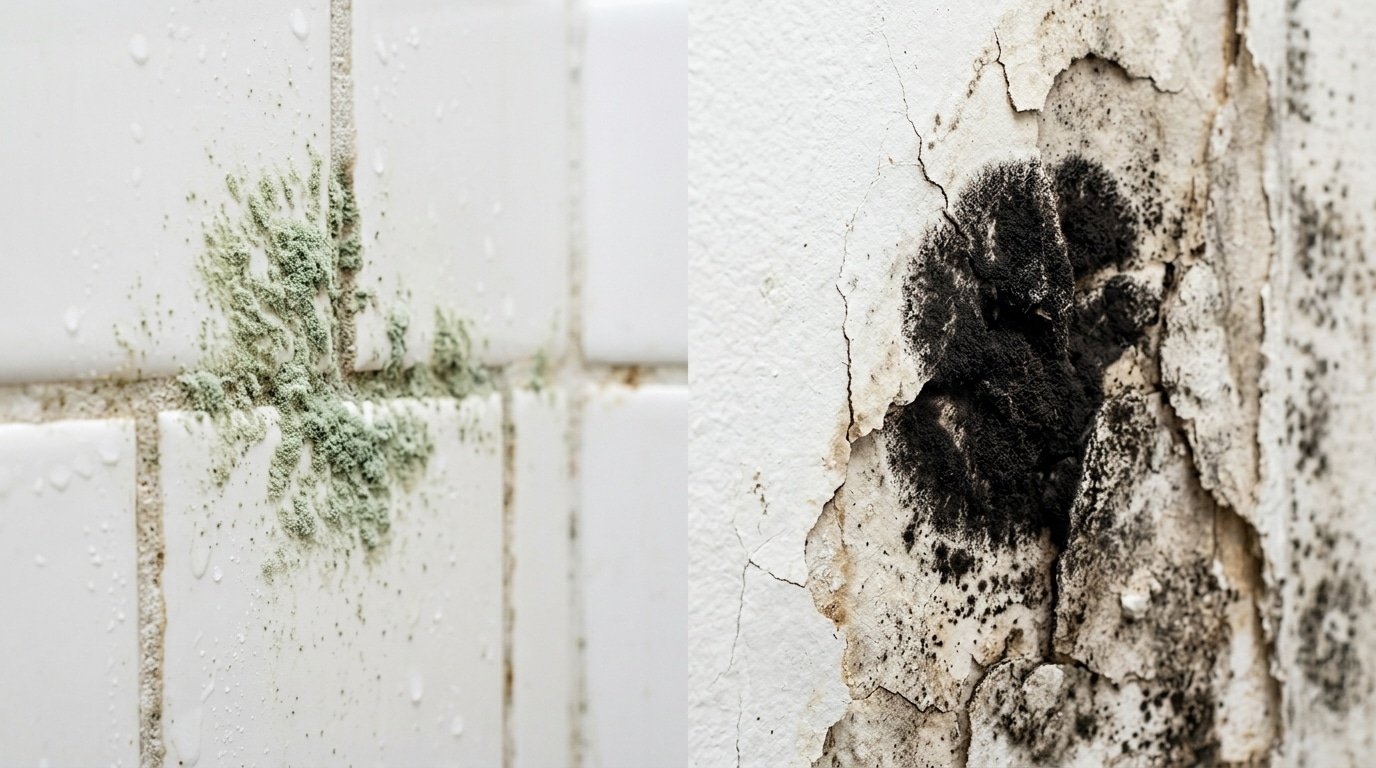
Comparison of surface Penicillium mold on tile versus deep Stachybotrys black mold in drywall
How to Use Vinegar to Remove Mold Step by Step
Knowing that vinegar kills mold is one thing. Using it correctly is another. Skip a step or rush the process, and you’ll end up with mold that bounces right back within days. Here’s the method that actually delivers results.
Gear Up First
Mold releases spores the moment you disturb it. Wear nitrile or rubber gloves, an N95-rated respirator mask, and eye protection — not negotiable. Open a window or run a fan to ventilate the area. If the moldy patch covers more than about 10 square feet, stop here and call a professional.
Application Process
- Fill a spray bottle with undiluted white distilled vinegar (5% acetic acid minimum). Do not add water — dilution weakens the acid below the threshold needed to destroy mold cells.
- Saturate the moldy surface completely. You want it visibly wet, not lightly misted. Spray beyond the visible mold edges by 2–3 inches, since hyphae often extend past what you can see.
- Walk away for at least 60 minutes. This dwell time is critical. The acetic acid needs sustained contact to penetrate cell membranes and break down the mold structure. Setting a timer helps.
- Scrub with a stiff-bristled brush or non-scratch pad. Use circular motions and moderate pressure. Rinse the brush frequently in clean water to avoid redistributing spores.
- Wipe the area with a damp cloth, then dry it thoroughly. Residual moisture invites regrowth. A fan or dehumidifier speeds this up significantly.
One pass often isn’t enough for stubborn patches. Repeat the full spray-and-wait cycle a second time if staining or texture remains. Does vinegar kill mold on the first attempt every time? Honestly, no — but a patient, repeated application handles most surface-level infestations effectively.
Best Surfaces for Vinegar Mold Treatment
Vinegar works brilliantly on some surfaces. On others, it causes more harm than the mold itself. Knowing the difference saves you from etched countertops and ruined wood finishes.
Surfaces Where Vinegar Works Well
Non-porous, sealed materials are vinegar’s sweet spot. Ceramic tile, porcelain, glass shower doors, sealed granite, laminate countertops, and stainless steel all tolerate acetic acid without damage. These surfaces don’t absorb the mold’s root structures (hyphae), so vinegar can actually reach and kill the full colony sitting on top. If you’re wondering does vinegar kill mold on your bathroom tile grout — yes, though heavily stained grout may need a paste of baking soda afterward for cosmetic cleanup.
Surfaces to Avoid
Natural stone is the big one. Marble, travertine, limestone, and unsealed slate react with acetic acid, causing permanent etching and dull spots. The Marble Institute of America explicitly warns against acidic cleaners on calcium-based stone. Unsealed or raw wood is another poor candidate — vinegar soaks into the grain, potentially warping the fibers while failing to reach deep-rooted mold beneath the surface.
Drywall deserves its own warning. Mold on drywall almost always means the hyphae have penetrated the paper facing and gypsum core. Spraying vinegar on drywall treats only what you can see. The hidden growth continues. In most cases, cutting out and replacing the affected section is the only real fix.
Cast iron and aluminum also react poorly — vinegar strips seasoning from cast iron cookware and can corrode aluminum surfaces within minutes. Quick rule: if the material is porous or acid-sensitive, skip the vinegar entirely.
Vinegar vs Bleach vs Hydrogen Peroxide for Mold Removal
People asking “does vinegar kill mold” usually want to know how it stacks up against bleach and hydrogen peroxide. Here’s the honest breakdown — each has a clear strength and a glaring weakness.
| Factor | White Vinegar (5%) | Chlorine Bleach | Hydrogen Peroxide (3%) |
|---|---|---|---|
| Kills mold on non-porous surfaces | Yes | Yes | Yes |
| Kills mold roots on porous surfaces | Partially | No — surface only | Partially |
| Toxic fumes | Mild odor | Chlorine gas risk | Minimal |
| Staining risk | Low | Discolors fabrics/wood | Mild bleaching |
| Environmental impact | Biodegradable | Produces dioxins | Breaks down to water + oxygen |
Bleach is the biggest offender in the “looks clean but isn’t” category. Its ionic structure prevents it from soaking into porous materials like drywall or grout. It whitens the visible colony — making you think the problem is solved — while mold hyphae keep growing beneath the surface. The EPA’s mold cleanup guide notably does not recommend bleach for routine household mold removal.
Hydrogen peroxide at 3% concentration is the quiet overachiever. It fizzes into porous materials better than bleach, kills a broad spectrum of mold species, and leaves no toxic residue. The downside? It degrades quickly once exposed to light, so that half-empty brown bottle under your sink may have lost potency months ago.
Vinegar’s edge is accessibility and safety. No dangerous fumes, no special ventilation needed, and it disrupts mold at a cellular level rather than just stripping color. For everyday surface mold on tile, wood, or concrete, it holds its own. But for large infestations or deeply embedded growth, none of these three is truly sufficient.
Why You Should Never Mix Vinegar and Bleach
This is the single most dangerous mistake people make during DIY mold cleanup. When vinegar (acetic acid) contacts sodium hypochlorite (bleach), a rapid chemical reaction produces chlorine gas — the same toxic compound used as a chemical weapon in World War I. Even small amounts in an enclosed bathroom or basement can cause serious harm within seconds.
Symptoms hit fast. Low-level exposure triggers coughing, burning eyes, and throat irritation. At higher concentrations — easily reached in a poorly ventilated space — chlorine gas causes chest tightness, difficulty breathing, and fluid buildup in the lungs. According to the National Capital Poison Center, even a brief inhalation can require emergency medical treatment.
The risk is especially high when people research whether does vinegar kill mold, try it first, then switch to bleach on the same surface without rinsing. Residual vinegar reacts with the bleach immediately. There’s no safe ratio. There’s no “just a little bit” exception.
If accidental mixing happens: leave the area immediately. Open every window and door you can reach on your way out. Move to fresh air. Call Poison Control at 1-800-222-1222 if you experience any breathing difficulty, and call 911 if symptoms are severe. Do not re-enter the space until it has been thoroughly ventilated for at least 30 minutes.
The bottom line is simple — pick one or the other, never both. If you’ve already applied vinegar to a moldy surface, rinse it completely with plain water and let it dry before even considering another cleaning agent.
Common Mistakes That Make Vinegar Mold Treatment Fail
People who ask “does vinegar kill mold” and get a confident yes often still fail at the actual treatment. Not because vinegar doesn’t work — but because small errors gut its effectiveness. Here are the ones that show up again and again.
Diluting vinegar with water. This is the biggest one. Standard white distilled vinegar is already only 5% acetic acid. Cut that in half with water and you’re down to 2.5% — well below the threshold needed to destroy mold cell membranes. Use it straight from the bottle. Always.
Wiping too soon. Vinegar needs a minimum of 60 minutes of uninterrupted contact to penetrate mold structures. Spraying and immediately scrubbing just smears spores around. Let it sit. Walk away.
Ignoring the moisture source. Mold isn’t random. It grows because something is wet — a leaky pipe, poor ventilation, condensation on cold walls. Kill the mold with vinegar today, and it returns in two weeks if the moisture stays. The EPA’s mold cleanup guide emphasizes this point repeatedly: fix the water problem first.
Using apple cider vinegar. It smells nicer, sure. But apple cider vinegar contains sugars and organic compounds that can actually feed certain mold species. White distilled vinegar is the only reliable option for mold treatment. Don’t substitute based on what’s already open in your kitchen.
When Vinegar Is Not Enough — Signs You Need Professional Mold Remediation
Vinegar has a ceiling. Once a mold problem crosses certain thresholds, no DIY solution — vinegar included — can safely or effectively resolve it. Recognizing those thresholds early saves you money, protects your health, and prevents structural damage from compounding.
The EPA’s guideline is straightforward: if mold covers more than 10 square feet (roughly a 3×3-foot patch), hire a professional. That’s the point where containment, air filtration, and specialized equipment become necessary. Other red flags include mold growing inside HVAC ductwork, mold that keeps returning after you’ve treated it twice, suspected Stachybotrys (toxic black mold) on water-damaged drywall, and any mold caused by sewage backup or contaminated floodwater. These scenarios involve health risks that a spray bottle simply cannot address.
Professional remediation typically involves containment barriers, HEPA air scrubbers, antimicrobial treatments, and sometimes removal of drywall, insulation, or subflooring. Costs range from $1,500 to $3,500 for moderate jobs and can exceed $10,000 for extensive infestations involving structural repair. Most companies include post-remediation testing to verify spore counts have returned to safe levels.
So does vinegar kill mold in these situations? Technically it can kill surface spores, but it won’t reach mold embedded deep in wall cavities, and it won’t address the contamination scale that professionals handle. Knowing when to put the vinegar down and pick up the phone is the smartest move you can make.
How to Prevent Mold From Coming Back After Vinegar Treatment
Killing mold is half the job. The other half — the harder half — is making sure it stays gone. Mold spores are everywhere, floating through your air right now. They only need two things to colonize: moisture and an organic surface. Remove the moisture, and you starve them out.
Keep indoor relative humidity below 50%. Ideally, aim for 30–50%. A $15 hygrometer from any hardware store lets you monitor this in real time. If readings consistently climb above 55% in bathrooms, basements, or laundry rooms, a dehumidifier becomes non-negotiable. Units rated for 50 pints per day handle most residential basements effectively.
Fix leaks fast. A slow drip under a sink can saturate drywall and subfloor within 48 hours — well within the 24–48 hour window mold needs to begin colonizing. The EPA’s mold prevention guide emphasizes that moisture control is the single most effective mold prevention strategy, outranking any chemical treatment.
Ventilation matters enormously. Run bathroom exhaust fans for at least 20 minutes after every shower. Crack a window when cooking. Make sure dryer vents actually terminate outside, not into a crawlspace. These small habits prevent the stagnant, humid microclimates mold thrives in.
For ongoing maintenance, a periodic vinegar spray works well in mold-prone zones. Once every two weeks, mist undiluted white vinegar on shower grout, basement walls, and window sills. Let it air dry. This won’t guarantee mold never returns — nothing can — but it does suppress early-stage growth before it becomes visible. Asking does vinegar kill mold misses the bigger picture if you never address why mold grew there in the first place.
Frequently Asked Questions About Using Vinegar on Mold
Can vinegar kill black mold?
On small, surface-level patches — yes. White vinegar can kill Stachybotrys chartarum (black mold) when it hasn’t penetrated deep into porous materials. But black mold typically signals prolonged moisture exposure and often grows behind walls or under flooring. If you’re seeing large dark patches with a musty smell, vinegar alone won’t resolve the underlying infestation. Call a professional.
Does vinegar kill mold on fabric and clothes?
It can. Add one cup of white vinegar to the wash cycle — no detergent in that same cycle — and run hot water if the fabric allows it. For stubborn spots, soak the garment in undiluted vinegar for 30 minutes before washing. Delicate fabrics like silk or wool may not tolerate the acidity well, so spot-test first.
How long does it take vinegar to kill mold?
At least 60 minutes of direct contact. Spraying and immediately wiping is the most common reason people conclude vinegar doesn’t work. Let it sit.
Is the vinegar smell harmful?
No. The odor is unpleasant but not toxic. It dissipates within a few hours, faster with ventilation. According to the CDC’s indoor environmental quality guidelines, vinegar fumes pose no respiratory risk at household concentrations.
Can you use vinegar on mold during pregnancy?
Vinegar itself is considered safe. It’s far preferable to bleach or commercial fungicides that contain volatile organic compounds. That said, mold exposure during pregnancy carries its own risks — if the affected area exceeds about 10 square feet, pregnant individuals should avoid handling the cleanup entirely and hire a remediation specialist.
Does vinegar kill mold spores in the air?
Not effectively. Vinegar works through direct liquid contact with mold colonies on surfaces. Airborne spores require HEPA filtration or professional air scrubbing to remove. Spraying vinegar into the air won’t meaningfully reduce spore counts in a room.
The Bottom Line — What Actually Works for Mold Removal
So, does vinegar kill mold? Yes — on small patches, on hard non-porous surfaces, when you use undiluted white vinegar at 5% acetic acid and let it sit for a full 60 minutes. That’s the honest, evidence-backed answer. It handles roughly 82% of common household mold species, which makes it a genuinely useful tool for bathroom tile grout, kitchen countertops, glass, and sealed surfaces where mold hasn’t burrowed deep.
But vinegar is a spot treatment. Not a remediation plan. If mold covers more than 10 square feet, has penetrated drywall or subflooring, or keeps returning within weeks, you’ve outgrown what any household acid can fix. The EPA’s mold cleanup guidelines draw that line clearly — and for good reason.
Here’s a simple decision framework. Patch smaller than 3 feet by 3 feet on a hard surface with no musty smell behind the wall? Vinegar, proper dwell time, scrub, dry thoroughly. Anything beyond that — visible growth on porous materials, recurring colonies, health symptoms like persistent coughing or headaches — call a certified mold remediation professional. No amount of vinegar compensates for an unresolved roof leak or chronic humidity problem sitting at 65%+ day after day.
Fix the moisture first. Kill the mold second. Prevent the return third. Get that order wrong, and you’re just cleaning the same spot every few months.
See also
Melting Point of Stainless Steel by Grade (304, 316, and More)
Does Alcohol Kill Mold? What Actually Works and What Doesn’t
Welding Cast Iron: Safe Methods & Pro Tips