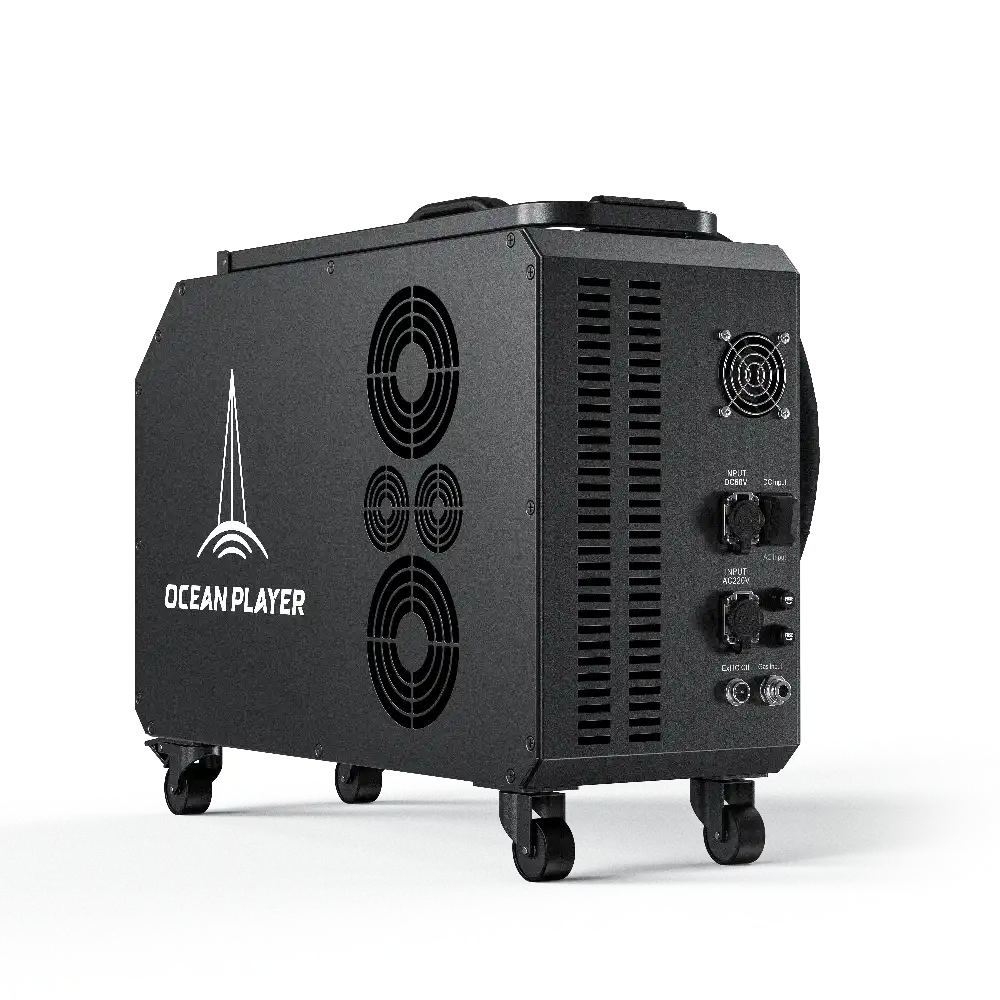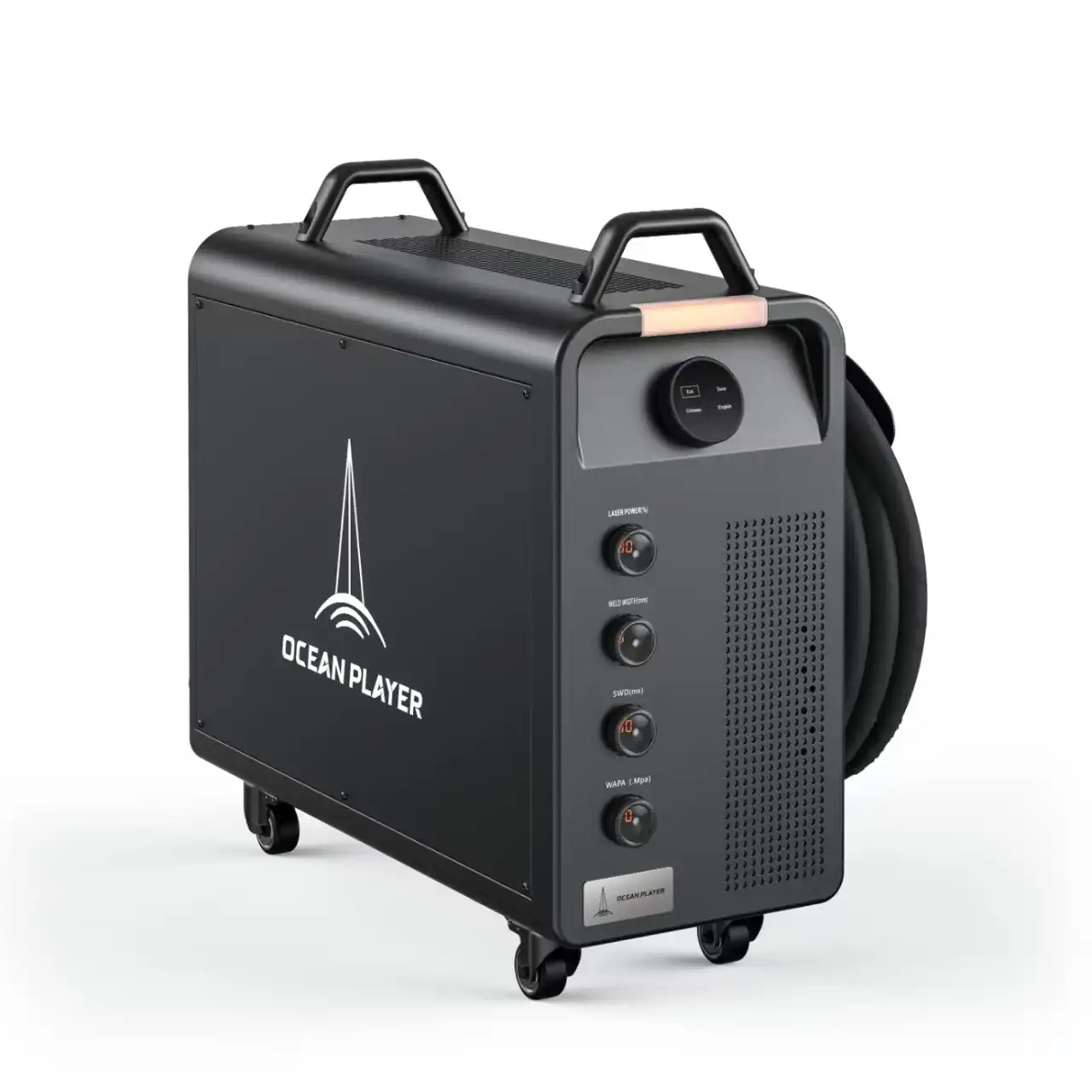
Grinding removes between 0.5 mm and 1.5 mm of base metal per pass — material you often can’t afford to lose on thin-gauge stainless or precision assemblies. If you’ve been wondering how to clean welds without grinding, the short answer is this: electrochemical cleaning, pickling paste, wire brushing, flap discs, laser cleaning, chemical passivation, and TIG dressing each offer a way to remove discoloration, oxide scale, and spatter while preserving the parent metal’s thickness and surface finish. This guide breaks down all seven methods with real cost figures, finish quality comparisons, and material-specific recommendations so you can pick the right approach for your shop.
Why You Might Want to Avoid Grinding Your Welds
Grinding works. Nobody disputes that. But it comes with a list of trade-offs that make experienced fabricators think twice — especially on stainless steel, thin-gauge material, or high-volume production lines where every minute counts.
The most immediate concern is material removal. A grinding disc doesn’t know when to stop. One extra pass can thin a weld joint below the parent metal thickness, creating a stress riser exactly where you need the most strength. On 16-gauge stainless, you’re working with roughly 1.5 mm of material — there’s almost no margin for error before you’ve compromised structural integrity.
Heat distortion is the second problem. Aggressive grinding generates localized temperatures above 300°C, enough to warp thin panels and introduce discoloration that’s nearly impossible to blend out. On austenitic stainless steels like 304 and 316, that heat also destroys the passive chromium oxide layer, which is the very thing protecting the metal from corrosion.
Then there’s the shop environment. Grinding throws abrasive dust and metal particulate into the air. OSHA’s permissible exposure limit for respirable dust containing chromium compounds sits at just 5 µg/m³ for hexavalent chromium, according to OSHA’s hexavalent chromium standards. That means ventilation, PPE, and monitoring — all adding overhead cost.
Noise is another factor people underestimate. A 4.5-inch angle grinder typically hits 95–100 dB. Run six of them in a fabrication bay for an 8-hour shift and you’ve got a serious hearing protection compliance issue on your hands.
Finally, there’s pure time cost. On a production run of 200 identical weldments, grinding and blending each bead manually can eat 3–5 minutes per joint. That adds up to 10–17 extra labor hours per batch. This is exactly why so many shops are searching for how to clean welds without grinding — they need a faster, more controlled alternative that doesn’t sacrifice quality or safety.

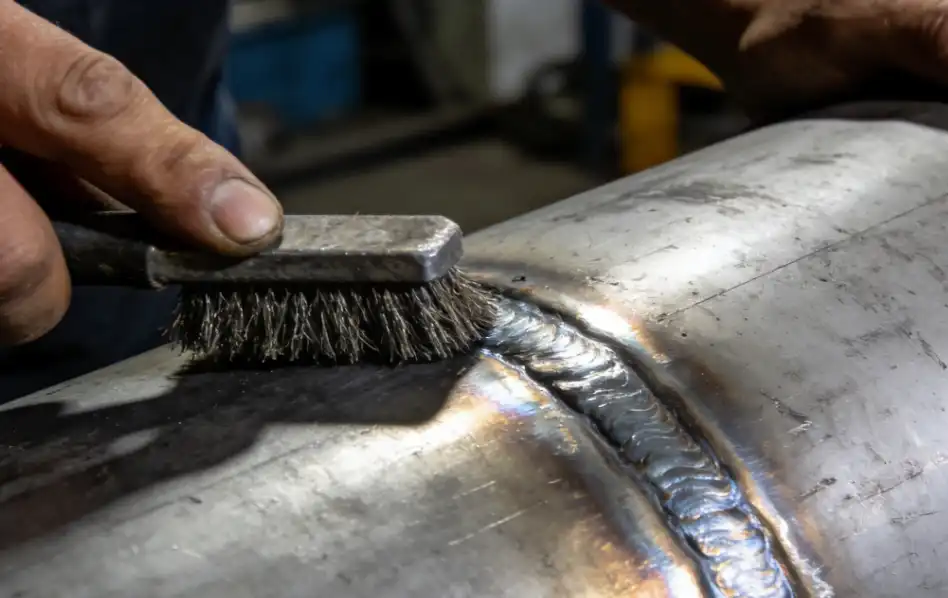
Heat discoloration and grinding damage on a stainless steel weld bead
Quick Overview of 7 Proven Methods to Clean Welds Without Grinding
Before diving into each technique, here’s a quick snapshot. The table below compares all seven methods for how to clean welds without grinding — sorted roughly from most accessible to most advanced.
| Method | Best For | Typical Cost | Finish Quality | Speed |
|---|---|---|---|---|
| Electrochemical Cleaning | Stainless steel TIG/MIG welds | $2,000–$6,000 (machine) | Excellent — mirror-like | Fast (seconds per inch) |
| Pickling Paste | Stainless steel heat tint removal | $30–$80 per jar | Very good | Slow (20–60 min dwell time) |
| Passivation | Corrosion protection after cleaning | $20–$60 per gallon | No visual change | Moderate (30–120 min soak) |
| Wire Brushing | Light slag and spatter on carbon steel | $5–$25 per brush | Acceptable — rough | Fast |
| Flap Discs | Blending and smoothing weld profiles | $3–$12 per disc | Good to very good | Moderate |
| Abrasive Belts | Long, straight seams and flat surfaces | $5–$15 per belt | Good — consistent | Fast on flat work |
| Laser Cleaning | High-volume production, zero consumables | $50,000–$300,000+ | Excellent — precise | Very fast |
A few things jump out. Electrochemical cleaning and laser cleaning deliver the best finish quality, but they sit at opposite ends of the budget spectrum. Pickling paste costs almost nothing upfront — you just need patience and proper ventilation. Wire brushing is the go-to for quick carbon steel cleanup, though it won’t remove heavy discoloration on stainless.
Flap discs blur the line between “grinding” and “not grinding.” They remove material, yes, but far less aggressively than a standard grinding wheel, which is why many fabricators consider them a separate category. The American Welding Society classifies them as finishing tools rather than grinding tools in several of their published guidelines.
No single method wins across every scenario. Material type, production volume, required finish, and budget all steer the decision. The sections ahead break down each option with enough detail to help you pick confidently — or combine two methods for an even better result.

Infographic comparing seven methods to clean welds without grinding including electrochemical, pickling paste, passivation, wire brushing, flap discs, abrasive belts, and laser cleaning
Electrochemical Weld Cleaning — How It Works and When to Use It
Think of it as reverse plating. Electrochemical weld cleaning passes a low-voltage electrical current through an electrolyte-soaked pad pressed against the weld surface. The current triggers a controlled electrochemical reaction that dissolves heat tint, oxide layers, and surface contamination — all without removing base metal. The process simultaneously passivates stainless steel, restoring its corrosion-resistant chromium oxide layer in a single step.
Most systems run between 12 and 60 volts AC/DC and use phosphoric acid-based electrolyte solutions. The operator drags a carbon fiber brush or felt pad across the weld zone, and discoloration disappears in seconds. A typical 12-inch TIG weld on 304 stainless can be cleaned in under 30 seconds — far faster than pickling paste, which might need 20 to 60 minutes of dwell time. That speed advantage alone makes electrochemical cleaning a go-to method for production shops figuring out how to clean welds without grinding.
Equipment costs range from roughly $2,000 for entry-level units to $8,000+ for industrial systems with variable power settings and integrated fume extraction. Brands like Cougartron and Walter have become industry standards. Consumable costs — electrolyte fluid and replacement pads — typically run $0.10 to $0.30 per linear foot of weld cleaned.
Where does it fall short? The method excels on austenitic and duplex stainless steels but struggles with carbon steel and aluminum. Carbon steel lacks the chromium needed for passivation, so you get cleaning without the protective benefit. Aluminum’s tenacious oxide layer requires different chemistry entirely. Also, the electrolyte is acidic — proper PPE and ventilation are non-negotiable, and wastewater disposal must comply with local environmental regulations.
For shops that primarily weld stainless and need a fast, repeatable way to clean welds without grinding, electrochemical cleaning delivers a mirror-bright finish with minimal operator skill after a short learning curve. The upfront investment pays for itself quickly on mid-to-high volume work.
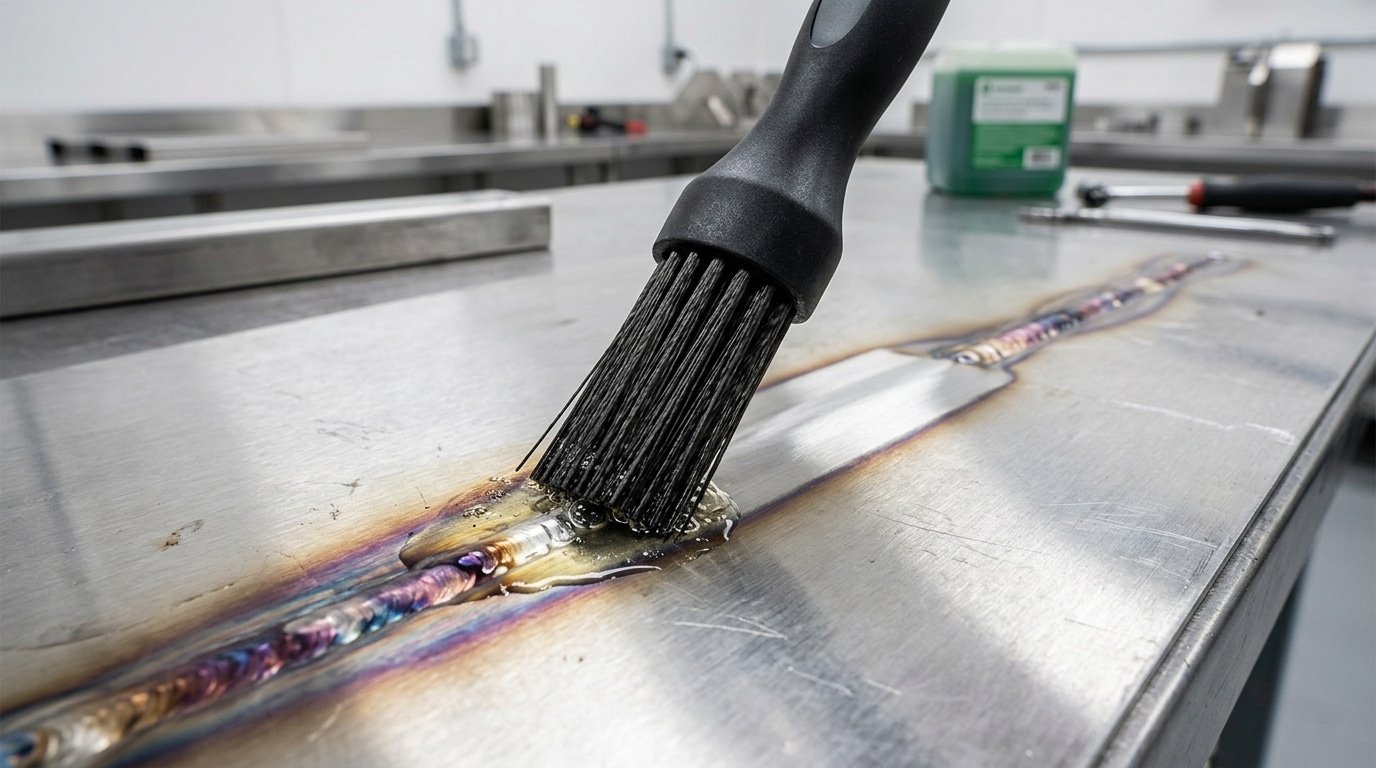
Electrochemical weld cleaning brush removing heat tint from a stainless steel TIG weld
Pickling Paste and Passivation for Stainless Steel Welds
If you work with stainless steel, pickling paste is probably already in your shop. This two-step chemical process — pickling followed by passivation — is the go-to method for removing heat tint and restoring corrosion resistance on stainless welds. It’s also one of the most reliable ways to learn how to clean welds without grinding, especially on food-grade, pharmaceutical, or marine fabrication where surface integrity is non-negotiable.
How Pickling Works
Pickling paste is an acid-based compound, typically a blend of nitric acid and hydrofluoric acid (HF concentrations usually range from 1–8%). You brush it directly onto the weld zone in a thick layer — roughly 3 mm — covering the heat-affected zone completely. The acid dissolves the chromium-depleted oxide scale that forms during welding, which is the discolored rainbow or blue-gray tint you see along the bead.
Dwell time matters more than most fabricators realize. Thin heat tint on 304 stainless might need only 20–30 minutes. Heavy oxide scale on 316L or duplex grades can require 60 minutes or longer. Ambient temperature plays a role too — below 15°C, chemical reactions slow considerably, and you may need to extend dwell time by 50%. Once the tint disappears, rinse thoroughly with clean water. Residual acid left on the surface will pit the metal.
Passivation: The Step People Skip
Passivation rebuilds the protective chromium oxide layer that pickling just stripped away. A passivation solution — often citric acid or dilute nitric acid — is applied after rinsing and left for 20–30 minutes. According to ASTM A967, proper passivation testing should confirm a uniform chromium oxide film free of free iron contamination. Skip this step, and your freshly pickled stainless will corrode faster than untreated material.
For corrosion-critical stainless steel fabrication, this pickling-then-passivation sequence remains the industry standard. It delivers a chemically clean surface without removing any parent material — a key advantage when you need to clean welds without grinding and preserve exact wall thickness on pressure vessels or sanitary tubing.
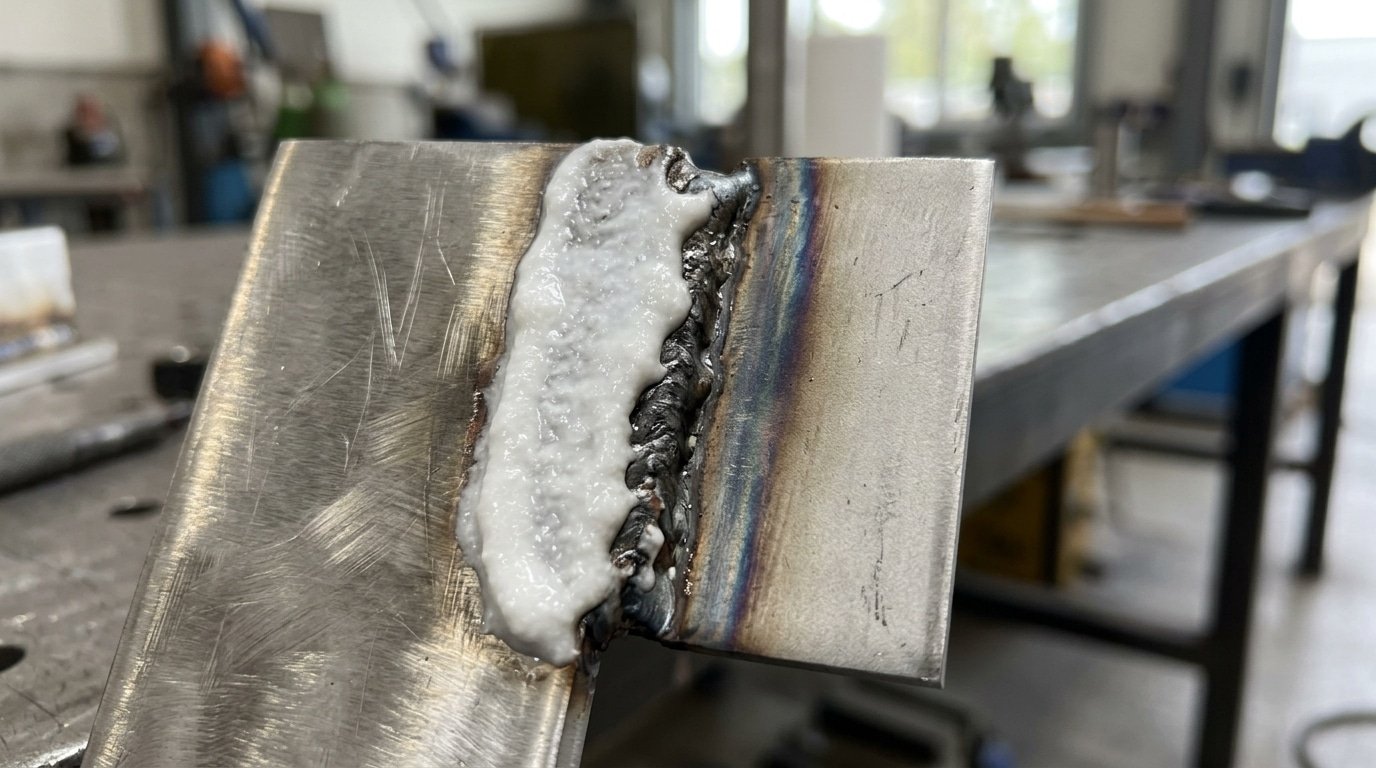
Pickling paste applied to stainless steel weld to remove heat tint without grinding
Wire Brushing, Flap Discs, and Other Mechanical Alternatives
Not every mechanical approach involves an aggressive grinding wheel. A dedicated stainless steel wire brush, for instance, removes heat tint and light spatter without cutting into the base metal at all. The key rule: always match the brush material to the workpiece. Use a stainless steel brush on stainless steel, a carbon steel brush on carbon steel. Cross-contamination embeds foreign particles into the surface and kickstarts corrosion within days.
Non-woven abrasive discs — often sold under brand names like Scotch-Brite or Walter Blendex — sit in a sweet spot between wire brushes and grinding wheels. They conform to weld contours, blend discoloration, and leave a uniform satin finish. Run them at 4,000–6,000 RPM on an angle grinder, and keep the disc moving in overlapping passes rather than dwelling in one spot. Dwell marks are surprisingly hard to fix later.
Flap discs deserve a mention too, but grit selection matters enormously. A 40-grit flap disc behaves almost like a grinding wheel; a 120-grit disc, on the other hand, polishes more than it cuts. For anyone figuring out how to clean welds without grinding aggressively, 80-grit or finer flap discs offer a practical middle ground — enough bite to knock down minor imperfections, gentle enough to preserve weld geometry. The American Welding Society recommends light, consistent pressure and letting the abrasive do the work rather than forcing the tool into the joint.
Abrasive belts on file belt sanders handle tight corners and inside fillets that discs can’t reach. They’re underrated. A 1/2-inch belt sander with a 120-grit ceramic belt cleans a fillet weld in seconds, leaving the profile intact. Whichever mechanical method you choose, one principle stays constant: remove discoloration and contamination, not the weld itself.
Laser Weld Cleaning — The High-Tech Alternative
A pulsed fiber laser fires rapid bursts of light—typically at 1064 nm wavelength—onto the weld surface. Each pulse vaporizes a microscopic layer of oxide, discoloration, or contamination without ever touching the base metal. The process is called laser ablation, and it’s genuinely contactless. No brushes, no chemicals, no electrolyte pads. Just light doing the work.
The physics are straightforward. Contaminants absorb laser energy at a far higher rate than clean metal. So the oxide layer flash-evaporates while the substrate underneath stays cool and undamaged. Pulse durations measured in nanoseconds mean heat-affected zones are virtually nonexistent. For anyone exploring how to clean welds without grinding, this is the closest thing to a “magic wand” solution on the market right now.
Where Laser Cleaning Excels
Stainless steel TIG welds respond beautifully—heat tint vanishes in a single pass. Titanium welds, notoriously sensitive to contamination, also benefit because there’s zero risk of embedding foreign particles. Aluminum is trickier; its high reflectivity at 1064 nm reduces efficiency, though newer 200W+ systems handle it adequately. Carbon steel cleanup works too, but the cost-per-part rarely justifies laser over simpler methods for mild steel.
The Investment Reality
Entry-level handheld pulsed laser systems start around $15,000–$20,000 for 100W units. Production-grade 200W–300W machines run $30,000–$80,000 depending on features like automated focal adjustment and fume extraction integration. That’s a steep number for a small fab shop. But consider the math: no consumable pads, no chemical replenishment, no hazardous waste disposal fees. According to Industrial Laser Solutions, shops processing 40+ hours of weld cleaning per week often hit ROI within 18–24 months when replacing electrochemical consumables.
The honest limitation? Speed on heavy scale. Laser cleaning removes thin oxide layers fast—roughly 1–3 square meters per hour on stainless heat tint—but thick mill scale or heavy spatter still demands mechanical prep first. It’s a finishing tool, not a sledgehammer. For high-volume stainless or titanium work where surface integrity is non-negotiable, though, the payback is real.
Chemical vs Mechanical Weld Cleaning — Cost, Finish, and Speed Comparison
Choosing how to clean welds without grinding ultimately comes down to balancing three things: what finish you need, what you can spend, and how fast you need results. Chemical and mechanical methods each dominate in different scenarios, and the gap between them is wider than most people assume.
On surface finish, chemical methods win decisively for stainless steel. Electrochemical cleaning restores a bright, uniform oxide layer in a single pass. Pickling paste achieves a similar result but demands 20–60 minutes of dwell time. Mechanical options like wire brushing leave visible brush marks, and flap discs—while smoother—still can’t match the corrosion resistance that chemical passivation delivers. Laser cleaning sits in a category of its own: mirror-quality finish with zero consumables, but at a steep entry price.
Cost tells a different story. A stainless steel wire brush costs $4–$12 and handles dozens of welds. A liter of pickling paste runs $30–$50 and covers roughly 15–25 linear feet of weld, depending on bead size. Electrochemical units start around $2,500 for a basic system, with electrolyte refills costing $40–$80 per liter. Laser systems? Expect $50,000–$300,000 depending on wattage. Per-weld cost drops dramatically at scale for electrochemical and laser, but for a small shop doing 20 welds a week, a wire brush and some pickling paste are hard to beat economically.
Speed favors electrochemical and mechanical methods. A TIG weld on 2-inch schedule 40 pipe takes about 15–30 seconds to clean electrochemically. Wire brushing is similarly fast. Pickling paste is the slowest option by far—you apply it, wait, neutralize, rinse. Laser cleaning matches electrochemical speed on straight runs but slows down on complex geometries where the beam can’t maintain consistent focus. The American Welding Society has published guidelines noting that production environments increasingly favor electrochemical methods for this exact reason.
| Factor | Wire Brush | Flap Disc | Pickling Paste | Electrochemical | Laser |
|---|---|---|---|---|---|
| Surface Finish Quality | Fair | Good | Excellent | Excellent | Excellent |
| Cost per Weld (approx.) | $0.10–$0.30 | $0.25–$0.75 | $1.50–$3.00 | $0.40–$1.00 | $0.05–$0.20* |
| Speed (per linear foot) | 30–60 sec | 20–45 sec | 20–60 min | 15–45 sec | 10–30 sec |
| Skill Level Needed | Low | Low–Medium | Medium | Low–Medium | Medium |
| Environmental Impact | Minimal | Dust/debris | Hazardous waste | Mild acid waste | Minimal |
*Laser per-weld cost assumes high-volume production to offset equipment investment.
The takeaway is straightforward. Small shops with mixed materials lean mechanical. Stainless-focused fabricators doing repeat production get the fastest ROI from electrochemical systems. And if your annual weld volume justifies six figures in equipment, laser cleaning pays for itself through consumable savings alone within 2–3 years.
Best Weld Cleaning Method by Material — Stainless Steel, Carbon Steel, and Aluminum
Each metal has its own personality. What delivers a mirror finish on stainless can wreck an aluminum weld, and what works fine on carbon steel might contaminate stainless beyond repair. Matching your cleaning method to the base material isn’t optional—it’s the difference between a part that passes inspection and one that gets scrapped.
Stainless Steel
Corrosion resistance is the whole point of stainless, so your cleaning method must restore the chromium oxide passive layer—not destroy it. Electrochemical cleaning is the top pick here, handling both heat tint removal and passivation in a single pass. Pickling paste runs a close second, especially for batch processing, though it requires careful neutralization and rinsing. One critical rule: never use a carbon steel wire brush on stainless. Even trace iron contamination triggers tea staining and pitting within weeks. According to the British Stainless Steel Association, even airborne carbon steel particles from nearby grinding operations can embed in stainless surfaces and cause premature corrosion.
Carbon Steel
Carbon steel is far more forgiving. It doesn’t need passivation, and it tolerates aggressive mechanical methods without the contamination risks stainless faces. Stainless steel flap discs, wire wheels, and even coarser abrasive options all work well. For shops figuring out how to clean welds without grinding on carbon steel, a simple wire brush pass followed by a rust-inhibiting primer often does the job. Chemical cleaning is rarely justified here unless the spec calls for a specific surface profile.
Aluminum
Aluminum is the tricky one. Its oxide layer melts at roughly 2,072°C while the base metal melts at just 660°C—that mismatch means oxide fragments can get trapped beneath the surface during aggressive cleaning. Stainless steel wire brushes dedicated exclusively to aluminum work best for light post-weld cleanup. Electrochemical systems with aluminum-specific electrolytes are gaining traction, but laser cleaning is arguably the cleanest option because it vaporizes oxides without any mechanical contact or chemical residue. Avoid pickling acids formulated for stainless; they’ll attack aluminum aggressively and leave a pitted, unusable surface.
Safety Tips for Chemical and Electrochemical Weld Cleaning
Pickling pastes contain hydrofluoric acid (HF) and nitric acid—both capable of causing severe chemical burns on contact. HF is especially dangerous because it penetrates skin painlessly at first, then attacks underlying bone and tissue hours later. Wear acid-resistant gloves (neoprene or butyl rubber, not latex), a full-face shield, and a chemical-splash apron every single time. No exceptions for “quick touch-ups.”
Ventilation matters more than most people realize. Nitric acid fumes irritate the respiratory tract at concentrations as low as 2 ppm. Work outdoors or under a local exhaust hood rated for acid vapors. A standard shop fan blowing fumes sideways doesn’t count—it just pushes the hazard toward someone else.
Electrochemical systems are safer than raw pickling paste, but they still use phosphoric acid-based electrolytes that can burn skin and eyes. Keep the electrolyte bottle sealed when not in use. If the felt pad dries out mid-job, re-wet it with fresh electrolyte rather than water—diluting it unevenly can cause inconsistent cleaning and unexpected splashing when current flows.
Two mistakes show up repeatedly. First, skipping the neutralization rinse after pickling. Residual acid left on stainless steel will pit the surface within hours, undoing the very corrosion protection you were trying to build. Rinse thoroughly with clean water, then apply a neutralizing solution (sodium bicarbonate at roughly 1 oz per gallon works). Second, mixing leftover pickling paste with alkaline cleaners during disposal—this reaction generates toxic nitrogen oxide gases. The OSHA hydrofluoric acid safety guidelines outline proper handling and emergency response steps worth reviewing before your first application.
Spent electrolytes and used pickling paste are classified as hazardous waste under EPA regulations. Store them in labeled, acid-resistant containers and arrange pickup through a licensed waste hauler. Dumping them down a drain—even a floor drain connected to an industrial sewer—can result in fines exceeding $37,500 per day per violation. Knowing how to clean welds without grinding includes knowing how to handle the chemistry responsibly.
Frequently Asked Questions About Cleaning Welds Without Grinding
Can you clean TIG welds without grinding?
Absolutely. TIG welds are already among the cleanest weld types, so they rarely need aggressive material removal. Electrochemical cleaning handles heat tint in seconds, and a light pass with a stainless steel wire brush removes minor oxidation without disturbing the bead profile. Grinding a good TIG weld is often counterproductive—it destroys the smooth, stacked-dime appearance that clients pay a premium for.
Is electrochemical cleaning as good as pickling paste?
For corrosion resistance, they’re comparable. Both restore the passive chromium oxide layer on stainless steel. Electrochemical systems do it faster—typically 5–15 seconds per inch of weld—while pickling paste needs 20–60 minutes of dwell time. The real difference is convenience and safety. Paste uses hydrofluoric acid; electrochemical units use a phosphoric acid electrolyte that’s far less hazardous. For high-volume production, electrochemical wins on throughput. For occasional jobs where budget matters, paste still holds its own.
How do you remove weld discoloration from stainless steel?
That rainbow heat tint is a thickened oxide layer. Electrochemical cleaning strips it almost instantly. Pickling paste dissolves it chemically. Even a citric acid passivation bath conforming to ASTM A380 can reduce light straw-colored discoloration, though it won’t touch heavy blue or black oxide. The method you pick depends on how dark the tint is and how many joints you’re processing.
What is the cheapest way to clean welds?
A stainless steel wire brush costs under $10 and handles light cleanup on most metals. For stainless steel specifically, a $15–$30 jar of pickling paste covers dozens of joints. These two options are the entry point for anyone figuring out how to clean welds without grinding on a tight budget.
Do you need to passivate after electrochemical cleaning?
Most modern electrochemical systems include a passivation step built into the process—you switch polarity or swap to a passivation fluid after cleaning. So the short answer is no, you don’t need a separate passivation treatment. That said, if your project spec calls for a verified passive layer (common in pharmaceutical or food-grade work), independent testing with a ferroxyl solution or copper sulfate test confirms the surface meets requirements.
Choosing the Right Method for Your Shop — Actionable Summary
You’ve seen seven methods. Now pick one. The decision comes down to four variables: what metal you weld most, how many parts you push per week, your available budget, and the finish quality your customers expect.
Hobbyists and Home Shops
If you’re welding stainless in a garage a few times a month, a stainless steel wire brush and a jar of pickling paste will cover 90% of your needs for under $80 total. That’s the cheapest path to learning how to clean welds without grinding while still getting a professional-looking result. Upgrade to a dedicated electrochemical brush unit—something in the $500–$1,200 range—once you start taking on paid work or want faster turnaround.
Small Fabrication Shops (5–50 Parts per Day)
An electrochemical weld cleaning system pays for itself fast at this volume. Expect to spend $2,000–$5,000 on a mid-tier unit from brands like Cougartron or Walter. Pair it with non-woven flap discs for carbon steel jobs where passivation isn’t needed. Keep pickling paste on hand for batch processing larger assemblies—handrails, food-service tables, architectural panels—where brush access is awkward.
High-Volume Production Environments
Laser cleaning becomes viable when you’re processing hundreds of parts daily and labor cost matters more than equipment cost. A 200 W pulsed fiber laser system runs $50,000–$150,000, but it eliminates consumables entirely and cleans a linear meter of weld in seconds. The American Welding Society has documented growing adoption of laser-based post-weld processing in automotive and aerospace production lines for exactly this reason.
Your Concrete Next Step
Grab one method that fits your budget today. Test it on scrap material before committing to production parts. Track three things: time per weld, consumable cost per joint, and whether the finish meets spec. That data—not guesswork—tells you if you need to scale up. Figuring out how to clean welds without grinding isn’t a one-size answer; it’s a match between your shop’s reality and the right tool for the job.
See also
Pulsed Laser Cleaning — Ultimate Guide to Oxide Removal
How to Match Laser Cleaning Power Levels to Your Needs
Stainless Steel vs Aluminum Which Is Better for Sheet Metal Work
Analysis of the causes of cracks in laser welded carbon steel