Rust can form on exposed carbon steel in as little as 4–5 hours at 70% relative humidity — and once it starts eating into a cutting edge, blade performance drops fast. If you’re looking for how to remove rust on cutting tools, the short answer is this: soak in white vinegar or apply a baking soda paste for light rust, use a commercial phosphoric-acid remover for moderate corrosion, and reserve electrolysis or abrasive methods for heavy pitting. This guide walks through each technique step by step, explains which method matches your specific tool and rust severity, and covers the prevention habits that keep blades clean long after restoration.
Quick Answer — How to Remove Rust on Cutting Tools
Here’s the short version. Figuring out how to remove rust on cutting tools comes down to five steps you can knock out in an afternoon — sometimes faster.
- Assess the rust severity. Light orange surface rust needs a different approach than deep brown pitting that’s eaten into the steel.
- Pick your method. A white vinegar soak (4–12 hours) handles mild cases. Baking soda paste works for spot treatment. Commercial rust removers containing phosphoric acid cut through moderate buildup in 15–30 minutes. For heavy rust, use abrasive tools like a wire wheel on a bench grinder. Electrolysis — a 12V battery charger, washing soda, and water — tackles the worst cases without removing good metal.
- Scrub or treat the surface. After soaking or applying your chosen product, work the loosened rust off with steel wool, a brass brush, or 220-grit sandpaper.
- Rinse and dry immediately. Even 10 minutes of moisture left on bare steel restarts oxidation. Towel dry, then hit it with a heat gun or hair dryer.
- Apply a protective coating. A thin layer of camellia oil, paste wax, or a dedicated tool protectant like Boeshield T-9 prevents future rust from forming.
That’s the framework. The sections below break each step into detail so you match the right technique to your specific tools and rust level.

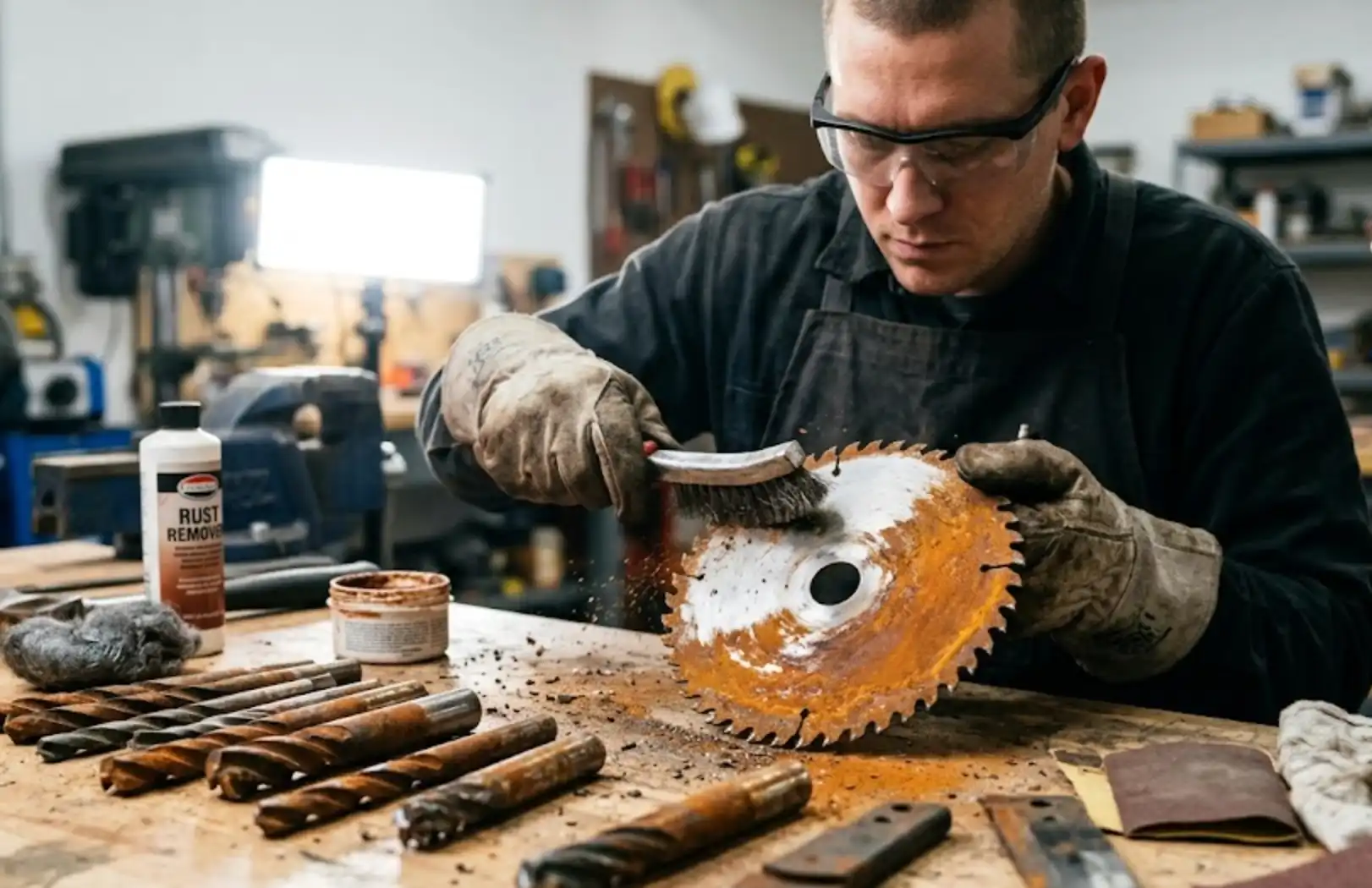
Rusty cutting tools on a workbench with rust removal supplies including vinegar, steel wool, and commercial rust remover
Why Cutting Tools Rust and How to Assess the Damage Level
Rust is iron oxide — a chemical reaction between iron (or steel), oxygen, and moisture. That’s it. Your cutting tools don’t need to be submerged in water to corrode. Humidity above 50%, a sweaty palm print left on a blade, or condensation inside a poorly ventilated toolbox is more than enough. The process accelerates dramatically when dissimilar metals touch — say, a carbon steel chisel resting against an aluminum bracket — creating a galvanic cell that speeds corrosion by 2–4x compared to normal oxidation.
Improper storage causes most workshop rust problems. Tools tossed into a damp drawer without oil or a vapor corrosion inhibitor (VCI) wrap will show orange spots within days in humid climates. According to NACE International, corrosion costs industries over $2.5 trillion annually — and your shop tools aren’t exempt from the same chemistry.
Three Damage Levels You Need to Identify
Before figuring out how to remove rust on cutting tools effectively, assess the damage. Surface rust appears as orange or reddish-brown discoloration that wipes partially with a rag — the metal underneath is still smooth and intact. Moderate rust feels rough to a fingernail drag test; tiny pits are forming, but the tool’s geometry holds. Severe rust shows deep pitting you can catch a fingernail in, flaking metal, or visible structural thinning along the cutting edge. Severe cases may compromise the tool beyond safe use.
A quick test: run a brass brush across the rusted area with light pressure. If bright steel appears easily, you’re dealing with surface-level corrosion. If dark pockmarks remain after brushing, pitting has begun — and your removal method needs to match that severity.

Three rust damage levels on cutting tools from surface rust to severe pitting
Surface Rust vs. Deep Pitting — Knowing When a Tool Is Worth Saving
Not every rusted tool deserves your time. Before figuring out how to remove rust on cutting tools, run your thumbnail across the affected area. Surface rust feels rough but the metal underneath is still solid — the discoloration wipes away partially with a dry rag, and you can still see the original grind lines on the bevel. This type responds well to any of the removal methods we’ll cover later.
Deep pitting is a different story. Look for small craters or pockmarks where the steel has actually been eaten away. If you can catch your fingernail in those pits, the metal is gone permanently. On a cutting edge, pitting deeper than roughly 0.5 mm means you’d need to grind past the damage to restore a functional bevel — and on thin blades like utility knives or precision shears, that often removes more material than the tool can afford to lose.
Here’s a practical rule: if the rust is only on flat surfaces or the body of the tool, it’s almost always salvageable. If pitting runs along the cutting edge itself and extends more than halfway across the bevel width, replacement is cheaper and safer. A compromised edge can chip under load, turning a routine cut into a safety hazard. The OSHA guidelines on hand tools explicitly flag damaged cutting edges as a workplace risk worth taking seriously.

Side-by-side comparison of surface rust versus deep pitting on cutting tool edges
Essential Supplies and Safety Precautions Before You Start
Gather everything before you begin. Jumping between methods mid-project wastes time and risks leaving a half-treated tool exposed to more moisture. Here’s the full supply list across every approach covered in this guide.
Materials for Rust Removal
- White vinegar (distilled, 5% acidity) — at least 500 ml for soaking
- Baking soda — a standard 16 oz box is plenty
- Steel wool (#0000 ultra-fine for delicate edges, #00 for heavier buildup)
- Nylon abrasive pads (Scotch-Brite or equivalent) for softer metals
- Commercial rust remover containing phosphoric or oxalic acid — Evapo-Rust and Naval Jelly are popular picks
- WD-40 or penetrating oil for loosening stubborn surface oxidation
- Washing soda (sodium carbonate) if you’re attempting electrolysis
- Clean rags, a plastic container, and an old toothbrush
Safety Gear — Non-Negotiable
Knowing how to remove rust on cutting tools means nothing if you end up with chemical burns or a sliced finger. Corroded blades are unpredictable — edges weaken, chips hide under rust flakes, and a tool can snap under pressure you wouldn’t expect. Wear chemical-resistant nitrile gloves (not latex, which degrades in acid), ANSI Z87.1-rated safety glasses, and work in a space with cross-ventilation or an exhaust fan. The OSHA PPE guidelines recommend matching glove material to the specific chemical — check the product’s SDS sheet if you’re using a commercial remover.
One more thing: keep a bucket of clean water and baking soda nearby. If acid splashes on skin, neutralize it immediately rather than just rinsing. Prep takes five minutes. Skipping it can cost you a lot more.
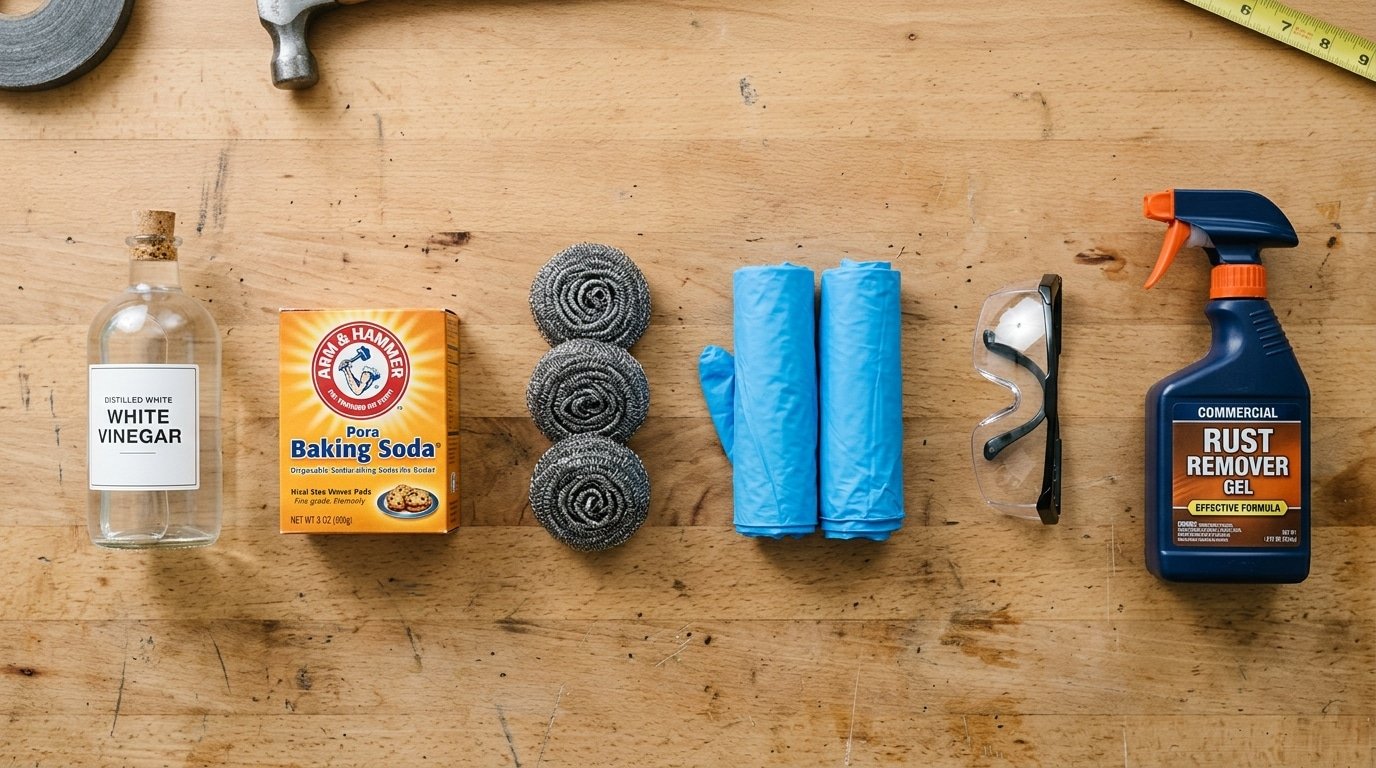
Essential supplies for removing rust on cutting tools including vinegar, steel wool, gloves, and safety glasses
5 Proven Methods to Remove Rust from Cutting Tools
Not every rusted chisel needs the same fix. A light orange film on a utility knife calls for a completely different approach than thick, crusty oxidation on a set of vintage pruning shears. The table below breaks down five methods so you can match the right technique to your specific situation — and skip straight to the section that applies.
| Method | Best For | Cost | Time | Skill Level |
|---|---|---|---|---|
| White Vinegar Soak | Light to moderate rust | Under $3 | 4–24 hours | Beginner |
| Baking Soda Paste | Spot treatment, delicate edges | Under $2 | 15–60 minutes | Beginner |
| Commercial Rust Removers | Moderate rust, fast results | $8–$20 | 15 min–2 hours | Beginner |
| Abrasive / Power Tools | Heavy, widespread rust | $10–$50+ | 10–30 minutes | Intermediate |
| Electrolysis | Severe rust, valuable tools | $15–$30 setup | 4–12 hours | Intermediate–Advanced |
A quick pattern stands out: cheap methods take longer, and fast methods cost more or demand extra care. When figuring out how to remove rust on cutting tools, your real decision comes down to three variables — how bad the rust is, how much time you have, and whether the tool’s edge geometry needs protecting. Vinegar and baking soda won’t damage a finely honed bevel. Wire wheels absolutely can.
Each method gets its own detailed walkthrough in the sections that follow, complete with step-by-step instructions. According to NACE International, corrosion costs the global economy over $2.5 trillion annually — so rescuing a $40 pair of tin snips from the scrap pile is a genuinely worthwhile 20-minute investment. Pick your method and scroll down.
Method 1 — White Vinegar Soak for Light to Moderate Rust
White vinegar works because its acetic acid (typically 5% concentration) dissolves iron oxide without attacking the underlying steel aggressively. It’s cheap, non-toxic, and already in your kitchen. Here’s how to remove rust on cutting tools using this method effectively.
Step-by-Step Process
- Fill a container with enough undiluted white vinegar to fully submerge the rusted area. A shallow plastic tray works well for chisels and plane irons.
- Submerge the tool and set a timer. Light surface rust typically loosens in 1–4 hours. Moderate rust with visible texture needs 8–24 hours. Check every few hours — don’t just walk away for a full day.
- Scrub the loosened rust using a brass brush or 0000 steel wool. Brass is gentler on polished surfaces; steel wool cuts faster on heavily corroded spots.
- Neutralize the acid immediately. Mix one tablespoon of baking soda into a cup of water, then wipe the tool thoroughly with this solution. Skip this step and you’ll invite flash rust within hours.
- Dry completely with a clean cloth, then apply a thin coat of oil.
Handling Tools with Non-Metal Components
Wooden or plastic handles don’t belong in an acid bath. Stand the tool upright in a narrow container so only the metal portion sits in vinegar, or wrap the handle tightly with plastic wrap and rubber bands to create a seal. According to Bob Vila’s rust removal guide, prolonged acid exposure can degrade wood finishes and weaken adhesive joints — so partial soaking is worth the extra setup time.
Method 2 — Baking Soda Paste for Spot Treatment on Delicate Edges
Vinegar soaks work great for broad surface rust, but they’re overkill for a single rust spot on a carving knife bevel. Baking soda paste gives you surgical precision. You control exactly where the mild abrasive and alkaline reaction hit, which matters enormously when figuring out how to remove rust on cutting tools with finely honed edges — think chisels ground to 25°, plane blades lapped flat to micron tolerances, or detail carving knives with compound bevels.
Mix three parts baking soda to one part water until you get a consistency like thick peanut butter. Too runny and it slides off; too dry and it won’t react. Apply the paste directly onto each rust spot using a cotton swab or your fingertip, building up a layer roughly 2–3 mm thick. Avoid smearing it across the cutting edge itself — keep it on the flat or the bevel face only.
Let it sit for 45 to 60 minutes. The sodium bicarbonate’s alkaline pH (around 8.3) loosens the iron oxide bond without attacking the base steel the way acids can. After the wait, scrub gently with a soft-bristle toothbrush or a piece of fine brass wool. Work in the direction of the existing scratch pattern — never across it. Rinse with clean water, dry immediately with a lint-free cloth, and inspect. Stubborn spots may need a second application. According to Bob Vila’s rust removal guide, baking soda is one of the safest household options precisely because it won’t etch or pit the metal surface.
Method 3 — Commercial Rust Removers and Phosphoric Acid Products
When vinegar and baking soda fall short, commercial rust removers earn their price. Products like Evapo-Rust use chelation chemistry — molecules that bond directly to iron oxide and lift it away without attacking the base metal. Phosphoric acid-based options like Naval Jelly take a different route: they convert rust into iron phosphate, a stable black coating you can paint over or scrub off.
Here’s how to remove rust on cutting tools with a commercial soak. Submerge the tool completely in Evapo-Rust for 30 minutes to 12 hours depending on severity. Moderate rust typically clears in 3–4 hours. Rinse with clean water, dry immediately, and apply a thin coat of oil. For Naval Jelly, brush a 1/8-inch layer onto the rusted area, wait 10–15 minutes (never longer — it can etch the steel), then rinse thoroughly.
Commercial removers outperform DIY solutions in two specific scenarios: rust that covers more than 60% of the tool surface, and corrosion lodged in serrations, teeth, or tight mechanical joints where paste methods can’t reach. The cost runs $8–$20 per quart, but one batch of Evapo-Rust handles multiple tools before losing effectiveness.
Skip Naval Jelly on thin blades or precision edges. Its acid concentration is aggressive enough to soften heat-treated steel if left beyond the recommended window.
Method 4 — Abrasive and Power Tool Cleaning for Heavy Rust
Chemical soaks can’t always cut it. When rust has built up thick, flaky layers on a machete, axe head, or large chisel, mechanical abrasion is the fastest path back to clean steel. This is the brute-force approach to how to remove rust on cutting tools — effective but demanding careful technique.
Sandpaper Progression
Start with 80-grit aluminum oxide paper to knock off heavy scale. Work in one direction along the blade’s length, not in circles. Once the bulk is gone, step up to 150-grit, then 220, and finish at 400-grit for a smooth surface. Skipping grits leaves deep scratches that trap moisture and invite rust right back.
Wire Wheels and Scotch-Brite Pads
A wire wheel on a cordless drill removes rust fast — almost too fast. Use a crimped wire wheel, not a knotted one, which is far too aggressive for most cutting tools. For finer work, medium-grit Scotch-Brite pads (maroon, rated roughly 320-grit equivalent) conform to curved surfaces like gouge flutes without gouging the steel itself. According to Norton Abrasives, non-woven pads reduce the risk of undercutting base metal compared to bonded abrasive discs.
Protecting the Tool’s Temper
Heat is the hidden danger here. Angle grinders spinning at 10,000+ RPM generate enough friction to turn a cutting edge blue — a visible sign the steel’s temper has been drawn and hardness permanently reduced. Keep the tool cool by working in short 3–5 second bursts and letting the metal rest between passes. If the surface feels too hot to touch, stop. A ruined temper is worse than rust.
Method 5 — Electrolysis for Severely Rusted or Valuable Tools
Electrolysis strips rust without removing any base metal. That’s why it’s the go-to method when you need to figure out how to remove rust on cutting tools that are antique, collectible, or simply irreplaceable.
What You Need
- A manual 12-volt battery charger (not a “smart” charger — those auto-shutoff features interrupt the process)
- A plastic container large enough to submerge the tool
- 1 tablespoon of washing soda (sodium carbonate) per gallon of water
- A sacrificial anode — a scrap piece of steel or iron, never stainless steel
Setup and Process
Dissolve the washing soda in warm water. Submerge the rusted tool and connect it to the negative (black) terminal — this makes it the cathode. Attach the sacrificial steel to the positive (red) terminal. Double-check polarity; reversing it destroys your tool instead of cleaning it.
Turn on the charger. You’ll see bubbles forming within seconds. Light rust clears in 2–4 hours. Heavily corroded tools may need 12–24 hours. The anode corrodes while rust migrates off the cathode — your tool stays dimensionally intact.
⚠️ Safety warning: Electrolysis produces hydrogen gas, which is flammable. Work outdoors or in a well-ventilated garage. Never use stainless steel as an anode — it releases toxic hexavalent chromium into the solution. The OSHA hexavalent chromium guidelines classify this compound as a known carcinogen.
After the session, scrub off the loose black residue with a nylon brush, rinse thoroughly, and dry immediately. The surface will look dark gray — that’s converted iron, not rust. It actually provides a thin protective layer until you apply oil or wax.
Which Rust Removal Method Works Best for Different Cutting Tool Materials
The alloy dictates the method. Get this wrong and you’ll trade a rust problem for a ruined tool. Here’s how each approach pairs with common cutting tool materials.
Carbon steel — the most rust-prone — responds well to every method. Vinegar soaks, baking soda paste, commercial removers, abrasives, electrolysis: all fair game. The real risk is leaving acidic solutions on too long, which eats into the softer base metal fast. Cap vinegar soaks at 8 hours max.
Stainless steel rusts less but still corrodes around edges and joints. Avoid coarse abrasives — they scratch the passive chromium oxide layer that protects the surface. Baking soda paste or a phosphoric acid gel works best. If you’re figuring out how to remove rust on cutting tools made from stainless, gentle wins.
High-speed steel (HSS) drill bits and end mills tolerate commercial rust removers containing phosphoric acid, but steer clear of hydrochloric or muriatic acid. HSS contains tungsten, molybdenum, and cobalt — aggressive acids can leach these alloying elements and weaken the tool’s heat resistance. Electrolysis is the safest deep-clean option for valuable HSS cutters, according to guidance from ASM International.
Carbide-tipped tools need the most caution. The carbide itself won’t rust, but the steel body will, and abrasive wheels can chip the brazed carbide insert in a heartbeat. Use a targeted baking soda paste on the steel portions only, or soak the entire tool in a mild phosphoric acid bath that won’t attack the tungsten carbide bond.
| Tool Material | Best Method | Avoid |
|---|---|---|
| Carbon Steel | Vinegar soak, electrolysis | Extended acid exposure (>8 hrs) |
| Stainless Steel | Baking soda paste, phosphoric acid gel | Coarse abrasives |
| HSS | Phosphoric acid remover, electrolysis | Hydrochloric/muriatic acid |
| Carbide-Tipped | Baking soda paste, mild phosphoric acid bath | Wire wheels, aggressive grinding |
Restoring the Cutting Edge After Rust Removal
Rust is gone. The tool looks clean. But pick it up and try to slice paper — chances are it tears instead of cuts. Knowing how to remove rust on cutting tools is only half the job; the edge still needs rebuilding.
Rust pitting leaves microscopic craters along the bevel. Even shallow pits — 0.05 mm deep — create weak spots where the edge folds or chips under pressure. A tool that held its edge for weeks before rusting may now dull in minutes. You have to grind past those pits entirely, or the edge will keep failing.
Sharpening Sequence That Works
Start coarse, finish fine. A 400-grit whetstone removes damaged steel quickly; switch to 1000-grit to refine the bevel, then 3000-grit or higher for a polished edge. Maintain the original bevel angle — typically 20° per side for kitchen knives, 25° for chisels, 30° for heavy-duty shears. A guided sharpening system like the Lansky system locks the angle for you, which matters when you’re removing more steel than a normal touch-up.
When to Call a Professional
If pitting extends more than 0.3 mm into the cutting edge, hand sharpening won’t reach clean steel without dramatically reshaping the bevel. Hollow-ground blades and tools with complex geometries — think serrated edges or convex grinds — also benefit from professional regrinding on a belt or surface grinder. Budget roughly $5–$15 per blade at a local sharpening service. Cheaper than replacing the tool, and far better than working with a compromised edge.
How to Prevent Rust on Cutting Tools After Cleaning
Knowing how to remove rust on cutting tools is useful — but doing it once should be enough. A solid prevention routine takes five minutes per tool and saves hours of restoration work down the road.
Apply a protective coating immediately after cleaning. Camellia oil (tsubaki oil) is the traditional choice among Japanese toolmakers for a reason: it’s non-drying, food-safe, and leaves a thin film that repels moisture for weeks. Apply 2–3 drops on a lint-free cloth and wipe every metal surface. For tools you won’t touch for months, paste wax like Renaissance Wax creates a harder, longer-lasting barrier. WD-40 works in a pinch, but it evaporates faster than most people realize — reapply every 3–4 weeks.
Control the storage environment. VCI (Vapor Corrosion Inhibitor) bags release molecules that form an invisible protective layer on metal surfaces inside a sealed enclosure. Toss a tool in, zip it shut, done. For open workshop storage, keep relative humidity below 50% — a small Corrosion Doctors reference confirms that corrosion rates spike dramatically above that threshold. Silica gel packets in toolbox drawers absorb surprising amounts of moisture; swap them out or recharge them in an oven at 250°F every few months. A standalone dehumidifier handles larger shops.
Build a habit: wipe tools dry after every use, oil them before putting them away, and inspect monthly. That three-step cycle eliminates 90% of rust problems before they start.
Frequently Asked Questions About Removing Rust from Cutting Tools
Does vinegar damage tool steel?
A 5% white vinegar soak under 24 hours won’t harm carbon or stainless steel. Leave it longer and the acid starts etching healthy metal, so set a timer. Rinse thoroughly and dry immediately after soaking.
Can you use Coca-Cola to remove rust?
Yes, but it’s slow. Coca-Cola contains phosphoric acid at a much lower concentration than dedicated rust removers. It can loosen light surface oxidation after 12–24 hours, but vinegar outperforms it in nearly every side-by-side test.
How long does rust removal take?
Depends on severity. A baking soda paste handles light spots in 30 minutes. Vinegar soaks need 6–12 hours for moderate rust. Electrolysis on heavily corroded tools can run 12–24 hours. Knowing how to remove rust on cutting tools means matching the method to the damage level.
Is a rusted cutting tool still safe to use?
Surface rust alone isn’t dangerous, but it creates drag, unpredictable cuts, and a rough edge that harbors bacteria. Deep pitting weakens structural integrity — a pitted blade can snap under pressure. Restore or replace before using it on any serious task.
Can rust come back after removal?
Absolutely. Bare steel re-oxidizes within hours in humid conditions. Apply a protective coating — mineral oil, paste wax, or a VCI wrap — right after cleaning to prevent recurrence.
What is the cheapest way to remove rust?
White vinegar and a steel wool pad. Total cost: under $3. That combination handles most light-to-moderate rust on cutting tools without any specialty products.
Keep Your Cutting Tools Rust-Free — Final Checklist
Bookmark this page. Print the list below. Tape it inside your workshop cabinet where you’ll actually see it.
- Assess the damage. Wipe the blade clean and classify the rust: surface film, moderate scale, or deep pitting.
- Choose your method. Vinegar for light rust, baking soda paste for delicate edges, commercial removers for moderate buildup, abrasives or electrolysis for severe cases.
- Remove the rust. Follow the method’s specific soak time, scrub pattern, or voltage setting — don’t skip steps to save 20 minutes.
- Neutralize and dry immediately. Rinse with clean water, apply a baking soda solution if you used acid, then towel-dry and hit it with compressed air or a hair dryer. Moisture left behind restarts the cycle within hours.
- Restore the cutting edge. Progress through grits — 400, 1000, then 3000 or a leather strop — to bring back a functional bevel.
- Apply protection. A thin coat of camellia oil, paste wax, or a VCI wrapper. Pick one and use it every time.
- Store properly. Low-humidity environment, silica gel packets, individual sheaths or tool rolls. No bare metal touching bare metal.
That’s the entire process of how to remove rust on cutting tools, condensed into seven repeatable steps. The National Park Service’s metal conservation guidelines reinforce the same sequence: clean, stabilize, protect. Go grab your toolbox right now, pull out every blade you own, and run through this checklist. The ones you catch today take five minutes to fix. The ones you ignore for another six months might not be worth saving.
See also
Why does stainless steel rust?
Rust Removal for Large Metal Objects — The Complete Guide
Complete Guide — Fastest Rust Removal from Steel 2026
What Is the Range of Laser Cutting Thickness for Common Materials