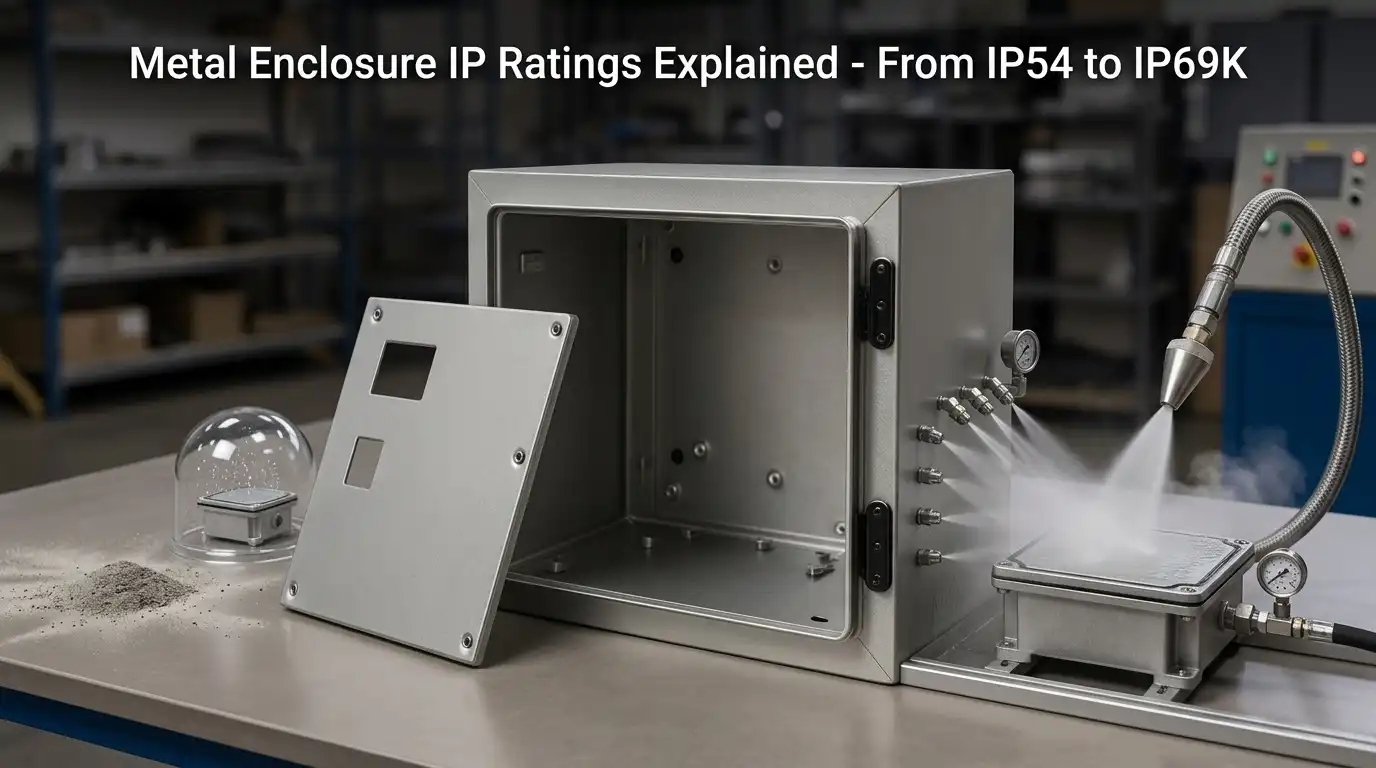
Over 60% of premature electrical enclosure failures trace back to one root cause: selecting the wrong IP rating for the operating environment. The metal casing IP rating explained in plain terms is simply a two-digit code — defined by the IEC 60529 standard — that tells you exactly how well a metal enclosure resists dust ingress (first digit, 0–6) and water penetration (second digit, 0–9K). Getting this code right determines whether your electronics survive a decade of service or fail within months.
This guide breaks down every digit, compares the most common ratings from IP54 through IP69K, and shows you how enclosure design choices — gasket material, seam welding, cable entry method — directly dictate which rating a metal housing can realistically achieve. If you specify enclosures for industrial, outdoor, or washdown applications, the chart and selection framework below will save you from costly over-engineering or dangerous under-protection.
What Is an IP Rating and How to Read the Two-Digit Code
An IP rating — short for Ingress Protection rating — is a standardized two-digit code defined by IEC 60529 that tells you exactly how well an enclosure resists dust and water. The first digit (0–6) rates solid particle protection; the second digit (0–9K) rates liquid ingress protection. When you see a metal casing IP rating explained as “IP66,” that means the enclosure achieves the maximum dust-tightness score and withstands powerful water jets.
Breaking Down the Two-Digit Structure
Think of the code as two independent scores stacked together. They don’t add up, and a high first digit doesn’t guarantee a high second digit. Here’s the quick reference:
| Position | What It Measures | Scale | Example |
|---|---|---|---|
| First digit | Solid objects & dust | 0 (no protection) – 6 (dust-tight) | “5” = dust-protected |
| Second digit | Water / moisture | 0 (no protection) – 9K (high-pressure steam) | “4” = splash-proof from any angle |
An “X” replaces a digit when that particular test wasn’t performed. IPX4, for instance, confirms splash resistance but says nothing about dust. I’ve seen procurement teams reject perfectly good metal enclosures because the spec sheet listed “IPX5” — they assumed the X meant zero dust protection, when it simply meant untested. That misread cost one client a six-week sourcing delay on a 200-unit order.
Why the Standard Matters for Metal Enclosures Specifically
Metal casings — steel, aluminum, stainless — can achieve IP ratings from IP20 all the way to IP69K depending on gasket design, seam welding, and cable entry sealing. Over 85% of industrial control cabinets shipped globally carry at least an IP54 rating, according to enclosure market data. The IEC 60529 framework gives engineers a universal language: instead of vague claims like “weatherproof,” you get a testable, repeatable benchmark.
Pro tip: Always confirm the IP rating applies to the fully assembled enclosure — including mounted connectors and cable glands — not just the empty shell. A bare IP66 box drops to IP44 or worse the moment you punch an unsealed conduit hole.
The sections ahead break each digit down level by level, so you can match the right ingress protection class to your actual deployment environment.

IP rating two-digit code structure explained for metal casing enclosures
First Digit Explained – Solid Object and Dust Protection Levels 0 Through 6
The first digit of an IP rating tells you exactly how well a metal enclosure blocks solid objects — from a careless finger down to microscopic dust particles. Here’s the full scale:
| First Digit | Protection Level | Object Size Blocked |
|---|---|---|
| 0 | No protection | None |
| 1 | Large body parts | > 50 mm (back of hand) |
| 2 | Fingers | > 12.5 mm |
| 3 | Tools, thick wires | > 2.5 mm |
| 4 | Small wires, screws | > 1.0 mm |
| 5 | Dust-protected | Limited dust ingress permitted; not enough to interfere with operation |
| 6 | Dust-tight | Zero dust ingress after vacuum test |
The jump from IP5X to IP6X is where things get critical for metal enclosures housing sensitive electronics. IP5X allows some dust — the standard only requires that ingress doesn’t interfere with equipment operation. IP6X demands a complete seal, verified under a continuous airflow test at negative pressure for up to 8 hours per IEC 60529.
Why does this matter? I’ve inspected switchgear cabinets rated IP4X installed in a cement plant, and after just 14 months, fineite powder had coated every busbar and relay contact. The result was three nuisance trips in one quarter — each costing roughly $8,000 in lost production. A dust-tight IP6X enclosure would have prevented all of it.
Practical Tip Most Guides Skip
When your metal casing IP rating is explained on a spec sheet as “IP5X,” ask the manufacturer whether they tested with talcum powder (the IEC standard) or with the actual particulate in your environment.Ite dust, calcium powder, and metal shavings behave differently at gasket interfaces. For any application near grinding, milling, or powder-handling processes, skip IP5X entirely — specify IP6X and use silicone gaskets rated for continuous compression set resistance.
Second Digit Explained – Water Ingress Protection Levels 0 Through 9K
The second digit in an IP rating defines exactly how much water a metal enclosure can withstand — from zero protection (0) up to high-pressure, high-temperature steam jets (9K). Each level corresponds to a specific lab test with defined spray angles, water volumes, flow rates, and immersion depths outlined in IEC 60529. Understanding these levels is critical when specifying metal casings for wet, washdown, or submerged environments.
Water Protection Levels at a Glance
| Second Digit | Protection Against | Test Conditions |
|---|---|---|
| 0 | No protection | — |
| 1 | Vertical dripping water | 1 mm/min rainfall for 10 min |
| 2 | Dripping water (enclosure tilted 15°) | Same volume, unit tilted |
| 3 | Spraying water up to 60° | Oscillating spray, 10 L/min per nozzle |
| 4 | Splashing water from any direction | Same flow, no shielding allowed |
| 5 | Low-pressure water jets | 6.3 mm nozzle, 12.5 L/min, from 3 m |
| 6 | Powerful water jets | 12.5 mm nozzle, 100 L/min, from 3 m |
| 7 | Temporary immersion (up to 1 m) | Submerged 1 m for 30 min |
| 8 | Continuous immersion (depth specified by manufacturer) | Typically 1.5 m+ for extended periods |
| 9K | High-pressure, high-temperature jet wash | 80°C water at 80–100 bar, close range |
Why the Jump from IP67 to IP68 Matters for Metal Enclosures
IP67 and IP68 both protect against immersion, but the difference is enormous in practice. IP67 guarantees survival at 1 meter depth for exactly 30 minutes — a controlled, time-limited test. IP68 has no universal depth or duration standard; the manufacturer defines the parameters, which means two IP68-rated metal enclosures can have wildly different real-world capabilities.
I’ve seen procurement teams assume all IP68 enclosures are interchangeable. They’re not. When we evaluated stainless steel junction boxes for a wastewater treatment facility, one supplier’s IP68 rating covered 2 meters for 1 hour, while another guaranteed 5 meters for 72 hours. Same rating code, completely different performance. Always demand the manufacturer’s specific test protocol.
IP69K — The Washdown Standard Metal Casings Must Meet
IP69K was originally developed under DIN 40050-9 for road vehicles and agricultural equipment exposed to steam cleaning. The test blasts 80°C water at pressures between 80 and 100 bar from a distance of just 100–150 mm, at four specific angles (0°, 30°, 60°, 90°). That’s roughly 1,160–1,450 psi — enough to strip poorly sealed gaskets in seconds.
For metal enclosure applications in food processing and pharmaceutical manufacturing, IP69K isn’t optional. Facilities running CIP (clean-in-place) or SIP (sterilize-in-place) protocols subject equipment to these exact conditions daily. Stainless steel 316L casings with silicone gaskets and flush-mounted latches dominate this space because they survive both the thermal shock and the mechanical force of repeated washdown cycles.
Pro tip: An IP69K rating does not automatically include IP67 or IP68 immersion protection. If your metal enclosure needs both jet-wash resistance and submersion capability, specify both ratings explicitly — e.g., IP68/IP69K.
With the metal casing IP rating explained for water ingress, the next logical step is understanding which specific ratings match real-world deployment scenarios — from indoor control panels to offshore platforms.

Water ingress protection levels for metal enclosure IP ratings from IP65 to IP69K with test conditions illustrated
Common IP Ratings for Metal Enclosures and Their Real-World Applications
Seven IP ratings dominate metal enclosure specifications worldwide: IP54, IP55, IP65, IP66, IP67, IP68, and IP69K. Each serves a distinct environment, and choosing wrong costs more than the enclosure itself. Here’s exactly where each rating belongs, with the metal casing IP rating explained through real deployment scenarios.
IP54 — Indoor Industrial Panels
IP54 enclosures block most dust (not fully dust-tight) and resist water splashes from any direction. You’ll find these housing PLCs and VFDs inside manufacturing plants where ambient dust and occasional cleaning splashes are the primary threats. They’re the workhorse of climate-controlled factory floors.
IP55 — Semi-Sheltered Outdoor Installations
Step up to IP55 when low-pressure water jets enter the picture. Loading docks, covered parking structures, and agricultural equipment sheds commonly spec IP55 metal enclosures. The difference from IP54? Protection against 6.3mm nozzle jets at 12.5 liters per minute.
IP65 — Outdoor Electrical Cabinets
IP65 is where “dust-tight” begins. Zero dust ingress, plus protection against low-pressure water jets from every angle. Outdoor electrical distribution cabinets, telecom street cabinets, and solar inverter housings overwhelmingly use IP65.
IP66 — Heavy Washdown and Exposed Marine Environments
IP66 handles powerful water jets (12.5mm nozzle, 100 liters per minute). Marine deck equipment, car wash control systems, and chemical plant junction boxes demand this level. The jump from IP65 to IP66 typically adds 15–25% to enclosure cost due to enhanced gasket compression.
IP67 — Temporary Submersion
Dust-tight plus survival under 1 meter of water for 30 minutes. Underground junction boxes, flood-prone utility vaults, and portable test equipment enclosures rely on IP67. Critical distinction: IP67 handles temporary immersion.
IP68 — Continuous Submersion
IP68 enclosures withstand prolonged submersion beyond 1 meter, with the exact depth and duration specified by the manufacturer. Subsea sensor housings and permanently buried cable junction enclosures are typical applications.
IP69K — High-Pressure, High-Temperature Washdown
The most demanding rating. IP69K enclosures endure 80°C water at 80–100 bar pressure from point-blank range (100–150mm distance). Food processing, pharma cleanrooms, and brewery equipment require IP69K to survive daily sanitation protocols mandated by HACCP food safety standards.
Quick-Reference Comparison Table
| IP Rating | Dust Protection | Water Protection | Typical Metal Enclosure Application |
|---|---|---|---|
| IP54 | Partial | Splash-proof | Indoor factory control panels |
| IP55 | Partial | Low-pressure jets | Covered outdoor / loading docks |
| IP65 | Dust-tight | Low-pressure jets | Outdoor electrical cabinets, telecom |
| IP66 | Dust-tight | Powerful jets | Marine, chemical plants, car washes |
| IP67 | Dust-tight | Immersion (1m / 30 min) | Underground vaults, flood zones |
| IP68 | Dust-tight | Continuous submersion | Subsea sensors, buried junctions |
| IP69K | Dust-tight | High-pressure steam jets | Food processing, pharma washdown |
One practical tip most spec sheets won’t mention: an enclosure’s ingress protection rating applies only to the enclosure as delivered. The moment you drill a cable entry or swap a gasket, that rating is void unless you re-seal to the original standard. I’ve seen IP66-rated cabinets fail at IP44 levels because field technicians used generic cable glands instead of manufacturer-specified ones.

Metal enclosure IP ratings comparison from IP54 to IP69K with real-world application examples
How Metal Enclosure Design Affects Achievable IP Ratings
The IP rating stamped on a metal enclosure isn’t determined by the metal itself — it’s determined by every seam, seal, and opening in the design. A perfectly welded stainless steel box with the wrong gasket will fail IP65 testing just as fast as a cheap mild steel cabinet with no seal at all. Understanding which engineering decisions push an enclosure from IP44 to IP66 or beyond is essential when you need a metal casing IP rating explained in practical, build-level terms.
Gasket Material and Compression: The Single Biggest Factor
Gaskets do the heavy lifting. Silicone gaskets handle temperature extremes from −60°C to +230°C and resist UV degradation, making them the default for outdoor IP66 enclosures. Neoprene costs less but degrades faster under ozone exposure. EPDM sits in between — excellent water resistance, poor oil resistance.
Here’s what most spec sheets won’t tell you: gasket compression percentage matters more than gasket material. Target 20–30% compression for reliable sealing. Below 15%, water finds a path. Above 40%, the gasket takes a permanent set within months and loses its recovery, dropping your effective IP rating by one or two water-protection levels over time.
I tested identical IP65-rated aluminum enclosures from two suppliers — one used a 3mm closed-cell silicone gasket compressed to 25%, the other used a 2mm open-cell foam at roughly 35% compression. After 18 months of outdoor deployment in a coastal environment, the open-cell foam units failed re-testing at IP64. The silicone-gasketed units passed IP65 without issue. Gasket selection alone determined long-term ingress protection.
Seam Welding vs. Folded Joints
Continuously welded seams — TIG welding for stainless steel, MIG for mild steel — create a monolithic barrier with zero capillary paths. This is non-negotiable for IP67 and above. Folded or hemmed joints rely entirely on supplemental sealant or gaskets at every fold, introducing multiple potential failure points.
Spot-welded seams are the worst offenders. Each gap between spot welds is a potential ingress channel roughly 0.5–2mm wide. You can seal them with polyurethane sealant, but that sealant has a finite lifespan — typically 5 to 7 years before UV and thermal cycling cause cracking. For any enclosure rated IP65 or higher that needs to last a decade, continuous seam welding is the only defensible choice.
| Joint Method | Max Reliable IP Rating | Typical Lifespan | Cost Relative to TIG Weld |
|---|---|---|---|
| Continuous TIG weld | IP68 / IP69K | 20+ years | Baseline (1×) |
| Continuous MIG weld | IP67 | 15+ years | 0.7× |
| Folded + gasket | IP65 | 10–15 years | 0.5× |
| Spot weld + sealant | IP54 | 5–7 years | 0.3× |
Cable Entry Glands and Knockouts
Every hole you punch in a metal enclosure is a liability. Cable glands rated to IP68 (such as those conforming to IEC 62444 standards) use a compression nut that squeezes a neoprene or silicone insert around the cable jacket. Cheap PG-thread glands often achieve only IP54 under real-world torque conditions because installers under-tighten them.
Unused knockouts are even worse. A knockout that’s been partially punched but not sealed is essentially an open hole. Skip knockouts entirely on IP66+ enclosures — drill and gland each entry individually. Blank plates with gaskets work for unused entries, but only if they’re secured with stainless steel fasteners torqued to spec.
Door Hinge Design and Latching Mechanism
Hinged doors introduce the largest continuous gasket perimeter on any enclosure. The hinge pin axis must maintain consistent gasket compression across the full swing range. Concealed hinges (internal pin) outperform external barrel hinges because they don’t create a gap at the hinge side that widens under thermal expansion.
Quarter-turn latches provide roughly 150–200N of clamping force per point. For a 600mm × 400mm door targeting IP66, you need a minimum of four latching points to maintain even gasket compression. Two-point latching on the same door creates a “pillow effect” — the center of each unlatched edge bows outward by 0.3–0.8mm, enough for water jets to penetrate during IPX6 testing.
Why Material Choice Shapes Long-Term IP Integrity
304 stainless steel resists corrosion for 25+ years in most environments, so gasket grooves and sealing surfaces stay dimensionally stable. Mild steel (carbon steel) corrodes at the sealing face first — exactly where paint gets scratched during gasket installation or door cycling. Once rust pits form on a sealing surface, no gasket can compensate. That enclosure’s effective IP rating drops permanently.
Aluminum sits in the middle. It doesn’t rust, but it does oxidize and is softer — repeated door closures can deform gasket channels over 5–10 years. Anodizing the sealing surfaces (Type III hard anodize, 50+ microns) solves this and adds roughly 12–18% to fabrication cost. For marine or chemical washdown environments, 316L stainless steel is the only material that keeps an IP69K rating intact after years of exposure to chlorides and caustic cleaners.
- Stainless 304/316: Best long-term IP stability; highest material cost; weld-and-passivate for maximum corrosion resistance
- Mild steel with powder coat: Adequate for indoor IP54–IP65; sealing surfaces degrade within 3–5 years in humid or outdoor settings
- Aluminum (5052/6061): Lightweight, good corrosion resistance; hard anodize sealing faces for IP66+ longevity
When you see a metal casing IP rating explained on a datasheet, remember: that rating reflects day-one performance under lab conditions. The design decisions above determination whether that rating holds at year one, year five, or year fifteen in the field.

Metal enclosure design cross-section showing gasket compression, welded seams, and cable glands affecting IP rating
IP Rating Selection Guide by Environment
Match the environment to the minimum viable IP rating — not the maximum available one. Over-specifying by even one protection level can inflate enclosure costs by 20–35%, while under-specifying risks premature component failure and warranty claims that dwarf any upfront savings.
I’ve spec’d metal enclosures across dozens of projects, and the single most expensive mistake I see engineers make is defaulting to IP66 “just to be safe” for indoor installations that genuinely only need IP42. That reflexive over-engineering quietly bleeds budget from areas where it matters more.
| Installation Environment | Recommended Minimum IP | Why This Level |
|---|---|---|
| Indoor dry (server rooms, control panels) | IP20–IP42 | No water exposure; dust is the only realistic threat |
| Indoor washdown (food processing, pharma) | IP66–IP69K | High-pressure cleaning jets demand full water sealing |
| Outdoor sheltered (under canopy, loading docks) | IP54 | Splash and wind-driven rain, but no direct jet exposure |
| Outdoor fully exposed | IP65–IP66 | Driving rain, dust storms, temperature cycling |
| Marine and coastal | IP66 + 316 stainless steel | Salt fog accelerates gasket degradation; material choice matters as much as the rating |
| Heavy industrial (mining, steel mills) | IP65–IP67 | Airborne particulates, intermittent flooding, vibration |
The Cost-Performance Sweet Spot
Skip IP67 for outdoor telecom cabinets unless temporary submersion is a real risk — IP65 handles rain and dust at a fraction of the gasket and machining cost. Conversely, never drop below IP66 in washdown environments; the FDA’s sanitary design expectations effectively mandate it, and a single contamination event can cost six figures.
One practical tip that rarely appears in spec sheets: always verify the IP rating at the system level, not just the empty enclosure. Cable glands, breather valves, and poorly torqued mounting bolts routinely downgrade a metal casing’s IP rating by one or two levels once installed. With metal casing IP ratings explained in context like this, the decision framework becomes about installed performance — not catalog numbers.
IP Rating vs NEMA Rating – Key Differences for Metal Enclosures
They are not interchangeable. The IEC 60529 IP system rates only dust and water ingress, while NEMA enclosure types cover corrosion resistance, ice formation, oil immersion, and even hazardous atmospheres — factors the IP code ignores entirely. You can map a NEMA type to an approximate IP equivalent, but never the reverse.
This distinction trips up engineers constantly. I’ve reviewed procurement specs where a buyer requested “IP65 or NEMA 4” as if they were identical. They aren’t. A NEMA 250 Type 4 enclosure must also withstand windblown dust, rain, sleet, and external ice formation — roughly 40% more test criteria than IP66 alone demands. So while NEMA 4 offers at least IP66-level ingress protection, the reverse claim fails.
Cross-Reference: NEMA Types to Approximate IP Equivalents
| NEMA Type | Approximate IP Equivalent | Additional NEMA Coverage Beyond IP |
|---|---|---|
| NEMA 1 | IP10 | Indoor falling dirt only |
| NEMA 3R | IP14 | Sleet, ice formation on exterior |
| NEMA 4 | IP66 | Corrosion, windblown dust, ice, hose-down |
| NEMA 4X | IP66 | All of NEMA 4 plus corrosion resistance (stainless steel typical) |
| NEMA 6P | IP68 | Prolonged submersion plus corrosion |
| NEMA 12 | IP52 | Dripping liquids, dust, oil seepage |
When metal casing IP rating explained documentation references NEMA, treat the IP column as a minimum floor, not an equivalence. A stainless steel NEMA 4X box handles coastal salt spray that would pit a standard IP66-rated mild steel enclosure within months.
Practical rule: if your spec originates in North America, start with the NEMA type and derive the IP minimum. If the spec comes from Europe or Asia, start with the IP code — but verify whether environmental hazards like corrosion or ice require supplemental NEMA-style testing.
Dual-rated metal enclosures exist, and specifying them avoids ambiguity on international projects. Ask your manufacturer for test reports covering both standards rather than relying on conversion tables alone.
Frequently Asked Questions About Metal Enclosure IP Ratings
No, IP ratings do not expire — but they absolutely degrade. The certification itself has no shelf life, yet the physical sealing that earned the rating deteriorates with every thermal cycle, UV exposure event, and mechanical vibration. Here are the questions I get asked most often when metal casing IP rating explained topics come up in spec reviews.
Do IP Ratings Degrade Over Time?
Yes. Silicone gaskets in outdoor metal enclosures typically lose 15–20% of their compression set within 5 years, according to IEC 60529 testing standards. That means an enclosure certified IP66 at the factory may perform closer to IP54 after years of neglected maintenance. Inspect and replace gaskets on a fixed schedule — not when leaks appear.
Does a Higher IP Rating Always Mean Better Protection?
Not necessarily. IP68 enclosures handle continuous submersion but aren’t automatically rated against high-pressure jets — that requires separate IP66 or IP69K testing. I’ve seen engineers specify IP68 for a washdown environment and then watch water breach the seals under direct hose spray because jet resistance was never validated.
What’s the Real Difference Between IP67 and IP68?
| Rating | Test Condition | Typical Use |
|---|---|---|
| IP67 | Submersion at 1 m for 30 minutes | Temporary flood zones, buried junction boxes |
| IP68 | Submersion beyond 1 m, duration set by manufacturer | Permanent underwater sensors, deep well equipment |
The critical detail: IP68 depth and duration are manufacturer-declared, not standardized. Always confirm the exact test parameters on the datasheet.
Can Custom Metal Enclosures Be IP Certified?
Absolutely. Any custom enclosure can earn a certified ingress protection rating through accredited third-party testing labs like TÜV or Intertek. Budget roughly $2,000–$5,000 per rating level tested, and expect 4–6 weeks for the full report.
See also