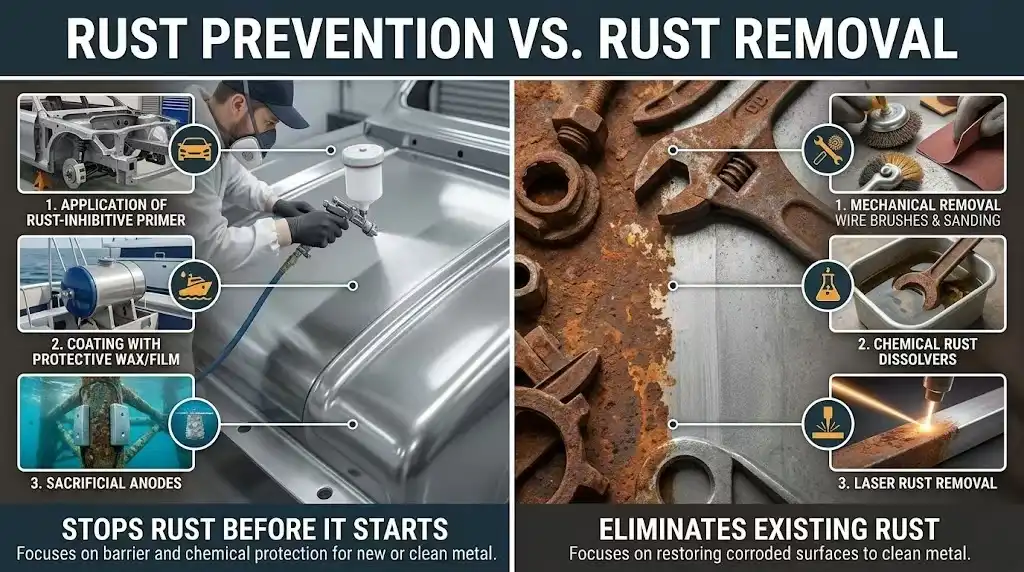
A single rust spot left untreated on a vehicle undercarriage can balloon from a $15 prevention fix into a $3,000+ structural repair in under two years. The rust prevention vs rust removal cost comparison almost always tilts heavily in favor of early intervention — prevention typically runs 5–15% of what full-scale removal and restoration will set you back. This guide breaks down the real dollar figures for both approaches across vehicles, buildings, and industrial equipment so you can decide exactly where your money works hardest.
Rust Prevention vs Rust Removal at a Glance
Prevention is cheaper. Every time. A full rust prevention vs rust removal cost comparison reveals a gap that widens dramatically as corrosion progresses — and most people underestimate just how fast that happens.
| Application | Prevention Cost (Annual) | Removal Cost (Per Incident) |
|---|---|---|
| Vehicles (undercoating, wax) | $100–$250 | $500–$3,000+ |
| Home structures (railings, gutters, decks) | $50–$200 | $300–$1,500 |
| Industrial equipment | $0.50–$3.00 per sq ft | $5.00–$25.00+ per sq ft |
For a typical sedan in a salt-belt state, annual undercoating runs about $150. Let that same vehicle develop rocker panel rust, and a body shop repair easily hits $1,200 to $2,500 — not counting the resale value you’ll never recover. The math isn’t subtle.
Home structures follow the same pattern. A quart of rust-inhibiting primer costs $12 to $20 and protects a wrought-iron railing for 3 to 5 years. Skip it, and you’re looking at sandblasting, repainting, or outright replacement — a job that often lands between $400 and $1,500 depending on the extent of damage. According to NACE International (now AMPP), global corrosion costs exceed $2.5 trillion annually, with studies estimating that 25–30% of those costs could be eliminated through proper preventive measures.
Industrial settings amplify the disparity further. Protective coatings applied during fabrication add pennies per square foot. Abrasive blasting and recoating corroded steel in the field? That can run 5 to 10 times more, plus downtime losses that dwarf the direct repair bill. The sections ahead break down exactly where your money goes — and where it’s wasted.

Rust prevention vs rust removal cost comparison shown through clean and corroded car undercarriages side by side
Average Costs of Common Rust Prevention Methods
Protective coatings sit at the affordable end of the spectrum. A standard rust-inhibiting primer runs $15–$40 per gallon and covers roughly 300–400 square feet. For a homeowner treating a backyard metal fence or a set of patio furniture, that’s often under $50 in materials. Step up to an epoxy-based coating or a zinc-rich primer, and you’re looking at $50–$90 per gallon — but the protection lasts 8–15 years instead of 3–5.
Vehicle undercoating is where the numbers get more interesting. A basic rubberized undercoat at a chain shop costs $100–$200. Oil-based rustproofing — the kind popular in salt-heavy northern states — typically falls between $120 and $250 annually. Wax-based and lanolin treatments push slightly higher, $150–$300, though they tend to outperform cheaper alternatives in independent testing. According to Consumer Reports, consistent annual rustproofing can extend a vehicle’s structural life by several years in corrosion-prone climates.
Hot-dip galvanization is the heavy hitter. Industrial facilities pay $0.75–$2.50 per square foot depending on steel thickness and batch size. Expensive upfront? Sure. But galvanized steel resists corrosion for 50+ years in rural environments and 20–30 years even in coastal areas. That math changes any rust prevention vs rust removal cost comparison dramatically when you’re protecting structural beams or large-scale infrastructure.
Environmental controls deserve a mention too. A commercial dehumidifier for a 1,500-square-foot warehouse or storage facility costs $1,200–$3,500 to purchase, plus $30–$80 monthly in electricity. Smaller units for residential garages or basements start around $200. Keeping relative humidity below 50% slows oxidation to a crawl — a passive strategy that compounds savings year after year.

Cost comparison chart of common rust prevention methods including protective coatings, vehicle undercoating, galvanization, and dehumidification
DIY Rust Prevention vs Hiring a Professional
A can of rust-inhibiting spray costs $12. A professional undercoating service runs $150–$300. The math seems obvious—until you factor in everything else. Your time, the tools you don’t own yet, and the spots you’ll inevitably miss all carry a price tag that doesn’t show up on a receipt.
For a basic DIY rust prevention job on a vehicle undercarriage, expect to spend roughly $40–$80 on materials: rubberized undercoating, surface prep cleaner, masking tape, and disposable brushes or a spray gun attachment. If you don’t already have a jack, stands, and a wire brush or drill attachment for surface prep, add another $50–$120. The real hidden cost is time. A thorough undercoating takes 3–5 hours for someone who’s done it before, and closer to a full weekend for a first-timer figuring out drainage holes and brake line routing.
Professionals bring heated spray rigs, lift access, and—critically—pattern recognition. They spot early corrosion in rocker panels and wheel wells that most DIYers walk right past. According to Consumer Reports, incomplete coverage is the single biggest failure point in DIY rustproofing, because moisture trapped under a partial coating accelerates corrosion faster than bare metal.
So when does DIY actually make financial sense? Flat, accessible surfaces like patio furniture, fence posts, or tool storage racks. These are forgiving projects where a missed spot won’t cascade into structural failure. For anything load-bearing, structural, or hard to reach—truck frames, boat trailers, building steel—professional application pays for itself. A proper rust prevention vs rust removal cost comparison almost always favors spending an extra $100–$200 upfront on professional prevention over gambling with incomplete DIY coverage that leads to expensive remediation two years later.
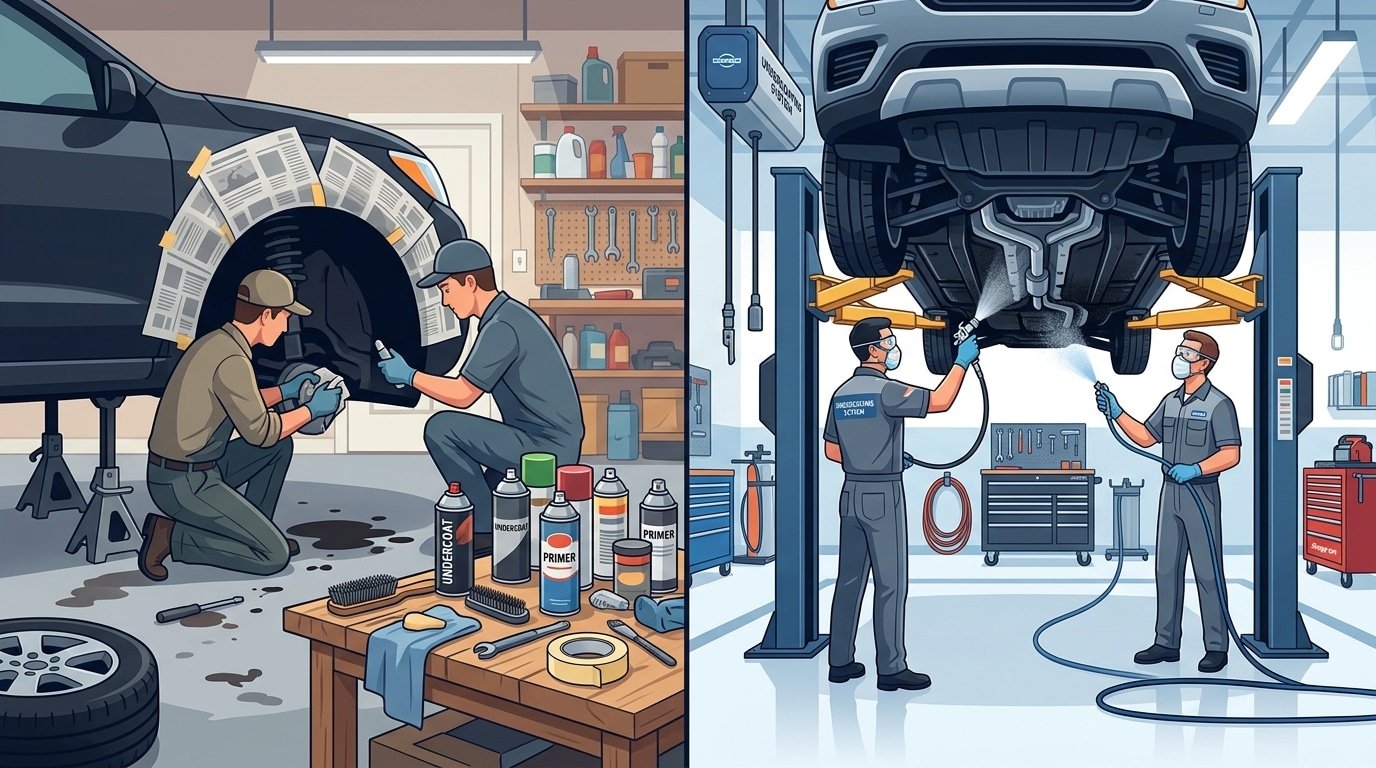
DIY rust prevention setup with spray cans compared to professional undercoating service in auto shop
How Much Professional Rust Removal Actually Costs
Light surface rust on a car fender? A body shop typically charges $150–$300 per panel for sanding, treating, and repainting. That’s the best-case scenario — rust caught early, confined to a small area, no structural compromise. Move into moderate corrosion territory, and you’re looking at $500–$1,000 per panel because the technician now needs to grind deeper, apply filler, and rebuild the surface before paint.
Heavy structural rust is where costs explode. Replacing a rusted-out rocker panel or truck bed section runs $1,500–$4,000 depending on the vehicle, and that’s before paint matching. Sandblasting alone — a common method for frames and chassis — costs $1–$3 per square foot for residential metalwork and $3–$6 per square foot for automotive applications, according to pricing data from HomeAdvisor. Chemical rust removal services fall in a similar range but add disposal fees for hazardous materials.
Industrial contexts push these numbers even higher. Remediating corroded structural steel on a commercial building or bridge section can cost $8–$15 per square foot when factoring in scaffolding, containment, and environmental compliance. A full rust prevention vs rust removal cost comparison becomes almost absurd at this scale — prevention coatings might run $2–$4 per square foot annually, while removal and restoration can exceed that by 400%.
Mechanical removal methods like needle scaling or wire wheel grinding sit in the middle: $40–$80 per hour for labor, plus materials. The real variable isn’t the method — it’s how far the corrosion has spread before anyone intervenes. Every month of delay compounds the final bill.
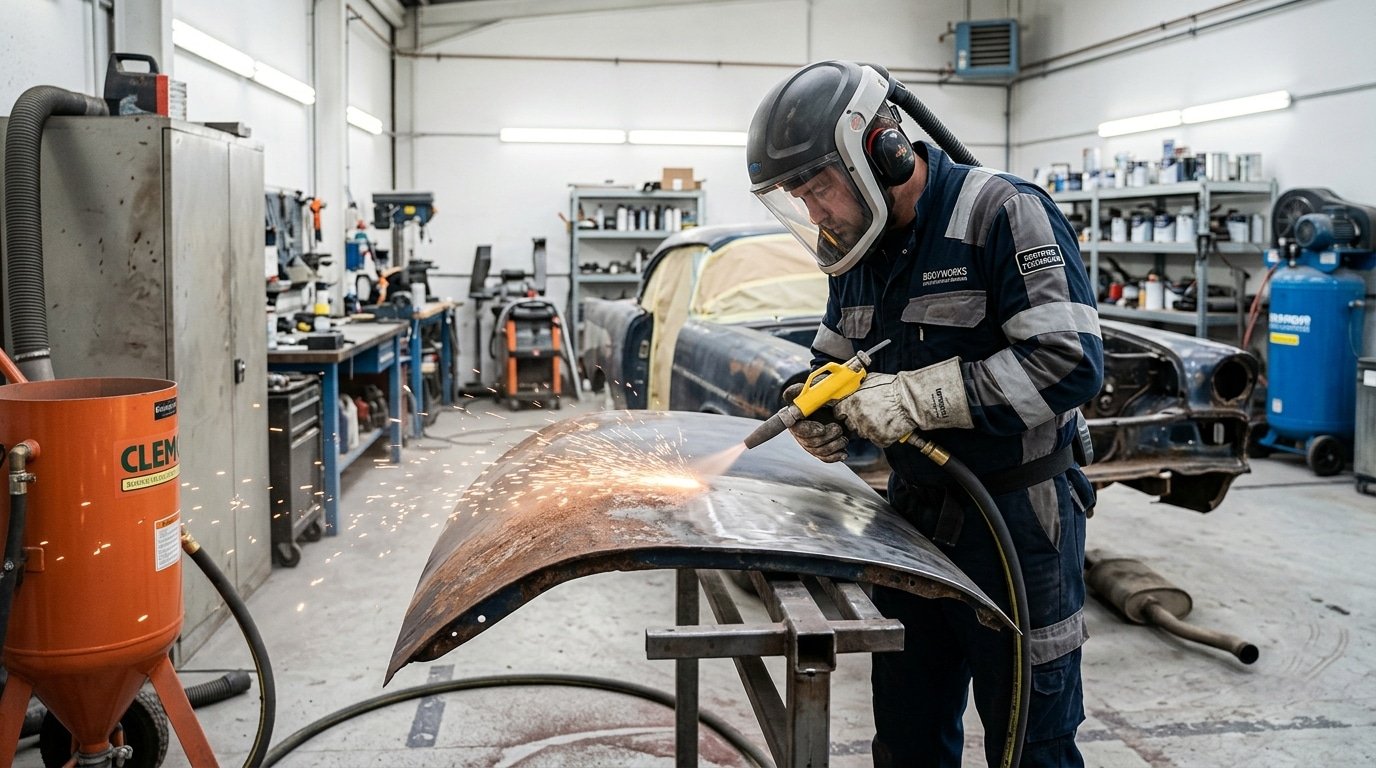
Professional sandblasting rust removal on a car panel in an auto body shop
Cost Differences by Rust Severity and Surface Type
Not all rust is created equal, and the price you’ll pay to fix it reflects that reality sharply. Surface rust—that thin, reddish film sitting on top of the metal—is the cheapest to address, typically costing $100–$250 per affected area on a vehicle. Scale rust, where the oxide layer starts flaking and pitting the metal underneath, pushes costs to $300–$600. Penetrating rust, the kind that eats clean through a panel or beam, can demand $800–$2,500+ depending on the component.
Think of it as a cost multiplier. If surface rust is 1x, scale rust runs roughly 2.5x, and penetrating rust jumps to 5x–10x. That multiplier exists because deeper corrosion requires more aggressive abrasion, chemical treatment, filler or welding, and often replacement of surrounding material that’s been structurally compromised.
Surface Type Changes Everything
Automotive body panels are relatively thin gauge steel—easy to sand, easy to burn through. A technician working on a quarter panel has almost no margin for error, which is why labor rates climb fast. Structural steel beams on buildings or bridges, by contrast, tolerate more aggressive blasting but require SSPC-certified surface preparation standards, adding compliance costs of 15–30% on top of the base removal price.
Cast iron components like engine blocks or vintage radiators present a different headache. The porous grain structure traps moisture deep, making complete rust elimination nearly impossible without media blasting at $50–$150 per hour. Aluminum doesn’t rust itself, but galvanic corrosion where aluminum meets steel creates a unique repair scenario—dissimilar metal corrosion zones often require both metals to be treated, effectively doubling the work area. Any honest rust prevention vs rust removal cost comparison has to account for these material-specific variables, because a flat “per square foot” estimate tells you almost nothing useful.
Long-Term ROI of Rust Proofing Compared to Repeated Repairs
Numbers over timelines tell the real story. Consider a vehicle worth $30,000 in a salt-belt state. A professional undercoating every 2–3 years costs roughly $200 per application—that’s $1,000 over a decade. Skip that step, and you’re looking at one moderate rust repair averaging $500–$1,200 every 3–4 years once corrosion takes hold, totaling $2,500–$4,000 across the same period. The rust prevention vs rust removal cost comparison gets uglier the longer you zoom out.
At the 20-year mark, the gap becomes brutal. Cumulative prevention spending lands around $2,000. Reactive repair costs? Easily $8,000–$12,000, assuming you catch problems before they require full panel or structural replacement. Many people don’t. According to NACE International’s corrosion cost study, corrosion-related expenses in the U.S. exceed $276 billion annually—a figure driven largely by deferred maintenance and reactive fixes.
A Simple ROI Framework You Can Use
Here’s a quick calculation. Take your asset’s current value, multiply by 0.02 (2%), and that’s a reasonable annual prevention budget. Then estimate how many repair events you’d face over 5, 10, or 20 years without protection—use the severity costs from earlier sections as a guide. Subtract your total prevention spend from total projected repair costs. That difference is your savings, and for most vehicles or structures in moderate-to-harsh environments, the return runs 3:1 to 6:1 in favor of prevention.
| Timeline | Prevention Cost (Cumulative) | Reactive Repair Cost (Cumulative) | Estimated Savings |
|---|---|---|---|
| 5 years | $400–$600 | $500–$1,800 | $100–$1,200 |
| 10 years | $800–$1,200 | $2,500–$4,000 | $1,300–$3,200 |
| 20 years | $1,600–$2,400 | $8,000–$12,000 | $5,600–$10,400 |
One caveat: these figures assume consistent maintenance. Miss a reapplication cycle in a coastal or salt-heavy climate, and corrosion can advance fast enough to erase a year’s worth of savings in a single season.
Hidden Expenses Most People Overlook When Ignoring Corrosion
The repair bill is the obvious cost. It’s the one people budget for, negotiate over, and complain about. But corrosion quietly racks up charges in places most owners never think to look—and those hidden costs often dwarf the repair itself.
Structural compromise tops the list. A rusted-through subframe on a vehicle doesn’t just need welding; it may fail a state safety inspection entirely. In states like Pennsylvania and New York, a failed inspection means the vehicle can’t legally be driven until repairs are complete. That’s not a $200 patch job anymore. That’s a tow truck, a rental car, missed work, and a shop bill that starts at $1,500.
Resale value takes a brutal hit. According to data from Kelley Blue Book, visible rust can reduce a vehicle’s trade-in value by 10–20%, depending on severity and location. On a $25,000 truck, that’s $2,500–$5,000 evaporated. No buyer negotiation recovers that.
Insurance adds another layer. Some policies exclude rust-related damage from coverage, classifying it as neglected maintenance rather than sudden loss. File a claim for a corroded brake line failure, and your insurer may deny it outright.
For businesses, downtime is the real killer. A fleet vehicle sidelined for rust repair costs $300–$500 per day in lost productivity, depending on the industry. Multiply that across a week-long shop stay, and a thorough rust prevention vs rust removal cost comparison suddenly looks less like budgeting and more like survival math. A $200 undercoating skipped three years ago has compounded into a $5,000 problem—plus the revenue you’ll never get back.
When Replacing the Part or Structure Makes More Sense Than Removing Rust
There’s a tipping point where rust removal stops being a repair and starts being a money pit. Recognizing that line saves you from pouring hundreds—or thousands—into metal that’s already too far gone. The decision isn’t emotional. It’s structural and financial.
The 50% Rule of Thumb
Most fabricators and body shops follow a straightforward guideline: if rust has consumed more than 50% of a panel’s thickness or surface area, replacement is cheaper than restoration. A rocker panel with scattered surface oxidation? Worth saving. That same rocker panel with holes you can push a screwdriver through? The metal has lost its structural capacity, and no amount of grinding and welding patches will return it to factory strength at a reasonable price. When removal labor alone exceeds 60–70% of a new part’s cost, the math collapses.
Structural Integrity Thresholds
Cosmetic rust and structural rust demand completely different responses. A rusted decorative trim piece is a $40 annoyance. A rusted frame rail on a truck is a safety crisis. The National Association of Corrosion Engineers (NACE) classifies severe corrosion as material loss exceeding 25% of original wall thickness in load-bearing components. Beyond that threshold, the part can’t be trusted to perform under stress. Subframes, suspension mounts, brake lines, and structural beams all fall into this category. Replacement isn’t optional here—it’s mandatory.
Getting an Honest Assessment
Ask any rust prevention vs rust removal cost comparison question to a shop that profits from labor hours, and you’ll get a predictable answer. Seek a second opinion from an independent inspector or a different shop with no stake in the repair. Request that they measure remaining metal thickness with an ultrasonic gauge—a 30-second test that removes all guesswork. If two professionals independently recommend replacement, trust the consensus. Spending $800 on removal for a part that costs $350 new plus $200 in labor to install is a decision you only make once before learning the lesson.
Frequently Asked Questions About Rust Prevention and Removal Costs
Is rust prevention worth it on older vehicles?
It depends on the vehicle’s current condition and your plans for it. If the frame and structural components are still solid, spending $150–$300 on an annual undercoating can extend the car’s usable life by 5+ years. That’s a strong return on a vehicle you’ve already paid off. But if rust has already compromised the subframe or rocker panels, you’re essentially waterproofing a sinking boat. A quick inspection at a body shop—usually free or under $50—tells you which side of that line you’re on.
How often do preventive treatments need reapplication?
Wax-based undercoatings typically last 12–18 months. Oil-based sprays like Krown recommend annual application, which runs $120–$160 per session. Rubberized coatings can last 3–5 years but don’t self-heal when chipped. For home tools and equipment, a coat of rust-inhibiting paint holds up about 2–3 years outdoors before it needs a refresh.
Does insurance cover rust damage?
Almost never. Standard auto insurance policies exclude corrosion because insurers classify it as a maintenance issue, not sudden damage. Manufacturer warranties rarely cover it either, unless you can prove a factory defect in the coating process. You’re on your own financially—which makes the rust prevention vs rust removal cost comparison even more relevant to your wallet.
What’s the cheapest effective prevention method?
For vehicles, a $12 can of fluid film applied to exposed undercarriage areas twice a year beats doing nothing by a wide margin. For tools, a thin coat of paste wax costs pennies per application. For outdoor metal furniture or railings, a $30 can of rust-inhibiting spray paint buys you years of protection. Cheap doesn’t mean ineffective here. Consistency matters more than the product’s price tag.
Making the Right Investment for Your Situation
Your best move depends on three variables: what you’re protecting, where you live, and how much corrosion already exists. A rust prevention vs rust removal cost comparison only matters if you apply it to your specific scenario. So here’s a quick framework to guide your decision.
Your Decision Checklist
- Climate: Coastal or salt-belt region? Prevention is non-negotiable. The corrosion rate in these environments can be 5–10× higher than arid climates, according to NACE International.
- Asset value: If the vehicle, tool, or structure is worth keeping for 5+ years, spend the $150–$500 on professional prevention now.
- Current condition: No rust yet? Coat it. Light surface rust? Treat and protect immediately — you’re still in the cheap zone. Deep pitting or structural compromise? Get a removal quote and a replacement quote side by side.
- Budget reality: Tight on cash? A $12 spray can and 30 minutes of effort beats doing nothing. Prevention scales to any budget.
What to Do This Week
Pick one asset — your daily driver, a backyard gate, workshop equipment — and inspect it. Run your fingers along hidden seams and undersides. If it’s clean, schedule a protective treatment. If you find rust, get two quotes: one for removal and one for replacement. That 20-minute exercise could save you thousands.
The gap between prevention and removal costs only widens with time. Act while the numbers are still small.
See also
Ultimate Guide to Laser Rust Removal Cost
Comparing Laser Rust Removal and Chemical Methods in 2026
Rust Removal for Large Metal Objects — The Complete Guide
How to Extend the Life of Metal Sheet Doors by Preventing Rust