
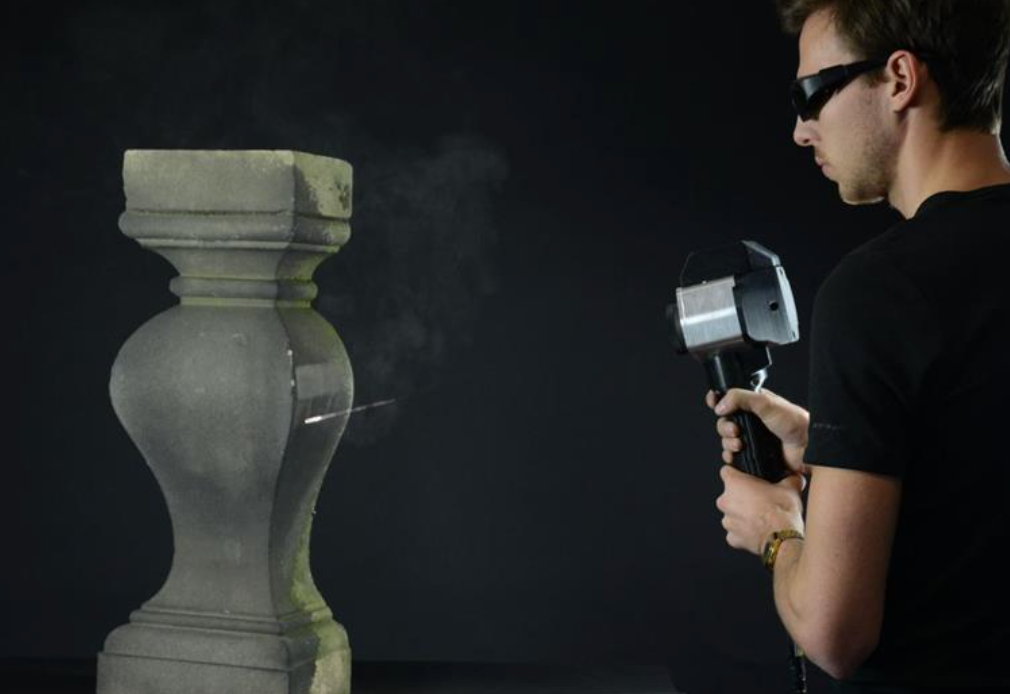
Over 70% of European national museums now list laser ablation among their approved surface cleaning methods — a dramatic shift from just two decades ago, when the technique was considered experimental. Laser cleaning for heritage conservation is a precision-driven, non-contact process that uses calibrated light pulses to remove contaminants — soot, biological crusts, corrosion layers, and aged coatings — from irreplaceable artifacts and monuments without mechanically touching or chemically altering the original substrate. This guide breaks down the physics, practical applications, equipment choices, and real-world limitations that conservators and heritage professionals need to evaluate before adopting laser-based cleaning in their own practice.
What Is Laser Cleaning and Why It Matters for Heritage Conservation
Laser cleaning is a photon-based surface treatment method that uses precisely controlled pulses of light energy to remove unwanted layers — soot, biological crusts, corrosion, paint, and pollution deposits — from the surface of historical objects without physical contact. When a laser beam strikes a contaminated surface, the energy is absorbed selectively by the darker or foreign material, causing it to vaporize, ablate, or detach through rapid thermal expansion. The underlying substrate, if lighter or more reflective, absorbs far less energy and remains unharmed.
That selectivity is what makes laser cleaning for heritage conservation a genuine paradigm shift rather than an incremental improvement.
For centuries, conservators relied on two broad approaches:
- Chemical methods — solvents, poultices, and alkaline or acidic solutions that dissolve contaminants but risk penetrating porous stone, altering patina, or leaving harmful residues.
- Mechanical methods — micro-sandblasting, scalpels, and abrasive tools that physically scrape surfaces, inevitably removing some original material along with the dirt.
Both approaches demand subjective judgment about when to stop, and both can cause irreversible damage. Laser ablation, by contrast, offers real-time operator control at the micrometer scale, with energy delivery measurable in joules per square centimeter. A conservator can tune wavelength (typically 1064 nm Nd:YAG or 532 nm frequency-doubled), pulse duration (nanoseconds to microseconds), fluence, and repetition rate to match the specific contaminant-substrate pair. Research published in the Journal of Cultural Heritage has consistently demonstrated that properly parameterized laser treatment preserves original surface morphology better than any competing technique.
The core principle is simple: light energy does the work that chemicals and abrasives once did — but with a precision those older methods could never achieve.
This scientific foundation is why laser cleaning for heritage conservation has moved from experimental curiosity in the 1970s to standard practice at institutions like the Opificio delle Pietre Dure in Florence and the Centre de Recherche et de Restauration des Musées de France (C2RMF) in Paris. It is not a niche tool anymore. It is the benchmark against which other cleaning methods are now measured.
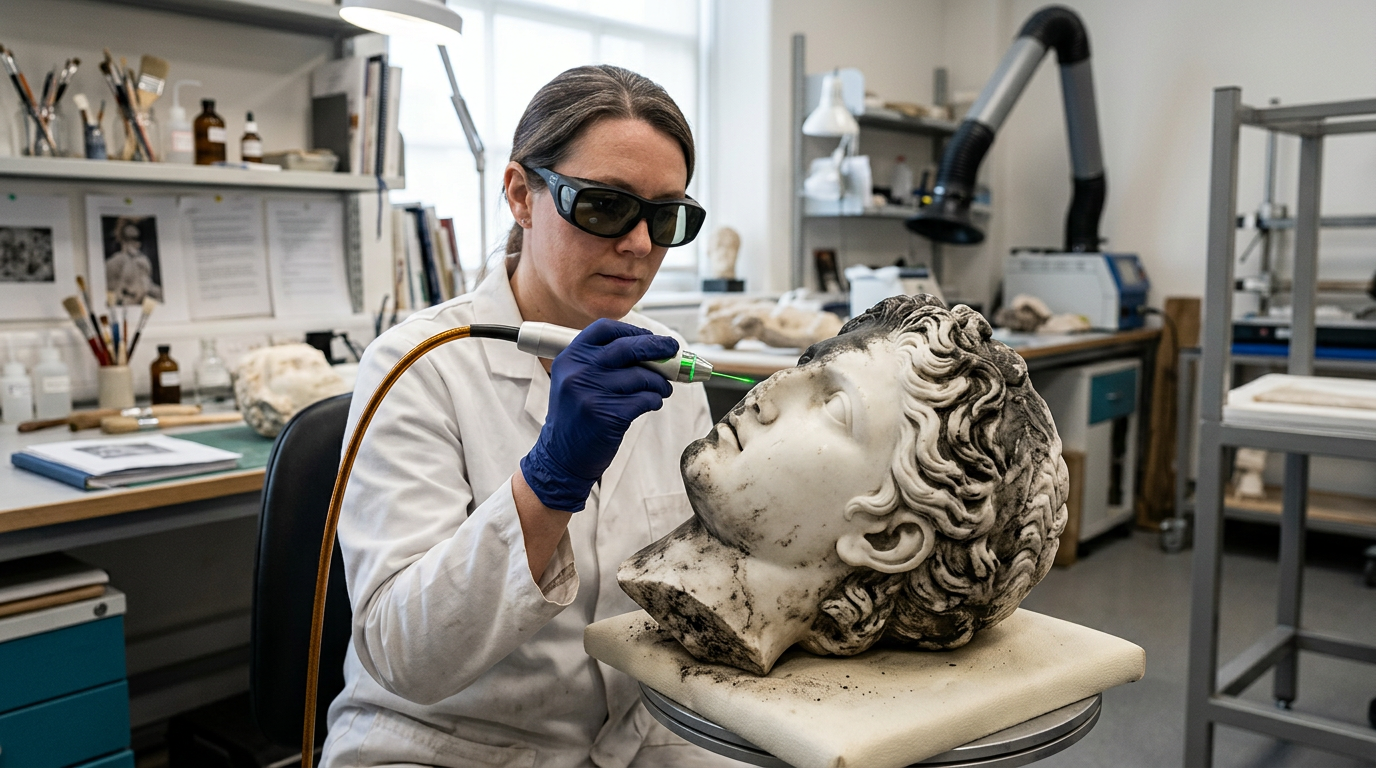
Laser cleaning for heritage conservation being performed on a marble sculpture with visible contrast between cleaned and soiled areas
How Laser Ablation Works on Historical Surfaces
When a laser pulse strikes a contaminated heritage surface, the energy transfer follows one of two dominant pathways: photothermal or photomechanical removal. In photothermal ablation, the absorbed photon energy rapidly heats the contaminant layer — soot, biological crust, or oxidation — until it vaporizes or decomposes. Photomechanical removal, by contrast, relies on shockwaves generated by rapid plasma expansion to physically detach particles from the substrate. Most real-world laser cleaning for heritage conservation involves both mechanisms simultaneously, with the balance determined by pulse parameters.
Wavelength Selection: Why It Matters
The Nd:YAG laser dominates conservation work because it offers three usable wavelengths through harmonic generation: the fundamental 1064 nm (near-infrared), 532 nm (green, second harmonic), and 355 nm (UV, third harmonic). Dark contaminants like black gypsum crusts absorb strongly at 1064 nm, making selective vaporization straightforward — the underlying white marble reflects most of the energy. Shorter wavelengths at 355 nm become essential when treating pigmented substrates or organic residues that require tighter absorption contrast.
Pulse Duration and Fluence Thresholds
Nanosecond pulses (typically 5–20 ns) concentrate energy into extremely short bursts, favoring photomechanical ejection with minimal heat diffusion into the substrate. Microsecond pulses spread thermal energy more broadly, which can be advantageous for thick encrustations but risks thermal damage to sensitive stone or painted surfaces.
The critical parameter is fluence — energy per unit area (J/cm²). Every contaminant-substrate combination has a specific ablation threshold. Operate below it, and nothing happens. Exceed the substrate’s damage threshold, and you’ve harmed the artifact. The operational window between these two values defines whether laser heritage cleaning succeeds or fails.
Research published by Siano et al. in the Journal of Cultural Heritage has shown that for black crust on Carrara marble, the safe fluence window at 1064 nm sits between roughly 0.5 and 3 J/cm² — a narrow but workable range that skilled conservators navigate through real-time monitoring and test patches.
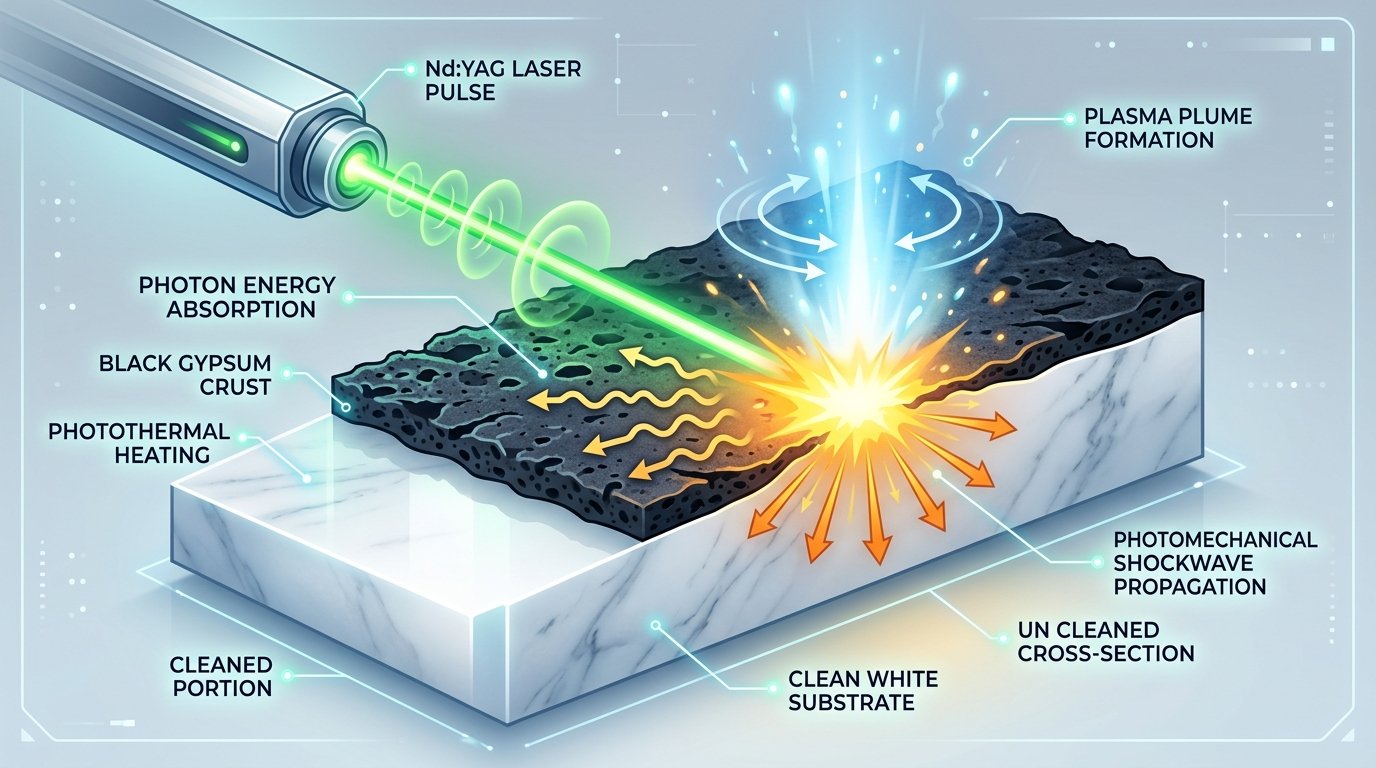
Laser ablation mechanism on heritage stone surface showing photothermal and photomechanical removal during laser cleaning
Benefits of Non-Contact Cleaning for Delicate Artifacts
Traditional cleaning methods force conservators into an uncomfortable trade-off: remove the contamination, but accept some degree of collateral damage. Sandblasting erodes soft limestone. Chemical solvents leave ionic residues that accelerate future decay. Even micro-abrasive techniques apply mechanical stress measured in newtons per square centimeter. Laser cleaning for heritage conservation eliminates this compromise entirely — the beam never physically touches the substrate.
Zero Mechanical Stress, Zero Chemical Residue
Because ablation occurs through photon-material interaction rather than physical contact, there is no shear force, no abrasion, and no solvent penetration into porous stone or wood. A 2019 study published in the Journal of Cultural Heritage confirmed that Nd:YAG laser cleaning on marble surfaces produced no detectable microcracking at fluences below 1.5 J/cm², while even gentle micro-sandblasting caused surface roughness increases of 15–30%.
Micron-Level Precision and Real-Time Control
Operators can adjust pulse energy, repetition rate, and spot diameter in real time — removing a single 10-micron layer of black crust while leaving the original calcite surface untouched. This kind of selectivity is simply impossible with a cotton swab and solvent.
- Patina preservation: Original oxidation layers on bronze sculptures survive intact because the laser’s wavelength can be tuned to target only foreign deposits.
- Polychromy protection: Painted surfaces on medieval wooden altarpieces — some with pigment layers thinner than 50 microns — can be cleaned without disturbing underlying color.
- Fragile substrates: Degraded parchment, corroded iron artifacts, and fire-damaged ceramics all benefit from a process that applies energy without mass.
“The ability to stop at exactly the right layer is what makes laser cleaning transformative for conservation.” — Salvatore Siano, Institute of Applied Physics, Italian National Research Council (CNR-IFAC)
What does this mean in practice? It means a conservator working on a 14th-century fresco can clean soot deposits in a single pass while preserving the artist’s original brushwork — something no chemical poultice can guarantee. The non-contact nature of laser cleaning for heritage conservation doesn’t just reduce risk; it redefines what “safe cleaning” looks like.
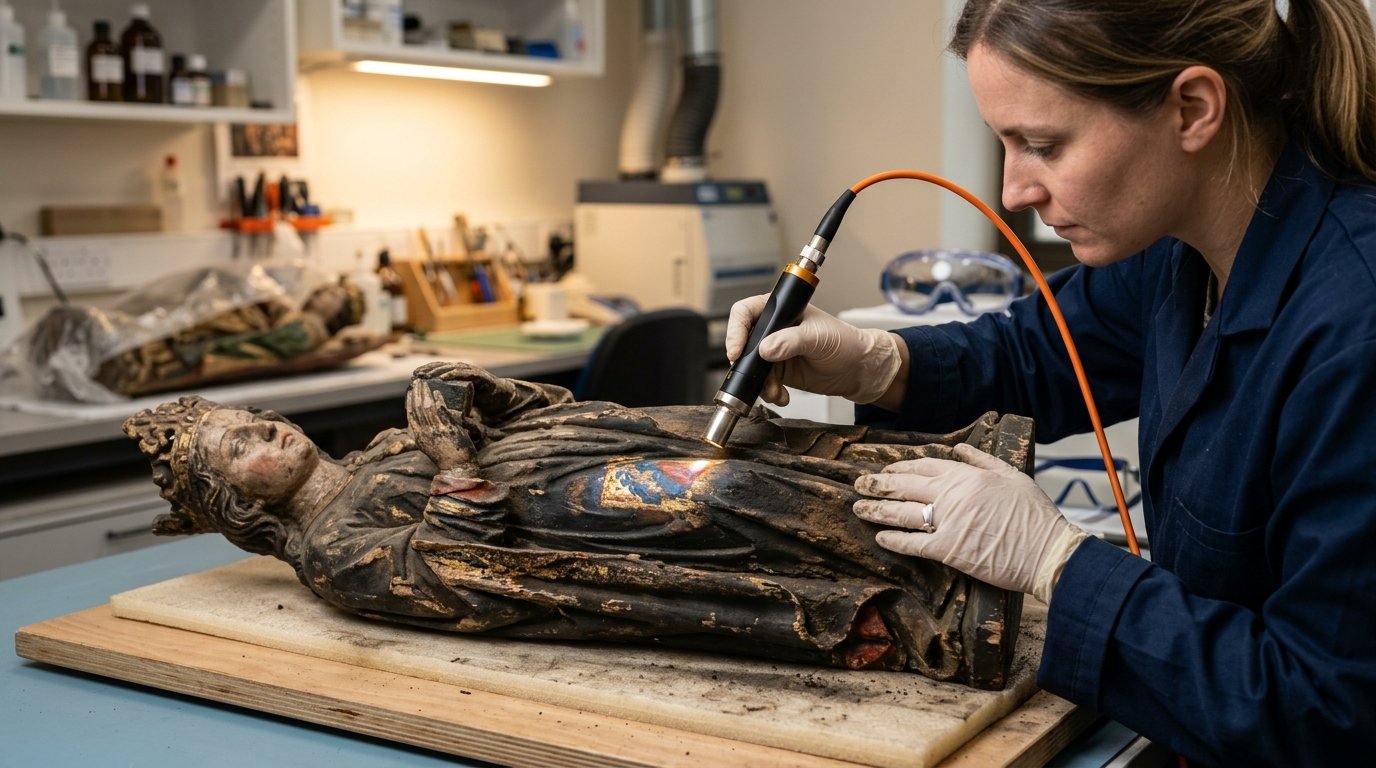
Laser cleaning for heritage conservation applied to a polychrome medieval sculpture showing preserved original pigment layers
Types of Heritage Materials Suitable for Laser Treatment
Not every artifact responds to laser energy the same way. The effectiveness of laser cleaning for heritage conservation depends heavily on the substrate material, its optical absorption coefficient, and its thermal tolerance. Here’s where the technology truly excels — and where conservators must proceed with caution.
Stone
Marble, limestone, and sandstone are among the most frequently laser-cleaned substrates. Dark encrustations — sulfation crusts (black gypsum layers), biological growth, soot — absorb Nd:YAG laser energy at 1064 nm far more readily than the lighter stone beneath. This contrast in absorption coefficients creates an almost self-limiting cleaning effect. Limestone cathedrals across Europe, including work documented by the Istituto di Fisica Applicata Nello Carrara (IFAC-CNR) in Florence, have been treated with excellent results.
Metals
Bronze statues, iron artifacts, and gilt surfaces each present distinct challenges. Corrosion products like cuprite and malachite on bronze can be selectively removed at fluences between 0.5–2 J/cm², but over-cleaning risks exposing the noble patina collectors and curators want preserved. Gilt surfaces demand even greater precision — gold leaf can be as thin as 0.1 µm, and excessive pulse energy will vaporize it instantly.
Organic and Composite Materials
- Parchment and paper: Er:YAG lasers (2940 nm wavelength) target surface contaminants without penetrating cellulose fibers, though heat sensitivity limits fluence to extremely low thresholds.
- Textiles: Successful on silk and linen tapestries when used at short pulse durations (nanosecond range), but dyed fibers risk irreversible color shifts.
- Painted surfaces: Laser cleaning for heritage conservation on polychrome works is perhaps the most demanding application. Pigments like vermilion (HgS) and lead white can darken under laser irradiation — a photochemical reaction, not thermal damage — requiring wavelength-specific protocols and real-time monitoring.
Ceramics
Glazed and unglazed ceramics tolerate laser treatment well, particularly for removing calcium carbonate deposits or burial accretions. Unglazed terracotta, with its porous structure, requires lower energy densities to avoid micro-spalling.
The golden rule: every material demands its own parameter set. Wavelength, pulse duration, fluence, and repetition rate must be calibrated through test patches before full treatment begins.
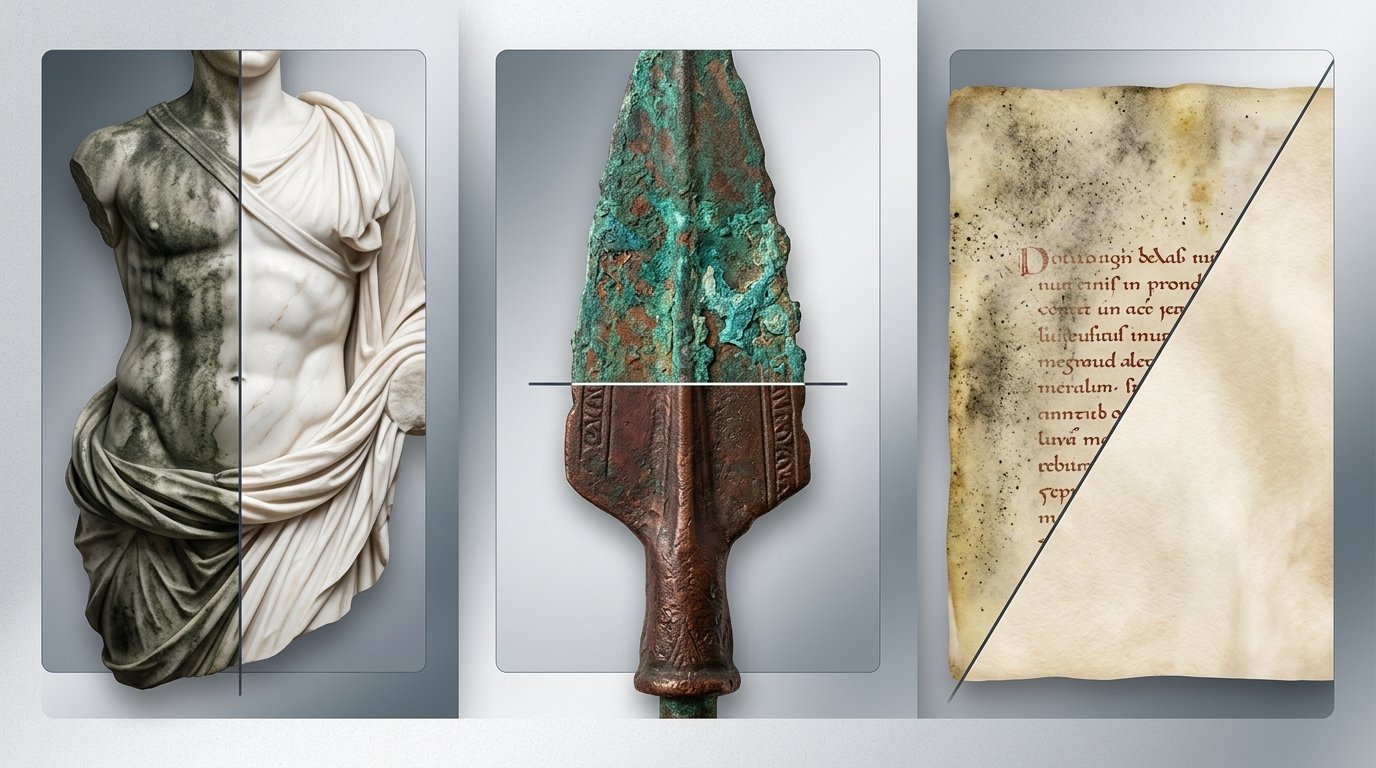
Laser cleaning for heritage conservation applied to stone, bronze, and parchment materials showing selective contaminant removal
Laser Systems and Equipment Used in Conservation Practice
Choosing the right laser system is never a one-size-fits-all decision. The substrate material, the type of encrustation, and whether the artifact sits in a climate-controlled lab or on a cathedral façade 30 meters above ground — all of these variables dictate equipment selection.
The Workhorse: Q-Switched Nd:YAG Lasers
The Q-switched Nd:YAG laser operating at 1064 nm remains the most widely deployed system for laser cleaning for heritage conservation. Its nanosecond pulse durations (typically 5–20 ns) deliver high peak power while minimizing thermal diffusion into the substrate. Many conservators also use the frequency-doubled variant at 532 nm, which is better absorbed by certain organic deposits and iron oxide stains. Systems from manufacturers like Quanta System (notably the Thunder Art series) and El.En. have become industry standards across European conservation workshops.
Er:YAG and Fiber Lasers
Er:YAG lasers emit at 2940 nm — a wavelength strongly absorbed by water — making them exceptionally effective for removing biological crusts and hydrated calcium sulfate layers from limestone. Fiber lasers, meanwhile, offer a compelling advantage: compact form factors, minimal maintenance, and pulse repetition rates exceeding 100 kHz. Their growing adoption reflects a broader shift toward equipment that field conservators can actually transport.
Emerging Femtosecond Systems
Ultrashort-pulse femtosecond lasers represent the cutting edge. By delivering energy in pulses shorter than 1 picosecond, they achieve “cold ablation” — material removal with virtually zero heat-affected zone. Research published in the Journal of Cultural Heritage has demonstrated their precision on polychrome surfaces, though high cost (often exceeding €150,000) currently limits deployment to specialized research institutions.
Portable vs. Laboratory Setups
| Feature | Portable Systems | Laboratory Systems |
|---|---|---|
| Weight | 15–40 kg | 100+ kg |
| Beam Delivery | Fiber-optic cable (up to 20 m) | Articulated arm or fixed optics |
| Typical Use | In-situ monument work | Small artifacts, detailed analysis |
| Power Range | 20–100 W | Up to 500 W |
Fiber-optic delivery systems have been transformative for in-situ projects. A conservator can position the laser unit at ground level and guide the handpiece across a stone relief high on a building exterior — a practical reality that makes laser cleaning for heritage conservation feasible on immovable monuments, not just portable objects.
Real-World Case Studies in Monument and Artifact Restoration
Theory means little without proof. These documented projects demonstrate how laser cleaning for heritage conservation performs under real-world constraints — on irreplaceable objects where failure is not an option.
The Parthenon Marbles, British Museum
Between 1999 and 2005, conservators at the British Museum used a Nd:YAG laser operating at 1064 nm to remove centuries of soot, biological crusts, and earlier failed cleaning residues from the Parthenon sculptures. Fluence levels were kept below 1 J/cm² to protect the original Pentelic marble surface. Scanning electron microscopy confirmed that the laser selectively vaporized dark encrustations without disturbing the marble’s crystalline microstructure — a result mechanical scraping had failed to achieve in the 1930s.
Amiens Cathedral Facade, France
The west facade of Amiens Cathedral, a UNESCO World Heritage Site, underwent laser treatment to strip black gypsum crusts formed by sulfur dioxide pollution. Conservators from LRMH (Laboratoire de Recherche des Monuments Historiques) selected an Er:YAG laser at 2940 nm for areas with fragile polychromy traces. The infrared wavelength targeted hydrated mineral deposits while preserving medieval paint pigments invisible to the naked eye. Post-treatment colorimetry showed a ΔE* shift of less than 2, meaning virtually no perceptible color change to the original stone.
Bronze Statuary: The Ghiberti Doors, Florence
The Opificio delle Pietre Dure used Q-switched Nd:YAG pulses at both 1064 nm and 532 nm to remove corrosion products from Lorenzo Ghiberti’s gilded bronze “Gates of Paradise.” Short pulse durations of 8 ns ablated cuprite and malachite layers without heating the underlying gold leaf beyond 40°C. X-ray fluorescence analysis verified zero gold loss across treated panels.
Illuminated Manuscripts
At the Institute of Electronic Structure and Laser (IESL-FORTH) in Crete, researchers applied femtosecond laser pulses to remove foxing stains from parchment manuscripts. Pulse energies as low as 5 µJ at 800 nm removed iron-oxide discoloration without degrading collagen fibers. This represents one of the most delicate applications of laser cleaning in heritage conservation to date.
Each case reinforces a consistent principle: measurable diagnostics before, during, and after treatment — not guesswork — drive successful outcomes.
Safety Protocols and Conservation Standards for Laser Use
Pointing a Class 4 laser at a 600-year-old fresco demands more than technical skill — it demands rigorous adherence to safety and ethical frameworks. Laser cleaning for heritage conservation operates at the intersection of occupational health regulation and conservation philosophy, and cutting corners on either side can cause irreversible harm.
Laser Safety Classifications and Personal Protection
Conservation-grade Nd:YAG and Er:YAG systems fall under Class 4 in both the OSHA laser hazard classification (ANSI Z136.1) and the EU’s IEC 60825-1 standard — the highest risk category. Direct or diffusely reflected beams can cause permanent retinal damage in milliseconds. Operators must wear wavelength-specific optical density (OD 5+) safety eyewear, and controlled access zones with interlocked doors are mandatory on indoor sites.
Skin protection matters too. Repeated exposure to scattered 1064 nm radiation can cause thermal burns. Long-sleeved, non-reflective clothing and laser-rated gloves are standard. Fume extraction systems — typically HEPA-filtered local exhaust ventilation — capture particulate matter and volatile compounds released during ablation, which may include lead oxides or calcium sulfate dust depending on the substrate.
Conservation Ethics: Charters and Pre-Treatment Protocols
Safety extends beyond the operator’s body to the object itself. The ICOMOS Burra Charter and AIC Code of Ethics both enshrine the principle of minimal intervention and reversibility. Before any laser cleaning campaign on heritage materials, conservators are expected to:
- Conduct spot tests on inconspicuous areas at multiple fluence levels
- Document the original surface condition with raking-light photography and colorimetry (L*a*b* measurements)
- Establish ablation thresholds through spectroscopic analysis — often laser-induced breakdown spectroscopy (LIBS)
- Maintain detailed treatment logs recording wavelength, pulse duration, repetition rate, and number of passes per zone
The European Committee for Standardization’s EN 16782:2018 provides the most specific technical guidance for laser cleaning of cultural property, covering everything from beam characterization to post-treatment assessment.
This documentation isn’t bureaucratic overhead. It creates a verifiable record that future conservators can reference decades later — a non-negotiable requirement under professional conservation standards.
Limitations and Challenges Conservators Should Understand
No cleaning technology is universally perfect, and laser cleaning for heritage conservation is no exception. Acknowledging these constraints isn’t a weakness — it’s a professional obligation that separates rigorous conservation practice from marketing hype.
Thermal Damage to Heat-Sensitive Pigments
Certain pigments — particularly vermilion (mercuric sulfide), lead white, and organic lake pigments — can undergo irreversible chemical transformation under laser irradiation. Vermilion darkens to metacinnabar at relatively low energy densities, sometimes below 0.5 J/cm². Even with Nd:YAG systems operating at 1064 nm, the photothermal effect can alter color values in ways invisible to the naked eye but measurable with spectrophotometry. Research published in the Journal of Cultural Heritage has documented these chromatic shifts extensively.
Yellowing of Calcareous Stone
White marble and limestone frequently develop a yellow discoloration after laser treatment. This phenomenon, linked to the reduction of iron compounds within the stone matrix, remains one of the most persistent challenges. Fluence levels that effectively remove black gypsum crusts can simultaneously trigger Fe³⁺ to Fe²⁺ conversion, producing an unwanted warm tone across the cleaned surface.
Cost and Operator Dependency
- Equipment investment: A conservation-grade Nd:YAG laser system costs between €50,000 and €200,000, putting it out of reach for many smaller institutions and private conservators.
- Skill threshold: Effective laser cleaning demands operator judgment that takes years to develop — reading surface response in real time, adjusting fluence on the fly, recognizing when to stop.
- Processing speed: Large-scale facades can take 5–10× longer to clean with lasers than with micro-abrasive or chemical poultice methods.
Contaminant Selectivity Gaps
Lasers excel at removing carbon-based soiling and biological encrustations. They struggle with salts embedded deep within porous substrates, silicone-based coatings, and certain synthetic polymers applied during previous restoration campaigns. For these contaminants, chemical or mechanical approaches remain more effective — sometimes the best strategy combines laser treatment with traditional methods in a hybrid protocol.
A responsible conservator treats laser cleaning as one tool in a broader toolkit, not a replacement for professional judgment about when not to use it.
The Future of Laser Technology in Heritage Science
The next generation of laser cleaning for heritage conservation is being shaped by ultrashort-pulse systems — specifically femtosecond (10⁻¹⁵ s) and picosecond (10⁻¹² s) lasers. These pulses are so brief that energy is deposited and material ejected before heat can diffuse into the substrate. For organic materials like parchment, painted wood, or ivory — surfaces that nanosecond systems still struggle with — this near-zero thermal impact is transformative. Research groups at institutions such as IESL-FORTH in Greece have demonstrated picosecond ablation of varnish layers from oil paintings with sub-micron precision.
Artificial intelligence is entering the workflow, too. Machine learning models trained on spectroscopic data can now recommend optimal fluence, pulse repetition rate, and number of passes for a given contaminant-substrate combination. Instead of relying solely on a conservator’s iterative test-patch approach, AI-assisted parameter optimization reduces trial time by an estimated 40–60%, according to preliminary findings published in the Journal of Cultural Heritage.
Real-Time Feedback Through Hyperspectral Monitoring
Hyperspectral imaging integrated directly into the laser delivery head allows operators to monitor chemical composition in real time. The system detects when a contaminant layer has been fully removed and can automatically halt the beam — eliminating the risk of over-cleaning. This closed-loop feedback represents a genuine leap beyond the operator-dependent methods used today.
Hybrid Cleaning Approaches
- Laser + gel poultice: Laser pre-treatment loosens stubborn crusts, then solvent gels dissolve residual salts without mechanical force.
- Laser + plasma jet: Low-temperature atmospheric plasma follows laser ablation to neutralize biological recolonization on outdoor stone.
- Laser + enzymatic cleaning: Enzymes target protein-based binders that lasers alone may char, while the laser handles inorganic deposits.
These hybrid strategies are expanding the range of treatable artifacts into categories once considered off-limits — waterlogged archaeological wood, gilded leather, and even degraded photographic emulsions. The future of laser cleaning for heritage conservation isn’t just faster or more precise hardware; it’s an integrated, sensor-driven ecosystem where the laser is one tool in a tightly coordinated chain.
Frequently Asked Questions About Laser Cleaning for Heritage Conservation
Does laser cleaning damage original surfaces?
When parameters are correctly set, no. The ablation threshold of the contaminant layer is almost always lower than that of the substrate — meaning the laser energy removes dirt, soot, or biological growth while leaving the original material intact. Conservators run test patches at incremental fluence levels (typically starting below 0.5 J/cm²) to confirm the safe operating window before full treatment begins. Peer-reviewed studies published in the Journal of Cultural Heritage consistently show no measurable surface loss on properly treated stone and metal substrates.
How much does laser conservation treatment cost?
Costs vary widely. Portable Nd:YAG systems range from $50,000 to $250,000 depending on pulse configuration, while project-level pricing for large monuments can run $15–$60 per square foot — comparable to or slightly above chemical poultice methods. The real savings come from reduced labor time and elimination of hazardous waste disposal fees.
Can laser cleaning remove graffiti from historic buildings?
Yes, particularly spray-paint graffiti on stone and brick. The pigment absorbs laser energy far more readily than most mineral substrates. However, deeply penetrating inks on porous limestone may require multiple passes or a hybrid approach combining laser treatment with micro-abrasive finishing.
Is laser cleaning suitable for painted or gilded objects?
It can be — but extreme caution is required. Er:YAG lasers at 2,940 nm are preferred for cleaning over polychrome surfaces because the energy is absorbed by surface moisture rather than pigment layers. Gilded surfaces respond well to short-pulse Nd:YAG systems at low fluence. Neither scenario is routine; both demand experienced operators and real-time monitoring.
How long does a typical laser cleaning project take?
A small bronze sculpture might require 8–20 hours of active treatment. Large-scale façade projects — like the multi-year restoration of Amiens Cathedral — can span months. Laser cleaning for heritage conservation is inherently slower than sandblasting, but the precision and reversibility justify the timeline for irreplaceable objects.
Key Takeaways for Conservators and Heritage Professionals
Laser cleaning for heritage conservation is not a silver bullet — it is a precision instrument that demands scientific understanding, rigorous testing, and professional judgment. Here is what matters most.
When to Consider Laser Cleaning
- Fragile or high-value substrates where mechanical and chemical methods pose unacceptable risk — polychromed surfaces, gilding, thin patinas, porous limestone.
- Selective contamination removal is required: biological crusts over original paint, soot layers on frescoes, corrosion products on bronze that must be thinned rather than stripped.
- Documentation and repeatability are priorities. Laser parameters can be recorded precisely, satisfying ICOM-CC and EN 16782 reporting standards.
How to Evaluate a Service Provider
- Verify that operators hold recognized training — look for certification through programs such as those offered by the Istituto di Fisica Applicata Nello Carrara (IFAC-CNR) or equivalent institutions.
- Request documented test-patch protocols, including fluence values, wavelength selection rationale, and spectroscopic analysis of ejected material.
- Confirm compliance with Class 4 laser safety standards (IEC 60825-1) and site-specific risk assessments.
Your Next Step
The gap between knowing laser cleaning exists and knowing how to specify it correctly is where irreversible damage happens. Close that gap.
Invest in hands-on workshop training — organizations like the American Institute for Conservation (AIC) and the International Council of Museums regularly offer courses covering laser-material interactions, parameter optimization, and ethical decision-making. If you are commissioning rather than performing the work, a consultation with a certified conservation specialist before tendering will save time, budget, and — most critically — original material.
The science is proven. The equipment is mature. What heritage objects need now are professionals confident enough to use laser cleaning where it excels and honest enough to choose alternatives where it does not.
See also
How Laser Cleaning Outperforms Traditional Cleaning Methods
Which Is More Effective: Laser Cleaning Technology or Traditional Polishing
What You Need to Know About Laser Cleaning Machine Certification





