
Chromium scores 8.5 on the Mohs hardness scale — higher than any other pure metal found in nature. So what are the three hardest metals? Ranked by measurable hardness, they are chromium, tungsten, and osmium, each dominating different hardness benchmarks from scratch resistance to tensile strength and compressive durability. This guide breaks down exactly how each metal earns its ranking, which hardness scale matters most for your application, and why confusing “hard” with “strong” can lead to costly material failures.
The Three Hardest Metals at a Glance
What are the three hardest metals? Ranked by measurable hardness, they are chromium, tungsten, and osmium. Each dominates a different hardness metric, but all three consistently outperform every other pure, naturally occurring metal.
| Rank | Metal | Mohs Hardness | Vickers Hardness (HV) | Key Property |
|---|---|---|---|---|
| 1 | Chromium (Cr) | 8.5 | 1,060 HV | Highest Mohs rating of any pure metal |
| 2 | Tungsten (W) | 7.5 | 3,430 HV (carbide form) | Highest tensile strength & melting point |
| 3 | Osmium (Os) | 7.0 | ~1,000 HV | Densest naturally occurring element |
Chromium sits at the top because no other pure metal scratches it on the Mohs scale — a scratch-resistance test geologists have trusted since 1812. Tungsten earns its place through sheer resistance to deformation; its tensile strength reaches roughly 1,510 MPa, dwarfing steel. Osmium rounds out the list with a density of 22.59 g/cm³ and exceptional incompressibility, measured by a bulk modulus of 395–462 GPa according to data published by the Royal Society of Chemistry.
Quick distinction: hardness isn’t the same as toughness or strength. A metal can be extremely hard yet brittle. We’ll unpack that difference later in this guide.
These rankings apply to pure elemental metals — not alloys like tool steel or tungsten carbide composites. Once you start blending elements, the rules change dramatically. But if someone asks what are the three hardest metals in their pure form, this trio is the definitive answer.

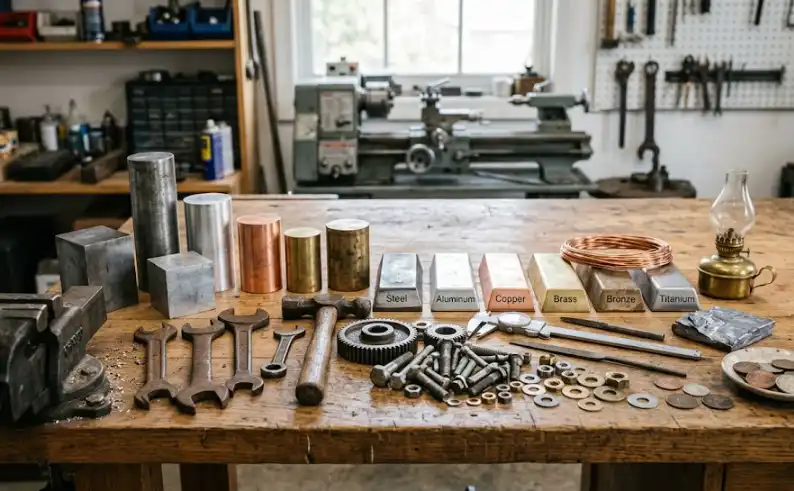
The three hardest metals — chromium, tungsten, and osmium — displayed with hardness ratings
How Scientists Measure Metal Hardness Using Mohs and Vickers Scales
Before answering what are the three hardest metals, you need to understand how hardness is actually measured — because the method you choose changes the ranking.
The Mohs Scratch Test
Developed by German mineralogist Friedrich Mohs in 1812, this scale ranks materials from 1 (talc) to 10 (diamond) based on one simple question: can material A scratch material B? It’s intuitive, fast, and still used in field geology. But Mohs is ordinal, not linear. The jump from 9 (corundum) to 10 (diamond) represents a roughly fourfold increase in absolute hardness, while the gap between 1 and 2 is trivial by comparison.
The Vickers Hardness Test (HV)
For metals, the Vickers indentation test delivers far more precision. A diamond pyramid indenter is pressed into a sample under a controlled load — typically 1 to 100 kgf — and the resulting indentation is measured under a microscope. The smaller the indent, the harder the metal. Vickers values are reported in HV units and can differentiate metals that sit at the same Mohs number.
Chromium scores 8.5 on Mohs but reaches approximately 1,060 HV. Tungsten sits around 7.5 Mohs yet hits roughly 3,430 MPa in tensile strength — a property Mohs ignores entirely.
This is exactly why different scales can rank the hardest metals differently. Mohs captures scratch resistance; Vickers captures resistance to plastic deformation under load. Neither tells the whole story alone. The ASTM E384 standard, maintained by ASTM International, governs the Vickers microindentation procedure used in most metallurgical labs worldwide.

Mohs scratch test versus Vickers hardness test comparison for measuring metal hardness
Chromium — The Hardest Pure Metal on the Mohs Scale
Chromium sits at 8.5 on the Mohs hardness scale — harder than topaz, nearly rivaling corundum. Its Vickers hardness clocks in around 1,060 HV, which is remarkable for an unalloyed element. No other pure metal comes close. That single fact is why chromium tops every credible list when people ask what are the three hardest metals.
What gives chromium this extreme scratch resistance? Its body-centered cubic (BCC) crystal structure locks atoms into a rigid lattice with strong metallic bonding and limited slip planes. Dislocation movement — the mechanism behind plastic deformation — is severely restricted at room temperature. The result: a metal that resists indentation the way ceramics do, yet remains electrically conductive and metallic in character.
Where Chromium’s Hardness Actually Matters
- Chrome plating: A layer as thin as 0.005 mm dramatically improves wear resistance on automotive parts, hydraulic cylinders, and industrial rollers.
- Stainless steel alloying: Adding 10.5–30% chromium to iron creates the passive oxide layer (Cr₂O₃) that defines stainless steel grades like 304 and 316.
- Hard chrome coatings: Aerospace landing gear and injection molds rely on electrodeposited chromium layers exceeding 800 HV to survive millions of cycles.
Pure chromium is brittle below roughly 150 °C, which limits its use as a standalone structural material. Engineers solve this by alloying it — blending hardness with the ductility of nickel or iron. According to data published by the Royal Society of Chemistry, chromium is the 21st most abundant element in Earth’s crust, so supply constraints rarely drive cost.
Bottom line: if your priority is pure scratch resistance without alloying tricks, chromium is unmatched among metals.
Tungsten — Unmatched Tensile Strength and Extreme Heat Resistance
Tungsten earns its place when asking what are the three hardest metals not through Mohs score alone (7.5), but through a combination of properties no other pure metal can match. Its tensile strength reaches 1,510 MPa — the highest of any unalloyed metal — and its melting point of 3,422°C (6,192°F) dwarfs every metallic competitor.
The real story is tungsten carbide. Combine tungsten with carbon, and hardness skyrockets to roughly 2,570 Vickers (HV), making it one of the hardest engineering materials available outside of diamond and cubic boron nitride. That’s why over 60% of global tungsten consumption goes into cemented carbide products, according to the International Tungsten Industry Association.
Where Tungsten Dominates
- Military armor-piercing projectiles: Tungsten alloy penetrators replaced depleted uranium in many NATO munitions due to lower toxicity and comparable density (19.3 g/cm³).
- Cutting and drilling tools: Tungsten carbide inserts outlast high-speed steel by 10× in CNC machining operations.
- Aerospace turbine components: Rocket nozzle throats rely on tungsten’s ability to maintain structural integrity above 2,000°C.
- Radiation shielding: Its density makes it a lead-free alternative in medical imaging equipment.
Pure tungsten is brittle at room temperature and difficult to machine — a limitation engineers solve by alloying it with nickel, iron, or cobalt to improve ductility while preserving hardness.
China produces approximately 80% of the world’s tungsten supply, which makes pricing and availability a geopolitical concern for defense and manufacturing sectors globally.
Osmium — The Densest Natural Metal with Superior Scratch Resistance
Osmium is a paradox. It’s the densest naturally occurring element on Earth — 22.59 g/cm³, roughly twice the density of lead — yet it remains one of the least utilized metals in engineering. When asking what are the three hardest metals, osmium earns its spot through a Vickers hardness of approximately 3,920 MPa, the highest among the six platinum-group metals.
That scratch resistance is remarkable. Osmium outperforms platinum, iridium, and palladium in resisting surface deformation under load, which makes it theoretically ideal for wear-resistant applications like electrical contacts and instrument pivots. Fountain pen nibs tipped with osmium-iridium alloys, for instance, have been prized for decades precisely because of this durability.
On the Mohs scale, osmium registers around 7 — lower than chromium’s 8.5. But Vickers testing, which measures resistance to indentation under precise loads, reveals osmium’s true strength against plastic deformation.
So why isn’t osmium everywhere? Two reasons kill its commercial viability. First, extreme rarity — global production sits at roughly 1,000 kg per year, according to the Royal Society of Chemistry. Second, brittleness. Osmium fractures under impact rather than bending, making it unsuitable for structural components that experience shock loading. Its powdered form also oxidizes into osmium tetroxide (OsO₄), a highly toxic and volatile compound that attacks soft tissue.
These constraints confine osmium to niche roles: hardness standards in metallurgy labs, specialized alloy tips, and — increasingly — as a rare investment metal. Hardness alone doesn’t guarantee usefulness, and osmium proves that point better than any element on the periodic table.
Hardness vs Toughness vs Strength — Why the Distinction Matters
Knowing what are the three hardest metals is only half the picture. A metal can resist scratching yet shatter on impact — chromium is a perfect example. Hardness, toughness, and tensile strength measure fundamentally different behaviors, and confusing them leads to catastrophic material choices in engineering.
| Property | What It Measures | Test Example | Real-World Analogy |
|---|---|---|---|
| Hardness | Resistance to surface deformation (scratching, indentation) | Vickers, Mohs | A ceramic plate — hard but shatters when dropped |
| Toughness | Energy absorbed before fracturing | Charpy impact test | A rubber mallet — deforms but doesn’t break |
| Tensile Strength | Maximum pulling force before failure | Universal testing machine | A steel cable under load |
Chromium scores 8.5 Mohs yet has a fracture toughness of only ~22 MPa√m — roughly one-third that of mild steel. Drop a chromium component onto concrete and it cracks. Tungsten, despite its extraordinary tensile strength of 1,510 MPa, also suffers from low ductility below its brittle-to-ductile transition temperature (~400 °C), making it prone to sudden failure in cold environments.
Hard does not mean indestructible. The best material for a job balances all three properties against the specific stresses it will face.
This is exactly why aerospace engineers rarely use the three hardest metals in pure form. Instead, they alloy them — adding nickel to tungsten for toughness, or embedding chromium in stainless steel for a balance of hardness and corrosion resistance. The ASM International Handbook of Materials Selection confirms that single-property optimization almost always creates a vulnerability elsewhere.
Frequently Asked Questions About the Hardest Metals
Is tungsten carbide harder than pure tungsten?
Yes — significantly. Tungsten carbide (WC) reaches roughly 2,600 Vickers, nearly three times the hardness of pure tungsten at around 900 Vickers. But tungsten carbide is a ceramic-metal composite, not a pure metal. When people ask what are the three hardest metals, the answer should focus on elemental metals, which is why chromium, tungsten, and osmium top the list rather than engineered alloys or carbides.
Where does titanium rank?
Titanium scores about 6 on the Mohs scale — impressive for aerospace applications, but well below chromium’s 8.5. Its real advantage is an extraordinary strength-to-weight ratio, not scratch resistance. Calling titanium one of the hardest metals is a common misconception fueled by marketing, not metallurgy.
What about tool steel or maraging steel?
Heat-treated tool steels can exceed 800 HV, and some specialty grades push past 900 HV. Still, these are alloys — iron blended with carbon, vanadium, or molybdenum. They don’t qualify as pure metals in hardness rankings.
Is diamond harder than all metals?
Diamond sits at 10 on the Mohs scale and roughly 10,000 Vickers — far beyond any metal. However, diamond is a crystalline form of carbon, not a metal at all. Among pure metallic elements, chromium remains the undisputed hardness champion.
Quick rule of thumb: if a material is an alloy, carbide, or non-metal, it falls outside the scope of the three hardest metals discussion — even if its hardness numbers are higher.
Key Takeaways and How to Choose the Right Hard Metal for Your Needs
So, what are the three hardest metals? Chromium (8.5 Mohs), tungsten (7.5 Mohs, but with a Vickers hardness of 3,430 MPa), and osmium (7 Mohs, 3,920 MPa Vickers). Each dominates a different dimension of hardness — and that distinction should drive your choice.
Pick based on your actual problem, not a ranking list:
- Industrial tooling and machining: Tungsten carbide is your go-to. Drill bits, cutting inserts, and mining equipment rely on its heat resistance up to 3,422°C and exceptional wear life.
- Scratch-resistant coatings and plating: Chromium wins. Hard chrome plating protects hydraulic cylinders, molds, and engine components at a fraction of the cost of exotic alternatives.
- Jewelry and luxury goods: Tungsten rings offer everyday scratch resistance at accessible prices. Osmium, while harder on the Vickers scale, is brittle and toxic in powder form — reserve it for specialized, controlled applications.
- High-density engineering (ballistics, counterweights): Osmium’s 22.59 g/cm³ density is unmatched, though depleted uranium and tungsten alloys are more practical substitutes in most defense applications.
Rule of thumb: hardness prevents scratching, but toughness prevents breaking. Always evaluate both before committing to a material.
The three hardest metals each solve different engineering challenges. Match the metal to the failure mode you’re designing against — abrasion, deformation, or thermal degradation — and you’ll make a decision that holds up under real-world stress.
See also
What Is Food Grade Stainless Steel and Why Does It Matter
Key Differences Between Galvanized Steel and Stainless Steel
Melting Point of Iron: The Ultimate Guide
Classification of Carbon Metal Content, Steel, and Alloy Steel
How to Protect Yourself When Operating a Laser Cleaning Machine