

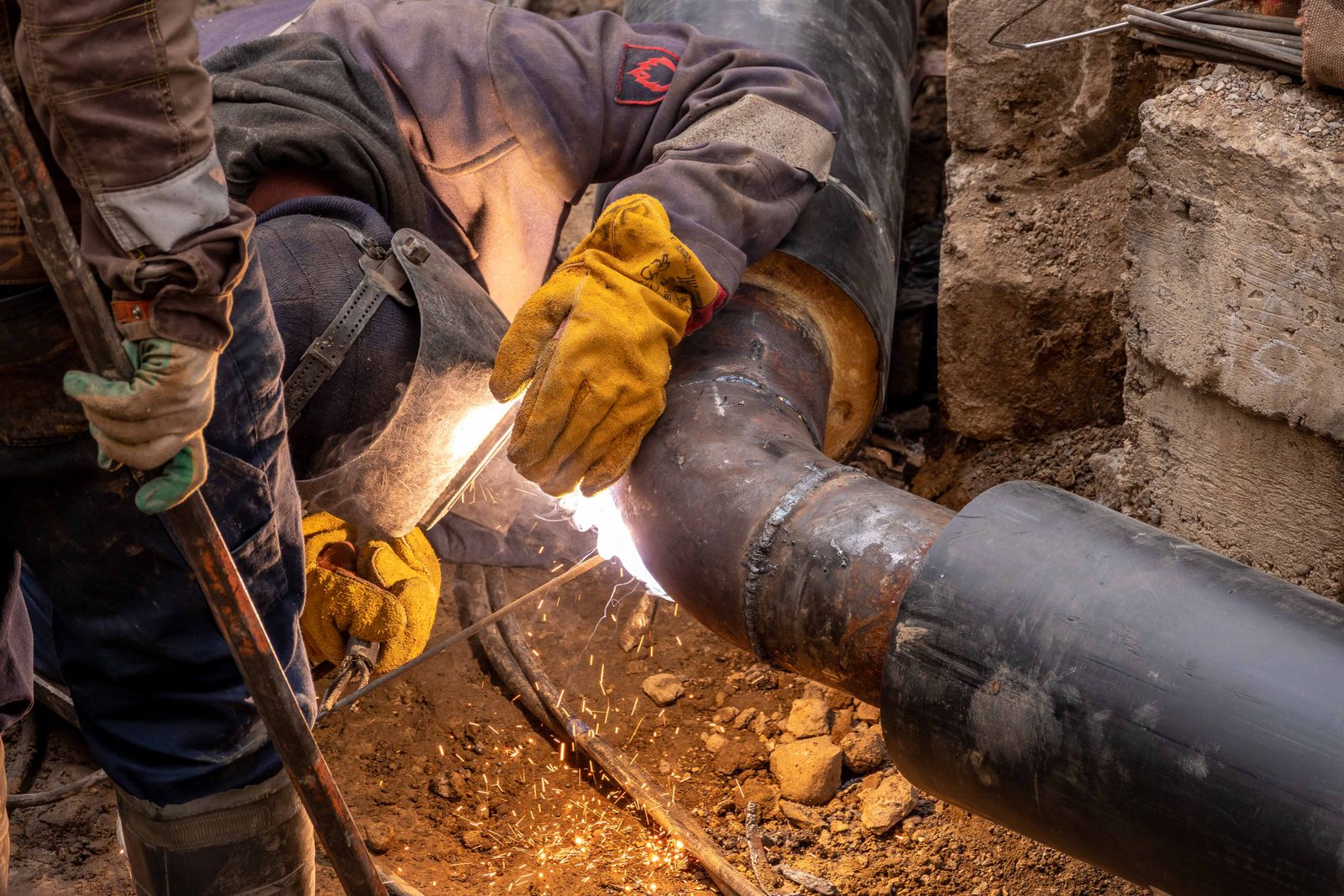
4130 Steel Properties, Composition & Uses
4130 is a chromium-molybdenum low-alloy steel, often called chromoly. Although people search for “4130 carbon steel,” it is not plain carbon steel. It combines useful strength and toughness with the ability to be formed, machined and welded. Its actual strength depends on the product and heat treatment—not the grade number alone.
What is 4130 steel, and what does the number mean?
SAE 4130, also identified as UNS G41300, belongs to the chromium-molybdenum alloy-steel family. In the traditional SAE naming system, 41 identifies that family and 30 indicates about 0.30% carbon. “Chromoly” is the family nickname; it does not identify one exact grade.
The alloying elements help the steel harden during heat treatment. This property is called hardenability: how readily a hard structure forms through a section during cooling. It is different from hardness, which is a measured resistance to indentation at a particular location.
That distinction explains why two genuine 4130 products can behave differently. Soft stock may suit a formed bracket; heat-treated stock may suit a loaded shaft. Neither condition can be inferred from a label that says only “4130.”
Choose the condition to suit the work: annealed stock for easier forming or machining; normalized stock when its certified properties suit the part; quenched-and-tempered stock when a defined higher-strength condition is needed. If the part will be welded, assess the properties after welding and any final heat treatment.
What is the chemical composition of 4130 steel?
Typical published ranges are 0.28–0.33% carbon, 0.80–1.10% chromium and 0.15–0.25% molybdenum by weight. These alloy additions distinguish 4130 from a plain carbon grade. The rest is mainly iron, with controlled amounts of other elements.
Swipe the table sideways to see all columns.
| Element | Published range / limit | Why it matters |
|---|---|---|
| Carbon | 0.28–0.33% | Strongly affects achievable hardness, strength and welding response. |
| Chromium | 0.80–1.10% | Improves hardenability; this amount does not make the steel stainless. |
| Molybdenum | 0.15–0.25% | Supports hardenability and resistance to softening during tempering. |
| Manganese | 0.40–0.60% | Contributes to hardenability and steelmaking control. |
| Silicon | 0.15–0.35% | Used in deoxidation; also contributes to strength. |
| Phosphorus | 0.035% maximum | A restricted residual element. |
| Sulfur | 0.040% maximum | A restricted residual element that influences inclusions and ductility. |
Source: TSM Steel, AISI 4130 datasheet. These are not universal limits for every 4130 product. For example, AED’s sheet and plate reference lists phosphorus and sulfur at 0.025% maximum each. Use the purchased product specification and mill test report for acceptance.

Why the product specification matters
A chemistry match does not prove that tube, bar and sheet are interchangeable. Their dimensions, manufacturing routes, tests and delivery conditions differ.
For example, ASTM A519/A519M covers seamless mechanical tubing, not every product made from 4130. Aircraft-quality tubing may instead require a named AMS specification. A material test report, or MTR, should connect the actual batch to the specification on the order.
Check the heat number on the stock against the certificate before cutting removes the original marking. This preserves the link between the part and its material evidence.
What are the strength and hardness of 4130 steel?
There is no single yield strength, tensile strength or hardness for all 4130 steel. Published values are useful only when you keep the product size and condition attached to them. The examples below show how much processing can change the result.
Yield strength describes the onset of permanent deformation. Tensile strength is the maximum engineering stress reached in a tensile test. Brinell hardness measures indentation resistance. They answer different questions; a hardness number is not a complete strength or toughness specification.
Swipe the table sideways to see all columns.
| Product condition and source | Tensile strength | Yield value | Brinell hardness |
|---|---|---|---|
| Hot-rolled, annealed Alro average test data | 84 ksi ≈579 MPa | 53 ksi ≈365 MPa | 183 |
| Normalized at 1600°F (≈871°C), air cooled E&J single-heat data | 97 ksi ≈669 MPa | 63.25 ksi ≈436 MPa | 197 |
| Water quenched from 1575°F (≈857°C), tempered at 900°F (≈482°C) E&J single-heat data | 161 ksi ≈1110 MPa | 137.5 ksi ≈948 MPa | 321 |
| Same quench temperature, tempered at 1100°F (≈593°C) E&J single-heat data | 128 ksi ≈883 MPa | 113.25 ksi ≈781 MPa | 262 |
Sources: Alro Metals Guide, pages 11-4–11-5 and Earle M. Jorgensen, 4130 mass-effect data, section R page 13. Alro labels its results averages; E&J identifies its values as coming from one heat. SI values are rounded conversions. Listed temperatures describe those reference tests, not a complete heat-treatment procedure.
How to read the table: the two E&J quenched-and-tempered examples use the same bar diameter and quench temperature. The higher tempering temperature accompanies lower strength and hardness. That illustrates a processing trade-off—not a guaranteed result for your part. A different section, chemistry or thermal cycle can give different values.
Is 4130 lighter or stiffer than mild steel?
4130 has a typical density of about 7.8 g/cm³, or 7,800 kg/m³, close to ordinary steels. A same-size replacement therefore weighs about the same. Any useful weight saving comes from a design that can safely use less material, not from a much lower density.
Do not confuse higher yield strength with higher stiffness. A stronger tube may resist permanent bending better while still flexing under normal load. Tube diameter, wall thickness, unsupported length, buckling and fatigue must all be checked before reducing the section.
How do annealing, normalizing and heat treatment change 4130?
Heat treatment changes the steel’s internal structure. It can make a part easier to form, give a more consistent starting condition, or build higher strength. The right route depends on what the finished component must do.
Annealed 4130
Annealing produces a softer condition for forming and machining. Spheroidizing is a particular softening treatment that changes the shape of carbides. Neither term guarantees that the stock already meets the final structural requirements.
Normalized 4130
Normalizing heats the steel into its austenitic range, then air cools it. It can provide a more uniform structure. Section size still matters because thick and thin areas do not cool at the same rate.
Quenched-and-tempered 4130
Quenching can create a hard structure; tempering reduces brittleness and adjusts strength and toughness. The center of a thick part may respond differently from its surface, so test location matters.
Should heat treatment happen before or after welding?
Plan the sequence before ordering the stock. Welding after final heat treatment creates a new local thermal cycle: the weld and nearby metal may no longer have the certified parent-metal properties. Heat treatment after welding may address that problem, but can also move dimensions or reduce strength elsewhere.
Stress relief is not the same as restoring every original property. A heat-treated assembly needs an agreed final strength, hardness, toughness and dimensional requirement. The selected process must meet those requirements together.
For machining, softer stock may reduce cutting forces, but the final heat treatment can distort finished features. Plan rough machining, heat treatment and finish machining as one route where tolerances are tight. Do not assign one cutting speed to all 4130 conditions.
Can you weld 4130 steel?
Yes, with a procedure suited to the material condition and the joint. Its lower carbon level generally makes 4130 less demanding to weld than 4140. It is still a hardenable steel, so “weldable” does not mean that any settings or filler will work.
The heat-affected zone (HAZ) is the base metal heated by the weld but not melted. Rapid cooling can create hard regions there. Hydrogen and tensile stress can then contribute to cracking, including cracks that appear after the joint has cooled.
How should preheat and filler metal be selected?
Use actual chemistry, starting condition, thickness, restraint, hydrogen control and heat input to decide the thermal controls. Thin tubing and a thick attachment can cool very differently even within the same assembly. This is why a rule such as “all thin 4130 needs no preheat” is unreliable.
Preheat can slow cooling and give hydrogen more time to escape. It does not make a poor joint design, contaminated surface or unsuitable filler acceptable. TWI’s hydrogen-cracking guidance explains the interaction between hard microstructures, hydrogen and stress.
Filler selection also depends on the final condition. Miller’s chromoly TIG guide distinguishes ER80S-D2 for common chromoly work, ER70S-2 for certain chromoly-to-mild-steel joints, and matching 4130 filler for parts that will be heat treated. These are application directions, not interchangeable approvals for every tube frame or critical component.
Can 4130 be laser welded?
Yes. However, a narrow laser weld does not prove a harmless HAZ. Concentrated energy can reduce the width of the heated region, while fast cooling can still produce hard microstructures.
What a published experiment showed: a 2015 study comparing autogenous TIG and laser welds in AISI 4130 found martensite in the fusion zone for both processes. The laser-heated regions were narrower; post-weld heat treatment improved ductility. These results belong to that experiment, not to every handheld laser welder or 4130 joint. Read the study.
For a production trial, hold the material condition and joint geometry constant. Check a cut cross-section for fusion and penetration, then measure hardness across the weld and HAZ. Add the mechanical tests and nondestructive testing required by the part’s service or code. Where delayed cracking is credible, use the prescribed inspection delay.
A welding procedure specification (WPS) records the permitted method and variables. A procedure qualification record (PQR), where required, records the test evidence behind that procedure. A good-looking sample is not a substitute for either. Our laser-welding HAZ guide explains what the heated region can change; the laser welding guide covers the broader process.
What is 4130 steel used for?
4130 is used where strength, toughness and fabrication need to work together. Typical examples include aircraft engine mounts and fittings, motorsport structures, bicycle frames, and selected machinery components. The grade is a starting point; the design and final condition decide suitability.
Welded tubing, frames and mounts
Thin-wall tubes can place material efficiently around a section, making 4130 attractive for weight-sensitive structures. Joint geometry and cyclic loading remain important: a strong parent tube does not remove a fatigue-sensitive weld toe or an unsupported load path.
Aircraft work must follow applicable manufacturer and approved engineering data. The FAA limits the use of AC 43.13-1B repair guidance; it is not permission to redesign a structure using a generic 4130 table. Motorsport projects likewise need the rulebook for the relevant class and event before tube sizes or joining methods are selected.
Machined and heat-treated components
Fittings, shafts and other loaded parts may benefit from 4130’s heat-treatment response. For a large section, the question is whether the required properties can be reached at the critical depth—not simply whether a surface hardness measurement passes.
If deeper hardening or a different strength–toughness balance is needed, compare other grades such as 4340 alloy steel. Pressure or corrosive-service parts also need the relevant material and service requirements; general availability of 4130 does not establish approval.
4130 vs 4140, mild steel and 25CrMo4: which should you choose?
Choose by the constraint that controls the part: fabrication, final strength, section size, corrosion or a specified material standard. Compare finished conditions, not only alloy names.
Swipe the table sideways to see all columns.
| Option | When to consider it | Main trade-off or check |
|---|---|---|
| 4130 | Welded or heat-treated parts needing a useful balance of strength and fabrication. | Verify the final condition and joint properties; plan corrosion protection. |
| 4140 | Parts needing greater hardening potential or higher hardness after a suitable treatment. | Its roughly 0.40% carbon changes the welding and thermal-treatment requirements. |
| Mild steel / specified DOM tube | Parts whose load requirements can be met with a simpler fabrication route. | DOM means drawn over mandrel, not an alloy grade. Specify chemistry and certified properties separately. |
| 25CrMo4 / 1.7218 | Designs and supply chains built around the applicable European product standard. | A similar designation is not automatic equivalence to 4130. |
| Stainless steel | Parts for which bare corrosion resistance is a primary requirement. | Select a suitable stainless grade for the environment; strength and welding behavior will differ. |
For a deeper comparison of carbon content, condition and joining, see 4140 steel properties and heat treatment.
Is 25CrMo4 exactly the same as 4130?
No. Cross-reference tables help find candidates, but they do not approve substitutions. For example, Ovako’s 25CrMo4 data for variant 9224 lists 0.22–0.29% carbon, compared with 0.28–0.33% in the 4130 reference above. Other chemistry limits and product requirements can differ too.
If a supplier offers an equivalent grade, compare the full standard, delivery condition, dimensions, mechanical tests and inspection requirements. Obtain the design authority’s approval where substitution affects a controlled drawing.
Does 4130 steel rust?
Yes. 4130 is not stainless steel. Its relatively small chromium addition is useful for heat-treatment response, but it does not provide stainless-like protection in wet exposure.
Choose a coating, plating, oiling or environmental-control system for the actual service. Think beyond the easy-to-see surface: tube interiors, joints that trap water, damaged coating edges and places that cannot be maintained may control service life.
Prepare and coat the assembly in a sequence compatible with welding and inspection. For high-strength parts, evaluate whether pickling or plating can introduce hydrogen. A bright finish does not prove the underlying material is suitable for the environment.
What should you specify when buying 4130 steel?
A useful purchase order makes the material inspectable. Ask for the product specification and supplied condition, not just “4130” or “aircraft quality.” Include the requirements that will still matter after cutting, welding and heat treatment.
- Grade and product form: identify 4130 plus tube, bar, sheet, plate or forging; distinguish welded from seamless tube.
- Governing specification: state the applicable product standard and the revision required by the drawing or contract. ASTM A519/A519M is one example for seamless mechanical tubing, not a universal steel specification.
- Dimensions and tolerances: include wall thickness, diameter, straightness, surface finish and any critical machining allowance.
- Delivery and final condition: name the supplied heat treatment and the required final properties. “4130N” commonly means normalized, but supplier shorthand needs confirmation.
- Tests and traceability: require an MTR linked to the heat or lot, plus the chemical, mechanical and inspection results actually required by the specification.
- Downstream processing: identify welding, heat treatment, coating and acceptance needs that could change the result after delivery.
Illustrative buying decision: a workshop is comparing two quotations for a welded tube assembly. One says only “4130 chromoly”; the other identifies the tube specification, normalized condition, dimensional tolerances and heat-linked certificate. The second quotation is easier to verify—but the finished weld still needs its own acceptance plan. Neither quotation alone establishes that the assembly will meet its service loads.
The practical takeaway: 4130 is valuable because its chemistry can support several useful manufacturing routes. Choose it when the finished part benefits from that flexibility. Confirm the state in which the part will operate, then connect material data, joining and inspection to that state.
Planning to laser weld a 4130 component?
Send Oceanplayer Laser the material specification and condition, thickness, joint drawing, intended service and required inspection results. These details help frame a relevant process discussion and determine what a representative trial would need to demonstrate.
Technical sources
- TSM Steel — AISI 4130: ASTM A29-based chemistry reference and product information.
- AED Motorsport Products — 4130 sheet and plate: chemistry limits and supplied-condition distinctions.
- Alro Steel — Metals Guide, reference section: average mechanical data for 1-inch round bars, with limitations.
- Earle M. Jorgensen — Mechanical Properties and Hardenability: condition- and size-specific 4130 test data, section R pages 12–13.
- Gautier Specialty Metals — 4130 alloy technical data: grade identification, density and applications.
- ASTM A519/A519M-24a: published scope for seamless mechanical tubing, including suitability of the joining procedure.
- TWI — Hydrogen cracks in steels: cracking factors, thermal controls and delayed inspection.
- Miller — TIG welding chromoly steel: joint preparation and application-dependent filler selection.
- An Analysis of the Mechanical Behavior of AISI 4130 Steel after TIG and Laser Welding Process, Procedia Engineering 114 (2015), 181–188: experimental weld microstructure and post-weld heat-treatment results.
- Ovako — 25CrMo4, variant 9224: the specific chemistry behind the grade cross-reference example.