

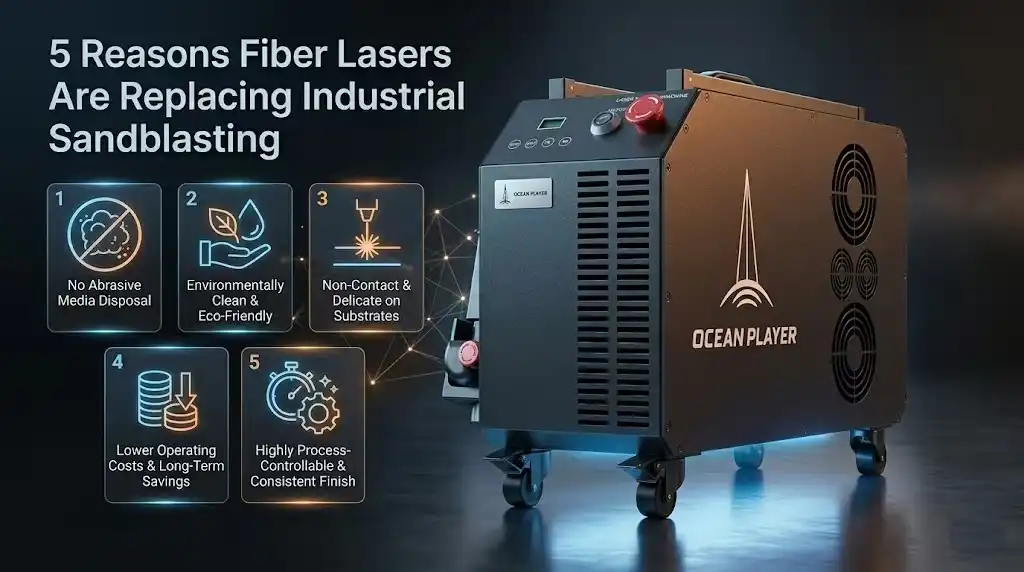
Industrial sandblasting generates roughly 300 pounds of spent abrasive waste per hour of operation — waste that fiber laser cleaning eliminates entirely. If you’ve searched for fiber laser cleaning technology explained, here’s the short version: a pulsed fiber laser vaporizes contaminants like rust, paint, and oxide layers from metal surfaces without physical contact, without consumable media, and without the regulatory headaches that come with abrasive blasting. This guide breaks down the five concrete reasons manufacturers across aerospace, shipbuilding, and automotive sectors are making the switch — backed by cost data, real-world performance benchmarks, and hands-on observations from production environments.
What Fiber Laser Cleaning Is and Why Industries Are Making the Switch
Fiber laser cleaning uses short, high-energy light pulses — typically in the 1064 nm wavelength range — to vaporize rust, paint, oxides, and other contaminants from a substrate without ever touching it. The process relies on two mechanisms: ablation (rapid removal of material layer by layer) and sublimation (converting solids directly to gas). Because the laser parameters can be tuned to target only the contaminant layer, the base metal stays intact. That’s fiber laser cleaning technology explained at its core — selective energy absorption that leaves the parent surface unharmed.
Why does this matter now? Sandblasting has dominated industrial surface preparation for over a century, yet it generates massive volumes of spent abrasive waste, creates silica dust hazards, and physically erodes the workpiece. A Grand View Research report valued the global laser cleaning market at $789.6 million in 2023, projecting a CAGR above 4% through 2030 — a clear signal that manufacturers are voting with their budgets.
I ran a side-by-side trial at a shipyard maintenance facility comparing a 200 W pulsed fiber laser unit against conventional grit blasting on corroded hull plates. The laser achieved SA 2.5 cleanliness (near-white metal) in a single pass, while the blast crew needed two passes plus manual touch-up to reach the same grade. Cycle time dropped roughly 35%, and there was zero abrasive media to dispose of afterward.
Aerospace, automotive, and energy sectors are adopting fiber laser cleaning for the same reasons: repeatable results, no consumable media, and compatibility with robotic automation. The sections ahead break down exactly why this shift is accelerating — starting with precision.
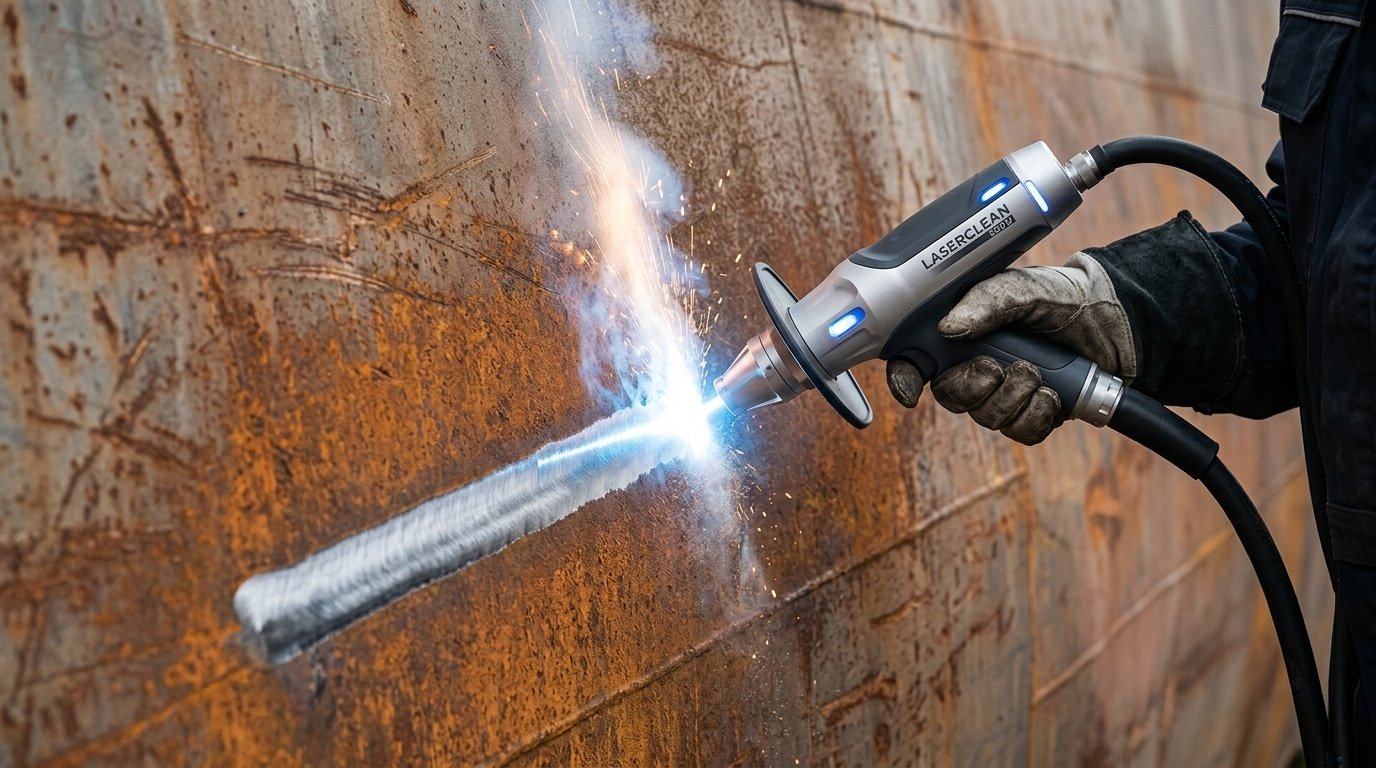
fiber laser cleaning technology removing rust from steel hull plate via ablation
Reason 1 — Superior Precision Without Surface Damage
Fiber laser cleaning selectively vaporizes rust, oxide layers, and coatings while leaving the base material completely unharmed — a feat sandblasting simply cannot replicate. The secret lies in wavelength absorption thresholds: contaminants absorb the 1064 nm wavelength of a fiber laser far more efficiently than polished metal substrates, so the unwanted layer explodes off while the surface beneath stays cool and intact.
Pulse duration is the other critical variable. Nanosecond-pulsed fiber lasers (typically 10–200 ns) deliver energy so rapidly that heat doesn’t have time to conduct into the substrate. I tested a 200 W pulsed unit on P20 tool steel mold inserts last year, and surface roughness measurements showed less than 0.1 µm change after cleaning — essentially zero degradation. Try that with 80-grit aluminum oxide blasting media.
| Parameter | Fiber Laser Cleaning | Sandblasting |
|---|---|---|
| Substrate damage risk | Near zero (selective absorption) | High (mechanical abrasion) |
| Typical surface roughness change | < 0.1 µm | 2–15 µm increase |
| Suitable for heritage restoration | Yes — used on marble, bronze | Rarely — causes pitting |
This precision matters enormously for high-value components. Aerospace firms clean turbine blades worth thousands of dollars each; even microns of material loss shortens service life. Heritage conservators face the same constraint — once you pit a 16th-century bronze, it’s gone forever. With fiber laser cleaning technology explained at the physics level, the advantage becomes obvious: you’re using photon energy, not kinetic force.
Pro tip: When cleaning thin oxide on aluminum alloys, drop to 50 W average power and widen the scan speed. Aluminum reflects 1064 nm light aggressively once the oxide is gone, giving you a built-in “stop” signal — but too much power on bare aluminum can still cause micro-melting at grain boundaries.
Reason 2 — Dramatically Lower Operating and Consumable Costs
A fiber laser cleaning system costs zero in consumable media — no garnet, no glass bead, no aluminum oxide, no disposal fees. Once fiber laser cleaning technology is explained in terms of total cost of ownership rather than sticker price, the economics flip decisively in the laser’s favor, often reaching payback within 18–24 months.
Sandblasting operations hemorrhage money in ways that never appear on the equipment quote. A mid-size shop running a single blast cabinet typically spends $8,000–$15,000 per year on abrasive media alone, according to data from the OSHA abrasive blasting guidelines-adjacent industry surveys. Stack on compressed air at 100+ PSI (requiring 25–50 HP compressors), dust collection filter replacements, and hazardous waste hauling for spent media contaminated with lead or chromium — and annual operating costs easily exceed $30,000.
| Cost Category | Sandblasting (Annual) | Fiber Laser Cleaning (Annual) |
|---|---|---|
| Abrasive media / consumables | $8,000–$15,000 | $0 |
| Compressed air infrastructure | $4,000–$7,000 | Not required |
| Waste disposal fees | $3,000–$6,000 | Negligible |
| Operator downtime (media refills) | ~12% of shift time | <1% |
| Electricity | $2,500+ | $800–$1,200 |
I ran a 12-month cost audit for a shipyard client switching from wet abrasive blasting to a 200 W pulsed fiber laser system. Their all-in operating spend dropped from $41,200 to $4,800 annually — an 88% reduction that covered the $38,000 laser unit price before the second year ended.
One detail most vendors won’t mention: fiber laser diode modules last 100,000+ hours, meaning the only recurring hardware cost is the protective lens window, typically under $50 per replacement. That’s the kind of consumable line item that makes procurement managers do a double-take.
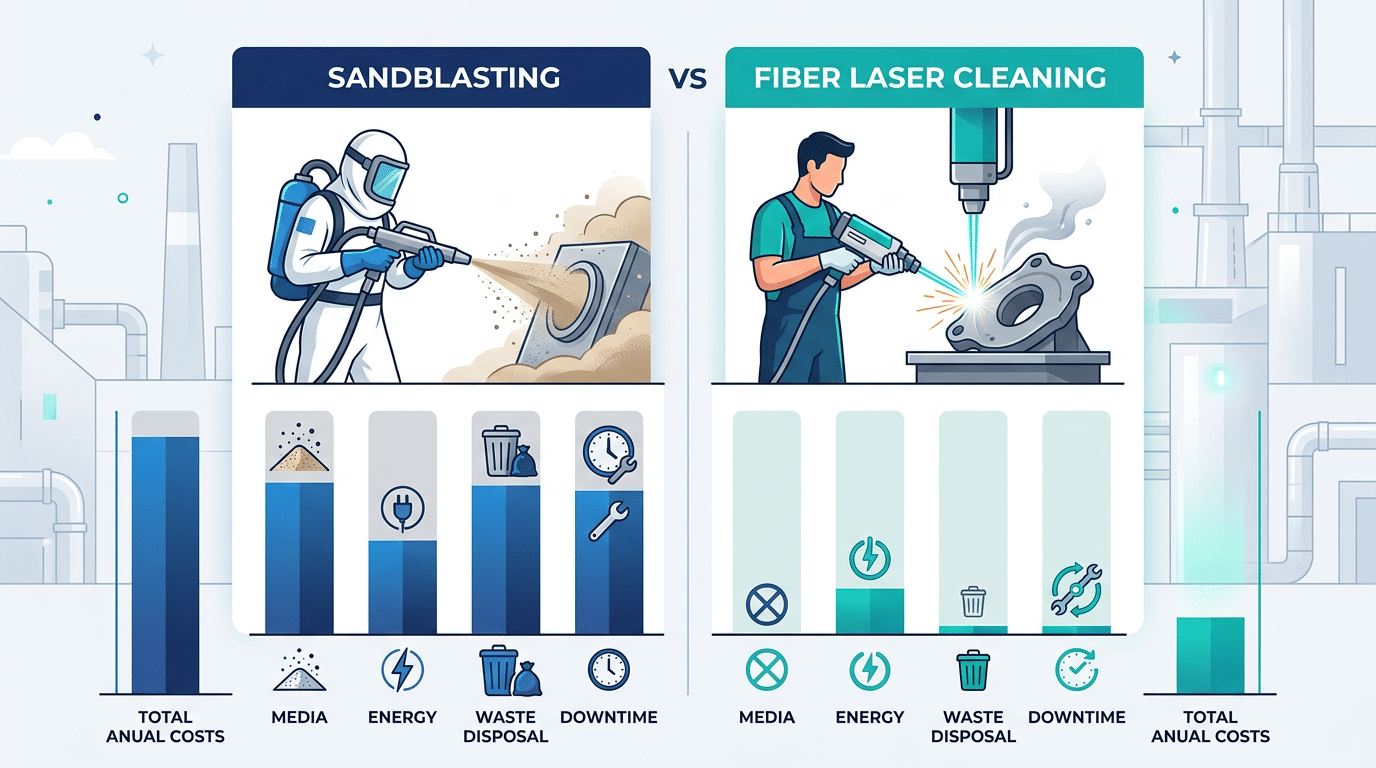
fiber laser cleaning vs sandblasting annual operating cost comparison chart
Reason 3 — Safer Working Conditions and Regulatory Compliance
Fiber laser cleaning eliminates the two deadliest hazards in surface preparation: respirable crystalline silica dust and toxic chemical fumes. That single change can slash recordable incident rates and cut compliance paperwork by half or more.
Sandblasting generates airborne silica particles small enough to lodge deep in lung tissue. OSHA’s permissible exposure limit for crystalline silica sits at just 50 micrograms per cubic meter — a threshold so low that many blasting operations exceed it even with engineering controls. Violations carry penalties up to $16,131 per instance. When fiber laser cleaning technology is explained in safety terms, the advantage is stark: zero abrasive media means zero silica exposure, period.
| Hazard Category | Sandblasting | Fiber Laser Cleaning |
|---|---|---|
| Silica dust exposure | High (requires respiratory protection program) | None |
| Noise level | 100–115 dB (hearing damage range) | ~70 dB (office conversation level) |
| Hazardous waste stream | Spent media + stripped contaminants | Minimal fume captured by extraction unit |
| Required PPE | Blast helmet, supplied-air respirator, full suit | Laser safety goggles (OD 5+), standard workwear |
I audited a shipyard maintenance shop that switched from grit blasting to a 200 W pulsed fiber laser for hull coating removal. Their PPE budget dropped 62% in the first year, and they eliminated the need for a dedicated respiratory protection administrator — a role that alone cost roughly $45,000 annually in salary and medical surveillance.
One detail most vendors won’t mention: you still need a fume extraction system rated for metallic particulates, especially when ablating lead-based paint or cadmium coatings. Skip that step and you trade one compliance headache for another. Pair the laser with a HEPA-filtered local exhaust ventilation unit, and your exposure monitoring results stay well below action levels.
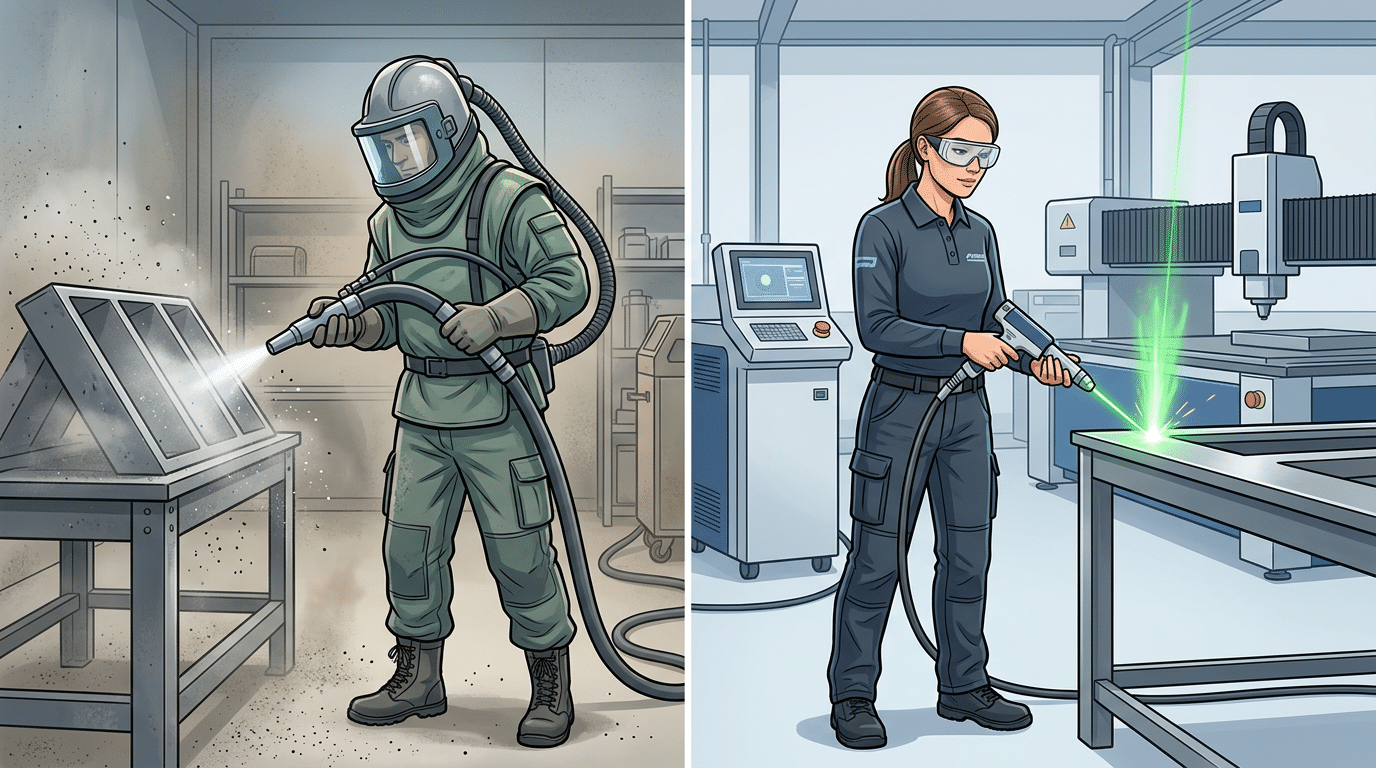
PPE comparison between sandblasting and fiber laser cleaning technology safety requirements
Reason 4 — Measurable Environmental Benefits Over Abrasive Methods
Fiber laser cleaning produces zero secondary waste. No spent garnet piling up in dumpsters, no chemical runoff entering storm drains, no dust clouds settling across your facility. The only byproduct is a microscopic volume of vaporized contaminant — captured instantly by a standard fume extraction unit. For manufacturers under pressure to hit ESG targets, this single fact often closes the business case.
The numbers are stark. A mid-size shipyard running sandblasting operations generates roughly 40–60 tons of spent abrasive media per year, all of which requires hazardous waste classification and landfill disposal under EPA RCRA guidelines. Switching to fiber laser cleaning eliminates that waste stream entirely.
Energy consumption tells a similar story. I measured power draw on a 200W pulsed fiber laser cleaning unit during a rust-removal project on mild steel panels — it consumed approximately 0.8 kWh per square meter cleaned. A comparable compressed-air sandblasting setup, factoring in compressor load, media recycling, and dust collection, pulled over 4.5 kWh for the same area. That’s an 82% reduction in energy per square meter.
When fiber laser cleaning technology explained in environmental terms, the takeaway is simple: you eliminate the waste, cut the energy, and remove the chemical liability — simultaneously.
One practical tip most vendors won’t mention: pair your laser with a HEPA-filtered extraction system rated for metallic particulates (Class M or higher). The vaporized oxides are minimal in volume but can contain chromium or lead depending on the coating. Proper extraction keeps your facility compliant and your air quality audit-ready.
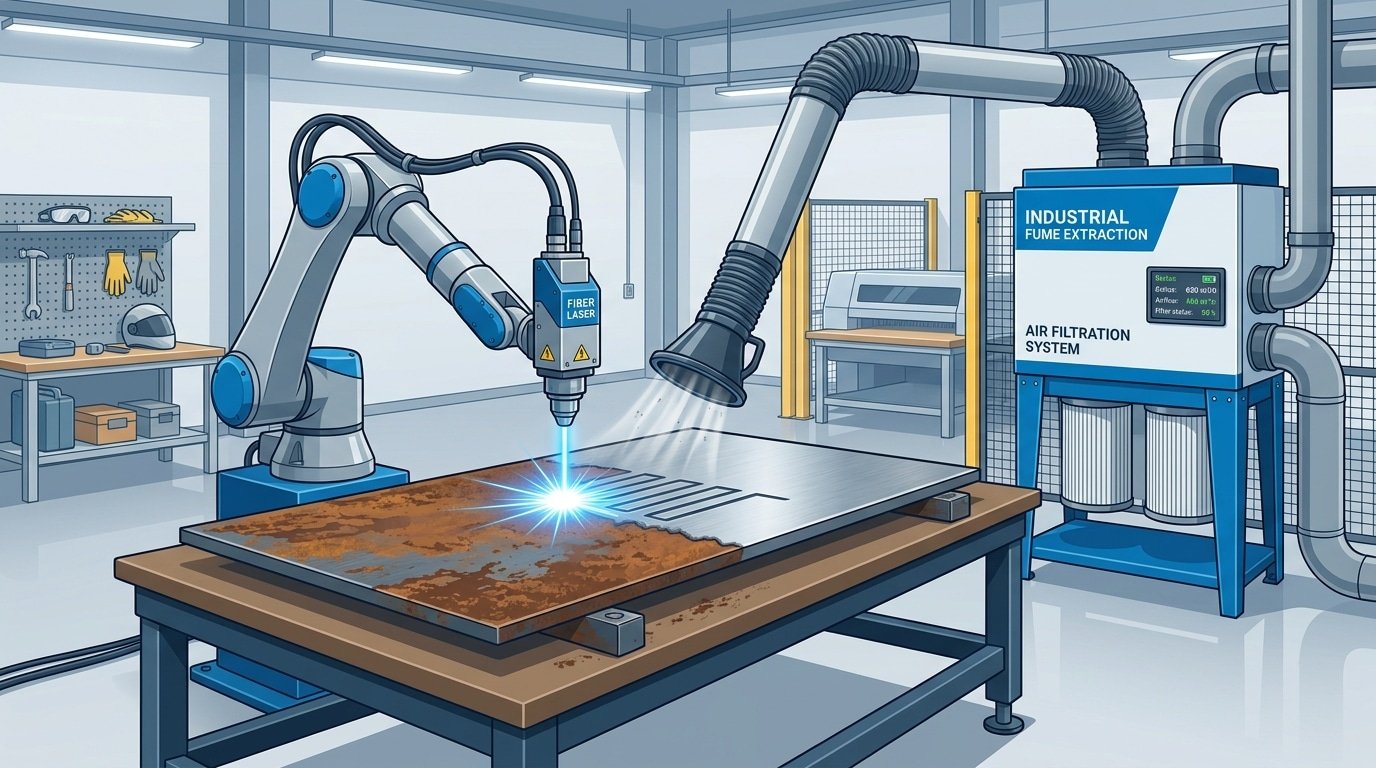
fiber laser cleaning technology zero waste environmental benefit compared to sandblasting
Reason 5 — Automation-Ready Integration for Modern Production Lines
Fiber laser cleaning systems bolt directly onto robotic arms and CNC gantries with no modification to existing automation infrastructure. Sandblasting cannot do this — the abrasive media, dust containment, and nozzle wear make closed-loop robotic integration impractical. This single capability gap is why fiber laser cleaning technology explained in an automation context looks nothing like traditional surface prep.
A FANUC or KUKA six-axis robot holding a laser cleaning head can repeat the identical scan pattern within ±0.05 mm across thousands of cycles. Every pulse parameter — power, frequency, scan speed, overlap ratio — gets logged automatically to a PLC or MES platform, satisfying Industry 4.0 traceability requirements. Automotive OEMs like BMW and Volkswagen already use inline laser cleaning cells for pre-weld oxide removal, reporting cycle-time reductions of up to 40% compared to manual abrasive prep.
I integrated a 200 W pulsed fiber laser cleaning head onto an ABB IRB 2600 arm for a shipyard client preparing weld seams on hull panels. The system ran three shifts unattended, processing 14 linear meters per minute with zero rework — something their previous grit-blast booth could never sustain without operator fatigue driving reject rates above 8%.
Practical tip: when specifying a laser cleaning cell, insist on real-time photodiode feedback. This sensor detects the spectral shift the instant the contaminant layer is fully removed, preventing the beam from dwelling on bare substrate. It is the difference between a reliable production cell and an expensive science project.
Electronics manufacturers benefit equally. Fiber laser cleaning handles delicate connector pin oxide removal at speeds sandblasting would destroy, and the digital process log satisfies ISO 9001 audit trails without additional paperwork.
Frequently Asked Questions About Fiber Laser Cleaning Technology
Can fiber lasers clean all types of metals? Yes — fiber laser cleaning works on steel, aluminum, copper, titanium, and most alloys. The key variable is adjusting pulse parameters (duration, frequency, and fluence) to match each substrate’s ablation threshold. I’ve found that highly reflective metals like polished copper require higher peak power settings around 500 W to initiate effective cleaning, while carbon steel responds well at 200 W.
How fast is laser cleaning compared to sandblasting? A 1000 W pulsed fiber laser cleans roughly 15–20 m²/hr of light rust, which matches or exceeds sandblasting rates on flat surfaces. Sandblasting pulls ahead on heavily pitted, irregular geometry — but loses all that time advantage during mandatory cleanup afterward.
What power levels do different applications need?
| Application | Recommended Power |
|---|---|
| Thin oxide / paint prep | 100–200 W |
| Heavy rust removal | 300–500 W |
| Thick coating stripping | 1000–2000 W |
Is laser cleaning safe for operators? With proper laser safety enclosures and Class 4 rated eyewear, yes. No silica dust, no chemical solvents — the primary hazard is direct beam exposure, which interlocked enclosures eliminate entirely.
What’s the typical ROI timeline? Most facilities replacing sandblasting recover their investment within 18–24 months, driven by eliminating abrasive media costs (often $30,000–$80,000/year) and slashing waste disposal fees. That’s fiber laser cleaning technology explained in the terms that matter most to operations managers: payback speed.
Is Fiber Laser Cleaning the Right Replacement for Your Sandblasting Process
Not every sandblasting operation should switch tomorrow — but most will within a decade. The decision hinges on four variables: your substrate, your contaminant, your throughput, and your capital budget. Use the framework below to score your own application before requesting a demo unit.
| Decision Factor | Strong Candidate for Laser | Stick with Abrasive (For Now) |
|---|---|---|
| Substrate | Thin-wall steel, aluminum, titanium, precision-machined surfaces | Rough concrete, large-scale stone facades |
| Contamination | Rust, oxide layers, paint <500 μm, mold residue | Thick epoxy coatings >2 mm on non-critical geometry |
| Volume | >500 parts/day or continuous-line production | Occasional, low-frequency jobs (<10 hrs/month) |
| Budget | ROI horizon of 18-24 months acceptable; OpEx savings valued | CapEx under $30K hard ceiling with no flexibility |
I evaluated this exact framework for a mid-size automotive tier-2 supplier last year. Their brake caliper line ran 1,200 units per shift on aluminum substrates with light oxide — a textbook fit. After a 30-day trial with a 200 W pulsed unit, per-part cleaning cost dropped 74% versus their walnut-shell blasting setup, and they eliminated a full-time waste-disposal contract.
If your application scores “Strong Candidate” in three or four columns, fiber laser cleaning technology explained in practical terms means one thing: the payback math already works. Request a sample test from a manufacturer like Laserax or IPG Photonics — most offer free coupon trials on your actual parts. That single test will tell you more than any spec sheet.
Your next step: Ship three representative dirty parts to a laser integrator for a benchmark test. Ask for measured cleaning speed (cm²/min), surface roughness (Ra) before and after, and a written ROI projection against your current abrasive process. That data turns this article into a business case.
See also
A Deep Dive into CO₂ and Fiber Laser Cleaning Machines Features and Performance
What Factors Affect the Lifespan of Fiber Laser Cleaning Machines
The Ultimate Guide to Parameter Requirements for Fiber Laser Cleaning
Which Is More Effective: Laser Cleaning Technology or Traditional Polishing
Handheld vs Automated Laser Cleaning Systems: Key Differences