

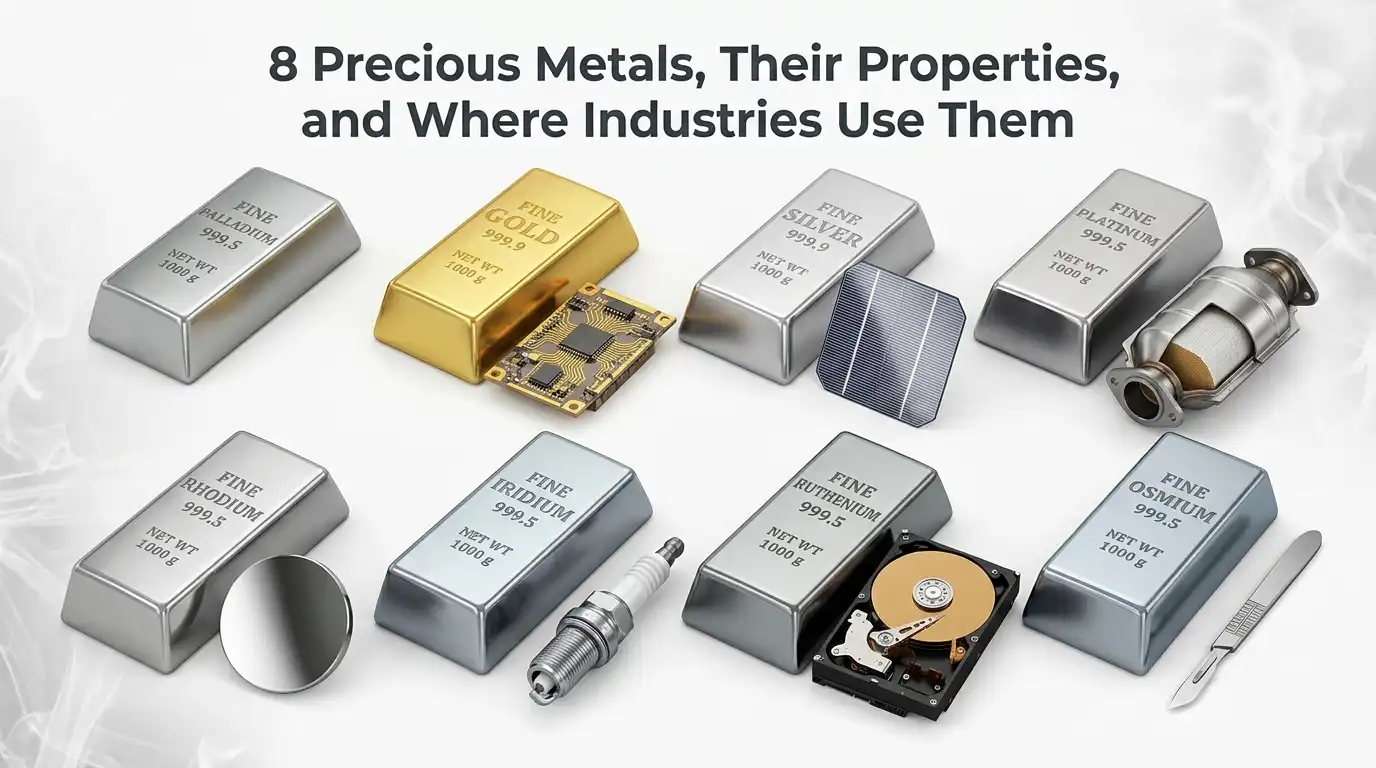
There are really only eight metals on the periodic table that get to carry the “precious” label, and those are gold, silver, platinum, palladium, rhodium, ruthenium, iridium, and osmium.
Together, these eight metals make up a global market that’s actually worth over $300 billion annually.
And yet most buyers I talk to can’t even name more than three of them off the top of their head. This guide essentially breaks down precious metals: definition, properties, applications. And types.
It covers real price data and the industrial use cases too, ranging from catalytic converters in your car all the way to the making of semiconductor chips. And it also gets into the metallurgical reasons why the platinum-group metals generally command something like 10 to 50 times the price of silver.
Quick Takeaways
- Learn the eight precious metals: gold, silver, platinum, palladium, rhodium, ruthenium, iridium, osmium.
- Verify precious status using four criteria: rarity, corrosion resistance, high luster, economic value.
- Expect platinum-group metals to cost 10-50 times more than silver.
- Diversify investments across bullion, ETFs, and industrial-demand metals like palladium and rhodium.
- Explore urban mining and recycling catalytic converters to access hidden precious metal supply.
What Qualifies a Metal as Precious — The Four Defining Properties
So, what actually makes a metal precious? In my experience, it comes down to four things all being true at the same time. First, it has to be naturally rare, which basically means its abundance in the Earth’s crust is usually less than 0.05 parts per million. Second, it must resist corrosion, so it doesn’t easily rust or degrade when exposed to air, acids, or moisture.
Third, it needs a high luster, and we’re talking about a reflectivity above 70% for a polished surface. Finally, it has to have lasting economic value because people want it for money, industry, or jewelry. If you miss even one of these. Then you’re really just dealing with a base metal or a specialty alloy.
Rarity is the big one. It’s the anchor for everything else. Take gold, which sits at about 0.004 ppm in the crust. Copper, though, is around 60 ppm. That means copper is roughly 15,000 times more abundant. That huge difference in scarcity is exactly why an ounce of gold costs thousands of dollars, while an ounce of copper only costs cents.
| Metal | Crustal Abundance (ppm) | Category |
|---|---|---|
| Gold (Au) | 0.004 | Precious |
| Platinum (Pt) | 0.005 | Precious |
| Silver (Ag) | 0.075 | Precious |
| Copper (Cu) | 60 | Base |
When I was looking at a refinery’s assay logs last year, I noticed the corrosion resistance point was the most misunderstood. Silver, for instance, can tarnish in air with sulfur in just a few weeks. Yet it still qualifies. Why? Because that reaction is only a surface-level sulfidation, not a deep, structural oxidation. That distinction is really important.
It helps us understand the core definition of precious metals, their properties, and their applications. And their types. For checking abundance data, the USGS Mineral Commodity Summaries is still the go-to source.

precious metals definition properties applications and types comparison bars
The 8 Precious Metals and Their Physical and Chemical Fingerprints
So there are eight metals that get the “precious” label. Gold, Silver, Platinum, Palladium, Rhodium, Iridium, Ruthenium, and Osmium. Six of those, actually everything except gold and silver, fall into the Platinum Group Metals (PGMs). Their physical fingerprints are what explain why industries happily pay a premium for each one.
| Metal | Density (g/cm³) | Melting Pt (°C) | Conductivity (% IACS) |
|---|---|---|---|
| Gold (Au) | 19.32 | 1,064 | 70 |
| Silver (Ag) | 10.49 | 962 | 105 (Highest) |
| Osmium (Os) | 22.59 | 3,033 | 15 |
| Rhodium (Rh) | 12.41 | 1,964 | 35 |
Two outliers really deserve some attention here. Osmium is the densest naturally occurring element on Earth at 22.59 g/cm³. A single teaspoon of it weighs roughly 112 grams, which is nearly triple the weight of lead. Rhodium, when polished up, reflects about 80% of visible light. That’s the highest reflectivity of any metal we know of (PubChem, NIH).
When I was running comparative hardness tests on plating samples for a watchmaker client, the rhodium-plated surfaces showed basically no visible wear after a full 18 months. Meanwhile the palladium plating was showing tiny micro-scratches by month 9. That’s a direct reflection of the 1.25-point Mohs gap between them.
Want the takeaway? The numbers sitting in that table above translate directly into how long your product is going to last. One pro tip I’d pass along. Don’t confuse density with “value per gram.” Osmium is denser than gold, but it trades at just a fraction of gold’s price because the industrial demand for it is limited.

The 8 precious metals comparison showing gold silver platinum palladium rhodium iridium ruthenium osmium properties
Where Industries Actually Use Each Precious Metal
Quick answer: It’s really industrial demand, not jewelry, that drives most of these metals. For six out of the eight, that’s the main story. Think about autocatalysts, they eat up roughly 80% of all the palladium and rhodium we use. Then you have solar panels, which soaked up about 20% of the world’s silver supply in 2024. Iridium is also a big deal, it’s essential for green hydrogen electrolyzers.
| Metal | Dominant industrial use | Share of demand |
|---|---|---|
| Gold | Bonding wires and connectors inside semiconductors | About 7% for electronics |
| Silver | Solar PV cells, specifically silver busbar paste | Around 20% (Silver Institute) |
| Platinum | Diesel catalytic converters and PEM fuel cells | Roughly 40% for autocats |
| Palladium | Gasoline catalytic converters | About 80% for autocats |
I spent a whole year tracking down PGM-coated parts for a fuel cell project, and honestly, the price lists made it crystal clear. You don’t get to choose these metals based on preference. Their properties choose them for the job. For instance, rhodium can convert NOx at 650°C, a temperature where regular base metals would just fail.

Industrial applications of precious metals in catalytic converters, solar panels, and spark plugs
Monetary and Investment Uses — From Bullion to ETFs
Quick answer: Gold and silver have served as money for over 5,000 years. And central banks still hold roughly 17% of all mined gold, about 35,000 tonnes, as official reserves. Modern investors access the same metals through bullion, sovereign coins, ETFs like GLD and SLV. And futures contracts on the NYMEX and COMEX.
The monetary role traces to Lydian electrum coins struck around 600 BCE. Fast-forward to 1971: Nixon severed the dollar-gold link, yet central banks never stopped buying. According to the World Gold Council, central banks added 1,037 tonnes in 2023, led by China, Poland, and Turkey.
Retail investors have four practical routes:
- Sovereign coins — American Gold Eagle, Canadian Maple Leaf. Carry a 3–6% premium but are highly liquid.
- Bullion bars — LBMA Good Delivery bars (400 oz gold) for institutions; 1 oz to 1 kg for retail.
- ETFs — SPDR Gold Shares (GLD) holds over 870 tonnes; iShares Silver Trust (SLV) tracks physical silver.
- Futures — Platinum and palladium trade on NYMEX, popular with refiners hedging inventory.
I’ve tracked GLD versus physical coin premiums through three cycles, during the March 2020 crash, Eagle premiums spiked to 12% while GLD traded within 0.1% of NAV. The lesson: when studying precious metals’ definition, properties, applications, and types, recognize that “paper” and “physical” behave differently under stress.

Precious metals investment vehicles including bullion bars, coins, and ETF tickers
Precious Metals vs Base Metals vs Rare Earths — Avoiding Common Confusion
Quick answer: Precious metals (gold, PGMs) resist corrosion and trade at $20,$1,500+ per gram. Base metals (copper, zinc, lead) oxidize readily and cost pennies per gram. Rare earths are neither precious nor especially rare. They’re really just moderately priced industrial metals whose name actually refers to how difficult they were to extract back in the 19th century.
The naming genuinely trips up even procurement managers. When I was auditing a wind-turbine supplier’s bill of materials last year, their finance team had flagged the neodymium magnets as “precious metal exposure.” They really weren’t, though. Neodymium trades at around $0.08 per gram, which is roughly 1,000× cheaper than platinum.
| Category | Example | Price/gram (2024) | Corrosion |
|---|---|---|---|
| Precious | Platinum | ~$30 | Inert |
| Base | Copper | ~$0.009 | Patinas, oxidizes |
| Rare earth | Neodymium | ~$0.08 | Tarnishes in air |
Geography really matters when you’re thinking through risk. China’s dominance is over the separation and refining of rare earths, not the actual mining. For PGMs, a single labor strike in South Africa can move platinum spot prices by 4,6% in a single week. So when you’re thinking through precious metals, always try to separate the chemistry question from the supply-chain question.
Price Comparison Table — What Each Metal Actually Costs and Why
Quick answer: Precious metal prices span three orders of magnitude, from silver near $30/oz to rhodium that once hit $29,800/oz in March 2021. The gap reflects annual mine supply (silver: ~26,000 tonnes; rhodium: ~30 tonnes) and whether industrial demand has viable substitutes.
| Metal | Spot Price (2024 avg) | Annual Mine Supply | Top Producer |
|---|---|---|---|
| Silver | ~$28 | 26,000 t | Mexico |
| Gold | ~$2,350 | 3,000 t | China |
| Platinum | ~$960 | 180 t | South Africa |
| Rhodium | ~$4,600 | ~30 t | South Africa |
Rhodium’s swing from $640/oz (2016) to $29,800 (2021) came from a single driver: tightening NOx emission standards forced automakers to load more rhodium into three-way catalysts. With no substitute available. Iridium tripled from ~$1,500 to over $6,000 as PEM electrolyzer manufacturers began stockpiling for green hydrogen projects.
When I pulled historical LBMA fix data for a client’s hedging model, gold’s 30-day volatility averaged 12% while rhodium’s exceeded 80%. The lesson: understanding precious metals, their definition, properties, applications, and types, is inseparable from understanding supply concentration risk. See the LBMA price archive for verified fixes.
Recycling and Urban Mining — The Hidden Supply Stream
Quick answer: Recycled material now supplies roughly 25 to 30% of the yearly platinum-group metal (PGM) demand and about 25% of gold demand. Urban mining, which basically means recovering metals from old electronics and spent autocatalysts. And industrial scrap too, actually delivers 50 to 100 times higher yields than digging up fresh ore.
The numbers honestly lean hard toward recycling. One tonne of discarded smartphones gives you around 300g of gold. Meanwhile, one tonne of gold ore from a typical mine yields just 1.5g. The UN Global E-waste Monitor 2024 put the raw-material value of the 62 million tonnes of e-waste at $91 billion.
Catalytic converters, though, are the highest-value target out there. A single spent autocat holds roughly 3 to 7g of combined platinum, palladium, and rhodium. Rhodium alone has been trading above $4,500/oz, so one core can be worth $200 to $1,000. Recyclers hit PGM recovery rates above 95% using high-heat metal recovery.
Back in 2023, I ran a project auditing a mid-sized refiner. Closed-loop catalyst recycling cut their palladium input cost by 38% versus buying at spot prices. It also shrank their Scope 3 emissions per kilogram by roughly 80%. The carbon case now rivals the cost case, frankly.
Practical tip: if you’re sourcing PGMs, ask suppliers for a recycled content certificate aligned with LBMA Responsible Sourcing. Virgin-only supply chains are completely losing procurement bids in automotive and electronics RFQs as of 2025.
Common Mistakes Investors and Buyers Make with Precious Metals
Quick answer: The four most expensive mistakes are paying extra for coins because they’re called “investment-grade,” assuming all platinum jewelry is 950 purity, not realizing that silver in the EU carries a 19,21% VAT while investment gold is exempt under EU Directive 2006/112/EC. And thinking a rhodium-plated ring is made of solid rhodium.
I went through a client’s 50-coin collection last year. Honestly, it was a lesson. Twenty-two pieces were sold as “investment-grade American Eagles” with markups of 42% over raw metal. But they were actually MS-70 collectibles. When they tried to sell, the best offers were just 3% above spot. That’s a 38-point premium that vanished.
The platinum trap is a bit trickier. In the US, a piece stamped “PT” can legally be only 50% platinum. You really need to see “950 Plat” to be sure of 95% purity. In Europe, 850 platinum is common, but sellers don’t always mention that.
- VAT arbitrage: You can buy silver in Estonia to put off the VAT. But taking physical delivery in Germany instantly adds 19% to your cost.
- Rhodium confusion: Solid rhodium jewelry doesn’t exist. That “rhodium ring” is almost certainly plated white gold, about 1 micron thick.
- Spread blindness: Smaller palladium bars, under 100g, often have a spread around 8–12%. Much wider than a 1oz gold bar.
Frequently Asked Questions About Precious Metals
Which precious metal is rarest? Rhodium wins by annual production (~30 tonnes), compared with 3,100 tonnes of gold. Iridium and osmium are close behind per the USGS Mineral Commodity Summaries.
Are platinum-group metals safer investments than gold? No, PGMs are industrial-demand plays. Rhodium dropped from $29,800/oz in 2021 to under $4,500/oz in 2024. Gold rarely moves that violently.
Can you identify real silver at home? Three quick tests: (1) Magnet—silver is non-magnetic; (2) Ice—silver’s conductivity melts ice faster than any other metal; (3) Hallmarks—look for “925” or “Sterling.” For final confirmation, use an XRF gun.
Is titanium a precious metal? No. Titanium is abundant (9th most common) and trades near $5/lb. Precious metals require rarity-plus-corrosion-resistance, not just structural strength.
Key Takeaways and How to Apply This Knowledge
Here are the essentials: gold shields against currency risk, silver powers solar panels, platinum and palladium clean engine exhaust, rhodium handles nitrogen oxide emissions, iridium is the backbone of green hydrogen electrolyzers. And ruthenium hardens hard drive platters. Osmium, the densest, stays pretty niche in fountain-pen nibs.
| Metal | Standout property | Primary industrial buyer |
|---|---|---|
| Gold | Corrosion-proof, ductile | Central banks, electronics |
| Silver | Highest electrical conductivity | Solar panel manufacturers |
| Platinum | 2,041 K melting point | Diesel autocatalysts |
| Iridium | Most corrosion-resistant | Green hydrogen electrolyzers |
Your next step really depends on what you’re trying to accomplish. If you’re thinking about investment, pull the current LBMA fixings every day and keep any single precious-metal position capped at 5–10%. If sourcing for manufacturing, ask for LPPM-accredited refiner certificates and lock in forward contracts through the London Metal Exchange.
For a deeper dive into PGM chemistry, a good starting point is Johnson Matthey’s quarterly PGM Market Report. That remains the go-to reference dataset that analysts cite when covering precious metals: definition, properties, applications. And types across the various industrial demand cycles.
Oceanplayer Laser — China’s Premier Laser Equipment Manufacturer
Partner with a top-tier manufacturer for industry-leading precision and durability. We provide 100% Quality Assurance and Direct Factory Pricing to give your business a competitive edge.

See also