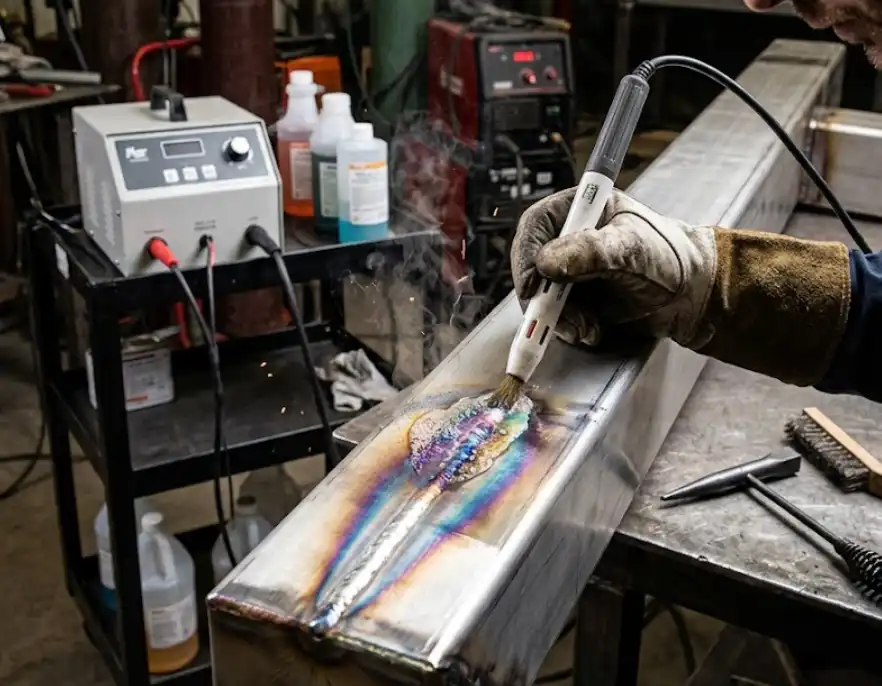
Stainless steel loses up to 30% of its corrosion resistance in the heat-affected zone surrounding an uncleaned weld — a fact that catches many fabricators off guard. So, does weld cleaning improve corrosion resistance? The short answer is yes, and dramatically so: proper post-weld cleaning removes the chromium-depleted oxide layer, restores the protective passive film, and can bring corrosion resistance back to near-base-metal levels within minutes of treatment.
Short Answer — Yes, Weld Cleaning Significantly Improves Corrosion Resistance
The short answer is unambiguous. Weld cleaning dramatically improves corrosion resistance — often by a factor of 10x or more compared to leaving welds untreated. The reason comes down to one thing: the chromium oxide passive layer that gives stainless steel its “stainless” quality gets destroyed during welding, and proper cleaning is the only way to bring it back.
Here’s what happens. When you weld stainless steel, temperatures in the heat-affected zone (HAZ) exceed 400°C. At those temperatures, chromium atoms near the surface react preferentially with oxygen and form a thick, discolored oxide scale — the familiar rainbow or dark blue heat tint. This isn’t just cosmetic damage. That discolored zone has been stripped of the free chromium needed to regenerate the protective passive film, which is normally only 1–5 nanometers thick but remarkably effective at blocking corrosive attack.
So does weld cleaning improve corrosion resistance? The data is clear. According to research published by the British Stainless Steel Association, even light straw-colored heat tint (corresponding to roughly 300°C exposure) reduces pitting resistance by up to 40%. Darker tints — blue, purple, black — can slash corrosion resistance by 70–90%. Proper weld cleaning removes these compromised oxide layers and allows a fresh, chromium-rich passive film to form spontaneously in the presence of oxygen.
The method you choose matters. Electrochemical cleaning, mechanical abrasion, and chemical pickling each restore passivation to different degrees, and we’ll break down exactly how in the sections ahead. But the core principle holds regardless of technique: an uncleaned weld is a corrosion site waiting to activate.

Before and after weld cleaning showing heat tint removal and restored passive layer on stainless steel
The Science Behind Weld Discoloration and Heat Tint
Stainless steel owes its corrosion resistance to a microscopically thin chromium oxide layer — roughly 1 to 5 nanometers thick. This passive film forms spontaneously when chromium in the alloy reacts with atmospheric oxygen. Welding disrupts that equilibrium violently. Once temperatures climb past approximately 400°C in the heat-affected zone (HAZ), chromium atoms begin migrating toward the surface, where they oxidize far faster than the passive layer can regulate.
The result is heat tint — that familiar discoloration radiating outward from a weld bead. But it’s not just cosmetic. Each color in the spectrum tells you something specific about the depth of chromium depletion beneath. A light straw tint (around 300–400°C exposure) indicates minimal oxide thickness, perhaps 10–20 nm, with only modest chromium loss. Gold shifts the picture: oxide layers thicken to roughly 30–50 nm, and the underlying metal has measurably less chromium available to rebuild its protective film.
Blue and purple tints are the real warning signs. These colors correspond to surface temperatures exceeding 600°C, producing oxide layers 80 nm or thicker. Research published by the British Stainless Steel Association confirms that chromium content in these heavily tinted zones can drop below the 10.5% threshold needed to maintain passivity. At that point, the steel behaves more like mild carbon steel than a corrosion-resistant alloy.
This is precisely why the question “does weld cleaning improve corrosion resistance” matters so much at a metallurgical level. The discoloration you see is a direct map of chromium depletion beneath it. Removing only the visible oxide without addressing the depleted sublayer leaves the metal exposed. Understanding this color-to-depletion relationship is the foundation for choosing the right cleaning method — a topic the following sections address in detail.

Heat tint color spectrum on stainless steel weld showing chromium depletion depth from straw through purple discoloration
Why Uncleaned Welds Are Vulnerable to Corrosion
Three distinct corrosion mechanisms target uncleaned welds, and each exploits a different weakness left behind by the welding process. Pitting corrosion initiates at microscopic breaks in the depleted passive layer, boring deep, narrow holes into the base metal. Crevice corrosion thrives under weld spatter, embedded slag, and oxide scale — anywhere stagnant electrolyte gets trapped against a compromised surface. Then there’s intergranular corrosion, which attacks grain boundaries where chromium carbides precipitated during welding, leaving chromium-starved zones that dissolve preferentially.
The heat-affected zone is the real problem child. HAZ temperatures between roughly 450°C and 850°C cause chromium to migrate toward carbon atoms, forming carbides at grain boundaries — a phenomenon metallurgists call sensitization. The result is a narrow band of metal that’s chemically distinct from the parent material. It becomes an electrochemical weak point, essentially a built-in galvanic cell where the depleted zone acts as the anode. Corrosion doesn’t wait. It starts there first.
Industry standards put hard numbers on the difference. Testing per ASTM G48 — the standard method for pitting and crevice corrosion resistance of stainless steels — consistently shows that uncleaned welds fail at critical pitting temperatures 15–25°C lower than properly cleaned counterparts. AWS D18.1, which governs stainless steel welding for hygienic applications, explicitly requires post-weld cleaning and passivation to meet acceptance criteria. So when fabricators ask does weld cleaning improve corrosion resistance, the standards themselves answer with mandatory requirements, not suggestions.
Left untreated, an uncleaned weld on 316L stainless can show visible pitting within weeks in chloride-rich environments — seawater, chemical processing lines, even indoor pool enclosures. The corrosion rate differential isn’t marginal. It’s the difference between a 20-year service life and a warranty claim in year one.

Diagram of pitting, crevice, and intergranular corrosion mechanisms attacking an uncleaned weld heat-affected zone
How Weld Cleaning Restores the Passive Layer
The previous sections explained how welding depletes chromium beneath the heat tint and why that depleted zone invites corrosion. The fix is straightforward in principle: strip away the damaged oxide, expose fresh metal rich in chromium, and let atmospheric oxygen do the rest. That sequence — removal followed by spontaneous repassivation — is the core reason weld cleaning improves corrosion resistance so effectively.
The Chemistry of Repassivation
When the chromium-depleted oxide layer is removed, the underlying alloy surface is momentarily bare. Chromium atoms at that fresh surface have an extremely high affinity for oxygen — far higher than iron does. Within seconds, chromium reacts with ambient O₂ to nucleate a new chromium(III) oxide (Cr₂O₃) film. This film is dense, amorphous, and self-healing. According to research published by the National Association of Corrosion Engineers (NACE), a functional passive layer can begin forming in as little as 20–30 minutes under clean, dry atmospheric conditions, though full maturation to roughly 1–5 nanometers thick may take 24–48 hours.
The Chromium Threshold That Matters
Not every surface repassivates equally. The critical variable is the chromium concentration available at the exposed metal surface. Stainless steel needs a minimum of approximately 10.5% chromium by weight to form a stable passive film — that’s the baseline that separates stainless from ordinary carbon steel. Most 304 and 316 grades contain 16–18% chromium in bulk, providing a comfortable margin. But if the cleaning method doesn’t remove enough of the depleted zone, the remaining surface chromium may sit dangerously close to that 10.5% threshold, and the reformed oxide will be thin, patchy, and weak.
This is exactly why the question “does weld cleaning improve corrosion resistance” depends so heavily on cleaning depth. A light brush that only removes surface discoloration but leaves the chromium-starved sublayer intact produces a cosmetically clean weld that still corrodes. Effective cleaning must reach past the depleted zone — typically 1–5 micrometers deep depending on heat input — to expose metal with full chromium content. Only then can the passive layer regenerate to its original protective quality.

Cross-section diagram showing how weld cleaning removes the chromium-depleted layer and allows a new chromium oxide passive film to form on stainless steel
Electrochemical Weld Cleaning and Its Effect on Corrosion Resistance
Electrochemical weld cleaning — sometimes called electrolytic cleaning — works by passing electrical current through a phosphoric acid-based electrolyte solution applied to the weld surface via a carbon fiber brush or pad. The process does two things simultaneously: it dissolves the chromium-depleted oxide layer (heat tint) and triggers immediate re-passivation of the freshly exposed metal beneath. That dual action is what sets it apart from purely mechanical or chemical methods.
The mechanism is straightforward. A DC or pulsed-DC current, typically between 3 and 50 amps depending on the machine, drives an electrochemical reaction at the surface. Iron oxides and embedded contaminants dissolve into the electrolyte, while chromium atoms in the base metal react with oxygen to form a new, uniform Cr₂O₃ passive film — often within seconds. The result is a surface that’s chemically cleaner and more corrosion-resistant than the original mill finish in many cases.
So does weld cleaning improve corrosion resistance when performed electrochemically? Salt spray testing data makes a compelling case. According to research published by TWI (The Welding Institute), electrochemically cleaned 304 and 316L stainless steel welds have survived over 1,000 hours of neutral salt spray exposure (ASTM B117) without visible pitting, matching or exceeding the performance of pickled samples. Mechanically ground welds tested under identical conditions showed red rust formation in under 200 hours.
Surface finish quality is another advantage. Electrochemical cleaning leaves a bright, aesthetically uniform appearance with Ra values often below 0.8 µm — important for pharmaceutical, food-processing, and architectural applications where both hygiene and appearance matter. There’s no material removal, no risk of embedded abrasive particles, and no hydrogen embrittlement concern. The process also generates far less hazardous waste than acid pickling baths, making it easier to manage in production environments.
Mechanical and Chemical Cleaning Methods Compared
Electrochemical cleaning isn’t the only game in town. Fabricators have relied on mechanical and chemical approaches for decades, and each carries distinct advantages — along with real drawbacks that can undermine the very corrosion resistance you’re trying to restore.
Mechanical Methods: Grinding, Wire Brushing, and Abrasive Blasting
Grinding with flap discs or abrasive wheels removes heat tint quickly, but it’s aggressive. Over-grinding thins the base metal and can smear the surface, trapping contaminants beneath a burnished layer that looks clean but isn’t. Wire brushing is gentler, yet here’s the critical rule: only use stainless steel brushes. A carbon steel brush embeds free iron particles into the surface, creating initiation sites for pitting corrosion within weeks. Abrasive blasting with glass bead or aluminum oxide media avoids iron contamination, but controlling the blast profile on thin-walled tubing or sanitary fittings is difficult — and any residual media lodged in crevices becomes a future corrosion nucleation point.
Chemical Pickling: Effective but Demanding
Pickling pastes containing 8–20% nitric acid and 1–5% hydrofluoric acid dissolve the chromium-depleted layer aggressively and expose fresh alloy underneath. The result is excellent. Pitting resistance values measured after proper pickling routinely match or exceed parent metal performance, which directly answers whether does weld cleaning improve corrosion resistance through chemical means — it absolutely does. Citric acid-based formulations, increasingly popular for environmental reasons, achieve comparable passivation on 304 and 316 grades according to ASTM A967 testing, though they work more slowly and struggle with heavy heat tint above straw-yellow discoloration.
The trade-offs are real. Nitric-hydrofluoric pastes produce toxic fumes, require neutralization before disposal, and can cause severe chemical burns with seconds of skin contact. Citric acid is safer to handle but demands longer dwell times — often 30 to 60 minutes versus 10 to 20 for nitric blends — and temperature control above 50 °C for consistent results. Both chemical routes require thorough rinsing; residual acid left in lap joints or socket welds accelerates crevice corrosion rather than preventing it.
Common Mistakes That Compromise Corrosion Resistance After Weld Cleaning
Even a thorough cleaning process can fail if basic contamination rules are ignored. The most damaging — and most common — error is using carbon steel wire brushes on stainless steel. Those brushes embed microscopic iron particles into the surface, creating hundreds of initiation sites for galvanic corrosion. Within weeks, rust streaks bloom across what looked like a perfectly finished weld. Dedicated stainless steel brushes cost a few dollars more. Skipping that swap can cost thousands in rework.
Insufficient rinsing after chemical pickling is another silent killer. Residual acid — especially hydrofluoric or nitric blends — continues to attack the base metal long after the paste is wiped away. The ASTM A380 standard specifies thorough water rinsing followed by pH-neutral verification for exactly this reason. A quick wipe with a damp rag doesn’t cut it.
A subtler mistake: cleaning only the visible heat tint while ignoring the full heat-affected zone. Discoloration is a rough visual guide, not a precise boundary. Chromium depletion often extends 3–5 mm beyond the last visible temper color, and leaving that depleted band untreated invites intergranular attack right next to an otherwise clean weld.
Finally, many fabricators never verify passivation after cleaning. Does weld cleaning improve corrosion resistance? Only if the passive layer actually reforms. A simple copper sulfate test per ASTM A967 takes under a minute and confirms whether the chromium oxide film has re-established. Skipping that check means you’re trusting appearance over chemistry — and appearance lies.
Best Practices for Passivation and Post-Weld Surface Treatment
Sequence matters more than any single step. The optimal post-weld workflow follows a strict order: degrease, mechanically clean or electrochemically clean, pickle if needed, passivate, rinse, then verify. Skipping steps or rearranging them introduces contamination that undermines everything downstream.
Passivation Bath Parameters
For austenitic stainless steels like 304 and 316, a citric acid bath at 4–10% concentration and 60–70 °C delivers consistent results with a 20–30 minute dwell time. Nitric acid baths — the traditional choice — run at 20–50% concentration and 50–60 °C for 30–60 minutes. Citric acid is gaining ground in food-grade and pharmaceutical work because it avoids hazardous fume generation and meets ASTM A967 requirements just as effectively.
Rinsing and Verification
After passivation, rinse with deionized water — not tap water. Chlorides in municipal water can nucleate pitting within hours. Two verification methods stand out: the ASTM A380 water immersion test, where the surface is submerged for 12–24 hours and inspected for rust spots, and the ferroxyl test, which applies a potassium ferricyanide solution to detect free iron. Blue spots mean failure. No blue, no free iron, no problem.
Industry-Specific Requirements
Pharmaceutical and biotech fabrication typically demands an Ra surface finish of 0.8 µm or finer before passivation, per ASME BPE standards. Marine applications call for 6% molybdenum super-duplex alloys with extended passivation dwell times of 45–60 minutes. Food-grade equipment requires electropolishing followed by passivation to eliminate micro-crevices where bacteria colonize. Each scenario answers the question of does weld cleaning improve corrosion resistance with a resounding yes — but only when the full treatment protocol matches the service environment.
Frequently Asked Questions About Weld Cleaning and Corrosion Resistance
Does weld cleaning work on all metals or just stainless steel?
Electrochemical weld cleaning is most effective on stainless steel, where restoring the chromium oxide passive layer is the primary goal. It also works on carbon steel, aluminum, and duplex alloys — but the electrolyte formulations differ. Carbon steel benefits from heat tint removal, though it still requires a protective coating afterward since it lacks a self-healing passive layer.
How long does corrosion protection last after cleaning?
A properly cleaned and passivated stainless steel weld can maintain its corrosion resistance indefinitely under normal service conditions. The passive layer regenerates itself in oxygen-rich environments. Aggressive exposures — chloride-heavy marine air, sustained chemical contact above 60°C — will shorten that timeline, but the cleaned surface still vastly outlasts an uncleaned one.
Can you over-clean a weld?
Yes. Excessive dwell time with electrochemical tools or overly concentrated pickling paste can etch the base metal, creating surface roughness that traps contaminants. A pitted surface is harder to passivate. Follow manufacturer dwell-time guidelines precisely.
Is electrochemical cleaning as effective as pickling paste?
For light-to-moderate heat tint (straw through dark blue), electrochemical cleaning matches or exceeds pickling paste performance. Heavy gray or black oxide layers may still require acid pickling or a two-step approach. The ASTM A380 standard provides guidance on selecting appropriate methods based on contamination severity.
Do TIG welds need cleaning if they already look clean?
Absolutely. A shiny TIG weld can still carry a thin, chromium-depleted oxide layer invisible to the naked eye. If the question is does weld cleaning improve corrosion resistance on visually acceptable welds — the answer remains yes. Even faint straw-colored tint represents measurable chromium loss.
What standards govern weld cleaning for corrosion-critical applications?
ASTM A380 and ASTM A967 cover cleaning and passivation of stainless steel. ASME BPE applies to pharmaceutical and bioprocessing equipment. AWS D18.1 addresses stainless steel welding in sanitary applications. Specifying the right standard depends on your industry and the corrosive environment the weld will face.
Final Takeaway — Weld Cleaning Is Essential, Not Optional, for Corrosion Prevention
The evidence across every section of this guide points to one conclusion: does weld cleaning improve corrosion resistance? Absolutely — and skipping it is one of the most expensive shortcuts a fabricator can take. A single uncleaned weld on a stainless steel system can trigger pitting, crevice corrosion, or stress corrosion cracking within months, turning a $200 cleaning task into a $50,000 field repair.
Weld cleaning restores the chromium oxide passive layer that welding destroys. That passive layer — just 1–5 nanometers thick — is the only barrier between the base metal and its environment. Without it, the chromium-depleted heat-affected zone becomes an active corrosion site. The method you choose matters, but doing something always beats doing nothing.
Your Post-Weld Corrosion Prevention Checklist
- Remove all heat tint and discoloration using electrochemical, chemical, or mechanical methods appropriate for your alloy grade.
- Eliminate iron contamination — use dedicated stainless steel brushes, never carbon steel tools.
- Passivate per ASTM A967 using citric or nitric acid after cleaning.
- Rinse with deionized or low-chloride water (below 50 ppm Cl⁻).
- Verify results — use a copper sulfate test, ferroxyl indicator, or PREN calculation to confirm passivation.
- Document every step for traceability, especially in pharmaceutical, food-processing, or marine applications.
Pick your cleaning method based on three factors: the alloy you’re working with, the corrosion environment it will face, and the surface finish your client or code requires. Electrochemical cleaning handles most shop and field work efficiently. Pickling paste suits heavy fabrication with thick oxide layers. Mechanical methods work when cosmetics matter less than speed. Match the tool to the job, follow the checklist above, and the passive layer will do what it was designed to do — protect the metal for decades.
See also
The Complete Guide to Stainless Steel Welding Techniques
Laser Welding of 304 vs 316 Stainless Steel
Top Portable Laser Welding Machines for Stainless Steel and Their Prices
Classification of Carbon Metal Content, Steel, and Alloy Steel