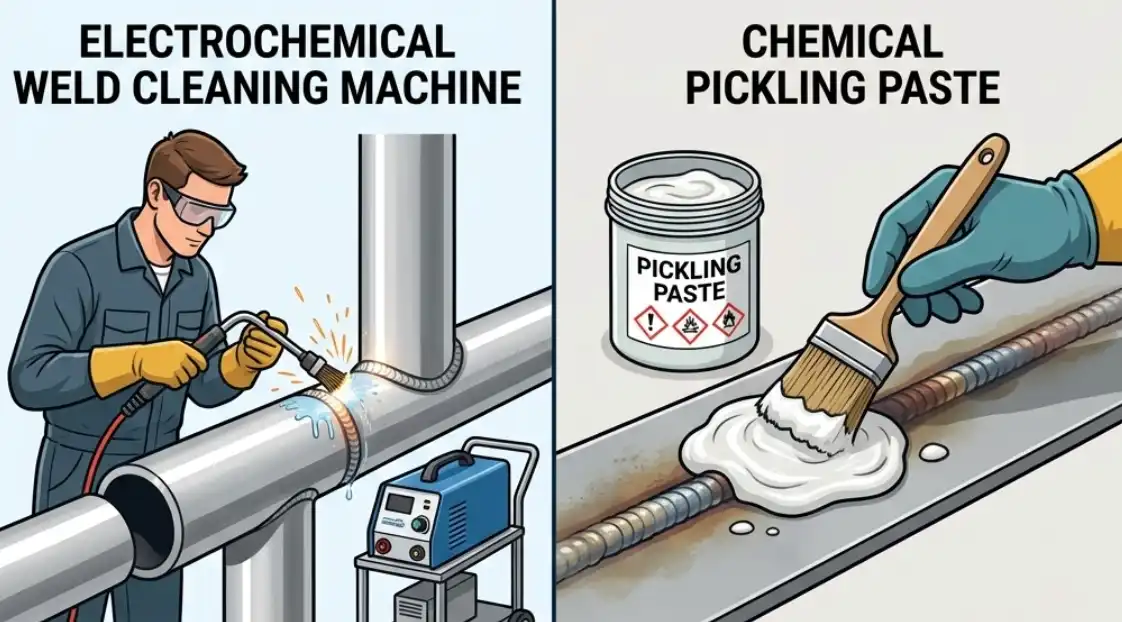
Roughly 78% of stainless steel fabrication shops still rely on pickling paste for post-weld cleaning — yet electrochemical weld cleaning machines have cut processing time by up to 90% in head-to-head shop trials. So when it comes to the debate of weld cleaning machine vs pickling paste which is better, the honest answer depends on your production volume, weld types, safety tolerance, and budget horizon. This guide breaks down both methods with real cost figures, finish quality data, and practical scenarios so you can pick the right tool — not just the popular one.
Quick Answer — Weld Cleaning Machine or Pickling Paste
There’s no single winner. If you’re asking weld cleaning machine vs pickling paste — which is better, the honest answer is that it depends entirely on your shop’s specific situation. A fabricator running 200 TIG welds per shift has radically different needs than a maintenance crew touching up a handful of MIG joints per week.
Here’s the short version:
- Electrochemical weld cleaning machines excel at high-volume, repeatable work where operator safety, speed (typically 1–3 minutes per weld), and a bright, consistent finish matter. Upfront cost ranges from $2,000 to $10,000+, but per-weld consumable costs stay low — often under $0.15.
- Pickling paste is cheaper to start with (a 2 kg jar runs $30–$60), handles large surface areas well, and requires zero electrical equipment. But it contains hydrofluoric and nitric acid, demands strict PPE protocols, and leaves you waiting 30–60 minutes per application for full effect.
Budget is the obvious first filter. A small shop doing occasional stainless steel handrail work may never justify a machine purchase. Production volume is the second filter — once you’re cleaning more than roughly 40–50 welds per day, the time savings from an electrochemical system start compounding fast. Safety regulations matter too; some facilities in the EU and parts of North America are actively restricting hydrofluoric acid use in open-shop environments, as outlined in guidance from the European Agency for Safety and Health at Work.
Finish quality expectations close the loop. Pickling paste can deliver excellent passivation, but results vary with dwell time, temperature, and operator technique. Machines offer more predictable, inspector-friendly outcomes weld after weld. The sections below break each factor down so you can match the method to your actual workflow — not someone else’s.

Weld cleaning machine vs pickling paste side-by-side comparison in a metal fabrication workshop
How Electrochemical Weld Cleaning Machines Work
The principle is straightforward: electricity plus chemistry. A weld cleaning machine passes a low-voltage electrical current through a conductive electrolyte fluid to dissolve the heat tint (that rainbow discoloration) and oxide layer left behind after welding stainless steel or other chromium-bearing alloys. The current triggers a controlled electrochemical reaction right at the weld surface — essentially reverse-plating the contamination off the metal.
Three components do the heavy lifting. The power unit supplies adjustable DC or AC/DC current, typically between 5 and 50 amps depending on the model and application. A carbon fiber brush (sometimes called a wand) serves as the electrode, delivering current directly to the workpiece through the electrolyte-soaked pad. And the electrolyte fluid — usually a phosphoric acid–based solution far milder than the hydrofluoric/nitric acid blends in pickling paste — completes the circuit and carries dissolved oxides away from the surface.
Here’s what makes the process genuinely clever. As the brush moves across the weld, the anodic reaction strips away iron oxides and heat tint while simultaneously encouraging a fresh, chromium-rich passive layer to form. Cleaning and passivation happen in one pass, which is why many fabricators weighing weld cleaning machine vs pickling paste which is better find the single-step workflow appealing. According to the British Stainless Steel Association, proper passivation is critical because it restores the self-healing chromium oxide film that gives stainless steel its corrosion resistance.
Typical brush speed across a TIG weld bead is roughly 1–3 inches per second. The result is a bright, uniform finish with no acid residue to rinse and no hazardous waste slurry to dispose of afterward.

Electrochemical weld cleaning machine brush removing heat tint from a stainless steel TIG weld
How Pickling Paste Works on Welds
Pickling paste is a thick, acidic gel — typically a blend of hydrofluoric acid (HF) at 2–8% and nitric acid (HNO₃) at 15–25%. The two acids perform different jobs. Nitric acid dissolves iron and iron oxide from the heat-affected zone. Hydrofluoric acid attacks the embedded iron particles and stubborn scale that nitric acid alone can’t reach, particularly on stainless steel grades like 304 and 316. Together, they strip away the discolored, chromium-depleted surface layer so a fresh, passive chromium oxide film can reform naturally in contact with air.
Application seems simple. Brush the paste onto the weld, wait, rinse. But the details trip people up. Dwell time depends on temperature, steel grade, and contamination level — anywhere from 20 minutes to over 60 minutes at ambient conditions. Go too short and the heat tint remains. Go too long and you risk pitting, especially on thinner material or duplex alloys. According to guidelines from the British Stainless Steel Association, precise control of dwell time is critical to avoid over-etching the base metal.
After the paste does its work, you need a proper neutralization step — usually a sodium bicarbonate solution or a dedicated neutralizer — followed by thorough rinsing with clean water. Residual acid left on the surface will cause exactly the corrosion you were trying to prevent. Many fabricators underestimate the rinse volume required; a quick splash from a spray bottle won’t cut it. You need sustained flushing, and then verification with pH paper to confirm the surface reads neutral.
When people ask about weld cleaning machine vs pickling paste which is better, the chemical effectiveness of paste is rarely the issue. It works. The challenge is everything around it: handling hazardous acids, managing waste runoff, and ensuring every square centimeter gets adequate contact time and rinse. Those process demands are where the real comparison begins.

Pickling paste applied to stainless steel weld showing gel coverage on heat-affected zone
Side-by-Side Comparison of Speed, Finish Quality, and Consistency
When debating weld cleaning machine vs pickling paste which is better, raw performance data matters more than marketing claims. Three dimensions separate these methods in practice: how fast they work, what the surface looks like afterward, and whether results stay uniform across operators and joint types.
Speed
An electrochemical weld cleaning machine processes a 12-inch TIG weld on 304 stainless in roughly 30–90 seconds, depending on amperage settings and heat discoloration severity. Pickling paste on that same weld? You’re looking at 20–60 minutes of dwell time. MIG welds with heavier oxidation push paste dwell times even longer — sometimes past 90 minutes in cooler ambient temperatures. The machine wins on speed by a factor of 10x or more.
Finish Quality
Paste delivers an aggressive chemical strip. It removes the entire oxide layer uniformly, often producing a matte, almost white finish that satisfies ASTM A967 passivation requirements with minimal follow-up. Electrochemical machines produce a bright, polished appearance — visually superior for architectural or food-grade work. Metallurgically, both methods restore the chromium oxide passive layer effectively, though paste tends to etch slightly deeper into the base metal.
Consistency Across Operators
This is where the gap widens. A machine delivers repeatable results because voltage and current are controlled settings. Paste performance fluctuates with application thickness, ambient temperature, and how long an operator remembers to leave it on. Undertreating leaves oxidation; overtreating pits the surface.
| Dimension | Weld Cleaning Machine | Pickling Paste |
|---|---|---|
| Speed (12″ TIG weld, 304 SS) | 30–90 seconds | 20–60+ minutes |
| Visual Finish | Bright, polished | Matte white, uniform etch |
| Passive Layer Restoration | Yes — immediate | Yes — after rinse |
| Operator Dependency | Low | High |
| Consistency on Complex Joints | Moderate (access-limited) | High (gel conforms to geometry) |
One nuance the table reveals: paste actually outperforms machines on complex joint geometries — T-joints, inside corners, pipe internals — because the gel conforms to irregular surfaces where a brush tip can’t easily reach. Speed and consistency favor the machine; geometric versatility favors the paste.

Side-by-side comparison of stainless steel TIG weld finish after electrochemical cleaning versus pickling paste treatment
True Cost Breakdown — Upfront Investment, Consumables, and Cost Per Weld
Sticker price tells you almost nothing. The real question when evaluating weld cleaning machine vs pickling paste which is better comes down to cost per weld over 12–36 months — and that number shifts dramatically depending on your volume.
Upfront and Equipment Costs
A capable electrochemical weld cleaning system runs between $3,000 and $12,000, depending on amperage, brand, and included accessories. Leasing options from manufacturers like Cougartron can bring the entry point down to roughly $150–$300/month. Pickling paste, by contrast, requires almost zero capital outlay — a 2 kg jar costs $25–$50, and the only “equipment” is a brush, PPE, and a rinse station.
Consumables and Ongoing Expenses
Machine consumables add up quietly. Electrolyte fluid runs about $30–$60 per liter, and a liter covers roughly 50–80 linear meters of weld. Carbon fiber brushes wear out every 20–40 hours of use at $15–$40 each. For pickling paste, expect to use 150–250 grams per linear meter on typical stainless TIG welds. That’s $2–$4 per meter in paste alone — before you factor in neutralizer solution and hazardous waste disposal, which can cost $3–$8 per kilogram depending on local regulations.
Example: Cost Per Meter at Two Scales
| Factor | Machine (Small Shop, 30 m/week) | Paste (Small Shop, 30 m/week) | Machine (High Volume, 200 m/week) | Paste (High Volume, 200 m/week) |
|---|---|---|---|---|
| Consumable cost per meter | $0.80–$1.20 | $2.50–$4.00 | $0.60–$0.90 | $2.00–$3.50 |
| Labor time per meter | ~2 min | ~20 min (incl. dwell + rinse) | ~2 min | ~18 min |
| Waste disposal per meter | ~$0.05 | $0.40–$0.80 | ~$0.03 | $0.30–$0.60 |
| PPE cost per meter | Negligible | $0.10–$0.20 | Negligible | $0.08–$0.15 |
At 200 meters per week, a machine pays for itself in roughly 4–6 months through labor savings alone — those 18 extra minutes per meter of paste dwell time are expensive when you’re paying a welder $35–$50/hour. A small shop welding 30 meters weekly hits breakeven closer to 14–18 months. The math isn’t complicated; it just requires honesty about your actual throughput.
Safety and Environmental Considerations for Each Method
This is where the gap between these two methods gets serious — and where the question of weld cleaning machine vs pickling paste which is better stops being about convenience and starts being about human health.
The Real Danger of Pickling Paste
Hydrofluoric acid doesn’t behave like other acids. It penetrates skin without immediate pain, binds to calcium and magnesium ions in tissue, and can cause cardiac arrest at exposures covering as little as 2% of body surface area. Burns from HF concentrations as low as 2% — the minimum found in most pickling pastes — may not produce symptoms for 24 hours, by which time deep tissue destruction is already underway. Nitric acid fumes add another layer: prolonged inhalation causes pulmonary edema that can appear hours after exposure.
OSHA classifies HF under its Hazard Communication Standard, requiring Safety Data Sheets, employee training, and calcium gluconate gel on-site as a first-aid countermeasure. The EU’s CLP regulation labels HF-containing pastes as Acute Toxicity Category 1 (dermal) and mandates restricted access. Required PPE includes acid-resistant gloves (neoprene or butyl rubber, not latex), full-face shields, chemical splash goggles, and acid-resistant aprons. Ventilation? Forced-air extraction or outdoor-only application — no exceptions.
Spent pickling paste is classified as hazardous waste containing heavy metals (dissolved chromium, nickel) and residual acid. Disposal requires licensed hazardous waste haulers, manifests, and in many jurisdictions, neutralization documentation before transport. That costs $3–$8 per kilogram in most of North America.
Electrochemical Cleaning Risks
Weld cleaning machines aren’t risk-free. The electrolyte fluid is mildly acidic (phosphoric acid–based, typically pH 1–2), and the process generates small amounts of hexavalent chromium mist during stainless steel cleaning. Operators still need safety glasses, chemical-resistant gloves, and adequate ventilation. But the exposure profile is categorically different — no HF, no tissue-penetrating burns, no cardiac risk from skin contact.
Spent electrolyte is generally non-hazardous or low-hazard waste, though local regulations vary. Most facilities can neutralize and dispose of it through standard industrial wastewater channels rather than specialized hazardous waste contractors.
When Pickling Paste Still Makes More Sense Than a Machine
Paste isn’t dead. Anyone who tells you otherwise is probably selling machines. There are real, practical scenarios where pickling paste outperforms electrochemical cleaning — and dismissing it entirely means ignoring legitimate workshop realities.
The most obvious case: large-area passivation. If you need to passivate an entire stainless steel tank interior — say, a 2,000-liter vessel — brushing every square centimeter with a weld cleaning machine electrode would take days. Applying paste across the full surface, letting chemistry do the work for 30–60 minutes, then rinsing is dramatically faster for broad coverage. The ASTM A967 standard recognizes chemical passivation methods for exactly this kind of application.
Budget is another honest factor. A shop that welds stainless maybe 10 hours a month can’t justify a $3,000–$6,000 machine investment. A $40 jar of paste handles those occasional jobs just fine. The math only shifts once volume climbs past roughly 15–20 welds per week consistently.
Then there’s access. Internal pipe welds, tight corners inside enclosures, recessed joints where no electrode brush can physically reach — paste can be applied with a small brush or even squeezed in from a tube. Gravity and dwell time do what a rigid electrode simply cannot. Field work without reliable power access falls into the same category. Remote pipeline repairs, on-site installations at facilities still under construction — paste needs nothing but itself and water for rinsing.
So when weighing weld cleaning machine vs pickling paste which is better, the answer for low-volume, large-surface, tight-access, or off-grid work still tilts toward paste. The key is managing its hazards properly rather than pretending they don’t exist.
When a Weld Cleaning Machine Is the Clear Winner
Some jobs remove all ambiguity from the weld cleaning machine vs pickling paste debate. High-volume stainless steel fabrication is the most obvious. When a shop processes 200+ welds per shift, the 30–90 second cycle time of an electrochemical unit compounds into hours saved daily. Paste simply can’t keep pace at that throughput without adding headcount.
Food-grade and pharmaceutical fabrication is another slam dunk. These sectors demand surface finishes that meet strict hygienic standards — think ASME BPE requirements for bioprocessing equipment, where surface roughness targets often sit below 0.5 µm Ra. Electrochemical cleaning delivers repeatable passivation without leaving acid residue in crevices or around sanitary fittings. One inconsistent paste application on a dairy processing line can mean a failed swab test and a shutdown.
Confined-space work tips the scales hard, too. Welding inside tanks, vessels, or ductwork where ventilation is limited makes hydrofluoric acid paste genuinely dangerous. A weld cleaning machine eliminates toxic fume exposure entirely — the operator needs a brush, electrolyte, and a power unit. That’s it.
Cosmetic consistency matters in architectural and decorative stainless projects — handrails, elevator panels, commercial kitchen facades. Clients reject visible color variation. Electrochemical cleaning produces a uniform bright finish weld after weld, removing the operator-dependent dwell-time guesswork that plagues paste work. Shops chasing ISO 14001 certification or operating under strict local discharge regulations also benefit, since electrolyte waste is classified as non-hazardous in most jurisdictions, slashing disposal costs by 60–80% compared to spent acid neutralization.
Frequently Asked Questions About Weld Cleaning Methods
Do weld cleaning machines work on carbon steel?
They can, but results vary. Electrochemical cleaning is optimized for stainless steel and other chromium-bearing alloys where passivation matters. On mild carbon steel, the process removes discoloration but won’t create a passive oxide layer — there’s no chromium to oxidize. Some manufacturers offer carbon steel–specific electrolytes, though corrosion protection still requires a coating or paint afterward.
Does pickling paste damage the base metal?
Over-application is the real risk. Leaving paste on 304 stainless for 60+ minutes — or using it on thin-gauge material under 1 mm — can cause pitting and intergranular attack. Follow the manufacturer’s dwell time precisely. Most formulations are safe within 20–45 minutes on standard austenitic grades, but duplex and super duplex stainless steels need shorter exposure windows, typically under 15 minutes.
How long do electrochemical machine brushes last?
A carbon fiber brush head typically handles 50–150 linear meters of weld before replacement, depending on amperage and surface condition. Budget roughly $8–$15 per brush. Heavier heat tint and wider welds chew through brushes faster.
Does electrochemical cleaning provide true passivation?
Yes — when done correctly. The process simultaneously cleans and passivates by stripping free iron from the surface and encouraging chromium oxide formation. Independent testing per ASTM A967/A967M has confirmed passivation levels comparable to citric acid baths on properly cleaned stainless welds.
Can you use both methods together?
Absolutely. Some fabricators apply pickling paste on heavy, multi-pass welds where deep oxide scale resists a single brush pass, then follow up with an electrochemical machine for final passivation and cosmetic finishing. It’s a practical hybrid approach — not an either/or situation. When people ask weld cleaning machine vs pickling paste which is better, the honest answer sometimes is “both, in sequence.”
What standards does each method meet?
Pickling paste processes typically reference ASTM A380 for cleaning and A967 for passivation verification. Electrochemical weld cleaning machines can meet the same A967 passivation criteria and are increasingly accepted under pharmaceutical (ASME BPE) and food-grade fabrication specs. Always confirm with your end client or inspector — acceptance still varies by project specification.
Making Your Decision — A Practical Framework
Forget marketing brochures. Sit down with five variables and you’ll have your answer in under ten minutes.
- Weekly weld volume. Below 30 welds per week, pickling paste’s low entry cost usually wins. Above that threshold, a machine’s speed advantage starts compounding into real labor savings — often $0.40–$0.80 per weld, which adds up fast at 150+ welds a week.
- Available budget window. Can you absorb $3,000–$6,000 upfront? If cash flow is tight and the work is intermittent, paste keeps you moving. If you can amortize equipment over 12–18 months, the machine pays for itself in most production shops.
- Safety culture and regulatory environment. Facilities governed by OSHA’s hydrofluoric acid guidelines face real compliance overhead with pickling paste — dedicated PPE, spill kits, neutralization stations, hazardous waste manifests. A weld cleaning machine eliminates nearly all of that burden overnight.
- Surface finish requirements. Pharmaceutical, semiconductor, and architectural stainless projects demand mirror-consistent results. Machines deliver that repeatability. Decorative or structural work with less stringent specs? Paste handles it fine.
- Disposal logistics. If your shop lacks a licensed hazardous waste hauler within reasonable distance, paste becomes disproportionately expensive and inconvenient to use legally.
Score each variable honestly. Three or more pointing toward the machine? Buy one. Three or more favoring paste? Stock up on jars and train your team on safe handling. Split down the middle? Start with paste, track your actual cost-per-weld for 90 days, then revisit.
The question of weld cleaning machine vs pickling paste which is better never has a universal answer — it has your answer, rooted in your numbers. Base the decision on cost-per-weld data and operational priorities, not on whoever has the louder booth at the trade show.
See also
The Complete Guide to Stainless Steel Welding Techniques
What Is Food Grade Stainless Steel and Why Does It Matter
Laser Cleaning Machine Process Explained in 5 Simple Steps
How to Prevent Weld Rust on Metal Surfaces Effectively
How to Protect Yourself When Operating a Laser Cleaning Machine