
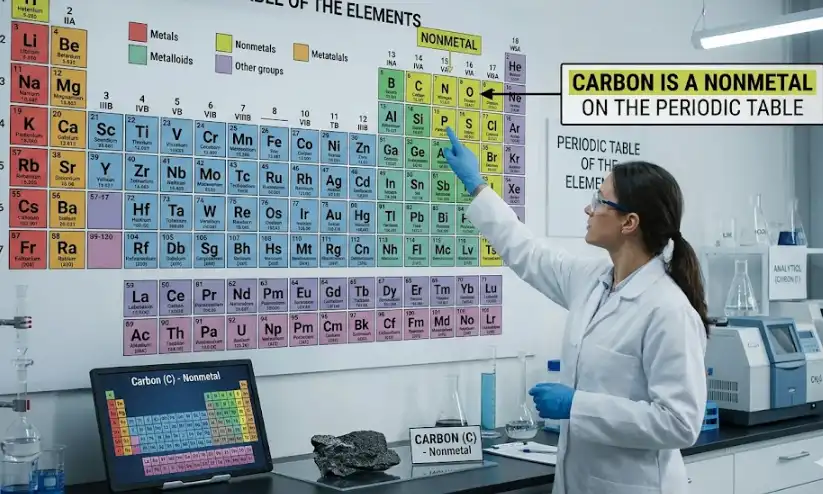
Carbon — element number 6, atomic weight 12.011 — is the fourth most abundant element in the universe by mass, yet its classification still trips up students, quiz-show contestants, and even the occasional engineer. So, is carbon a metal? No. Carbon is firmly classified as a nonmetal on the periodic table, sitting in Group 14, Period 2, alongside elements like nitrogen and oxygen. That said, some of its forms — graphite being the famous example — display electrical conductivity that looks suspiciously metallic, which is exactly why the question keeps coming up.
The Short Answer — Carbon Is a Nonmetal
No, carbon is not a metal. It is classified as a nonmetal element, sitting at atomic number 6 on the periodic table with the symbol C. The International Union of Pure and Applied Chemistry (IUPAC) places carbon firmly in the nonmetal category, and this classification has never been seriously disputed in modern chemistry.
So why does the question “is carbon a metal” come up so often? Partly because carbon breaks expectations. Graphite conducts electricity. Diamond is extraordinarily hard. Carbon fibers rival steel in tensile strength. These properties feel metallic, and that creates genuine confusion. But classification on the periodic table depends on a specific set of criteria — not just one or two standout traits.
Here’s what makes carbon a nonmetal at its core. It has high ionization energy (1,086.5 kJ/mol), meaning it strongly resists losing electrons. It gains or shares electrons during bonding rather than donating them the way metals do. Its electronegativity sits at 2.55 on the Pauling scale — far higher than any metal. It lacks the sea of delocalized electrons that gives metals their characteristic luster, malleability, and thermal conductivity.
Carbon also fails the most basic physical test for metals: it doesn’t form a metallic crystal lattice under normal conditions. At standard temperature and pressure, its most stable form is graphite — layered, brittle, and dark. That’s a far cry from the shiny, ductile solids we associate with metallic elements like iron or copper. The rest of this article digs into exactly why carbon behaves the way it does, where the confusion comes from, and what makes its chemistry so remarkably versatile despite being a straightforward nonmetal.

Periodic table highlighting carbon as a nonmetal element in group 14
Where Carbon Sits on the Periodic Table and Why It Matters
Carbon occupies a very specific address: Group 14, Period 2, atomic number 6. That placement tells you almost everything you need to know about its behavior. Its electron configuration — 1s² 2s² 2p² — gives it exactly four valence electrons, which means carbon neither eagerly donates electrons like metals nor aggressively snatches them like halogens. Instead, it shares. This tendency toward covalent bonding is one of the clearest markers of nonmetal character.
Group 14 is fascinating because it showcases a full spectrum of metallic character as you move down the column. Carbon and silicon sit at the top — both nonmetals, though silicon already shows some borderline traits. Below them, germanium is classified as a metalloid. Keep going and you hit tin and lead, which are unmistakably metals. This top-to-bottom shift happens because larger atoms hold their outer electrons more loosely, making electron donation (a hallmark of metallic behavior) increasingly favorable.
So when someone asks “is carbon a metal,” the periodic table itself provides a structural answer. Carbon’s small atomic radius and relatively high ionization energy — 1,086.5 kJ/mol according to the Royal Society of Chemistry — mean it grips its electrons tightly. Metals, by contrast, typically have ionization energies well below 800 kJ/mol. Carbon doesn’t come close to that threshold.
Period 2 matters too. Elements in this row are small and compact, with no inner d-orbitals to complicate bonding. Carbon’s four valence electrons can form up to four strong covalent bonds, enabling the staggering molecular diversity we see in organic chemistry. That bonding versatility is a nonmetal superpower — not a metallic trait.

Group 14 periodic table column showing carbon as nonmetal transitioning to lead as metal
Physical and Chemical Properties That Make Carbon a Nonmetal
The question “is carbon a metal” gets answered quickly once you examine its measurable properties side by side with those of true metals. Carbon’s electronegativity sits at 2.55 on the Pauling scale — far higher than metals like sodium (0.93) or iron (1.83). That strong pull on shared electrons means carbon overwhelmingly forms covalent bonds, sharing electron pairs rather than surrendering them the way metallic elements do.
Its first ionization energy is 1086.5 kJ/mol. Compare that to aluminum at 577.5 kJ/mol or copper at 745.5 kJ/mol. Stripping an electron from carbon takes serious energy, which is a textbook nonmetal trait. Metals give up electrons easily. Carbon holds on tight.
Physically, the contrasts are just as stark. Most carbon allotropes lack the shiny metallic luster you’d expect from a metal — diamond is transparent, amorphous carbon is a dull black powder, and charcoal crumbles between your fingers. Metals are malleable and ductile; you can hammer gold into sheets thinner than paper or draw copper into wire. Try that with a chunk of coal and it shatters. Brittleness is a defining nonmetal behavior.
Carbon also fails the thermal and electrical conductivity tests that metals pass effortlessly. Diamond, despite being the hardest known natural material, is an electrical insulator. Most carbon forms are poor conductors of heat compared to metals like silver or copper, which conduct thermal energy roughly 5 to 10 times more efficiently. These combined properties — high ionization energy, covalent bonding preference, brittleness, and poor conductivity — leave no ambiguity about carbon’s classification.

Comparison chart of carbon nonmetal properties versus typical metal characteristics including electronegativity and ionization energy
Why Graphite Conducts Electricity Like a Metal
This is where the confusion gets real. Graphite conducts electricity — roughly 3.3 × 10⁵ S/m along its basal planes — which puts it in the same ballpark as some metallic alloys. For anyone asking “is carbon a metal,” graphite’s conductivity is usually the reason behind the question. But one metallic behavior doesn’t change an element’s classification.
The explanation lies in graphite’s layered hexagonal structure. Each carbon atom bonds to three neighbors through strong sp² covalent bonds, forming flat sheets of interconnected hexagons. That leaves one unbonded electron per atom. These leftover electrons don’t stay locked in place — they delocalize across the entire plane, forming what chemists call a pi-electron cloud. Think of it as a sea of mobile electrons hovering above and below each sheet, free to carry charge. Sound familiar? It should. That’s essentially the same metallic bonding mechanism that makes copper wire work.
Here’s the critical catch. Conductivity in graphite is wildly anisotropic. Along the planes, electrons flow with ease. Perpendicular to them? Conductivity drops by a factor of roughly 1,000. The sheets are held together only by weak van der Waals forces, with no delocalized electrons bridging the gap between layers. A true metal conducts in all three dimensions without this dramatic directional dependence.
One property does not rewrite a classification. Carbon lacks metallic luster in most forms, doesn’t form cations in chemical reactions, has a high ionization energy of 1,086 kJ/mol, and gains electrons rather than donating them. Graphite’s conductivity is a structural quirk of one specific allotrope — not evidence that carbon belongs among the metals or even the metalloids. The periodic table classifies elements by the full weight of their behavior, not a single outlier trait.
Common Allotropes of Carbon and Their Unique Structures
One element, radically different forms. Carbon exists as at least six distinct allotropes, each built from the same atoms yet behaving nothing alike. The secret lies entirely in how those atoms bond and arrange themselves in three-dimensional space.
Diamond locks every carbon atom into a rigid tetrahedral lattice — four covalent bonds per atom, no exceptions. That sp³ hybridization creates the hardest known natural material, scoring a perfect 10 on the Mohs scale. It also makes diamond an electrical insulator, since no electrons are free to roam. Graphite, covered in the previous section, takes the opposite approach: sp² bonding forms flat hexagonal sheets with delocalized electrons gliding between layers.
Fullerenes (C₆₀) look like hollow soccer balls — 60 carbon atoms arranged in pentagons and hexagons, first synthesized in 1985 by Kroto, Smalley, and Curl. Carbon nanotubes are essentially graphene sheets rolled into cylinders with diameters as small as 1 nanometer, yet tensile strengths roughly 100 times that of steel at one-sixth the weight. Then there’s graphene itself: a single atom-thick sheet that conducts electricity better than copper and earned Geim and Novoselov the 2010 Nobel Prize in Physics, as documented by the Nobel Prize organization.
Amorphous carbon — think charcoal, soot, activated carbon — lacks any long-range crystalline order. It’s the messy, disordered cousin. Yet even amorphous carbon finds massive industrial use in water filtration and air purification. When someone asks “is carbon a metal,” these allotropes illustrate why the answer stays firmly at nonmetal: the bonding in every single form is covalent, not metallic. No electron sea, no metallic crystal lattice. Just carbon doing what carbon does — forming versatile covalent networks that produce everything from the hardest gem to the thinnest material ever isolated.
How Carbon Compares to Metals, Metalloids, and Other Nonmetals
Side-by-side comparisons strip away ambiguity fast. Stacking carbon against iron (a quintessential metal), silicon (a metalloid), and nitrogen (a fellow nonmetal) reveals exactly why the question “is carbon a metal” has such a clear-cut answer — even when a few properties seem to blur the lines.
| Property | Iron (Metal) | Silicon (Metalloid) | Carbon (Nonmetal) | Nitrogen (Nonmetal) |
|---|---|---|---|---|
| Melting Point | 1,538 °C | 1,414 °C | 3,550 °C (diamond) | −210 °C |
| Electrical Conductivity | ~1.0 × 10⁷ S/m | ~1.56 × 10³ S/m | ~3.3 × 10⁵ S/m (graphite basal plane) | Insulator |
| Dominant Bond Type | Metallic | Covalent (with metallic character) | Covalent | Covalent |
| Crystal Structure | BCC / FCC lattice | Diamond cubic | Varies by allotrope | Molecular solid (N₂) |
| Malleability | High | Brittle | Brittle | N/A (gas) |
| Electronegativity (Pauling) | 1.83 | 1.90 | 2.55 | 3.04 |
A few things jump out. Carbon’s electronegativity of 2.55 sits far closer to nitrogen than to iron, confirming its preference for grabbing electrons rather than surrendering them. Iron’s metallic bonding lets its electrons roam freely through the entire lattice; carbon’s covalent bonds lock electrons between specific atom pairs. That distinction alone disqualifies it from metal status, according to IUPAC’s classification framework.
Silicon makes an interesting middle case. It shares carbon’s diamond cubic crystal structure yet conducts electricity poorly at room temperature — until you dope it with impurities. Carbon doesn’t behave this way. Diamond is a full insulator; graphite conducts through delocalized pi electrons, not through a semiconductor band gap mechanism. Two completely different stories.
The melting point column might surprise people. Diamond’s 3,550 °C dwarfs iron’s 1,538 °C, but that extreme heat resistance comes from incredibly strong sp³ covalent bonds, not metallic bonding. High melting point alone never makes something a metal. If it did, tungsten carbide and silicon carbide would qualify too — and they don’t.
Carbon’s Role in Organic Chemistry and Biological Systems
Four bonds. That single number explains why carbon dominates the chemistry of life. With four valence electrons and an electronegativity of 2.55, carbon forms stable covalent bonds with hydrogen, oxygen, nitrogen, sulfur, and — critically — with itself. No metal does this. Metals donate electrons; carbon shares them, building molecular architectures of staggering complexity.
This sharing behavior lets carbon create chains hundreds of atoms long, branching networks, rings, and double or triple bonds that alter a molecule’s geometry and reactivity entirely. The American Chemical Society recognizes over 20 million known organic compounds — all built on a carbon skeleton. Silicon, carbon’s neighbor one row down in Group 14, can also form four bonds, but Si–Si bonds are roughly 50 kJ/mol weaker than C–C bonds. That gap is the difference between a thriving biochemistry and a dead end.
DNA stores genetic instructions in sugar-phosphate backbones held together by carbon frameworks. Proteins fold into precise 3D shapes because carbon-based amino acids link through peptide bonds. Lipids form cell membranes because long hydrocarbon tails — 16 to 18 carbons each — are hydrophobic enough to self-assemble into bilayers. Every one of these functions depends on covalent bonding, the signature behavior of a nonmetal.
So when someone asks “is carbon a metal,” the biological record answers loudly. A metallic carbon — one that gave away electrons instead of sharing them — could never anchor a glucose molecule, let alone an entire genome. Carbon’s nonmetal classification isn’t just a periodic table label. It’s the reason biochemistry exists at all.
Common Misconceptions About Carbon Being a Metal
Myths stick around because they sound logical on the surface. A few persistent ones keep fueling the question “is carbon a metal,” so let’s break them apart with actual chemistry.
Myth: Carbon Steel Means Carbon Is a Metal
Carbon steel contains between 0.05% and 2.1% carbon by weight. The carbon atoms sit inside the iron lattice, filling interstitial gaps and strengthening the crystal structure. They don’t contribute metallic bonding — they disrupt the orderly slip planes of iron atoms, which is precisely why the alloy becomes harder. Calling carbon a metal because it appears in steel is like calling salt a grain because it shows up in bread.
Myth: Diamond’s Hardness Is a Metallic Property
Diamond scores a perfect 10 on the Mohs scale. Impressive, but hardness and metallicity are unrelated properties. Diamond’s extreme hardness comes from a rigid three-dimensional network of sp³ covalent bonds — each carbon atom locked to four neighbors at 154 pm bond lengths. Metals like gold and sodium are actually soft. Hardness reflects bond geometry, not metallic character.
Myth: If It Conducts Electricity, It Must Be Metal
Graphite’s conductivity was covered earlier, but the broader logic fails too. Silicon conducts electricity. So does saltwater. Conductivity depends on mobile charge carriers — whether those are delocalized electrons, semiconductor band-gap electrons, or dissolved ions. Graphite’s delocalized pi electrons allow in-plane conductivity, yet it remains brittle, non-malleable, and forms covalent bonds. According to the Royal Society of Chemistry, carbon is firmly classified as a nonmetal despite this single metal-like trait.
Each misconception cherry-picks one property while ignoring the full profile. Classification requires evaluating ionization energy, electronegativity, bonding behavior, and physical characteristics together — not isolating a single data point.
Frequently Asked Questions About Carbon’s Classification
Is carbon a metal, nonmetal, or metalloid?
Carbon is a nonmetal. It lacks metallic luster in most forms, has high ionization energy (1,086 kJ/mol), and gains or shares electrons rather than losing them. No major scientific body — including IUPAC — classifies carbon as a metal or metalloid.
Can carbon ever behave like a metal?
In specific structural arrangements, yes. Graphite conducts electricity along its basal planes because delocalized pi electrons move freely between carbon layers. That’s a metallic behavior, but it doesn’t change carbon’s classification. One property doesn’t override the full set of nonmetal characteristics.
Why is carbon in the same group as metals like tin and lead?
Group 14 spans a dramatic range. Carbon sits at the top with four valence electrons and strong covalent bonding tendencies. Moving down the group, atoms get larger, ionization energies drop, and metallic character increases. Tin and lead lose electrons easily enough to form cations — carbon does not. Same column, completely different chemistry.
Is carbon a good conductor of heat?
It depends on the allotrope. Diamond conducts heat five times better than copper (~2,200 W/m·K) yet blocks electricity entirely. Graphite conducts heat well along its planes but poorly perpendicular to them. So the answer to “is carbon a metal based on thermal conductivity” is still no — the mechanism in diamond is phonon-based, not electron-based like metals.
What makes carbon different from silicon?
Both share Group 14 and four valence electrons, but the similarities thin out fast. Carbon forms strong double and triple bonds; silicon almost never does. Carbon-carbon bonds are shorter (154 pm vs. 235 pm for Si-Si) and far more stable, which is exactly why carbon anchors organic chemistry while silicon anchors semiconductor technology. Silicon is a metalloid. Carbon is not.
Final Takeaway — Understanding Carbon’s Place on the Periodic Table
Carbon is a nonmetal. Full stop. Its high ionization energy (1,086 kJ/mol), tendency to form covalent bonds rather than ionic ones, and lack of a metallic crystal structure all point to the same conclusion. The fact that one allotrope — graphite — conducts electricity doesn’t rewrite the rules any more than water being a liquid rewrites the classification of hydrogen and oxygen as gases at standard conditions.
Here’s a simple framework to lock this in: metals donate electrons, nonmetals share or accept them. Carbon shares. It forms four covalent bonds, builds the backbone of over 10 million known organic compounds, and never produces free electrons in a metallic sea the way iron or copper does. That behavioral pattern is the clearest answer to “is carbon a metal” — it simply doesn’t act like one at the atomic level.
What makes carbon genuinely fascinating is its range. Diamond is the hardest natural material on Earth. Graphite is soft enough to leave marks on paper. Fullerenes behave like molecular cages. Graphene is stronger than steel by weight yet only one atom thick. All nonmetal. All carbon. The diversity comes from bonding geometry — sp³, sp², sp — not from any shift toward metallic character.
If you want to go deeper, explore the Royal Society of Chemistry’s carbon profile for detailed thermodynamic and structural data. From there, periodic table trends like electronegativity gradients and allotropy in other nonmetals (sulfur, phosphorus) start making a lot more sense. Carbon’s classification isn’t an edge case — it’s a textbook example of how nonmetals behave, even when they surprise you.
See also
Ultimate Guide to Metal Melting Point Chart
Weld Cleaning Machine for Carbon Steel – How to Choose the Right One
Melting Point of Aluminum: The Ultimate Guide
Understanding Non-Conductive Metals: Everything You Need To Know
How to Heliarc Weld Carbon Steel: Step-by-Step Troubleshooting