Chromium registers a Mohs hardness of 8.5 — harder than any other pure metal element on the periodic table, and only a few points below diamond at 10. So what are the three hardest metals? By nearly every recognized hardness scale, the answer is chromium, tungsten, and osmium, each offering extraordinary resistance to scratching and deformation that makes them indispensable in aerospace, military, and industrial manufacturing. This guide breaks down their exact hardness values across multiple testing methods, explains why “hardest” doesn’t always mean “strongest,” and shows you where these metals actually matter in the real world.
Quick Answer — The Three Hardest Metals on Earth
So, what are the three hardest metals? Among pure metallic elements, the answer is chromium, tungsten, and osmium — in that order when ranked by Vickers hardness. No alloys, no composites. Just elemental metals straight from the periodic table.
Chromium dominates the list. With a Vickers hardness ranging from 687 to 1,060 HV depending on purity and crystal structure, it outperforms every other pure metal by a wide margin. Tungsten and osmium trail behind but still far exceed common metals like iron (~150 HV) or titanium (~970 MPa tensile, ~250 HV).
| Metal | Vickers Hardness (HV) | Mohs Hardness | Key Trait |
|---|---|---|---|
| Chromium (Cr) | 687–1,060 | 8.5 | Hardest pure metal element |
| Tungsten (W) | 310–343 | 7.5 | Highest melting point of any metal (3,422 °C) |
| Osmium (Os) | 300–670 | 7.0 | Densest naturally occurring element (22.59 g/cm³) |
One critical distinction: these are pure metals, not alloys. Tungsten carbide (WC), a ceramic-metal composite, reaches 1,600–2,200 HV — dwarfing pure tungsten. But that’s a manufactured alloy, not an element. The rankings above reflect what nature gives us before human engineering steps in.
Quick note: hardness values vary across sources because crystal orientation, temperature, and testing method all affect results. The ranges above reflect data commonly cited in materials science references, including ASM International’s handbooks.
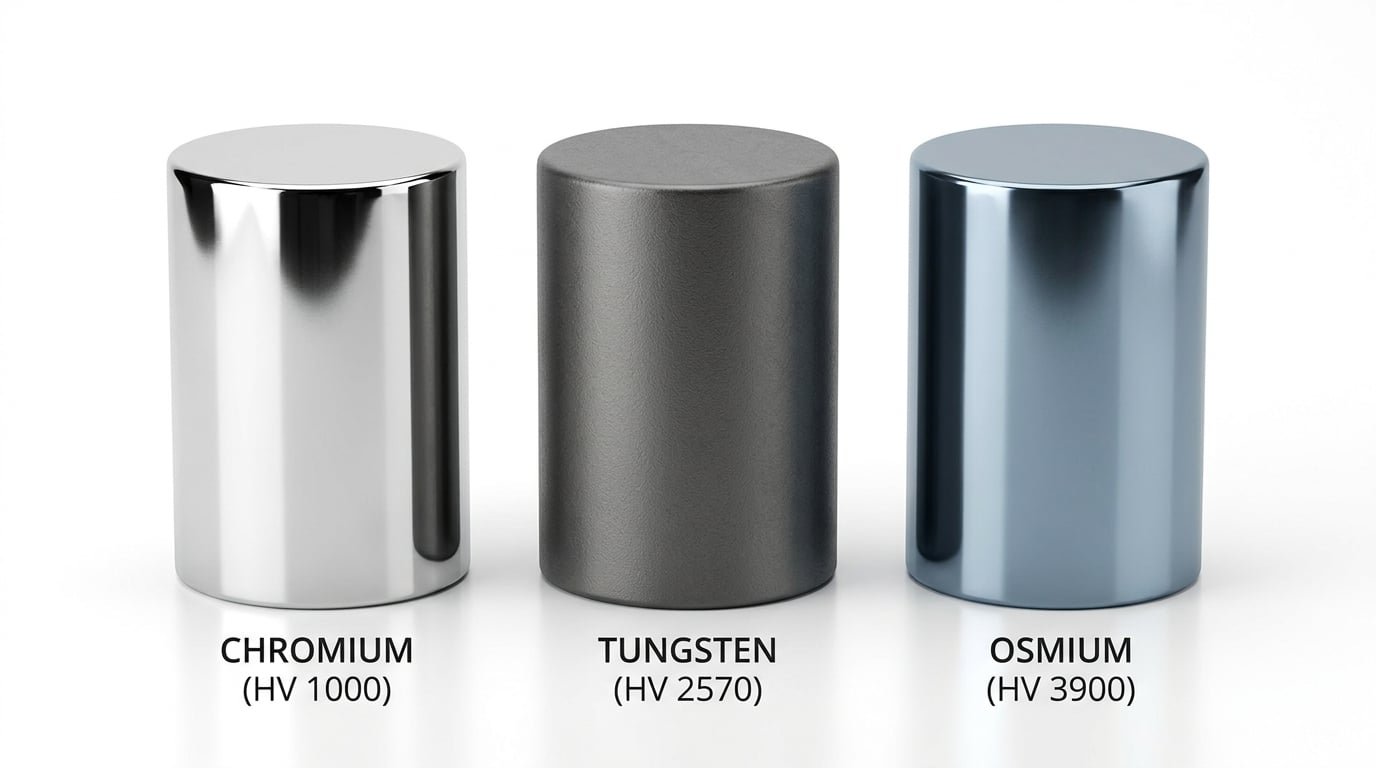
the three hardest metals chromium tungsten osmium with Vickers hardness values compared
How Metal Hardness Is Actually Measured
Before you can answer what are the three hardest metals, you need to understand how hardness is tested — because the method you choose changes the ranking. Three scales dominate materials science: Mohs, Vickers (HV), and Brinell (HB). Each works differently, and each produces results that don’t translate neatly to the others.
Mohs Scale — Simple but Misleading
The Mohs scale ranks minerals from 1 (talc) to 10 (diamond) based on scratch resistance. It’s intuitive, but the intervals aren’t equal — the jump from 9 to 10 is vastly larger than from 1 to 2. For metals, Mohs values cluster between 4 and 9, making fine distinctions nearly impossible. Chromium sits around 8.5 Mohs while tungsten lands near 7.5, but those numbers mask a huge difference in actual resistance to deformation.
Vickers Hardness — The Precision Standard
Vickers testing presses a diamond pyramid into a metal surface under a controlled load, then measures the indentation size. The result is reported in HV units. Chromium registers approximately 687–900 HV, while tungsten comes in around 343 HV — a gap the Mohs scale barely hints at. Materials engineers at organizations like ASM International rely on Vickers data precisely because it offers continuous, comparable values across all metals and alloys.
Brinell Hardness — Built for Bulk Materials
Brinell testing uses a hardened steel or carbide ball instead of a pyramid. It works well for softer metals and large castings but loses accuracy with extremely hard materials. That’s why Brinell rarely appears in discussions about the hardest metals — the indenter itself can deform before the specimen does.
Bottom line: if you see conflicting hardness rankings online, check which scale was used. Vickers gives the most reliable comparison for hard metals; Mohs is a rough guide at best.

Comparison of Mohs Vickers and Brinell hardness testing methods used to measure the hardest metals
Mohs Scale vs Vickers vs Brinell — Which One Matters Most
Not all hardness tests measure the same thing, and picking the wrong scale can lead you to completely wrong conclusions about what are the three hardest metals. Each method tests a different physical response — scratch resistance, micro-indentation, or bulk deformation — and the results aren’t interchangeable.
| Scale | What It Measures | Best For | Limitation |
|---|---|---|---|
| Mohs (1–10) | Scratch resistance | Minerals, gemstones | Too coarse for comparing metals — chromium and tungsten both land near 8–9 |
| Vickers (HV) | Resistance to diamond-tip indentation under precise loads | Pure metals, thin coatings, small samples | Requires polished surface prep |
| Brinell (HB) | Indentation from a hardened steel or carbide ball | Large castings, structural steel | Inaccurate on very hard or very thin specimens |
Why does Vickers dominate metallurgical research? Because it works across the full hardness spectrum with a single continuous scale. Chromium registers roughly 687–900 HV, while tungsten sits around 343 HV — a clear, quantifiable gap that Mohs simply can’t reveal. The ASTM E384 standard, maintained by ASTM International, governs Vickers microhardness testing and is the benchmark most materials scientists rely on.
Brinell testing still earns its place in foundries and steel mills where samples are large and surface finish doesn’t matter. But for answering precise questions about the three hardest metals in elemental form, Vickers is the only scale that gives you meaningful resolution. Skip Mohs for metal comparisons — it was designed for mineralogy, and that’s where it should stay.
Chromium — The Hardest Pure Metal Element
Chromium sits at the top. With a Vickers hardness ranging from 687 to 900 HV and a Mohs rating of 8.5, no other pure metallic element comes close. When people ask what are the three hardest metals, chromium earns its first-place position by a wide margin — tungsten, the runner-up, registers only about 343 HV by comparison.
What makes chromium so remarkably hard? The answer lies in its body-centered cubic (BCC) crystal structure and its tightly bound electron configuration. BCC metals resist dislocation movement — the atomic-level sliding that allows softer metals like gold or copper to deform. Chromium’s high number of unpaired d-electrons strengthens metallic bonding further, creating a lattice that stubbornly resists indentation.
Pure chromium is harder than most steels, yet too brittle to use as a structural metal on its own. That brittleness is precisely why it’s alloyed rather than used in bulk form.
Its real-world value is enormous. Adding just 10.5–13% chromium to iron produces stainless steel — the chromium reacts with oxygen to form a passive chromium oxide layer that blocks corrosion. Chrome plating, used on everything from automotive trim to industrial rollers, exploits chromium’s surface hardness to protect softer substrates. According to data published by ASM International, chromium remains one of the most commercially significant alloying elements in metallurgy.
But here’s the trade-off: pure chromium is brittle at room temperature. You can’t forge it into beams or bend it into sheets the way you can mild steel. Alloys like tungsten carbide actually exceed chromium’s hardness in industrial cutting applications — a distinction between pure metals and engineered alloys that matters greatly when evaluating the three hardest metals.
Tungsten — Extreme Hardness Combined With the Highest Melting Point
Tungsten doesn’t win the hardness race against chromium. At roughly 343 HV on the Vickers scale and a Mohs rating of 7.5, it falls well short of chromium’s 687–900 HV. So why does it consistently appear when people ask what are the three hardest metals? Because raw hardness numbers only tell half the story.
What sets tungsten apart is its melting point: 3,422°C (6,192°F) — the highest of any pure metal. No other element stays structurally intact under that kind of thermal assault. This single property makes tungsten irreplaceable in environments where chromium or osmium would simply fail.
Where Tungsten Dominates
- Cutting tools: Tungsten carbide (WC), an alloy reaching 1,500–2,200 HV, is the backbone of industrial drill bits, milling inserts, and mining equipment. Pure tungsten provides the foundation; alloying with carbon supercharges its hardness.
- Military armor-piercing rounds: Dense tungsten alloy penetrators replaced depleted uranium in several NATO munitions programs due to lower toxicity and comparable performance.
- Incandescent filaments: Tungsten wire survives temperatures above 2,500°C inside light bulbs — a use dating back to the early 1900s that persists in specialty lighting.
A critical distinction worth remembering: pure tungsten is hard yet brittle at room temperature. It’s the engineered alloys — especially tungsten carbide — that deliver the toughness industrial applications demand. According to data published by ASM International, tungsten carbide composites rank among the hardest commercially used materials, bridging the gap between pure metals and ceramics.
Among the three hardest metals in pure elemental form, tungsten earns its place not by outscoring the others on a hardness chart, but by performing where nothing else survives.
Osmium — The Densest and One of the Hardest Metals Known
Osmium is a paradox. At 22.59 g/cm³, it holds the title of the densest naturally occurring element — roughly twice as dense as lead. Yet despite that extraordinary mass, it’s also remarkably hard, earning its place when asking what are the three hardest metals among pure elements.
Its Vickers hardness spans a wide range: approximately 300–670 HV depending on sample purity, crystal orientation, and testing conditions. On the Mohs scale, osmium lands near 7. Why such variation? Osmium is exceptionally difficult to produce in high-purity bulk form. Most tested samples contain microstructural defects or trace impurities that shift results significantly, which is why published hardness data from sources like ASM International often includes broad ranges rather than single values.
Osmium’s extreme brittleness makes it nearly useless as a structural material — it shatters rather than deforms under impact.
That brittleness, however, doesn’t diminish its niche value. Osmium finds use in:
- High-pressure scientific experiments — its incompressibility under extreme pressures makes it ideal for diamond anvil cell research
- Specialized alloy tips — osmium-tipped fountain pen nibs and electrical contacts exploit its wear resistance
- Osmiridium alloys — combined with iridium, osmium creates alloys harder than either parent metal
Rarity keeps osmium out of mainstream industrial use. Annual global production sits below 1,000 kilograms, and prices can exceed $400 per troy ounce. Compared to chromium’s 687–900 HV dominance, osmium’s hardness is more modest — but its density-to-hardness ratio is unmatched in the periodic table.
Hardness vs Toughness — Why the Hardest Metals Are Often the Most Brittle
Knowing what are the three hardest metals is only half the story. Chromium tops the list at 687–900 HV, yet you’ll never see a chromium I-beam holding up a bridge. Why? Because hardness and toughness are fundamentally different — and often inversely related.
Hardness measures resistance to surface deformation. Toughness measures how much energy a material absorbs before fracturing. A hard metal resists scratching; a tough metal resists cracking. Chromium excels at the first and fails spectacularly at the second.
Think of it this way: a ceramic plate is hard enough to resist a knife scratch, but drop it on tile and it shatters. Chromium behaves similarly under sudden impact or tensile stress.
Materials scientists quantify this trade-off using fracture toughness (KIC), measured in MPa√m. Structural steel typically scores 50–100 MPa√m, while chromium sits below 30. Tungsten fares slightly better but remains far too brittle for load-bearing structures without alloying. According to ASM International’s materials databases, this hardness-ductility inverse relationship is one of the most critical constraints in engineering design.
That’s exactly why alloys exist. Engineers blend hard metals with more ductile ones — adding nickel and iron to chromium for stainless steel, or binding tungsten carbide particles in a cobalt matrix for cutting tools. The result sacrifices peak hardness for the toughness needed to survive real-world forces like vibration, thermal cycling, and sudden impact loads.
So when people ask what are the three hardest metals, the practical follow-up should always be: hard enough for what? Pure hardness without adequate fracture toughness is a liability, not an advantage.
Hardest Pure Metals vs Hardest Metal Alloys — A Critical Distinction
When people ask what are the three hardest metals, they almost always mean pure elements. But here’s the reality: no pure metal comes close to the hardness of engineered alloys. Chromium tops out around 900 HV. Tungsten carbide — a cemented carbide alloy — starts at 1,500 HV and can exceed 2,500 HV. That’s nearly three times harder.
This gap explains why drill bits, mining tools, and armor-piercing projectiles never use pure chromium or pure tungsten. Industry demands alloys because they combine hardness with other properties — wear resistance, thermal stability, or fracture toughness — that brittle pure metals simply can’t deliver alone.
| Material | Type | Vickers Hardness (HV) |
|---|---|---|
| Chromium | Pure metal | 687–900 |
| Tungsten | Pure metal | ~343 |
| Osmium | Pure metal | 300–670 |
| Hardened tool steel (D2) | Alloy | 600–750 |
| Ti-6Al-4V (Grade 5 titanium) | Alloy | 340–395 |
| Tungsten carbide (WC-Co) | Cemented carbide | 1,500–2,500 |
Notice something surprising? Grade 5 titanium — the aerospace workhorse — is actually softer than pure chromium. Its dominance comes from an exceptional strength-to-weight ratio, not raw hardness. Data sourced from ASM International’s materials handbooks confirms these ranges across standardized testing conditions.
The question of what are the three hardest metals matters for science. For engineering, the answer is almost always an alloy.
Real-World Applications — From Phone Components to Jet Engines
Knowing what are the three hardest metals means little until you see where they actually end up. Each one — chromium, tungsten, and osmium — fills roles that softer metals simply cannot handle.
Chromium: The Invisible Shield
That mirror-like finish on your smartphone’s stainless-steel frame? Chromium plating. Surgical instruments rely on chromium-rich stainless steel (typically 10.5–18% Cr content) because the metal’s hardness resists scratching while its oxide layer prevents corrosion in sterilization cycles. Decorative chrome plating on faucets and automotive trim also exploits this dual advantage — surface hardness paired with lasting shine.
Tungsten: Built for Extremes
Pure tungsten’s 343 HV hardness is modest, but combine it with carbon and you get tungsten carbide — exceeding 2,000 HV. That’s why roughly 60% of all tungsten produced globally goes into cemented carbide cutting tools, drill bits, and mining equipment, according to the International Tungsten Industry Association. Jet engine turbine blades use tungsten-based superalloys because no other element maintains structural integrity at temperatures above 2,500 °C.
Osmium: Precision in Miniature
Osmium’s extreme density and hardness make it ideal for tiny, high-wear components. Fountain pen nibs tipped with osmium-iridium alloys last decades without deforming. High-end electrical contacts in pacemakers and industrial switches use osmium for the same reason — the metal resists arc erosion far better than platinum or gold.
| Metal | Key Application | Why Hardness Matters |
|---|---|---|
| Chromium | Smartphone frames, surgical tools | Scratch resistance + corrosion barrier |
| Tungsten | Drill bits, jet engine parts | Wear resistance at extreme temperatures |
| Osmium | Pen nibs, electrical contacts | Minimal deformation under repeated stress |
The pattern is clear: pure-metal hardness determines the starting application, but alloying unlocks industrial-scale performance. Chromium protects surfaces, tungsten survives heat, and osmium endures precision wear — three distinct hardness profiles solving three very different engineering problems.
How the Hardest Metals Compare to Non-Metal Materials Like Diamond
Even chromium — the hardest pure metal — barely registers against the non-metallic heavyweights used in industrial cutting and grinding. Diamond sits at Mohs 10 with a Vickers hardness around 10,000 HV. Chromium tops out near 900 HV. That’s roughly an 11× gap, and it explains why no machine shop uses pure metal edges to cut other metals.
So what are the three hardest metals actually competing against?
| Material | Type | Vickers Hardness (HV) | Mohs Rating |
|---|---|---|---|
| Diamond | Non-metal (carbon) | ~10,000 | 10 |
| Cubic Boron Nitride (cBN) | Ceramic compound | ~4,500 | ~9.5 |
| Boron Carbide (B₄C) | Ceramic compound | ~3,000 | 9.3 |
| Tungsten Carbide (WC) | Metal alloy/cermet | ~1,600–2,200 | 9.0 |
| Chromium | Pure metal | 687–900 | 8.5 |
| Tungsten | Pure metal | ~343 | 7.5 |
| Osmium | Pure metal | ~400–670 | 7.0 |
The pattern is clear: covalent-bonded ceramics and carbon structures dominate scratch resistance because their atomic bonds are shorter and more rigid than metallic bonds. Diamond’s sp³ carbon lattice is essentially the stiffest arrangement atoms can form. Metals, by contrast, rely on a “sea of electrons” bonding model that permits dislocation movement — great for ductility, terrible for maximum hardness.
This is exactly why industrial drill bits and grinding wheels embed synthetic diamond or cBN particles rather than pure chromium or osmium. According to materials data published by ASM International, tungsten carbide bridges the gap as a cermet — combining metallic toughness with ceramic-level hardness — making it the go-to material for CNC cutting inserts where neither pure metals nor brittle diamonds alone would survive.
Frequently Asked Questions About the Hardest Metals
Is titanium harder than tungsten?
No. Titanium scores about 6 on the Mohs scale (~970 MPa Vickers for commercially pure grades), while tungsten reaches roughly 7.5 Mohs and 343 HV. Tungsten is harder — and significantly denser at 19.25 g/cm³ versus titanium’s 4.51 g/cm³.
What is the hardest metal alloy ever made?
Tungsten carbide (WC) routinely hits 1,600–2,200 HV, dwarfing every pure metal. Some experimental chromium-cobalt alloys and certain high-entropy alloys push even higher, though tungsten carbide remains the industry benchmark for cutting tools and drill bits.
Can you make jewelry from the hardest metals?
Tungsten carbide rings are widely sold and extremely scratch-resistant. Pure chromium and osmium, however, are impractical — chromium is too brittle, and osmium oxidizes into toxic osmium tetroxide. Stick with tungsten carbide if scratch resistance is your priority.
Is hardness the same as strength?
Not at all. Hardness measures resistance to surface indentation; strength (tensile or compressive) measures how much load a material can bear before failure. Chromium is the hardest pure metal yet fractures easily under impact — a textbook case of high hardness paired with low toughness.
Why isn’t steel on the list?
Steel is an alloy of iron and carbon, not a pure metal. When people ask what are the three hardest metals, the answer focuses on elemental metals: chromium, tungsten, and osmium. Hardened tool steel can exceed 800 HV, but that hardness comes from alloying and heat treatment, not from the base element alone.
Final Takeaway — Choosing Hardness for the Right Purpose
So, what are the three hardest metals? Chromium leads at 687–900 HV, followed by tungsten at ~343 HV with an unmatched 3,422 °C melting point, and osmium at ~300–400 HV paired with the highest density of any element. Those numbers tell a clear story — but they don’t tell the whole one.
Hardness is a single axis on a multi-dimensional engineering problem. Chromium is brittle. Tungsten fractures under impact at room temperature. Osmium oxidizes into toxic tetroxide if mishandled. No engineer selects a material on hardness alone — toughness, ductility, corrosion resistance, thermal stability, and cost all weigh in.
Pure metal hardness rankings and alloy hardness rankings are fundamentally different lists. Tungsten carbide (~2,600 HV) dwarfs every pure metal, yet it wouldn’t exist without tungsten as its base element. Always clarify which category you’re comparing.
If you want to go deeper — and you should — the ASM Handbooks published by ASM International remain the gold-standard reference for mechanical property data across thousands of metals and alloys. Their Global Materials Platform provides peer-reviewed Vickers, Brinell, and Rockwell values you can actually cite in engineering decisions.
Pick hardness when wear resistance is the priority. Pick toughness when impact loads dominate. Pick the right combination when real-world performance matters more than a ranking chart. That distinction separates curiosity from competence.
See also
What Is Food Grade Stainless Steel and Why Does It Matter
Key Differences Between Galvanized Steel and Stainless Steel
Melting Point of Iron: The Ultimate Guide
Classification of Carbon Metal Content, Steel, and Alloy Steel
How to Protect Yourself When Operating a Laser Cleaning Machine