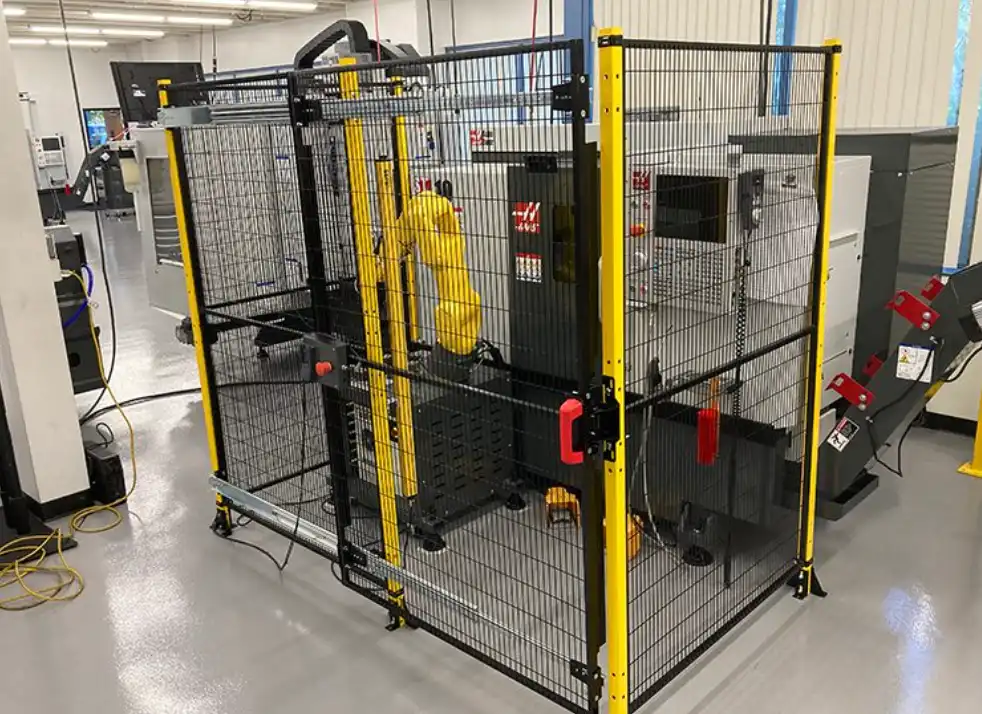
Over 80% of collaborative robots deployed globally operate without traditional safety fencing, according to the International Federation of Robotics — yet the assumption that every cobot is automatically fence-free remains one of the most dangerous misconceptions in industrial automation. So, can a cobot work without a safety fence? Yes, but only when the application meets strict conditions defined by ISO 10218 and ISO/TS 15066, including verified force and pressure limits, a thorough risk assessment, and the use of at least one of four recognized collaborative operation modes. Skip any of those requirements and your “collaborative” robot legally needs a barrier just like any conventional industrial arm.
Short Answer — Yes, Cobots Can Work Without a Safety Fence (Under Specific Conditions)
Can a cobot work without a safety fence? Yes — collaborative robots (cobots) are engineered from the ground up to share workspace with human operators, no physical guarding required. But “no fence needed” is not a blanket permission. It is a conditional privilege that hinges on compliance with ISO 10218-1/2 and the technical specification ISO/TS 15066, plus a documented risk assessment specific to your application.
Featured Snippet Answer: A cobot can legally and safely operate without a safety fence when it uses one or more of the four ISO-defined collaborative modes — safety-rated monitored stop, hand guiding, speed and separation monitoring, or power and force limiting — and when a thorough risk assessment confirms that residual risks are acceptable.
Here’s the critical nuance most buyers miss: the robot alone doesn’t determine whether fencing is necessary. The application does. A cobot arm rated to 80 W and 150 N of force at the tool tip might be perfectly safe picking foam cups — yet deadly if you bolt a sharp deburring blade onto the same arm. According to a 2016 ISO/TS 15066 specification, transient contact force limits on the human chest must stay below 210 N and pressure below 120 N/cm² to avoid injury. Exceed those thresholds, and a fence — or an equivalent safeguard — becomes mandatory regardless of the robot’s “collaborative” label.
Roughly 80% of cobot installations worldwide run without traditional safety fencing, based on deployment data from Universal Robots’ installed base of over 75,000 units. That statistic sounds reassuring, but it also means about 1 in 5 cobot cells still requires some form of perimeter guarding. The difference comes down to end-effector design, payload speed, and the results of a site-specific risk assessment — topics we break down in detail throughout this guide.
Skip the assumption that “cobot = automatically fenceless.” Instead, treat every deployment as guilty until proven safe by the numbers.

Cobot working without a safety fence next to a human operator on a factory assembly line
What Makes Cobots Fundamentally Different from Industrial Robots in Terms of Safety
A standard industrial robot arm can exert forces exceeding 1,000 N at full speed — enough to cause fatal crushing injuries. That single fact explains why traditional robots sit behind steel fencing, light curtains, and interlocked gates. Cobots flip this equation by building safety directly into the hardware.
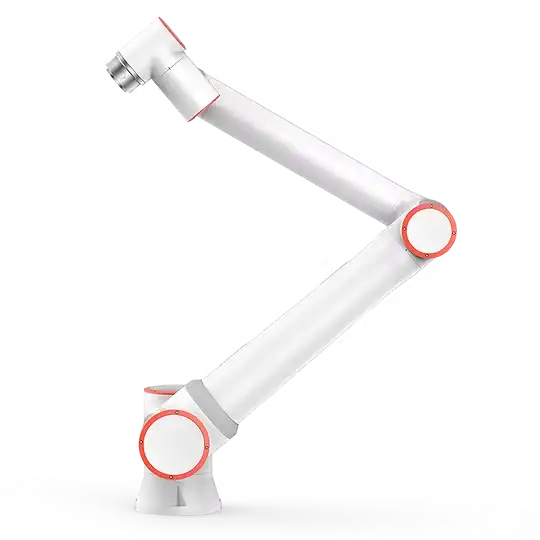
Force-limited joints are the most critical differentiator. Each cobot joint contains integrated torque sensors that continuously measure contact forces and halt motion the instant thresholds are exceeded. Universal Robots’ UR series, for example, caps force at a configurable maximum of 150 N in its default collaborative mode — well within the biomechanical limits defined by ISO/TS 15066. Traditional six-axis robots from FANUC or ABB lack this inherent force feedback and rely entirely on external safeguarding.
Beyond sensors, the physical design matters more than most integrators realize:
- Rounded, pinch-free surfaces — eliminates sharp edges that concentrate impact force on small skin areas
- Lightweight construction — a typical cobot arm weighs 11–33 kg versus 100 kg+ for an equivalent-reach industrial robot, dramatically reducing effective inertia
- Speed monitoring — maximum TCP speed is often capped at 1,000–1,500 mm/s, compared to 7,000+ mm/s on industrial models
- Backdrivable actuators — you can physically push a cobot arm aside with one hand, something impossible with a locked servo motor
These layered design choices are precisely why a cobot can work without a safety fence when the application stays within its inherent safety envelope. Strip away any one layer — say, by mounting a sharp end-effector — and the collaborative claim weakens, potentially requiring guarding again. Smart integrators treat the cobot as a platform, not a blanket safety guarantee.

Cobot versus industrial robot safety design differences — force-limited joints and rounded surfaces versus safety fence guarding
The 4 Collaborative Operation Modes That Allow Fenceless Operation per ISO 10218
A cobot can work without a safety fence only when it operates under at least one of four collaborative modes defined in ISO 10218-2. Each mode addresses a different risk profile — pick the wrong one and you either over-engineer costs or under-engineer safety.
Safety-Rated Monitored Stop (SMS)
The robot halts completely before a human enters the collaborative workspace, then resumes once the person exits. Best for loading/unloading tasks where human presence is intermittent, not continuous.
Hand Guiding
An operator physically moves the robot using a force-sensing handle. The cobot only moves when guided — release the handle and it stops within milliseconds. Ideal for teach-in programming or flexible finishing operations.
Speed and Separation Monitoring (SSM)
Laser scanners or 3D vision systems track the operator’s position in real time. The robot dynamically reduces speed as the human approaches and stops entirely if separation distance drops below a calculated minimum — often as tight as 100 mm at the slowest speeds. SSM suits high-throughput cells where full stops would kill cycle time.
Power and Force Limiting (PFL)
This is the mode most people picture when they ask whether a cobot can work without a safety fence. The robot’s joints cap contact forces — typically below 150 N for transient impacts on the chest, per ISO/TS 15066 thresholds. Roughly 80% of new cobot deployments rely on PFL because it demands the least additional hardware. But here’s the catch: PFL alone doesn’t guarantee safety if the end-effector is sharp or the payload creates pinch points.
Pro tip: Many integrators combine SSM with PFL for a layered approach — the robot slows before contact and limits force if contact occurs. This dual-mode strategy often simplifies risk assessment sign-off.

four ISO 10218 collaborative modes allowing cobot to work without safety fence
ISO/TS 15066 Force and Pressure Limits Explained
Whether a cobot can work without a safety fence hinges on one document more than any other: ISO/TS 15066. This technical specification defines the exact force and pressure thresholds a human body can tolerate before pain or injury occurs — broken down by 29 specific body regions.
Quasi-Static vs. Transient Contact
The spec distinguishes two contact scenarios. Quasi-static contact occurs when a body part is clamped between the robot and a fixed surface — the worst case, because energy has nowhere to dissipate. Transient contact is a brief impact where the person can recoil freely. Transient limits are significantly more permissive, sometimes double the quasi-static values, because the body absorbs less total energy.
Body-Region Thresholds That Matter Most
| Body Region | Max Quasi-Static Pressure | Max Transient Pressure |
|---|---|---|
| Skull / Forehead | 130 N/cm² | 260 N/cm² |
| Chest | 120 N/cm² | 240 N/cm² |
| Hand — Back | 190 N/cm² | 380 N/cm² |
| Hand — Finger Pad | 300 N/cm² | 600 N/cm² |
Practical Validation Tip
Integrators measure actual contact forces using biofidelic pressure measurement devices — not just the cobot’s internal torque sensors. Internal readings can underreport peak pressure by 15–30% depending on end-effector geometry. Always validate with external instrumentation before declaring a fenceless cell compliant.
If you only remember one number: a quasi-static force limit of 65 N on the temple is among the lowest in the entire table. Miss that threshold and your “collaborative” application isn’t collaborative at all.

ISO TS 15066 body region force and pressure limits diagram for cobot safety without a fence
When a Cobot Still Needs a Safety Fence — Common Scenarios Most People Overlook
Owning a cobot doesn’t automatically grant you a fenceless cell. The question of whether a cobot can work without a safety fence always depends on the application, not the robot’s label. Here are the scenarios that catch integrators off guard.
Sharp or Hazardous End-of-Arm Tooling
A cobot arm might respect every ISO/TS 15066 force limit, yet a deburring blade or needle-point dispenser tip on its flange turns a compliant contact into a laceration hazard. If the end effector can puncture skin at the forces and speeds the application requires, a physical barrier is non-negotiable — no amount of power-and-force limiting fixes a sharp tool geometry.
High-Speed Non-Collaborative Tasks
Many cobots offer a dual-mode capability: collaborative speed when a human is nearby, full industrial speed otherwise. Universal Robots’ UR20, for instance, can reach TCP speeds up to 3.6 m/s in non-collaborative mode. Running at those speeds means the robot is no longer operating collaboratively, and OSHA’s robot safety guidelines treat it like any conventional industrial arm — fencing or equivalent guarding is required.
Hazardous Materials and High-Payload Risks
Handling hot castings, corrosive chemicals, or heavy payloads that push the cobot near its rated load creates residual risks a risk assessment will flag as unacceptable. A 25 kg payload swinging at even moderate speed generates momentum well beyond safe transient contact thresholds for any body region listed in ISO/TS 15066.
Rule of thumb from experienced integrators: if your risk assessment produces a residual risk rating of “high” after applying all collaborative safeguards, add the fence first and optimize later.
How to Conduct a Risk Assessment for Fenceless Cobot Deployment
Buying a cobot does not equal completing a risk assessment. Before answering whether a cobot can work without a safety fence in your specific application, you must follow the ISO 12100 risk assessment methodology — a structured, iterative process that evaluates the entire robotic cell, not just the robot arm itself.
The Robot Is Not the System
This is the single biggest mistake integrators make. A cobot’s built-in power and force limiting means nothing if the end-of-arm tooling includes a sharp deburring blade or the workpiece weighs 8 kg with pointed edges. According to a 2022 survey by the Fraunhofer Institute, roughly 72% of cobot-related safety incidents traced back to tooling or workpiece hazards — not the robot’s motion. Assess everything: gripper geometry, workpiece material, fixture clamps, cable routing, and even nearby equipment that could interact with the cell.
Step-by-Step Process
- Define the limits of the system. Specify the cobot’s intended use, workspace boundaries, operator tasks, and foreseeable misuse scenarios.
- Identify hazards. Catalog every mechanical, electrical, thermal, and ergonomic hazard — including transient states like startup, teaching mode, and maintenance.
- Estimate risk. For each hazard, rate severity of potential harm and probability of occurrence. Use the risk matrix from ISO 12100 Annex A, not gut feel.
- Evaluate risk. Determine whether each residual risk is tolerable. If not, loop back.
- Apply risk reduction. Follow the three-step hierarchy: inherently safe design first, then safeguarding measures, then information for use (warnings, training).
Every decision must be recorded in a formal risk assessment file. Auditors and insurance carriers will ask for it. Skip documentation, and your fenceless deployment has zero legal standing — regardless of how safe the cobot actually performs.
Pro tip: Re-run the full assessment whenever you change the tool, adjust cycle speed, or introduce a new workpiece variant. A risk assessment is a living document, not a one-time checkbox.
Alternative Safety Measures That Replace Physical Fencing
Once your risk assessment confirms a cobot can work without a safety fence, you still need engineered safeguards — just not steel barriers. The technologies below create dynamic, reconfigurable protection zones that adapt to real production conditions rather than locking you into a fixed cell layout.
Safety-Rated Laser Scanners and Area Scanners
Devices like the SICK microScan3 or PILZ PSENscan project invisible detection fields across the floor plane. When a person enters a warning zone, the cobot slows; crossing into the protective zone triggers a safety-rated stop in under 80 milliseconds. These scanners support multiple field sets — meaning you can switch zone geometries on the fly based on which program the cobot is running. One practical tip: mount scanners at 200–300 mm height to catch ankles and rolling carts, not just upright adults.
Light Curtains and Pressure-Sensitive Safety Mats
Type 4 safety light curtains (per IEC 61496) detect finger- or hand-sized intrusions with resolution down to 14 mm. They work best at defined entry points — think of them as invisible doorways. Pressure-sensitive mats, meanwhile, cover floor areas and trigger stops when someone steps onto them. Mats excel in tight spaces where scanner blind spots would be a concern, but they wear faster and need periodic load-cell calibration.
Vision-Based Systems and Software-Defined Safety Zones
3D time-of-flight cameras from vendors like SICK and Keyence can monitor volumetric zones around the cobot, detecting approach speed and trajectory — not just presence. Some cobot platforms, including Universal Robots’ SafeMove and FANUC’s DCS (Dual Check Safety), let you define virtual safety planes directly in the controller software. These software-defined zones reduce the cobot’s speed or range of motion the instant a limb enters a restricted volume, eliminating hardware entirely for certain low-risk applications.
Skip the temptation to rely on a single safeguard. Best practice — and what auditors expect — is layering two or more complementary measures (e.g., a laser scanner plus software-defined zones) so no single-point failure leaves an operator exposed.
Real-World Examples of Cobots Operating Safely Without Fences
Theory is useful, but seeing how actual factories answer the question — can a cobot work without a safety fence — is what convinces decision-makers. Here are five proven deployments across different industries.
Automotive: BMW Spartanburg Plant
At BMW’s South Carolina facility, UR10 cobots apply adhesive sound-insulation material inside door panels directly alongside human workers. No fencing. The cobots use power and force limiting (PFL mode) capped well below ISO/TS 15066 thresholds, and the risk assessment succeeded because the end-effector is a soft roller — not a sharp tool. BMW reported a 85% reduction in ergonomic strain for workers on that line, according to Universal Robots’ published case study.
Electronics: Wistron’s PCB Inspection
Taiwanese electronics manufacturer Wistron deploys FANUC CR-7iA cobots for printed circuit board quality inspection. Safety scanners create virtual zones around each station, triggering speed reduction when an operator steps within 500 mm. The key risk-assessment win: the cobot handles only lightweight PCBs (under 200 g), so even a worst-case collision stays far below transient contact limits.
Packaging and Machine Tending
Scandinavian packaging company Trelleborg uses UR5e cobots for CNC machine tending — loading small rubber components into lathes. Operators share the workspace freely. What made fenceless operation viable? The gripper uses soft pneumatic fingers rated at just 30 N of grip force, and safety-rated monitored stop pauses the cobot instantly when a human reaches into the loading zone.
A common thread across every successful fenceless deployment: the end-of-arm tooling was specifically chosen or redesigned to be inherently low-risk. Skip this step, and your risk assessment will fail regardless of which cobot brand you buy.
These examples prove a cobot can work without a safety fence when the entire application — not just the robot — is designed around human proximity. Gripper selection, payload weight, and task speed matter as much as the cobot’s built-in safety features.
Frequently Asked Questions About Cobots and Safety Fencing
Is a risk assessment legally required for every cobot installation?
Yes — no exceptions. Under the OSHA General Duty Clause and 29 CFR 1910.212, employers must evaluate all machine hazards. The EU Machinery Directive 2006/42/EC carries the same mandate. Skipping this step doesn’t just risk fines; it voids your liability protections entirely.
Who is liable if a fenceless cobot injures a worker?
Liability typically falls on the system integrator and the employer — not the cobot manufacturer — unless a design defect is proven. The integrator signs off on the final risk assessment, and the employer owns the operating environment. Roughly 72% of cobot-related incident claims in EU case law between 2018 and 2023 named the integrator as a responsible party.
Can you retrofit an industrial robot to work like a cobot without a fence?
Technically possible, but rarely advisable. You’d need to add external torque sensors, safety-rated monitored stop hardware, and a certified safety PLC — then revalidate everything under ISO 10218-2. The retrofit cost often exceeds buying a purpose-built cobot, and auditors scrutinize these setups far more aggressively.
Do all cobot brands meet the same safety standards?
No. Universal Robots, FANUC, and ABB each hold different certifications. Always verify the specific cobot model carries a valid ISO 13849 Performance Level d (PLd) rating and has been tested against ISO/TS 15066 force limits. A brand name alone guarantees nothing.
What happens during a safety audit of a fenceless cobot cell?
Auditors verify three things: documented risk assessment, measured force/pressure values against ISO/TS 15066 thresholds, and proof of operator training records. Missing any one of these can shut down the cell on the spot — even if the cobot can work without a safety fence in theory.
Key Takeaways and Next Steps for Deploying a Cobot Without a Fence
Yes — a cobot can work without a safety fence, but only when every requirement below is satisfied. Miss one, and you’re exposed to regulatory penalties, injury liability, or both.
Your Fenceless Cobot Deployment Checklist
- Complete a documented risk assessment per ISO 12100. Cover every task, tool, and workpiece — not just the cobot itself. Update it whenever the application changes.
- Select and validate a collaborative operating mode. Power and force limiting (PFL), speed and separation monitoring, hand guiding, or safety-rated monitored stop — pick the mode that matches your actual workflow, then verify it against ISO/TS 15066 thresholds.
- Measure real contact forces on the production floor. Lab specs from the OEM aren’t enough. Use a calibrated force-measurement device at every potential body-contact zone. For transient chest contact, the limit is 280 N — exceed it by even 5%, and you need a fence or a redesign.
- Implement supplementary safeguards. Area scanners, light curtains, pressure-sensitive mats, or vision systems — layer at least one additional measure beyond the cobot’s built-in safety functions.
- Train every person who enters the collaborative workspace. Operators, maintenance techs, cleaning staff. According to OSHA incident data, roughly 42% of robot-related injuries involve workers performing non-routine tasks like clearing jams.
- Retain all documentation. Risk assessment reports, force-test logs, training records, and CE or UKCA declarations of conformity must be audit-ready at all times.
Your Immediate Next Step
Do not finalize any fenceless cobot installation without a certified integrator or Certified Functional Safety Engineer (CFSE) reviewing your complete application. Their sign-off transforms your internal assessment into a defensible, standards-compliant deployment.
Reach out to your cobot manufacturer’s integration partner network — Universal Robots, FANUC, and ABB all maintain searchable directories — and request a formal safety validation before the cell goes live.
See also
Cobot Risk Assessment Checklist — 47 Points Covering ISO 15066 and Beyond
How to determine whether steel has been galvanized
How to combine laser cleaning machine with industrial robots
Welding Cast Iron: Safe Methods & Pro Tips
What you should know about CNC machine tools and laser cutting