
The global collaborative robot market in automotive is projected to reach $12.3 billion by 2030, growing at a 34.3% CAGR according to MarketsandMarkets research — and the sharpest acceleration is happening right now. Seven cobot trends in automotive manufacturing 2026 are converging to fundamentally reshape how vehicles get built: AI-native vision, higher-payload arms designed for EV battery modules, tighter human-robot proximity, and factory-floor analytics that predict failures before they cost a single minute of downtime. This guide breaks down each trend with concrete data, real deployment examples, and strategic implications so automotive leaders can separate genuine opportunity from vendor hype.
Why Cobots Are Redefining Automotive Manufacturing Right Now
Three forces are colliding at once — and they’re making collaborative robots impossible to ignore on the automotive factory floor. A persistent skilled-labor gap, the explosive complexity of electric vehicle production, and relentless pressure to run flexible, mixed-model assembly lines have pushed cobots from “interesting pilot project” to “strategic imperative.” If you’re tracking cobot trends in automotive manufacturing 2026, the underlying drivers matter as much as the technology itself.
The numbers tell a stark story. According to the International Federation of Robotics’ World Robotics 2023 report, global cobot installations grew by roughly 12% year-over-year, with automotive remaining the single largest adopter by sector. Meanwhile, the U.S. manufacturing sector had over 600,000 unfilled positions throughout 2023 — a deficit that traditional industrial robots, locked behind safety cages, simply can’t address alone.
EV assembly demands something fundamentally different: the ability to handle high-voltage battery modules alongside delicate wiring harnesses on the same line, often switching between model variants within a single shift.
That’s where cobots — robots designed for direct, cage-free collaboration with human operators — earn their place. Unlike conventional six-axis industrial arms that require dedicated cells and lengthy reprogramming cycles, cobots can be redeployed in hours. This “flexible manufacturing” capability (sometimes called high-mix, low-volume production) is exactly what OEMs and Tier 1 suppliers need as EV platforms multiply faster than traditional ICE lineups ever did.
The seven emerging cobot trends outlined below reflect where capital, engineering talent, and R&D budgets are actually flowing. Each trend addresses a specific bottleneck — from AI-driven quality inspection to energy-efficient cobot hardware — that will define competitive advantage through 2026 and beyond. Thought leaders who understand these shifts won’t just keep pace; they’ll shape procurement strategy, plant layout, and workforce planning before their competitors catch up.
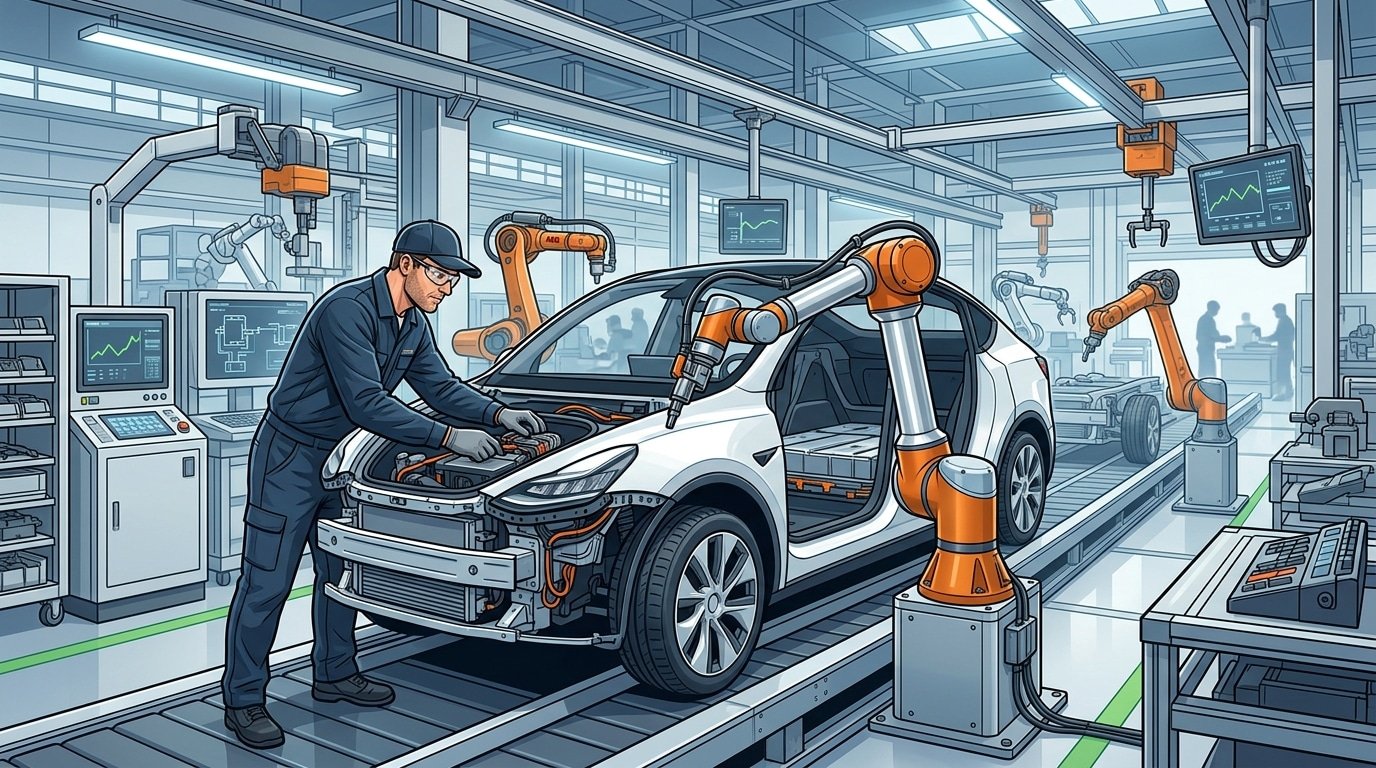
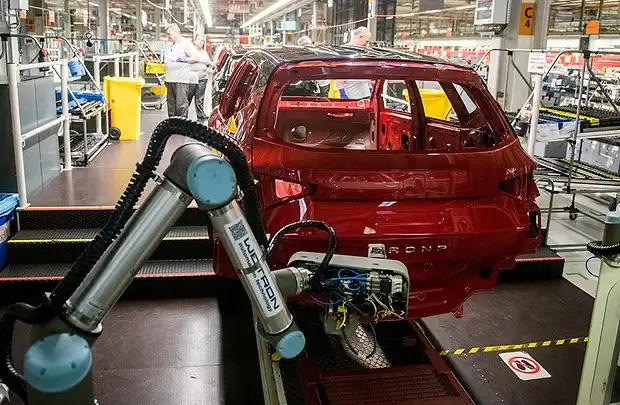
Cobot trends in automotive manufacturing 2026 — collaborative robot assisting human worker on EV assembly line
Trend 1 — AI-Powered Vision Systems for Precision Assembly
Wire harness routing used to be the task nobody wanted to automate. The cables flex unpredictably, connectors vary by fractions of a millimeter, and a single misrouted wire can trigger a costly recall. That’s changing fast. Among the most impactful cobot trends in automotive manufacturing heading into 2026, AI-powered 2D/3D vision systems stand out because they solve the exact problem that kept cobots off mixed-model assembly lines: part variability.
Modern deep-learning vision stacks — built on convolutional neural networks (CNNs) trained with thousands of labeled images — let a cobot identify connector orientation, pin count, and insertion depth in under 200 milliseconds. According to a MarketsandMarkets analysis, the machine vision market in manufacturing is projected to reach $18.2 billion by 2028, growing at roughly 7.7% CAGR — a trajectory driven heavily by automotive applications.
What Actually Changes on the Line
- Gap-and-flush inspection — Vision-guided cobots measure panel alignment to ±0.1 mm tolerances, replacing manual feeler-gauge checks that consume 45–90 seconds per vehicle.
- Self-calibrating pick-and-place — When a supplier ships a connector with a slightly different mold revision, the vision model adapts without reprogramming. This alone can cut changeover downtime by up to 70%.
- Reduced teach-pendant time — Traditional cobot programming requires an operator to jog the arm point-by-point. Vision inference replaces dozens of waypoints with a single “look-then-act” routine.
Here’s a practical tip most integrators won’t mention upfront: lighting matters more than the camera itself. Diffuse dome lighting eliminates specular reflections on glossy plastic connectors, and without it, even a $15,000 vision sensor will misclassify parts. Budget at least 15–20% of your vision hardware spend on structured lighting rigs.
Bottom line: AI vision doesn’t just make cobots more accurate — it makes them reprogrammable at the speed your model mix demands, which is the real unlock for high-variety automotive plants.
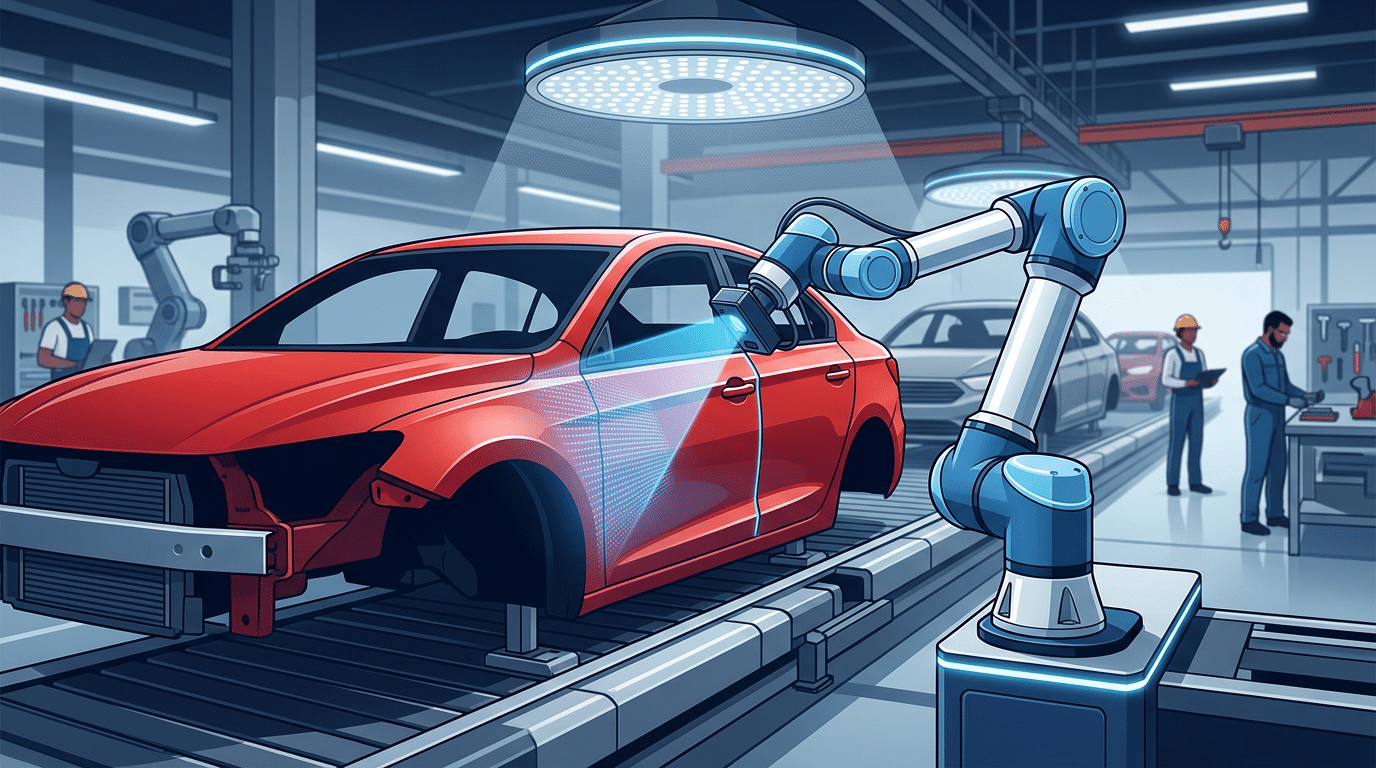
AI-powered vision system on a cobot performing gap-and-flush inspection in automotive manufacturing
Trend 2 — Higher Payload Cobots Built for EV Battery Handling
A standard collaborative arm tops out around 12–16 kg. That’s fine for door-seal application or dashboard sub-assembly — but an EV battery module can weigh 30 kg or more. Until recently, the only option was a caged industrial robot with a 100+ kg payload rating, which eliminated the collaborative advantage entirely. The new generation of 25–35 kg payload cobots closes that gap, and it’s one of the most consequential cobot trends in automotive manufacturing 2026 will bring to scale.
FANUC’s CRX-25iA and Universal Robots’ UR30 already target this payload class, but the real story is how OEMs are deploying them. Cell stacking — the repetitive, ergonomically punishing process of layering pouch or prismatic cells into module housings — is a prime use case. So is thermal interface material (TIM) application, where a cobot dispenses thermally conductive paste across battery cooling plates at tolerances under ±0.3 mm. Human workers previously handled this with handheld dispensers, leading to inconsistent bead profiles and rework rates above 8%.
Practical tip: When evaluating higher-payload cobots for battery lines, don’t just check the rated payload — verify the effective payload at full reach. A cobot rated at 30 kg may only sustain 20 kg at its maximum arm extension, which matters when positioning modules inside long pack enclosures.
BMW’s Debrecen plant, set to ramp EV production through 2026, has publicly discussed using collaborative robots in battery module pre-assembly zones where traditional six-axis robots would require excessive floor space and safety fencing. According to the IEA’s Global EV Outlook 2024, global EV sales surpassed 14 million units in 2023 — a 35% year-over-year increase — which directly intensifies demand for flexible, high-payload automation on battery lines. These cobots don’t replace heavy industrial robots for full-pack insertion, but they own the middle ground: module handling, busbar fastening, and quality-critical TIM dispensing where human proximity and force-limited operation still matter.

Higher payload cobot handling EV battery module in automotive manufacturing assembly line
Trend 3 — Seamless Integration With Autonomous Mobile Robots
Bolt a cobot onto an autonomous mobile robot (AMR) and you get something genuinely new: a mobile manipulation platform that drives itself between workstations, docks, performs a task, then moves on. No rails. No fixed tooling. No re-pouring concrete when the line changes. Among the most impactful cobot trends in automotive manufacturing 2026, this convergence is dissolving the assumption that a robot arm must stay in one place.
The economics are compelling. A 2023 study by the Interact Analysis research firm projected the mobile manipulator market would grow at a 45% CAGR through 2027, with automotive and electronics leading adoption. OEMs like BMW already deploy KUKA KMR iiwa units — a cobot mounted on an omnidirectional AMR — to deliver pre-assembled components across body shop, paint, and final assembly zones without dedicated conveyors.
Why This Matters for Multi-Zone Flexibility
- Body shop: Mobile cobots transport and spot-weld small brackets at varying stations, reducing the number of fixed welding cells needed.
- Paint zone: Units equipped with inspection cameras autonomously patrol freshly coated panels, flagging defects before clear-coat application.
- Final assembly: A single mobile manipulator can service 4–6 stations per shift, torquing fasteners or placing trim clips wherever the bottleneck appears.
Practical tip: fleet orchestration software — think of it as air-traffic control for AMRs — is the hidden bottleneck. Before purchasing hardware, validate that your MES (Manufacturing Execution System) can exchange real-time task queues with the AMR fleet manager. Skipping this step leads to expensive robots idling at charging docks.
The real unlock isn’t the robot or the vehicle alone; it’s the shared autonomy stack that lets both negotiate paths, hand off payloads, and re-prioritize tasks on the fly. Expect this capability to become table stakes for any greenfield EV plant breaking ground before 2026.

Mobile manipulation platform combining cobot and AMR in automotive manufacturing plant
Trend 4 — Advanced Safety Sensors Enabling Closer Human-Robot Collaboration
Old-school cobots had one safety trick: force-torque limiting. The arm moved slowly all the time, whether a human stood two centimeters away or twenty meters. That blanket speed cap crushed cycle times — often by 40–60% compared to fenced industrial robots. The next generation of safety hardware changes the equation entirely, and it’s one of the most consequential cobot trends in automotive manufacturing heading into 2026.
From Binary Safety to Dynamic Speed-and-Separation Monitoring
Three sensor modalities are converging on a single cobot skin:
- 3D time-of-flight (ToF) sensor arrays — embedded directly in the robot’s outer shell, these map a human’s position in real time at refresh rates above 100 Hz.
- Radar-based proximity detection — millimeter-wave radar sees through dust, weld spatter, and oil mist that blind optical sensors, making it ideal for body-in-white stations.
- Capacitive pre-contact sensing — detects a human hand within 5–10 cm before any physical contact occurs, triggering deceleration before the force-torque limiter even engages.
What This Means for Cycle Time
BMW’s Dingolfing plant reported a 34% improvement in cobot throughput after retrofitting radar-based proximity zones on door-assembly stations — without a single safety incident. The key insight most integrators miss: sensor placement matters more than sensor quality. Mount ToF arrays at elbow height, not end-effector height, because that’s where unplanned human contact actually happens on the line.
Pro tip: Don’t rely on a single sensing modality. Layering radar with capacitive skins creates redundancy that satisfies both ISO/TS 15066 and internal OEM safety audits — the latter often being stricter.
Expect these multi-modal sensor skins to become standard on every new cobot deployment in automotive by mid-2026, turning safety hardware from a speed penalty into a genuine productivity enabler among emerging cobot trends in automotive manufacturing 2026.
Trend 5 — Predictive Maintenance and Real-Time Factory Floor Analytics
A cobot doesn’t fail without warning. Weeks before a joint seizes, torque readings drift by fractions of a newton-meter, thermal signatures creep upward, and vibration harmonics shift. The problem was never the absence of signals — it was the absence of anyone listening. That’s changing fast, and it ranks among the most impactful cobot trends in automotive manufacturing 2026 will bring to scale.
Modern collaborative arms from Universal Robots, FANUC, and ABB now ship with embedded accelerometers, current sensors, and thermocouples at every axis. These feed continuous telemetry to edge-computing gateways — small industrial PCs mounted on or near the cell — that run lightweight machine-learning models trained on failure-mode libraries. The models flag joint wear, torque drift, and thermal anomalies in real time, often weeks before a breakdown would occur. According to McKinsey’s research on predictive maintenance, plants adopting these approaches see unplanned downtime drop by 30–50% and maintenance costs fall by up to 25%.
Connecting Cobot Data to the Broader Factory Brain
Raw sensor streams become truly powerful once they flow into a Manufacturing Execution System (MES) — the software layer that tracks production orders, quality records, and equipment status across an entire plant. When cobot health data merges with MES dashboards, maintenance planners can schedule part replacements during planned changeovers instead of reacting to mid-shift failures.
- Digital-twin integration: Platforms like Siemens Xcelerator and NVIDIA Omniverse ingest cobot telemetry to mirror physical cells in a virtual environment, enabling “what-if” simulations before adjusting cycle times or rebalancing lines.
- OPC UA standardization: Most new cobots support OPC Unified Architecture, the open protocol that lets heterogeneous equipment share data without custom middleware — a practical must-have if your floor mixes cobot brands.
- Actionable alerts, not noise: Tune anomaly thresholds conservatively at first. A common pitfall is setting sensitivity too high, flooding technicians with false positives that erode trust in the system within weeks.
Pro tip: Start by tracking harmonic-drive backlash on joints 2 and 3 — they bear the highest loads in typical automotive pick-and-place cycles and account for the majority of unplanned cobot service calls.
This data-driven maintenance layer doesn’t just prevent breakdowns. It generates the historical performance baselines that justify future cobot investments, giving plant managers hard ROI numbers rather than vendor promises.
Trend 6 — No-Code and Low-Code Programming for Rapid Redeployment
A typical automotive plant juggles 15–30 trim-level variations per model year. Every new variant means retooling — and traditionally, retooling a cobot cell required a robotics engineer writing or editing Polyscope scripts, URCaps plugins, or vendor-specific code. That bottleneck is disappearing fast. Among the most impactful cobot trends in automotive manufacturing 2026, no-code and low-code programming stands out because it directly attacks changeover downtime.
Teach-by-Demonstration and Drag-and-Drop Task Builders
Hand-guiding — physically moving the cobot arm through a path while the controller records waypoints — has existed for years. What’s new is the software layer on top. Platforms like Universal Robots’ PolyScope X and FANUC’s CRX Notebook now offer drag-and-drop task builders where a production engineer sequences pick, place, screw-drive, and inspection blocks without writing a single line of code. According to a Universal Robots product brief, redeployment time for a new task can drop to under 30 minutes — compared with 4–8 hours using traditional teach-pendant programming.
LLM-Assisted Programming: The Next Leap
Large language models are entering the picture. Prototype tools already let an engineer type a plain-English instruction — “apply 3 Nm torque at each of these six fastener locations” — and receive executable robot code. The practical advice here: don’t trust LLM-generated motion paths without a dry-run at reduced speed. Collision geometry and singularity avoidance still need human review.
Pro tip: Pair no-code redeployment with version-controlled task libraries stored in your MES. When a model changeover hits, the line supervisor loads a validated recipe rather than building from scratch — cutting risk and audit headaches simultaneously.
For plants managing frequent model changeovers, this trend is non-negotiable. Cobot trends in automotive manufacturing through 2026 will increasingly reward flexibility over raw cycle-time gains, and no-code interfaces are the fastest path to that flexibility.
Trend 7 — Sustainable Manufacturing Through Energy-Efficient Cobot Design
A single traditional six-axis industrial robot can draw 5–8 kW under load. Multiply that across 400 cells in a body shop and you’re looking at a serious chunk of a plant’s Scope 2 emissions. Automakers chasing Science Based Targets initiative (SBTi) commitments need every kilowatt-hour they can claw back — and next-generation cobots are delivering exactly that.
Three design shifts are driving the gains. First, carbon-fiber-reinforced polymer (CFRP) arms slash moving mass by 30–40%, which means smaller motors draw less current for the same payload. Second, regenerative braking drives — borrowed from EV powertrain engineering — recapture kinetic energy during deceleration and feed it back to the DC bus. Third, sleep-mode intelligence: embedded accelerometers and proximity sensors let the cobot drop into a 10 W standby state within seconds of the last part leaving its work envelope, then wake in under 200 ms when the next part arrives.
Combined, these features cut energy consumption by up to 60% compared to legacy industrial arms performing equivalent tasks. That’s not a lab figure — Universal Robots and FANUC have both published comparable efficiency benchmarks for their latest lightweight platforms.
Procurement teams are now weighting energy-per-unit-produced alongside cycle time and uptime in RFQ scoring. If your cobot vendor can’t provide a certified energy profile per ISO 50001 standards, expect pushback from sustainability officers before the PO is signed.
This is one of the most underappreciated cobot trends in automotive manufacturing heading into 2026: the buying decision is no longer purely about throughput. Carbon accounting is reshaping capital equipment selection, and energy-efficient cobot design gives plant managers a tangible line item to report against corporate ESG dashboards.
How These Seven Trends Interconnect to Shape the Smart Automotive Factory
None of these trends deliver their full ROI in isolation. The compounding effect is where the real capital-efficiency gains hide — and where most investment plans fall short. Consider a concrete loop: an AI vision system on a battery-module line detects a 0.3 mm electrode-tab misalignment. That defect data feeds directly into the predictive analytics layer, which correlates the anomaly with rising torque variance in the cobot’s J4 joint. Maintenance gets a 72-hour heads-up instead of a line-down surprise.
Now layer in AMR integration. When that cobot goes offline for a scheduled servo swap, a mobile cobot — reprogrammed in under 15 minutes via a low-code interface — rolls into position and picks up the task. No production gap. No overtime. According to McKinsey’s analysis of industrial robotics, factories that integrate robotics with real-time data platforms see up to 30% higher overall equipment effectiveness (OEE) than those deploying standalone automation.
Higher-payload cobots handling 25 kg+ EV modules demand the advanced safety-sensor stacks discussed in Trend 4 — skin-proximity sensors, 3D time-of-flight cameras — precisely because the kinetic energy at those payloads is non-trivial. One trend literally unlocks the other.
Decision-maker takeaway: map your capital plan as an interconnected graph, not a line-item list. Budget for the data backbone (OPC UA, MQTT brokers, edge compute) first, because it’s the multiplier that turns seven separate cobot trends in automotive manufacturing 2026 into a single, self-reinforcing system.
Energy-efficient cobot designs close the loop by keeping power consumption manageable even as cell density on the factory floor climbs. Without 0.5 kW-class arms, scaling to 40+ cobots per line would blow past most plants’ electrical budgets. The smart factory isn’t one trend — it’s the interaction layer between all seven.
Frequently Asked Questions About Cobot Trends in Automotive Manufacturing
What differentiates cobots from traditional industrial robots in automotive settings?
Traditional industrial robots operate inside safety cages at speeds exceeding 2 m/s, handling payloads of 100 kg or more. Cobots, by contrast, are designed for shared workspaces — they use force-torque limiting, skin-based tactile sensors, and speed-reduction zones to work safely alongside humans. The practical upshot? A cobot cell can be redeployed to a different station in hours, while re-fencing an industrial robot typically takes weeks of engineering and safety validation.
Which cobot payload range suits EV battery lines?
Most EV battery module handling requires 25–35 kg of lift capacity. FANUC’s CRX-25iA and Universal Robots’ UR30 both target this range. For full battery pack manipulation — where assemblies exceed 50 kg — dual-cobot lift configurations or hybrid setups pairing a cobot with a servo-assisted fixture are the standard approach heading into 2026.
How quickly do cobots achieve ROI in automotive plants?
Payback periods vary, but most Tier 1 suppliers report 12–18 months for single-station deployments. A MarketsandMarkets analysis projects the collaborative robot market reaching $6.8 billion by 2029, driven largely by automotive ROI cases. Plants that combine cobots with no-code programming platforms shave an additional 20–30% off integration costs, accelerating break-even significantly.
What safety standards govern human-cobot collaboration on the factory floor?
ISO/TS 15066 is the governing technical specification. It defines four collaborative modes — safety-rated monitored stop, hand guiding, speed and separation monitoring, and power and force limiting — along with biomechanical pain-threshold limits for 29 body regions. Any cobot deployment in an automotive OEM must also comply with ISO 10218-1/2 and undergo a task-specific risk assessment per ISO 12100. Skip the risk assessment and you risk both regulatory action and insurance exclusions.
These questions capture the core concerns shaping cobot trends in automotive manufacturing 2026 — from payload sizing to safety compliance. Getting the details right at the evaluation stage prevents costly retrofits later.
Strategic Takeaways for Automotive Leaders Evaluating Cobot Investments
Seven trends, one decision framework. Prioritize based on where your plant sits today — not where a vendor pitch says it should be.
| Plant Profile | Start Here | Phase Two | Long-Term Play |
|---|---|---|---|
| Legacy ICE lines | No-code programming + predictive maintenance | Advanced safety sensors for fenceless cells | AMR-cobot integration for flexible logistics |
| Dedicated EV production | High-payload cobots for battery module handling | AI vision for harness and connector assembly | Energy-efficient cobot fleets tied to Scope 2 targets |
| Mixed ICE/EV platforms | Low-code redeployment + AMR mobility | AI vision + real-time analytics across both lines | Full digital-twin orchestration linking all seven capabilities |
The sequencing matters more than the budget. McKinsey estimates that manufacturers who phase automation investments against clear production bottlenecks achieve 25–30% faster payback than those who deploy broadly without prioritization. Apply the same logic to cobot trends in automotive manufacturing 2026: map each trend to a specific pain point — cycle-time loss, ergonomic injury rates, changeover delays — before writing a purchase order.
Audit action: Pull your last 12 months of unplanned downtime logs, ergonomic incident reports, and model-changeover timelines. Overlay them against the seven capabilities above. The gaps will tell you exactly which cobot investment delivers the fastest return.
Skip the temptation to pilot everything simultaneously. Pick two trends that address your highest-cost failure modes, prove ROI within one production cycle, then expand. That disciplined approach is what separates plants that treat cobots as strategic infrastructure from those still running one-off demo cells three years later. The cobot trends in automotive manufacturing 2026 reward decisive, sequenced action — not cautious observation from the sidelines.
See also
Cobot vs AMR — Which Is Easier to Integrate
Are Cobots Replacing Human Workers (Real Industry Data)
Welding Cast Iron: Safe Methods & Pro Tips