The global collaborative robot market hit $1.9 billion in 2023 and is projected to exceed $11.8 billion by 2030, according to MarketsandMarkets research — and the fastest-growing segment is units with embedded artificial intelligence. AI powered cobots are fundamentally reshaping modern manufacturing by combining machine learning, computer vision, and adaptive force control to perform tasks that traditional automation simply cannot handle: inspecting micro-defects at 99.5% accuracy, reprogramming themselves for new product variants in minutes, and predicting their own maintenance needs before a single minute of downtime occurs. This guide breaks down exactly how these intelligent collaborative robots deliver measurable ROI across seven critical manufacturing applications, what separates genuinely AI-driven models from standard cobots, and how to evaluate whether your operations are ready for the upgrade.
What AI Powered Cobots Are and Why They Matter in Manufacturing
Strip away the marketing buzz, and here’s what you’re left with: AI powered cobots are collaborative robots equipped with machine learning algorithms, computer vision systems, and adaptive decision-making capabilities that allow them to perceive, learn from, and respond to unstructured environments in real time. Unlike traditional cobots — which follow fixed, pre-programmed routines — these systems adjust their behavior based on sensor input, production variability, and even operator proximity.
Why does this distinction matter? Because conventional automation breaks down the moment conditions deviate from the script. A standard cobot performing pick-and-place will halt if a part arrives at an unexpected angle. An AI-enhanced cobot recognizes the deviation, recalculates its grasp strategy, and continues — no human intervention, no downtime.
The market trajectory confirms the shift. According to MarketsandMarkets research, the global collaborative robot market is projected to reach $6.8 billion by 2029, with AI-integrated models driving the fastest-growing segment. Manufacturers deploying AI powered cobots report up to 85% reduction in programming time for new tasks — a metric that directly translates to faster changeover on mixed-product lines.
The paradigm shift isn’t about replacing workers. It’s about giving every operator on the floor a teammate that learns, adapts, and never loses concentration during a 12-hour shift.

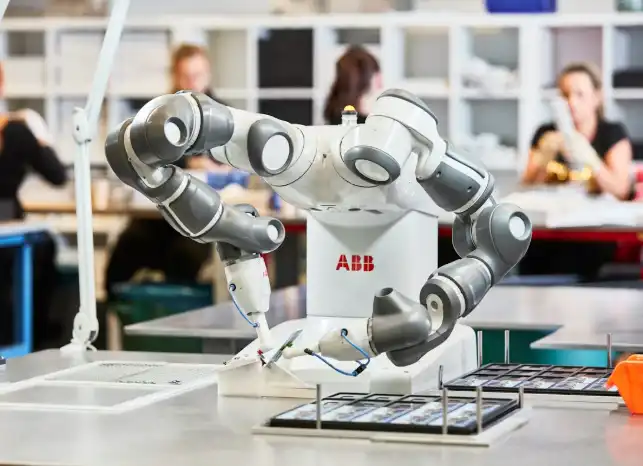
AI powered cobot with computer vision working alongside human operator in manufacturing
What Makes a Cobot Truly AI-Powered — Vision, Machine Learning, and Adaptive Intelligence
A standard collaborative robot follows waypoints. You teach it a path, it repeats that path thousands of times. An AI powered cobot, by contrast, perceives its workspace, makes decisions in real time, and improves with every cycle. The difference isn’t incremental — it’s architectural.
Four core technologies separate genuine AI-driven cobots from their conventional counterparts:
- Real-time computer vision — 2D/3D cameras paired with deep neural networks let the cobot identify, classify, and locate objects even under variable lighting or partial occlusion. Think bin picking where parts arrive in random orientations.
- Reinforcement learning (RL) — Instead of explicit programming for every scenario, the cobot trains through trial-and-reward loops. A 2023 study by Google DeepMind demonstrated RL-based robotic manipulation achieving 95.4% grasp success on previously unseen objects after just 7 hours of real-world training.
- Sensor fusion — Force/torque sensors, LiDAR, proximity detectors, and tactile skins feed a unified perception model. This is what enables context-aware safety around human workers.
- Natural language interfaces — Emerging large language model integrations allow operators to issue plain-English task instructions, drastically cutting reprogramming time from hours to minutes.
Here’s the practical takeaway most integrators miss: sensor fusion quality matters more than any single AI model. Garbage input data — a poorly calibrated depth camera, a noisy torque sensor — will cripple even the most sophisticated machine learning algorithm. Calibrate your sensor stack first, then layer on intelligence.
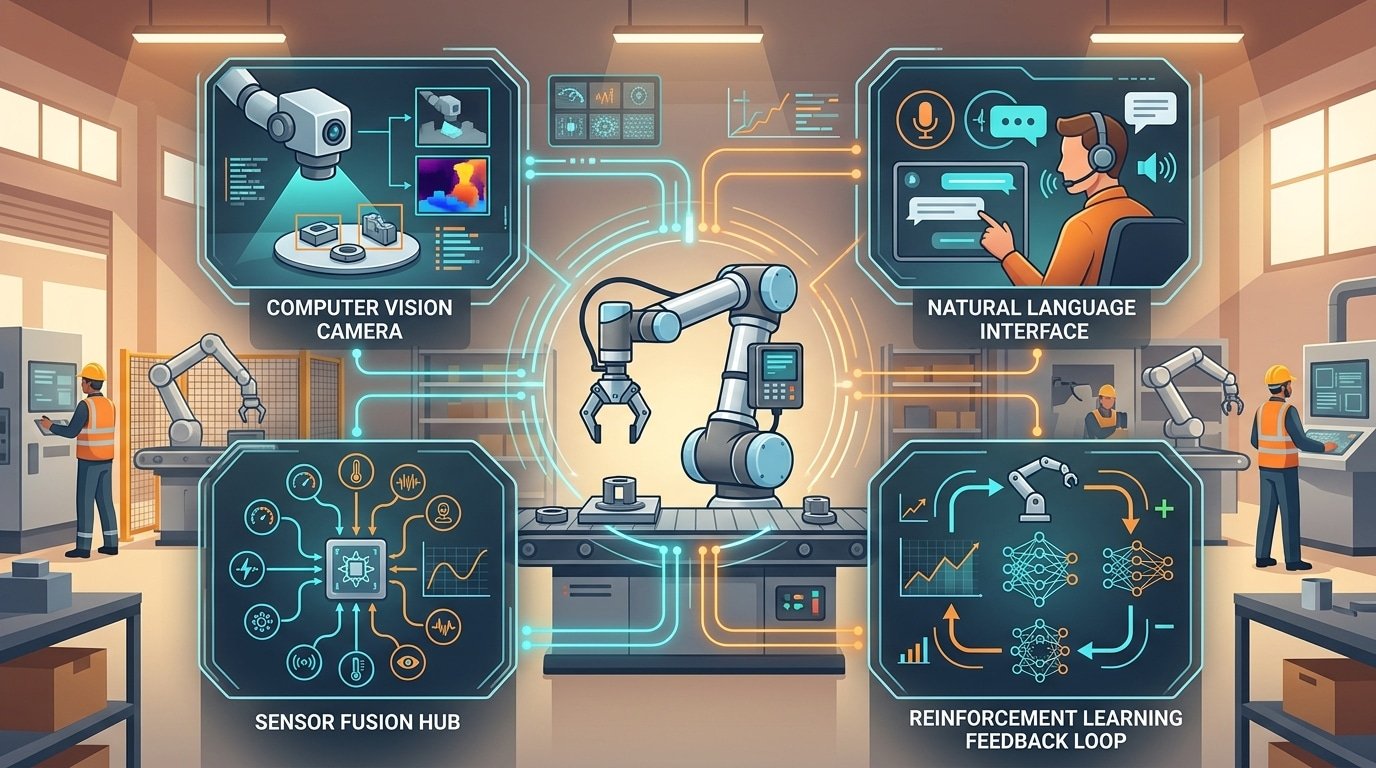
AI powered cobot core technologies including computer vision, reinforcement learning, sensor fusion, and natural language interface
7 Ways AI Powered Cobots Transform Modern Manufacturing
The impact isn’t theoretical. A MarketsandMarkets analysis projects the collaborative robot market will reach $6.8 billion by 2029, with AI-integrated models driving the fastest-growing segments. That growth traces directly to measurable shop-floor results — not vendor promises.
So where exactly do AI powered cobots deliver? Seven applications stand out because they solve problems that conventional automation simply cannot address: variability, ambiguity, and the need for real-time decision-making without human intervention at every step.
The common thread across all seven: each application leverages perception, learning, or adaptive control — the AI capabilities covered in the previous section — to handle tasks that once demanded skilled human judgment.
Here’s the roadmap. The sections that follow break down each transformation in detail, covering adaptive quality inspection, self-reprogramming assembly, predictive maintenance, intelligent bin picking, context-aware safety, continuous process optimization, and autonomous finishing operations. Each includes concrete ROI data and implementation pitfalls worth knowing before you commit budget.
One practical note: these seven aren’t ranked by importance. The right starting point depends entirely on your bottleneck — whether that’s scrap rate, changeover time, or unplanned downtime. Read selectively.
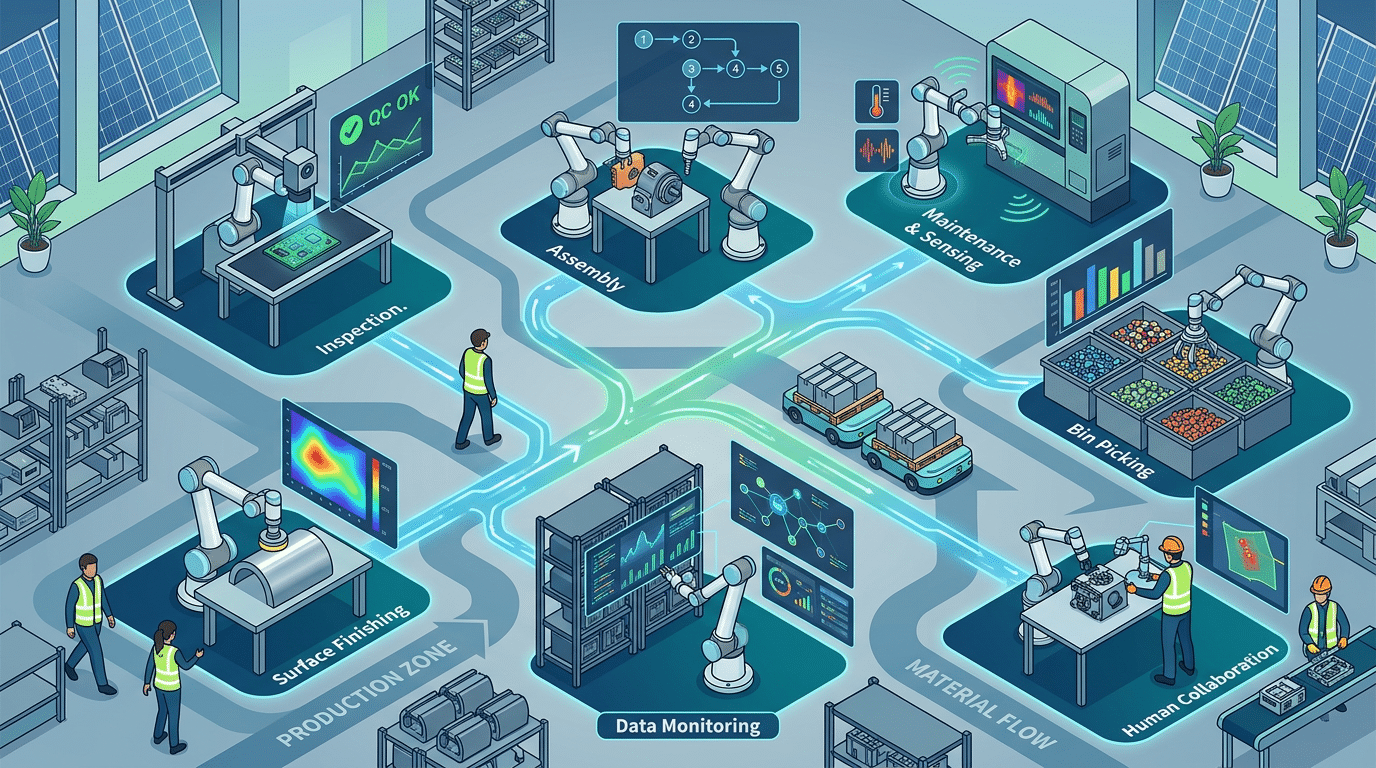
Seven AI powered cobots performing different manufacturing tasks across a smart factory floor
Adaptive Quality Inspection That Learns From Every Defect
Traditional machine vision systems flag defects based on rigid, pre-programmed thresholds — a scratch wider than 0.3 mm triggers a reject, anything smaller passes. The problem? Real-world defects don’t follow neat rules. AI powered cobots equipped with deep-learning vision models take a fundamentally different approach: they classify anomalies by pattern, not just dimension, catching hairline cracks, subtle discoloration, and surface porosity that rule-based systems routinely miss.
How much of a difference does this make? Cognex reports that deep-learning-based inspection can reduce false reject rates by up to 50% compared to conventional machine vision, while simultaneously improving true defect detection. That dual improvement matters enormously — false rejects waste material and slow throughput, while missed defects create costly downstream failures.
Pro tip: Feed your cobot’s vision model with labeled images of borderline defects — the ones your human inspectors argue about. That ambiguous middle ground is exactly where neural networks outperform static thresholds, and it’s where most manufacturers lose money.
The real power is the feedback loop. Every inspected part — pass or fail — becomes training data. The model’s confusion matrix tightens over weeks, not months. One practical detail most integrators overlook: schedule periodic retraining cycles (typically every 2–4 weeks) rather than relying on continuous online learning, which can introduce drift if a batch of mislabeled parts enters the pipeline. AI powered cobots excel at inspection precisely because they combine physical dexterity — repositioning parts under multiple lighting angles — with inference engines that sharpen autonomously.

AI powered cobot performing adaptive quality inspection with deep-learning vision on an automotive component
Flexible Assembly Lines That Reprogram Themselves
Changeover time kills profitability in high-mix, low-volume production. Traditional automation demands hours — sometimes days — of manual reprogramming when switching between product variants. AI powered cobots sidestep this bottleneck through demonstration-based learning (also called “learning from demonstration” or LfD): an operator physically guides the cobot through a new task once, and the system’s neural network generalizes that motion into a reusable skill.
The real multiplier is digital twin integration. By pairing a cobot’s learned skills with a virtual replica of the production cell, engineers can simulate and validate new assembly sequences offline — then push updates to the physical robot in minutes. Universal Robots reports that customers using their UR20 platform with offline programming tools have cut changeover times by up to 90% compared to conventional teach-pendant methods.
Pro tip: Don’t rely on a single demonstration. Capture 3–5 demonstrations with slight positional variation so the model builds a robust trajectory envelope rather than memorizing one rigid path.
What makes this economically transformative? Factories running batch sizes as small as 50 units can now justify automation. The cobot doesn’t need a dedicated program per SKU — it interpolates between learned skills, adjusting grasp force, insertion angle, and sequence order on the fly. That’s the gap AI powered cobots fill: making flexibility and automation no longer mutually exclusive.
Predictive Maintenance Through Real-Time Self-Monitoring
Unplanned downtime costs industrial manufacturers an estimated $50 billion annually, according to a Deloitte analytics report. AI powered cobots attack this problem at the source — embedded sensors continuously stream vibration signatures, torque loads, and thermal profiles to onboard edge-computing modules that detect degradation patterns long before a human operator would notice anything wrong.
Here’s what actually matters in practice: the AI doesn’t just flag when a joint motor exceeds a temperature threshold. It correlates subtle torque drift with historical cycle data to estimate remaining useful life (RUL) of specific components — harmonic drives, timing belts, encoder bearings. That distinction separates genuine predictive maintenance from glorified alarm systems.
Pro tip: Configure your cobot’s anomaly-detection baseline during the first 500 operating hours under normal load. Skipping this “learning window” produces noisy false positives that erode operator trust fast.
AI powered cobots from manufacturers like Universal Robots (with third-party analytics layers) and FANUC’s CRX series can push maintenance alerts directly into CMMS platforms — SAP PM, Fiix, or UpKeep — so work orders generate automatically. The result? Facilities running these systems report 30–50% reductions in unplanned stops and measurably longer component service life because replacements happen at the optimal moment, not too early and never too late.
Intelligent Material Handling and Bin Picking
Bin picking has been called the “holy grail” of industrial automation for decades. The reason is simple: randomly oriented parts in a bin create near-infinite pose variations that rule-based vision systems can’t resolve. Deep learning changed that equation entirely. AI powered cobots equipped with 3D structured-light or time-of-flight cameras now generate point clouds of cluttered bins, then run convolutional neural networks to segment individual parts, estimate 6-DOF grasp poses, and plan collision-free extraction paths — all within milliseconds.
The results speak for themselves. According to Universal Robots, modern AI-driven bin picking solutions achieve pick success rates above 99% on mixed-SKU bins, a figure that was below 60% with conventional 2D pattern-matching just five years ago.
Practical tip: start with a depth camera mounted on the cobot’s wrist rather than a fixed overhead unit. Wrist-mounted sensors let the arm capture multiple viewpoints of the bin, dramatically reducing occlusion errors on tightly packed or reflective parts.
Where this really transforms operations is in warehouse kitting and order fulfillment. Instead of dedicating one feeder bowl per part number — expensive and inflexible — a single AI powered cobot cell can handle dozens of SKUs from the same bin. That consolidation cuts floor space requirements and slashes changeover to a software update rather than a mechanical retool. If your operation runs high-mix kitting, bin picking intelligence isn’t a nice-to-have; it’s the bottleneck breaker.
Human-Robot Collaboration With Context-Aware Safety
Fixed speed and separation monitoring — the legacy approach defined in ISO/TS 15066 — treats every human the same way. Worker reaches into the cobot’s zone? It slows to a crawl or stops entirely, regardless of whether that person is grabbing a finished part or just walking past. That blanket reaction tanks throughput.
AI powered cobots replace these static safety envelopes with dynamic ones. Using depth cameras, LiDAR arrays, and capacitive skin sensors, the system builds a real-time skeletal model of nearby workers. Gesture recognition algorithms classify intent — is the operator reaching for a tool, signaling a pause, or inadvertently drifting closer? Behavioral prediction models, often LSTM neural networks trained on thousands of hours of shop-floor footage, anticipate a worker’s trajectory 0.5 to 1.5 seconds ahead.
The practical payoff is significant. A 2023 pilot at a BMW assembly plant in Spartanburg, South Carolina, reported a 32% reduction in unnecessary cobot stoppages after deploying proximity-aware speed scaling, directly boosting cell-level OEE (overall equipment effectiveness). The cobot didn’t become less safe — it became smarter about when to slow down.
Pro tip: Don’t rely solely on vision for safety-rated functions. Fuse at least two independent sensing modalities — for example, 3D time-of-flight cameras plus force-torque feedback — so the system remains functional even if one sensor degrades under dust, glare, or vibration.
Context-aware safety turns AI powered cobots from cautious machines that constantly flinch into genuine collaborators that modulate behavior the way an experienced human coworker would — staying alert without being paralyzed.
Process Optimization Through Continuous Data Analysis
Every motion an AI powered cobot executes generates data — torque curves, cycle timestamps, positional deviations, force feedback. Most manufacturers collect this telemetry but barely scratch the surface. The real advantage comes from edge computing modules embedded in the cobot controller that run lightweight inference models locally, processing thousands of data points per second without round-tripping to the cloud.
What does that look like in practice? A cobot performing screw-driving logs torque-angle signatures for every fastener. When the distribution drifts — say, 3% tighter than baseline — the onboard model flags a potential material batch change or fixture misalignment before a single reject appears. According to McKinsey’s Industry 4.0 research, manufacturers that close this data-to-action loop see productivity gains of 15–30%.
The critical integration point is your MES (Manufacturing Execution System). AI powered cobots should push structured OPC UA or MQTT messages directly into MES dashboards, not sit in a data silo. Pro tip: define KPI tags — OEE loss categories, micro-stop durations, first-pass yield deltas — at deployment, not after. Retrofitting tag structures later is painful and expensive.
Skip vanity dashboards showing cobot uptime alone. Map cobot-generated insights to specific bottleneck stations so production engineers can act within the same shift.
Autonomous Welding, Polishing, and Finishing With Force Control
Skilled welders are retiring faster than apprentices replace them. The American Welding Society projects a shortage of 360,000 welding professionals by 2027. AI powered cobots equipped with force-torque sensors and seam-tracking algorithms are filling that gap — not by mimicking a welder’s motions, but by adapting in real time to joint geometry, material warpage, and thermal distortion.
The key technology here is force-torque sensing — a six-axis sensor mounted between the cobot’s wrist and end effector that measures forces and torques at up to 1,000 Hz. During polishing or deburring, the cobot maintains a constant contact force (typically 5–15 N for aluminum finishing) regardless of surface irregularities. This is called impedance control, and it’s what separates a scratched part from a mirror finish.
Pro tip: Don’t rely solely on force control for weld seam tracking. Pair it with laser-based through-arc seam tracking so the cobot corrects its path before the arc even touches misaligned joints. Force feedback alone introduces a lag that causes burn-through on thin-gauge steel.
What makes AI powered cobots excel at finishing tasks is path learning through demonstration. An operator guides the arm through a complex contour once, the system records waypoints and force profiles, then neural-network-based trajectory optimization smooths the path and generalizes it across part variations. The result: consistent Ra surface roughness values within ±0.1 µm — performance that rivals a craftsperson with 20 years of experience.
Traditional Cobots vs AI-Driven Models — Key Differences That Impact Your Operations
A teach-pendant-programmed cobot does exactly what you tell it — nothing more. An AI powered cobot observes, adapts, and improves autonomously. That distinction reshapes every operational metric you care about.
| Dimension | Traditional Cobot | AI-Driven Cobot |
|---|---|---|
| Deployment time | Days to weeks per new task | Hours via demonstration or simulation transfer |
| Flexibility | Fixed waypoints; manual reprogramming for variants | Self-adjusts to part variation in real time |
| Error handling | Stops and waits for operator intervention | Classifies anomalies, attempts corrective action |
| Scalability | Linear — each new SKU needs a new program | Logarithmic — learned skills transfer across tasks |
| Total cost of ownership (3-year) | Lower upfront, higher integration labor | ~15-30% premium offset by reduced changeover costs |
According to the International Federation of Robotics 2023 report, cobot installations grew 12% year-over-year, with AI-enhanced models capturing a rising share — particularly in high-mix environments where traditional programming bottlenecks stall ROI.
Here’s the evaluation shortcut experienced integrators use: if your product mix changes fewer than four times per year, a conventional cobot likely suffices. Beyond that threshold, AI powered cobots pay for themselves through eliminated reprogramming labor alone. Don’t over-buy intelligence you won’t use — but don’t underestimate how quickly product variety creeps upward.
Safety Standards and Compliance for AI-Enabled Collaborative Robots
Two standards form the regulatory backbone: ISO 10218 (safety requirements for industrial robots) and ISO/TS 15066 (specific guidance on collaborative operation, including biomechanical force limits). These cover deterministic cobots well. But AI powered cobots introduce a problem neither standard fully anticipated — non-deterministic behavior, where a learned model may produce outputs the integrator never explicitly programmed.
The emerging ISO/TR 23482-1 framework begins addressing AI-specific robotics safety, including validation of machine-learned models and transparency requirements. A 2023 EU Machinery Regulation update also mandates that self-learning systems undergo risk assessment for every reasonably foreseeable behavioral variation — not just the trained baseline.
Practical compliance tip: treat each model update as a new machine configuration. Universal Robots and FANUC now embed “behavioral envelopes” — hard-coded kinematic and force boundaries that override AI decisions, ensuring no learned policy violates ISO/TS 15066 force thresholds (e.g., 150 N maximum for hand contact). Cybersecurity adds another layer; over 83% of OT environments experienced at least one intrusion in 2022, making encrypted model pipelines and firmware signing non-negotiable for AI powered cobots connected to factory networks.
Don’t wait for final AI-specific standards. Document your model validation process, lock behavioral limits in firmware, and audit network access quarterly — auditors already expect this diligence.
How to Calculate the ROI of Your AI Cobot Investment
Most vendors quote a 12–18 month payback period. That number is real — but only if you account for all cost lines, not just the sticker price versus one operator’s salary.
The Five-Bucket ROI Framework
- Direct labor savings. Calculate fully burdened labor cost (wages + benefits + overtime) for the shifts the cobot covers. A single AI powered cobot running two shifts typically offsets $80,000–$120,000/year in a U.S. facility.
- Quality improvement gains. Fewer scrap parts and customer returns. Quantify your current defect rate, then apply the reduction you validated during pilot — often 30–60%.
- Reduced unplanned downtime. If predictive maintenance catches failures early, multiply avoided downtime hours by your line’s cost-per-hour.
- Flexibility premium. Shorter changeover times mean you can accept smaller batch orders at higher margins. This is the line item most teams forget.
- Hidden costs. Integration engineering, safety risk assessments, employee training, and ongoing AI model retraining. Budget 20–35% on top of hardware for these.
According to McKinsey’s analysis of industrial automation ROI, companies that include flexibility and quality metrics in their calculations see 25% higher realized returns than those tracking labor savings alone. Skip the single-metric spreadsheet — build a model that captures all five buckets, and your AI powered cobots investment case will survive CFO scrutiny.
Frequently Asked Questions About AI Powered Cobots
How much do AI cobots cost compared to traditional cobots?
Expect a 30–60% premium. A standard cobot arm runs $25,000–$50,000, while an AI powered cobot with integrated vision, force sensing, and machine learning software typically lands between $75,000 and $150,000 fully deployed. The gap narrows fast once you factor in reduced programming labor and higher throughput.
What skills does my team need?
No robotics PhD required. Most operators learn the no-code interface in under a week. However, you’ll want at least one person comfortable with data interpretation — reviewing model confidence scores, adjusting inference thresholds, and validating edge cases the AI flags.
How long does deployment take?
Simple pick-and-place tasks: 2–4 weeks. Complex inspection or welding cells with custom-trained models: 8–12 weeks, including data collection and validation. According to the Association for Advancing Automation (A3), firms that run a pilot cell first cut full-scale rollout timelines by roughly 40%.
Can AI cobots integrate with my existing automation?
Yes — most support OPC UA, MQTT, and standard fieldbus protocols (EtherNet/IP, PROFINET). They slot into existing PLC architectures without ripping out legacy equipment.
Which industries benefit most outside manufacturing?
Logistics warehousing, pharmaceutical compounding, food packaging, and surgical assistance are the fastest-growing segments. Agriculture is emerging too, with AI cobots handling selective harvesting of delicate crops like strawberries.
Bringing AI Powered Cobots Into Your Manufacturing Strategy — Next Steps
You’ve seen the seven capabilities — adaptive inspection, self-reprogramming assembly, predictive maintenance, intelligent bin picking, context-aware safety, continuous process optimization, and autonomous finishing. Each one solves a specific, measurable production problem. The question isn’t whether to adopt, but where to start.
A Three-Phase Pilot Framework
- Audit your pain points. Identify the single workstation with the highest scrap rate, longest changeover time, or most ergonomic injury reports. That’s your pilot cell — not your most complex line.
- Run a 90-day proof of value. Deploy one AI powered cobot on that cell with clear KPIs: defect reduction percentage, cycle time delta, and operator satisfaction scores. According to the World Economic Forum’s 2023 Future of Jobs Report, 75% of companies plan to adopt AI-driven automation within five years — early movers capture compounding efficiency gains.
- Scale with data, not assumptions. Use pilot metrics to build the business case for cells two through ten. Insist on OPC UA or MQTT connectivity so every new cobot feeds your MES from day one.
Pro tip most integrators won’t mention: negotiate your AI software licensing separately from hardware. Bundled deals often lock you into a single vision or ML stack, limiting future flexibility.
Start small, measure ruthlessly, and expand only when the numbers justify it. That discipline turns a pilot into a production-wide transformation — without the budget blowouts that stall most automation programs.
See also
How to Calculate Your Labor Cost Savings from Laser Welding
Cobot Risk Assessment Checklist — 47 Points Covering ISO 15066 and Beyond
How Much Does Each Weld Seam Actually Cost to Clean?
How to extend the service life of laser welding machine
How to combine laser cleaning machine with industrial robots