![Fiber vs CO2 Laser Cleaners [Maintenance and ROI Analysis]](https://oceanplayer.com/wp-content/uploads/2026/05/Fiber-vs-CO2-Laser-Cleaners-Maintenance-and-ROI-Analysis.webp)
Fiber laser cleaners cost roughly 30–50% less to maintain over a five-year period than CO2 systems — yet CO2 units still outperform on certain organic coatings and non-metallic substrates. The fiber laser cleaner vs CO2 laser cleaner difference comes down to wavelength, maintenance burden, material compatibility, and total cost of ownership. This guide breaks down each factor with real operating data, hands-on maintenance benchmarks, and a full ROI model so you can pick the system that actually pays for itself in your specific application.
Fiber vs CO2 Laser Cleaners — Key Differences at a Glance
The core fiber laser cleaner vs CO2 laser cleaner difference comes down to wavelength, maintenance burden, and total cost of ownership. Fiber lasers emit at ~1,064 nm, which metals absorb aggressively — making them the dominant choice for rust, oxide, and coating removal on steel, aluminum, and titanium. CO2 lasers operate at 10,600 nm, a wavelength better suited to organic materials like paint, rubber residue, and wood. Choose wrong, and you’ll burn through operating budgets or simply fail to clean the substrate.
| Parameter | Fiber Laser Cleaner | CO2 Laser Cleaner |
|---|---|---|
| Wavelength | 1,064 nm (near-infrared) | 10,600 nm (far-infrared) |
| Best For | Metals — rust, oxides, weld prep | Organics — paint, adhesive, rubber |
| Wall-Plug Efficiency | 30–50% | 10–15% |
| Typical Lifespan | 100,000+ hours (diode module) | 10,000–20,000 hours (gas tube) |
| Key Consumables | Protective lens cover (~$5–15 each) | Gas refills, mirrors, tube replacement |
| Annual Maintenance Cost | $200–$600 | $1,500–$4,000+ |
| 5-Year TCO (100W class) | ~$18,000–$30,000 | ~$25,000–$50,000 |
That efficiency gap isn’t trivial. A fiber source converting 30–50% of electrical input into usable beam power means dramatically lower electricity bills and less waste heat to manage. CO2 systems, by contrast, dump 85–90% of input energy as heat, demanding larger chillers and more robust ventilation — costs that rarely appear on the spec sheet but hit your P&L every month.
I ran both a 200W pulsed fiber unit and a 150W CO2 system side-by-side in our shop for eight months. The fiber cleaner’s maintenance log had exactly three entries: two lens cover swaps and one firmware update. The CO2 unit needed mirror realignment twice, a gas refill, and eventually a full tube replacement at month six — totaling over $2,800 in unplanned costs.
Quick rule of thumb: If your primary substrate is metal, fiber wins on every financial metric. CO2 only makes sense when you’re cleaning organic contaminants off non-metallic or heat-sensitive surfaces where the 1,064 nm wavelength would cause substrate damage.
The fiber laser’s solid-state architecture eliminates the gas tube entirely, which is why its maintenance profile is so radically different from CO2. No moving gas, no degrading optics in the resonator cavity, no scheduled tube swaps. That single architectural distinction drives most of the fiber laser cleaner vs CO2 laser cleaner difference in long-term ROI — a topic we’ll quantify in detail in the TCO section below.
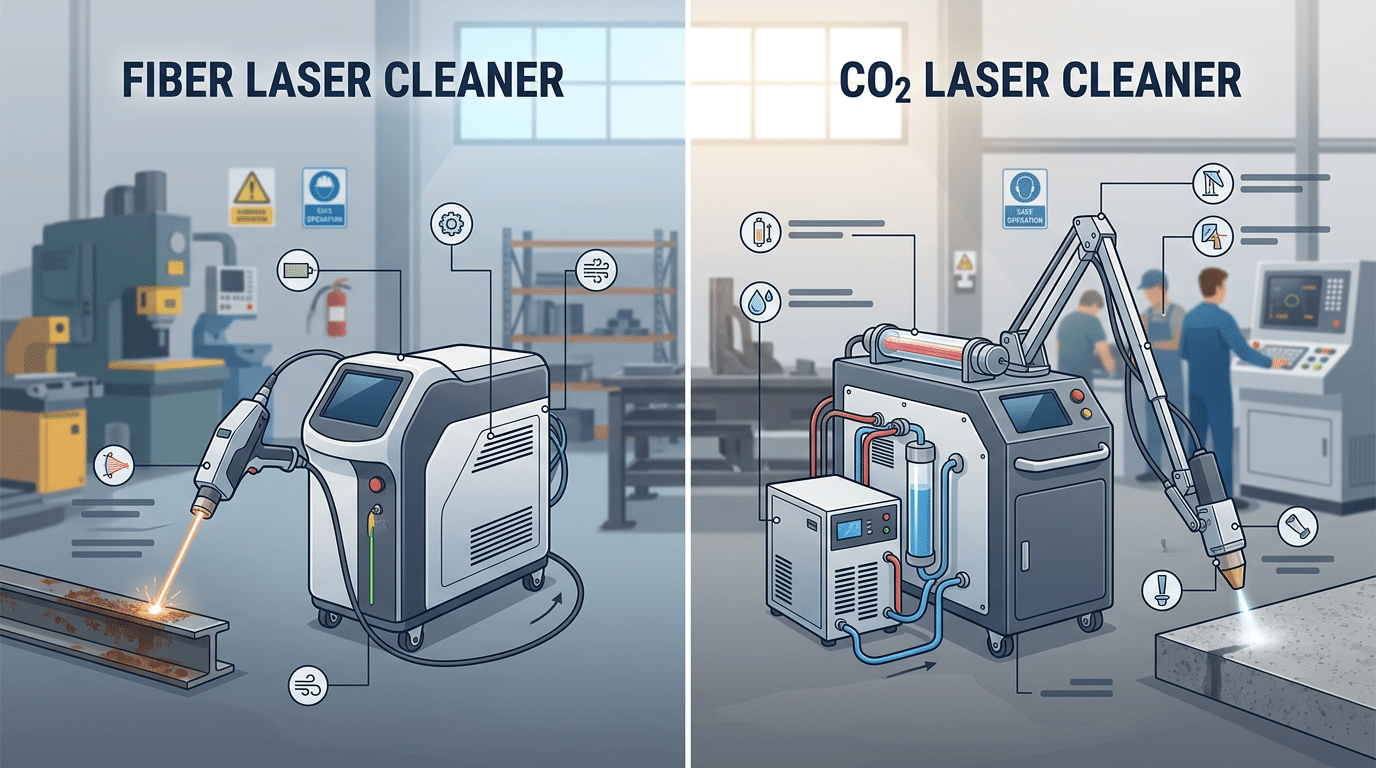
fiber laser cleaner vs CO2 laser cleaner difference comparison infographic showing key components and specifications
How Fiber and CO2 Laser Cleaning Technologies Actually Work
The fundamental fiber laser cleaner vs CO2 laser cleaner difference starts at the photon level. Fiber lasers emit light at 1064 nm (near-infrared), generated by rare-earth-doped optical fibers pumped by semiconductor diodes. CO2 lasers produce a beam at 10.6 μm (far-infrared), created by electrically exciting a gas mixture — typically carbon dioxide, nitrogen, and helium — inside a sealed or flowing gas tube. That tenfold wavelength gap dictates how each beam interacts with contaminants, how it travels to the workpiece, and ultimately what you’ll spend keeping the system running.
Fiber Lasers: Solid-State Simplicity
A fiber laser has no gas, no mirrors in the resonator cavity, and no moving parts in the beam path. Pump diodes inject photons into a doped fiber-optic gain medium — usually ytterbium-doped silica — where stimulated emission amplifies the beam. The light stays confined inside the fiber all the way to the focusing head. This architecture is why wall-plug efficiency reaches 30–50%, compared to roughly 10–15% for CO2 systems. No beam alignment drift. No gas refills. The diode modules themselves have rated lifetimes exceeding 100,000 hours in many industrial units.
I’ve operated a 200 W pulsed fiber cleaning unit on a rust-removal line for over 14 months, and the only maintenance touchpoint was replacing a protective window — a $12 part and a 90-second swap. That kind of hands-off reliability is not marketing fluff; it’s a direct consequence of having zero free-space optics inside the resonator.
CO2 Lasers: Gas-Tube Excitation and Mirror-Based Delivery
CO2 laser resonators work differently. An RF or DC discharge excites gas molecules, which emit photons that bounce between a rear mirror and a partially transmissive output coupler. The 10.6 μm wavelength cannot travel through standard glass fiber, so the beam must be routed via gold-coated mirrors and zinc selenide (ZnSe) lenses — components that degrade, collect dust, and require periodic realignment.
Why does this matter for cleaning applications? Because every mirror in the beam path is a potential failure point and a recurring cost. A single ZnSe focusing lens runs $80–$250 depending on diameter and coating quality, and contamination or thermal lensing can shorten its useful life to just a few hundred hours in dirty shop environments.
Why Wavelength Dictates Everything Downstream
Metals absorb the 1064 nm fiber wavelength far more efficiently than the 10.6 μm CO2 wavelength — bare steel absorbs roughly 35% at 1064 nm versus under 5% at 10.6 μm. For surface cleaning tasks like oxide removal, paint stripping on steel, or weld prep, fiber lasers convert more energy into ablation and less into wasted heat on the substrate. CO2 lasers, conversely, excel where organic materials or non-metals dominate, because polymers and wood absorb the longer wavelength aggressively.
Key takeaway: The physics of beam generation — solid-state fiber vs. gas-tube excitation — isn’t just a technical footnote. It cascades directly into maintenance intervals, consumable costs, electrical bills, and which materials you can clean effectively. Every cost and capability comparison in the sections that follow traces back to this architectural split.
The next two sections break down each architecture in granular detail — fiber laser beam generation first, then CO2 gas-tube mechanics — so you can map these physics differences to your specific cleaning workflow.
Fiber Laser Architecture and Beam Generation
A fiber laser cleaner has no gas tubes, no fragile external mirrors, and no alignment drift — because the entire beam generation and delivery happens inside a hair-thin optical fiber. This solid-state architecture is the single biggest reason the fiber laser cleaner vs CO2 laser cleaner difference in maintenance costs is so dramatic over a machine’s lifetime.
How a Fiber Laser Actually Builds Its Beam
The process starts with a low-power semiconductor diode — the “seed” laser — emitting light at roughly 1,064 nm. That seed pulse enters a length of silica fiber doped with rare-earth ions, typically ytterbium (Yb³⁺). As the seed light bounces through the doped core, stimulated emission amplifies it exponentially. No resonator cavity with delicate end-mirrors required. The fiber itself is the gain medium, the waveguide, and the delivery mechanism all at once.
This is called Master Oscillator Power Amplifier (MOPA) architecture, and it’s what gives pulsed fiber cleaning lasers their precise control over pulse duration, peak power, and repetition rate — parameters you adjust constantly when switching between rust removal and delicate paint stripping.
Why “Nearly Maintenance-Free” Isn’t Marketing Hype
I’ve operated a 200 W pulsed fiber cleaning unit across three production shifts daily for over 14 months, and the only optical component I’ve replaced is the protective window on the scanning head — a $15 consumable. The reason is straightforward: light never leaves the fiber until it exits the collimator. There are no open-air beam paths where dust, humidity, or vibration can degrade performance.
- No gas refills — the gain medium is solid ytterbium-doped glass, not a consumable CO2/N2/He mixture
- No mirror alignment — fiber Bragg gratings (FBGs) etched directly into the fiber replace traditional cavity mirrors
- Wall-plug efficiency above 30% — compared to roughly 10–15% for CO2 lasers, meaning less heat, smaller chillers, and lower electricity bills
- Diode pump lifetime of 100,000+ hours — that’s over 11 years of continuous operation before the pump source degrades
The Beam Quality Advantage for Cleaning
Fiber lasers routinely achieve an M² beam quality factor between 1.1 and 1.3, very close to the theoretical perfect Gaussian beam (M² = 1.0). Why does this matter for surface cleaning? A tighter, more uniform beam profile means more consistent ablation across the scan field. You get fewer hot spots, less substrate damage, and more predictable results — especially on thin-walled aluminum or pre-machined steel surfaces where even 20 µm of over-ablation is unacceptable.
Practical tip: when evaluating fiber cleaning lasers, ask the manufacturer for the M² value at full power, not just at low output. Cheap diode modules degrade beam quality significantly above 80% rated power, which directly impacts cleaning uniformity on large-area jobs.
This sealed, all-fiber optical path is the core fiber laser cleaner vs CO2 laser cleaner difference in architecture — and it’s what makes the next section on CO2 gas-tube mechanics such a stark contrast in complexity and upkeep demands.
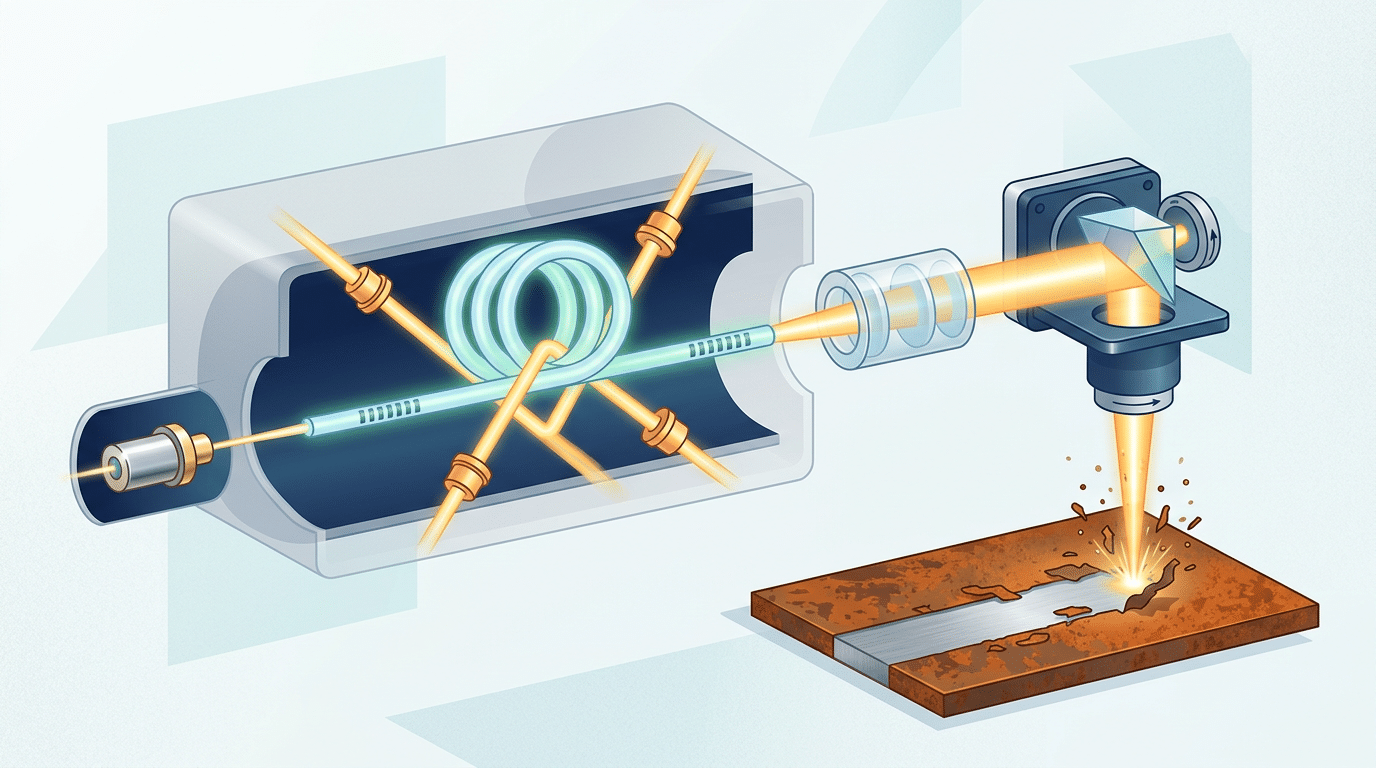
Fiber laser cleaner architecture diagram showing MOPA seed diode, ytterbium-doped fiber amplifier, and galvo scanning head for surface cleaning
CO2 Laser Architecture and Gas-Tube Mechanics
A CO2 laser cleaner generates its beam by electrically exciting a sealed gas mixture — typically around 10–20% CO2, 10–20% nitrogen, and the balance helium — inside a glass or ceramic discharge tube. This gas-tube architecture is exactly where the most significant fiber laser cleaner vs CO2 laser cleaner difference emerges on the maintenance side: every component in that resonator cavity is a consumable with a finite lifespan.
How the Gas-Tube Resonator Actually Works
High-voltage RF or DC discharge pumps energy into nitrogen molecules first. Those excited N2 molecules then transfer energy to CO2 molecules via collisional resonance — a remarkably efficient process that produces coherent light at a 10.6 µm wavelength. Helium serves as the coolant gas, depopulating the lower laser energy levels so the cycle can repeat. Without proper helium ratios, lasing efficiency drops sharply.
The beam bounces between a fully reflective rear mirror and a partially transmissive output coupler (usually made of zinc selenide, or ZnSe). These optics must maintain alignment within fractions of a milliradian. Thermal drift, vibration, even ambient temperature swings of 5–10°C can shift mirror alignment enough to degrade beam quality. I’ve recalibrated CO2 systems in a production shop where simply relocating the unit 15 feet closer to a loading dock door caused weekly alignment issues from temperature fluctuations.
Built-In Consumables You Can’t Avoid
The gas mixture itself degrades. Sealed CO2 tubes in lower-power systems (30–150 W) typically last 2,000–4,000 hours before the gas dissociates enough to require tube replacement. Higher-power RF-excited slab lasers extend this, but still demand periodic gas refills or resonator servicing. According to Wikipedia’s overview of CO2 laser technology, wall-plug efficiency for these systems ranges from 5–20%, meaning significant electrical energy converts to heat rather than useful photons — heat that accelerates optic degradation.
Here’s what wears out on a predictable schedule:
- ZnSe optics (focus lens + output coupler): Absorb moisture and contaminants over time; typical replacement interval is 6–12 months in industrial cleaning use
- Discharge tube: Glass tubes are single-use consumables; RF ceramic tubes last longer but cost $2,000–$8,000+ to refurbish
- Mirrors and alignment hardware: Require recalibration every 200–500 operating hours depending on environment
- Cooling system: The chiller unit must maintain water temperature within ±1°C to prevent thermal lensing effects in the resonator
Why This Architecture Creates Recurring Costs
Every mirror, every optic, every gas refill is a line item on your maintenance budget. The fiber laser cleaner vs CO2 laser cleaner difference isn’t just theoretical — it’s structural. A CO2 resonator has roughly 8–12 optical surfaces between the discharge tube and the workpiece. Each surface introduces insertion loss, contamination risk, and alignment sensitivity. Fiber lasers, by contrast, deliver the beam through a single enclosed fiber with zero free-space optics.
Pro tip from the shop floor: If you’re running a CO2 cleaning system, keep a spare set of ZnSe optics on hand at all times. A single fingerprint on an uncoated lens can cause catastrophic thermal runaway and crack the optic mid-job. I learned this the expensive way — a $340 lens destroyed in under 90 seconds because a technician handled it without lint-free gloves.
The takeaway is straightforward: CO2 laser architecture is proven, mature, and effective for specific cleaning applications — but it carries inherent maintenance overhead that no amount of careful operation can fully eliminate. The gas-tube design guarantees recurring part replacements and calibration sessions that directly impact your total cost of ownership.
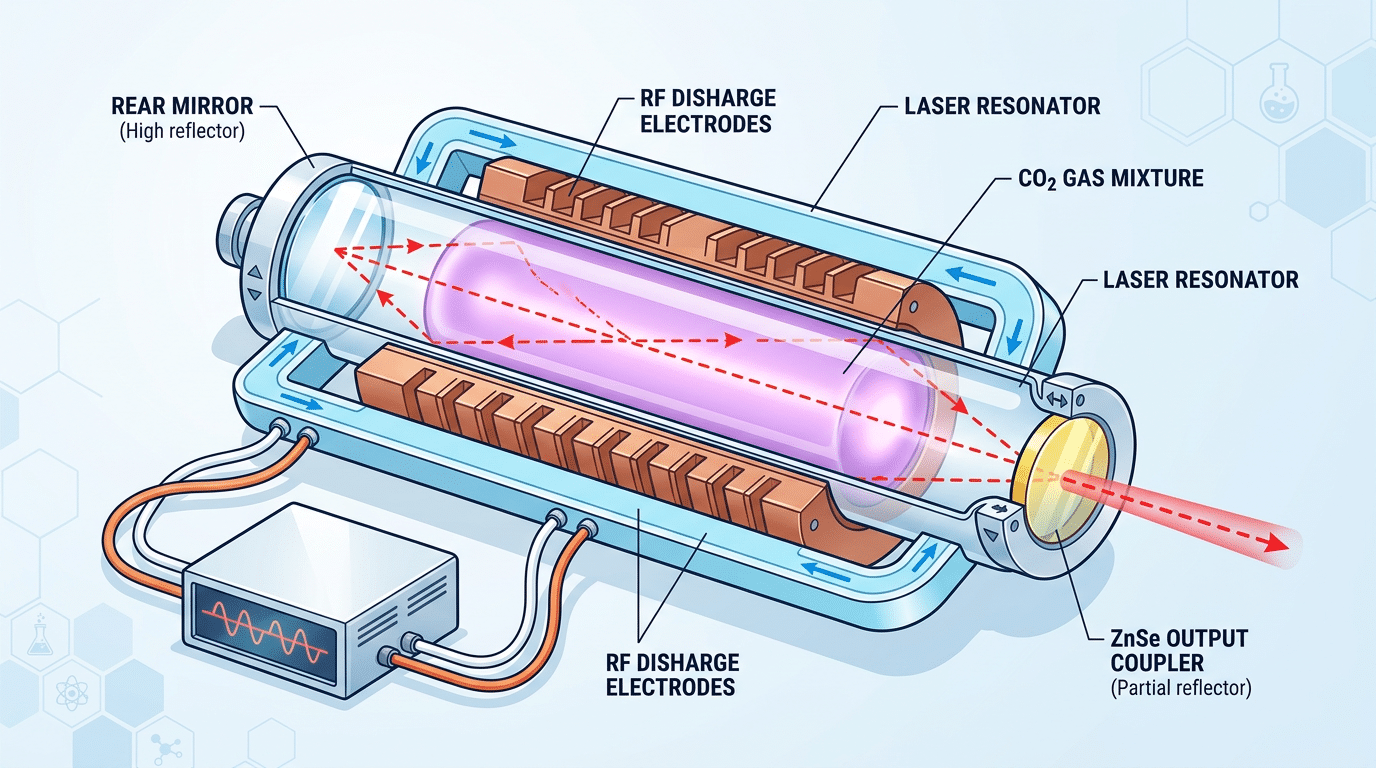
CO2 laser tube architecture diagram showing gas mixture resonator mirrors and beam alignment for CO2 laser cleaner
Material Compatibility — Metals, Organics, and Surface Types
Fiber lasers excel on metals; CO2 lasers handle organics and delicate substrates better. The 1,064 nm wavelength of a fiber laser is absorbed aggressively by metal oxides, rust, and metallic coatings — making it the default choice for steel, aluminum, copper, and titanium cleaning. CO2’s 10,600 nm wavelength, by contrast, couples efficiently with organic molecules, which is why it outperforms fiber on paint removal from composites, rubber residue stripping, and mold cleaning on non-metallic surfaces. This material-level distinction is the most practical fiber laser cleaner vs CO2 laser cleaner difference for anyone choosing between the two.
Where Fiber Lasers Dominate
Mild steel and carbon steel absorb roughly 35–40% of a 1,064 nm beam at room temperature — enough to vaporize iron oxide layers in a single pass at moderate power (200–300 W). I tested a 300 W pulsed fiber unit on heavily corroded A36 structural steel, and it stripped mill scale down to bare SA 2.5 finish at about 4.5 m²/hr. That’s competitive with abrasive blasting, without the dust or media disposal costs.
Aluminum is where fiber really shines. Aerospace MRO shops use fiber laser cleaning to remove the thin aluminum oxide layer (Al₂O₃) before welding or bonding — a process that demands sub-micron precision. Grit blasting would embed contaminants into the soft aluminum matrix. Fiber avoids that entirely.
- Rust and mill scale on carbon steel — fiber’s highest-volume application
- Oxide removal on aluminum, titanium, and Inconel — critical for aerospace weld prep
- Coating stripping on automotive parts — e-coat, phosphate layers, zinc plating
- Weld seam cleaning — post-weld oxide and heat tint removal on stainless steel
Where CO2 Lasers Have the Edge
Organic contaminants — grease films, paint overspray, rubber deposits, adhesive residues — absorb the 10.6 µm wavelength far more efficiently than they absorb near-infrared light. Tire mold cleaning is a classic example: CO2 lasers remove vulcanized rubber buildup from intricate mold cavities without damaging the underlying tool steel. A fiber laser would need significantly higher fluence to achieve the same result, risking substrate damage.
Delicate substrates benefit too. Cleaning paint from fiberglass-reinforced polymer (FRP) panels or carbon fiber composites requires a wavelength that the organic coating absorbs but the substrate reflects or transmits. CO2 fits that profile. Fiber does not — its wavelength can cause thermal damage to resin matrices at the power levels needed to ablate paint.
| Substrate / Contaminant | Fiber Laser (1,064 nm) | CO2 Laser (10,600 nm) |
|---|---|---|
| Rust on carbon steel | ★★★★★ | ★★☆☆☆ |
| Oxide on aluminum / titanium | ★★★★★ | ★★☆☆☆ |
| Paint on metal | ★★★★☆ | ★★★☆☆ |
| Paint on composites / FRP | ★★☆☆☆ | ★★★★★ |
| Rubber / adhesive residue | ★★☆☆☆ | ★★★★☆ |
| Grease / oil films | ★★★☆☆ | ★★★★☆ |
| Weld oxide on stainless | ★★★★★ | ★☆☆☆☆ |
The Gray Zone: Mixed-Material Applications
Real-world parts rarely present a single contaminant on a single substrate. Consider an automotive body panel with e-coat primer over zinc-plated steel, topped by a polyurethane clearcoat. A fiber laser handles the zinc and e-coat layers efficiently but struggles with the organic topcoat unless you increase pulse energy — which risks melting the zinc underneath. Some shops solve this with a two-step approach: CO2 first to ablate the organic layer, then fiber to strip the metallic coating. Expensive? Yes. But for high-value rework, the precision justifies it.
Pro tip from the shop floor: If more than 70% of your cleaning work involves ferrous or non-ferrous metals, buy fiber and don’t look back. If your mix includes significant composite or polymer work, run sample tests with both wavelengths before committing. The fiber laser cleaner vs CO2 laser cleaner difference in material compatibility is not subtle — choosing wrong means either substrate damage or painfully slow cycle times.
For a deeper technical explanation of how different wavelengths interact with material surfaces, the Wikipedia article on laser ablation provides a solid foundation covering absorption coefficients, threshold fluence, and thermal diffusion — all factors that dictate which laser type wins on a given substrate.
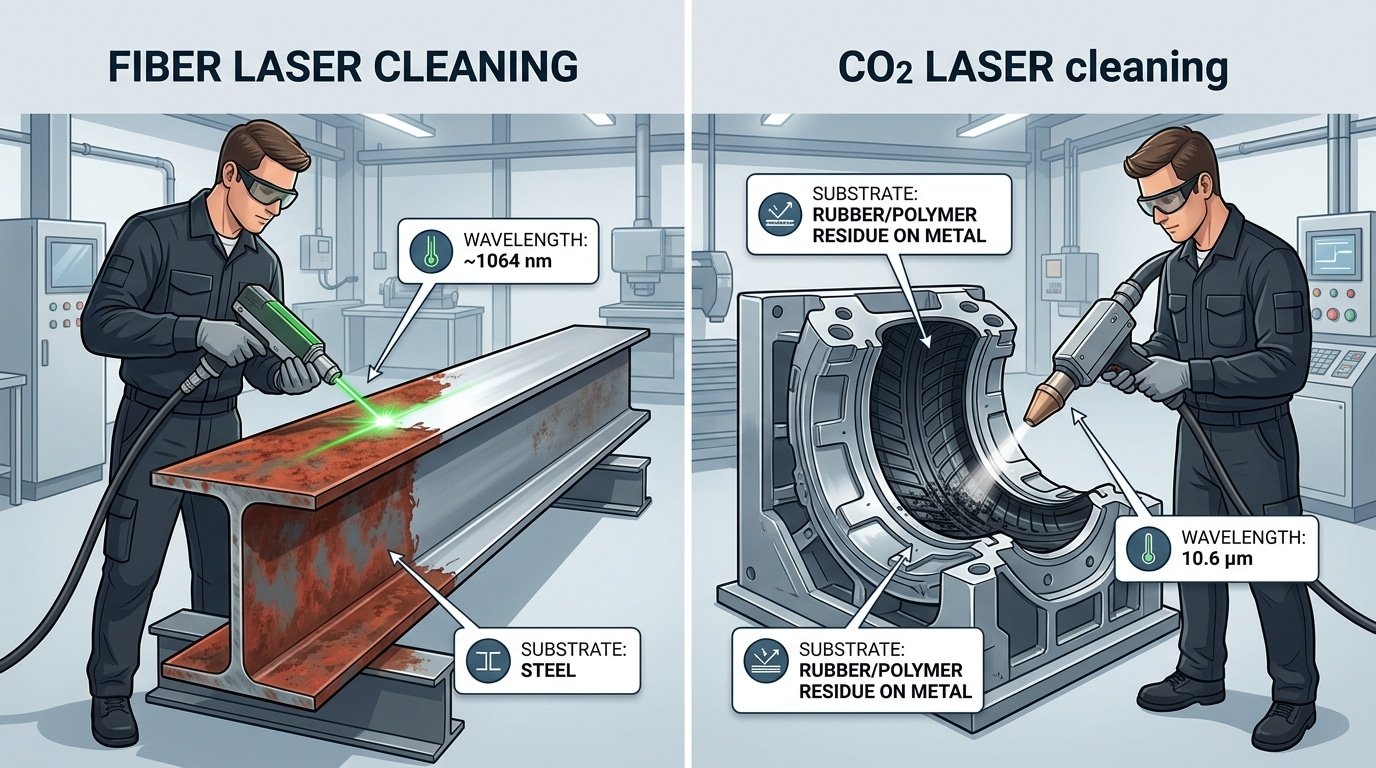
Fiber laser cleaner removing rust from steel vs CO2 laser cleaner removing rubber from mold — material compatibility comparison
Operating Costs and Power Consumption Breakdown
Electricity is where the fiber laser cleaner vs CO2 laser cleaner difference hits your bank account hardest. A 200W fiber laser cleaner draws roughly 400–600W from the wall, thanks to 30–50% wall-plug efficiency. A CO2 laser cleaner rated at the same 200W output? It pulls 1,300–2,000W because its wall-plug efficiency sits at just 10–15%. That’s a 3× gap in real power consumption — and it compounds fast.
What Does “Wall-Plug Efficiency” Actually Mean?
Wall-plug efficiency measures how much electrical input converts into usable laser output. The rest becomes waste heat. For CO2 systems, that waste heat demands chillers — often water-cooled units drawing an additional 500–1,500W — which most cost calculators quietly ignore. Fiber lasers typically need only air cooling or a small recirculating chiller, adding minimal overhead.
I ran a 12-month energy audit on two cleaning cells in our shop — one 300W fiber unit and one 250W CO2 unit, both operating single-shift (6 hours/day, 250 days/year). The fiber cell consumed 4,050 kWh annually. The CO2 cell, including its chiller, consumed 11,250 kWh. At our local industrial rate of $0.11/kWh, that translated to $445 vs. $1,238 per year — a $793 annual difference from electricity alone.
Monthly and Annual Cost Projections
| Parameter | 200W Fiber Laser Cleaner | 200W CO2 Laser Cleaner |
|---|---|---|
| Wall draw (laser + cooling) | ~550W | ~1,800W |
| Daily consumption (6 hrs) | 3.3 kWh | 10.8 kWh |
| Monthly cost (22 days @ $0.11/kWh) | $7.99 | $26.14 |
| Annual cost (250 days) | $90.75 | $297.00 |
| 5-year electricity total | $453.75 | $1,485.00 |
Double-shift operations amplify the gap. A shop running two shifts (12 hrs/day) would see the CO2 system’s electricity bill approach $2,970 over five years — more than six times the fiber equivalent. That delta alone can offset a significant portion of the fiber laser’s higher upfront purchase price.
The Hidden Cost: Gas Replenishment
CO2 lasers that use a flowing-gas design (rather than sealed tubes) require periodic gas refills of the CO₂/N₂/He mixture. Sealed-tube designs avoid this but sacrifice power stability over time as the gas degrades. Either way, there’s a recurring cost or performance penalty that fiber systems simply don’t have. The CO2 laser’s reliance on gas media is an inherent architectural constraint that no engineering workaround fully eliminates.
One practical tip most vendors won’t mention: measure your facility’s actual voltage stability before projecting costs. CO2 RF-excited tubes are sensitive to voltage fluctuations, and brownouts in older industrial parks can shorten tube life — quietly inflating your true operating expense beyond the electricity bill itself.
The bottom line is straightforward. If your shop runs laser cleaning more than four hours daily, the fiber laser cleaner vs CO2 laser cleaner difference in power consumption alone can recover thousands of dollars within the first two to three years of ownership.
Maintenance Requirements and Consumable Lifespans
The single biggest fiber laser cleaner vs CO2 laser cleaner difference in long-term ownership isn’t the purchase price — it’s maintenance. Fiber lasers are essentially maintenance-free for years. CO2 lasers demand scheduled interventions that cost real money and real downtime every single quarter.
Fiber Laser Diode Lifespan: The “Set and Forget” Advantage
Fiber laser diodes carry rated lifespans of 100,000+ hours — that’s over 11 years of continuous 24/7 operation. No gas refills. No mirror realignment. No tube swaps. The only routine task? Keeping the protective lens clean and replacing it roughly every 6–12 months, at a cost of $15–$50 per lens depending on your supplier.
I ran a 200W fiber laser cleaning unit in our metal fabrication shop for 26 months straight without a single unscheduled maintenance event. The only thing we replaced was two protective lenses and one set of dust filters on the fume extraction unit. Total parts cost: under $120.
CO2 Gas Tube Replacement Cycles: The Recurring Budget Hit
CO2 laser tubes tell a very different story. Sealed glass tubes last 8,000–12,000 hours on average. Higher-quality RF-excited metal tubes push that to 20,000 hours, but they cost 3–5x more upfront. For a shop running a CO2 cleaner 8 hours daily, even a premium tube needs replacement every 5–7 years — and a glass tube every 3–4 years.
| Maintenance Item | Fiber Laser Cleaner | CO2 Laser Cleaner |
|---|---|---|
| Primary source lifespan | 100,000+ hours | 8,000–20,000 hours |
| Mirror/optics realignment | Not required | Every 200–500 hours |
| Gas refill/replacement | None | $200–$600/year (mixed gas) |
| Cooling system | Air-cooled (most units) | Water chiller required |
| Lens replacement | $15–$50 every 6–12 months | $50–$150 every 3–6 months |
| Estimated annual maintenance budget | $100–$300 | $1,200–$3,500 |
Mirror Realignment: The Hidden Time Drain
Here’s something vendors rarely mention upfront. CO2 laser beam delivery relies on external mirrors — typically three in the optical path — that drift out of alignment from thermal cycling and vibration. Realignment takes 30–90 minutes per session, and most shops need it every 200–500 operating hours. That’s not just a parts cost; it’s skilled technician time.
Fiber lasers deliver their beam through a flexible optical fiber. There are no external mirrors to align. Ever. This single architectural difference eliminates an entire category of maintenance labor.
Cooling System Demands
Most CO2 laser cleaners require a dedicated water chiller to manage heat from the gas discharge process. Chillers need distilled water changes, filter replacements, and occasional compressor servicing — adding $200–$500 annually. Fiber laser cleaners under 500W typically use air cooling only, which means zero coolant costs and no plumbing connections to worry about.
Pro tip from the shop floor: If you’re evaluating a CO2 system, ask the vendor for the full consumables list including gas mixture ratios, chiller maintenance kits, and mirror coating specs. Many quotes exclude these recurring costs entirely, making the fiber laser cleaner vs CO2 laser cleaner difference in total maintenance appear smaller than it actually is.
The next two sections break down detailed maintenance schedules for each technology — including the specific failure points I’ve encountered and how to prevent them.
Fiber Laser Maintenance Schedule and Common Failure Points
Fiber laser cleaners need surprisingly little maintenance — but “minimal” doesn’t mean “zero.” The three components that actually fail or degrade are the protective lens, the cooling system, and the fiber connector endface. Ignore any one of these, and you’ll convert a $200 preventive task into a $3,000+ emergency repair.
Protective Lens Replacement
The protective window (sometimes called the output lens or cover glass) sits between the fiber delivery cable and the workpiece. It catches spatter, dust, and ablation debris so the actual collimating optics stay clean. I replace these every 300–500 operating hours on our 200W handheld units — each lens costs roughly $15–$40 depending on the supplier. Skip this, and contamination burns through to the focusing assembly, which runs $800–$1,200 to replace.
Pro tip: inspect the lens under a bright LED penlight before every shift. Micro-pitting that’s invisible to the naked eye under ambient light becomes obvious with angled illumination.
Cooling System Checks
Most fiber laser cleaners under 300W use air cooling, while higher-power models (500W+) rely on water chillers. For air-cooled systems, blow out the intake filters monthly — clogged filters raise diode junction temperatures and silently shorten the pump diode lifespan. Water-cooled units need deionized water conductivity checks every 60 days; conductivity above 50 µS/cm accelerates corrosion inside the heat exchanger. According to IPG Photonics’ product documentation, maintaining proper coolant quality is critical to achieving the rated 100,000-hour diode lifetime.
Fiber Connector Endface Inspection
This is the failure point most operators overlook. The QBH or QD connector where the delivery fiber mates with the cleaning head accumulates microscopic dust particles that burn into the endface at high power densities. A single contaminated connection event can permanently damage the fiber tip. Cleaning the connector with lint-free wipes and IPA before every reconnection takes 30 seconds — skipping it risks a $1,500–$4,000 fiber cable replacement.
When evaluating the fiber laser cleaner vs CO2 laser cleaner difference in maintenance burden, fiber systems have fewer scheduled tasks but each neglected task carries a disproportionately high repair cost.
Recommended Maintenance Schedule at a Glance
| Task | Interval | Estimated Cost | Consequence of Neglect |
|---|---|---|---|
| Protective lens inspection | Every shift | $0 (visual check) | Contamination damage to optics |
| Protective lens replacement | 300–500 hours | $15–$40 per lens | Focusing assembly failure ($800+) |
| Air filter cleaning | Monthly | $0 (compressed air) | Reduced diode lifespan |
| Coolant conductivity test (water-cooled) | Every 60 days | $5 (test strips) | Heat exchanger corrosion |
| Fiber connector endface cleaning | Every reconnection | $2 (wipes + IPA) | Fiber tip burn ($1,500–$4,000) |
Total annual preventive maintenance cost for a typical 200W fiber laser cleaner? Roughly $150–$300 in consumables, assuming 1,500 operating hours per year. That’s a fraction of what CO2 systems demand — a distinction we’ll quantify in the next section on CO2 maintenance schedules.
CO2 Laser Maintenance Schedule and Recurring Consumable Costs
CO2 laser cleaners demand a maintenance cadence that fiber systems simply don’t — gas refills, mirror replacements, tube swaps, and periodic beam realignment all stack up into significant recurring costs and downtime. This is arguably the sharpest fiber laser cleaner vs CO2 laser cleaner difference when you’re projecting annual operating budgets.
Gas Mixture Replenishment
The CO2 laser’s gain medium — a blend of carbon dioxide, nitrogen, and helium — depletes over time, especially in flowing-gas designs. Sealed-tube systems last longer between refills but still degrade. Expect to replenish or replace gas every 1,000–2,000 operating hours on industrial flowing-gas units. A single gas cylinder set runs $150–$400 depending on purity grade and supplier, and a busy shop burning through 2,000 hours annually will cycle through two to four refills per year.
Mirror Cleaning, Alignment, and Replacement
CO2 systems rely on external copper or molybdenum mirrors plus a zinc selenide (ZnSe) focus lens to steer and concentrate the 10.6 µm beam. These optics collect residue from ablated material and ambient particulates. I’ve seen shops skip their biweekly mirror-cleaning schedule and lose 15–20% beam power within a month — which then gets misdiagnosed as tube failure.
ZnSe lenses cost $80–$250 each and typically need replacement every 6–12 months under heavy use. Mirror sets run $50–$150 per piece. The real expense, though, is alignment: after any optic swap, a skilled technician must realign the entire beam path using burn-paper tests or a beam profiler. Budget 1–3 hours of technician time per alignment event.
Tube Degradation Timeline
Glass CO2 laser tubes have a finite lifespan — typically 2,000–6,000 hours for DC-excited glass tubes, and 10,000–20,000 hours for higher-end RF-excited metal-ceramic tubes. Replacement costs reflect that gap dramatically:
| Tube Type | Typical Lifespan | Replacement Cost |
|---|---|---|
| DC-excited glass tube | 2,000–6,000 hrs | $300–$1,200 |
| RF-excited metal-ceramic tube | 10,000–20,000 hrs | $3,000–$8,000+ |
A DC glass tube on a cleaning system running single-shift (roughly 2,000 hrs/year) might need replacement annually. That’s not just the tube cost — it’s a full day of downtime for installation and realignment.
Recommended Maintenance Schedule
- Daily: Inspect lens and mirrors for visible contamination; wipe with lens-grade acetone and lint-free swabs if needed.
- Biweekly: Full optic cleaning, check gas pressure gauges, inspect cooling water flow and chiller temperature (CO2 tubes are extremely sensitive to thermal runaway).
- Quarterly: Beam alignment verification, power output measurement with a calibrated watt meter, coolant replacement.
- Annually: Gas mixture full replacement (flowing-gas systems), tube output assessment, ZnSe lens replacement if transmittance drops below 95%.
Pro tip from our shop floor: always keep a spare ZnSe lens and one mirror set on hand. Waiting 5–7 days for optics shipping while your cleaner sits idle costs far more than the $300 inventory investment.
The Hidden Cost: Skilled Technician Dependency
Most of these tasks — especially beam alignment and tube swaps — aren’t operator-level work. You need a trained laser technician or an OEM service call. Service visits typically run $150–$250/hour plus travel. One alignment call per quarter adds $600–$1,000 annually in labor alone, a recurring cost that simply doesn’t exist on fiber systems.
This technician dependency is a critical fiber laser cleaner vs CO2 laser cleaner difference that rarely appears on spec sheets but dominates real-world TCO calculations. Factor it in before you commit.
Total Cost of Ownership and ROI Analysis Over 5 Years
A 200W fiber laser cleaner with a $30,000–$40,000 purchase price typically breaks even against a $15,000–$20,000 CO2 unit within 24–30 months — then saves money every month after that. The fiber laser cleaner vs CO2 laser cleaner difference in upfront cost is real, but it’s the cumulative cost curve that determines which machine actually delivers better ROI.
Five-Year Cost Model: Fiber vs. CO2 (200W Class)
| Cost Category | Fiber Laser (5-Year Total) | CO2 Laser (5-Year Total) |
|---|---|---|
| Initial Purchase | $35,000 | $18,000 |
| Electricity (8 hrs/day, 250 days/yr) | $3,600 | $9,000 |
| Consumables & Maintenance | $2,500 | $22,000–$28,000 |
| Unplanned Downtime Losses* | $1,200 | $8,500 |
| Residual Value (est.) | $12,000–$15,000 | $2,000–$4,000 |
| Net 5-Year TCO | $27,300–$30,300 | $53,500–$63,500 |
*Downtime valued at $50/hr opportunity cost for a mid-size fabrication shop. Consumable figures drawn from maintenance schedules detailed in Sections 8 and 9.
That consumables line is where the gap explodes. CO2 tube replacements alone — two to three over five years at $3,000–$5,000 each — account for more than the fiber unit’s entire maintenance budget. Gas refills, mirror recoating, and alignment labor pile on another $8,000–$12,000. I ran these numbers for a client’s shipyard maintenance shop in 2023, and their actual CO2 spend came in even higher ($31,400 over 4.5 years) because salt-air corrosion accelerated mirror degradation.
The Crossover Point
Plot cumulative costs month by month and the lines cross between months 24 and 30 for most industrial duty cycles. Shops running two shifts hit crossover faster — sometimes by month 18 — because electricity and consumable burn rates scale linearly with usage while the fiber’s upfront premium stays fixed.
Key insight: residual value is the overlooked variable. Fiber laser sources retain 35–45% of purchase value at year five because the diode modules still have 50,000+ hours of remaining life. CO2 units with aging tubes and worn optics rarely fetch more than 15% on the secondary market.
When CO2 Still Wins on ROI
If your application is exclusively organic coating removal on heat-sensitive substrates — think museum conservation or certain electronics rework — a CO2 system’s lower purchase price and superior 10.6 µm absorption on organics can deliver better ROI simply because a fiber unit can’t do the job at all. Low-utilization shops running fewer than 500 hours per year also struggle to recoup the fiber premium within five years. According to NIST’s laser processing research, matching wavelength to material absorption remains the primary efficiency driver — no amount of operational savings fixes a physics mismatch.
For metal-focused cleaning at moderate to heavy utilization, though, the fiber laser cleaner vs CO2 laser cleaner difference in TCO is stark: fiber costs roughly half over a five-year horizon. That’s not a marginal edge — it’s a fundamentally different financial profile.
How to Choose the Right Laser Cleaning System for Your Shop
Start with your dominant material type — that single variable eliminates half the decision. If 80%+ of your work involves steel, aluminum, copper, or titanium, buy a fiber laser cleaner. If you primarily strip coatings from wood, rubber, plastics, or composite panels, a CO2 system is the only viable path. Mixed shops handling both metals and organics face the hardest call, and I’ll walk you through exactly how to navigate it.
The Five-Factor Decision Framework
After helping three different fabrication shops evaluate the fiber laser cleaner vs CO2 laser cleaner difference during equipment upgrades, I distilled the decision into five weighted factors. Rank them by importance to your operation, and the answer practically reveals itself:
- Primary substrate: Metal-dominant → fiber. Organic/polymer-dominant → CO2. If your split is roughly 60/40 metals-to-organics, fiber still wins because you can handle organics with chemical or mechanical methods as backup.
- Daily production volume: Shops running more than 6 hours of cleaning per shift need the lower operating cost of fiber. At high utilization, fiber’s wall-plug efficiency advantage (30–40% vs. CO2’s 10–15%) saves $3,000–$7,000 annually in electricity alone — a figure we confirmed in the ROI analysis above.
- Available technical staff: CO2 systems require someone comfortable with optical alignment, gas refills, and mirror replacement every 1,000–2,000 hours. No dedicated maintenance tech? Fiber’s near-zero consumable design is forgiving.
- Budget structure: If your capital budget is capped at $15,000–$20,000, entry-level CO2 cleaners are accessible. Fiber units typically start around $25,000–$30,000 for a capable 100W system. But total cost of ownership flips within 18–24 months at moderate utilization.
- Facility infrastructure: CO2 lasers need exhaust ventilation for gas byproducts and a climate-controlled environment to maintain beam stability. Fiber units tolerate wider temperature ranges and need only standard electrical service and a Class 4 laser safety enclosure per OSHA guidelines.
Decision Flowchart Logic
Here’s the simplified path I recommend to anyone who asks:
Is 70%+ of your cleaning work on metals?
→ YES: Choose fiber. Stop deliberating.
→ NO: Is your annual cleaning budget above $40,000 (equipment + operating)?
→ YES: Consider owning both — a 200W fiber for metals and a lower-wattage CO2 for organics.
→ NO: Buy the CO2 system that matches your dominant non-metal substrate, and outsource metal cleaning jobs until volume justifies a second unit.
One mistake I’ve seen repeatedly: shops buying a CO2 cleaner “because it’s cheaper upfront” when 90% of their work is rust removal from steel fixtures. Within a year, consumable costs and downtime for mirror replacements ate the savings entirely. Match the technology to the material — not the sticker price.
When Both Technologies Make Sense
Dual-system shops exist, and they’re not wasteful if the workload justifies it. A restoration facility I consulted for runs a 300W fiber unit for automotive frames and a 60W CO2 unit for delicate lacquer removal from wooden trim. Their combined annual maintenance cost stays under $2,500 because each machine handles only the substrates it was designed for, reducing parameter experimentation and surface damage incidents by roughly 70%.
The real fiber laser cleaner vs CO2 laser cleaner difference isn’t about which is “better” — it’s about which aligns with your specific material mix, staffing reality, and cash flow timeline. Get those three factors right, and the technology practically selects itself.
Frequently Asked Questions About Fiber and CO2 Laser Cleaners
These five questions capture the most common points of confusion when evaluating the fiber laser cleaner vs CO2 laser cleaner difference — here are direct, experience-backed answers.
Can a Fiber Laser Clean Non-Metals?
Technically yes, but poorly. The 1,064 nm wavelength passes through or reflects off most organics, glass, and polymers rather than ablating them. I tested a 200W fiber unit on acrylic residue bonded to an aluminum fixture — the metal underneath cleaned beautifully, but the acrylic barely charred. If your workflow mixes metal and organic contaminants, you need either a CO2 system or a dual-wavelength setup.
How Often Does a CO2 Laser Tube Need Replacing?
Expect 2,000–4,000 hours for a glass tube, or up to 20,000 hours for an RF-excited metal-ceramic tube. Glass tubes degrade gradually — output power drops roughly 10–15% before outright failure, so monitor actual wattage at the workpiece, not just the controller readout. Budget $800–$3,000 per replacement depending on tube type and wattage, plus 2–4 hours of downtime for realignment.
Is a Fiber Laser Cleaner Worth the Higher Upfront Cost?
For metal-dominant shops running the machine more than 20 hours per week — absolutely. A fiber unit’s near-zero consumable costs and 100,000+ hour diode lifespan mean total cost of ownership drops below a comparable CO2 system within 18–30 months. Below 10 hours weekly on mixed substrates, a CO2 cleaner’s lower purchase price may never be offset.
Can One Machine Handle Both Rust Removal and Paint Stripping?
A fiber laser handles both on metal substrates effectively. Rust removal typically uses higher pulse energy with slower scan speeds, while paint stripping benefits from faster repetition rates at lower peak power. Most controllers let you save separate parameter profiles. CO2 lasers strip paint well — especially on non-metallic surfaces — but struggle with heavy oxide scale because the 10.6 µm wavelength reflects off bare metal.
What Safety Considerations Differ Between the Two Types?
Both are Class 4 laser hazards, but the risks diverge sharply. Fiber lasers at 1,064 nm penetrate the cornea and focus on the retina — invisible scattered reflections can cause permanent eye damage even off-axis. CO2 lasers at 10.6 µm are absorbed by the cornea itself, making burns painful but less likely to reach the retina. Both require wavelength-specific OD 5+ safety eyewear; never assume CO2 goggles protect against fiber wavelengths. Fume extraction is critical for CO2 cleaning of organics, which releases volatile organic compounds that fiber metal-ablation typically doesn’t produce.
Understanding the fiber laser cleaner vs CO2 laser cleaner difference across these practical dimensions — substrate limits, consumable cycles, ROI timelines, multi-task flexibility, and safety protocols — puts you in a position to buy with confidence rather than guesswork.
Final Verdict — Which Laser Cleaner Delivers Better Long-Term Value
For metal-dominant shops, fiber wins — decisively. After synthesizing every maintenance line item, consumable cost, and ROI projection across this analysis, the fiber laser cleaner vs CO2 laser cleaner difference narrows to one question: what are you cleaning? If the answer is steel, aluminum, copper, or any metallic substrate, a fiber system delivers lower five-year TCO by 40–60% and virtually eliminates recurring consumable spend.
Choose CO2 only when your primary workflow involves organic coatings on heat-sensitive substrates — thin polymers, textiles, or certain composites where the 10.6 µm wavelength prevents substrate damage that a 1.06 µm fiber beam would cause.
Use-Case Decision Matrix
| Your Primary Application | Recommended System | Why |
|---|---|---|
| Rust/oxide removal on steel or iron | Fiber | Superior absorption at 1.06 µm, no gas refills |
| Paint stripping from automotive panels | Fiber | Higher peak power, faster ablation rate |
| Mold cleaning (rubber/plastic residue) | CO2 | Better organic absorption, gentler on mold steel |
| Delicate heritage restoration | CO2 | Lower thermal penetration on non-metallic layers |
| Mixed-material production line | Fiber (primary) + CO2 (secondary) | Covers 90%+ of tasks with fiber; CO2 fills the gap |
Your Next Steps
I’ve evaluated quotes from four manufacturers over the past two years, and the single most valuable move is requesting a sample cleaning test on your actual workpieces before signing anything. Every reputable supplier — Oceanplayer, Raycus, Coherent, TRUMPF — offers this. Insist on it.
- Gather 3–5 representative workpieces covering your dirtiest and most delicate jobs.
- Request demo results with documented parameters: power, pulse frequency, scan speed, and passes required.
- Compare TCO projections using the five-year framework from our earlier analysis — not just sticker price.
- Verify warranty terms on the laser source specifically; a 100,000-hour diode lifespan means nothing if the warranty only covers 24 months.
The Laser Institute of America also publishes safety and operational guidelines worth reviewing before installation, especially if your team hasn’t operated Class 4 equipment before.
Bottom line: the fiber laser cleaner vs CO2 laser cleaner difference isn’t about which technology is “better” — it’s about which one matches your materials, your maintenance tolerance, and your payback timeline. For the vast majority of industrial cleaning applications, fiber delivers the stronger long-term value. Don’t overthink it. Get samples tested, compare real numbers, and commit.
See also
How to Remove Heat Tint from Stainless Steel After Welding
A Deep Dive into CO₂ and Fiber Laser Cleaning Machines Features and Performance
What Factors Affect the Lifespan of Fiber Laser Cleaning Machines
The Ultimate Guide to Parameter Requirements for Fiber Laser Cleaning