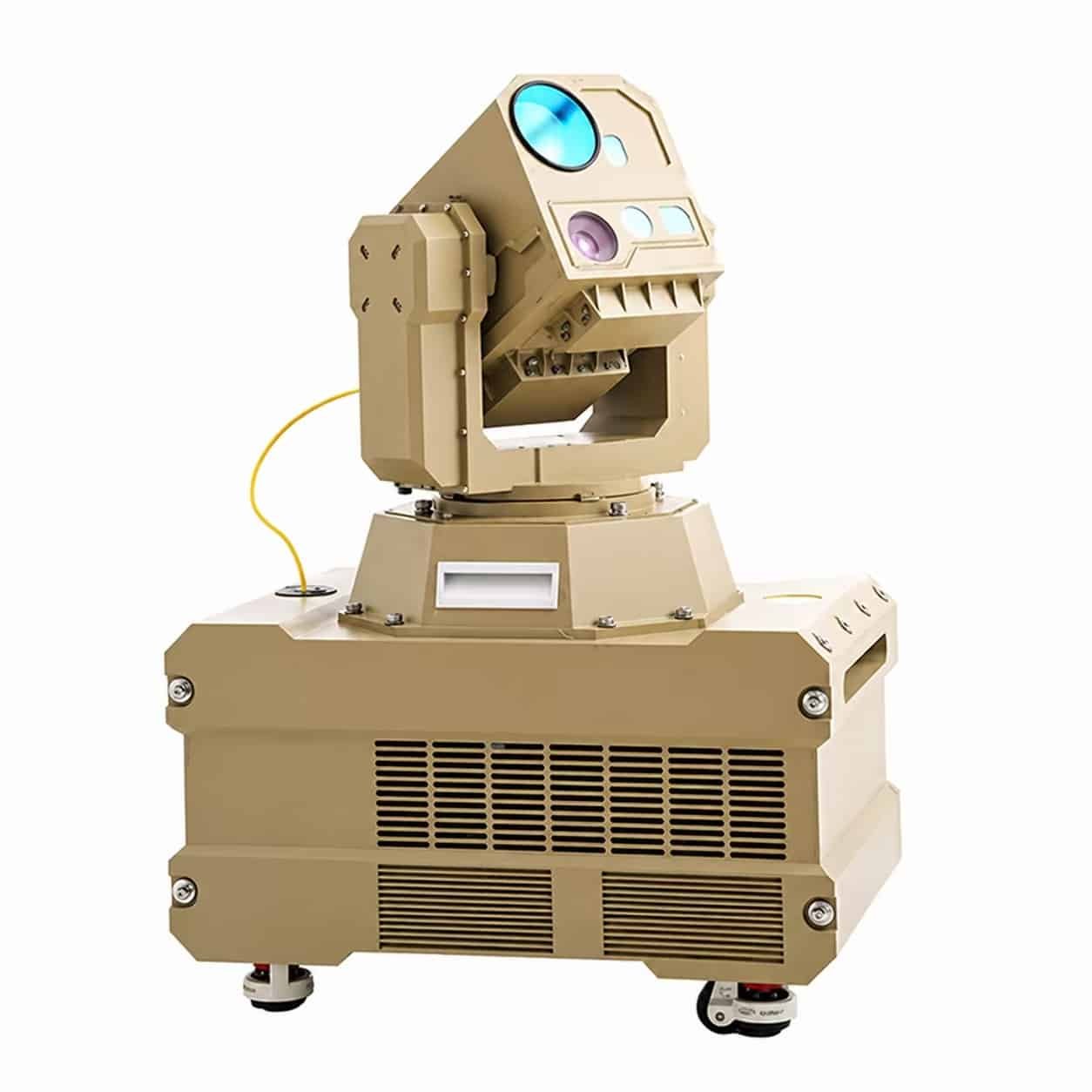
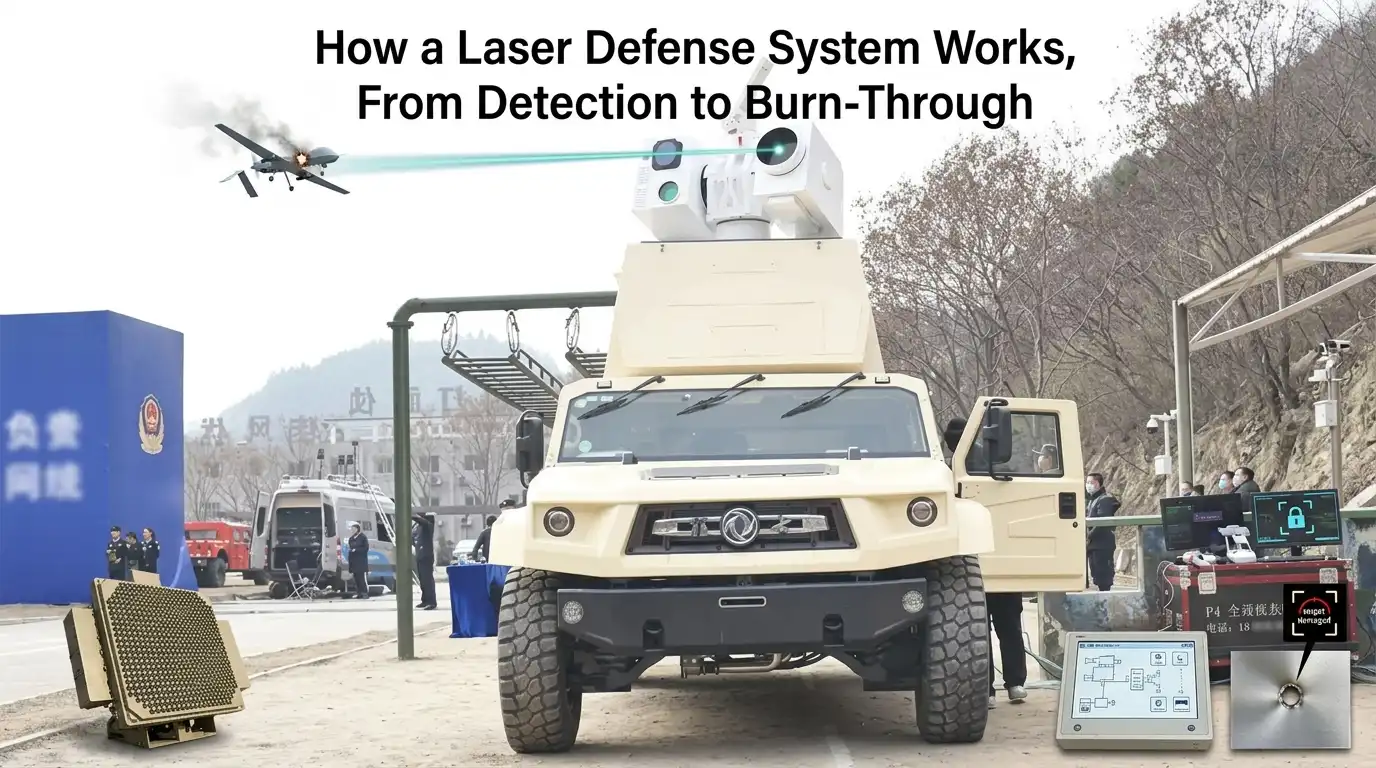
A 50-kilowatt fiber laser can burn through a Group 2 drone’s airframe in under four seconds at 3 km range, and the marginal cost per shot is roughly $1 to $13 of electricity, according to CRS Report R46925. So how does a laser defense system work? It chains together radar detection, optical tracking, adaptive beam steering, and sustained thermal dwell on a single aimpoint until the target’s structure, sensor, or warhead fails — a sequence that typically unfolds in 2 to 15 seconds per engagement.
What a Laser Defense System Actually Does in 30 Seconds
A laser defense system spots an incoming threat on radar, hands it off to an electro-optical tracker, slews a mirror assembly to put crosshairs on a single weak point (fuse, fin, warhead seam), and then holds a focused high-energy beam on that exact spot for 2–6 seconds until the metal softens, the fuel cooks off, or the airframe tears itself apart from aerodynamic stress. That is the whole loop — detect, track, aim, dwell, destroy.
Kinetic interceptors like the Iron Dome Tamir or a Patriot PAC-3 blow a target up by flying a guided warhead into it. A directed-energy weapon does the opposite: nothing flies out. The beam is photons, traveling at 299,792,458 m/s, so time-of-flight targeting error is effectively zero. Burn-through means structural failure from sustained heating, not an explosion.
The economics are the real story. A Tamir interceptor runs roughly $50,000 per shot per CSIS analysis, and a PAC-3 MSE clears $4 million. A 100 kW class laser shot consumes about 30 kWh of electricity — call it $3–10 at industrial rates. That 4,000-to-1 cost ratio is why every serious military is funding this, and it is the core of how a laser defense system works as an economic weapon, not just a physics one.
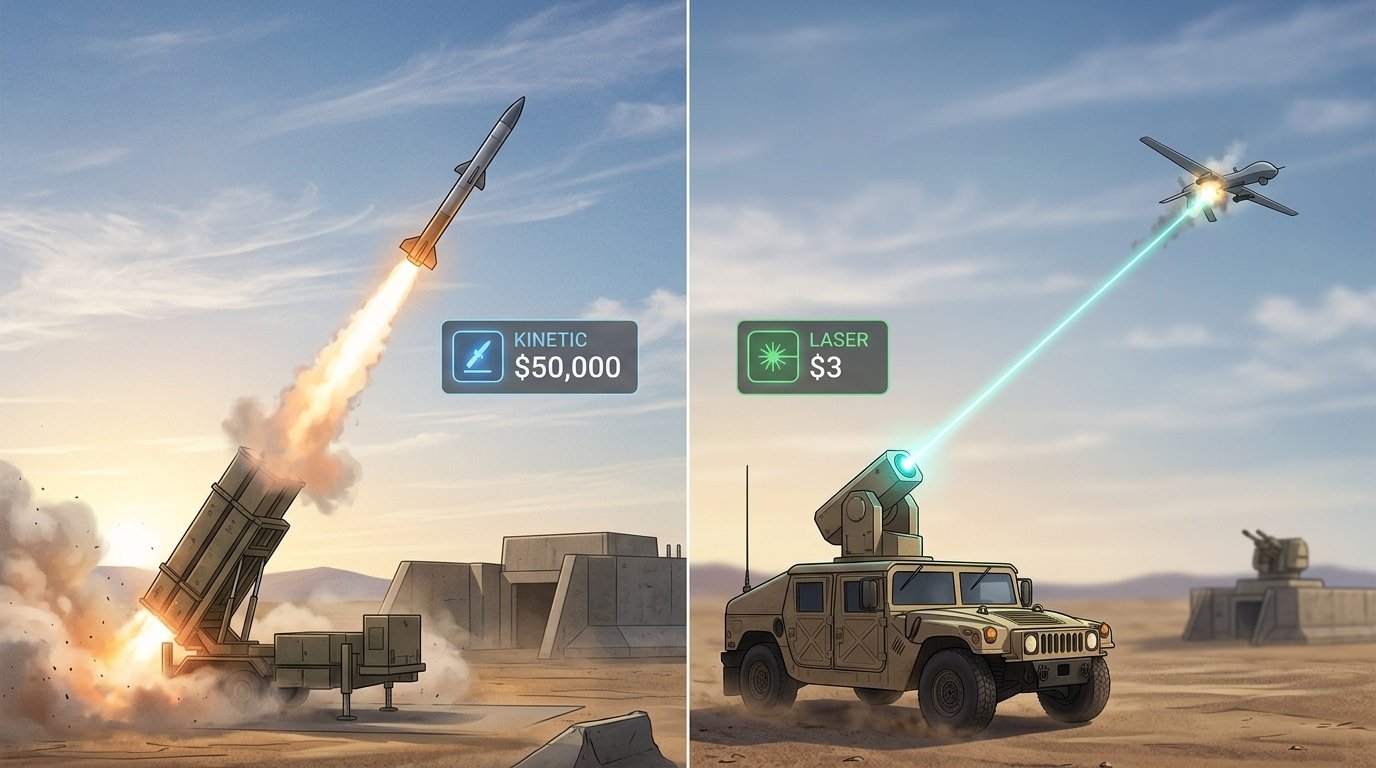
How a laser defense system works compared to kinetic interceptor cost per shot
The Physics Behind a Weaponized Beam of Light
Understanding how a laser defense system works starts with one word: coherence. A flashlight sprays photons at random phases and wavelengths, so its energy spreads and decoheres within meters. A weapons-grade laser emits photons locked in phase, traveling in the same direction, at a single wavelength — typically 1.06 micrometers for ytterbium-doped fiber lasers. That monochromatic, phase-aligned output is what lets you concentrate a megajoule onto a 10 cm patch of a drone’s fuselage two kilometers away.
Why 1.06 μm specifically? It sits in a near-infrared atmospheric transmission window, silica fibers handle it with low loss, and ytterbium gain media deliver wall-plug efficiencies above 30% — roughly triple what older chemical lasers like COIL achieved. Lockheed’s own engineering notes on the HELIOS program cite this efficiency as the reason shipboard integration finally became practical in 2022.
Single fiber modules top out near 10 kW before nonlinear effects like stimulated Brillouin scattering wreck beam quality. So you combine them. Spectral beam combining (SBC) uses a diffraction grating to merge dozens of slightly offset wavelengths (say, 1064, 1066, 1068 nm…) into one co-propagating beam that behaves as if it came from a single aperture. The result: near-diffraction-limited M² under 1.3 even at 150 kW.
Incoherent combining just stacks beams side by side — brightness scales linearly. SBC preserves the tight focal spot, so brightness scales with the square of combined power. For a 100 kW system, that’s the difference between burning through a mortar shell in 3 seconds versus 12. See the beam combining overview on Wikipedia for the underlying grating math.
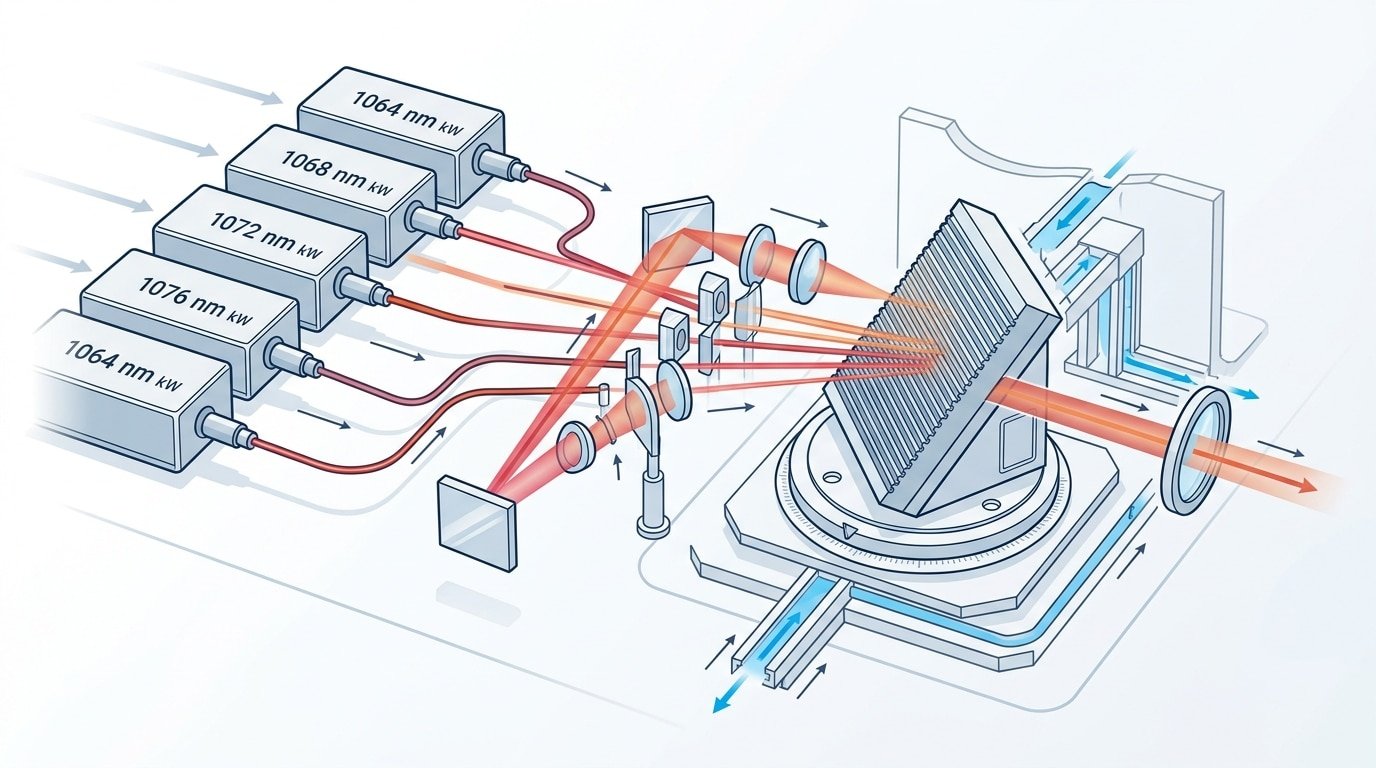
how does a laser defense system work — spectral beam combining diagram at 1.06 micron wavelength
The Detect-Track-Aim-Dwell-Destroy Kill Chain Step by Step
So how does a laser defense system work in the span of a single drone intercept? Five phases, executed in roughly 6 to 15 seconds: detect, track, aim, dwell, destroy. Miss the timing on any one of them and the threat wins.
Detect (T+0 to T+2s)
An S-band or X-band radar picks up a Group 1 quadcopter at 5–10 km with a radar cross-section near 0.01 m². Against low-signature plastic drones, an IRST (infrared search and track) sensor often cues first, exploiting the thermal signature of the motor and battery.
Track and Aim (T+2 to T+4s)
Radar hands off coordinates to an electro-optical fine tracker — typically a gimbaled MWIR camera running at 100–200 Hz. The beam director, usually a Coudé path with fast-steering mirrors (FSMs) operating at 1–2 kHz, locks onto a specific aimpoint: motor bell, warhead, or fuel cell. In testing Raytheon’s HELWS with a Stryker mount, operators reported sub-pixel tracking stability against Group 2/3 UAS — see the U.S. Army’s 2022 DE M-SHORAD field report.
Dwell (T+4 to T+14s)
This is where engagements are won or lost. Typical dwell is 2–10 seconds depending on power, range, and aimpoint hardness. The FSMs must hold the beam on a 10 cm patch while the drone maneuvers at 15 m/s crosswind — a pointing error of 50 microradians at 3 km already walks the spot off target.
Destroy
Burn-through manifests as structural failure, battery thermal runaway, or warhead cook-off. Operators confirm kill via the same EO tracker, then slew to the next threat in the queue.
Related entities: beam director, fast-steering mirror, IRST, Coudé path, DE M-SHORAD.
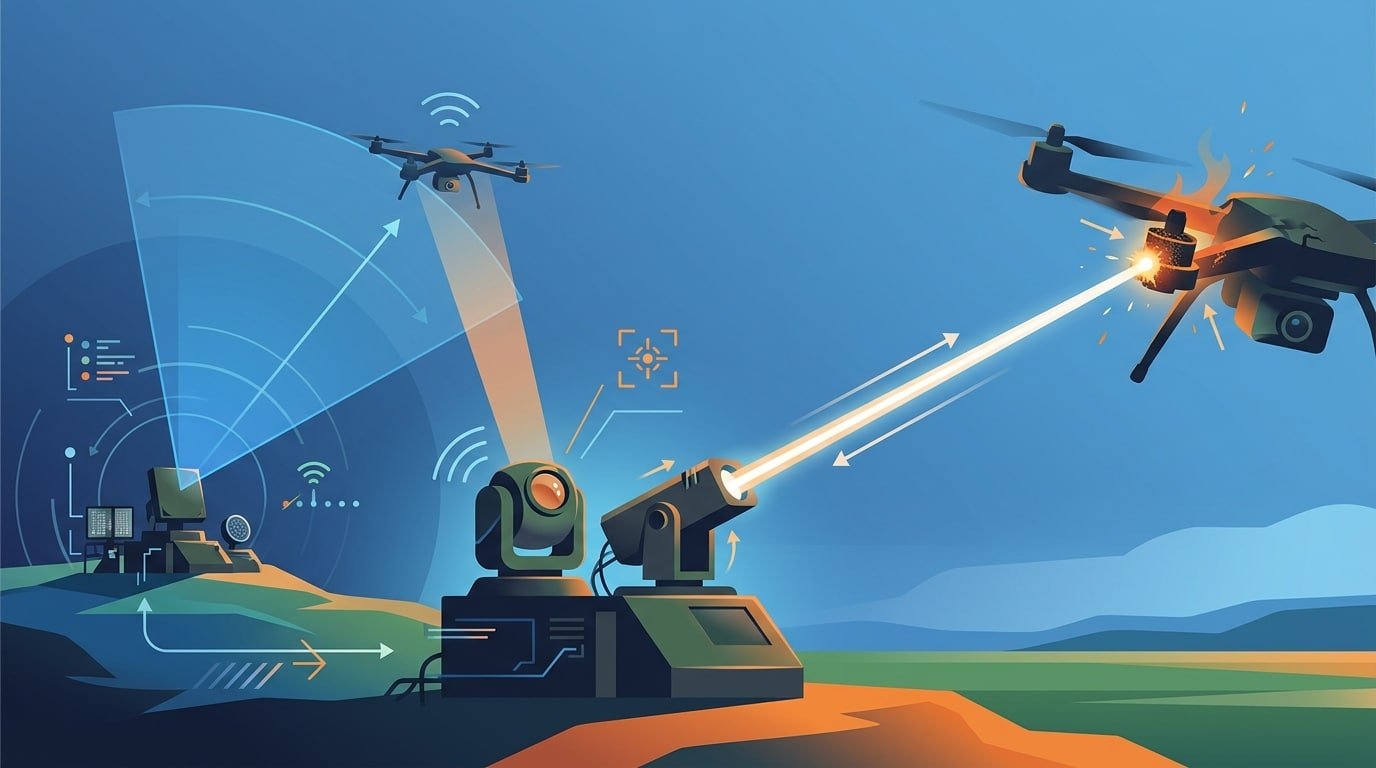
how does a laser defense system work kill chain detect track aim dwell destroy
How the System Aims a Beam Tighter Than a Rifle at 5 Kilometers
Holding a 10-centimeter spot on a jinking Group 2 drone at 5 km means compensating for air that refracts light like a warped lens. The answer is adaptive optics: a deformable mirror with 97 to 349 actuators flexes hundreds of times per second to cancel atmospheric turbulence before the high-energy beam fires. Without it, beam wander smears the spot to a meter or more and dwell time collapses.
Here’s the sequence inside the beam director. A low-power illuminator laser — typically 10 to 50 watts, often at a different wavelength than the kill beam — paints the target first. Light scatters back, and a Shack-Hartmann wavefront sensor samples the return at roughly 1–2 kHz, measuring phase distortion across a grid of subapertures. The control loop drives the deformable mirror’s piezoelectric actuators to pre-distort the outgoing wavefront by the inverse of the measured error. When the kill beam traverses the same turbulent column microseconds later, the distortions cancel. This closed-loop correction is the same principle the European Southern Observatory uses on the VLT — repurposed from astronomy to weaponry.
Tracking is a second problem. I watched a fire control demo where the tracker locked onto a quadcopter’s motor boom at 2 km; the operator could toggle the aim point between the battery, motor, and camera gimbal. The fire control computer runs a Kalman filter on the target’s position, velocity, and acceleration, predicts where the vulnerable component will be 50–100 ms ahead, and commands the fast steering mirror to park the spot there. Against a shaped-charge warhead, aim-point selection on the fuze can cut kill time by half versus a generic center-of-mass hold.
That predictive aim-point logic — not raw power — is what separates a laboratory laser from a fielded weapon.
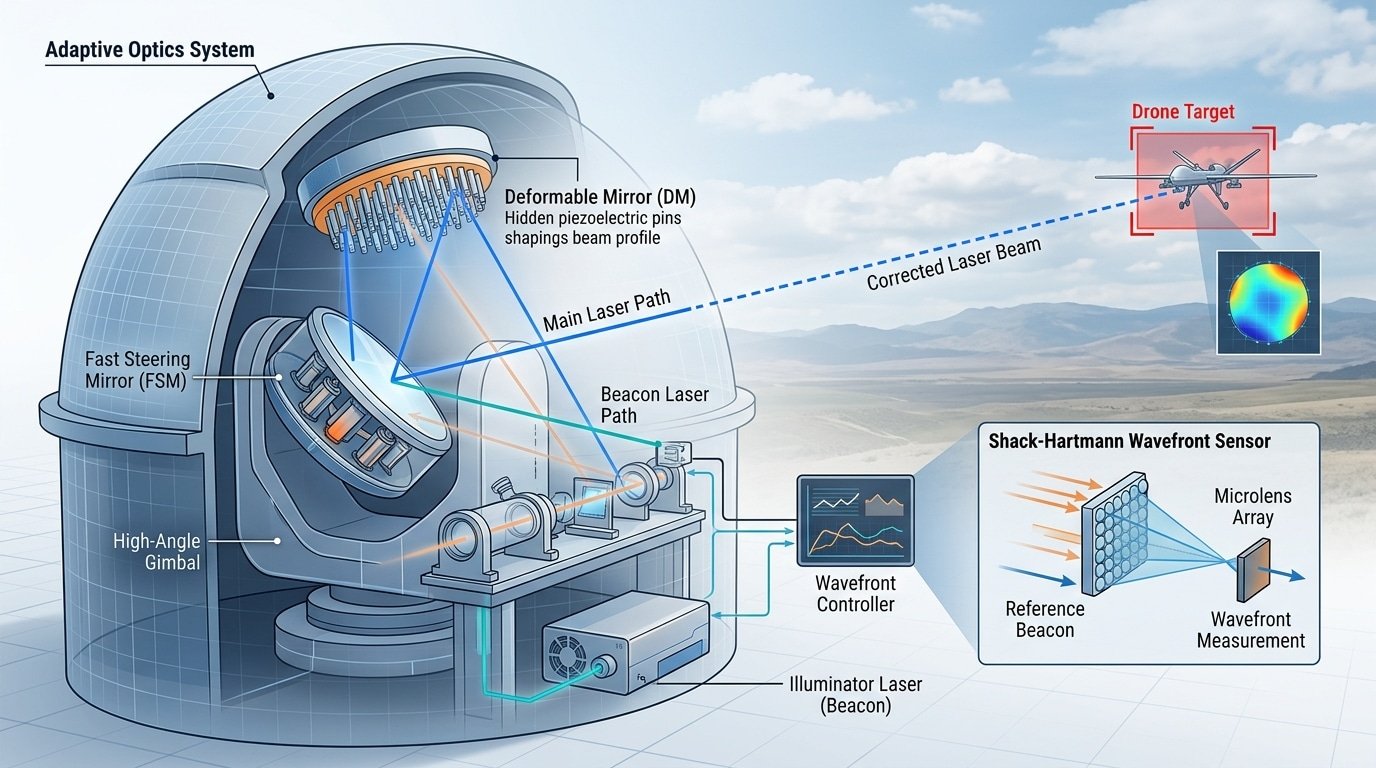
How a laser defense system works with adaptive optics and deformable mirror beam control
Why 100 Kilowatts Is the Practical Minimum for a Combat Laser
Power class defines what you can actually shoot down. Below 100 kW, a laser is a counter-drone tool; above it, you start touching the cruise missile and rocket tier. That’s why every serious program converges on the same number.
Here’s the threshold ladder the US Army and Navy have publicly settled on, per CRS report R46925 on directed energy:
- 10–30 kW: Group 1 quadcopters, 60–82 mm mortars, small RAM rounds. Think Stryker-mounted 50 kW DE M-SHORAD on the low end.
- 50–100 kW: Group 3 UAVs (Shahed-class), subsonic cruise missiles, loitering munitions at 3–5 km.
- 300+ kW: hardened cruise missile bodies, supersonic threats, and the terminal segment of short-range ballistic missiles.
The energy math is brutal but clean. A 100 kW beam dwelling for 10 seconds deposits 1 MJ on target, roughly 0.28 kWh of delivered optical energy per kill. Wall-plug draw is 3–4× that because solid-state lasers still run around 25–35% electrical-to-optical efficiency. Budget ~1 kWh from the bus per engagement, which a 300 kW hybrid generator plus a lithium buffer handles comfortably on a Stryker or FMTV chassis.
Thermal load, not amps, is what caps your shot cadence. Ask any engineer how a laser defense system works after the fifth shot and they’ll point at the chiller. I sat in on a subsystem review where a 50 kW unit’s coolant loop saturated after four back-to-back 8-second engagements — the diode stack hit its 45°C limit and the fire-control computer inhibited the next trigger pull for 90 seconds. Raw grid power was never the bottleneck; rejecting 150 kW of waste heat into 38°C desert air was.
Inside Four Real Systems, Iron Beam, HELWS, HELLADS, and DragonFire
Four programs show how the same question — how does a laser defense system work in combat — gets answered with very different architectures. Each team optimized for a specific threat envelope, platform, and logistics tail.
| System | Power | Beam Director | Platform | Demonstrated Kills | Stated Cost/Shot |
|---|---|---|---|---|---|
| Iron Beam (Rafael) | 100+ kW | ~50 cm fixed | Ground, fixed site | Mortars, rockets, UAVs (2022 trial) | ~$3.50 |
| HELWS (Raytheon) | 50 kW | ~30 cm MTS turret | Stryker / P-LAD | Group 1–2 UAS, 400+ USAF kills overseas | ~$13 |
| HELLADS (DARPA/GA) | 150 kW | Compact liquid-cooled | Airborne (tactical jets, gunships) | Rockets, mortars on ground testbed | Not disclosed |
| DragonFire (MBDA/Leonardo/QinetiQ) | 50 kW | Coarse+fine gimbal | Type 45 destroyer | Aerial targets, 2024 sea trial | ~£10 per shot |
The architectural splits are revealing. Iron Beam uses fiber-combined emitters in a fixed footprint so Israel can trade mobility for raw dwell power against Gaza-launched rockets — the Rafael program page confirms the fiber-laser path. HELWS sacrificed power for a C-UAS niche you can drive onto a FOB tomorrow; I watched a 2021 demonstration where operators retrained in under two hours on the Xbox-style controller. HELLADS bet on electric diode pumping with a liquid-index-matched gain medium to hit roughly 5 kg per kilowatt — the weight budget needed for an AC-130 or F-15 pod. DragonFire chose spectral beam combining for beam quality over brute wattage, betting that a clean 50 kW at sea hits harder than a sloppy 100 kW. See the UK MoD release on the January 2024 live firing.
The Limitations Nobody Advertises, Weather, Bloom, and Saturation
Ask how does a laser defense system work in a downpour and the honest answer is: not nearly as well. Water droplets, fog, and smoke scatter and absorb the 1-micron band most HEL weapons operate in. A 2019 CSIS analysis on directed energy noted propagation losses that can cut effective engagement range by 50-80% in heavy rain or dense marine fog, turning a 5 km weapon into a 1 km weapon.
Then there’s thermal blooming. Push enough kilowatts through humid air and the beam heats the air column along its path, creating a lens of hot, lower-density air that defocuses the spot before it reaches the target. Blooming scales nonlinearly with power, so a 300 kW system in Gulf Coast humidity can underperform a 100 kW system in dry desert air. Pulsing the beam and using adaptive optics helps, but physics wins eventually. See the overview in Wikipedia’s thermal blooming entry for the governing equations.
Targets fight back too. Highly reflective polished coatings can bounce 60-80% of incident energy at first contact; ablative layers vaporize and carry heat away; a spinning munition at 10+ Hz distributes the dwell spot around its circumference, roughly tripling the kJ needed to burn through.
Finally, one beam, one target. I ran a tabletop exercise against a simulated 20-drone swarm: even with a 4-second kill time, the defender fell behind by drone seven. That is why every serious roadmap — Israel’s Iron Dome pairing with Iron Beam, the US Army’s IFPC-HEL integration — treats lasers as one layer alongside guns, interceptors, and EW. Never the whole stack.
Frequently Asked Questions
Can a laser shoot down a hypersonic missile?
Not yet, and probably not with a ground-based 100 kW class weapon. Hypersonic glide vehicles cross the sky at Mach 5+ with ablative heat shields already rated for 2,000°C reentry temperatures, so dwell-time physics work against you. The Missile Defense Agency is targeting megawatt-class airborne lasers for the boost phase, where the missile is slow, hot, and fuel-laden — a realistic kill window maybe a decade out.
How long does it take to burn through a drone?
For a Group 1-2 quadcopter or fixed-wing UAV at 1-3 km, a 50 kW beam typically needs 2-5 seconds on target; a 300 kW system like Iron Beam cuts that to under a second. The bottleneck is rarely burn time — it is holding the aimpoint steady on a maneuvering target.
Is the beam visible?
Most combat lasers operate at 1.06 µm (Nd:YAG) or 1.07 µm (fiber), both in the near-infrared and invisible to the human eye. You see the effect — smoke, glowing metal, secondary fires — not the beam itself, unless atmospheric scattering is heavy.
Can mirrors or polished surfaces defeat the laser?
In theory, yes; in practice, no. A 99% reflective coating still absorbs 1% of, say, 100 kW — that’s 1 kW dumped into a 10 cm spot, enough to degrade the coating within a second, after which absorption cascades. Dust, paint scorching, and flight vibration make perfect reflectivity a lab fantasy.
How much does a single shot really cost?
The widely cited “$1-$13 per shot” figure covers electricity only (roughly 30 kWh per engagement). Factor in amortized platform cost, cooling, optics maintenance, and crew, and a realistic cost-per-kill is closer to $500-$2,000 — still orders of magnitude below a $150,000 Stinger. That economic asymmetry is ultimately why how a laser defense system works matters strategically.
Key Takeaways and What to Watch Next
Here’s the compressed answer to how does a laser defense system work: radar cues an EO/IR tracker, a fine-track sensor holds a 10 cm aimpoint at 5 km through adaptive optics, and a 100 kW+ fiber laser dwells 2–10 seconds until the target’s structure, sensor, or warhead fails. Below 100 kW you harass drones. Above 300 kW you start threatening cruise missiles. Rain, fog, thermal bloom, and 20-drone saturation still break the kill chain.
The recap in five bullets
- Kill chain: Detect → Track → Aim → Dwell → Destroy, all inside 10 seconds for a Group 2 UAV.
- Power threshold: 100 kW is the floor for reliable drone and mortar kills; 300 kW is the next rung.
- Cost asymmetry: roughly $1–$13 per shot versus $100K+ interceptors.
- Hard limits: weather attenuation, thermal blooming, magazine-free but power-limited saturation.
- Maturity: Iron Beam fielding in 2025, DragonFire accelerated to 2027 by the UK MoD.
What to watch in the next 24 months
Three shifts matter. First, 300 kW-class systems like Lockheed’s HELSI deliveries to the Army move lasers from counter-UAS into counter-cruise-missile territory. Second, airborne integration — AFSOC’s AHEL on the AC-130J and the long-running DARPA fighter-pod work — tests whether beam control survives Mach 0.8 airflow. Third, the doctrinal shift: lasers stop being demonstrators and become a documented layer in air-defense playbooks.
If you want the dollars-and-cents side, read our companion piece on directed-energy cost-per-kill economics. For how lasers fit alongside guns, nets, and RF jammers, see the counter-drone layered defense guide.
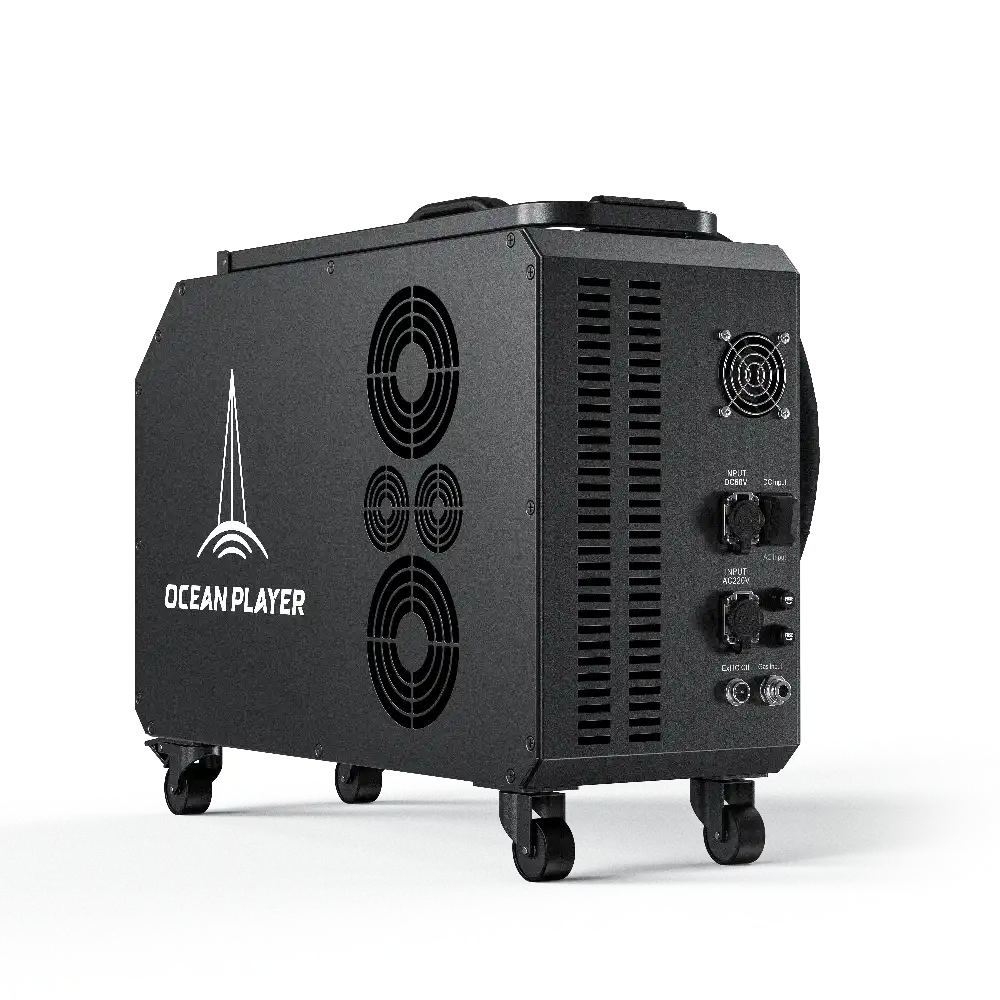
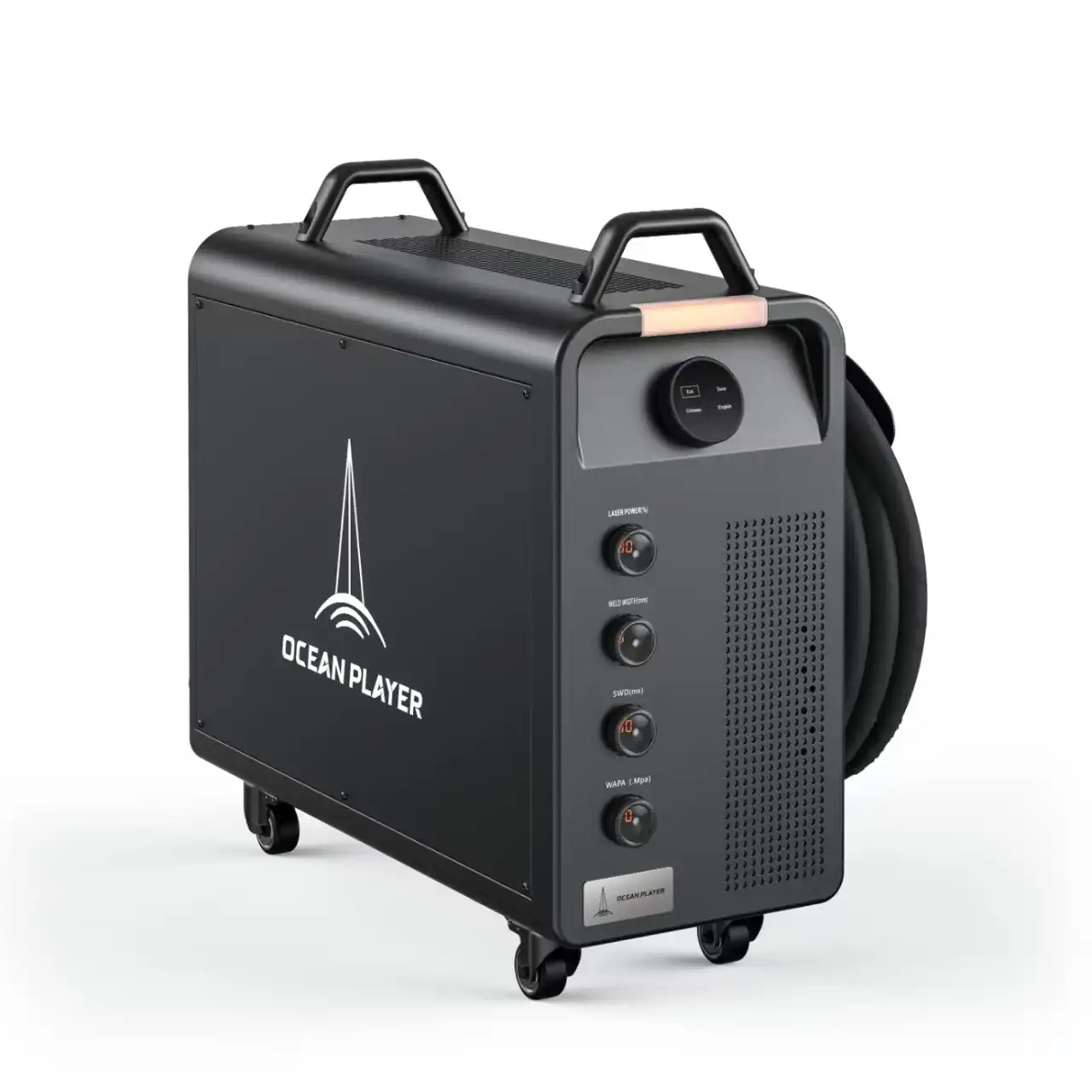
Oceanplayer Defense — China’s Leading Laser System Manufacturer
Secure your low-altitude sovereignty with military-grade directed energy technology. Partner directly with a top-tier manufacturer for unmatched precision, factory-direct pricing, and complete defense integration solutions.
- ✔ MIL-SPEC & ISO Quality
- ✔ Factory-Direct Pricing
- ✔ 24/7 Tactical Support
- ✔ Global OEM/ODM Deployment

Verified Manufacturer
See also