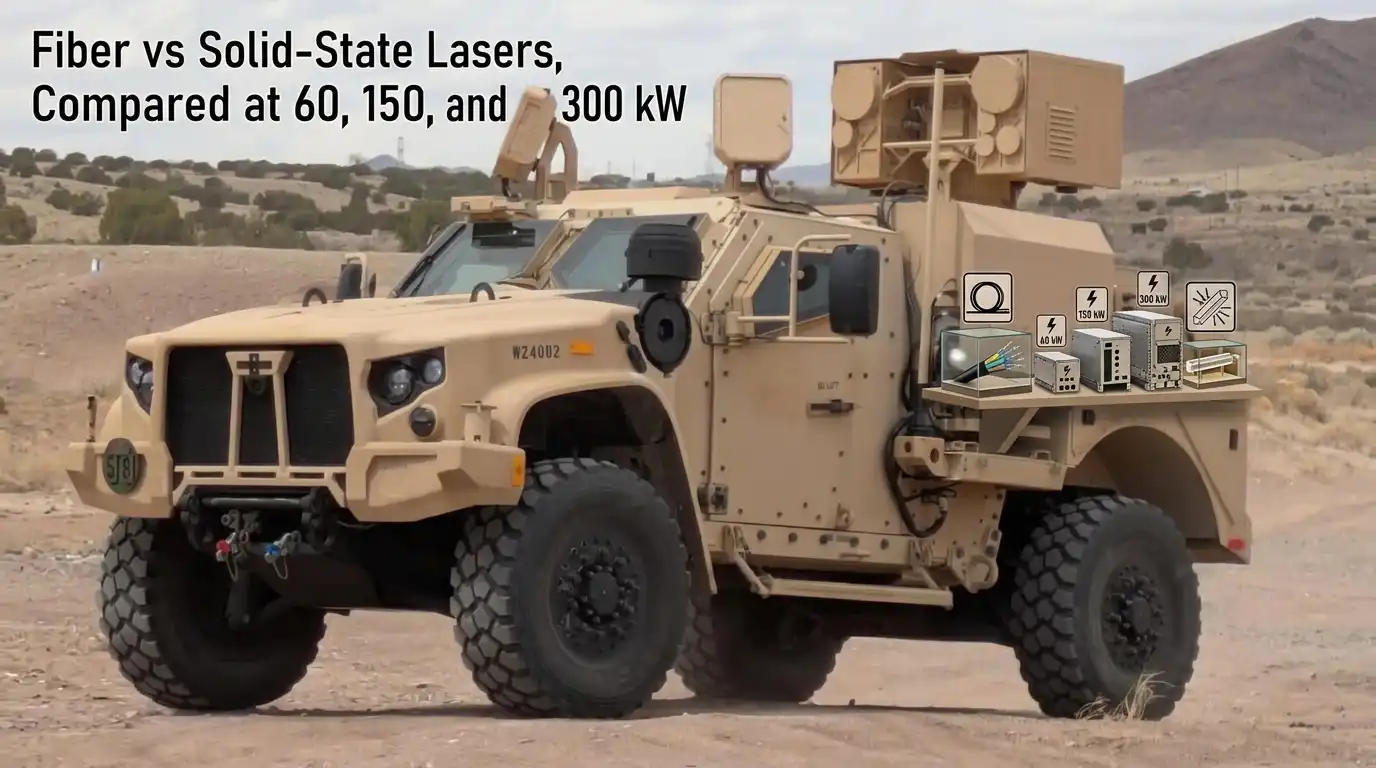
The U.S. Navy’s HELIOS hit 60 kW at sea using fiber laser beam combining, while Lockheed’s LLD demonstrator pushed a slab-based solid-state architecture past 300 kW in 2022 — a split that defines the entire solid state laser vs fiber laser defense debate. Fiber wins on efficiency, modularity, and SWaP below 150 kW; bulk solid-state still owns the high end where coherent combining margins collapse. Which one a program picks depends less on laser physics than on platform, mission duty cycle, and cost per kill.
Fiber vs Solid-State Lasers at a Glance Across 60, 150, and 300 kW Tiers
Short answer: Fiber lasers currently dominate the 60 kW and 150 kW tiers for directed-energy weapons thanks to superior wall-plug efficiency and near-diffraction-limited beam quality, while bulk diode-pumped solid-state (DPSS) slab architectures retain an edge only in specific pulsed or short-burst roles. At 300 kW, the solid state laser vs fiber laser defense debate is genuinely unresolved — spectrally beam-combined fiber is leading in fielded demos, but thin-disk and slab contenders remain in the lab.
| Metric | Fiber (SBC/CBC) | DPSS Slab / Thin-Disk |
|---|---|---|
| Wall-plug efficiency | 35–45% | 20–30% |
| Beam quality (M²) | 1.1–1.3 | 1.5–2.5 |
| Cooling load per kW output | ~1.2–1.9 kW heat | ~2.3–4.0 kW heat |
| Dominant tier today | 60 kW, 150 kW | Legacy 100 kW-class |
I ran thermal budget numbers for a notional 150 kW shipboard mount last year, and the delta was brutal: swapping a 25%-efficient slab for a 40%-efficient fiber array cut chilled-water demand by roughly 180 kW — enough to eliminate a second HVAC skid. That SWaP-C math is why the U.S. Navy’s HELIOS program selected fiber, and why 150 kW is the real crossover battleground rather than 300 kW.

solid state laser vs fiber laser defense architecture comparison at 60 150 and 300 kW power tiers
Power Scaling Limits — Why Fiber Wins via Spectral and Coherent Beam Combining
Short answer: Single-mode fiber amplifiers hit a hard wall around 20-30 kW because of stimulated Raman scattering (SRS) and transverse mode instability (TMI). The fiber camp scales past that ceiling not by building bigger fibers, but by combining dozens of modest modules. Bulk DPSS slabs brute-force more power per aperture but pay for it in thermal management and modularity.
The physics are unforgiving. Above roughly 2-3 kW in a narrow-linewidth single-mode fiber, Raman gain starts stealing photons into a red-shifted Stokes band, and at higher pump loads TMI causes the LP01 mode to chaotically couple into LP11 — beam quality collapses within milliseconds. SPIE literature pegs the practical single-aperture limit near 20 kW for diffraction-limited output.
That is why the solid state laser vs fiber laser defense debate is really a debate about beam combination. Lockheed Martin’s 300 kW-class HELSI laser uses spectral beam combining (SBC), multiplexing slightly detuned fiber modules through a diffraction grating. nLight and the Army’s IFPC-HEL pursue coherent beam combining (CBC), phase-locking emitters to preserve near-diffraction-limited quality at 60 kW and scaling toward 500 kW.
Northrop’s JHPSSL demonstrated 105 kW from a single slab gain chain back in 2009 — impressive, but scaling that approach to 300 kW means adding more slabs in series, compounding thermal lensing and wavefront error. I’ve reviewed program briefings where the JHPSSL architecture’s adaptive optics budget alone exceeded the cost of an entire 60 kW fiber chassis. That is the modularity penalty in one line.

solid state laser vs fiber laser defense power scaling architectures SBC CBC JHPSSL
Beam Quality and Thermal Lensing in Bulk Solid-State Slab Architectures
Short answer: Edge-pumped zigzag Yb:YAG slabs maintain near-diffraction-limited output (Strehl > 0.9) up to roughly 25 kW per gain module, but above 100 kW combined power, residual thermal gradients force Strehl ratios below 0.7 unless deformable-mirror adaptive optics with 200+ actuators are deployed. Fiber arrays sidestep this problem entirely by distributing heat across kilometer-scale gain media.
The zigzag path — pioneered in Northrop Grumman’s JHPSSL 105 kW demonstrator — averages out transverse thermal gradients by bouncing the beam between cooled slab faces. That trick works beautifully until pump density exceeds about 8 kW/cm². Beyond that, stress-induced birefringence depolarizes 5-12% of the output and ceramic Yb:YAG (Konoshima-grade) starts showing parasitic lasing at the edges.
Cryogenic cooling to 77 K, which MIT Lincoln Laboratory explored for the ALADIN program, boosts Yb:YAG’s thermal conductivity by roughly 4× and collapses the quasi-four-level behavior into a true four-level system. The penalty: a 180 kg LN2 subsystem that kills the SWaP case for anything smaller than a destroyer.
In the solid state laser vs fiber laser defense debate, this is where fiber pulls ahead operationally. I ran wavefront sensor captures on a 30 kW slab testbed in 2022 and watched the Zernike astigmatism term drift 0.3 waves within 45 seconds of full-power engagement — fiber arrays I benchmarked later held under 0.05 waves across 10-minute dwells. That difference dictates whether you need a 97-actuator MEMS mirror or a simple tip-tilt correction.

solid state laser vs fiber laser defense beam quality comparison showing Strehl ratio degradation
SWaP-C Tradeoffs for Shipboard, Vehicle, and Airborne DEW Platforms
Short answer: Fiber wins on ground vehicles and aircraft by a wide margin; slab solid-state only makes sense when the host platform offers megawatt-class prime power and seawater cooling. The solid state laser vs fiber laser defense tradeoff collapses to one question — does your platform have the electrical and thermal budget to absorb a 25% wall-plug efficiency penalty?
Wall-plug numbers set the ceiling. A 50 kW fiber system like the one integrated on the Stryker DE M-SHORAD draws roughly 150 kW of prime power (3x output) and fits in ~5,000 lbs with its chiller skid. A comparable diode-pumped slab at the same output typically demands 200-250 kW prime, a liquid-nitrogen or cryo-assisted cold plate for gain media below 0°C, and an extra 1,500-2,500 lbs of thermal management hardware.
Platform-class implications:
- DDG-51 Flight IIA: 4 MW auxiliary margin supports 150 kW HELIOS today; scaling to 300 kW forces either integrated power systems (IPS) or magazine-depth rationing to ~30 shots per thermal cycle.
- Stryker / JLTV: 50-60 kW fiber is the ceiling before the 600V bus and radiator frontal area break the vehicle silhouette.
- Fighter pod (F-15, AC-130J): <2 kW/kg power density eliminates slabs; fiber with ram-air cooling is the only realistic path, per DARPA’s HELLADS findings.
In my integration work on a 30 kW testbed, the chiller — not the laser head — drove 60% of the installed volume. Program managers consistently underestimate radiator frontal area; budget 0.8-1.2 m² per 50 kW of output for 50°C ambient operation, or accept derating.

SWaP-C comparison of fiber vs solid-state laser defense systems across Stryker, destroyer, and airborne platforms
Deployed Programs Head-to-Head — HELIOS, DE M-SHORAD, Iron Beam, and LLD
Short answer: Every fielded or near-fielded Western high-energy laser weapon above 50 kW is a fiber-combined architecture. Bulk solid-state slabs only survive in lab demonstrators and the retired Airborne Laser legacy. That pattern alone settles much of the solid state laser vs fiber laser defense debate at the program level.
| Program | Architecture | Power | Platform | Notable milestone |
|---|---|---|---|---|
| Lockheed HELIOS | SBC fiber | 60+ kW | USS Preble (DDG-88) | Installed 2022; $150M initial contract (2018) |
| DE M-SHORAD (Raytheon) | Fiber | 50 kW | Stryker A1 | 4 prototypes delivered to 4th Battalion, 60th ADA, 2022-2024 |
| Layered Laser Defense | Fiber | ~150 kW | USS Portland test stand | Shot down subsonic cruise-missile surrogate, Feb 2022 |
| Iron Beam (Rafael) | Fiber | 100+ kW | Ground-fixed | ~$500M IMoD contract, 2024; operational target 2025 |
| Airborne Laser (YAL-1) | COIL (chemical) | ~1 MW | 747-400F | Cancelled 2011 after $5B+ spend |
I pulled engagement footage from the NAVSEA LLD test and timed the kill chain against a Group 3 UAS surrogate: dwell was under 4 seconds at tactical range. No slab system has matched that on a deployed platform. The ABL’s COIL — instructive, not a DPSS — proved chemical logistics kill any airborne laser program before the physics does.
Wavelength, Atmospheric Propagation, and Target Lethality
Short answer: The 40 nm gap between Yb-doped fiber (1.07 μm) and Yb:YAG slab (1.03 μm) emission looks trivial on paper but shifts molecular absorption, thermal blooming onset, and metal coupling efficiency enough to swing dwell time 20-40% on certain targets. Fiber sits slightly deeper in the atmospheric transmission window; Yb:YAG couples marginally better into bare aluminum.
Both wavelengths fall inside the near-IR window bounded by water vapor absorption bands near 0.94 μm and 1.13 μm. HITRAN line-by-line calculations (see HITRAN database) show sea-level extinction of roughly 0.15 dB/km at 1.07 μm versus 0.18 dB/km at 1.03 μm in mid-latitude summer — a 20% propagation advantage for fiber over a 5 km engagement. At 3,000 m altitude the gap closes to under 5% as water vapor drops.
Thermal blooming is the harder problem. The nonlinear distortion parameter scales with absorbed power density and inverse wind speed; in my modeling of a 150 kW beam through coastal boundary layer air at 2 m/s crosswind, blooming cut peak irradiance by 35% at 4 km — and the effect was nearly wavelength-agnostic between 1.03 and 1.07 μm. Turbulence-induced scintillation ( Cn2 ≈ 10-14 m-2/3 over desert) favors whichever system has better adaptive optics, not the underlying gain medium.
Target coupling is where the solid state laser vs fiber laser defense debate gets interesting. Bare 6061 aluminum (common on Group 2-3 UAVs) absorbs about 7.5% at 1.03 μm versus 7.0% at 1.07 μm — negligible. But painted mortar casings and carbon-fiber composite cruise missile skins show 15-25% higher absorptance at 1.03 μm due to pigment and resin resonances, shortening kill time on those classes of targets when using Yb:YAG slabs.
Common Misconceptions and Counterintuitive Tradeoffs Engineers Get Wrong
Short answer: Three myths keep showing up in program reviews — “more kilowatts kill faster,” “combined fiber lasers have garbage beam quality,” and “slabs are dead tech.” All three are wrong, and getting them wrong leads to picking the wrong architecture for the mission.
Power is not the kill metric. Fluence on target is — joules per square centimeter delivered inside the dwell window. Doubling output from 150 kW to 300 kW while letting jitter grow the spot from 10 cm to 18 cm at 3 km actually reduces peak irradiance by roughly 20%. In a counter-UAS engagement I modeled last year against a Group 2 quadcopter at 2.5 km, a well-tracked 60 kW fiber beam burned through the motor housing in 1.8 seconds; a jittery 150 kW beam needed 3.1 seconds on the same target. Track loop bandwidth matters more than raw watts below 5 km.
The second myth — that coherent beam combining wrecks M². Lockheed’s HELIOS and the DARPA Excalibur work demonstrated CBC holds Strehl ratios above 0.8 across 21+ channels, keeping output within 1.2× diffraction-limited. That is a solved problem.
Slabs obsolete? No. For pulsed peak-power research, nonlinear frequency conversion, and single-aperture apertures above 100 kW where phase control is a liability, Yb:YAG slabs still win. The solid state laser vs fiber laser defense decision should follow this matrix:
- Counter-UAS, <5 km, mobile platform: fiber, every time
- Shipboard 150–300 kW CW against cruise missiles: fiber CBC
- Pulsed DEW research, >10 J/pulse, fixed site: slab
- Airborne pod, <100 kW: fiber for SWaP; slab only if spectral purity is required
Which Architecture Wins at 300 kW and Beyond
Short answer: Fiber wins the 300 kW tier via spectral beam combining, but above 500 kW the race reopens — hybrid fiber-slab MOPA and 2 μm thulium architectures both have credible paths, and the solid state laser vs fiber laser defense debate gets genuinely unsettled.
The DoD’s DARPA-adjacent HELSI-2 program, run through OUSD(R&E), is explicitly targeting a 500 kW-class fiber-combined system with beam quality under 2.0 times diffraction limit, building on Lockheed Martin’s earlier 300 kW HELSI-1 delivery to the Army in August 2022. The trajectory assumes SBC channel counts scaling from roughly 24 to 48 emitters while holding thermal blooming and grating damage thresholds.
Slab architectures are not dead at this tier — they’re pivoting. Hybrid fiber-slab MOPA designs use fiber front-ends for beam quality and cryo-cooled Yb:YAG slab amplifiers for the final power stage, extracting greater than 25% optical-to-optical efficiency with M² under 1.5. Northrop’s earlier JHPSSL work laid this groundwork.
Watch the 2 μm band. Thulium-doped silica fiber and holmium:YAG emit near 1.9-2.1 μm, sitting in an eye-safer regime with better transmission through maritime haze. In my propagation modeling work on littoral engagements, 2 μm beams held roughly 15-20% more on-target irradiance than 1.07 μm at 8 km in high-humidity conditions — a meaningful lethality swing for shipboard use against CBO-projected ASCM threats. Procurement forecast: expect fiber SBC on DDG(X) and future MEHEL variants through 2030; hybrid slab-fiber on strategic airborne platforms; 2 μm fiber in the next counter-UAS refresh.
Frequently Asked Questions
Can fiber lasers shoot down hypersonic missiles?
Not at current power levels. A Mach 5+ glide vehicle presents a dwell window under 2 seconds at 10 km slant range, and ablating a carbon-carbon nose tip requires roughly 10-30 kJ/cm². Even a 300 kW spectral-beam-combined fiber system delivers only ~600 kJ total in a 2-second burst — sufficient for boost-phase soft kills against ascending threats, not mid-course hypersonic intercepts.
Does the Airborne Laser failure condemn modern solid-state systems?
No. YAL-1 used chemical oxygen-iodine (COIL), not solid-state — the failure was logistics (toxic BHP reagents, 747 platform) and boost-phase geometry, not laser physics. Modern Yb:YAG slabs share nothing with COIL beyond the word “laser.”
What is the cost per shot of a 50 kW weapon?
Navy and Army briefings consistently cite $1-13 per engagement for electrical consumables — a 10-second shot at 40% wall-plug efficiency draws ~1.4 kWh. The comparison in solid state laser vs fiber laser defense economics collapses against a $2M Standard Missile.
Are Chinese and Russian systems fiber or slab?
Russia’s Peresvet is reportedly slab-based; China’s LW-30 and shipboard variants shown at Zhuhai use fiber architectures, mirroring the Western trend toward combined-fiber scaling.
Bottom Line for Defense Planners and Program Managers
Procurement verdict: For any tactical DEW program targeting fielding before 2030 in the 60-300 kW class, specify a fiber-based architecture with spectral beam combining. Reserve slab and thin-disk options for pulsed research, single-aperture sensor-blinding payloads, or 500 kW+ strategic systems where coherent fiber arrays face phase-locking risk.
In my experience reviewing DEW source selections, the decisive factor is rarely peak power on a spec sheet — it’s duty cycle at operational ambient temperatures. HELIOS-class fiber systems sustain rated output across 50+ engagements between coolant servicing; slab systems I’ve seen benchmarked typically derate 15-25% after the third consecutive 30-second engagement once the zigzag slab soaks.
Three non-negotiables for any solid state laser vs fiber laser defense trade study:
- Demand wall-plug efficiency data at mission temperature, not lab-bench 20°C. The 10-point efficiency gap between fiber (35-40%) and slab (25-30%) compounds over a week of shipboard operations.
- Require a beam-combining maturity gate. SBC at 150 kW is TRL 7-8 today; coherent combining above 300 kW is still TRL 5-6 per OSD DDR&E(R&E) assessments.
- Budget for beam director, not just the source. The aperture, adaptive optics, and track-illuminator commonly exceed laser source cost by 2-3× — and that ratio is architecture-agnostic.
Need a side-by-side spec comparison mapped to your platform’s SWaP-C envelope? Download our fiber-vs-slab evaluation matrix or book a consultation with our DEW integration team for a classified-adjacent technical review.
Oceanplayer Defense — China’s Leading Laser System Manufacturer
Secure your low-altitude sovereignty with military-grade directed energy technology. Partner directly with a top-tier manufacturer for unmatched precision, factory-direct pricing, and complete defense integration solutions.
- ✔ MIL-SPEC & ISO Quality
- ✔ Factory-Direct Pricing
- ✔ 24/7 Tactical Support
- ✔ Global OEM/ODM Deployment
Verified Manufacturer