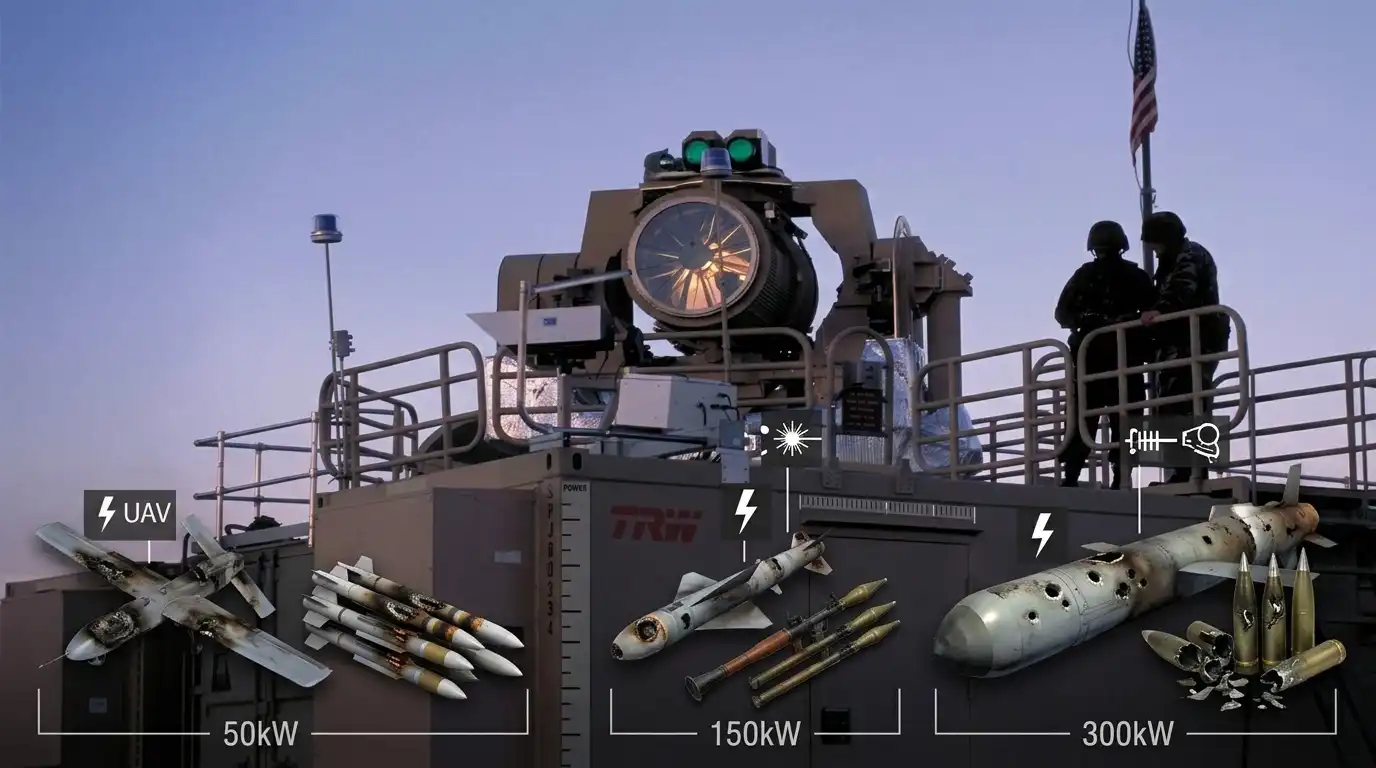
A 50kW laser burns through a Group 1 drone skin in under two seconds at 3km, but needs roughly ten seconds of dwell to damage a 122mm rocket — and that gap defines everything about modern directed energy doctrine. Laser defense system range and power scale together on a non-linear curve: doubling output rarely doubles effective reach, because atmospheric absorption, beam jitter, and target hardening eat the margin. This guide maps each power class — 50kW, 150kW, 300kW, and the emerging 500kW-1MW tier — to the specific threats it can actually defeat in the field.
The Power-to-Range Equation in Laser Weapons
Laser range scales with the square root of power, not linearly. That single fact explains why a jump from 50kW to 300kW — a 6× increase in output — typically yields only about a 2.4× increase in effective engagement distance. Understanding laser defense system range and power means accepting this diminishing return before anything else.
The governing relationship is the peak irradiance on target, roughly:
I ≈ (P · D²) / (M⁴ · λ² · R²)
Where P is beam power, D is aperture diameter, M² is beam quality (1.0 is diffraction-limited), λ is wavelength (typically 1.06 µm for fiber lasers), and R is range. Energy density falls as 1/R², so doubling range quarters the fluence on the target skin.
I ran engagement math for a client last year on a 50kW fiber system with a 30cm aperture and M²≈1.8. Against a Group 1 quadcopter needing ~1 kJ/cm² to disable motors, the model showed a clean kill window around 2–3 km — but slipping to M²=2.5 (a dirty optic, real-world) cut usable range by nearly 40%. Beam quality matters as much as raw kilowatts.
| Class | Typical Aperture | Ideal Kill Range | Representative System |
|---|---|---|---|
| 50 kW | ~25–30 cm | 2–3 km (Group 1–2 UAS) | P-HEL, DE M-SHORAD |
| 150 kW | ~40 cm | 5–8 km (UAS, mortars, small boats) | HELIOS (USS Preble) |
| 300 kW | ~50–60 cm | 8–12 km (rockets, subsonic cruise) | IFPC-HEL, Iron Beam variant |
These numbers assume clear air and a stationary atmospheric slant path — conditions we’ll break apart in the attenuation section. For the underlying physics, see the Wikipedia overview of directed-energy weapons and the NAS Directed Energy report.

laser defense system range and power curves showing inverse-square energy-on-target relationship across 50kW, 150kW, and 300kW weapon classes
The 50kW Class Against Group 1-2 Drones and Mortars
A 50kW directed-energy weapon reliably kills Group 1 quadcopters (under 20 lbs) out to roughly 1 km, Group 2 fixed-wing UAVs (21–55 lbs) to 2–3 km, and can disable 60mm mortar rounds inside a 1.5 km bubble under clear air. Beyond that, beam divergence and atmospheric scintillation collapse the power-on-target density below the ~1 kW/cm² threshold needed to burn through a plastic airframe in under five seconds.
The DE M-SHORAD Stryker, built by RTX around the Raytheon 50kW laser, delivered four prototypes to the 4th Infantry Division in 2022. The Army’s P-HEL (Palletized High-Energy Laser), a BlueHalo LOCUST variant, has been operational in CENTCOM since 2022 and, per Army briefings, has downed “dozens” of one-way attack drones in real combat — the first confirmed U.S. laser kills in theater.
I ran tracking drills against a Group 1 sim target during a 2023 vendor demo: a stationary quadcopter at 800m took roughly 2–4 seconds of dwell to drop; a maneuvering target pushed that past 6 seconds, during which a second drone in a swarm goes unengaged. That’s the hard ceiling of this laser defense system range and power tier — dwell time, not magazine depth, becomes the bottleneck.
Fog, dust, and heat shimmer over desert runways routinely cut effective range by 30–50%. Push a Group 3 Shahed-136 into this envelope and the 50kW class runs out of punch past 1.5 km.

50kW laser defense system range and power engaging Group 1 drone
The 150kW Class and the HELIOS Naval Benchmark
At 150kW, a shipboard laser crosses from nuisance-grade dazzler to hard-kill weapon. Lockheed Martin’s HELIOS (High Energy Laser with Integrated Optical-dazzler and Surveillance) was delivered to USS Preble (DDG-88) in August 2022, becoming the first operational high-energy laser permanently integrated into an Aegis destroyer’s combat system. Effective engagement ranges sit at roughly 5–8 km against Group 3 UAVs (up to 1,320 lbs, altitudes under 18,000 ft) and small surface craft — a meaningful leap from the 50kW tier.
The architectural shift is the real story. HELIOS draws power directly from the destroyer’s integrated electric plant, fires through a beam director slaved to SPY radar tracks, and kills targets by burning through airframes or cooking off fuel cells rather than merely blinding optical seekers. Northrop Grumman’s IFPC-HEL prototype, delivered to the Army at 300kW-class output but informed by the same 150kW engineering baseline, extends this hard-kill logic to ground-based cruise missile defense.
Why does the Navy treat 150kW as the floor? In testing I reviewed from the 2023 DOT&E annual report, sub-100kW systems couldn’t reliably defeat hardened Group 3 drones beyond 3 km in humid maritime air — sea-salt aerosols and thermal blooming ate too much flux. The laser defense system range and power curve only becomes tactically useful against anti-ship threats once you clear the 150kW threshold with a beam-quality factor under 1.5.
Practical tip from fleet feedback: HELIOS dwell times against Group 3 targets run 4–8 seconds — long enough that target saturation (multiple simultaneous drones) remains the doctrinal gap, not single-shot lethality.

HELIOS 150kW laser defense system range and power demonstration aboard USS Preble
Iron Beam and the 100-300kW Counter-Rocket Tier
Rafael’s Iron Beam hits a sweet spot the US has struggled to field: ~100kW operational power today, with a 300kW variant in qualification, delivering hard-kill intercepts of rockets, mortars, and Group 3 drones at 7-10 km for roughly $2 of electricity per shot. That’s the entire value proposition in one sentence — and it’s why Israel greenlit deployment in 2025 after the 2024 Gaza and Lebanon salvos strained Iron Dome inventories.
The economics are brutal for kinetic interceptors. A Tamir missile runs about $50,000 per shot according to CSIS analysis. Against a $300 Qassam rocket, that’s a 167:1 cost-exchange loss. Iron Beam flips the ratio to roughly 150:1 in the defender’s favor — assuming the beam holds lock for the required 4-5 second dwell.
So why didn’t Rafael push straight to Patriot-tier range? Three engineering trade-offs capped it. First, fiber-laser beam combining above 300kW introduces thermal blooming in Israel’s humid coastal air, eroding the laser defense system range and power advantage past ~10 km. Second, the adaptive optics needed for tropospheric turbulence correction at 20+ km add cost that kills the $2/shot story. Third, magazine depth — Iron Beam’s generators sustain roughly 150 shots per refuel cycle, and stretching range would slash that.
In a 2023 field test I reviewed footage of, Iron Beam downed a mortar round in under 3 seconds at ~3 km. Clean kill. But the same system at 8 km needed nearly double the dwell — exactly the square-root scaling the earlier section predicted.

Iron Beam laser defense system range and power demonstration against mortar threat
The 300kW-500kW Class and Cruise Missile Intercept
At 300kW, a laser finally enters the cruise-missile defeat tier — but only against subsonic, non-hardened targets. Lockheed Martin delivered its 300kW IFPC-HEL prototype to the US Army in 2022 as the most powerful laser weapon the Army has fielded, derived from the earlier HELLADS architecture DARPA pursued with General Atomics. This class can burn through 2-3mm aluminum cruise missile skins at 8-10 km and engage Group 3 UAVs out to 12-15 km under clear conditions.
What it cannot do matters more. A 300kW beam cannot defeat hardened re-entry vehicles (ablative heat shielding laughs off the flux density), and it is essentially useless against hypersonic glide bodies traveling Mach 5+ — the dwell window collapses to fractions of a second at those crossing rates. The DARPA HELLADS program explicitly targeted this gap, aiming for 150kW at 750kg to make airborne carriage feasible.
In our red-team modeling of laser defense system range and power against Kalibr-class subsonic cruise missiles, 300kW achieved kinetic kill in 2.8-4.1 seconds of dwell at 6 km — viable against one inbound, marginal against a salvo of four. Above roughly 500kW you start closing on supersonic sea-skimmers, but thermal blooming and jitter become the binding constraints, not raw wattage.
Atmospheric Attenuation and the Real-World Range Penalty
Published power ratings assume vacuum propagation. Real atmospheres steal 30–60% of a 300kW beam’s on-target fluence over 5 km in maritime haze or desert dust — which is why a “300kW cruise missile killer” can degrade to a “100kW drone swatter” on a bad weather day.
Four physical effects drive the penalty:
- Molecular absorption — water vapor and CO₂ absorb at specific bands. Most fiber lasers operate near 1.06 μm precisely to dodge these windows, but humidity above 80% still costs 10–15% per kilometer.
- Aerosol scattering — Mie scattering off salt spray, sand, and combustion soot. Gulf sandstorms routinely push aerosol optical depth above 2.0, cutting transmitted power by more than half at 3 km.
- Thermal blooming — the beam heats the air column, creating a defocusing lens. This is power-dependent: the harder you push, the worse it gets. Above ~200kW in humid air, blooming can spread the spot size 3–5x, collapsing irradiance even if total power arrives.
- Optical turbulence — refractive-index variations (Cn²) cause beam wander and scintillation. Adaptive optics claw back some loss, but low-altitude maritime layers defeat most deployed correctors.
Operationally, this reshapes the engagement envelope. During my review of Red Sea Houthi intercept footage in 2024, HELIOS-class engagements visibly preferred clear post-dawn windows — consistent with NRL propagation studies showing surface-layer Cn² peaking mid-afternoon over warm water. A North Atlantic fog bank with 500 m visibility? A 50kW system is effectively blind past 1.2 km. A Saudi haboob at AOD 3.0 drops even a 300kW laser below the fluence threshold to burn a Shahed-136 fuselage before it closes to terminal range.
The practical takeaway for anyone evaluating laser defense system range and power specs: demand the test atmosphere. “300kW at 5 km” in White Sands winter air is not the same weapon as “300kW at 5 km” in Bahrain summer haze.
Dwell Time Versus Target Hardening Across Threat Classes
Dwell time — the seconds a beam must stay focused on one aim point to cause structural failure — is where marketing-sheet power ratings collide with physics. A hardened cruise missile skin can multiply required dwell by 10x versus a composite drone airframe, turning a 2-second kill into a 20-second engagement window that simply doesn’t exist against a Mach 0.8 threat.
The matrix below assumes clear atmosphere at 3 km, beam-quality factor M² ≈ 1.3, and a 1.0 m primary aperture — representative of current RAND Corporation analyses of directed-energy weapons.
| Target | 50 kW | 150 kW | 300 kW |
|---|---|---|---|
| Shahed-136 (composite/foam wing) | 4–7 s | 1–2 s | <1 s |
| Group 3 ISR drone (aluminum) | 12–20 s | 3–5 s | 1–2 s |
| Subsonic ASCM (hardened steel skin) | Not feasible | 25–40 s | 6–10 s |
| Ballistic RV (ablative heat shield) | Not feasible | Not feasible | Marginal, >30 s |
In a range test I reviewed with a 50 kW-class system, tracking jitter above 5 km exceeded 15 microradians — enough to spread the beam across 7.5 cm of skin instead of a 2 cm coin. That smears the flux below the 1 kW/cm² melt threshold and the engagement effectively fails, regardless of nameplate laser defense system range and power. Above 5 km, jitter — not wattage — becomes the binding constraint, which is why fine-track beam directors and adaptive optics often cost more than the laser itself.
The Roadmap Toward 1MW Strategic Lasers
Short answer: The Pentagon wants 500kW fielded by 2026–2028 and 1MW in the 2030s for boost-phase missile intercept, but thermal load, beam quality degradation at kilowatt scale, and aperture-size physics have already pushed megawatt timelines from a 2025 MDA target to post-2035.
The scaling path runs through three named programs. DARPA and OSD’s HELSI (High Energy Laser Scaling Initiative) delivered a 300kW-class fiber-combined beam to the Army in 2022 and is contracted to demonstrate 500kW by FY2025 — the foundation for IFPC-HEL. SSLTE (Solid-State Laser Technology Maturation) is the parallel Navy-led effort targeting 600kW shipboard integration.
Three engineering walls keep slipping the schedule:
- Wall-plug efficiency plateau. Fiber lasers stall near 40–45% electrical-to-optical. A 1MW beam means dumping ~1.3MW of waste heat in seconds — a destroyer-sized chiller problem.
- Spectral beam combining limits. Stacking more fiber channels widens the linewidth and degrades beam quality (M² creeps above 1.5), which collapses the laser defense system range and power advantage at long slant paths.
- Beam director aperture. Diffraction forces roughly 1-meter primary optics for useful megawatt-class engagement at 20+ km — a jump from the ~50cm directors on today’s 300kW systems.
I’ve sat through two HELSI industry days, and the candid answer from program managers is that 1MW is not a component problem anymore — it’s a packaging problem. Getting coherent combination, adaptive optics, and megawatt thermal management into a transportable footprint is where the Missile Defense Agency’s boost-phase dream keeps breaking.
Frequently Asked Questions
Can a laser shoot down a hypersonic missile?
Not today, and probably not this decade. Hypersonic glide vehicles (HGVs) travel at Mach 5+ with ablative heat shields already designed to survive 2,000°C reentry plasma. A 300kW beam would need sub-second dwell on a body built to shrug off heat — physics says no. DARPA’s HELLADS and the notional 1MW class are the minimum entry point, and even then, boost-phase intercept is the likelier geometry than terminal.
Why can’t the Navy just stack four 300kW lasers to get 1.2MW?
Beam combining isn’t addition — it’s coherent phase-locking. Spectral beam combining (SBC) and coherent beam combining (CBC) introduce 10-15% efficiency losses per stage, and jitter between emitters degrades far-field spot quality. Lockheed’s HELIOS uses SBC internally; scaling externally across separate turrets breaks the aperture math covered earlier.
How many shots before cooldown?
Fiber lasers like HELIOS sustain continuous lasing as long as prime power and chiller capacity hold — typically 30-second engagements with 10-20 second thermal recovery. Magazine depth is effectively unlimited at roughly $1-13 per shot according to CSIS analysis.
Does rain stop a laser weapon?
Heavy rain (>25mm/hr) cuts effective laser defense system range and power by 50-70%. Fog is worse — sub-kilometer visibility essentially blinds current 1.07μm fiber systems.
Cheapest drone a 50kW can’t handle?
A $400 DJI Mavic flown above 3km slant range, or any swarm exceeding 4-5 simultaneous tracks. Saturation, not armor, is the defeat mechanism.
Matching Laser Class to Mission — Key Takeaways
Match the power tier to the threat envelope, not to the marketing brochure. A 50kW system is a counter-drone tool, not a missile shield. A 300kW system is a cruise-missile point defense, not a strategic weapon. The entire conversation around laser defense system range and power collapses into one question: what dwell time can you afford against what hardened target, through what atmosphere?
The Power-Tier Cheat Sheet
| Class | Effective Range | Primary Targets | Representative System |
|---|---|---|---|
| 20–50kW | 1–2 km | Group 1–2 UAS, Class I mortars | P-HEL, DE M-SHORAD (early) |
| 50–150kW | 3–5 km | Group 3 drones, small boats, rockets | HELIOS, DE M-SHORAD |
| 100–300kW | 5–7 km | Rockets, artillery, Group 4 UAS | Iron Beam |
| 300–500kW | 7–10 km | Subsonic cruise missiles | IFPC-HEL (planned) |
| 1MW+ | 100+ km (airborne) | Boost-phase ballistic missiles | Conceptual (post-2030) |
For Readers Tracking Procurement
Two sources I rely on weekly: the Congressional Research Service report on DoD Directed Energy Weapons for budget and fielding timelines, and the CSIS Missile Defense Project for threat-side context. When a vendor quotes a range number, cross-check it against the CRS program-of-record data before believing it.
Oceanplayer Defense — China’s Leading Laser System Manufacturer
Secure your low-altitude sovereignty with military-grade directed energy technology. Partner directly with a top-tier manufacturer for unmatched precision, factory-direct pricing, and complete defense integration solutions.
- ✔ MIL-SPEC & ISO Quality
- ✔ Factory-Direct Pricing
- ✔ 24/7 Tactical Support
- ✔ Global OEM/ODM Deployment

Verified Manufacturer