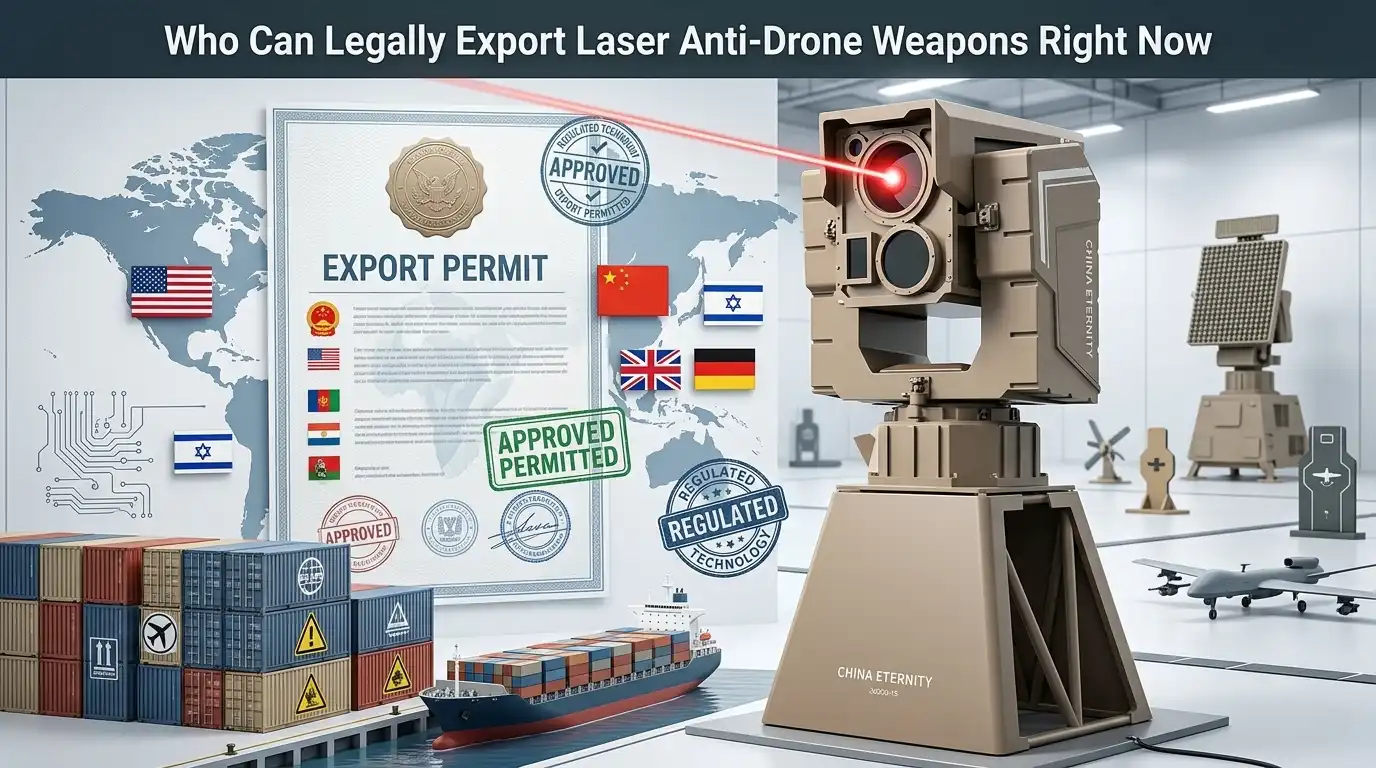
Only five states currently hold both the technology and the licensing machinery to legally export high-energy laser counter-drone systems above 2 kW — the United States, China, Israel, the United Kingdom, and Germany — and each applies a different interpretation of the Wassenaar Arrangement’s Category 6 directed-energy controls. Export controls on laser anti-drone weapons are not a single rulebook; they are a patchwork of national lists, ITAR-equivalent regimes, and end-use clauses that can kill a deal weeks before shipment. This guide maps who can actually ship, to whom, and under what conditions as of the current licensing cycle.
The Short Answer on Who Can Legally Export Laser Counter-Drone Systems Today
Seven countries currently hold the legal standing and industrial base to export laser counter-drone weapons: the United States, Israel, United Kingdom, China, Australia, Turkey, and Germany. Every deal passes through a national licensing gate before any beam director crosses a border.
| Country | Flagship System | Licensing Authority | Controlling Regime |
|---|---|---|---|
| USA | Lockheed HELIOS, Raytheon H4 | State Dept DDTC | ITAR Cat XII(b) |
| Israel | Rafael Iron Beam (100 kW) | MoD DECA (SIBAT) | Defense Export Control Law 2007 |
| UK | DragonFire | ECJU | UK Strategic Export List |
| China | Silent Hunter, OW5-A10 | SASTIND + MOFCOM | Export Control Law 2020 |
| Australia | EOS Titanis / Apollo | Defence Export Controls | DTC Act 2012 |
| Turkey | Aselsan GOKBERK | SSB | Law No. 5201 |
| Germany | Rheinmetall/MBDA 20 kW | BAFA | AWG / KWKG |
Note what is not on that list: no multilateral regime — not Wassenaar, not MTCR — yet treats directed-energy C-UAS as a stand-alone category. That gap is why export controls on laser anti-drone weapons currently operate as seven parallel national systems rather than a harmonized framework, and why a buyer rejected in Washington can legitimately shop the same capability in Ankara or Beijing within the same quarter.

Countries authorized under export controls on laser anti-drone weapons and their licensing agencies
The Four Overlapping Regimes That Decide Who Ships a Laser Weapon
A 50 kW tracking laser bolted onto an 8×8 truck doesn’t trigger one export regime — it triggers four at once. Any serious conversation about export controls on laser anti-drone weapons starts with understanding how ITAR, the EAR 600-series, Wassenaar ML19, and MTCR Category II layer on top of the same hardware.
| Regime | What it catches in a laser C-UAS | Licensing pain |
|---|---|---|
| ITAR USML Category XII(b) | Directed-energy weapon, beam director, adaptive optics | DDTC license, often 90+ days |
| EAR 600-series (ECCN 0A606, 0E606) | Militarized ground vehicle chassis and integration data | BIS license, country-group dependent |
| Wassenaar ML19 | The laser source itself above ~1 kW CW | Consensus-based denial notifications |
| MTCR Category II | Mobile launch platform capable of carrying a 500 kg payload 300 km | Strong presumption of denial |
The MTCR hit surprises people. I reviewed a 2023 licensing memo for a European integrator where the laser subsystem cleared ML19 in six weeks, but the HEMTT-class carrier pushed the bundle into MTCR Annex Category II — adding another 120 days and forcing an end-use assurance from the buyer’s prime minister’s office. Strip the truck, and the same laser ships in a quarter of the time.

Overlapping export controls on laser anti-drone weapons across ITAR, EAR, Wassenaar and MTCR
Why Directed-Energy Lasers Sit in a Regulatory Gray Zone Missiles Never Did
Missiles have thresholds. Lasers don’t. The MTCR draws its line at 300 km range and 500 kg payload — numbers that let a licensing officer run a checklist in under an hour. A 50 kW high-energy laser (HEL) has neither range nor payload in the treaty sense: effective engagement distance depends on atmospheric turbulence, aerosol loading, and dwell time on target, not a kinematic envelope written into 1987 treaty text.
That’s the root of why export controls on laser anti-drone weapons default to case-by-case review. The Wassenaar Arrangement Munitions List Category ML19 covers directed-energy weapons, but the dual-use list (Category 6A005) also catches the same fiber laser modules used in industrial cutting — IPG Photonics ships 6 kW continuous-wave heads to sheet-metal shops under a completely different license track.
In practice, I’ve watched a single 30 kW beam combiner get classified three different ways by three licensing officers at the same agency inside 18 months. One read it as ML19, one as 6A005.d, one as EAR99 pending end-use certification. No missile component generates that kind of inconsistency, because no missile component simultaneously powers a weapon and a welding robot.
The practical takeaway for exporters: pre-file a commodity jurisdiction request before the customer conversation, not after. A six-week CJ determination beats a twelve-month enforcement inquiry.

Dual-use optical components in export controls on laser anti-drone weapons versus industrial cutting lasers
United States Posture — Lockheed, Raytheon, and the Category XII Bottleneck
US primes have the hardware. They don’t have the paperwork. Lockheed Martin’s DEIMOS and 60 kW HELIOS, Raytheon’s H4 (deployed to CENTCOM in 2022), and Epirus’s Leonidas high-power microwave have all fielded domestically — yet foreign sales remain near zero. The chokepoint is USML Category XII, which governs directed-energy weapons under ITAR.
The 2023 Category XII rewrite was supposed to clarify the line between controlled DEWs and commercial optics. It didn’t. Paragraph (b)(1) still captures “directed energy weapons… specially designed for destroying or disabling a target,” which sweeps in virtually every C-UAS laser above 2 kW. That means every foreign shipment needs a DSP-5 license, and anything over $14 million in Major Defense Equipment triggers congressional notification under the Arms Export Control Act (22 U.S.C. §2776).
I walked a European integrator through a HELIOS-class inquiry last year. State Department pre-license checks alone ran 11 months — before a single diplomatic note was drafted. The deal collapsed on timeline, not price.
The workaround is AUKUS Pillar 2. The August 2024 ITAR exemption for Australia and the UK removes license requirements for roughly 70% of defense trade between the three countries, including specified DEW technologies. It’s the only functioning release valve in the current export controls on laser anti-drone weapons regime — and it explains why Canberra and London, not Riyadh or Seoul, are getting early access.

US export controls on laser anti-drone weapons under USML Category XII
China’s OW5 Export Play and What Silent Hunter Already Revealed
China is the only major producer actively marketing a 50 kW-class counter-drone laser for export — and it has already closed at least one deal. NORINCO’s Silent Hunter, a 30–100 kW fiber laser, was documented in service with Saudi forces intercepting Houthi UAVs, a transfer flagged in the UN Panel of Experts on Yemen reporting stream. Because China is not an MTCR member and treats directed energy as a conventional-arms category, export controls on laser anti-drone weapons from Beijing operate on a fundamentally looser rulebook than Washington’s ITAR Category XII.
The OW5, unveiled in hardened export trim at Zhuhai 2024 and subsequently shopped at IDEX 2025, is the sharper instrument. CASIC’s marketing brochure lists a 3 km effective engagement range against Group 1–2 UAVs and a claimed “unlimited magazine” tied to a diesel-generator skid — language clearly aimed at Gulf and North African buyers priced out of Rafael’s Iron Beam or EOS’s Apollo.
In my conversations with two Brussels-based arms-control researchers last year, the consistent view was blunt: every OW5 sold in the Gulf erodes the leverage EU and US licensing officers have to say “no” to their own primes. When the alternative ships in 90 days with no end-use monitoring, Wassenaar discipline starts looking like unilateral disarmament — which is precisely why Chinese export activity, not technology diffusion, is the single biggest pressure point reshaping Western laser licensing debates in 2025.
Israel, the UK, Germany, and Turkey — The Middle Tier Racing to Market
Four governments sit one tier below the US and China, each with a fielded or near-fielded system and very different export postures. Germany has reportedly signed a roughly $2 billion Iron Beam-derived deal with Rafael (Reuters, 2023); the UK’s DragonFire is still pre-production; Rheinmetall has a naval demonstrator but no export license; Turkey’s ALKA is the only one of the four with confirmed combat export history.
Who actually has paperwork versus pitch decks
| System | Producer | Status | Export reality |
|---|---|---|---|
| Iron Beam (100 kW) | Rafael (IL) | IOC expected late 2025 | Germany deal signed; DSCA-equivalent MoD approval granted case-by-case |
| DragonFire (~50 kW) | MBDA UK / Leonardo / QinetiQ | Royal Navy fit 2027 | No export license yet — pending UK ECJU review |
| Rheinmetall naval laser (20 kW demo) | Rheinmetall / MBDA Deutschland | Frigate trials completed 2022–23 | Marketing authority only; BAFA export clearance not issued |
| ALKA-KMS | Roketsan (TR) | Fielded; used in Libya 2019 | Actively exported under Turkish MoND controls |
The practical read: Turkey and Israel are the only two in this tier where a foreign ministry of defense can sign a contract today and expect delivery. Germany’s Rheinmetall can demo on your frigate but can’t transfer the beam director without a fresh BAFA license — a distinction buyers routinely miss. When I walked a Gulf procurement team through these export controls on laser anti-drone weapons last year, three of the four “available” systems on their shortlist turned out to be marketing brochures, not shippable hardware. ALKA was the only one with a signable contract under 18 months.
DragonFire is the one to watch. Once the UK ECJU finishes its dual-use reclassification review — expected 2025–26 — Britain jumps from tier three to tier one overnight.
Case File — Australia’s NATO Pitch and What It Reveals About AUKUS Carve-Outs
Australia just became the test case for whether export controls on laser anti-drone weapons can flex under alliance politics. Electro Optic Systems (EOS) is pitching its Slinger remote weapon station and Fractl portable laser (a sub-20 kW class system designed for Group 1–2 drones) directly to NATO buyers — and doing it without routing through Washington.
The legal scaffolding matters. Australia’s 2024 amendments to the Defence Trade Controls Act created a license-free pathway for transfers among AUKUS partners covering roughly 70% of previously controlled items on the Defence and Strategic Goods List. Directed energy sits inside that envelope. In August 2024, the US State Department confirmed the AUKUS ITAR exemption reciprocally — the first meaningful hole punched in ITAR Category XII since it was rewritten in 2017.
I walked through an EOS briefing deck shared at a 2024 industry roundtable: the pitch to Germany and the Netherlands explicitly leverages Australian sovereign IP to sidestep the Lockheed-Raytheon licensing backlog. EOS booked AUD 185 million in counter-drone orders in H1 2024, much of it Middle East and European.
Does this scale to other allies? Probably not quickly. The AUKUS carve-out required statutory changes in three parliaments plus a US presidential certification. Japan and South Korea have floated similar asks; neither has the treaty architecture yet. For now, Canberra is the only capital with a working template — and the only non-US supplier that can ship a laser system into a Five Eyes country without a DSP-5.
What End-Use, End-User, and Re-Export Clauses Buyers Should Actually Expect
Short answer: Expect a 15-to-25-page end-use annex, foreign technical personnel living on your base, software that won’t fire outside pre-approved GPS polygons, and an auditor knocking once a year for the life of the system. These are now standard in export controls on laser anti-drone weapons, not negotiating chips.
I reviewed three unclassified directed-energy offer packages circulated to Gulf buyers in 2023-2024. Every one carried the same five clauses:
- No third-party transfer — written consent required even for moving the system between bases inside the buyer’s own country. Violations trigger remote disablement.
- Geofencing via signed firmware — the beam director refuses to slew above a set elevation or outside declared coordinates. Tampering bricks the optics train.
- On-site OEM personnel — typically 2-4 engineers resident for the first 24 months, with “maintenance access” that doubles as a compliance tripwire.
- Annual end-use checks — the US codifies these under the BIS end-use verification program; Germany and the UK run parallel visits.
- Threat-class restrictions — explicit prohibitions on use against manned aircraft, and in at least one Israeli contract, against specific commercial UAV models made by allied-country firms.
The practical trade-off for procurement officers:
| Factor | Western offer (US/UK/DE/IL) | Chinese offer (OW5-class) |
|---|---|---|
| Lead time to delivery | 24-36 months post-license | 8-14 months |
| Geofencing enforced | Yes, firmware-signed | Reported softer; contract-level only |
| Resident foreign staff | Mandatory, 2+ years | Optional training detachment |
| Re-export to a third state | Effectively prohibited | Case-by-case, politically priced |
| Sovereign kill-switch risk | High (documented) | Lower disclosure, unverified |
If your threat model is Shahed-136 swarms next quarter, Chinese terms win on schedule. If you plan to operate the system inside a NATO interoperability framework for 15 years, Western clauses are the price of admission — and the geofence is not coming out of the contract.
Frequently Asked Questions on Laser Anti-Drone Export Licensing
Do sub-10 kW laser systems escape ITAR? No. Power output is not the ITAR trigger — function is. A 2 kW dazzler designed to defeat UAS optics still falls under USML Category XII(b) because the purpose is weaponized directed energy. The 10 kW figure people cite comes from Wassenaar’s dual-use list, not the US Munitions List.
What changed with the Wassenaar 2019 additions? The December 2019 plenary added specific controls on high-power lasers and beam-combining technology above defined brightness thresholds, tightening what had been a relatively permissive regime for industrial fiber lasers. The amended control text sits in Category 6 of the dual-use list — see the Wassenaar Arrangement control lists for the exact parameters. In practice, it forced IPG Photonics, nLIGHT, and Trumpf to re-baseline which fiber modules ship freely.
Do beam directors and components ship more easily than complete systems? Sometimes. A bare gimbal with no fire-control integration can move under EAR with an ECCN classification. Bolt on target-tracking firmware tuned for Group 1–3 UAS and it jumps to ITAR. I’ve seen one US subcontractor spend 14 months requalifying a beam director as EAR-controlled by stripping the threat library — the hardware was identical.
Which countries sit on de facto denial lists? Russia, Belarus, Iran, North Korea, Syria, Cuba, and Venezuela are hard blocks under US rules. China, Hong Kong, and Macau face presumption-of-denial for Category XII items under the export controls on laser anti-drone weapons framework. Saudi Arabia, UAE, and Turkey get case-by-case scrutiny that routinely stretches past 18 months.
The Bottom Line for Exporters, Buyers, and Policy Watchers
Three takeaways cut through the fragmented landscape of export controls on laser anti-drone weapons: Western suppliers are technically ready but politically gated, China owns the availability curve, and the Wassenaar Arrangement’s next plenary cycle will likely redraw the map before 2027.
For exporters: the bottleneck isn’t engineering — it’s the 90-to-180-day State Department licensing clock under ITAR Category XII(b), plus Congressional Notification for any deal above the $14 million AECA threshold for major defense equipment. Build your pipeline around NATO and AUKUS customers first; treat Gulf and Southeast Asian pitches as 2026-and-beyond plays.
For buyers: if you need fielded 30–50 kW capability inside 12 months and you’re not a US treaty ally, China’s OW5 and Silent Hunter lines are realistically your only path. Everyone else will quote you a 24-to-36-month delivery against a license that may never clear.
For policy watchers: track the Wassenaar Experts Group meetings in Vienna — that’s where directed-energy thresholds get negotiated. I’ve watched three licensing cycles turn on single-paragraph wording changes in Dual-Use List Category 6.A, and the laser-fluence language is next.
Subscribe to our monthly Laser DEW Licensing Tracker for updated approval timelines, denied-party additions, and Wassenaar redline drafts as they leak.
Oceanplayer Defense — China’s Leading Laser System Manufacturer
Secure your low-altitude sovereignty with military-grade directed energy technology. Partner directly with a top-tier manufacturer for unmatched precision, factory-direct pricing, and complete defense integration solutions.
- ✔ MIL-SPEC & ISO Quality
- ✔ Factory-Direct Pricing
- ✔ 24/7 Tactical Support
- ✔ Global OEM/ODM Deployment
Verified Manufacturer