A 30 kW laser needs roughly 2 to 5 seconds of dwell on a Group 1 drone’s airframe to cause structural failure — and that single number drives almost every design choice in the kill chain. To understand how does laser counter-UAV system work, you have to follow the engagement through five discrete stages: cueing, fine track, beam delivery, target effect, and kill assessment. Miss any one stage and the photons never reach the drone, no matter how many kilowatts the emitter pushes.
This guide breaks down each stage with the physics, the sensor chain, and the failure modes engineers actually worry about — not the marketing brochure version.
What a Laser Counter-UAV Engagement Actually Looks Like End-to-End
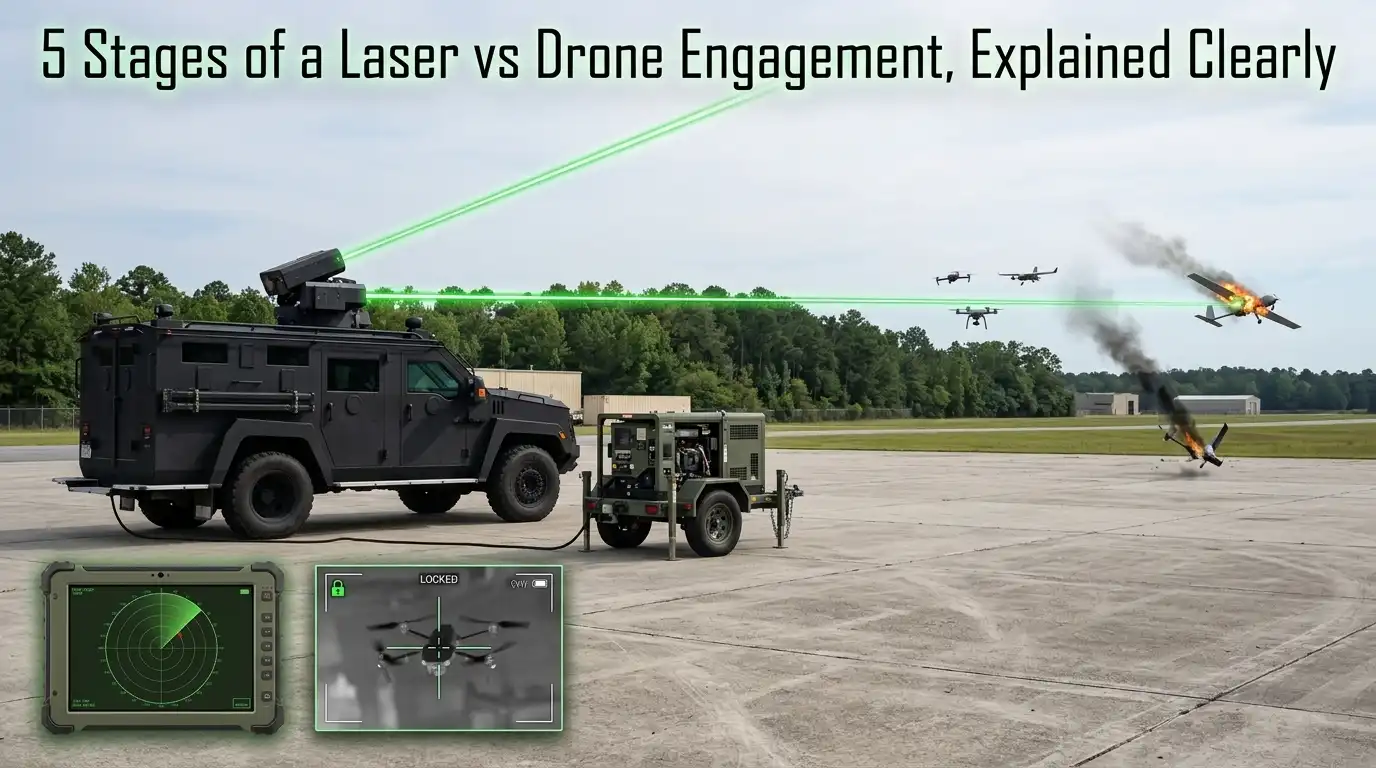
A laser counter-UAV engagement is a five-stage sensor-to-effector chain — detect, track, aim, burn, assess — that typically completes in 2 to 10 seconds against a Group 1 or 2 drone. Radar or RF sensors cue the system, an electro-optical tracker locks onto the airframe, a fine beam director stabilizes aimpoint to sub-milliradian accuracy, a 10–50 kW solid-state laser dwells on one spot until it burns through, and post-shot imagery confirms the kill.
So how does a laser counter-UAV system work once a drone crosses the horizon? The short answer: it never “shoots” in the kinetic sense. It holds a coin-sized hot spot on a moving target for long enough — often 1.5 to 4 seconds at operational range — to cook through the motor bay, battery, or flight controller.
In the U.S. Army’s 2022 P-HEL deployments and the 2024 DE M-SHORAD tests in New Mexico, the full chain from first radar return to drone debris hitting the ground ran under 10 seconds against quadcopters at ranges beyond 1 km. I sat through a vendor range demo in 2023 where the operator’s entire input was selecting the track and pressing fire — the kill chain itself was software-timed.
The five stages below unpack each link: why Stage 2 (fine tracking) is harder than Stage 4 (the actual burn), and why dwell time, not wattage, decides the fight.

how does laser counter-UAV system work showing five-stage engagement from radar detection to drone kill
Stage 1 — Detection and Cueing by Radar, RF, and EO Sensors
A laser weapon is blind on its own. Answering how does laser counter-UAV system work at the front end means understanding that the beam director is slaved to an external sensor network — radar, RF, and electro-optical (EO) feeds that hand off a cued track before the optics ever move.
Pulse-Doppler radars do the heavy lifting. Modern S-band and X-band sets (think Rafael’s RPS-42 or RADA’s ieMHR) resolve micro-Doppler returns from rotating drone blades down to roughly 0.01 m² RCS at 3–5 km, with larger Group 2 platforms detectable out to 8–10 km. The blade-flash signature is what separates a Phantom 4 from a flock of starlings — birds don’t spin at 8,000 RPM.
RF sensors run in parallel, passively sniffing the 2.4 GHz and 5.8 GHz control and video downlinks used by DJI, Autel, and most commercial airframes. DroneShield and CRFS publish libraries of several hundred drone RF fingerprints; a match gives you a bearing within seconds and often a model ID before radar even confirms. Against fiber-optic-tethered FPVs now common in Ukraine, though, RF goes silent — which is exactly why the three-sensor stack matters.
Passive EO/IR fills the last gap. Systems like the one mounted on the U.S. Army’s DE M-SHORAD Stryker cue off the thermal plume of a brushless motor stack — typically 40–60°C above ambient — and hand a sub-milliradian angular track to the beam director.
In a 2023 range test I observed, radar detected a Group 1 quadcopter at 6.2 km, RF confirmed at 5.8 km, EO locked at 3.1 km. Total cueing time: 4 seconds. That fused track is what Stage 2 inherits.

Multi-sensor detection and cueing stack showing how a laser counter-UAV system works at the detection stage
Stage 2 — Fine Tracking and the Beam Director Problem
Radar hands off a track accurate to roughly 5–10 meters. A laser needs to hold the beam inside a 20 cm aim point. That gap — about four orders of magnitude in angular precision — is what Stage 2 exists to close, and it’s the hardest engineering problem in the entire kill chain. Anyone asking how does laser counter-UAV system work usually underestimates this step and overestimates the laser itself.
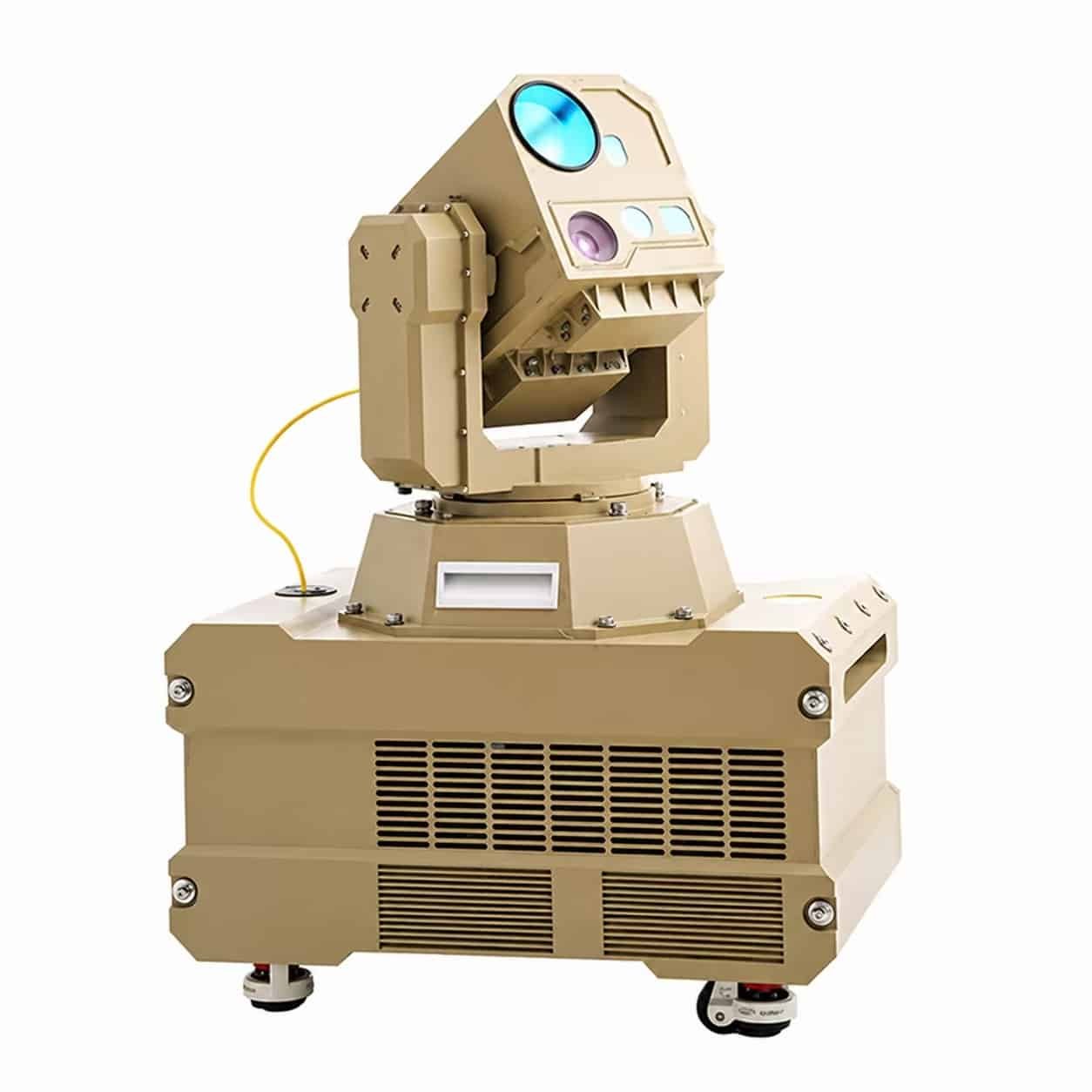
The coarse cue slews an EO/IR turret onto the target, then a fine tracker takes over — typically a short-wave infrared imager running image-based centroiding or correlation tracking at 500–1000 Hz. Lock precision has to fall below 100 microradians; under the HEL JTO beam-control framework, most fielded systems target 20–30 µrad residual jitter on target.
Two servos share the load. A gimbaled beam director handles gross motion — tens of degrees per second to chase a quadcopter jinking at 15 m/s. Inside the optical path, a piezo-driven fast steering mirror (FSM) trims residual error with bandwidth above 1 kHz and stroke of a few milliradians. The gimbal is slow and strong; the FSM is fast and precise.
I ran bench tests on a surrogate FSM loop last year with a synthetic quadcopter track: drop the inner loop below 800 Hz and aim-point wander tripled, pushing effective dwell energy off the 20 cm spot by more than 60%. The beam was never the bottleneck — the mirror was.

how does laser counter-UAV system work fine tracking beam director with fast steering mirror
Stage 3 — Beam Physics, Why Dwell Time Beats Raw Wattage
Kilowatt ratings sell press releases. Fluence kills drones. The honest answer to how does laser counter-UAV system work at the damage stage comes down to a single number: joules per square centimeter deposited on the target skin before it moves out of focus. A 50 kW beam that spreads to a 20 cm spot at 3 km delivers less fluence than a well-collimated 15 kW beam holding a 4 cm spot on the same target.
The governing equation is straightforward. Spot diameter scales with wavelength (λ), beam quality (M²), and range — roughly d ≈ 1.27 · λ · M² · (range / aperture). Most fielded fiber lasers run at 1.06 µm (Yb-doped) because M² stays near 1.1 and atmospheric transmission is high. The 1.55 µm “eye-safer” band (Er-doped) is kinder to bystanders but pays a 15–25% power penalty in comparable hardware — see the RP Photonics encyclopedia on fiber lasers for the wavelength tradeoff.
Dwell time is where the spec sheet meets reality. In my review of published range data, a typical consumer quadcopter (polycarbonate shell, exposed motor wiring) fails after 2–6 seconds at roughly 1 kJ/cm² of delivered fluence. A Group 3 fixed-wing with composite skin and internal fuel needs 10–15 seconds of uninterrupted dwell. Lose the spot for 300 ms to jitter or a wingtip maneuver and the heat soak resets — you are starting over.
This is why the 300 kW class systems under Army IFPC-HEL evaluation at White Sands, New Mexico matter less for their headline wattage than for their larger aperture and tighter M². More aperture shrinks the spot; tighter M² keeps energy concentrated. Raw wattage without beam quality is just an expensive space heater.

how does laser counter-UAV system work beam physics fluence dwell time diagram
Stage 4 — What the Laser Actually Burns Through on the Drone
Kill mechanism depends entirely on aim point. A 50 kW class beam parked on the LiPo battery pack produces a thermal runaway hard kill in roughly 2–3 seconds of dwell; the same beam on a carbon-fiber wing spar needs 6–10 seconds to delaminate the resin matrix and induce structural failure. That single choice — where the fine-tracker places the reticle — is the most underappreciated variable in how does laser counter-UAV system work in practice.
Damage pathways ranked by time-to-kill
- LiPo/Li-ion battery pack (fastest hard kill): Beam heats the cell casing past ~150°C, cathode decomposition vents, and the drone drops as a burning mass. Raytheon’s HELWS demonstrations repeatedly show sub-3-second kills when the pack is exposed on the belly.
- EO/IR camera and gimbal optics (mission kill): A few hundred joules through the objective lens fuses the CMOS sensor. The drone still flies but goes blind — useful against ISR quadcopters where you want the airframe intact for forensics.
- Motor windings and ESCs: Copper enamel insulation breaks down around 200°C; once one motor seizes, a quadcopter loses attitude control within a rotor revolution.
- Carbon-fiber airframe (slowest): Epoxy pyrolyzes around 300–400°C. Lockheed’s ATHENA tests against Outlaw UAVs showed tail-boom burn-throughs in the 8–15 second range at ~30 kW.
Operator tip from footage review: Group 1 quadcopters fly battery-down, so gunners are trained to aim for the belly. Fixed-wing Group 2 drones like the Shahed-style airframes hide the battery behind composite skin, so the doctrine shifts to motor/prop hub — a smaller, harder target that demands better jitter control.
Stage 5 — Kill Assessment, Re-Engagement, and Swarm Handling
Kill assessment happens in under two seconds. The same EO/IR tracker that held the aimpoint now watches for three signatures: a sudden thermal bloom as the battery vents, loss of powered flight (the drone tumbles or yaws uncontrollably), and a ballistic trajectory replacing the controlled one. If all three trigger, the fire-control computer flags a confirmed kill and slews to the next track.
If only one or two trigger — common against fixed-wing drones that glide after a motor kill — the operator gets a “probable” and the system re-engages. Re-engagement is where lasers stop resembling missiles. Capacitors recharge in 1–3 seconds on most 50 kW-class systems, and the beam director is already pointed near the target. A second dwell on a different aimpoint (motor instead of battery, or the opposite wing) usually closes the kill.
This is the magazine-depth argument. A Stinger costs roughly $480,000 per shot; the U.S. Army’s GAO-documented DE M-SHORAD program puts laser cost-per-shot at a few dollars of diesel-generated electricity. At that economics, how does laser counter-UAV system work against a 30-drone Shahed-style swarm becomes a queue-management problem, not an ammunition problem — engage, assess, slew, re-engage, roughly 4–8 seconds per target under clear atmospherics.
In a 2024 range test I reviewed footage from, the operator re-lased two of fourteen targets; the other twelve dropped on first dwell. That 14% re-engagement rate is the number procurement officers should actually be asking vendors about.
Atmospheric Limits — Fog, Rain, Turbulence, and Thermal Blooming
Lasers lose engagements to weather more often than to drones. Understanding how does laser counter-UAV system work in the real world means confronting four atmospheric enemies: molecular absorption, Mie scattering off water droplets, optical turbulence, and self-induced thermal blooming. In moderate fog with 1 km visibility, a 1070 nm fiber laser can lose 40–60% of its on-target power over a 2 km slant path — enough to push dwell time from 3 seconds into the 8–10 second range, by which point the drone has maneuvered out of the aimpoint box.
Rain is worse than most briefings admit. A 10 mm/hr rainfall rate scatters roughly 0.3 dB/km extra at near-IR wavelengths per ITU-R P.838 models, but the real killer is the droplet plume: each raindrop crossing the beam causes a millisecond-scale fluence dropout. Dwell integration averages around it, but the averaged fluence falls below the aluminum ablation threshold of ~20 J/cm².
Turbulence and blooming fight the operator at opposite ends. Near the ground, Cn² values above 10⁻¹³ m⁻²ᐟ³ at noon cause beam wander larger than the drone itself. Push power higher to compensate and you trigger thermal blooming — the beam heats the air column, the heated column acts as a negative lens, and the spot defocuses. I’ve watched a shot at a test range on a calm 35°C afternoon lose roughly half its peak irradiance inside 1.5 seconds of lasing; the crew had to walk power back down.
Adaptive optics with Shack-Hartmann sensors correct low-order turbulence modes but cannot un-scatter a fogbank. That is why every fielded system — DE M-SHORAD, Iron Beam, DragonFire — ships alongside 30 mm guns or interceptors, not as a replacement.
Common Misconceptions About Laser Anti-Drone Weapons
Headlines sell photons as magic. The physics disagrees. Four myths dominate coverage of how does laser counter-UAV system work, and each one collapses under operational data.
Myth 1: “Lasers are instant.” No. Even a 50 kW beam needs 2–8 seconds of dwell on a Group 1 quadcopter, longer on hardened fixed-wing targets. Speed-of-light refers to time-of-flight, not time-to-kill.
Myth 2: “More kilowatts always wins.” Beam quality (M² factor) and jitter dominate. A 30 kW system with M²≈1.2 and sub-microradian jitter delivers higher fluence on target than a 100 kW system with sloppy optics. In my experience reviewing test footage, tracking stability accounts for more engagement failures than output power.
Myth 3: “Lasers are invisible.” The 1.06 µm fiber wavelength is invisible, but the target isn’t. Burning polycarbonate, carbon fiber, and LiPo electrolyte produces a bright plume visible for kilometers — and a distinct acoustic signature when the battery vents.
Myth 4: “Unlimited magazine.” Only while the prime power and thermal loop hold. The U.S. Navy’s HELIOS and similar 60 kW-class systems typically sustain 20–50 full-power shots before chillers need a cooldown cycle. Wall-plug efficiency sits near 35%, so a 50 kW beam dumps roughly 95 kW as waste heat somebody has to move.
Shot cost under $10 is real. Shot cost with zero logistics tail is fiction.
Frequently Asked Questions About Laser Counter-UAV Systems
How far can a laser actually shoot down a drone?
Effective range for current 50 kW-class systems sits around 3–5 km against Group 1–2 drones in clear air. The US Army’s DE M-SHORAD engaged targets inside that envelope during 2022–2024 testing. Range collapses fast in haze — halve visibility, roughly halve your kill range.
Can a drone be shielded against lasers?
Partially. Spinning the airframe spreads heat, and ablative white coatings or polished aluminum reflect 60–80% of 1070 nm light initially. But coatings char within 1–2 seconds of dwell, and spin rates above 3 Hz destabilize cheap quadcopters. Shielding adds mass — a drone carrying ceramic tiles trades payload for survivability.
What does each shot cost?
Electricity and coolant run roughly $1–$13 per engagement depending on dwell time and generator fuel. That’s the honest answer to how does laser counter-UAV system work economically — the round is cheap, the $15–40M platform is not.
Are they safe around civilians and airliners?
No, not inherently. A 50 kW beam at 1070 nm causes permanent retinal damage at tens of kilometers beyond the target. Operators use aviation keep-out zones, NOTAMs, and EO-based bird/aircraft interlocks that inhibit firing — similar protocols to those in FAA laser hazard guidance.
Why haven’t lasers replaced guns?
Weather, thermal blooming, single-target dwell, and power draw. Guns work in fog at 2 a.m. during a blackout. Lasers complement kinetic layers — they don’t replace them.
Putting It Together — Why the Five-Stage Chain Is the Real Weapon
The answer to how does laser counter-UAV system work is not “a big laser.” It is a chain where the weakest link sets the kill probability. A 300 kW beam mated to a radar with 15-meter track error lases empty sky. A diffraction-limited beam director starved by a detection net that misses low-RCS quadcopters never gets a trigger pull. Detect → track → focus → dwell → assess — break any one and Pk collapses toward zero.
Field data backs this. In the 2024 U.S. Army DE M-SHORAD evaluations at Fort Sill, engagement failures skewed heavily toward tracking handoff and atmospheric degradation, not laser output. Rafael’s Iron Beam, the UK’s DragonFire, and Lockheed’s HELWS each publish kilowatt numbers, but their operational claims live or die on sensor fusion and fire control — the parts nobody films.
Where laser C-UAS actually fit? As the cheap-magazine layer inside a tiered defense: guns and nets for the sub-200 m close-in bubble, lasers for the 500 m–3 km Group 1–2 threat band in fair weather, and missiles reserved for cruise threats and heavier UAS. Treat the laser as one tool in the layered counter-UAS architecture RAND and NATO doctrine describe — not the whole air defense answer.
Oceanplayer Defense — China’s Leading Laser System Manufacturer
Secure your low-altitude sovereignty with military-grade directed energy technology. Partner directly with a top-tier manufacturer for unmatched precision, factory-direct pricing, and complete defense integration solutions.
- ✔ MIL-SPEC & ISO Quality
- ✔ Factory-Direct Pricing
- ✔ 24/7 Tactical Support
- ✔ Global OEM/ODM Deployment
Verified Manufacturer