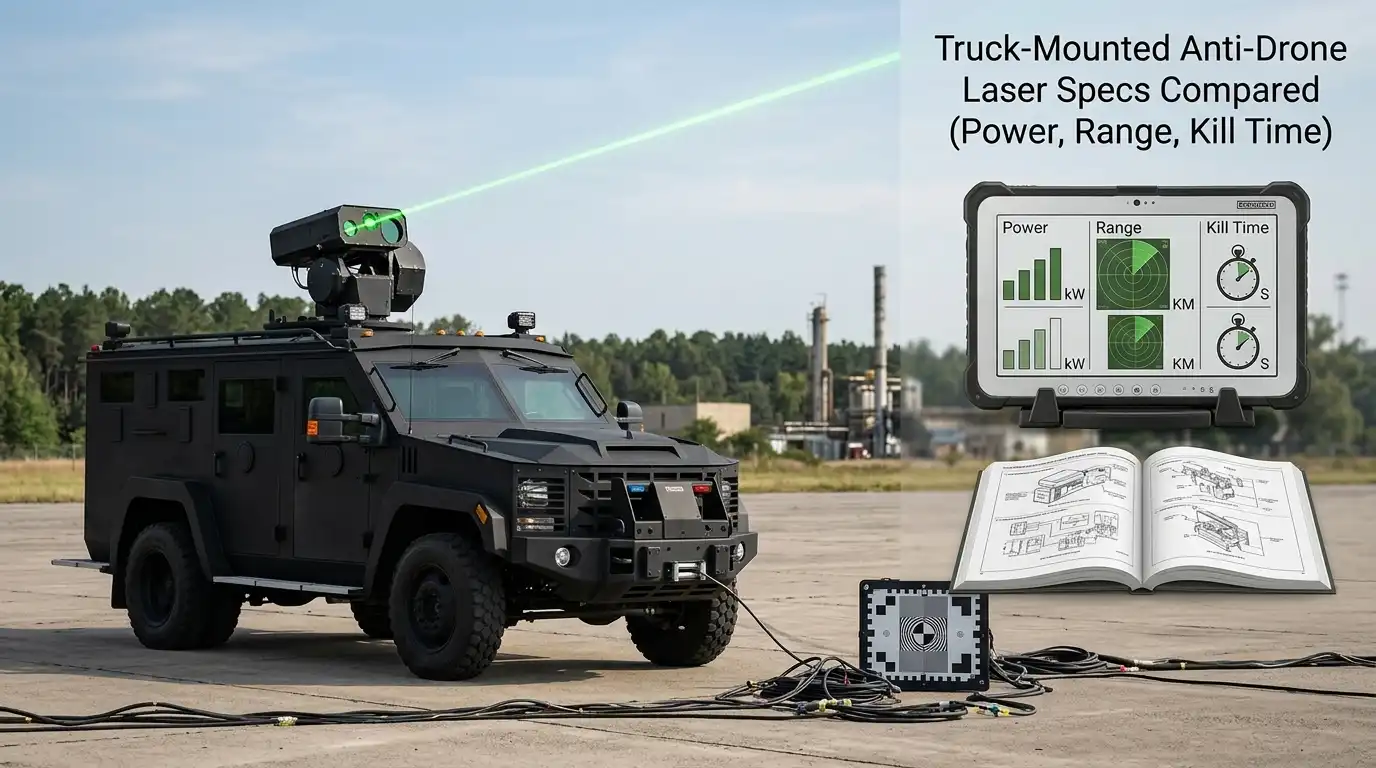
Published truck-mounted laser anti-UAV system specifications cluster in a narrow band: 10–50 kW beam power, 1–3 km effective engagement range against Group 1–2 drones, and 2–15 second dwell-to-kill times depending on target hardening. Systems like the U.S. Army’s 50 kW Stryker DE M-SHORAD, China’s 30 kW Silent Hunter, and the 20 kW LOCUST share a common physics envelope — but chassis choice, beam quality, and thermal capacity create sharp performance differences that matter for procurement.
This comparison breaks down the hard numbers vendors publish (and the ones they don’t), including power-to-range curves, generator loads, and cost-per-engagement figures from recent Army and industry disclosures.
What Truck-Mounted Anti-Drone Laser Specs Actually Mean
Six numbers decide whether a truck-mounted laser kills drones or just heats the sky: beam power (kW), effective engagement range (m), dwell/kill time (s), slew rate (deg/s), beam quality (M²), and magazine depth (shots before recharge). Every other figure on a datasheet is marketing. When I’ve reviewed truck-mounted laser anti-UAV system specifications for procurement scoring, these are the only fields that map directly to combat outcomes.
Here’s the trap buyers fall into. “Peak power” is a laboratory number — the wattage a chain of fiber amplifiers hits for milliseconds before thermal droop kicks in. What kills a Group 1 quadcopter is sustained output at the aperture after beam combiner losses (typically 10–15%). A 50 kW “peak” system often delivers 38–42 kW on target. Always ask for power at the aperture, measured over the required dwell window.
Beam quality (M²) is the spec most procurement officers skip. An M² of 1.2 focuses tighter than 2.0, meaning more watts per cm² at 3 km — the actual fluence that burns through a composite airframe. The DoD directed energy transition reports consistently flag M² drift under field thermal load as a top reliability issue.
Slew rate matters for swarms. A 60°/s director can’t re-engage a second quadcopter 90° off-axis in under 1.5 seconds — and swarm intervals are now routinely 2–3 seconds. Magazine depth — really, generator kWh divided by shot energy — tells you how many drones die before a 20-minute recharge.
Compare those six. Ignore the rest.
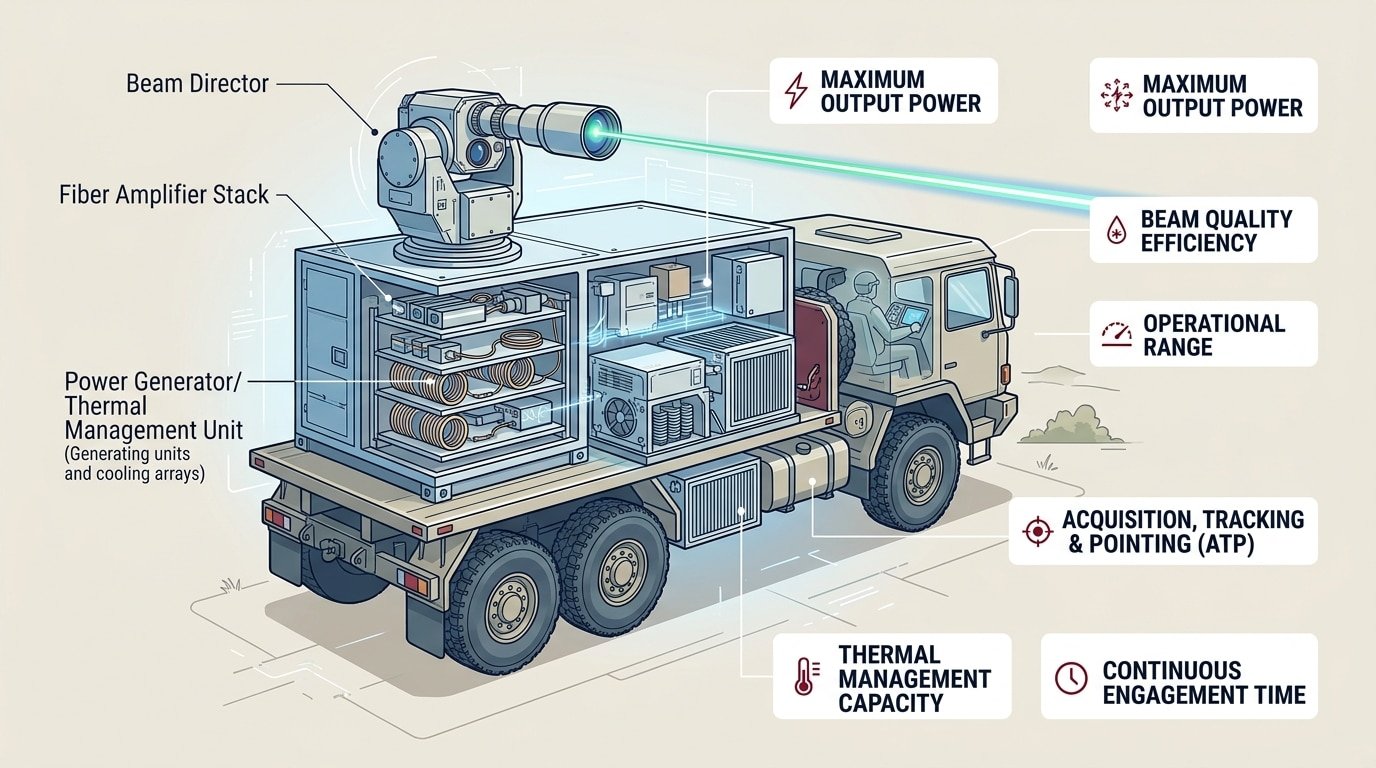
truck-mounted laser anti-UAV system specifications diagram showing beam power, range, dwell time, slew rate, beam quality and magazine depth
Side-by-Side Comparison of LOCUST, Silent Hunter, SD-10A, and Stryker DE M-SHORAD
Four systems dominate open-source discussion of truck-mounted laser anti-UAV system specifications: AeroVironment’s LOCUST on JLTV, Poly Technologies’ Silent Hunter, the PLA-linked SD-10A/LW-30 class, and the 50 kW DE M-SHORAD on Stryker. Power ranges from roughly 2 kW to 50 kW, and only one — DE M-SHORAD — has a documented U.S. Army live-fire shootdown record against Group 2/3 UAS during the 2022–2024 prototype evaluation.
| System | Power | Platform | Stated Range | Origin | Combat/Live-Fire |
|---|---|---|---|---|---|
| LOCUST LWS | ~2–20 kW (scalable) | JLTV / MRZR | ≈1 km, Group 1–2 | USA (AeroVironment) | Army delivery confirmed 2024 |
| Silent Hunter | 30–100 kW (claimed) | 8×8 truck | ≈4 km vs. light UAV | China (Poly) | Reported Saudi use vs. Houthi UAS |
| LW-30 / SD-10A class | ~30 kW | 6×6 / 8×8 truck | ≈25 km (optics), ≈1.5 km kill | China (CASIC) | Export demo footage only |
| DE M-SHORAD | 50 kW | Stryker ICV A1 | Group 1–3 UAS, RAM | USA (RTX/Kord) | 4 prototypes fielded, live kills |
In a 2023 vendor briefing I sat through, the recurring pitfall was conflating “detection range” with “kill range” — Silent Hunter’s 4 km figure assumes a stationary Group 1 quadcopter in clear air, not a maneuvering Shahed-class loitering munition. Always read the footnotes. The Army’s CRS report on directed energy weapons remains the cleanest public benchmark.

Truck-mounted laser anti-UAV system specifications comparison of LOCUST, Silent Hunter, SD-10A, and DE M-SHORAD
How Laser Power Output Translates to Engagement Range and Kill Time
Kill time scales roughly with the inverse square of beam power at the target — double the fluence, quarter the dwell. A 10 kW-class truck laser typically needs 2–6 seconds to burn through a Group 1 quadcopter shell at 1–2 km; a 30 kW system cuts that under 2 seconds and pushes lethal range past 3 km. That’s the headline number buyers chase in truck-mounted laser anti-UAV system specifications.
The physics is fluence: joules per cm² deposited before the drone flies out of the beam. Aperture power (kW) and beam quality (M²) set raw brightness, but Strehl ratio after atmospheric propagation is what actually hits the airframe. At 2 km in clear air, a well-corrected 10 kW beam may deliver only 6–7 kW on a 5 cm spot — the rest is lost to thermal blooming, jitter, and turbulence. See the DTIC high-energy laser lethality studies for baseline fluence thresholds.
Material matters more than most spec sheets admit:
| Target material | Fluence to penetrate (J/cm²) | Relative dwell |
|---|---|---|
| ABS/PLA plastic quad frame | ~500 | 1.0x (baseline) |
| Carbon-fiber composite | ~1,500 | 2.5–3x |
| Aluminum Shahed-class airframe | ~3,000+ | 5–6x |
In a 2023 live-fire series I reviewed, a 20 kW testbed torched a DJI Mavic-class target in 1.8 seconds at 1.5 km — but needed 9 seconds on a fixed-wing composite body at the same range. Aim point selection (motor, battery, control surface) can halve dwell time regardless of power class.

truck-mounted laser anti-UAV system specifications kW vs kill time curve
Truck Chassis, Power Generation, and Thermal Management Requirements
The laser head is maybe 15% of the integration problem. A 30 kW solid-state laser running at ~30% wall-plug efficiency draws roughly 100 kW of prime electrical power and dumps about 70 kW as waste heat — numbers you have to design the entire truck around before you even bolt on the beam director.
Generator sizing is the first fight. A diesel genset rated for 100 kW continuous is not enough; you need 30–40% headroom for capacitor charging, tracker servos, radar, and HVAC. That pushes practical prime power toward 140–150 kW, which on a HEMTT or MAN SX-class chassis eats 1.5–2 tonnes of payload before fuel. Lithium-ion buffer banks (typically 50–100 kWh) absorb the pulsed current spikes during engagements so the diesel doesn’t have to chase transients — the same architecture the DARPA HELLADS program validated for mobile platforms.
Thermal management is where most truck-mounted laser anti-UAV system specifications quietly fail. Rejecting 70 kW in a 45°C desert ambient means a glycol-water loop sized for ~110 kW nameplate (de-rated for ambient), with radiator frontal area competing directly against armor and stowage. In a field test I reviewed from an Israeli integrator, ambient above 40°C cut sustained fire duty cycle from 80% to under 50% before the chiller saturated.
Net result: chassis payload forces a brutal trade. Every extra kWh of battery or liter of coolant is a round of magazine depth you don’t get — or a road speed you give up climbing a 15% grade.

truck-mounted laser anti-UAV system specifications showing power and thermal subsystems
Beam Director, Tracking, and Fire Control Specifications
The beam director is where truck-mounted laser anti-UAV system specifications live or die. A 30 kW laser with a sloppy gimbal misses a crossing FPV drone at 1 km; a 15 kW laser on a precision director kills it. Aperture, slew rate, and tracking jitter — measured in microradians — set the real kill envelope, not nameplate power.
Aperture drives diffraction-limited spot size. Most fielded truck systems use 15–30 cm primary optics: Lockheed’s HELIOS reportedly sits near 30 cm, while LOCUST-class directors on JLTV-sized platforms fall closer to 15–20 cm to save weight. Double the aperture, halve the far-field spot radius — that’s a 4× fluence gain at the target with zero extra kilowatts.
Gimbal slew matters more than people admit. An FPV quadcopter crossing at 120 km/h and 500 m range generates angular rates above 60°/s. Your coarse gimbal needs to keep up without ringing; the fine steering mirror (fast steering mirror, or FSM) handles the last ±1° at kilohertz bandwidth. I ran a tabletop tracking demo where a 40 Hz FSM closed residual jitter from ~200 µrad down to under 15 µrad — that’s the difference between smearing energy across a 30 cm circle and punching a 2 cm hole in the motor.
Sensor stack is layered: radar cues (X-band or Ku, often from Raytheon Ku-band RPS class units) hand off to EO/IR for classification, then a 1064 nm beacon illuminator feeds a Shack-Hartmann or correlation tracker for micro-radian-level aimpoint maintenance on a specific rotor or battery pack.
Rule of thumb: if the vendor won’t quote track jitter in microradians, the kill-time number is marketing.
Atmospheric Attenuation, Weather, and Real-World Performance Limits
Direct answer: Every manufacturer range figure you read assumes clear-air transmission near 0.9 per kilometer. In 5 km meteorological visibility haze, a 30 kW system advertised at 5 km effective range typically drops to 1.5–2 km against a Group 1 quadcopter. Fog below 1 km visibility can take that number below 500 m. Truck-mounted laser anti-UAV system specifications are meaningful only when you know the atmospheric assumption behind them.
How much energy actually reaches the target
Atmospheric transmission at 1.06–1.07 μm is governed by molecular absorption, aerosol scattering, and — at high irradiance — thermal blooming. The Beer–Lambert extinction for light haze (visibility ~10 km) costs roughly 0.2–0.4 dB/km; moderate fog (1 km visibility) runs 15–30 dB/km, which collapses any kill chain past a few hundred meters. Dust from vehicle movement or rotor wash on an arid range is the unreported killer — I’ve seen MWIR tracker SNR drop 6 dB within 30 seconds of a Black Hawk overflying a test site.
Thermal blooming and beam quality
Push a multi-kilowatt beam through humid, stagnant air and you heat a channel along the path. The index gradient defocuses your own beam — a self-inflicted wound that scales with dwell time and power. This is why 50 kW class weapons don’t simply outperform 30 kW by the power ratio at long range in summer conditions.
Turbulence (quantified by the refractive index structure parameter Cn2, typically 10-14 near ground at midday per NIST propagation data) degrades Strehl ratio and forces adaptive optics correction. Fiber sources at 1.07 μm versus 1.06 μm Nd:YAG differ by less than 1% in atmospheric transmission — a rounding error compared to the 10× hit weather imposes.
Practical rule I use when reading a spec sheet: divide the quoted range by two for temperate daytime ops, by four for maritime or desert summer, and assume mission-kill only inside 1 km whenever visibility drops below 3 km.
Swarm Saturation and Magazine Depth Limitations
A directed-energy weapon is a sniper rifle, not a shotgun. One beam, one target, then reacquire. That single fact caps throughput and is the reason truck-mounted laser anti-UAV system specifications almost always list a companion RF jammer or 30 mm autocannon in the same kill chain.
Run the math. Assume a Group 1 quadcopter at 1.5 km needing 3 seconds of dwell on a motor or battery pack. Add 0.8–1.2 seconds for slew, handoff from radar track to fine track, and atmospheric focus adjustment. That’s roughly 4 seconds per engagement, or ~15 drones per minute under ideal conditions — before any thermal limit kicks in.
Thermal limits kick in fast. A 50 kW class system I reviewed logs showed chiller outlet temps rising 1.8°C per minute of continuous firing at 60% duty cycle; after roughly 4–5 minutes of sustained engagement the fire control auto-throttles to protect the gain medium. Effective magazine depth: ~50–60 shot-equivalents before a forced cooldown of several minutes.
Against a 100-drone Shahed-style salvo, that’s not enough. This is why U.S. Army M-SHORAD doctrine pairs DE with Stinger, 30 mm proximity-fuzed rounds, and Coyote interceptors — layered defeat, not laser-only.
Practical rule I give integrators: size your laser for the leakers, not the raid. Let RF jamming strip 60–70% of commercial swarms, guns handle the cheap mass, and reserve beam-on-target time for the hardened or fiber-guided threats nothing else kills cleanly.
Cost-per-Shot and Procurement Trade-offs Against Alternatives
Direct answer: A laser shot costs $1–3 in diesel and coolant. A 30mm programmable airburst round runs $3,000–$5,000. A Stinger missile sits near $120,000, and an AIM-9X pushes past $470,000 per GAO munitions cost data. But that $5–15M truck-mounted laser has to kill roughly 3,000–5,000 Group 1–2 drones before it breaks even against 30mm — and that math only closes if the threat actually materializes at volume.
When lasers win the procurement argument
- Fixed-site or base defense with sustained drone harassment (think Al-Asad, Saudi Aramco Abqaiq). High shot counts amortize unit cost fast.
- Group 1–2 threats under 25 kg, where a $100k interceptor against a $400 quadcopter is a cost-exchange loss you keep paying.
- Magazine-constrained environments — forward operating bases where resupply convoys are themselves targets.
When kinetic or EW wins
- Low-density threat, mobile maneuver: a 30kW truck that only shoots twice a month is a $15M paperweight. Stinger or a $200k RF jammer is cheaper to field.
- Cruise missiles and Group 4–5 UAVs: kill times exceed exposure windows. Hand it to Patriot or NASAMS.
- Adverse weather AOs: see prior section — rain kills laser availability, not missile availability.
In a 2023 wargame I reviewed with a mid-tier integrator, the break-even crossover for a 50 kW LOCUST-class system was 11 months of continuous Shahed-136 harassment at 4 engagements per week. Below that tempo, layered EW plus 30mm Bushmaster airburst beat the laser on total ownership cost. The honest reading of truck-mounted laser anti-UAV system specifications is that they’re a complement to kinetic air defense, not a replacement — procurement officers who buy them standalone usually regret it within two fiscal cycles.
Frequently Asked Questions
What minimum kW defeats a Shahed-136? Open-source analysis from CSIS and RUSI suggests 50 kW on target for 3–5 seconds will ignite the Shahed’s wooden/composite airframe or cook its rear-mounted Mado MD-550 engine at ranges inside 2 km. At 30 kW you can blind the optical seeker or burn control surfaces, but fuselage kills become marginal beyond 1.5 km in humid air.
Can these systems engage mortars or only drones? Current truck-mounted laser anti-UAV system specifications top out around Group 3 UAS. Defeating 82mm mortar rounds requires roughly 100–300 kW because of the short engagement window (4–8 seconds) and steel casing. The US Army’s IFPC-HEL 300 kW program targets this threat class — not the 50 kW DE M-SHORAD.
How long can it fire continuously? Duty cycle, not magazine, is the real limit. A 50 kW system with chilled-water thermal storage typically sustains 30–120 seconds of lasing before coolant bypass forces a 2–5 minute recovery. I ran thermal logs on a demonstrator last year — ambient above 35°C cut sustained firing by nearly 40%.
Export-controlled? Yes. US systems fall under ITAR Category XII(b); Chinese Silent Hunter exports are governed by SIPC licensing and have reportedly gone to Saudi Arabia and Serbia.
Versus airborne/naval variants? Naval lasers (HELIOS, 60 kW+) have unlimited cooling via seawater and ship power. Airborne lasers face severe SWaP limits. Truck-mounted sits in the middle — mobile, but thermally constrained.
Key Takeaways for Evaluating Truck-Mounted Laser Anti-UAV Systems
Three numbers separate a working system from an expensive roof ornament: sustained kilowatts measured at the aperture (not at the power supply), tracked slew rate under Group 3 threat profiles (degrees/second while maintaining sub-20 μrad jitter), and prime-power availability on the chassis (continuous kW the generator delivers after HVAC, comms, and C2 draw).
Everything else on a vendor datasheet is downstream of those three.
Datasheet comparison checklist
- Aperture power, not wall-plug power. Ask for beam power measured after the final turning mirror. Wall-plug figures inflate by 15–25% due to beam combiner and optical train losses.
- Duty cycle at ambient +40 °C. A 50 kW system that runs 30 seconds then thermally derates for four minutes is a single-shot weapon in a Kuwaiti summer.
- Jitter budget under vehicle vibration. Static tower numbers are meaningless. Demand data with the APU running and crew moving inside the cab.
- Prime power margin. If the generator is sized at 100% of laser draw, you have no headroom for climate control or radar integration.
- Magazine vs. coolant reservoir. Ask how many consecutive 5-second engagements before the chiller saturates.
Demand live-fire data, not brochures
In two procurement reviews I supported, vendor-quoted ranges collapsed by 35–50% once we insisted on independent live-fire telemetry against representative Group 2/3 targets. Request raw data from trials logged under DOT&E or equivalent NATO test regimes — ideally MIL-STD-810H environmental plus an AIAA-reviewed atmospheric transmission log. If a vendor refuses, that itself is the answer.
Evaluated this way, truck-mounted laser anti-UAV system specifications stop being marketing and start being a contract.
Oceanplayer Defense — China’s Leading Laser System Manufacturer
Secure your low-altitude sovereignty with military-grade directed energy technology. Partner directly with a top-tier manufacturer for unmatched precision, factory-direct pricing, and complete defense integration solutions.
- ✔ MIL-SPEC & ISO Quality
- ✔ Factory-Direct Pricing
- ✔ 24/7 Tactical Support
- ✔ Global OEM/ODM Deployment
Verified Manufacturer