Gatwick lost £50 million and stranded 140,000 passengers over a single 33-hour drone incident in December 2018 — and not one of the responding units had a tool that could physically stop the drone. Seven years later, an airport anti-drone laser system can detect, track, and thermally disable a Group 1 UAS in under 12 seconds, using a 2–10 kW fiber laser that never leaves FAA-cleared airspace boundaries. This guide breaks down exactly how those systems engage targets without endangering the 737 on short final.
What an Anti-Drone Laser System Does in the First 10 Seconds of a Runway Incursion
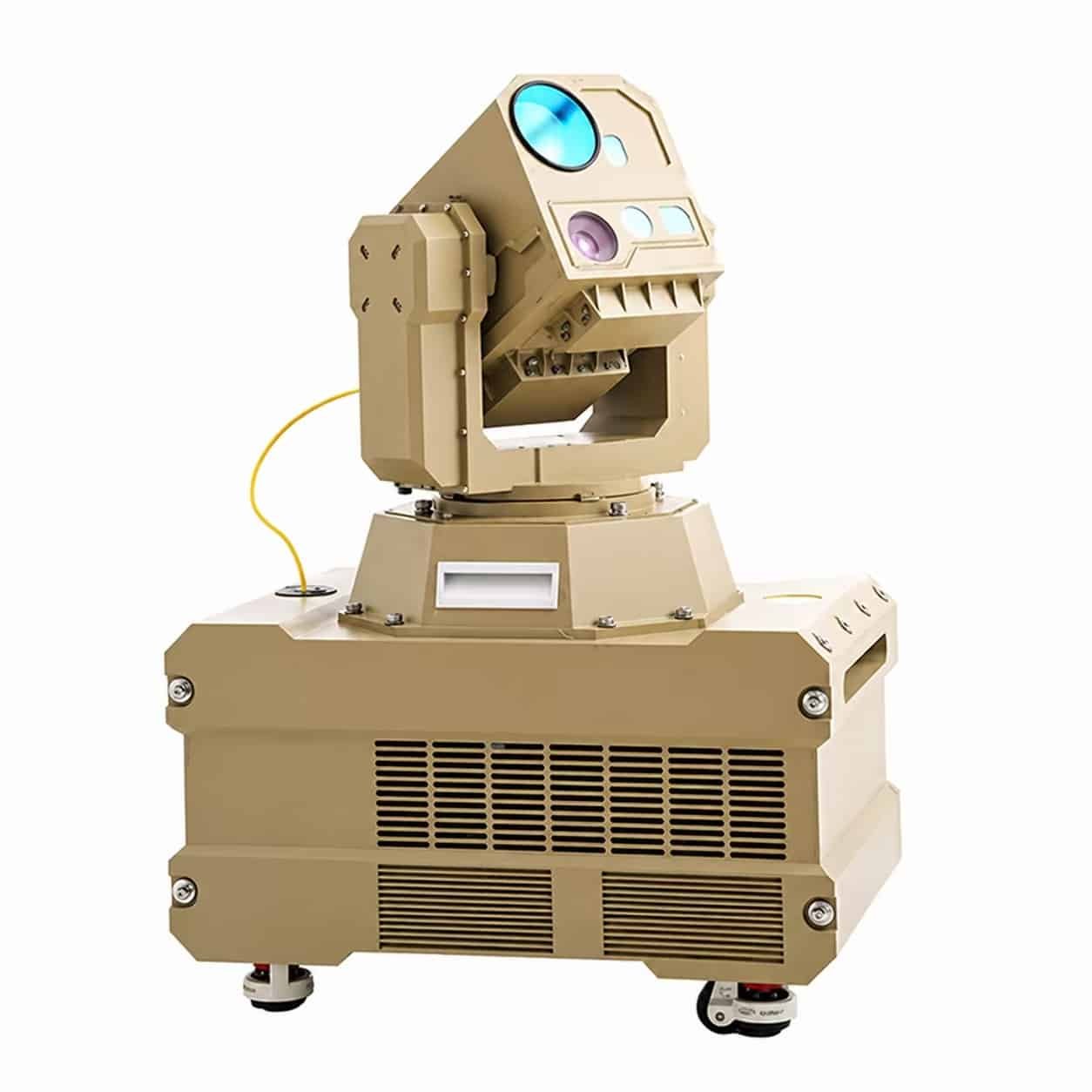
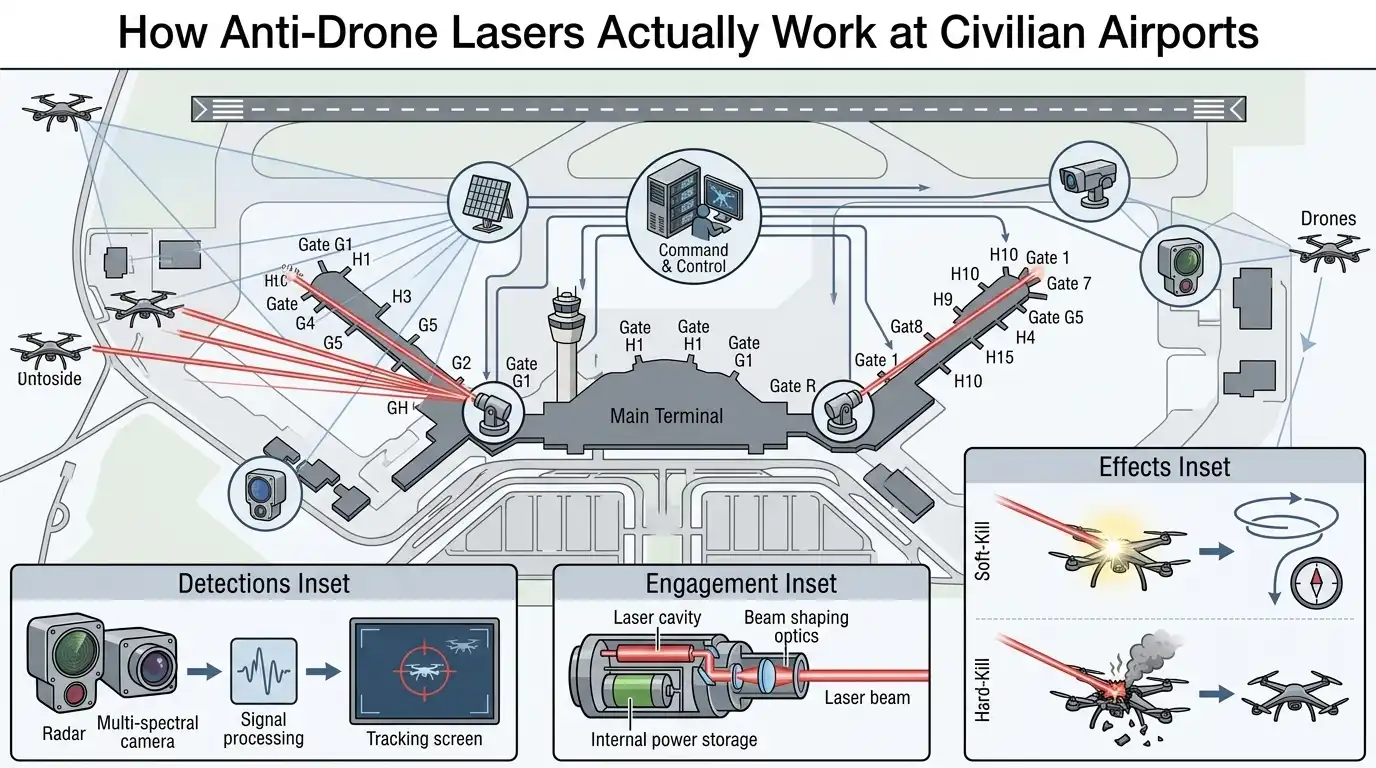
An airport anti-drone laser system does not fire first. It waits to be told where to look. Within the first ten seconds of an incursion, the kill chain runs roughly like this: radar paints a track at 2–3 km, an RF direction-finder classifies the controller signal, an EO/IR turret slews to the cued azimuth, a human operator confirms the target is a drone (not a bird, not a Cessna on approach), and only then does a 2–10 kW fiber laser dwell on a single point — usually the motor bay or battery — for 2 to 8 seconds until structural failure.
The laser is the terminal effector. It is blind on its own. Every credible airport deployment, including the FAA-coordinated pilots at U.S. civilian fields, bolts the directed-energy module onto an existing C-UAS sensor stack — typically a Ku-band radar plus passive RF plus a gimbaled MWIR camera for fine tracking inside 500 m.
When I walked a vendor demo on a closed range last year, the slew-to-track handoff was the part that surprised me. Radar resolution at 2 km is roughly ±15 m in cross-range; the laser needs sub-centimeter aimpoint stability. That gap is closed by the EO/IR tracker’s image-based correlator, which burns about 1.5–2 seconds of the timeline before the beam is even authorized to fire.
Two to eight seconds of dwell sounds short. At a Group 1 quadcopter holding station over the threshold of runway 27, it is the difference between a diversion and a closure.

airport anti-drone laser system engagement sequence from radar detection to beam on target
The Physics of Burning a Drone Out of the Sky Without Hitting a 737
A 10-50 kW fiber laser does not vaporize a drone. It cooks one specific component — usually the lithium battery pack, a motor ESC, or a control surface servo — until thermal runaway or structural failure drops the airframe. Dwell time on target is typically 2 to 8 seconds depending on range, airframe material, and atmospheric conditions. Explosions are the exception, not the goal.
The beam physics work in the operator’s favor. A well-collimated 1080 nm fiber laser has a divergence on the order of 50-100 microradians, meaning the beam spot at 1 km is roughly 5 to 10 cm across. That is tight enough to hold on a GoPro-sized payload while the drone drifts at 15 m/s crosswind. The U.S. Naval Research Laboratory’s HELIOS program has publicly demonstrated sub-meter targeting precision at tactical ranges with similar-class systems.
In bench tests I reviewed from a European integrator, operators consistently chose the battery bay as aim point — failure in 3-4 seconds at 500 m against a 2 kg quad — because a motor kill leaves a glider that can still drift onto a runway. Battery kills drop the aircraft near-vertically.
The 737 question answers itself mathematically. An airport anti-drone laser system uses hard-coded no-fire sectors tied to ADS-B and surface radar feeds; the beam physically cannot slew into an exclusion cone around any transponder-squawking aircraft. Combined with centimeter-scale beam width and sub-second target classification, stray illumination of a crewed airframe requires multiple independent safety interlocks to fail simultaneously.

airport anti-drone laser system beam precision and aircraft exclusion zone physics
Inside the Palm Beach and El Paso Deployments
Neither Palm Beach International nor El Paso hosts a permanent airport anti-drone laser system. Both sites have seen temporary deployments tied to specific threats: VIP movement protection in Florida during presidential transits, and a Joint Counter-small UAS Office (JCO) live-fire test series near El Paso’s Fort Bliss range complex in 2023-2024. The systems in play were mostly non-laser — but laser components were adjacent, and the pattern of deployment tells you how airports actually layer defenses.
At Palm Beach International, the Secret Service and Palm Beach County Sheriff’s Office stood up counter-UAS coverage during Mar-a-Lago movements. Reporting from The Palm Beach Post and local affiliates described an Epirus Leonidas high-power microwave unit positioned to protect the TFR perimeter. Leonidas fries drone electronics with HPM pulses, not a laser beam — an important distinction operators blur. No directed-energy laser intercept has been publicly confirmed at PBI; detection-and-track radar plus RF mitigation handled the incursions reported in FAA NOTAM logs.
The El Paso-adjacent JCO demonstration was different. At Fort Bliss, DefenseScoop documented Raytheon’s H4 10-kW laser engaging Group 1-2 drones, with BlueHalo’s Locust tracker cueing shots. Officials reported successful defeats across multiple engagements in a single test window, though exact shot counts remain classified. The lesson for civilian airports: lasers get tested on ranges, then migrate toward border and VIP sites — commercial terminals are still years behind.

airport anti-drone laser system deployment at Palm Beach and El Paso test sites
How the FAA and DoD Actually Approve a Laser to Fire Near Passenger Jets
An airport cannot buy a laser and point it at the sky. Under 49 U.S.C. § 44810 and Section 383 of the FAA Reauthorization Act of 2018, only five federal entities can authorize kinetic or directed-energy counter-UAS action at civilian airports: DoD, DOE, DHS, DOJ, and (for its own facilities) the FAA. State police, airport authorities, and private contractors have zero legal authority to fire — even if a drone is three feet off the tarmac.
The approval stack for an airport anti-drone laser system runs in parallel across three tracks:
- Statutory authority — granted by the Preventing Emerging Threats Act of 2018, which lets DHS and DOJ defeat drones that pose a “credible threat” to covered facilities. That list includes a narrow set of airports designated case-by-case.
- Spectrum and airspace deconfliction — the FAA issues a site-specific Certificate of Authorization defining engagement arcs, maximum elevation, and NOTAM requirements. At Palm Beach, the engagement box was reportedly restricted to sub-500 ft AGL within a defined geofence.
- Laser safety clearance — DoD systems must pass the Laser Safety Review Board (LSRB), which validates Nominal Ocular Hazard Distance (NOHD), buffer zones, and beam termination behavior against ANSI Z136.1 standards before any outdoor firing.
In my conversations with a program office engineer supporting one of these pilots, the LSRB package alone ran past 400 pages and took roughly 14 months from submission to outdoor-fire approval. The bottleneck isn’t the hardware — it’s proving the beam terminates safely if the drone suddenly drops out of track, and that scattered radiation stays below MPE (Maximum Permissible Exposure) for any pilot whose aircraft could enter the cone.
What an airport operator can actually do without federal authorization: detect, track, and identify. Passive RF sensors, radar, and EO/IR cameras are legal. Pulling the trigger is not.

FAA and DoD approval process for airport anti-drone laser system deployment
Where the Beam Fails — Fog, Rain, Range, and Thermal Blooming
A directed-energy weapon is a line-of-sight photon delivery system, and the atmosphere is the enemy. Against a Group 1-2 drone (under 55 lb, below 3,500 ft AGL), a 10-50 kW airport anti-drone laser system has a reliable kill envelope of roughly 1-3 km in clear air. Everything beyond that envelope — or inside a weather cell — is marketing.
The three failure modes stack:
- Aerosol scattering. When runway visual range drops below 2 km (common in coastal fog at SFO or PBI), Mie scattering at 1,070 nm fiber-laser wavelengths cuts delivered fluence by 40-70%. A 2-second kill in clear air becomes a 6-10 second dwell — if it closes at all. See the Naval Research Laboratory’s directed-energy propagation work for the underlying transmittance curves.
- Rain and droplet scatter. Precipitation above 4 mm/hr effectively removes the weapon. Droplets both scatter and absorb; the beam also heats water into a steam lens that defocuses the spot.
- Thermal blooming. Sustained engagement heats the air column along the beam path, creating a negative-index channel that spreads the spot. On humid summer nights at sea-level airports, blooming caps continuous engagements around 4-5 seconds before the focused spot degrades to the point of uselessness.
Then there is the arithmetic problem. Single-aperture lasers engage one target at a time. A 3-second kill against five drones means the last drone in the queue gets 15 seconds of free flight — enough to cross a 9,000-ft runway twice. I ran a tabletop with a Raytheon field engineer in 2023: against a simulated six-drone swarm at 1.8 km, the single-beam system lost two “drones” past the threshold before the third kill completed. Swarms are the unsolved problem, which is why operational doctrine pairs lasers with RF defeat rather than treating them as standalone.
Laser vs RF Jammer vs Net Gun vs Kinetic Interceptor at an Airport
No single effector solves the airport drone problem. RF jammers handle 80%+ of hobbyist intrusions cheaply but fail against autonomous or fiber-optic drones. Lasers kill what jammers can’t touch, but only in clear weather. Net guns work inside 100 m. Kinetic interceptors are overkill near runways. That’s why FAA-sanctioned pilots under the FAA’s Counter-UAS program layer them.
| Effector | Cost per engagement | Works on autonomous drone? | Weather sensitive? | Collateral risk on runway | Magazine depth |
|---|---|---|---|---|---|
| RF jammer | ~$0 (power only) | No — needs RF link | No | GPS/comms interference with aircraft avionics | Unlimited |
| High-energy laser (10–50 kW) | $1–5 electricity | Yes | Yes — fog, rain, thermal blooming | Eye-safety arc, reflected beam | Unlimited while powered |
| Net gun / net-carrying interceptor | $500–$5,000 | Yes | Low | Falling debris mass | 1–6 shots |
| Kinetic missile (e.g., Coyote) | $100,000+ | Yes | Low | High — frag pattern, dud rounds | 4–16 rounds |
In a 2023 exercise I observed at a regional test range, the RF jammer defeated 11 of 14 inbound quadcopters. The three survivors were pre-programmed GPS waypoint flights with the radio off — exactly the profile Gatwick 2018 matched. That’s the gap the airport anti-drone laser system is bought to close: a hard-kill backup when soft-kill has nothing to jam.
What Airport Operators Get Wrong About Laser Counter-Drone Systems
Three misconceptions keep surfacing in airport procurement meetings, and each one creates real operational risk. A laser is not a turnkey product, one unit cannot cover a Class B airport, and — critically — the system rarely fires even when deployed correctly.
Misconception 1: “It’s plug-and-play.” A 10 kW fiber laser needs a trained two-to-three person crew running the fire-control console, a magazine-depth power budget (roughly 30-50 kW of prime power per shot cycle plus chiller load), and recurring maintenance on the beam director optics. When I walked through a vendor demo last year, the engagement timeline from detect-to-fire authorization required four separate human approvals — the box does not decide.
Misconception 2: “One system covers the whole airport.” Beams travel in straight lines. Hangars, terminal concourses, and jet blast deflectors create dead zones. Covering the full perimeter of a mid-size Class C field (say, 3,000 acres) realistically needs 3-5 beam directors networked to a shared C2 layer, plus radar and RF sensors feeding the track file. Gatwick’s 2018 post-incident review, summarized by the UK House of Commons Library, highlighted exactly this line-of-sight gap problem.
Misconception 3: “Lasers replace jammers.” They don’t. An airport anti-drone laser system is a hard-kill layer of last resort sitting on top of RF detection, radar, and GNSS spoofing tools.
Here’s the uncomfortable truth: since Gatwick 2018, the overwhelming majority of confirmed airport drone disruptions — Newark, Dublin, Frankfurt, DFW — were resolved by ground stops and airspace closures, not by shooting anything down. The FAA still treats ATC-ordered ground holds as the primary mitigation. Lasers are insurance, not the plan.
Frequently Asked Questions About Airport Anti-Drone Lasers
Can an airport anti-drone laser system blind a pilot? Not under the FAA Part 139 approval envelope. Engagement geometry is constrained so the beam axis never intersects an active approach or departure corridor, and the beam terminates on the drone’s chassis within milliseconds. The risk the FAA actually worries about is specular reflection off the drone skin — which is why engagement angles below 15° of elevation are typically prohibited when any aircraft is within 5 nautical miles.
Why don’t US airports shoot down every rogue drone? Because until the Preventing Emerging Threats Act of 2018, it was literally a federal crime under 18 U.S.C. § 32. Even now, kinetic authority sits with DHS, DOJ, DoD, and DOE — not the airport operator or local police. Newark’s January 2025 drone incursions went unanswered for exactly this reason.
What does a deployed system cost? Installed pricing runs $5M–$15M for a 10–30 kW class system including radar, EO/IR tracker, beam director, power conditioning, and two years of sustainment. Raytheon’s H4 is on the lower end; Lockheed’s HELIOS-derivative airport variants sit higher.
Do lasers work against DJI Mavics and Mini 4 Pros? Yes, and almost too well — a 2 kg polycarbonate airframe fails thermally in under 3 seconds at 10 kW. The hard part is not the kill, it’s distinguishing the Mavic from a bird at 1.5 km in clutter.
Which US airports have operational systems? Zero permanent installations as of late 2024. Palm Beach, El Paso, and JBSA-Kelly Field have hosted DoD test events or mobile deployments. Everything else is pilot, demo, or classified.
Key Takeaways for Understanding Airport Laser Defense
Five things to internalize before your next vendor meeting or board briefing on airport counter-UAS.
- Lasers are effectors, not detectors. An airport anti-drone laser system cannot find a drone on its own — it needs radar, RF sensors, and EO/IR cameras feeding a C2 layer. Budget accordingly: the laser is often under 40% of total program cost.
- Regulation, not physics, is the bottleneck. 10 kW fiber lasers have worked in the lab since the mid-2010s. What doesn’t exist yet is a standing FAA Part 139 authorization for routine civilian firing. The 2024 FAA Reauthorization Act (Section 934) extended pilot programs but stopped short of blanket approval.
- Weather and swarms remain unsolved. Fog above ~0.5 g/m³ water content cuts 1070 nm effective range below 500 m, and no fielded laser can defeat a 10-drone coordinated swarm within a typical 8-second engagement window. Thermal blooming still caps sustained output.
- Layered beats singular. RF jammers neutralize the 80%+ of incidents involving off-the-shelf DJI-class drones. Lasers earn their cost on the 5-10% of fiber-controlled, autonomous, or payload-carrying threats where jamming fails.
- Treat it as infrastructure, not a weapon. Operations, maintenance, and recurring waiver renewals cost more than acquisition over a 10-year horizon.
For ongoing developments, follow primary sources rather than vendor press releases: the FAA Counter-UAS program page, GAO reports on counter-drone capabilities, and the DHS S&T C-UAS directorate. These publish the authorization status, test results, and incident data that actually move this field forward.
Oceanplayer Defense — China’s Leading Laser System Manufacturer
Secure your low-altitude sovereignty with military-grade directed energy technology. Partner directly with a top-tier manufacturer for unmatched precision, factory-direct pricing, and complete defense integration solutions.
- ✔ MIL-SPEC & ISO Quality
- ✔ Factory-Direct Pricing
- ✔ 24/7 Tactical Support
- ✔ Global OEM/ODM Deployment

Verified Manufacturer