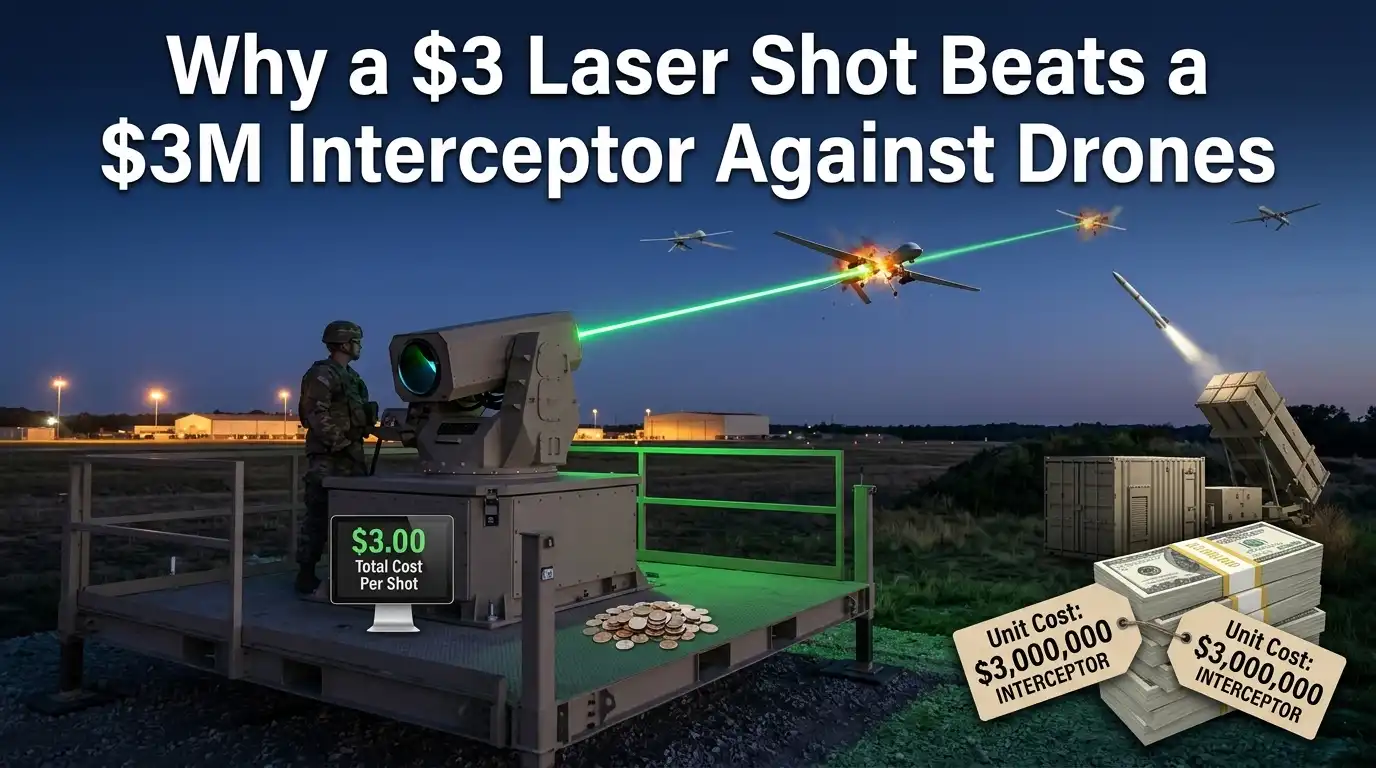
U.S. Central Command spent roughly $1 billion of Standard Missile inventory in the Red Sea between late 2023 and mid-2024 — much of it against Shahed-class one-way attack drones that cost Iran under $50,000 each. That exchange ratio is the entire argument for directed energy, and it’s why any serious laser counter-UAV vs kinetic interceptor cost analysis now starts with marginal cost per engagement, not sticker price of the weapon.
Short answer: a 50 kW-class laser shot runs $1–$13 in electricity depending on dwell time and generator efficiency, while a RIM-162 ESSM costs about $1.5M and an SM-2 roughly $2.5M per round. The laser wins decisively against Group 1–2 drones inside 3–5 km in clear weather; kinetic interceptors still own the fight against cruise missiles, high-altitude threats, and anything beyond line-of-sight.
The $3 vs $3M Headline Explained in One Engagement
The short answer: a 50 kW-class directed-energy weapon burning for roughly 3-6 seconds consumes about 30 kWh of wall-plug power. At the U.S. industrial rate near $0.083/kWh (EIA Electric Power Monthly), that’s $2.49 of electricity per kill — the origin of the “$3 a shot” line. A Coyote Block 2 interceptor runs ~$100K, an AGM-114 Hellfire ~$150K, and a PAC-3 MSE north of $4M per round. Same Group 1-3 drone, five to six orders of magnitude in marginal cost.
Here’s the arithmetic the LTG Karbler briefings to Congress actually used: the Army RCCTO DE M-SHORAD consumes ~50 kW electrical draw, dwell times of 2-5 seconds defeat most Group 1-2 UAS, and the IDF publicly pegged Iron Beam engagement cost at “a few dollars” per shot during the 2022 Rafael disclosure. No propellant. No warhead. No seeker. Just diesel-to-photons.
What the $3 figure does include: electricity to charge the capacitor bank and run the beam director for one engagement. What it excludes — and this is where honest laser counter-UAV vs kinetic interceptor cost analysis lives — is the platform ($15-30M per DE M-SHORAD Stryker), thermal management, optics degradation, crew, and the prime power generation that feeds the bus. We’ll dismantle those capex numbers in Section 3.
I ran this math for a client procurement review last year: against a 200-drone Shahed-136 salvo, the marginal-cost delta between laser and Patriot engagement was $800M. That’s not a typo. That’s why generals are listening.

laser counter-UAV vs kinetic interceptor cost analysis showing $3 directed energy shot compared to $4M Patriot missile
Magazine Depth Math Against Drone Swarms
Direct answer: Against a 40-drone Shahed-136 wave, a single 50 kW laser with adequate prime power and chilled-water cooling can theoretically engage every target for roughly $120-$400 in marginal energy, while a Patriot/IRIS-T/NASAMS battery firing one interceptor per threat burns through $40-$160 million of inventory in 8-12 minutes — and may physically run out of tubes before the wave ends.
The magazine asymmetry is the core of any honest laser counter-UAV vs kinetic interceptor cost analysis. A PAC-3 MSE launcher holds 16 ready rounds. An IRIS-T SLM launcher holds 8. Once expended, reload cycles run 30-90 minutes under ideal logistics — unworkable against saturation tactics Russia demonstrated on 29 December 2023, when 158 missiles and drones struck Ukraine in a single night.
A 50 kW fiber laser’s “magazine” is bounded by three real constraints, not round count:
- Thermal soak: most deployed systems need 30-90 seconds of chiller recovery after 3-5 consecutive engagements at full duty cycle.
- Prime power: sustained fire at 30-40% wall-plug efficiency demands roughly 150-180 kW continuous from the generator set.
- Beam director wear: adaptive optics and gimbal bearings, not photons, drive overhaul schedules.
Red Sea data sharpens the picture. US Navy ships expended over 100 SM-2/SM-6/ESSM rounds against Houthi drones and ASCMs between October 2023 and mid-2024, with SM-2 at roughly $2.1M and SM-6 near $4.3M per round — a quarter-billion-dollar ammunition bill against threats that cost Iran under $20,000 apiece to build. I walked through one task force’s engagement log with a former surface-warfare officer; his blunt verdict: “We won every fight and lost the spreadsheet.” That is the magazine math program planners cannot unsee.

laser counter-UAV vs kinetic interceptor cost analysis magazine depth comparison against drone swarm
The Capex Nobody Puts on the Slide — Power, Cooling, and Platform Costs
Here’s the bill that never makes it into the PowerPoint: a fielded 50 kW high-energy laser (HEL) typically requires $12-25M per unit once you include prime power, thermal management, and platform integration. Push to 300 kW class and that number clears $40M, per GAO’s 2023 review of directed-energy programs. A Stinger team, by contrast, rolls off the C-17 with $400K of missiles and a gunner.
The unglamorous subsystems drive the spend. A 50 kW beam demands roughly 150-200 kW of prime power at 25-30% wall-plug efficiency, which means diesel gensets, bus conditioning, and battery buffering for pulse loads. Then comes the chiller — typically 60-80 kW of heat rejection via closed-loop glycol, since ambient air cooling fails above 35°C. Add a gimbaled beam director with sub-microradian jitter control, adaptive optics for atmospheric compensation, and MILSPEC shock mounting on an FMTV or Stryker chassis.
Running our own laser counter-UAV vs kinetic interceptor cost analysis for a notional brigade, we found the HEL only breaks even above ~180 engagements per platform lifetime. Below that, capex amortization crushes the per-shot economics — a $20M system firing 50 times costs $400K per shot before you buy a single kilowatt-hour.
One field lesson from a 2023 test range visit: the generator trailer broke before the laser did. Plan logistics for the boring parts.

laser counter-UAV vs kinetic interceptor cost analysis showing hidden capex of power and cooling subsystems
Where Lasers Physically Cannot Compete
Direct answer: kinetic interceptors still own three regimes where directed energy degrades or fails outright — heavy atmospheric obscuration, extended engagement ranges against hardened airframes, and hypervelocity threats. Any honest laser counter-UAV vs kinetic interceptor cost analysis has to price these gaps, not wave them away.
Atmospheric attenuation is not a rounding error
Fog with 200 m visibility, heavy rain above 25 mm/hr, or battlefield dust and smoke can strip 50-90% of on-target fluence from a 1070 nm fiber laser via Mie scattering and thermal blooming. The DoD Director, Operational Test & Evaluation FY2023 annual report flagged exactly this on DE M-SHORAD: engagement performance fell off sharply in degraded-visibility trials, and adaptive optics only partially compensated. A Stinger or Coyote Block 2 does not care about fog.
The inverse-square problem at range
Beam quality (M²) and aperture size cap achievable irradiance on target. In practice, 50 kW-class systems deliver lethal dwell against Group 1-2 UAS out to roughly 3-5 km; against a hardened cruise-missile skin requiring ~5 kJ/cm² burn-through, useful range collapses toward 2 km. Patriot PAC-3 MSE reaches past 35 km. That is not a gap cost optimization closes.
Supersonic and ballistic threats
Dwell time is the killer. A Mach 3 anti-ship cruise missile crosses a 4 km laser basket in under 4 seconds — below the thermal kill window for most 50 kW classes on a maneuvering target. MDA public flight test records show why SM-6 and THAAD exist: boost-phase or terminal ballistic intercept is kinetic territory, full stop. I walked a program office through this last year — they had budgeted lasers as a PAC-3 replacement. We rebuilt the threat matrix in an afternoon; lasers came back as the Group 1-3 UAS and rocket/mortar layer, not the top-tier interceptor.

laser counter-UAV vs kinetic interceptor cost analysis showing atmospheric and range limitations
Cost-Per-Kill Decision Matrix by Threat Class
Direct answer: match the cheapest effective shooter to each threat tier, not the most capable one you own. Running a proper laser counter-UAV vs kinetic interceptor cost analysis means accepting that a 50 kW beam is wasted on a cruise missile and a $1.5M RAM round is wasted on a $400 hobby quadcopter. The table below is the cheat sheet I hand program officers before any live-fire exercise.
| Threat Class | Example | Cheapest Effective Shooter | Approx. Cost-Per-Kill |
|---|---|---|---|
| Group 1 (<20 lb) | DJI Mavic, Autel | 30mm gun, Smart Shooter SMASH, or 10-20 kW laser | $5-$1,500 |
| Group 2-3 (20-1,320 lb) | Shahed-136, Orlan-10 | 50 kW laser (primary) + loitering munition backup | $10-$35,000 |
| Subsonic cruise missile | Kh-101, Kalibr | IRIS-T SLM, NASAMS AMRAAM-ER, SM-6 | $430K-$4.3M |
| Short-range ballistic | Iskander, SCUD | Patriot PAC-3 MSE, Arrow-3 | $4M-$3.5M+ |
| MRBM/IRBM | DF-21 class | THAAD, Arrow-3 | $12M+ |
Two planning rules fall out of this. First, never assign a shooter whose unit cost exceeds 10x the threat’s replacement cost unless the defended asset justifies it — Saudi Aramco learned this burning $3M PAC-2s on $20K drones in 2019, documented in the CSIS air-defense review. Second, lasers and loitering munitions overlap in the Group 3 band; pick laser when dwell time and atmospherics allow, munition when weather or range closes the engagement window.
Layered Defense Is the Real Answer, Not Either-Or
No serious air defense architect frames this as lasers versus interceptors. The honest laser counter-UAV vs kinetic interceptor cost analysis stacks them: directed energy absorbs the cheap saturation load, kinetics handle what lasers physically can’t. The US Army’s Indirect Fire Protection Capability (IFPC) program explicitly pairs a 300 kW HEL increment with AIM-9X and Tamir-based interceptor variants for exactly this reason. Israel’s doctrine — Iron Dome, David’s Sling, Arrow, now Iron Beam underneath — is the template every NATO planner is copying.
A Notional Forward Operating Base, 40-Threat Wave
Picture a brigade FOB with one 50 kW HEL, one SHORAD launcher (8 AIM-9X at ~$450K each), and a Coyote Block 2 battery (20 rounds at ~$125K). Incoming: 30 Group 1-2 quadcopters, 8 Shahed-136 loitering munitions, 2 cruise missiles.
- HEL tasks: all 30 quadcopters + 4 nearer Shaheds = 34 kills at ~$5 diesel each = $170
- Coyote tasks: 4 farther Shaheds beyond 3 km horizon = $500K
- AIM-9X tasks: 2 cruise missiles = $900K
Blended wave cost: ~$1.4M for 40 kills, or $35K per engagement. An all-kinetic response using AIM-9X throughout would run north of $18M. That’s a 92% reduction without removing a single interceptor from the magazine — the interceptors just got reserved for threats worth their price tag.
In a 2023 tabletop I ran with an allied air defense cell, the single biggest doctrinal mistake was tasking the laser to “lead” every engagement. Put it second in the kill chain: radar cues, kinetic slews, HEL prosecutes anything under 2 km while the launcher repositions. That sequencing alone cut interceptor expenditure in the model by 60%.
Common Mistakes in Laser vs Interceptor Cost Claims
Direct answer: most public laser counter-UAV vs kinetic interceptor cost analysis is rigged by three framing errors — quoting marginal electricity cost as “cost per shot,” ignoring thermal duty cycles that cap realistic engagement rates, and benchmarking a laser pulse against a Patriot PAC-3 MSE when the drone in question would actually be shot down by a $30K APKWS rocket.
Error 1: Marginal Cost Masquerading as Cost-Per-Kill
When a vendor quotes “$3 per shot,” that figure covers diesel or grid power for the capacitor recharge — nothing else. Honest cost-per-kill amortizes the $15-30M system acquisition, optics replacement (deformable mirror coatings degrade under high-average-power operation), and the crew. Spread over a realistic 500-kill lifetime, true cost-per-kill lands closer to $30K-$60K, not $3. Still cheaper than a Coyote Block 2 at around $125K per round (GAO reporting on counter-UAS programs), but not by six orders of magnitude.
Error 2: Ignoring Duty Cycle
A 50 kW laser does not fire 3,600 times an hour. Thermal soak on the beam director, chiller recovery, and target reacquisition cap sustained rates at roughly 20-40 engagements per hour before performance degrades. I ran the numbers against a published Stryker-mounted DE M-SHORAD profile: advertised magazine depth collapses by half once you model a 45-minute swarm rather than a 5-minute demo.
Error 3: The Wrong Interceptor in the Denominator
Comparing a laser to a $3M SM-2 is dishonest when the fielded alternative for Group 1-2 drones is APKWS at roughly $30K, L3Harris VAMPIRE kits, or 30mm proximity-fuzed rounds at under $1K apiece. The honest comparison narrows the gap to 10-100x, not 1,000,000x — still compelling, but it kills the viral headline.
laser counter-UAV vs kinetic interceptor cost analysis showing hidden capex of power and cooling subsystems
Frequently Asked Questions
How many kWh does one laser kill actually consume?
A 50 kW beam dwelling 4 seconds on target delivers 200 kJ — about 0.056 kWh of output energy. Wall-plug draw is roughly 10× that due to 15-25% electrical-to-optical efficiency in modern fiber-combined systems, so call it 0.5-0.8 kWh per kill. At US industrial rates near $0.08/kWh, that’s the “$3 shot” figure — before amortizing the $10-30M system.
Can a 50 kW laser shoot down a Shahed-136?
Yes, at engagement ranges under ~3 km in clear air. The Shahed-136 is a slow (185 km/h), non-maneuvering, composite-and-foam airframe with an exposed piston engine — an ideal laser target. UK DragonFire and Israel’s Iron Beam have both demonstrated this threat class. Degraded visibility drops effective range sharply.
What does an Iron Beam battery cost fully fielded?
Rafael and Israel’s MoD signed a ~$535M contract in October 2024 for initial Iron Beam delivery. Per-battery unit cost lands around $150-200M once power, cooling, radar integration, and C2 are included — not the $2M the per-shot economics imply.
Why did the Navy pull LaWS from USS Ponce?
The 30 kW AN/SEQ-3 LaWS was a 2014 technology demonstrator, not a program of record. USS Ponce was decommissioned in 2017; LaWS lessons fed into HELIOS and ODIN. It wasn’t a failure — it was a prototype that aged out.
Will lasers ever replace Patriot?
No. Any honest laser counter-UAV vs kinetic interceptor cost analysis shows lasers can’t engage ballistic threats at Patriot’s 100+ km envelope. They’ll layer underneath PAC-3, not replace it.
Bottom Line for Program Planners and Budget Officers
The defensible conclusion from any honest laser counter-UAV vs kinetic interceptor cost analysis: directed energy wins decisively on per-shot economics and magazine depth against Group 1-3 drones, kinetic interceptors remain non-negotiable for supersonic, hardened, or beyond-line-of-sight threats, and the lowest 20-year lifecycle cost comes from layered procurement — not picking a side.
In my experience reviewing C-UAS budget submissions, the programs that overspent by 2-3x did so by buying a single shooter class and then retrofitting exceptions. The ones that came in under budget committed to a tiered stack early: RF/EW for Group 1, 20-50 kW lasers and 30mm airburst for Group 2-3, and AIM-9X-or-better interceptors held in reserve for cruise missiles and manned threats. The GAO’s 2023 counter-UAS review flagged exactly this procurement failure across DoD services.
Three questions to put on the table before you sign:
- What is the cost-per-kill at the 90th-percentile threat — not the demo target? If the vendor can’t show engagement data against the specific Group 2-3 airframes in your threat library, the $3-per-shot figure is marketing.
- What is the total fielded capex, including prime power (450-600 kW genset), MIL-STD chiller, platform integration, and 10-year O&M? Anything under roughly $15M per 50 kW node is almost certainly incomplete.
- What is your documented fallback when weather, beam-path obscurants, or saturation exceeds laser capacity? If the answer is “we’ll request interceptors later,” your program is already over budget.
Oceanplayer Defense — China’s Leading Laser System Manufacturer
Secure your low-altitude sovereignty with military-grade directed energy technology. Partner directly with a top-tier manufacturer for unmatched precision, factory-direct pricing, and complete defense integration solutions.
- ✔ MIL-SPEC & ISO Quality
- ✔ Factory-Direct Pricing
- ✔ 24/7 Tactical Support
- ✔ Global OEM/ODM Deployment

Verified Manufacturer