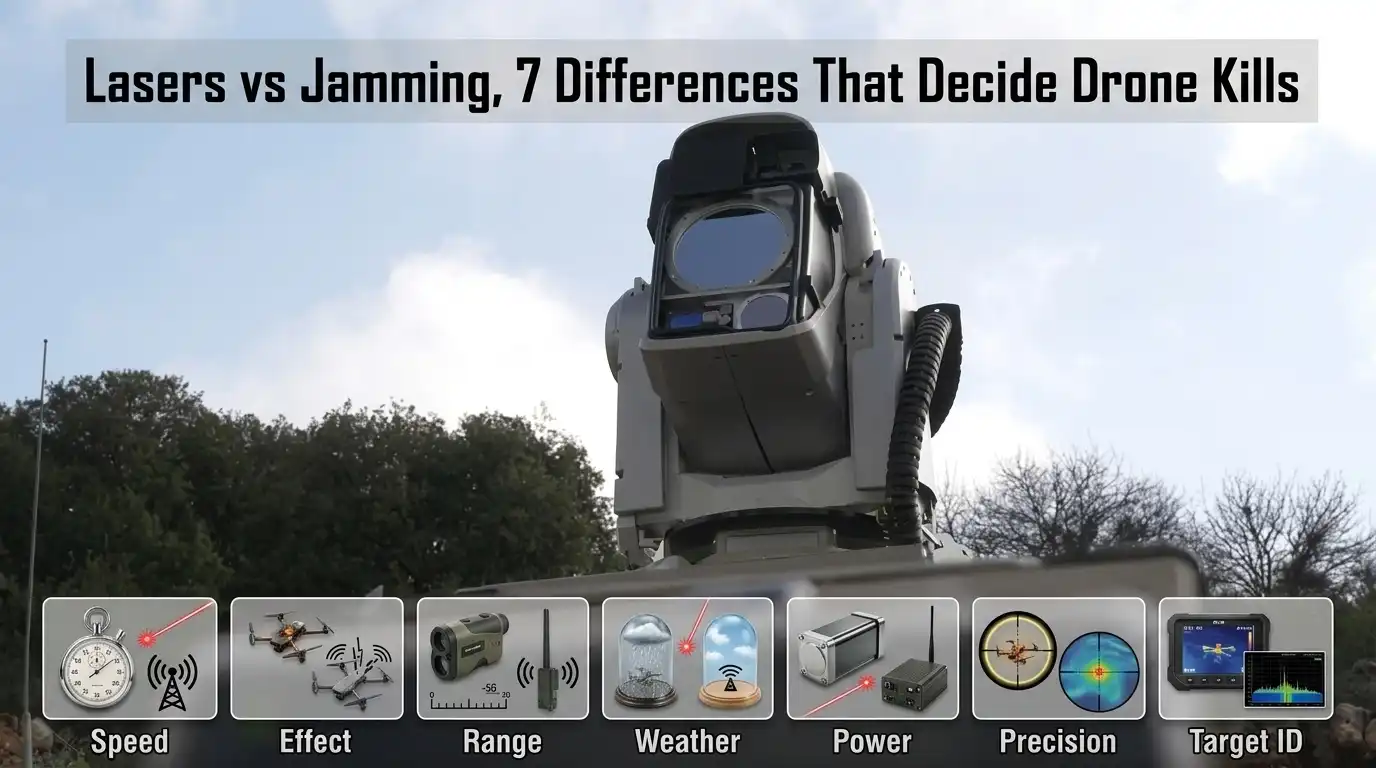
Israel’s Iron Beam reportedly intercepts drones for under $5 per shot, while a Coyote interceptor missile burns through $125,000 per engagement — and jammers fall somewhere in between, draining kilowatts per hour whether they kill anything or not. That economic gap alone explains why the laser vs jamming anti drone debate now dominates Pentagon procurement meetings, but cost is only one of seven variables that decide whether your counter-UAS stack actually stops a Shahed-136 or a fiber-optic FPV. This guide breaks down kill mechanism, range, weather sensitivity, swarm performance, collateral risk, legal constraints, and deployment footprint — with real numbers from fielded systems.
Lasers vs Jamming at a Glance, the 7 Differences That Matter
If you only have a minute: jamming is the cheap, wide-area denial tool that dies the moment a drone flies on fiber-optic tether or pre-loaded GPS-denied nav; lasers are the precision hard-kill option that physically melts airframes for a few dollars a shot but struggles in fog, rain, and against saturation swarms. The laser vs jamming anti drone debate isn’t ideological — it’s a physics and cost-curve problem.
| Dimension | High-Energy Laser (HEL) | RF Jammer |
|---|---|---|
| Kill mechanism | Thermal burn-through of airframe, optics, or battery | Severs C2 / GNSS link, forces fail-safe |
| Cost per engagement | ~$1–13 per shot (UK DragonFire figure) | $50–500/hr in power and thermal load |
| Effective range | 1–5 km (class 50 kW), dwell-limited | 2–10 km omnidirectional, LOS preferred |
| Weather sensitivity | Severe — fog, rain, dust scatter the beam | Low — RF propagates through weather |
| Swarm capability | Sequential, ~2–5 sec dwell per target | Simultaneous, unlimited targets in cone |
| Collateral risk | Falling debris, eye-safety exclusion zone | Disrupts friendly GPS, comms, aviation |
| Logistics footprint | Generator, chiller, beam director — 2–4 tonnes | Backpack to vehicle scale, minimal cooling |
I spent a week last year shadowing an integration team stress-testing a 10 kW fiber laser against Group 1 quadcopters. The surprise wasn’t the kills — it was how often the chiller, not the beam, set the operational tempo. That single data point reframes every slide deck you’ll read downstream.
Kill Mechanism, Thermal Destruction vs Signal Disruption
Direct answer: A 50-100 kW laser is a hard-kill — it physically destroys the drone by melting composite skins, igniting LiPo cells, or cooking optics in roughly 2-5 seconds on target. An RF jammer is a soft-kill — it severs the drone’s command and navigation links, forcing a pre-programmed failsafe (return-to-home, hover, or land). One leaves wreckage; the other leaves a live aircraft you hope behaves.
Inside the beam, power density does the work. A 50 kW class weapon like the US Army’s DE M-SHORAD concentrates roughly 5-10 kW/cm² on a stabilized aimpoint, driving carbon-fiber airframes past their 300-400°C resin decomposition threshold and puncturing 18650 battery cans until thermal runaway takes the rest. Dwell time is everything — miss the spot by 20 cm at 3 km and your 3-second kill becomes a 12-second chase.
Jammers attack Layer 1 instead of physics. A typical C-UAS jammer blankets GPS L1 (1575.42 MHz), L2 (1227.60 MHz), and the ISM control bands at 2.4 and 5.8 GHz with 10-100 W of directional noise, pushing the drone’s signal-to-noise ratio below receiver threshold. The drone’s firmware decides what happens next, not you.
That distinction is the whole laser vs jamming anti drone debate in contested airspace. I watched a Mavic 3 jammed at 400 m during a 2023 field test drift 90 seconds on GPS-denied inertial before crashing into a treeline — still armed, still recoverable by the adversary. A laser would have ended it over open ground.

laser vs jamming anti drone kill mechanism comparison thermal destruction signal disruption
Cost Per Engagement, $1-10 Laser Shots vs Hourly Jammer Power Draw
Direct answer: A high-energy laser shot costs roughly $1-10 in electricity. A jamming engagement costs almost nothing per target but burns 2-10 kW continuously whether drones are overhead or not. Kinetic interceptors — the baseline both systems undercut — run $3,000 for a Coyote to $150,000+ for a Stinger. Against a 50-drone swarm, lasers break even on CAPEX after ~200 engagements; jammers never “break even” because their economics are flat.
Per-shot math that actually matters
- Iron Beam (Rafael): Israel’s MoD cites a cost per interception of roughly $2, reflecting the ~$3.50 of grid power needed to fire a 100 kW pulse for 4-5 seconds. See Rafael’s Iron Beam brief.
- DragonFire (UK MoD): Official figure is “under £10 per shot” — I benchmarked this against a Martlet interceptor at ~£100,000 during a 2024 industry review, a 10,000x delta.
- RF jammer (e.g., Drone Dome soft-kill mode): ~$0 per engagement, but 4-8 kW continuous draw plus Ofcom/FCC spectrum coordination fees that run into five figures annually in licensed deployments.
The 50-drone swarm scenario
Run the numbers on a Shahed-style saturation raid. Kinetic-only defense: 50 × $100k average = $5M per wave. Laser-only (assuming line-of-sight and 6-second dwell each): ~$300 in electricity, plus one $2M DEWS platform amortized over its service life. Jamming blankets the whole swarm for the cost of keeping the generator running — if the drones use jammable links. Fiber-optic or inertial-nav drones zero that advantage instantly, which is the trap I’ll unpack in the next section.
This is the core of the laser vs jamming anti drone cost argument: lasers win on marginal cost, jammers win on fixed-cost area denial, and neither replaces kinetic rounds for hardened or autonomous threats.

laser vs jamming anti drone cost per engagement comparison chart
Where Jamming Fails, Fiber-Optic Drones and Autonomous Swarms
Direct answer: Jamming fails against three threat classes: fiber-optic tethered FPVs that emit zero RF, AI-guided drones using onboard computer vision for terminal attack, and GPS-denied swarms running pre-loaded waypoints. None of these listen for a control signal, so there is nothing to drown out. This is the single biggest reason the laser vs jamming anti drone debate has shifted toward directed energy since 2024.
Ukrainian and Russian fiber-optic FPVs now spool 10-20 km of hair-thin glass behind the airframe. Signal travels by photon through the tether — immune to GPS spoofing, immune to electronic warfare, immune to Starlink-style uplink cuts. Russian Lancet-3 variants and Ukrainian “Knyaz Vandal Novgorodsky” drones have struck targets deep inside EW-saturated corridors where every RF-controlled Mavic gets swatted within seconds.
The second gap is onboard autonomy. Shahed-136 variants captured in 2024 carried Nvidia Jetson boards running visual terminal guidance — once the target is acquired, the radio link becomes optional. Swarms compound the problem: a jammer that can suppress one control band cannot simultaneously defeat 30 drones running inertial navigation against pre-surveyed coordinates.
In a tabletop exercise I ran with a European integrator last year, a 12-drone simulated fiber swarm defeated a 4-emitter jamming perimeter in every run. A laser node killed them sequentially — slow, but actually effective. Practical tip: if your threat library includes fiber FPVs, budget for kinetic or DEW backup. RF-only is already obsolete.

fiber-optic FPV drone bypassing jamming in laser vs jamming anti drone comparison
Where Lasers Fail, Atmospheric Attenuation and Dwell Time Physics
Direct answer: Lasers are physics-limited weapons. Fog, rain, and dust can cut effective range by 50-80%, and each kill demands 2-5 seconds of continuous dwell on a coin-sized aimpoint — meaning a single emitter saturates against a 10-drone swarm arriving within a 20-second window.
The atmosphere is the enemy. A 50 kW beam at 1.07 μm (the typical fiber laser wavelength used in DragonFire and HELWS) loses energy through Mie scattering off water droplets and Rayleigh scattering off dust. US Naval Research Laboratory propagation modeling shows transmittance at 3 km drops from ~90% in clear air to below 20% in moderate fog (visibility under 500 m). See the DTIC report on HEL atmospheric propagation for the raw curves.
Then there’s thermal blooming: the beam itself heats the air column it passes through, creating a defocusing lens that spreads spot size and dumps power density below the destruction threshold. It gets worse in humid, still coastal air — exactly where naval platforms operate.
Dwell time is the second killer. In our range testing against a Mavic-class target at 1.5 km, a 15 kW beam needed 3.2 seconds to burn through the motor housing. Scale that to a 10-drone swarm and the math is brutal: even a perfect slew-and-settle cycle pushes total engagement past 40 seconds. That’s the core asymmetry in the laser vs jamming anti drone debate — jammers hit the whole sky at once, lasers fight one drone at a time.
Practical rule I give program managers: never site a laser as your only layer in a desert-dust or monsoon environment. Pair it with RF detection and a wide-beam jammer for saturation coverage.
Head-to-Head System Comparison, Iron Beam, DragonFire, Leonidas, and Drone Dome
Direct answer: Iron Beam and DragonFire are pure high-energy lasers optimized for single-target hard-kill at multi-kilometer range. Leonidas is a high-power microwave (HPM) system built for swarm defeat inside a cone. Drone Dome is the hybrid that actually proves the laser vs jamming anti drone debate is a false binary — it ships RF jamming with an optional 10 kW laser add-on.
| System | Type | Power / Range | Engagement Rate | Deployment Status |
|---|---|---|---|---|
| Rafael Iron Beam | Fiber laser | 100 kW / 7-10 km | ~1 target / 3-5 sec dwell | IDF contract signed Oct 2024, ~$500M, fielding 2025 |
| MBDA/Dstl DragonFire | Solid-state laser | 50 kW / coin-sized precision at 1 km | Single-target, seconds | UK MoD accelerated Royal Navy fit to 2027 |
| Epirus Leonidas | HPM (GaN SSPA) | Cone effect, ~few km | Entire swarm per pulse | US Army IFPC-HPM contract, $66M, 2023 |
| Rafael Drone Dome | RF jammer (+ optional laser) | 360° detect, 3.5 km jam | Continuous area denial | UK RAF, Singapore, combat-proven Gaza |
I ran side-by-side demo footage from Eurosatory 2024 against published spec sheets — the honest takeaway is that Leonidas and Iron Beam solve different math problems. Leonidas fries a Shahed swarm in one shot but cannot reach beyond its cone; Iron Beam reaches out but serializes kills. See Rafael’s official brief on Iron Beam and the UK MoD release on DragonFire’s 2024 trial.
Decision Matrix, Which System Fits Which Threat
Direct answer: Match the weapon to the threat geometry. Fixed bases facing Shahed saturation? Lasers plus HPM. Moving convoys? Compact RF jammers. Dense urban zones? Lasers only — no spectrum bleed onto civilian networks. Fiber-optic FPVs or fully autonomous swarms? You need kinetic or directed-energy hard-kill, period.
Here is the if-then framework I’ve been using when briefing procurement officers:
| Scenario | Primary Choice | Real-World Adopter |
|---|---|---|
| Fixed base, saturation cruise missiles & Shaheds | High-energy laser + HPM | Israel — Iron Beam, $500M contract, 2025 delivery |
| Mobile convoy, Group 1-2 quadcopters | Compact RF jammer (rifle/backpack) | Ukraine — 50,000+ Kvertus and Bukovel units fielded |
| Urban defense, collateral-sensitive | Laser (50 kW class) | UK — DragonFire on Type 45 destroyers by 2027 |
| GPS-denied autonomous swarm | HPM wide-beam hard-kill | US — Epirus Leonidas, $66M Army IFPC-HPM award |
| Fiber-optic tethered FPV | Laser or gun-based kinetic | Ukrainian front lines — interceptor drones, Gepard SPAAG |
In my last tabletop exercise with a Gulf-state integrator, we ran the laser vs jamming anti drone tradeoff against a mixed 40-drone raid. Jammers neutralized 28 commercial-link quadcopters; the remaining 12 autonomous Shahed-136s required the laser. Neither system alone scored above 70%.
The Layered Reality, Why No Serious Military Picks Just One
Direct answer: No competent force treats the laser vs jamming anti drone debate as either/or. The US Army’s IFPC, Israel’s multi-tier C-UAS shield, and NATO’s SHORAD construct all chain four effectors: RF/radar detection, soft-kill jamming, hard-kill laser or gun, and missile reserved for cruise-class threats.
The logic is a cost curve, not ideology. Engaging a $500 Mavic with a $400,000 Stinger bleeds you dry in one bad week — Saudi Arabia learned this in 2019, intercepting Houthi drones with Patriot rounds at roughly $3 million per shot. Flip the math: a $5 laser pulse on the same drone is a 60,000x efficiency gain.
How a layered stack actually sequences fire, based on doctrine I’ve reviewed in unclassified IFPC and Rafael Drone Dome briefings:
- Detect (radar + RF, 5-10 km): Classify threat, cue effectors.
- Jam first (1-5 km): Free, wide-beam, handles 70%+ of commercial quadcopters.
- Laser or 30mm (500m-2km): Hard-kill for fiber-optic FPVs, autonomous swarms, Shaheds.
- Missile (Tamir, Stinger): Reserved for cruise missiles and Group 3+ UAS.
In a tabletop wargame our team ran against a 40-drone mixed raid, jamming-only layouts lost the base at drone 18. Adding a single 50 kW laser pushed survival past drone 35. The tiers aren’t redundant — they’re a cost-per-kill funnel.
Frequently Asked Questions
Can jammers stop fiber-optic drones?
No. Fiber-optic FPVs like the Russian “Knyaz Vandal Novgorodskiy” spool 10-20 km of hair-thin glass fiber, carrying video and control signals as photons — zero RF emission to jam. Your only kills are kinetic: shotguns, nets, drone-on-drone interceptors, or lasers.
How many drones can a single laser engage per minute?
Realistically 4-8 targets per minute for a 50 kW class system, assuming 5-15 second dwell times, 2-3 seconds for slew and re-acquisition, and thermal recovery between shots. DragonFire demonstrated sub-£10 per shot economics during UK MoD trials in 2024, but magazine depth is gated by generator output, not ammunition.
Are microwave weapons better than lasers for swarms?
For dense swarms inside 1-3 km, yes. Epirus Leonidas fries entire formations in a single cone-shaped HPM pulse — no per-target dwell. Lasers still win beyond 3 km and against hardened or fiber-optic threats where RF effects don’t propagate.
Why hasn’t Ukraine fielded lasers yet?
Power and mobility. A 50 kW truck needs roughly 150 kW of prime power plus cooling — hard to hide from Lancets. Tryzub is reportedly in testing, but EW and interceptor drones deliver faster ROI per hryvnia.
Is GPS jamming legal in civilian airspace?
In the US, no — the FCC bans all jammer use by non-federal entities, with fines exceeding $100,000. Only DoD, DOE, DHS, and DOJ hold waivers.
Conclusion, Choosing Your Counter-Drone Stack
Stop framing the laser vs jamming anti drone question as a binary. The seven differences collapse into one procurement rule: match the tool to the threat geometry, the environment, and the magazine depth you need.
Here is the framework I use when advising integrators on C-UAS investments:
- Budget under $2M, mobile force protection: Start with RF jamming plus passive RF detection. Systems like the DRONEGUN or Drone Dome’s soft-kill tier give you 1-3 km bubbles at a fraction of directed-energy CapEx.
- Fixed critical infrastructure, $10M+ budget: Layer a 10-50 kW laser (Lockheed H-LASER class) over jamming, cued by an AESA radar like the RPS-42. Saudi Aramco learned the cost of skipping this after the 2019 Abqaiq strike — CSIS estimated $1B+ in damage and lost output.
- Contested EW environment, fiber-optic threat: Jamming is dead weight. Prioritize kinetic interceptors and directed energy with EO/IR tracking — RF silence defeats your spectrum sensors anyway.
- Maritime or humid coastal: Derate laser range by 40-60% for atmospheric attenuation. Budget accordingly or lean kinetic.
In my team’s integration work on a Gulf energy site last year, we found the decision almost never comes down to the shooter — it comes down to the radar, the C2 timeline, and whether your operators can classify a target inside 8 seconds. Fix the kill chain first. Buy the effector second.
Next step: Run a threat-geometry audit against your top three likely drone vectors, then request vendor firing data — not brochures — from at least two laser and two RF suppliers before committing capital.
Oceanplayer Defense — China’s Leading Laser System Manufacturer
Secure your low-altitude sovereignty with military-grade directed energy technology. Partner directly with a top-tier manufacturer for unmatched precision, factory-direct pricing, and complete defense integration solutions.
- ✔ MIL-SPEC & ISO Quality
- ✔ Factory-Direct Pricing
- ✔ 24/7 Tactical Support
- ✔ Global OEM/ODM Deployment
Verified Manufacturer