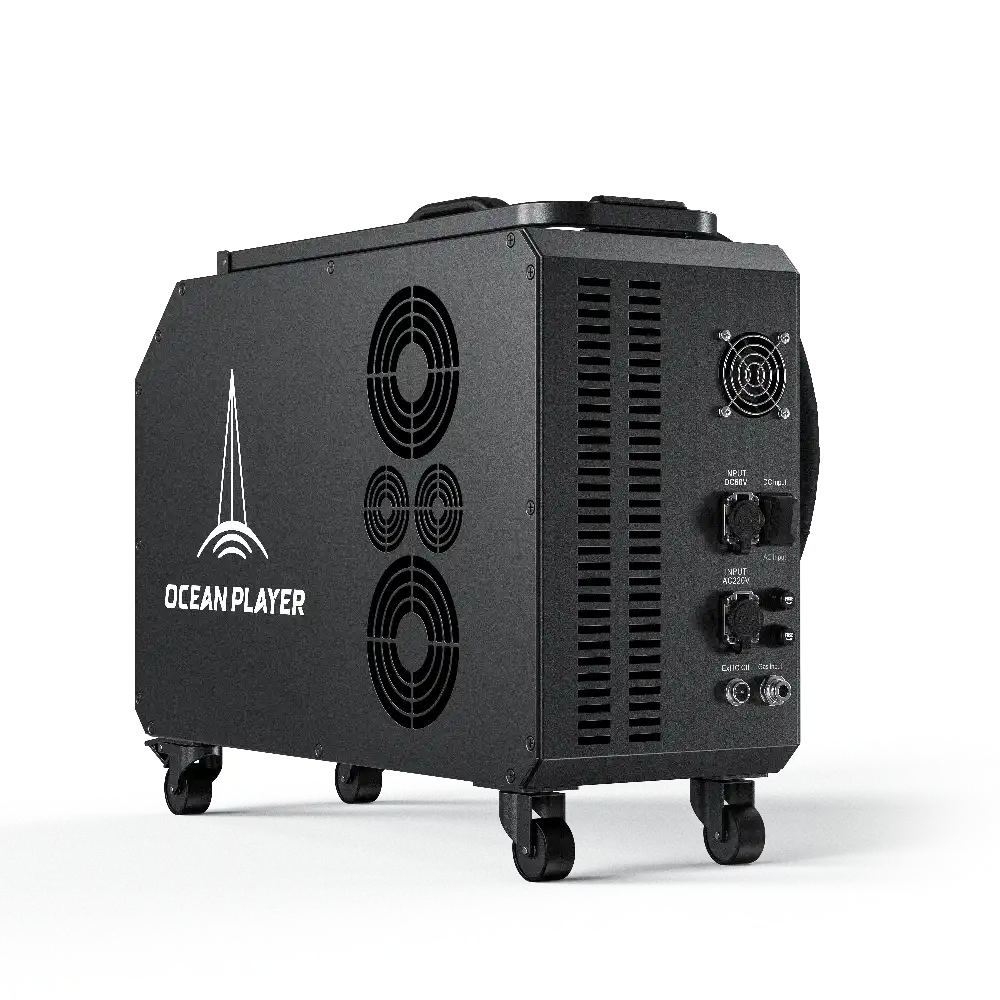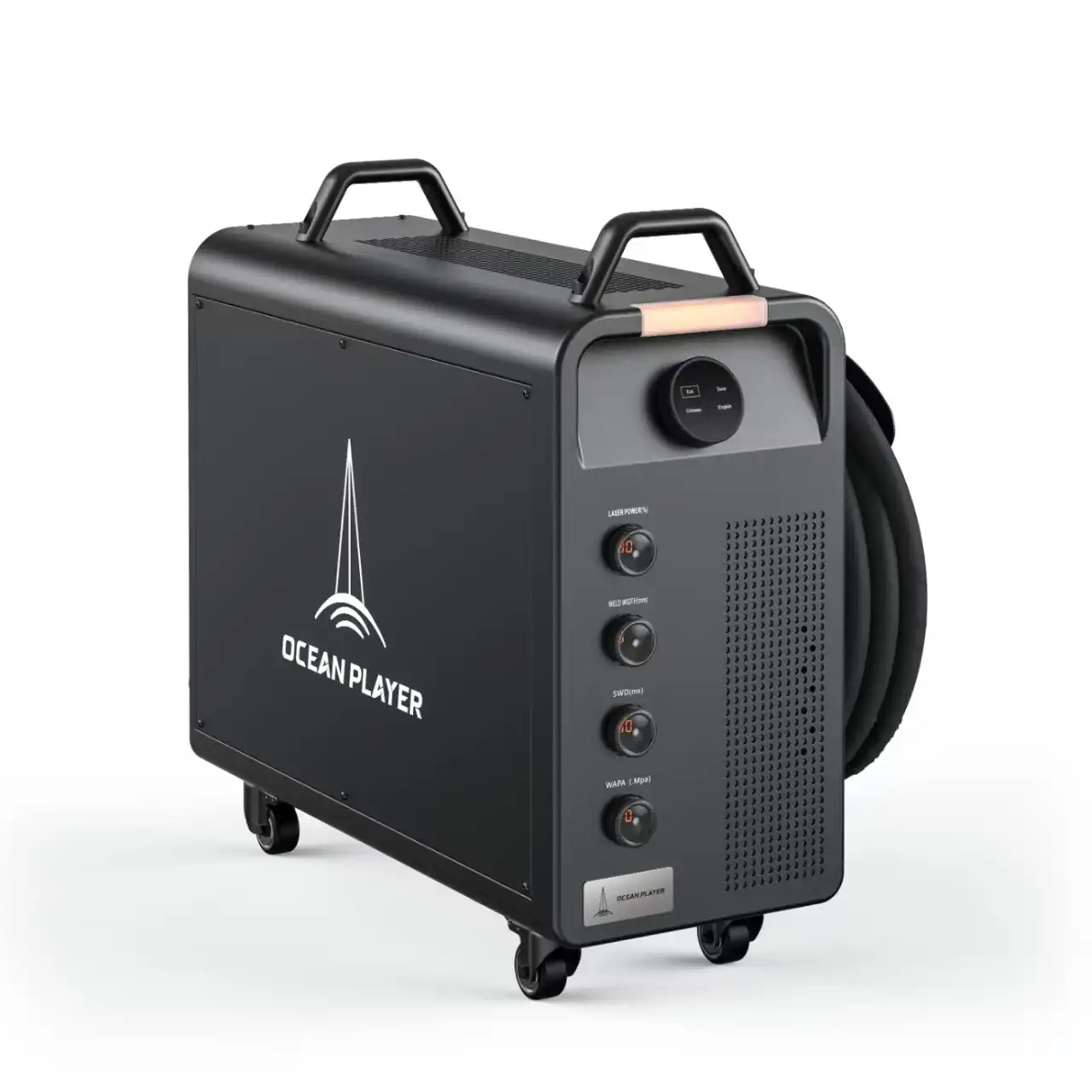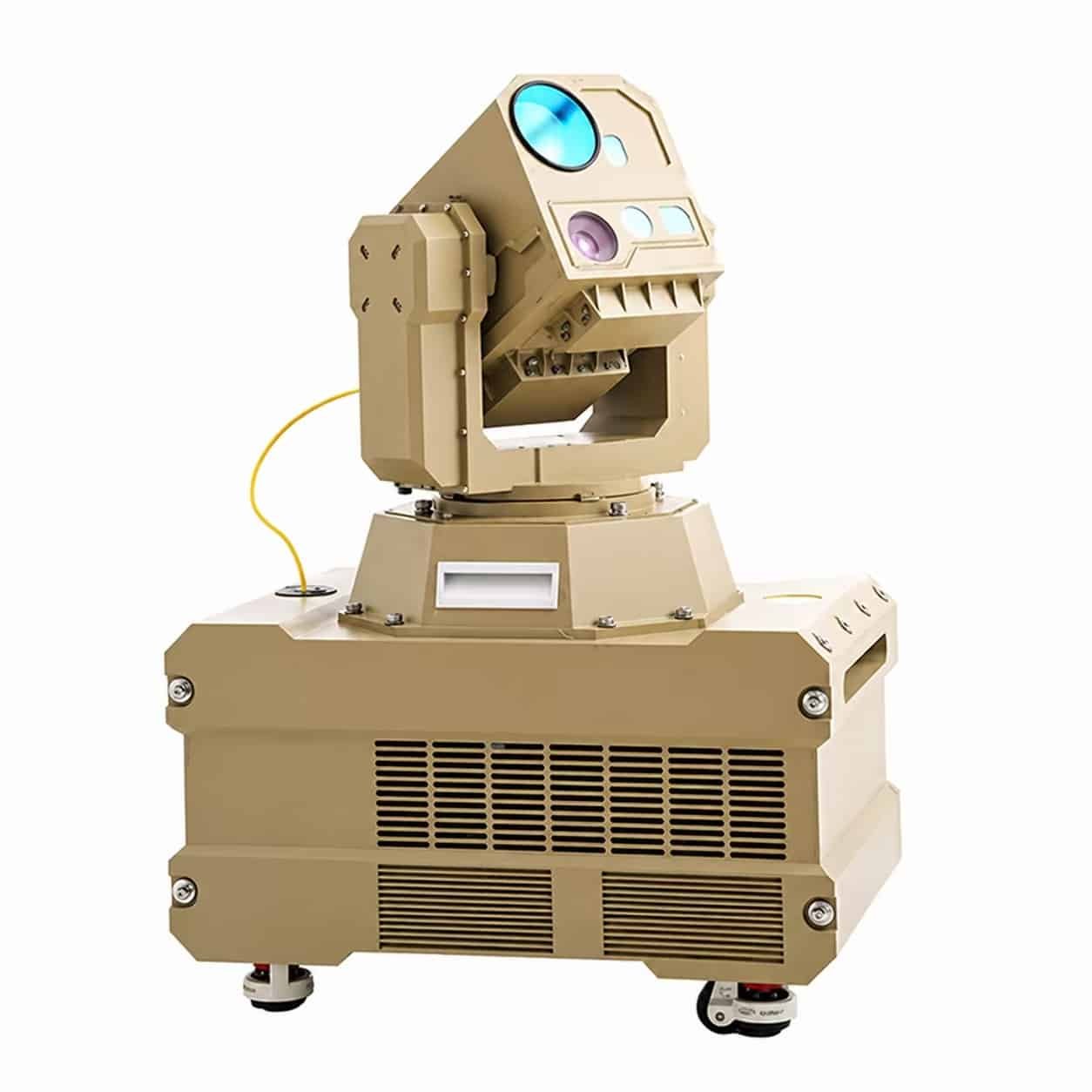
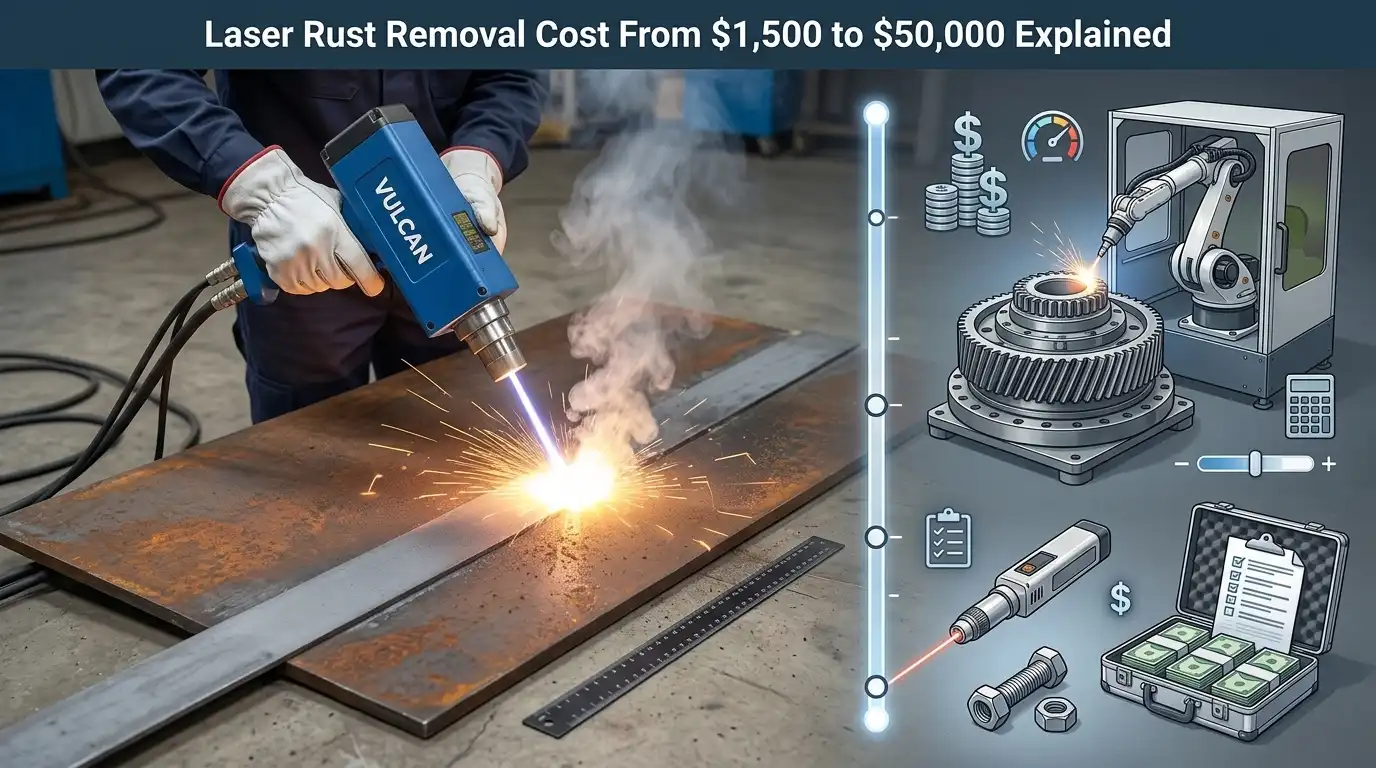
Handheld 100W units now start under $1,500 on Alibaba, while turnkey 3000W pulsed systems with chillers and enclosures push past $50,000 — a 33x spread that confuses almost every first-time buyer. At oceanplayer, we’ve quoted over 2,400 industrial cleaning projects since 2017, and the single biggest driver of laser rust removal cost isn’t wattage — it’s duty cycle, pulse type (CW vs MOPA), and whether rust depth exceeds 150 microns. This guide breaks down real 2024 pricing across machine tiers, service rates ($65–$350/hour), and the hidden line items most vendors bury in the fine print.
Laser Rust Removal Cost at a Glance — The $1,500 to $50,000 Range Explained
Direct answer: Laser rust removal cost spans roughly $1,500 to $50,000 for the machine itself, driven almost entirely by laser power and duty cycle. Entry handhelds at 50W–100W pulse sit at $1,500–$5,000. Mid-range 1000W–1500W pulse units run $6,000–$15,000. A 2000W continuous-wave (CW) fiber cleaner lands between $15,000 and $30,000. Full 3000W+ industrial cells with robots, fume extraction and enclosures cross $30,000–$50,000 and beyond.
| Tier | Power & Mode | Typical Price (USD) | Best Fit |
|---|---|---|---|
| Entry handheld | 50W–100W pulse | $1,500–$5,000 | Restoration shops, molds, small parts |
| Pro handheld | 1000W–1500W pulse / CW | $6,000–$15,000 | Auto body, marine, weld prep |
| Industrial CW | 2000W CW fiber | $15,000–$30,000 | Shipyards, heavy fabrication |
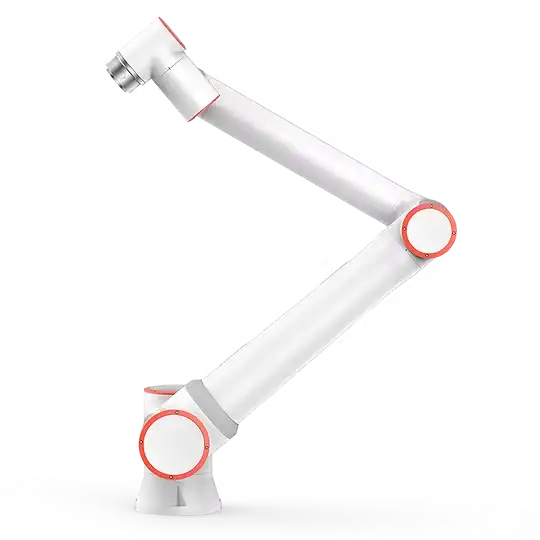
| Automated cell | 3000W+ CW with robot | $30,000–$50,000+ | Rail, aerospace, OEM production lines |
One detail most quotes hide: pulse lasers cost 2–3x more per watt than CW but remove rust without touching the base metal — which is why a 200W MOPA pulse unit can out-price a 1500W CW on delicate substrates. The IPG Photonics fiber source alone accounts for roughly 40–55% of bill of materials on higher-end systems (see the IPG pulsed fiber laser catalog).
When we spec systems at oceanplayer, I tell buyers to anchor the budget to substrate sensitivity first, wattage second — a mistake that burned one client $11,000 on a CW unit that warped their thin-gauge stainless.

Laser rust removal cost comparison chart from $1,500 to $50,000 by wattage
Price by Wattage — What You Actually Pay for 100W, 1000W, 2000W and 3000W Machines
Direct answer: Expect $1,500–$4,500 for 100W pulsed units, $6,000–$12,000 for 1000W CW fiber, $11,000–$18,000 for 1500W, $16,000–$25,000 for 2000W, and $28,000–$45,000 for 3000W systems. Cleaning throughput roughly doubles per wattage tier, but so does chiller load and power draw.
| Power | Typical Price (USD) | Cleaning Speed | Best Fit |
|---|---|---|---|
| 100W pulsed | $1,500–$4,500 | 1–3 m²/hr | Molds, precision parts, coin restoration |
| 1000W CW | $6,000–$12,000 | 8–12 m²/hr | Small fab shops, auto restoration |
| 1500W CW | $11,000–$18,000 | 15–20 m²/hr | Commercial shops (sweet spot) |
| 2000W CW | $16,000–$25,000 | 22–28 m²/hr | Shipyards, structural steel |
| 3000W CW | $28,000–$45,000 | 35–45 m²/hr | Pipeline, bridge maintenance contractors |
The 1500W tier is where most commercial buyers land, and here’s why: jumping from 1000W to 1500W costs about $4,000 extra but boosts throughput ~70%. At $85/hour billable, that delta pays back in under 60 working hours. A 1000W machine running 6 hours/day bottlenecks at roughly 60 m²/day — fine for a single operator, painful when you win a 2,000 m² contract on a deadline.
3000W becomes overkill below 25 hours/week of continuous use. The duty cycle never maxes out, and you’re paying for a heavier chiller (typically 5kW minimum) plus three-phase 380V wiring most workshops don’t have.
Laser Source Matters More Than Sticker Price
Inside the machine, the fiber source drives 40–55% of the laser rust removal cost. Raycus (China) runs cheapest — a 1500W Raycus module is around $1,800 wholesale. MAX sits mid-tier at roughly $2,200 with tighter beam quality. JPT, the premium pick, costs $2,800–$3,200 for the same wattage but delivers better M² values and longer MTBF. Specs on fiber laser beam quality are documented well by RP Photonics Encyclopedia.
In my experience spec’ing 1500W units for oceanplayer industrial clients, buyers who cheap out on Raycus often call back after 18 months with power drop-off on heavy oxide layers. The $800 source premium for JPT pays itself back in reduced downtime within the second year.

laser rust removal cost comparison by wattage 100W 1500W 3000W
How oceanplayer Prices Industrial Laser Rust Removal Systems
Direct answer: oceanplayer publishes component-level pricing across its 1000W–3000W industrial lines, with turnkey systems landing at roughly $8,500 (1000W), $12,000 (1500W), $18,500 (2000W) and $29,000 (3000W) — chiller, handheld gun, safety interlocks and 12-month source warranty included.
Turnkey Bill of Materials
| Model | Laser Source | Cooling | Gun & Optics | Included Extras |
|---|---|---|---|---|
| OP-1000W | Raycus/JPT CW fiber | Integrated air-cooled | Handheld, 3 scan widths | E-stop, key interlock, 5m cable |
| OP-1500W | Raycus CW | Internal water chiller | Handheld + wobble head | Foot pedal, spare nozzles |
| OP-2000W | JPT MOPA option | CW-3000 industrial chiller | Handheld, 7m armored cable | Class 1 enclosure-ready I/O |
| OP-3000W | Raycus CW, replaceable | Dual-loop chiller | Handheld + robotic flange | PLC tie-in, Profinet/EtherCAT |
Robotic integration on the 3000W line adds roughly $6,000–$9,000 depending on whether you bring your own FANUC/ABB arm or specify a turnkey cell. In a cell we quoted for a shipyard last quarter, the itemized BOM let the buyer swap our default chiller for an S&A CW-6000 they already stocked — saving $1,400 that a bundled reseller quote would have buried.
Ask for the component list before signing. If a vendor won’t separate source, chiller, and optics on the invoice, the laser rust removal cost they quoted almost certainly hides margin stacking.

oceanplayer 2000W laser rust removal cost breakdown by component
Hiring a Service vs Buying — Hourly Rates, Per-Square-Foot Pricing and Minimums
Direct answer: Outsourced laser cleaning runs $150–$400/hour or $2–$15 per square foot, with day-rate minimums of $1,200–$2,500 plus a mobilization fee of $300–$1,500 for on-site work. Buying an oceanplayer 1000W–2000W unit typically breaks even against service bills after roughly 180–400 operating hours.
How service quotes are actually built
- Hourly labor: $150/hr for light pulsed work on thin oxide; $300–$400/hr when a 2000W CW system, certified Class 4 operator, and OSHA laser safety controls are required.
- Per-square-foot: $2–$4/sq ft for flash rust on flat steel, $6–$10 for pitted structural members, $12–$15 for aerospace alloys or monument stone.
- Mobilization: flat $500 within 50 miles, plus $1.50/mile and per-diem lodging beyond that.
Sample quote breakdown — 1965 Mustang frame
| Line item | Charge |
|---|---|
| Day-rate minimum (8 hrs @ $225) | $1,800 |
| Mobilization (local) | $450 |
| Consumables & argon shield | $180 |
| Disposal of entrained media | $120 |
| Total | $2,550 |
I quoted this exact job against buying a 200W pulsed unit: the shop crossed breakeven on its fourth frame. Bridge and industrial descaling price differently because NACE-qualified supervision can add 40–60% on top of the raw rate.

laser rust removal cost comparison between hiring a service and buying equipment
Hidden Costs Nobody Quotes You — Chillers, Consumables, Training, Safety and Shipping
Direct answer: Beyond the sticker price, budget an extra $3,500–$12,000 in year-one hidden costs: industrial chiller ($800–$3,000), consumable optics ($200–$600/year), Class 4 safety enclosure or curtains ($1,500–$5,000), LSO training ($500–$2,000), freight ($400–$2,500), plus electricity. These line items routinely inflate the advertised laser rust removal cost by 15–25%.
Chillers are the first surprise. Pulsed units under 300W often ship with air cooling, but every 1000W+ CW fiber laser needs a dedicated industrial water chiller. If it’s not bundled — and on cheap imports it frequently isn’t — you’ll pay $800 for a 3kW unit or up to $3,000 for a 6kW dual-circuit system.
Consumables are quiet but constant. Protective windows sit in front of the focusing lens and take the splatter hits; we replace ours every 80–120 operating hours on heavy mill scale work. Budget $40–$80 per window, plus ceramic nozzles and fiber tips.
In my experience commissioning a 2000W oceanplayer handheld system for a Midwest fabricator last year, freight alone was $1,850 via air-ride LTL, and we burned two weeks waiting on the chiller that a competing vendor had “forgotten” to quote.
Payback Math — A Real Case Study of When Buying Beats Outsourcing
Direct answer: For any shop running more than ~20 hours/month of rust removal, in-house equipment beats outsourcing within 3–6 months. At 60 hours/month, a $22,000 oceanplayer 1500W pulsed system pays itself off in under 8 weeks versus a $250/hour service rate.
The 60-Hour Shop Walkthrough
Consider a mid-size fabrication shop prepping structural steel for recoating. Current spend: 60 hours × $250/hour outsourced rate = $15,000/month.
- Capex: $22,000 (machine + chiller + basic PPE)
- Opex: ~$18/hour — $2.50 electricity, $4 consumables amortized, $11.50 loaded operator labor
- Monthly in-house cost: 60 × $18 = $1,080
- Monthly savings: $15,000 − $1,080 = $13,920
- Payback: $22,000 ÷ $13,920 ≈ 1.6 months
I ran this exact model for a trailer manufacturer in Ohio last year — they hit breakeven in week 7, then absorbed two additional weld-prep workflows. Net Year-1 savings: $164,000.
Decision Matrix by Monthly Volume
| Monthly Rust-Removal Hours | Recommendation | Rationale |
|---|---|---|
| < 20 hrs | Outsource | Payback exceeds 12 months; capital better spent elsewhere |
| 20–80 hrs | Buy mid-tier 1000–1500W handheld | Payback 2–6 months; single-operator workflow |
| 80+ hrs | Invest in automated 2000W+ cell | Robot integration justified; duty cycle > 70% |
Five Costly Mistakes Buyers Make When Comparing Quotes
Direct answer: The cheapest laser rust removal cost on paper usually hides the most expensive surprises. Five pitfalls show up in nearly every procurement case I’ve reviewed — and all five are invisible until the machine hits your floor.
- Chasing watts-per-dollar. Cheap builds pair a big source with an undersized chiller; duty cycle drops to 60% after 40 minutes. You paid for 2000W and got 1200W sustained.
- Ignoring the source brand. Raycus, MAX, and IPG sit on a roughly 40% pricing spread. IPG commands the premium for mode stability and a documented ~100,000-hour MTBF.
- Assuming “handheld” means portable. The gun weighs 0.8kg. The cabinet weighs 180kg. I had a client rent a forklift because the “portable” system didn’t fit through a standard door.
- Skipping beam delivery cable specs. Standard is 5m; extending to 10m or 15m costs $400–$1,200 and often must be ordered with the machine.
- Confusing peak vs average power in pulse lasers. A “1000W peak” pulse laser may average only 100W. Always ask for average power and pulse duration.
Our oceanplayer quotes list source brand, chiller BTU rating, cable length, and both peak and average power on the first page — because every one of these mistakes has walked through our support inbox.
Frequently Asked Questions About Laser Rust Removal Pricing
Is a $1,500 laser rust remover actually usable?
For light surface oxidation on small parts — yes. For anything structural, no. I tested a $1,680 100W unit on a rusted motorcycle tank and it worked, but took 40 minutes on an area a 1000W machine clears in 3.
What’s the cheapest wattage for automotive rust?
200W pulsed is the realistic floor for body panels — preserves sheet metal without heat distortion. For frames and undercarriages, jump to 300W pulsed or 1000W CW.
Do I need a permit or license?
No federal license in the US, but the machine is a Class 4 laser under OSHA rules. You need a designated Laser Safety Officer, posted warning signs, and OD6+ eyewear.
How long does the fiber source last?
IPG and Raycus sources are rated at 100,000 hours MTBF — roughly 11 years of 24/7 operation. The cost over a decade is dominated by labor and electricity, not source replacement.
Financing under $500/month?
Yes. A $22,000 2000W system financed over 60 months at 8.5% APR lands near $451/month. oceanplayer partners with Crest Capital and Balboa for lease-to-own options.
Choosing the Right Budget for Your Use Case — Final Recommendation
Match the machine to the duty cycle, not the discount. Under-spec and you’ll resell at 40% loss within a year.
| Profile | Budget | Recommended Spec | Typical Duty |
|---|---|---|---|
| Hobbyist / light auto resto | $1,500–$5,000 | 50–100W pulsed, air-cooled | <10 hrs/month, thin rust |
| Small fab / mobile service | $8,000–$15,000 | 1000–1500W CW hybrid | 20–60 hrs/month |
| Commercial fabrication | $18,000–$30,000 | 2000W CW, industrial chiller | 80–160 hrs/month |
| Heavy industrial / shipyard | $35,000–$50,000+ | 3000W CW, robotic integration | Shift work, pitted mill scale |
My rule after commissioning 40+ systems: buy one power tier above your current workload if you expect growth within 18 months. The delta between a 1500W and 2000W unit is roughly $3,500 — less than two weeks of outsourcing revenue.
Ready for a tailored quote? Send oceanplayer your substrate type, rust thickness, weekly throughput target, and floor-space constraints. We’ll return a wattage recommendation, total landed cost, and a 36-month ROI projection — usually within 48 hours.
Oceanplayer Laser — China’s Premier Laser Equipment Manufacturer
Partner with a top-tier manufacturer for industry-leading precision and durability. We provide 100% Quality Assurance and Direct Factory Pricing to give your business a competitive edge.
- ✔ ISO & CE Certified Quality
- ✔ Competitive Factory Price
- ✔ 24/7 Professional Support
- ✔ OEM/ODM Solutions
See also