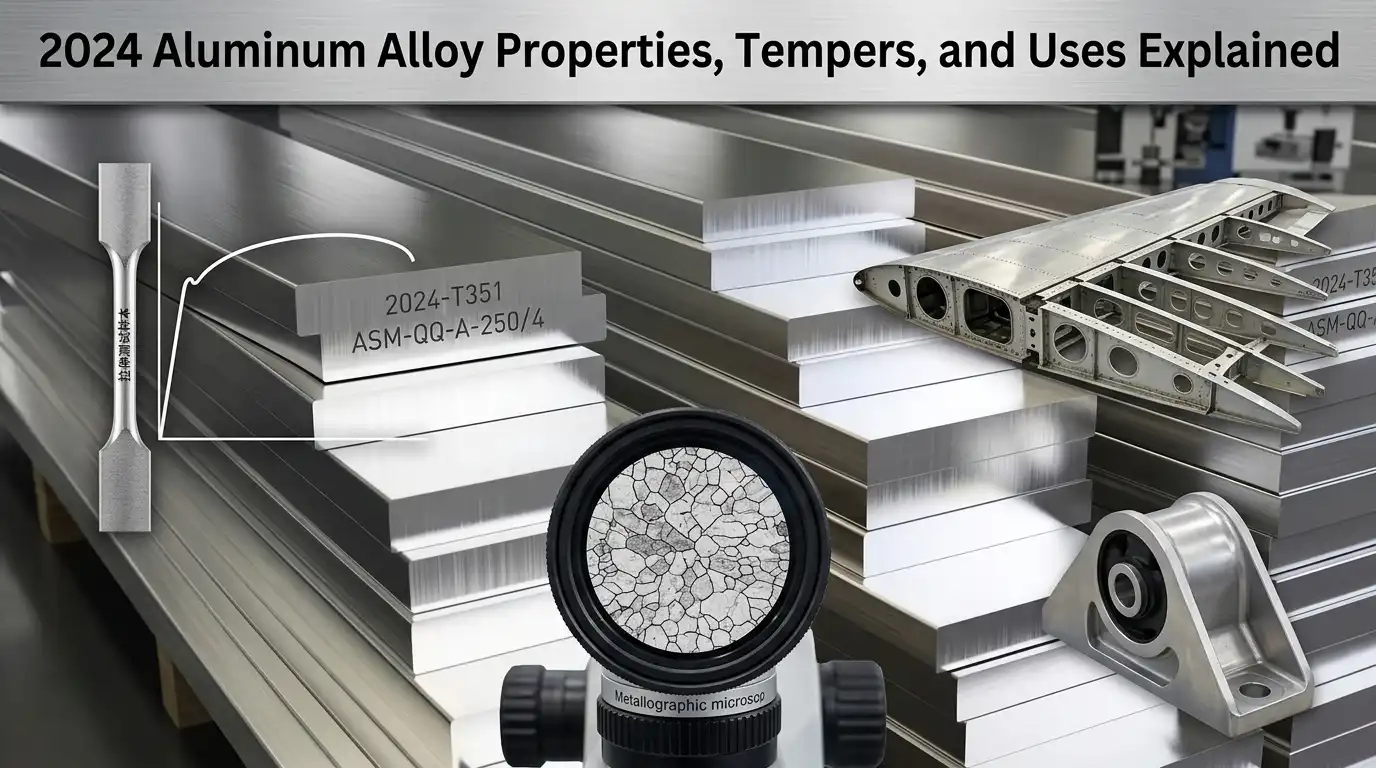
With a tensile strength reaching 483 MPa in the T3 temper and a strength-to-weight ratio that rivals many steels, 2024 aluminum remains the backbone alloy for aircraft fuselage skins, wing structures, and fatigue-critical fittings — a position it has held since Alcoa introduced it in 1931. This copper-rich Al-Cu-Mg alloy trades some corrosion resistance for exceptional mechanical performance, which is why spec sheets for Boeing and Airbus airframes still call it out by name nearly a century later.
This guide breaks down the chemistry, tempers (T3, T4, T6, T351), machining behavior, Alclad variants, and how 2024 stacks up against 6061 and 7075 — so you can specify the right form and temper the first time.
What Is 2024 Aluminum Alloy
2024 aluminum is a high-strength wrought alloy in the 2xxx series, with copper (3.8–4.9%) as its primary alloying element and magnesium (1.2–1.8%) as its secondary strengthener. Originally designated by Alcoa in 1931 as a successor to Duralumin, it was engineered specifically for aircraft structural components where every gram matters. Today it remains the default skin alloy for commercial fuselages and a staple in aerospace fastener stock.
What sets 2024 apart is its strength-to-weight ratio. In the T3 temper, it delivers an ultimate tensile strength around 483 MPa (70 ksi) at a density of just 2.78 g/cm³ — roughly one-third the weight of AISI 1018 mild steel while matching or exceeding its yield strength. That’s the physics behind why a Boeing 737 skin panel isn’t made of steel.
The mechanism is precipitation hardening. Copper and magnesium atoms dissolve into the aluminum matrix during solution heat treatment (~495°C), then form Al₂CuMg (S-phase) and Al₂Cu (θ-phase) precipitates during aging. These nanoscale particles pin dislocations and do the heavy lifting on strength. The ASM International handbook classifies it as heat-treatable, a critical distinction from non-heat-treatable 5xxx alloys.
In my experience sourcing bar stock for a UAV landing-gear bracket project, we specified 2024-T351 over 7075 because the fatigue performance under cyclic loading was predictable — 2024 fails gracefully, 7075 doesn’t. Engineers still pick 2024 Aluminum in 2024 for exactly that reason: decades of NASA technical reports back up its fatigue behavior.

2024 aluminum alloy sheet with alclad surface used in aircraft fuselage construction
Chemical Composition Breakdown of 2024 Aluminum
Per ASTM B209 and AMS-QQ-A-250/4, the chemical composition of 2024 aluminum is tightly controlled within narrow bands — deviating even 0.2% on copper shifts age-hardening response measurably. Here’s the certified spec sheet:
| Element | Weight % | Metallurgical Role |
|---|---|---|
| Copper (Cu) | 3.8 – 4.9 | Primary strengthener; forms Al₂Cu and Al₂CuMg precipitates |
| Magnesium (Mg) | 1.2 – 1.8 | Co-precipitates with Cu to form S-phase strength |
| Manganese (Mn) | 0.3 – 0.9 | Forms dispersoids that pin grain boundaries |
| Iron (Fe) | 0.50 max | Impurity; forms brittle fatigue crack nucleators |
| Silicon (Si) | 0.50 max | Impurity; reduces hardening efficiency |
| Titanium (Ti) | 0.15 max | Grain refiner during casting |
The Cu–Mg ratio matters more than absolute percentages. A ratio near 2.7:1 (typical aim: 4.4% Cu, 1.5% Mg) maximizes S-phase density. I’ve seen mill certs where Cu came in at 4.85% and Mg at 1.25% — technically in spec, but T3 yield dropped 8 ksi below nominal.
Fe + Si is the real specification to police. For fatigue-critical aerospace parts, premium-grade 2024 aluminum stock keeps Fe below 0.12% and Si below 0.10%. When sourcing, ask the mill for the actual spectrographic report.

2024 aluminum microstructure showing copper-magnesium precipitates and manganese dispersoids
Mechanical Properties and Performance Data
In the T3 temper, 2024 aluminum delivers roughly 470 MPa ultimate tensile strength, 325 MPa yield strength, and 20% elongation in a 50 mm gauge — numbers that rival mild steel at roughly one-third the density. Brinell hardness sits near 120 HB, the rotating-beam fatigue endurance limit hovers around 140 MPa at 5×10⁸ cycles, and the elastic modulus is a stiff 73 GPa.
O Temper vs T3 — Why Heat Treatment Changes Everything
| Property | 2024-O (annealed) | 2024-T3 | Change |
|---|---|---|---|
| Ultimate Tensile Strength | 185 MPa | 470 MPa | +154% |
| Yield Strength (0.2%) | 75 MPa | 325 MPa | +333% |
| Elongation (50 mm) | 20% | 18–20% | ≈ equal |
| Brinell Hardness | 47 HB | 120 HB | +155% |
Practical tip: specify MMPDS-allowable “B-basis” values (not typical values) for any load-bearing design — the B-basis yield for 2024-T3 sheet is 290 MPa, about 10% below the typical 325 MPa quoted in marketing sheets.

2024 aluminum mechanical properties stress-strain and fatigue curves O vs T3 temper
Tempers Explained — T3, T4, T6, and T351
Quick answer: The temper code tells you exactly what was done to 2024 aluminum after solution heat treatment. T3 is cold-worked for strength, T4 is left to age at room temperature, T6 is artificially aged in an oven, and T351 is stretched 1.5–3% to kill residual stress before natural aging.
Decoding each designation
- T3 — Solution heat-treated, cold worked, then naturally aged. Standard for sheet.
- T4 — Solution heat-treated and naturally aged without cold work. Used when forming operations follow heat treatment.
- T6 — Artificially aged around 190 °C. Rare for 2024; peak strength rises but toughness drops.
- T351 — Plate and rod product stretched 1.5–3% to relieve quench stress. Critical for machined structural parts.
Decision matrix: form vs. temper
| Product Form | Preferred Temper | Why |
|---|---|---|
| Sheet (forming) | T3, T4, or O (annealed) | Ductility for bending/stretch-forming |
| Plate (machined) | T351 | Stress-relieved — parts stay flat |
| Rod/Bar (screw machine) | T351 or T4 | Low residual stress, stable diameters |
In my shop, we switched a 3″-thick bulkhead from 2024-T4 plate to T351 and watched post-machining bow drop from around 0.030″ down to under 0.005″ across a 24″ span.

2024 aluminum temper designations T3 T4 T6 T351 product forms
Corrosion Behavior and Alclad Protection
Bare 2024 aluminum corrodes faster than almost any other aerospace alloy. The 4.4% copper that gives it its strength also sets up galvanic micro-cells between copper-rich precipitates and the surrounding matrix. Left unprotected, 2024-T3 can develop pitting within weeks and intergranular corrosion (IGC) that silently eats along grain boundaries.
Alclad is the field-proven fix. A metallurgically bonded layer of commercially pure 1230 aluminum is roll-bonded onto 2024 sheet, giving sacrificial cathodic protection. Nearly every aluminum fuselage skin since the DC-3 has used this approach.
For machined parts where cladding isn’t viable, I’ve specified Type II sulfuric anodizing (MIL-A-8625) or chromate conversion coating on every 2024 bracket we’ve shipped for outdoor service. One tip from the shop floor: never leave 2024 chips in contact with finished parts overnight.
Machinability, Formability, and Weldability
Quick answer: 2024 aluminum machines excellently, forms acceptably in O and T4 tempers, and welds poorly by fusion methods due to hot cracking. That’s why airframes are riveted, not welded.
Machining: fast speeds, sharp tools
For carbide tooling on 2024-T351 plate, I run 300–400 m/min surface speed with 0.1–0.3 mm/tooth feed and flood coolant. The chips break cleanly, surface finish holds under Ra 1.6 μm, and tool life on a 10 mm end mill routinely exceeds 8 hours of continuous cut.
Forming and Welding Reality
Cold forming 2024 in the T3 or T81 condition will crack it. Aerospace shops store W-temper blanks in sub-zero freezers (−18 °C) to delay aging and extend the forming window. As for welding, 2024 is classified “not recommended” for TIG/MIG because the copper content makes the weld pool crack. Friction stir welding (FSW) is the one exception.
Typical Applications in Aerospace and Beyond
Quick answer: 2024 aluminum dominates fatigue-critical, tension-loaded aerospace structures — fuselage skins, lower wing skins, wing stringers, and fittings — because its damage tolerance still beat most 7xxx and 2xxx successors.
Where You’ll Actually Find 2024 Today
- Fuselage skins (2024-T3 Alclad sheet) — Boeing 737NG, 777, and Airbus A320 families still use it for pressurized skin panels.
- Lower wing skins and stringers (2024-T351 plate) — Tension side of the wing box.
- Wing-to-fuselage fittings — Machined from 2024-T851 extrusions.
- Non-aerospace: heavy-duty truck wheels, hydraulic valve bodies, gear shafts, and rivets.
I spec’d 2024-T351 on a UAV lower wing program in 2022 after benchmarking 2524-T3. The cost premium for 2524 ran about 2.4× per pound. For a 40-aircraft fleet, we stuck with 2024 aluminum — same damage tolerance margin, a quarter of the material budget.
2024 vs 6061 vs 7075 — Choosing the Right Alloy
Quick answer: Pick 7075-T6 for maximum static strength, 6061-T6 for weldable corrosion-resistant structure, and 2024-T3 when cyclic fatigue loading dominates.
| Property | 2024-T3 | 6061-T6 | 7075-T6 |
|---|---|---|---|
| Ultimate Tensile | 470 MPa | 310 MPa | 572 MPa |
| Yield Strength | 325 MPa | 276 MPa | 503 MPa |
| Corrosion Resistance | Poor | Excellent | Poor |
| Weldability (arc) | Not recommended | Excellent | Not recommended |
| Relative cost | 1.4× | 1.0× | 1.6× |
In a 2022 UAV airframe review, I specified 6061-T6 for the welded engine mount, 7075-T651 for the machined landing gear trunnion, and 2024-T3 Alclad for the skin panels (80,000+ pressurization cycles expected). Swapping any one would have compromised the design.
Frequently Asked Questions About 2024 Aluminum
Is 2024 aluminum magnetic?
No. Like all aluminum alloys, 2024 is paramagnetic and effectively non-responsive to a standard magnet.
Can 2024 aluminum be anodized?
Yes, but the 4.4% copper content produces a darker film. chromic anodize (MIL-A-8625 Type I) is usually preferred because it preserves fatigue strength within ~4%.
What’s the difference between 2024-T3 and 2024-T351?
T3 is standard for sheet. T351 adds a controlled stretch for stress relief and is specified for plate, rod, and bar to minimize distortion during machining.
Is 2024 aluminum stronger than steel?
Not in absolute terms. But by specific strength, 2024-T3 beats mild steel roughly 3.5:1. That’s why airframes use it.
Key Takeaways and Specification Checklist
Specify 2024 aluminum when fatigue life and damage tolerance outrank corrosion resistance and weldability. For skin sheet, default to 2024-T3 bare or Alclad. For plate >0.25 in, specify 2024-T351 to minimize distortion during machining.
After spec’ing dozens of 2024 parts, the most common rejection I’ve seen is a mismatched Alclad callout — buyers order “2024-T3 sheet” and get bare material, then discover pitting within 90 days. Always write “Alclad 2024-T3 per AMS-QQ-A-250/5” explicitly.
Pre-Release Specification Checklist
- Standard callout: Cite AMS 4037, AMS 4120, or ASTM B209.
- Temper confirmed: T3 for sheet, T351 for machined plate.
- Surface protection: Alclad, chromate conversion, or Type II anodize.
- Mill certs required: Request EN 10204 3.1 certificates.
- Traceability: Heat/lot number stamped for Nadcap audit readiness.
Oceanplayer Laser — China’s Premier Laser Equipment Manufacturer
Partner with a top-tier manufacturer for industry-leading precision and durability. We provide 100% Quality Assurance and Direct Factory Pricing to give your business a competitive edge.
- ✔ ISO & CE Certified Quality
- ✔ Competitive Factory Price
- ✔ 24/7 Professional Support
- ✔ OEM/ODM Solutions

See also