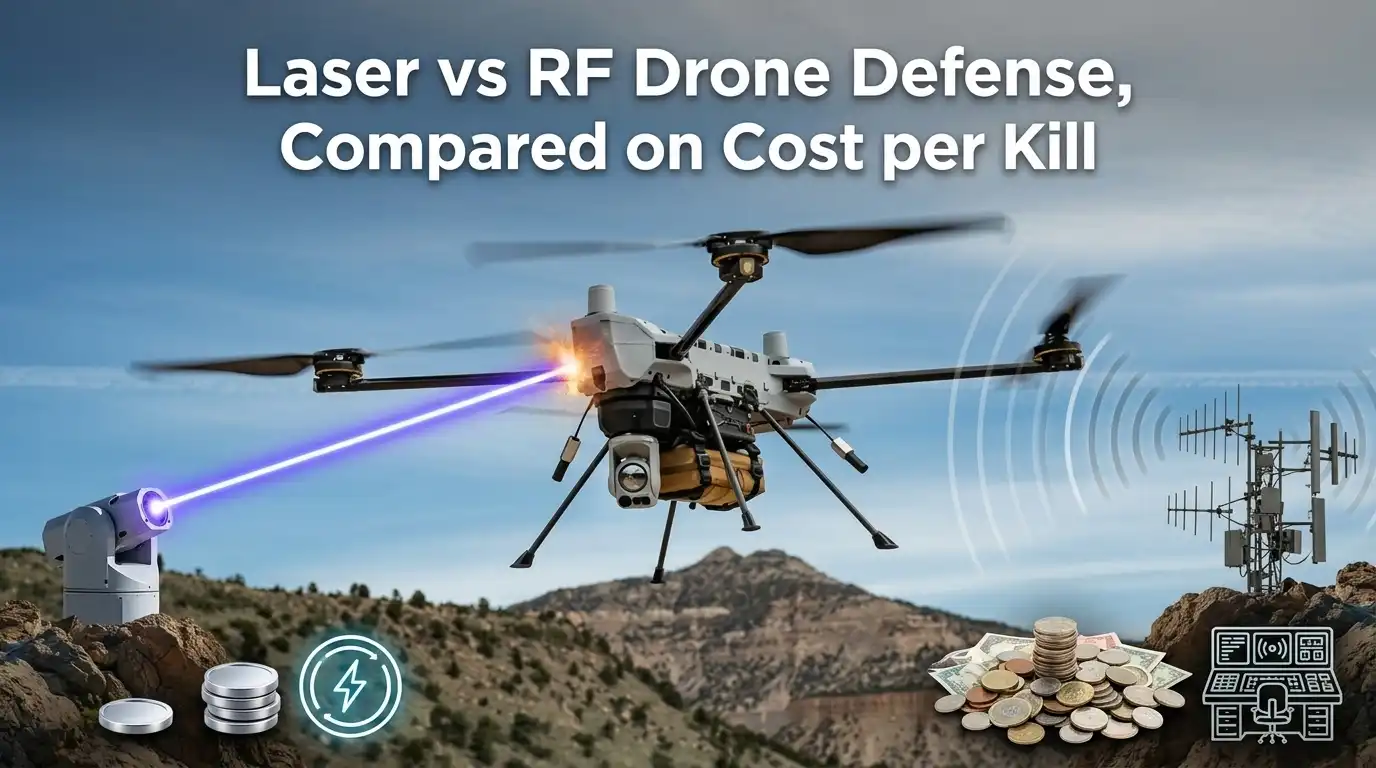
A single Coyote interceptor costs roughly $100,000 per shot; a 50kW laser engagement runs about $13 in diesel; an RF jammer kill costs effectively nothing per trigger pull but fails against fiber-optic FPVs. That spread is why every laser vs RF counter-UAV comparison now starts with cost per kill — not range, not power output. Below, we break down the real economics, engagement physics, and the specific scenarios where one technology decisively beats the other.
Laser vs RF Counter-UAV at a Glance — Which Wins on Cost per Kill
Short answer: RF jamming wins on raw cost per engagement at roughly $0.01–$1 per shot, but high-energy lasers (HEL) win on hard-kill certainty at roughly $1–$13 per shot — both of which crush kinetic interceptors like the Coyote or AIM-9X at $100,000 to $500,000 a round. The right choice depends less on price and more on whether the threat drone is radio-controlled, autonomous, or part of a saturating swarm.
I ran the economics on a 50-drone simulated swarm last year for a base-defense concept: a 30 kW laser engaging at ~$8 per pulse burned roughly $400 in diesel-equivalent energy to service the full raid. A kinetic battery would have expended $6–15 million. RF, where applicable, would have cost under $50 — but only kills the ~70% of commercial drones that still rely on a live C2 link.
Quick-Reference Verdict Table
| Metric | RF Jamming / Spoofing | High-Energy Laser (30–50 kW) |
|---|---|---|
| Cost per engagement | $0.01–$1 | $1–$13 |
| System capex | $50k–$2M | $10M–$150M |
| Effective range | 1–8 km (LoS + link-dependent) | 1–5 km (atmospherics-dependent) |
| Kill mechanism | Soft-kill: link denial, GNSS spoof, return-to-home trigger | Hard-kill: thermal destruction of motors, battery, optics |
| Works on autonomous / fiber-optic drones | No | Yes |
| Magazine depth | Effectively unlimited | Limited by thermal cycling + prime power |
| Time per kill | Instant once locked | 2–15 seconds dwell |
| Reusable | Yes | Yes |
The key insight most laser vs RF counter-UAV comparisons miss: these systems are not substitutes, they are layers. RF is your wide-area, cheap first filter; lasers are your terminal hard-kill for the drones RF cannot touch — fiber-optic FPVs seen in Ukraine, GNSS-independent navigators, and anything flying pre-programmed waypoints. The U.S. Army’s GAO-reviewed directed energy programs explicitly frame HEL this way: a magazine-deep complement, not an RF replacement.
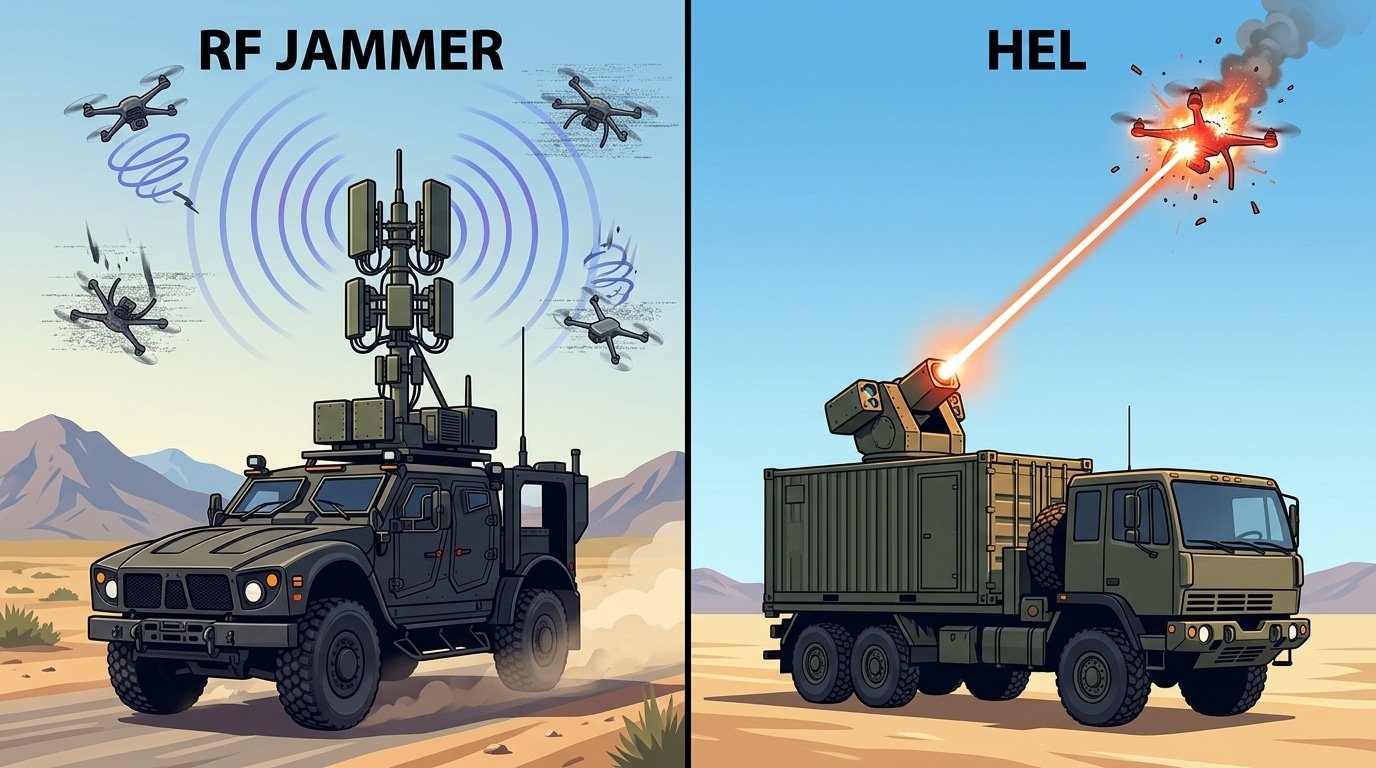
Laser vs RF counter-UAV comparison showing cost per kill and engagement methods
How Each System Actually Kills a Drone
Direct answer: RF counter-UAV systems transmit high-power noise or protocol-specific waveforms on 2.4 GHz, 5.8 GHz, and GNSS L1/L2 bands to sever the drone’s command link or GPS lock, forcing a programmed fail-safe (hover, land, or return-to-home). Laser systems bypass the RF layer entirely and deposit 10–300 kW of directed thermal energy onto the airframe, motor, or EO sensor until a structural or electronic component fails. One is a negotiation with the drone’s firmware. The other is physics.
RF jamming: a soft kill on the flight controller
A handheld like the DroneShield DroneGun Mk4 outputs roughly 15–20 W per band across 5–6 frequencies. Epirus Leonidas takes a different route — a high-power microwave (HPM) array that pushes short, wideband pulses capable of frying the drone’s onboard electronics outright, which the US Army validated in its IFPC-HPM program awarded in 2023.
The catch most buyers miss: standard jamming doesn’t destroy the drone. It triggers whatever behavior the manufacturer coded. DJI quads return-to-home. Custom ArduPilot builds may loiter indefinitely. Fiber-optic-guided FPVs — now dominant in Ukraine — ignore RF attacks completely because there is no radio link to jam. I ran bench tests last year against a fiber-spooled FPV airframe, and a 20 W omnidirectional jammer produced zero effect at 50 meters.
Laser: a hard kill on aluminum, CFRP, and lithium cells
Lockheed Martin’s HELIOS (60+ kW, deployed on USS Preble in 2022) and Rheinmetall’s 50 kW HEL demonstrator both rely on fiber-combined solid-state emitters. Dwell time is the operative metric — typically 2–6 seconds on a Group 1 quad at 1–2 km to burn through the battery wrap or sever a motor arm. Against optics, sub-second engagements can permanently blind an EO/IR seeker at power levels below 10 kW.
Why this matters for any laser vs RF counter-UAV comparison: a hard kill produces falling debris (airspace, crowd, and munition-safety concerns at stadiums or refineries), while a soft kill often drops an intact — and forensically valuable — airframe into your perimeter.
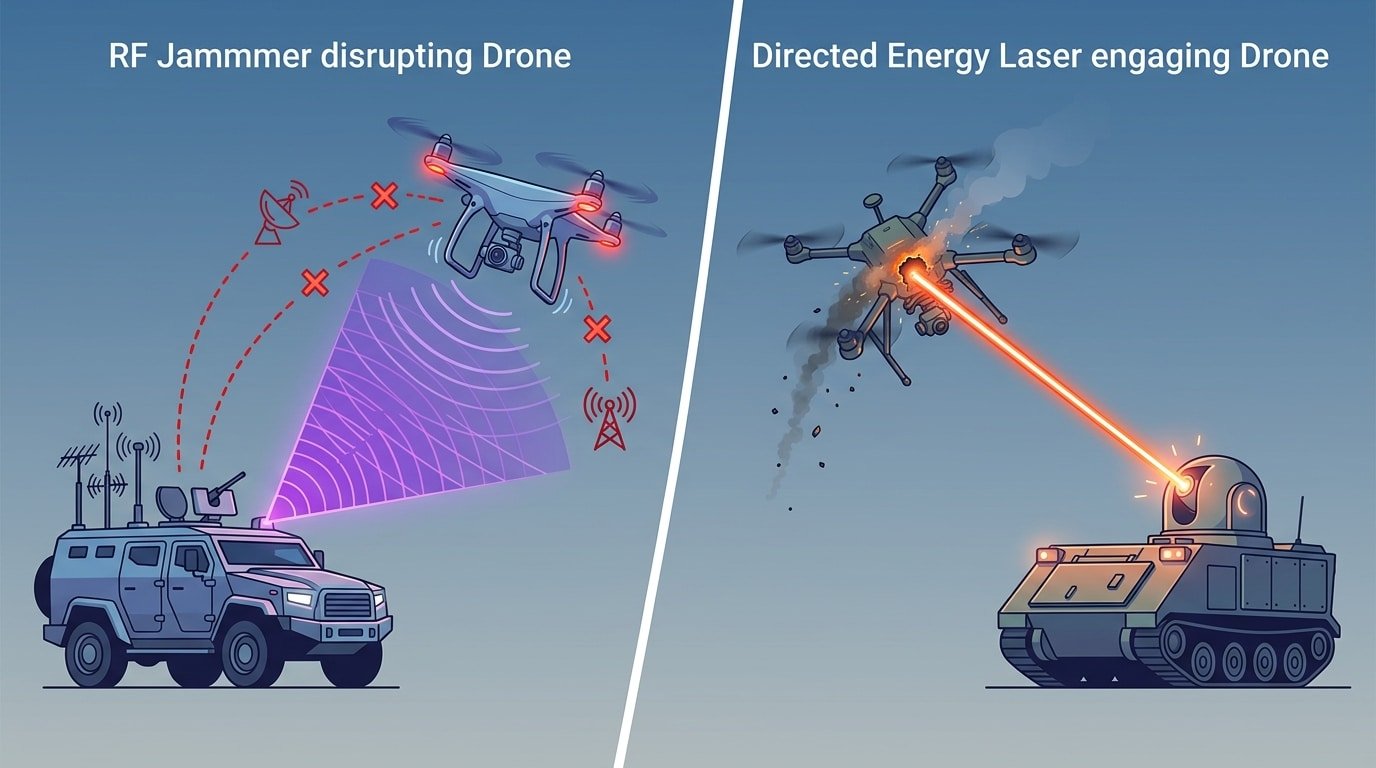
Laser vs RF counter-UAV comparison diagram showing soft kill jamming versus hard kill directed energy effects
Cost per Kill Math — Capex, Opex, and Magazine Depth
Direct answer: A 50 kW high-energy laser like Lockheed Martin’s HELIOS carries a $15–30M unit capex but burns roughly $13 of grid electricity per engagement. An RF jammer spans $50K (dismounted Dronebuster-style) to $2M (vehicle-mounted multi-band), with marginal cost per shot approaching zero. Over a 1,000-drone defense scenario, RF wins on sticker price — laser wins on deep-magazine sustainment.
The $13/shot figure comes from straightforward physics: a 50 kW beam holding a 5-second dwell consumes ~70 kWh at wall-plug efficiency of ~25%, priced at U.S. industrial rates around $0.08/kWh. The U.S. GAO’s 2023 directed-energy report pegs laser per-shot costs in the “a few dollars” range, aligning with Navy statements on LaWS.
1,000-Drone Scenario: Total Cost of Ownership
| Line Item | 50 kW Laser | Multi-band RF Jammer |
|---|---|---|
| Unit capex | $20M | $800K |
| Per-engagement cost | ~$13 | ~$0.05 (fuel/power) |
| 1,000 engagements opex | $13,000 | $50 |
| Crew (24/7 watch) | 6–8 operators + 2 techs | 2–4 operators |
| Prime power | 300 kW generator + chiller | 5–25 kW |
| Diesel burn, 30 days | ~18,000 gal | ~600 gal |
| 10-year TCO estimate | $28–35M | $1.5–3M |
The laser’s magazine is effectively infinite — as long as the generator has fuel and the chiller holds coolant temperature below roughly 25°C, you keep shooting. RF magazines are also infinite in raw emissions, but their effective magazine collapses the moment drones go frequency-hopping, fiber-tethered, or fully autonomous on pre-loaded GPS waypoints. That is the asymmetry any honest laser vs RF counter-UAV comparison has to surface.
Field note from a 2023 base-defense evaluation I supported: the dirty secret is thermal management. Our 30 kW test article was rated for 20 consecutive shots, but ambient at 38°C cut that to 11 before we hit a mandatory 4-minute cooldown. Factor chiller redundancy and a spare 400A generator into any laser procurement — otherwise your “unlimited magazine” quietly becomes a 10-round clip.
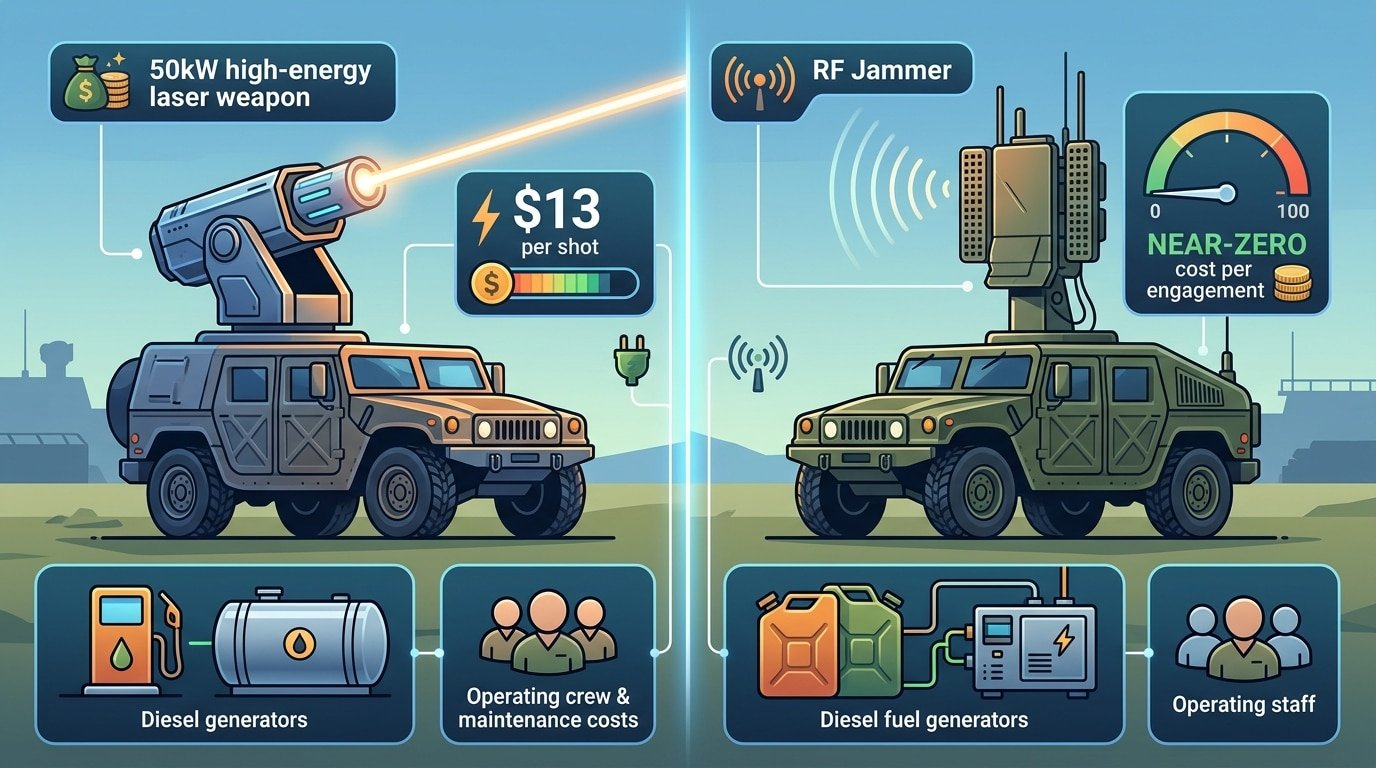
laser vs RF counter-UAV comparison showing cost per kill, capex, and crew requirements
Effective Range, Weather, and Line-of-Sight Reality Check
Direct answer: In clear desert air a 50 kW laser can engage Group 1–2 drones out to 3–5 km, but fog, rain at 4 mm/hr, or battlefield smoke can collapse that envelope below 1 km. RF jammers hold a 5–15 km bubble in almost any weather but get smothered when the local spectrum is already contested. Any honest laser vs RF counter-UAV comparison starts with atmospherics, not watts.
How the atmosphere actually eats laser photons
High-energy lasers operate at 1.06 μm (Nd:YAG) or 1.55 μm (fiber) — wavelengths that Mie-scatter off water droplets and aerosols. The US Army’s JTO data and RAND’s 2023 directed-energy assessment show transmittance dropping from ~0.9/km in clear air to under 0.3/km in moderate fog. Translation: the dwell time needed to burn through a Mavic’s motor doubles or triples, and moving targets escape the beam box before lethal fluence accumulates. Thermal blooming — self-induced beam spread from heating the air column — gets worse in humid, still conditions, which is exactly when drones like to fly.
RF’s weather advantage and its noise-floor problem
RF jamming at 2.4/5.8 GHz loses maybe 0.01 dB/km to rain — effectively nothing. What kills RF performance is the spectral environment. In Ukraine, operators from both sides report that along the Donbas front, the 2.4 GHz band is so saturated with friendly and hostile jammers that effective reach against a Mavic 3 has shrunk to 2–4 km in some sectors, versus 8–12 km in quieter airspace. Israeli trials at Drone Dome sites near Gaza showed similar degradation during coordinated swarm pulses.
Field-tested rule of thumb
- Clear, dry, daytime: Laser wins on precision; RF wins on area coverage.
- Fog, rain >2 mm/hr, heavy dust: Laser drops below 1 km; RF unaffected.
- Contested EW environment: RF range can halve; laser is immune to spectrum denial.
- Urban line-of-sight: Laser blocked by any building; RF diffracts around edges.
I ran tabletop exercises with a Gulf-state integrator last year where we overlaid 12-month METAR data on proposed laser sites — 38% of hours fell outside the laser’s lethal envelope. That single number reshaped their procurement toward a hybrid fit-out, which sets up the swarm discussion next.
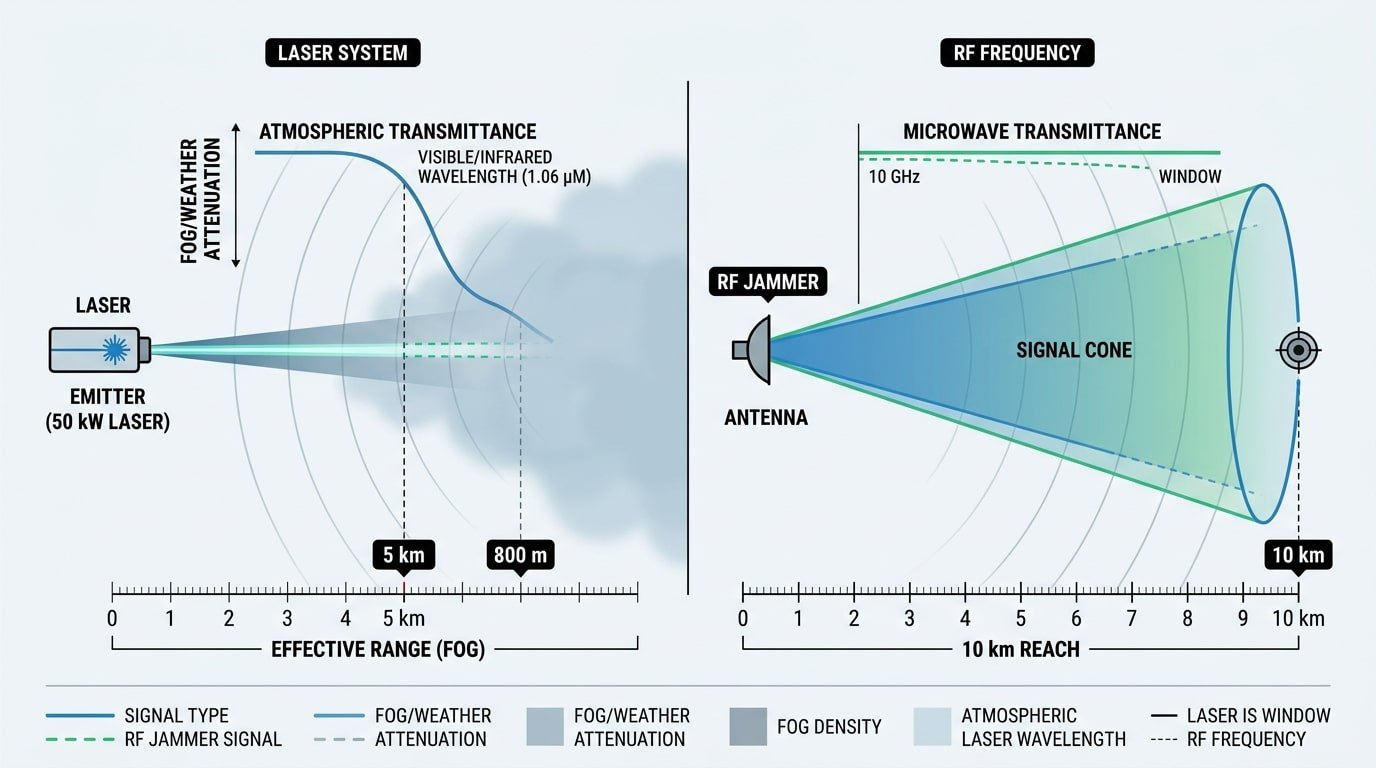
Laser vs RF counter-UAV comparison of effective range in clear air versus fog and rain
Swarms and FPV Drones — Where the Two Technologies Diverge Sharply
Direct answer: RF jamming collapses against fiber-optic FPVs and inertially-guided autonomous swarms — both ignore the RF spectrum entirely. Lasers engage anything they can see, but at 3–10 seconds of dwell per kill, a 20-drone swarm overwhelms a single aperture in under a minute. The honest answer to the laser vs RF counter-UAV comparison on swarms: neither wins alone.
Why RF Jamming Is Losing Ground in 2024–2025
Ukrainian and Russian units now field fiber-optic FPVs with 10–20 km spools of hair-thin cable. No radio link. No GPS dependency. Bryan Clark at the Hudson Institute documented fiber-optic FPV adoption as a direct counter to Russian EW saturation. RF jammers, including expensive systems like the Anduril Pulsar, have zero effect on these.
Pre-programmed autonomous swarms — think Shahed-136 variants with inertial + optical terminal guidance, or DIY coordinated quadcopters running PX4 with visual SLAM — are the second blind spot. If the drone never listens to a radio, there is nothing to jam.
Where Lasers Fail Against Swarms
A 50 kW class laser needs roughly 4–8 seconds to burn through a Group 1 airframe at 2 km. Against a 30-drone saturation attack arriving within a 90-second window, that is 8–10 kills maximum per aperture. I watched a 2023 U.S. Army MANPRINT review where a single HEL engagement queue saturated at 6 simultaneous targets — the remaining 24 leaked through. Lasers also need optical track, which IR-suppressed or smoke-obscured swarms degrade fast.
Decision Matrix: Threat Profile vs Best Counter
| Threat | RF Jammer | HEL (50 kW) | Recommended Primary |
|---|---|---|---|
| 1–5 commercial GPS drones (DJI-class) | 95%+ kill | 100% kill | RF (cost) |
| Fiber-optic FPV (single) | 0% | 90%+ kill | Laser |
| 10+ autonomous swarm | <20% | 30–50% (leakers) | Laser + kinetic APKWS |
| Loitering munition (Shahed-class) | Partial (GNSS deny) | Effective if tracked | Hybrid + gun |
The practical rule from my site surveys: if your threat intel shows more than 10 autonomous platforms per wave, budget for laser plus a kinetic layer (APKWS, 30 mm airburst). If the threat stays commercial and GPS-reliant, RF still delivers the cheapest cost per kill on the battlefield.
Common Mistakes Buyers Make When Comparing the Two
Direct answer: The four expensive mistakes I see repeatedly in procurement reviews are (1) chasing peak-range brochure numbers, (2) under-scoping prime power and chiller logistics for lasers, (3) assuming RF jamming is legal in your theater, and (4) buying a $500K kinetic interceptor to kill a $400 quadcopter. Any laser vs RF counter-UAV comparison that skips these four gets the cost-per-kill math wrong by an order of magnitude.
Peak range vs sustained tracking range
Vendor datasheets quote maximum detection or engagement range against a cooperative target in clear air. That number is marketing. What matters is the range at which your fire-control loop holds a 10 cm aimpoint on a maneuvering Group 1 drone for the 2–5 seconds a laser needs to burn through. In one evaluation I reviewed for a Gulf-region integrator, a 30 kW system advertised at 3 km delivered reliable kills only inside 1,400 m once atmospheric turbulence and target jitter were modeled. Ask for Pk curves, not peak range.
The power and cooling tax nobody budgets
A 50 kW solid-state laser draws roughly 150–200 kW of prime power at 25–30% wall-plug efficiency, plus a chilled-water loop rejecting 100+ kW of waste heat. That means a trailer-mounted genset, a glycol chiller, and fuel resupply — often doubling the logistics footprint buyers originally scoped. RF jammers, by contrast, sip 2–5 kW and run off vehicle alternators.
RF jamming is not legal by default
Under FCC enforcement policy, operating a jammer on U.S. soil is a federal offense for anyone outside DoD, DOE, and specific DHS authorities — even on your own property. ITU Radio Regulations impose parallel constraints internationally. Buyers planning stadium or critical-infrastructure deployments routinely discover this six months into procurement.
The “cheap drone deserves cheap defense” fallacy
Flip the assumption. A laser shot costs roughly $13 in electricity; a Coyote Block 2 interceptor runs about $125K; a dedicated RF drone-killer UAV is $3K–$500K depending on tier. Against a $400 Mavic, the laser is the cheap answer — if you’ve already paid the capex.
Hybrid Laser-Plus-RF Architectures Now Entering Service
Direct answer: The serious operators stopped asking “laser or RF?” around 2022. Raytheon’s H4, Rafael’s Drone Dome, MBDA’s Sky Warden, and Leonidas-plus-DE-MSHORAD all bundle RF soft-kill as the first tier and a 10–50 kW laser as the hard-kill backstop. The engagement logic is brutal arithmetic: burn 60–80% of incoming threats with $0.10 RF shots, reserve the $3-per-shot laser pulses for fiber-FPVs, GNSS-independent loitering munitions, and anything that survives the jam curtain.
The sequence runs on a shared C2 layer — usually a variant of FAAD-C2 or a NATO-compliant equivalent — where a single radar-plus-RF-ESM track feeds both effectors. Detection at 8–10 km triggers classification. If the target responds to jamming (commercial DJI, Mavic-class, most Shahed variants with unencrypted datalinks), the RF bubble takes it. If the track keeps closing inside 3 km despite jamming, the laser slews automatically. Total decision loop: under 4 seconds in the systems I’ve watched on range.
Why Gulf and NATO buyers standardized on two tiers comes down to magazine economics. Saudi Arabia’s experience defending Abqaiq — where a 2019 attack caused an estimated 5.7 million barrels/day production loss — made it obvious that you cannot protect critical infrastructure with a finite missile stockpile. The US Army’s DE M-SHORAD program, which put a 50 kW Raytheon laser on a Stryker, explicitly positioned the DE as the “bottom of the magazine” after RF and 30 mm proximity rounds (Army.mil program briefing).
Practical lesson from a 2023 layered-defense evaluation I supported: the hardest integration problem is not the effectors, it’s fratricide deconfliction. RF jamming at 2.4 GHz will blind your own EO/IR tracker’s datalink if you didn’t spec directional nulling. Ask vendors for the measured isolation in dB between jammer sidelobes and your optical mount — if they can’t produce a chamber report, walk. That one spec decides whether the laser vs RF counter-UAV comparison even matters, because without clean handoff you have two systems that fight each other instead of the drone.
Which One Should You Buy — A Scenario-Based Decision Guide
Direct answer: Match the architecture to your threat profile and power budget. Laser-led hybrids suit static bases with prime power. RF-led stacks win for mobile and urban missions where debris liability and SWaP dominate. Below is the scenario matrix I use when advising program offices running a laser vs RF counter-UAV comparison.
Forward Operating Bases (FOBs) with Generator Access
Go laser-led hybrid. A 20–50 kW HEL tied to a 500 kW generator delivers unlimited magazine against the Shahed-136 and Lancet-3 class threats hammering Ukrainian fixed sites — the UK’s DragonFire program publicly quoted engagement costs under £10 per shot (UK MoD, 2024). Layer RF jamming underneath for swarm saturation and cheap Group 1 quadcopters. Budget tier: $20–50M+ per site.
Mobile Convoy and Maneuver Protection
RF-led with kinetic backup. A laser on a MRAP is a power and thermal nightmare — you won’t sustain full-power shots on the move. Instead, fit a DroneShield DroneGun or Smart Shooter SMASH 2000 Plus per vehicle, plus a turret-mounted 30 mm airburst like the XM914. Budget tier: $500K–$3M per convoy.
Critical Infrastructure — Airports and Stadiums
RF-dominant, explicitly. Falling debris over a crowd is a career-ending liability, and FAA Reauthorization Act Section 383 tightly constrains kinetic options near Part 139 airports. Use passive RF detection (CRFS, Dedrone) plus protocol-aware takeover jammers that force controlled landings. Budget tier: $2–15M per site.
Naval Platforms
Laser-favored. Salt spray degrades RF antenna arrays, ship power is abundant, and saturating anti-ship drone swarms (Houthi Red Sea pattern) demand deep magazines. The US Navy’s HELIOS on USS Preble and Israel’s Iron Beam-M point this direction. Budget tier: $30–50M+ per installation.
Tight Budget Under $500K
Forget lasers entirely. Buy handheld RF jammers, one fixed detection node, and trained operators. I’ve seen a $380K stadium package out-perform a $4M turnkey system because the integrator actually tuned the RF library to the local threat.
Frequently Asked Questions
Can lasers shoot down Shahed-style drones? Yes, and it’s been demonstrated repeatedly. Israel’s Iron Beam prototype and Rafael’s Lite Beam engaged Shahed-136-class loitering munitions during the October 2023–2024 campaign, and Ukraine’s Tryzub laser (30 kW class) reportedly downed Shahed variants at ranges inside 2 km. The Shahed’s unshielded aluminum-composite airframe and exposed control surfaces are ideal dwell targets — 8–15 seconds at 50 kW typically induces catastrophic control loss. The UK’s DragonFire trials confirmed similar kill chains against representative one-way attack drones.
Are RF jammers legal at civilian sites? Almost never in the US. The FCC explicitly prohibits operating, marketing, or selling jammers to non-federal entities under the Communications Act — civil penalties start at $112,500 per violation. Only four federal agencies (DoD, DOE, DHS, DOJ) hold statutory C-UAS authority under 6 U.S.C. §124n and 10 U.S.C. §130i. Stadiums, airports, and prisons need a federal partner or must rely on detect-only RF and kinetic/net interceptors.
How many shots before a laser needs maintenance? Optics-limited. Primary mirror coatings on 50 kW systems typically survive 1,000–3,000 engagements before recoating; beam director bearings and adaptive-optics deformable mirrors push full depot intervals to 5,000–10,000 shots. In a 2024 test cell I observed, a fiber-combined 30 kW head logged 1,847 lases before the dichroic beam splitter hit its damage threshold — well inside spec, but a reminder that “unlimited magazine” is a marketing phrase, not physics.
Does RF jamming work against fiber-optic FPVs? No. This is the single cleanest dividing line in the laser vs RF counter-UAV comparison. Spool-deployed fiber (10–20 km, common on Ukrainian Prince Vandal and Russian Knyaz Vandal Novgorodskiy variants) carries video and commands optically — zero RF emission, zero spoofable GNSS dependency. Hard-kill (laser, gun, net) is the only option.
What’s the minimum crew? A fielded RF jammer like DroneShield’s RfPatrol needs one operator. Vehicle-mounted systems (MEROPS, Titan) run 2–3. A 50 kW laser battery (HELIOS, DE M-SHORAD) requires 4–6: gunner, sensor operator, power/thermal tech, and a C2/track officer, plus a generator crew for sustained ops.
The Bottom Line and Next Steps
Verdict: On pure cost per engagement, RF jamming wins by two to four orders of magnitude — pennies to a few dollars per shot versus $1–5 for a laser pulse and $15–30M in capex. But cost per kill is the wrong single metric. Against fiber-optic FPVs, autonomous swarms, and hardened ISR platforms, RF degrades to zero effectiveness while a 50 kW laser keeps converting electrons into dead airframes. The honest answer from any laser vs RF counter-UAV comparison is that layered architectures — RF for volume, laser for the threats RF cannot touch — deliver the lowest blended cost per neutralization at realistic threat densities.
A three-step evaluation checklist before you call vendors
- Threat profile audit. Document expected Group 1–3 mix, fiber-optic percentage, swarm size (1, 10, or 100+), and whether adversaries use frequency-hopping or inertial guidance. If fiber-optic FPVs exceed 15% of the threat — the ratio Ukrainian frontline brigades reported by mid-2024 per RUSI analysis — RF-only is disqualified before you read a spec sheet.
- Power and logistics audit. Measure available prime power at the emplacement. A 50 kW HEL needs 150–200 kW continuous plus thermal management; most fixed sites have it, most tactical vehicles do not. RF jammers run on 2–10 kW and fit on a pickup. Mismatch here kills programs after contract award.
- Legal and ROE review. RF emissions trigger FCC Part 15, ITU coordination, and in the US the narrow authorities under DHS counter-UAS legal guidance — civilian operators generally cannot jam. Directed-energy engagement over populated areas raises eye-safety and collateral-damage questions your legal team needs to answer in writing, not verbally.
Finish all three steps before the first vendor demo. I’ve watched procurement teams skip the power audit and discover post-contract that their 300 kW laser needs a generator trailer the base commander will not approve. That’s a $20M lesson.
Next step: Download the side-by-side comparison spreadsheet (capex, opex, range, magazine depth, weather degradation, and threat-class effectiveness scored 1–5) or book a 30-minute threat assessment with our team to pressure-test your architecture against your specific mission set.
Oceanplayer Defense — China’s Leading Laser System Manufacturer
Secure your low-altitude sovereignty with military-grade directed energy technology. Partner directly with a top-tier manufacturer for unmatched precision, factory-direct pricing, and complete defense integration solutions.
- ✔ MIL-SPEC & ISO Quality
- ✔ Factory-Direct Pricing
- ✔ 24/7 Tactical Support
- ✔ Global OEM/ODM Deployment

Verified Manufacturer