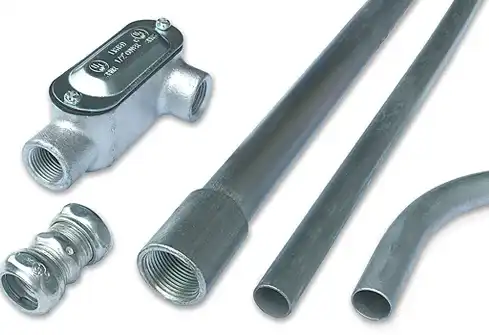
Rigid metal conduit accounts for roughly 30% of all metallic raceway installed in commercial and industrial electrical projects across the United States — and for good reason. RMC is the heaviest-duty, thickest-walled conduit option recognized under NEC Article 344, providing superior mechanical protection, serving as an equipment grounding conductor, and standing up to physical damage in exposed locations where other conduit types simply won’t pass inspection. This guide breaks down RMC sizes, real-world applications, code requirements, and step-by-step installation methods so you can spec and install it correctly the first time.
What Is Rigid Metal Conduit (RMC) and How Is It Made
Rigid metal conduit is the thickest-walled, heaviest steel or aluminum raceway available for electrical wiring. Think of it as the armor-plated option. Where other conduit types flex or dent under stress, RMC shrugs it off. It looks and threads exactly like standard plumbing pipe — because the manufacturing lineage is nearly identical — but it exists solely to protect electrical conductors.
RMC is produced from steel coils that are formed into tubes and welded along a longitudinal seam. After welding, the tube passes through sizing rolls that bring the outside diameter to within the tolerances set by UL 6. The critical next step is hot-dip galvanizing: each length is submerged in a molten zinc bath at roughly 840 °F (449 °C), depositing a zinc layer both inside and out. That dual coating is what separates RMC from cheaper alternatives — it resists corrosion for decades, even in damp concrete or direct-burial applications.
Wall thickness matters here. A trade-size 1″ RMC has a wall thickness of about 0.133 inches, compared to just 0.057 inches for the same size EMT. That extra steel is the reason RMC can serve as an equipment grounding conductor all by itself under NEC 250.118.
Material options go beyond standard galvanized steel. Stainless steel RMC (Type 304 or 316) handles chemical plants and coastal environments where even zinc coatings would eventually fail. Aluminum RMC cuts weight by roughly 60 percent and eliminates galvanic corrosion concerns when paired with aluminum fittings. Each variant ships in standard 10-foot lengths with factory-cut threads on both ends and one coupling per stick.
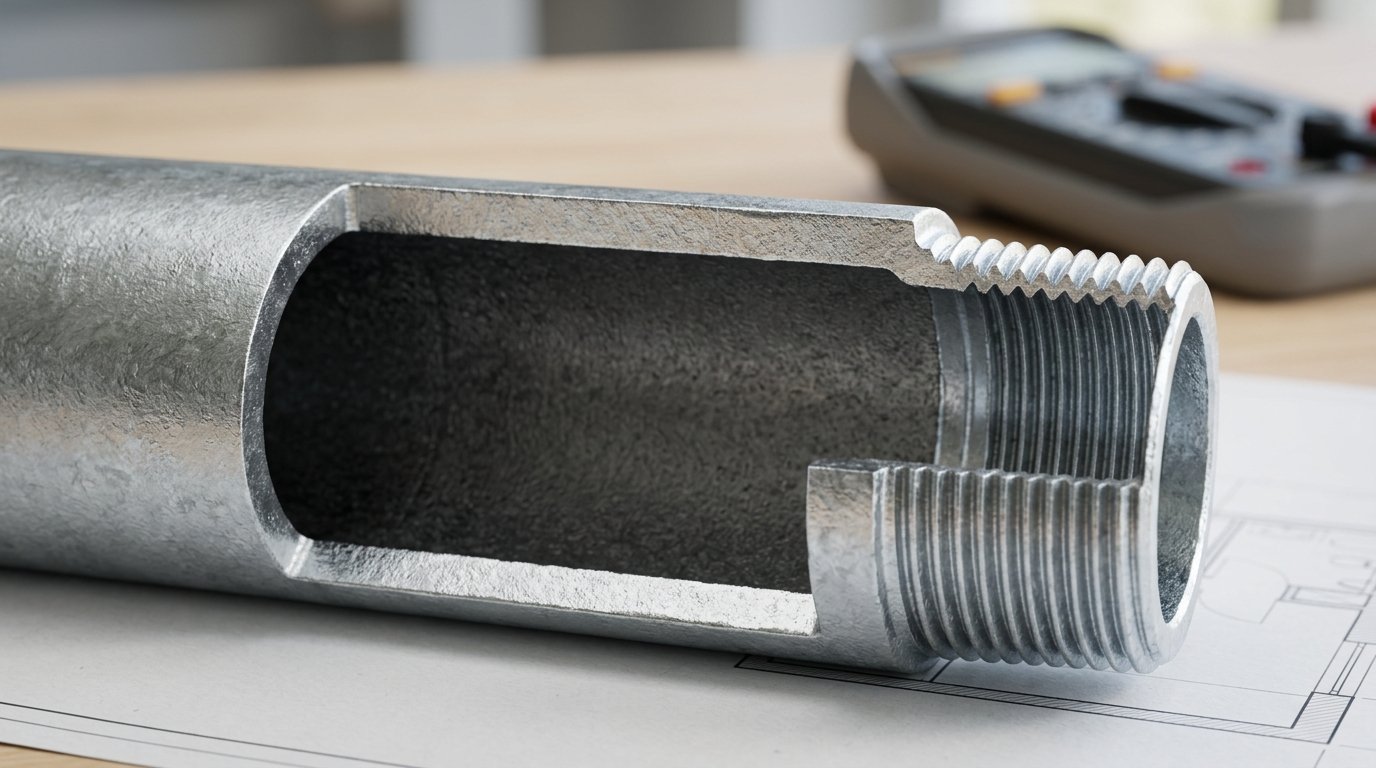
Cross-section of galvanized steel rigid metal conduit showing wall thickness and zinc coating
Standard RMC Sizes and Dimensions Chart
Trade sizes for rigid metal conduit don’t match actual measurements — a detail that trips up plenty of people. A ½-inch trade size, for example, has an outer diameter of 0.840 inches and an inner diameter of roughly 0.622 inches. The “½ inch” label is a nominal designation inherited from the pipe industry, not a direct measurement of any physical dimension.
Here’s a reference chart covering the most common galvanized steel RMC sizes per ANSI/NEMA RN 1 standards:
| Trade Size | OD (in.) | ID (in.) | Wall Thickness (in.) | Weight per 10 ft (lbs) |
|---|---|---|---|---|
| ½” | 0.840 | 0.622 | 0.109 | 7.9 |
| ¾” | 1.050 | 0.824 | 0.113 | 10.5 |
| 1″ | 1.315 | 1.049 | 0.133 | 16.0 |
| 1¼” | 1.660 | 1.380 | 0.140 | 21.6 |
| 1½” | 1.900 | 1.610 | 0.145 | 25.6 |
| 2″ | 2.375 | 2.067 | 0.154 | 34.1 |
| 2½” | 2.875 | 2.469 | 0.203 | 54.1 |
| 3″ | 3.500 | 3.068 | 0.216 | 70.6 |
| 4″ | 4.500 | 4.026 | 0.237 | 99.7 |
| 5″ | 5.563 | 5.047 | 0.258 | 134.6 |
| 6″ | 6.625 | 6.065 | 0.280 | 174.0 |
Picking the Right Size Using NEC Chapter 9
Size selection comes down to conductor fill. NEC Chapter 9, Table 1 sets the maximum fill percentages: 53% for one conductor, 31% for two, and 40% for three or more. You calculate the total cross-sectional area of all conductors (including insulation), then compare that figure against the internal area listed in Table 4 for rigid metal conduit.
Quick example. Three 3/0 AWG THHN conductors each occupy 0.2679 square inches, totaling 0.8037 sq in. At a 40% fill, you need a conduit with at least 2.009 sq in. of usable area. A 1½” RMC offers only 2.036 sq in. — technically compliant but razor-thin margin. Most electricians would upsize to 2″ for easier pulling and future capacity. That practical buffer matters more than people realize.

RMC sizes and dimensions chart showing trade sizes from half inch to 6 inches with outer diameter inner diameter and wall thickness
Common Applications and Where RMC Is Required by Code
Some installations give you a choice of raceway. Others don’t. Rigid metal conduit falls squarely into both categories — it’s the go-to option when the environment is harsh and often the only option when the NEC says so.
Exposed outdoor runs are one of the most common use cases. RMC handles direct sunlight, rain, and temperature swings without degrading, which is why you’ll see it protecting feeders along exterior walls of warehouses and running up utility poles. NEC Article 344 governs its installation and explicitly permits it in all atmospheric conditions and occupancy types.
Hazardous locations demand RMC more than almost anywhere else. In Class I, Division 1 areas — think refineries and chemical plants where ignitable gases are present during normal operations — Article 501.10(A) requires threaded rigid metal conduit with at least five full threads engaged. Class II environments with combustible dust carry similar mandates under Article 502.10. The threaded joints create a flame path long enough to cool escaping gases below their ignition temperature. That’s the engineering logic behind the code requirement, not just bureaucratic preference.
Service entrance installations are another code-driven application. Article 230.43 lists RMC as an approved wiring method for service-entrance conductors, and many local jurisdictions go further by requiring it for the mast or riser that supports the utility’s service drop. Commercial buildings frequently spec it wherever conduit is subject to physical damage — loading docks, parking garages, mechanical rooms. If a forklift could clip it, RMC belongs there.
Rigid Metal Conduit vs EMT vs IMC — Key Differences
These three conduit types look similar on a shelf. The differences show up fast once you start working with them — and even faster when an inspector arrives.
| Feature | RMC | IMC | EMT |
|---|---|---|---|
| Wall Thickness (1″ trade size) | ~0.133″ | ~0.095″ | ~0.057″ |
| Weight per 10 ft (1″ trade size) | ~16.4 lb | ~11.6 lb | ~6.5 lb |
| Joining Method | Threaded couplings | Threaded couplings | Set-screw or compression fittings |
| Approximate Cost per 10 ft (1″ steel) | $25–$40 | $18–$30 | $8–$15 |
| Equipment Grounding Conductor | Qualifies per NEC 250.118 | Qualifies per NEC 250.118 | Qualifies per NEC 250.118 |
| Threadable | Yes | Yes | No |
EMT is thin-wall tubing. You can’t thread it, and it relies on compression or set-screw connectors that don’t hold up well where physical damage is a real threat. IMC splits the difference — it threads like rigid metal conduit but weighs roughly 30% less, making overhead runs far less punishing on installers. The NEC (NFPA 70) permits IMC in nearly every location where RMC is required, which is why many contractors default to it when code doesn’t specifically mandate the heavier option.
So when does RMC actually earn its keep? Pole risers exposed to vehicle traffic. Underground direct-burial runs where you want maximum crush resistance. Hazardous locations where the threaded joints and thick walls provide an extra margin of mechanical integrity that IMC technically matches on paper but not always in practice under severe impact. The labor premium is real — threading, reaming, and hauling RMC takes roughly 40–50% more installation time than EMT — but in high-risk environments, that tradeoff is straightforward.
NEC Code Requirements for Rigid Metal Conduit Installation
NEC Article 344 governs every aspect of RMC installation. Miss a single provision, and an inspector will red-tag the job. Here are the requirements that matter most on real job sites.
Support and Securing Intervals
RMC must be securely fastened within 3 feet of every box, cabinet, or fitting, and supported at intervals no greater than 10 feet thereafter. Inspectors check this constantly. Sagging runs between supports are one of the fastest ways to fail a rough-in inspection.
Bends and Conductor Fill
No more than 360 degrees of total bends — the equivalent of four 90-degree sweeps — between pull points. Exceed that, and you need an additional pull box or junction box. Conductor fill follows NEC Chapter 9, Table 1: one wire can occupy 53% of the conduit’s cross-sectional area, two wires drop to 31%, and three or more max out at 40%. Overstuffing conductors into rigid metal conduit generates heat buildup and makes future wire pulls nearly impossible.
Grounding and Expansion Fittings
RMC qualifies as an equipment grounding conductor under NEC 250.118(2), provided all joints are tight and mechanically sound. Loose couplings break that grounding path — a violation inspectors flag often. For straight runs exceeding 25 feet exposed to temperature swings greater than 40°F, expansion fittings are required per NEC 344.44. Parking garages and rooftop installations are common spots where electricians forget this rule.
Common Code Violations
- Missing bushings on conduit terminations where conductors are 4 AWG or larger (NEC 300.4(G))
- Using running threads instead of proper couplings for conduit-to-conduit connections
- Failing to ream cut ends, leaving sharp edges that damage conductor insulation
How to Cut, Thread, and Install Rigid Metal Conduit Step by Step
Start with accurate layout. Measure your run from box to box, accounting for the thread engagement depth at each coupling — typically 3/4 inch for trade sizes up to 1 inch. Mark cut lines with a wraparound template or pipe marker to keep your cuts square. A cut that’s even 2 degrees off-square creates a poor thread and a joint that won’t tighten properly.
For cutting, a portable band saw gives the cleanest results. A hacksaw works fine on smaller sizes but demands patience on anything above 1-1/4 inch. After every cut, ream the inside edge. This step is non-negotiable. Unreamed burrs slice through conductor insulation during wire pulls, and that damage might not show up until the circuit is energized. A half-round reamer or a deburring tool handles this in about 15 seconds per cut.
Threading comes next. A manual ratchet threader (like a RIDGID 12-R) suits occasional work; power threaders cut time dramatically on larger jobs. Apply cutting oil generously — dry threading produces rough, shallow threads that leak and loosen. Run the die until exactly three threads extend past the die face, then back off and clean the chips.
Bending and Final Assembly
Hydraulic benders handle rigid metal conduit bends without crimping the wall. Mechanical and hand benders exist for smaller trade sizes, but anything 1-1/2 inch and above practically requires hydraulic force. Keep your bend radius at or above NEC Table 344.24 minimums to avoid conductor damage during pulls.
When assembling threaded joints, tighten couplings wrench-tight — hand-tight isn’t enough for grounding continuity or mechanical integrity. Three to five full threads should engage. Secure runs to the structure with two-hole straps or beam clamps at intervals matching NEC 344.30 requirements. Check alignment with a level at every support point; a sagging run creates low spots where condensation collects inside the raceway.
Fittings and Connectors Used with Rigid Metal Conduit
Every run terminates, turns, or transitions somewhere. The fittings you choose at those points determine whether the system stays watertight, maintains grounding continuity, and passes inspection without a callback.
Couplings and Unions
Threaded couplings join two conduit lengths end-to-end — simple enough. But when a run is fixed at both ends and you can’t rotate either piece, a three-piece union solves the problem. Erickson couplings serve a similar purpose where exact alignment matters. Skip the union on a rigid run that’s anchored at both terminations, and you’ll fight the threads until something strips.
Conduit Bodies
LB, LL, LR, and T bodies each redirect conductors at specific angles while providing a pull point. An LB mounts flush against a wall for service entrances. LL and LR bodies route conductors left or right, respectively, when viewed from the cover side. T bodies split a run in two directions. Per NEC 314.28, sizing the body correctly for conductor pull space is non-negotiable — undersized bodies are a common rejection item.
Elbows, Bushings, and Grounding Hardware
Factory elbows in 90° and 45° configurations handle turns that field bending can’t achieve cleanly, especially above 2-inch trade size. At every termination, an insulating bushing protects conductor insulation from the sharp threaded end. Grounding locknuts with bonding screws or bonding bushings ensure the enclosure and rigid metal conduit maintain an effective fault-current path — a requirement that standard locknuts alone don’t always satisfy on concentric or eccentric knockouts.
Threaded vs. Threadless
Threaded fittings are the default for RMC. Threadless (set-screw or compression) options exist but are less common and typically limited to dry locations. Choosing the wrong type in a wet or hazardous area creates a code violation and a corrosion entry point.
Pros and Cons of Rigid Metal Conduit for Your Project
Every conduit choice involves trade-offs. RMC delivers clear advantages in certain scenarios — and real drawbacks in others. Here’s an honest breakdown to help you decide.
Advantages
- Unmatched mechanical protection. The thick wall shrugs off direct impacts, vehicle traffic, and crushing loads that would flatten EMT instantly.
- Fire resistance. Steel doesn’t burn. In a structure fire, rigid metal conduit maintains circuit integrity far longer than PVC or nonmetallic alternatives, buying critical evacuation time.
- Built-in equipment grounding conductor. Per NEC 344.60, a properly installed RMC system qualifies as an effective ground-fault current path — no separate green wire needed in many cases. That saves copper costs on long runs.
- Longevity measured in decades. Galvanized steel RMC routinely lasts 40+ years in indoor environments. Aluminum versions resist corrosion in chemical plants where steel would deteriorate.
- UV and weather resistance. Outdoor exposure barely affects it, unlike PVC that can become brittle after prolonged sun exposure.
Disadvantages
- Material cost runs high. Expect to pay roughly 2–3x more per foot than EMT in comparable trade sizes, according to pricing data from RSMeans.
- Weight is a real issue. A 10-foot stick of 1-inch steel RMC weighs about 16.5 pounds. Carry a dozen of those up scaffolding and your crew feels it by lunch.
- Labor-intensive installation. Threading, reaming, and torquing every joint adds significant hours. A job that takes one day with EMT might take two with RMC.
- Field modifications are painful. Rerouting a run means cutting, rethreading, and sourcing new couplings. Quick changes don’t exist with this product.
So when does RMC make sense? If your project involves hazardous locations, exposed outdoor runs, or areas with heavy physical abuse, the extra cost pays for itself in protection and code compliance. For a protected indoor commercial space with no special hazard classification, EMT or IMC often gets the job done at lower cost and labor. Match the conduit to the actual risk — not to habit or assumption.
Frequently Asked Questions About Rigid Metal Conduit
Can RMC Be Installed Underground or Embedded in Concrete?
Yes to both. Steel RMC with its protective zinc coating handles direct burial and concrete encasement well. Per NEC Article 344.10, rigid metal conduit is approved for all atmospheric conditions and occupancies — underground, in concrete, in wet locations, and in corrosive environments when protected by a suitable supplementary coating. Aluminum RMC is a different story in concrete; the alkaline chemistry attacks aluminum, so avoid embedding it unless you apply an approved protective wrap.
Does RMC Qualify as an Equipment Grounding Conductor?
It does. NEC Section 250.118(2) explicitly lists RMC as an acceptable equipment grounding conductor. Every threaded joint must be wrench-tight — finger-tight connections break the grounding path. Lose continuity at one coupling, and the entire run fails as a ground.
What Is the Maximum Support Spacing?
NEC 344.30 requires supports every 10 feet and within 3 feet of each box, cabinet, or fitting. Shorter spans may be necessary in seismic zones or where local amendments tighten the requirement.
How Does RMC Differ from GRC?
They’re the same product. GRC — galvanized rigid conduit — is simply a trade name describing the zinc-coated steel version of RMC. You’ll see both terms on spec sheets and purchase orders. No performance or dimensional difference exists between them.
Is Aluminum RMC Suitable for Wet Locations?
Aluminum resists moisture-driven corrosion better than steel in many wet environments, making it a solid choice for coastal or high-humidity installations. But direct contact with concrete, earth, or dissimilar metals accelerates galvanic corrosion. Use supplementary coatings or isolation fittings whenever aluminum RMC meets those conditions.
Choosing the Right Conduit for a Safe and Code-Compliant Installation
Getting the conduit right matters more than most people realize. A wrong trade size means pulling conductors becomes a nightmare — or fails inspection entirely. An improper fitting corrodes within a season. Skipping a single NEC Article 344 provision can void insurance coverage on a commercial build. The details covered throughout this guide exist to prevent exactly those outcomes.
Here’s what to carry forward. Match your trade size to actual conductor fill using NEC Chapter 9 tables, not gut instinct. Verify that rigid metal conduit is genuinely required for your application — or whether IMC saves labor cost without sacrificing protection. Thread every cut end properly, ream it clean, and use listed fittings rated for the environment. Wet locations, corrosive atmospheres, and direct burial each demand specific coating and connector choices that generic hardware won’t satisfy.
Actionable next steps before you start:
- Contact your local AHJ (Authority Having Jurisdiction) to confirm any amendments layered on top of the NEC — some municipalities mandate RMC where the national code allows alternatives.
- Hire a licensed electrician for complex runs involving multiple offsets, expansion joints near building separations, or hazardous classified areas under NEC Articles 500–506.
- Source fittings and conduit from the same manufacturer when possible; thread compatibility between brands occasionally causes headaches on-site.
- Request mill certifications or UL listing documentation for any conduit purchased from unfamiliar suppliers, especially imported steel.
A well-planned RMC installation outlasts the building it protects. Spend the extra time on layout, material verification, and code review upfront. That effort pays back every year the system runs without a callback. For the latest edition of NEC requirements, the NFPA 70 resource page is the definitive reference to bookmark.
See also
How to Calculate Your Labor Cost Savings from Laser Welding
How to Tell Aluminum from Stainless Steel: Shop Guide
How to determine whether steel has been galvanized