Global demand for lightweight materials is projected to reach $248.2 billion by 2026, driven largely by manufacturers replacing conventional sheet metal in automotive, aerospace, and construction applications (MarketsandMarkets). If you’re evaluating lightweight sheet metal alternatives in 2026, the real challenge isn’t finding options — it’s knowing which material delivers the right balance of tensile strength, weight reduction, and per-unit cost for your specific use case. This guide compares nine commercially viable alternatives head-to-head, with exact strength-to-weight ratios, current pricing benchmarks, and practical sourcing considerations so you can make a confident procurement decision.
Why Manufacturers Are Moving Away from Traditional Sheet Metal
Steel and aluminum sheet metal dominated manufacturing for over a century. That dominance is cracking — fast. Three converging pressures are forcing procurement teams and design engineers to actively evaluate lightweight sheet metal alternatives in 2026: regulatory weight mandates, volatile raw material pricing, and aggressive corporate sustainability targets.
Start with weight. The European Union’s CO₂ fleet-wide emission targets for 2025 demand that new passenger cars average no more than 93.6 g CO₂/km — a threshold that’s essentially impossible to hit without shedding 15–20% of body-in-white mass. Automakers like BMW and Stellantis have publicly committed to multi-material strategies that replace conventional mild steel panels with composites, magnesium, and advanced high-strength steel (AHSS). The ripple effect reaches every tier supplier quoting structural or semi-structural components.
Raw material cost tells the other half of the story. Hot-rolled coil steel prices swung between $600 and $1,900 per short ton across 2022–2024, according to World Steel Association data. That kind of volatility destroys margin predictability for any volume manufacturer locked into single-material BOMs.
Sustainability adds a third, non-negotiable force. Scope 3 emissions reporting — the upstream and downstream carbon footprint a company must now disclose under frameworks like the CSRD — penalizes heavy, energy-intensive materials. Switching to lighter alternatives doesn’t just reduce vehicle or product weight; it shrinks the embodied carbon per unit shipped, which directly improves ESG scores that institutional buyers increasingly demand.
These aren’t theoretical trends. They’re purchase-order-level realities shaping which lightweight sheet metal alternatives manufacturers spec into new programs right now. The sections ahead break down nine specific options — ranked by strength, weight savings, and landed cost — so you can match the right material to your application without over-engineering or overspending.

Lightweight sheet metal alternatives 2026 comparison on manufacturing floor with composite and aluminum panels
How We Compared These 9 Alternatives for Strength, Weight, and Cost
Every material vendor will tell you their product is “lighter and stronger.” That claim means nothing without standardized metrics. To evaluate these lightweight sheet metal alternatives for 2026, we built a comparison framework around four measurable criteria that procurement engineers actually use when specifying materials.
The Four Core Metrics
- Tensile strength (MPa) — the maximum stress a material can withstand before fracturing under tension. We sourced values from published manufacturer datasheets and cross-referenced them against ASTM E8/E8M testing standards.
- Density (g/cm³) — raw mass per unit volume. Lower density directly translates to weight savings, but only matters when paired with adequate strength. That ratio — specific strength — is what separates a genuine alternative from a gimmick.
- Cost per square foot (USD, 1 mm gauge) — normalized to a consistent thickness for apples-to-apples pricing. We used Q1 2025 supplier quotes for quantities of 500+ sheets, not retail pricing.
- Formability rating (1–5 scale) — our subjective but experience-informed score reflecting how easily each material can be stamped, bent, or hydroformed using standard tooling. A score of 5 means existing press brakes handle it without modification; a 1 means dedicated equipment is required.
Why Specific Strength Matters More Than Raw Numbers
A material with 600 MPa tensile strength sounds impressive — until you realize it weighs 40% more than an alternative hitting 450 MPa at half the density. Specific strength (tensile strength divided by density) is the metric that actually predicts real-world weight reduction. For context, 7075-T6 aluminum achieves roughly 203 kN·m/kg, while mild steel sits near 51 kN·m/kg — a 4× advantage that raw strength numbers completely obscure.
Pro tip: When evaluating lightweight sheet metal alternatives in 2026, always request specific strength data alongside cost. Suppliers who only quote tensile strength are hiding unfavorable density numbers.

Evaluation methodology for lightweight sheet metal alternatives comparing tensile strength density cost and formability
Advanced Aluminum Alloys — The Closest Drop-In Replacement
If you need a lightweight sheet metal alternative in 2026 that slots into existing fabrication workflows with minimal retooling, aluminum alloys are the answer. Specifically, 5000-series (Al-Mg) and 7000-series (Al-Zn) grades deliver roughly 65% weight reduction compared to mild steel while preserving the formability and weldability your shop floor already understands.
5000-Series vs. 7000-Series — Picking the Right Grade
- 5052 and 5083 — Excellent corrosion resistance, ideal for marine enclosures and chemical processing panels. Yield strengths range from 193–228 MPa, and they bend cleanly on standard press brakes.
- 7075-T6 — Tensile strength hits 572 MPa, rivaling some structural steels. The trade-off? Poor weldability and higher susceptibility to stress-corrosion cracking, so it’s best suited for fastened assemblies rather than welded structures.
Cost is the real conversation starter. Commercial-grade 5052 sheet currently runs $2.80–$3.40 per pound at mill-direct volumes, versus $0.40–$0.60/lb for hot-rolled carbon steel. That 5–6× price premium shrinks dramatically when you factor in eliminated painting, lighter shipping pallets, and zero rust-related warranty claims. A 2023 Aluminum Association lifecycle analysis found that total ownership costs for aluminum panels can break even with steel within 3–5 years in outdoor applications.
Pro tip: Specify H32 temper for 5052 if you need a balance of strength and formability. H34 is stiffer but cracks more easily on tight radii — a mistake procurement teams make when they optimize for spec sheets instead of actual bend requirements.
For teams evaluating lightweight sheet metal alternatives for 2026 projects, advanced aluminum alloys remain the lowest-risk entry point — familiar tooling, proven supply chains, and recyclability rates exceeding 90%.

5052 and 7075 advanced aluminum alloy sheets as lightweight sheet metal alternatives
Ultra-Thin High-Strength Steel — Lighter Without Changing Materials
Sometimes the smartest lightweight sheet metal alternative for 2026 isn’t a different material at all — it’s the same steel, just engineered to do more with less. Advanced high-strength steel (AHSS) and ultra-high-strength steel (UHSS) achieve weight savings of 25–40% compared to conventional mild steel by using thinner gauges while maintaining or exceeding the original load-bearing capacity. The trick is metallurgy: dual-phase, martensitic, and press-hardened grades reach tensile strengths above 1,500 MPa, roughly three times what standard low-carbon steel delivers.
Where does UHSS actually beat aluminum? Crash-critical automotive structures. A 1.0 mm press-hardened boron steel panel can absorb more energy in a frontal impact than a 2.0 mm 6061-T6 aluminum panel at comparable weight — and at roughly half the raw material cost per kilogram. That’s why brands like Volvo and Toyota rely on hot-stamped AHSS for B-pillars and rocker panels rather than switching to aluminum or composites.
Pro tip: Specify the exact AHSS generation. Gen 3 steels (medium-Mn, Q&P grades) offer the best elongation-to-strength balance for complex stampings. Gen 1 dual-phase grades are cheaper but crack on tight radii below 2T bend allowance.
The main limitation? Corrosion. Thinner gauges leave less sacrificial material, so zinc-coated or galvannealed finishes are non-negotiable for exterior panels. Factor in the coating cost — typically $0.04–$0.08 per square foot — when comparing total landed price against other lightweight sheet metal alternatives in 2026.
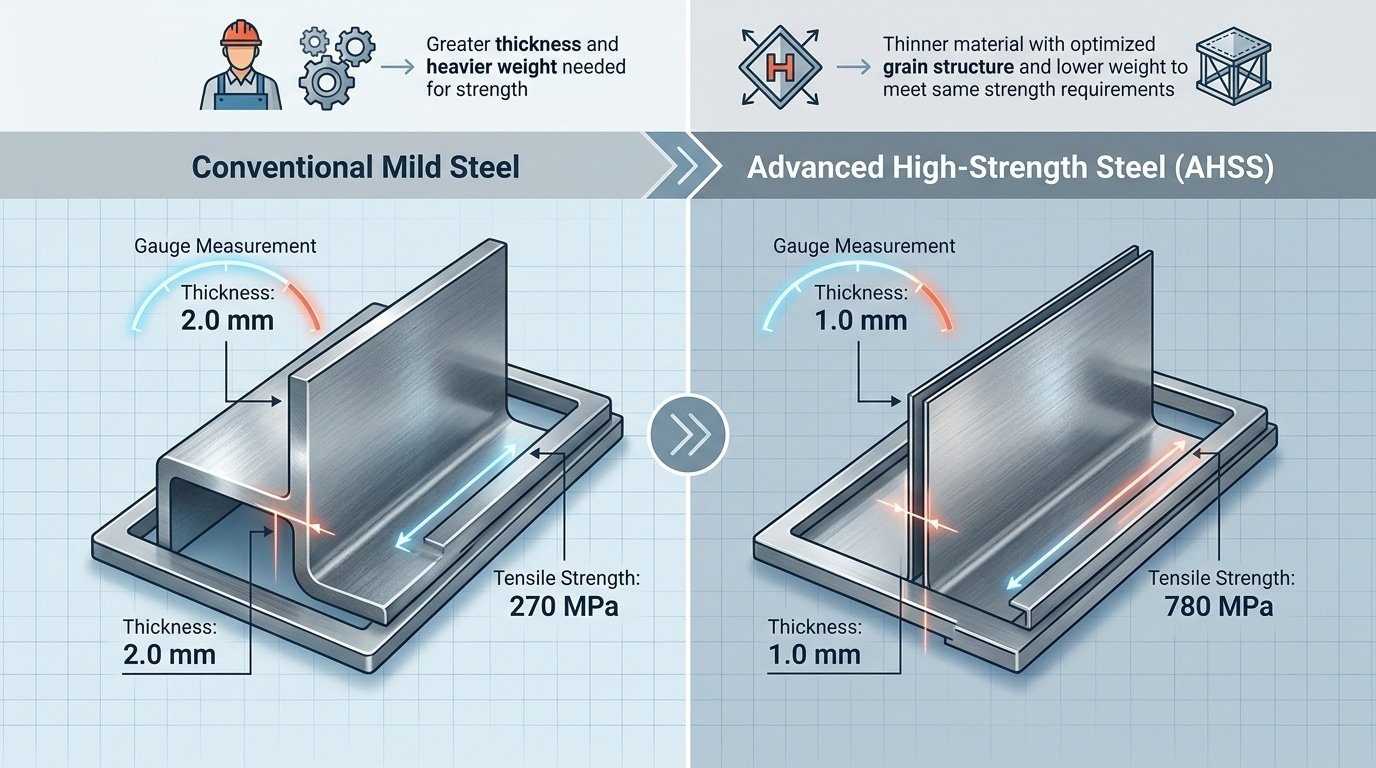
Ultra-thin high-strength steel vs conventional steel gauge comparison as lightweight sheet metal alternative
Fiber-Reinforced Composites — Balancing Weight Savings Against Cost
Glass-fiber-reinforced polymers (GFRP) and sheet molding compounds (SMC) sit in a sweet spot that pure metals and premium carbon fiber can’t reach. They deliver a 30–50% weight reduction over mild steel at a fraction of what carbon fiber costs — making them practical lightweight sheet metal alternatives for 2026 production runs in automotive, construction, and industrial enclosures.
SMC, a compression-molded composite of chopped glass fibers in a thermoset resin matrix, is the workhorse here. Tooling costs typically range from $50,000–$150,000 per mold — steep for prototyping, but the per-part price drops sharply once you cross roughly 5,000–10,000 units annually. Below that threshold, you’re often better off with hand-laid GFRP or even aluminum. Above it, SMC can undercut aluminum stampings by 15–20% when you factor in secondary finishing and assembly consolidation.
Pro tip: SMC parts can integrate ribs, bosses, and mounting features in a single molding cycle — eliminating fasteners and welding steps that inflate total cost on metal assemblies.
The real limitation? Temperature. Most polyester- and vinyl-ester-based GFRP composites lose structural integrity above 150–180 °C, which rules them out for exhaust systems, engine-bay components, and high-heat industrial housings. Phenolic resin systems push that ceiling to around 250 °C, but they’re harder to mold and more brittle. If your application sees sustained heat above 120 °C, validate with GFRP material property data before committing to tooling.
Carbon Fiber and Honeycomb Core Panels for Aerospace and Automotive
Carbon-fiber-reinforced polymer (CFRP) sheets deliver a specific strength roughly five times that of steel — at just one-fifth the density. That ratio makes CFRP the gold standard among lightweight sheet metal alternatives in 2026 for any application where shaving grams directly translates to performance or fuel savings. Boeing’s 787 Dreamliner, for instance, uses CFRP for approximately 50% of its airframe by weight, cutting fuel burn by roughly 20% compared to conventional aluminum-bodied predecessors.
Honeycomb sandwich panels take this further. An aluminum or Nomex (aramid paper) honeycomb core bonded between thin CFRP face sheets creates a structure with extraordinary flexural stiffness at a fraction of solid-panel mass. Think of it as an I-beam principle applied across an entire surface. Nomex cores dominate interior aerospace panels; aluminum honeycomb handles higher-temperature or load-critical zones.
Practical tip: Specify the cell size carefully. A 3.2 mm (1/8″) cell honeycomb offers better surface finish and higher crush strength, while 6.4 mm cells save cost and weight when flatness tolerances are looser.
The tradeoff? Cost and fabrication complexity. Raw CFRP prepreg runs $30–$80 per kilogram depending on fiber grade, and autoclave curing adds capital overhead that pushes finished-part prices 5–10× above stamped steel. Out-of-autoclave (OoA) processes are closing that gap, but these panels still demand skilled layup technicians or automated fiber placement (AFP) equipment. For most teams evaluating lightweight sheet metal alternatives for 2026 projects, CFRP honeycomb panels make economic sense only when weight savings justify a premium — think motorsport body panels, satellite bus structures, or EV battery enclosures where every kilogram saved extends range.
Thermoplastic and Polymer Panels for Non-Structural Applications
Not every panel needs to bear a load. Enclosures, machine guards, interior linings, and equipment covers often just need to resist impact, shrug off moisture, and weigh as little as possible. That’s where thermoplastic sheets — polycarbonate (PC), ABS, and polypropylene (PP) — outperform every other lightweight sheet metal alternative in 2026 on a pure cost-per-part basis.
Polycarbonate delivers roughly 250 times the impact resistance of glass at about half the density of aluminum (1.2 g/cm³ vs. 2.7 g/cm³). ABS sits in a similar density range and thermoforms easily at 220–260 °C, making it ideal for complex enclosure geometries. Polypropylene is the budget king — often priced below $1.50/lb in bulk — and its near-total chemical inertness eliminates painting or coating steps entirely.
Pro tip: specify UV-stabilized grades for any outdoor-facing polymer panel. Unstabilized polycarbonate yellows and loses up to 10% of its impact strength within 3 years of direct sun exposure, according to published degradation data.
The real savings show up downstream. Thermoplastics eliminate corrosion-related maintenance, require no primer or powder coat, and can be CNC-routed or laser-cut on the same equipment used for sheet metal. Skip ABS for anything exposed to acetone or strong solvents — it dissolves on contact. Choose PP or PC instead.
For teams evaluating lightweight sheet metal alternatives in 2026, polymer panels deserve serious consideration wherever structural loads stay below ~5 MPa. They won’t replace steel in a chassis, but for 60–70% of non-structural panels in HVAC, kiosk, and electronics enclosure applications, they’re faster to fabricate, cheaper to maintain, and dramatically lighter.
Magnesium Alloys and Titanium Sheets — Niche but High-Performance Options
Magnesium alloy sheet — typically AZ31B — weighs roughly 33% less than aluminum and 75% less than steel at equivalent volume. That density advantage (about 1.77 g/cm³) makes it one of the most aggressive lightweight sheet metal alternatives for 2026 in defense electronics housings, drone airframes, and portable medical devices. The catch? Magnesium ignites at around 473 °C and corrodes fast without protective coatings like micro-arc oxidation or e-coating.
Pro tip: Always specify AZ31B-H24 temper for sheet forming. The softer O-temper cracks during room-temperature bending, a mistake that wastes entire production runs.
Titanium sheets — primarily Ti-6Al-4V (Grade 5) — deliver a strength-to-weight ratio that no other metal sheet matches, plus near-total corrosion immunity. Surgical implant housings, naval bulkheads, and hypersonic vehicle skins all rely on it. But raw material cost runs $25–$60 per kilogram depending on grade and thickness, versus $3–$5/kg for aluminum alloy sheet.
Sourcing Realities You Should Know
- Lead times: Magnesium sheet from major suppliers like Luxfer MEL Technologies or POSCO often runs 12–16 weeks for custom gauges.
- Minimum orders: Titanium sheet distributors typically enforce 500 lb minimums for cut-to-size orders.
- Machining hazard: Magnesium chips require Class D fire extinguishers on every CNC station — a compliance cost many buyers overlook.
Neither material qualifies as a general-purpose lightweight sheet metal alternative in 2026. Reserve them for applications where extreme weight savings or extreme corrosion resistance justifies the 5–15× cost premium over advanced aluminum alloys.
Side-by-Side Comparison Table — All 9 Alternatives Ranked
Staring at spec sheets from nine different suppliers is exhausting. The table below distills every lightweight sheet metal alternative for 2026 into the six metrics commercial buyers care about most. Values represent typical grades at 1–2 mm nominal thickness; exact figures shift with alloy temper, fiber layup, or panel core geometry, so treat these as procurement-grade benchmarks rather than design-final numbers.
| Alternative | Weight (lb/ft²) | Tensile Strength (MPa) | Cost ($/ft²) | Max Service Temp (°F) | Formability | Best-Fit Application |
|---|---|---|---|---|---|---|
| 7075-T6 Aluminum | 0.72 | 572 | 4–7 | 250 | Moderate | Structural brackets, chassis |
| Ultra-Thin AHSS (0.6 mm) | 0.95 | 980–1,180 | 2–4 | 800 | Low–Moderate | Safety-critical auto panels |
| GFRP / SMC | 0.55 | 150–300 | 5–10 | 300 | Mold-only | Enclosures, body panels |
| CFRP Sheet | 0.40 | 600–1,500 | 25–60 | 350 | Mold-only | Aerospace skins, race cars |
| Honeycomb Core Panel | 0.30 | 200–400 (flexural) | 30–70 | 400 | Pre-formed | Aircraft floors, satellite decks |
| Polycarbonate | 0.31 | 55–75 | 3–6 | 270 | High | Machine guards, glazing |
| ABS / ASA | 0.28 | 40–50 | 1–3 | 180 | High | Interior linings, covers |
| AZ31B Magnesium | 0.48 | 255 | 8–14 | 300 | Warm-form only | Laptop housings, drone frames |
| Ti-6Al-4V Titanium | 1.15 | 950 | 40–80 | 600 | Low | Jet engines, chemical processing |
One pattern jumps out: CFRP and honeycomb panels deliver up to 75% weight reduction versus mild steel, but at 10–20× the material cost. For most commercial buyers evaluating lightweight sheet metal alternatives in 2026, advanced aluminum or ultra-thin AHSS will hit the sweet spot — strong enough, formable enough, and priced for volume. Refer to MatWeb’s material property database to verify grades specific to your sourcing region.
Pro tip: Sort by max service temperature first if your application involves heat. A material that’s cheap and light but softens at 180 °F will cost you far more in warranty claims than titanium ever would upfront.
How to Choose the Right Alternative Based on Your Application
Start with load. If your part must withstand sustained stress above 250 MPa, carbon fiber, titanium, or ultra-thin AHSS belong on the shortlist — thermoplastics don’t. Define your minimum yield strength (the stress level at which permanent deformation begins) before you ever request a quote.
Environmental exposure is the next filter. Outdoor panels facing UV, salt spray, or temperature swings above 150 °C eliminate most unfilled polymers immediately. Magnesium alloys corrode fast without protective coatings. A practical rule: if the part lives outside and uncoated, aluminum alloys or GFRP composites survive longest with the least maintenance.
Production volume changes everything. Carbon fiber makes sense at 500 units; at 50,000, the per-part cost can be 8–12× higher than stamped AHSS. According to the U.S. Department of Energy’s lightweight materials research, cost-effective mass adoption of composites still depends on cycle-time reductions below 3 minutes per part.
Budget constraints and regulatory compliance round out the decision. Map each candidate against three questions:
- Does it meet the relevant standard? — FAR 25.853 for aerospace flammability, FMVSS 216 for automotive roof crush, UL 94 for electrical enclosures.
- Can your existing tooling handle it? — Switching from steel stamping to composite layup means capital expenditure, not just material cost.
- What’s the total landed cost per part at your target volume? — Include scrap rate, secondary finishing, and freight weight savings.
Choosing among lightweight sheet metal alternatives in 2026 isn’t about picking the “best” material — it’s about eliminating the wrong ones fast, then optimizing on cost-per-function for what remains.
Frequently Asked Questions About Lightweight Sheet Metal Alternatives
What are typical minimum order quantities?
MOQs vary sharply by material. Aluminum alloy sheet from major mills like Novelis or Aleris usually starts at 5–10 metric tons per SKU. Composite panels (GFRP, SMC) often have lower minimums — some compounders accept orders as small as 500 kg — but tooling charges for custom layups can run $8,000–$25,000 upfront. For carbon fiber sheets, expect MOQs of 50–100 panels unless you negotiate blanket orders.
How do lead times compare to traditional sheet metal?
Standard cold-rolled steel ships in 2–4 weeks from domestic service centers. Most lightweight sheet metal alternatives in 2026 fall within 4–8 weeks, though thermoplastic panels often match steel timelines because extrusion is continuous. Carbon fiber and magnesium alloy sheets can stretch to 10–12 weeks when demand spikes, so plan procurement cycles accordingly.
Are composite alternatives recyclable?
Thermoset composites (epoxy-based CFRP, polyester SMC) are notoriously difficult to recycle mechanically. Thermoplastic composites, however, can be reground and remolded with roughly 85–90% property retention. The EPA’s sustainable materials management framework increasingly favors thermoplastic options for closed-loop manufacturing.
Will these materials work with my existing fabrication equipment?
Aluminum alloys and ultra-thin AHSS run on conventional press brakes, shears, and CNC punches with minor tooling adjustments. Composites and magnesium require dedicated cutting setups — waterjet or diamond-coated tooling — and magnesium demands spark-suppression ventilation. Don’t assume drop-in compatibility without a trial run.
Which alternatives qualify for lightweighting tax incentives?
Section 45X of the U.S. Inflation Reduction Act offers advanced manufacturing production credits for components that meet specific weight-reduction benchmarks in clean vehicles. Aluminum, CFRP, and magnesium parts used in qualifying EV assemblies can earn credits worth up to $2/kg of documented weight savings. Verify eligibility with your tax advisor before committing to a material switch.
Next Steps for Sourcing Lightweight Alternatives at Scale
You’ve seen the data across all nine categories. Now turn that knowledge into action with a focused three-step process: sample, test, engage.
Request Material Samples Strategically
Don’t order one coupon of every material. Narrow your shortlist to two or three lightweight sheet metal alternatives that match your load, environment, and budget criteria from the comparison table above. Ask each supplier for test coupons in the exact gauge and alloy or resin grade you’d specify in production — generic samples waste weeks. According to Thomasnet’s supplier directory, lead times for sample shipments average 5–10 business days domestically, so stagger requests to keep your timeline tight.
Run a Controlled Pilot Test
Bench-level coupon testing isn’t enough. Fabricate 25–50 pilot parts using your actual tooling or forming process, then subject them to the real-world stresses — thermal cycling, vibration, corrosion spray — your end product will face. Track reject rates closely; anything above 3% at pilot scale signals a process mismatch worth resolving before committing to volume tooling.
Engage Suppliers for Volume Pricing
Pilot data gives you negotiating leverage. Share your validated test results, annual volume forecast, and target cost-per-part when requesting quotes. Suppliers respond faster — and more competitively — when they see you’ve already de-risked the material choice. Lock in pricing tiers for 2026 production runs early, especially for composites and magnesium alloys where raw-material costs fluctuate quarterly.
Ready to move? Download our detailed specification sheet comparing all nine lightweight sheet metal alternatives for 2026, or request a custom quote tailored to your application, volume, and delivery schedule. The sooner you lock in samples, the sooner you validate — and the sooner you ship lighter, stronger products.
See also
Metal Grades: A Complete Guide to Sheet Metal Designations
Automotive sheet metal repair and laser welding technology
Sheet metal thickness table helps you pick right metal
Weld Cleaning Machine for Carbon Steel – How to Choose the Right One
Stainless Steel vs Aluminum Which Is Better for Sheet Metal Work