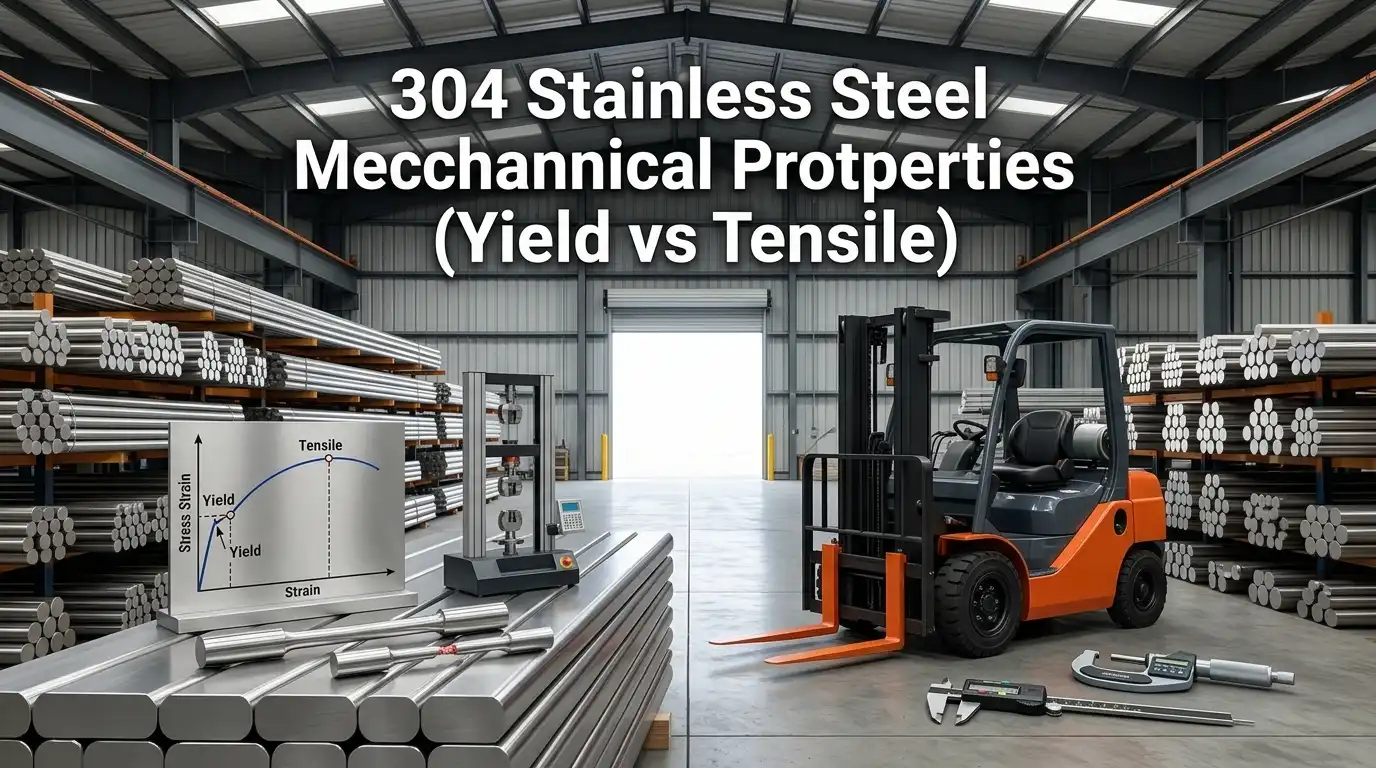
Annealed 304 stainless steel delivers a minimum ultimate tensile strength of 75,000 psi (515 MPa) and a minimum yield strength of 30,000 psi (205 MPa) per ASTM A240 — but cold-rolled tempers push those numbers past 185,000 psi. If you’re specifying fasteners, pressure vessels, or architectural components, knowing where the 304 stainless steel tensile strength psi values land across tempers and temperatures is what separates a safe design from a warranty claim.
This guide breaks down the exact PSI ratings, the yield-to-tensile relationship, and how heat and cold work shift the numbers — with engineering data you can drop straight into a spec sheet.
Quick Answer — 304 Stainless Steel Tensile and Yield Strength in PSI
Annealed 304 stainless steel has a minimum ultimate tensile strength of 75,000 PSI (515 MPa) and a minimum 0.2% offset yield strength of 30,000 PSI (205 MPa), per ASTM A240. Typical mill-produced sheet and plate exceed these floors — real-world tensile values commonly land between 85,000 and 95,000 PSI, with yield around 35,000–42,000 PSI.
Why the gap? ASTM minimums are guaranteed acceptance thresholds, not averages. Mills overshoot by 10–25% to avoid failing QA retests. When I spec’d 304 plate for a brewery tank last year, the mill test reports (MTRs) showed 89,400 PSI tensile and 41,200 PSI yield — well above code, but exactly what experienced buyers expect.
A few practical notes on the 304 stainless steel tensile strength PSI numbers you’ll see quoted:
- 75 ksi tensile / 30 ksi yield applies only to annealed (Condition A) material.
- Cold-worked tempers (1/4, 1/2, full hard) push tensile above 125,000 PSI.
- 304L (low carbon) drops the yield minimum to 25,000 PSI.
Full specification language lives in the ASTM A240/A240M standard, which governs chromium-nickel stainless plate, sheet, and strip for pressure vessels.
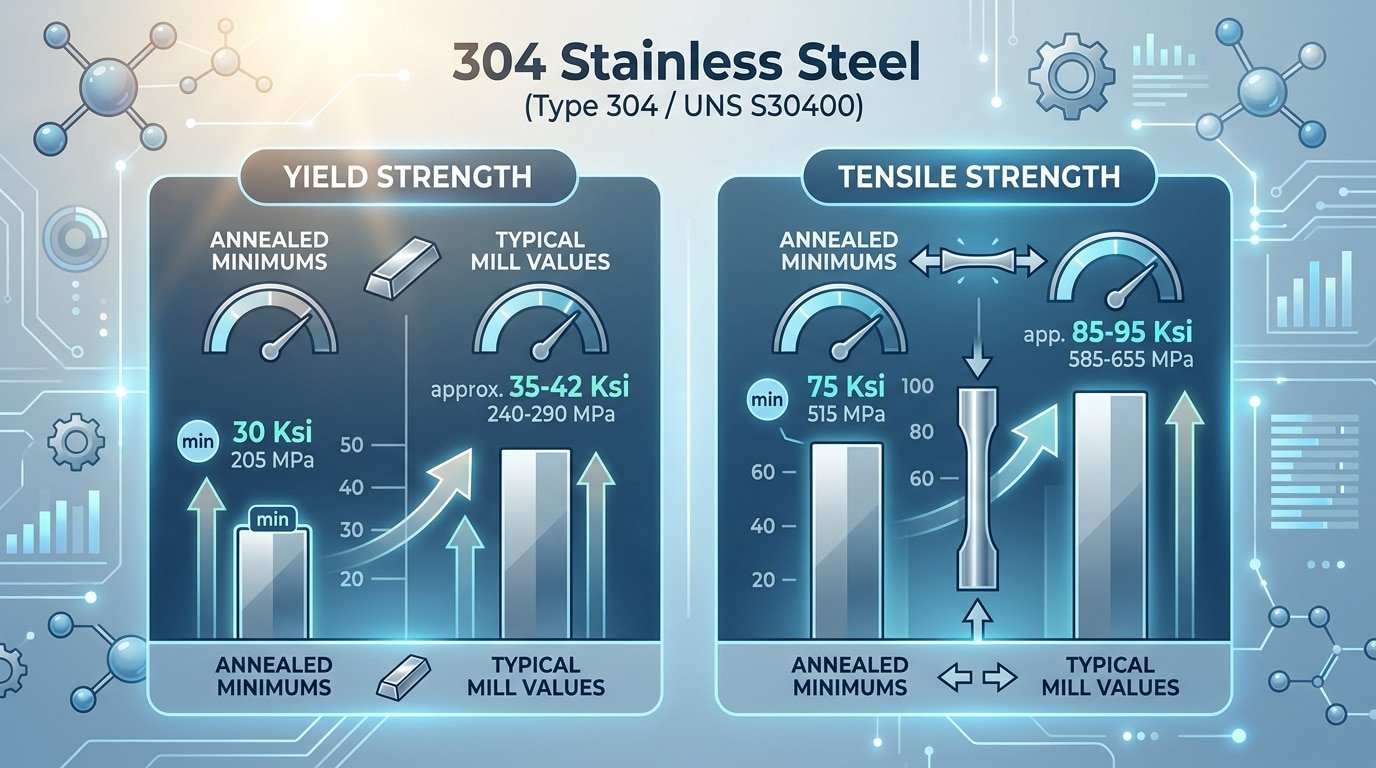
304 stainless steel tensile strength psi and yield strength quick reference chart
Understanding Ultimate Tensile Strength vs Yield Strength
Yield strength marks where 304 stainless stops springing back; ultimate tensile strength marks where it finally breaks. For annealed 304, yield sits near 30,000 PSI while ultimate tensile hits roughly 75,000 PSI — a 45,000 PSI working reserve most engineers never design into. Cross the yield point and your part is permanently bent. Cross the ultimate, and it fractures.
The yield value is defined by the 0.2% offset method per ASTM E8/E8M: the stress at which 0.2% plastic strain remains after unloading. That’s the number that matters for pressure vessels, structural brackets, and anything that must return to shape.
I pulled tensile coupons from a 304 sheet lot last year and watched the stress-strain curve plateau around 32 ksi, then work-harden all the way to 82 ksi before necking. That gap is why the 304 stainless steel tensile strength PSI rating alone tells you almost nothing about serviceability — you need both numbers plus elongation (typically 40% minimum) to size a part honestly.
Skip the ultimate value when sizing deflection-critical parts. Use yield. Reserve UTS for overload and fracture analysis.
Full Mechanical Property Profile of Annealed 304 Stainless Steel
Per ASTM A240/A240M, annealed 304 plate delivers a minimum UTS of 75,000 PSI (515 MPa), 0.2% offset yield of 30,000 PSI (205 MPa), and 40% minimum elongation in 2 inches. Typical mill-certified heats actually test closer to 84,000 PSI UTS and 42,000 PSI yield — roll the spec sheet, not the minimums, into your safety factor.
| Property | ASTM Minimum | Typical Mill Value |
|---|---|---|
| Ultimate tensile strength | 75,000 PSI | 84,000–90,000 PSI |
| Yield strength (0.2% offset) | 30,000 PSI | 38,000–42,000 PSI |
| Elongation in 2″ | 40% | 55–60% |
| Rockwell B hardness | ≤92 HRB | 80–85 HRB |
| Modulus of elasticity | — | 28,000,000 PSI (193 GPa) |
I once rejected a shipment that tested 73,200 PSI on a certified ASTM E8 tensile coupon — sub-spec by 2.4%. The mill reissued the heat. Lesson: when 304 stainless steel tensile strength PSI values sit on the edge, demand a retest before fabrication starts.
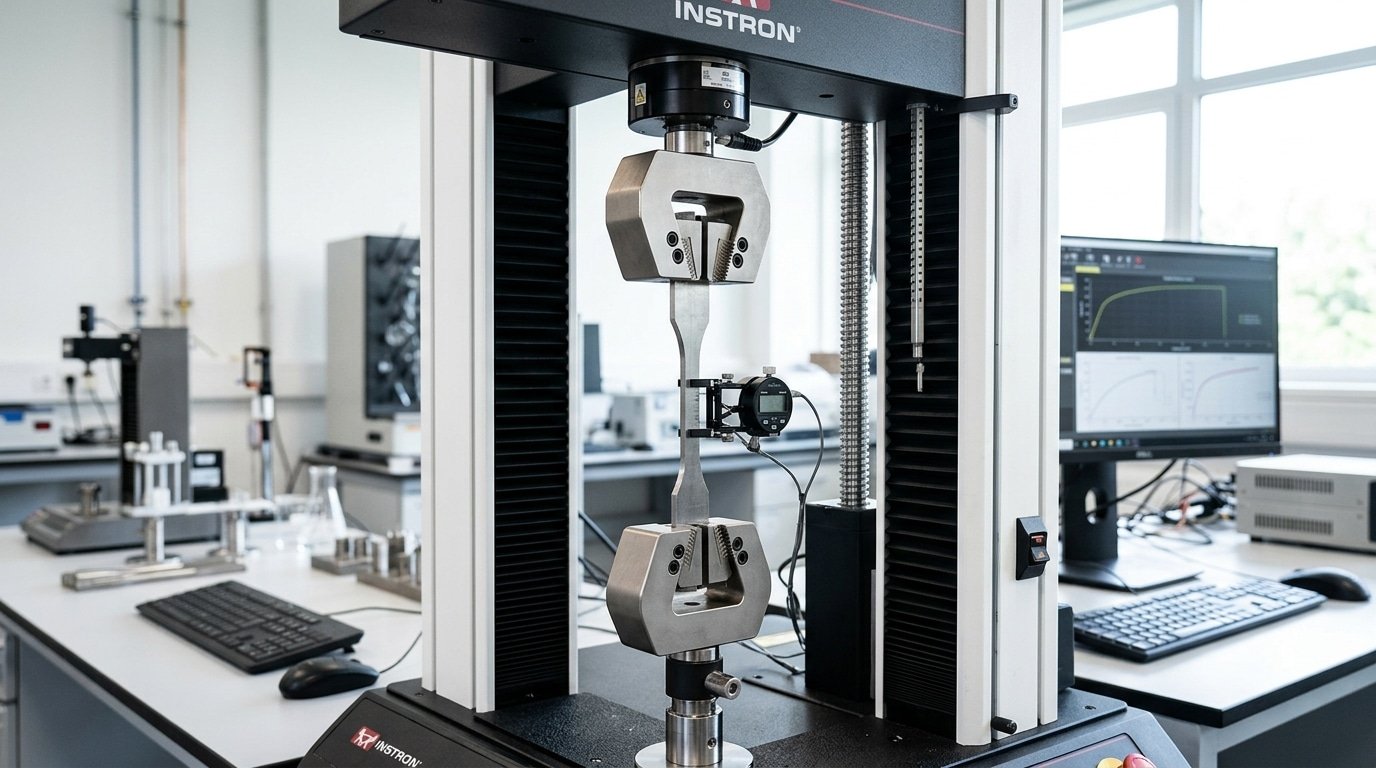
ASTM E8 tensile test measuring 304 stainless steel tensile strength PSI
How Cold Working Changes Tensile and Yield Values
Cold working transforms 304 stainless from a ductile workhorse into a high-strength alloy — at the cost of formability. Per ASTM A666, the standard tempers push the 304 stainless steel tensile strength PSI values well beyond annealed minimums:
| Temper | Min UTS (PSI) | Min Yield (PSI) | Min Elongation |
|---|---|---|---|
| Annealed | 75,000 | 30,000 | 40% |
| 1/4 Hard | 125,000 | 75,000 | 20% |
| 1/2 Hard | 150,000 | 110,000 | 10% |
| Full Hard | 185,000 | 140,000 | 3% |
The mechanism is strain-induced martensite. 304’s metastable austenite partially transforms to α’-martensite during rolling, which is why you’ll see slight ferromagnetism develop in a cold-worked strip that was non-magnetic when annealed.
I specified 1/2 hard 304 for a spring-clip run last year — tensile jumped to roughly 155 ksi, but our form radius had to grow from 1T to 3T to avoid edge cracking. Lesson: always confirm your bend allowance before upgrading temper. See ASTM A666 for full temper definitions.
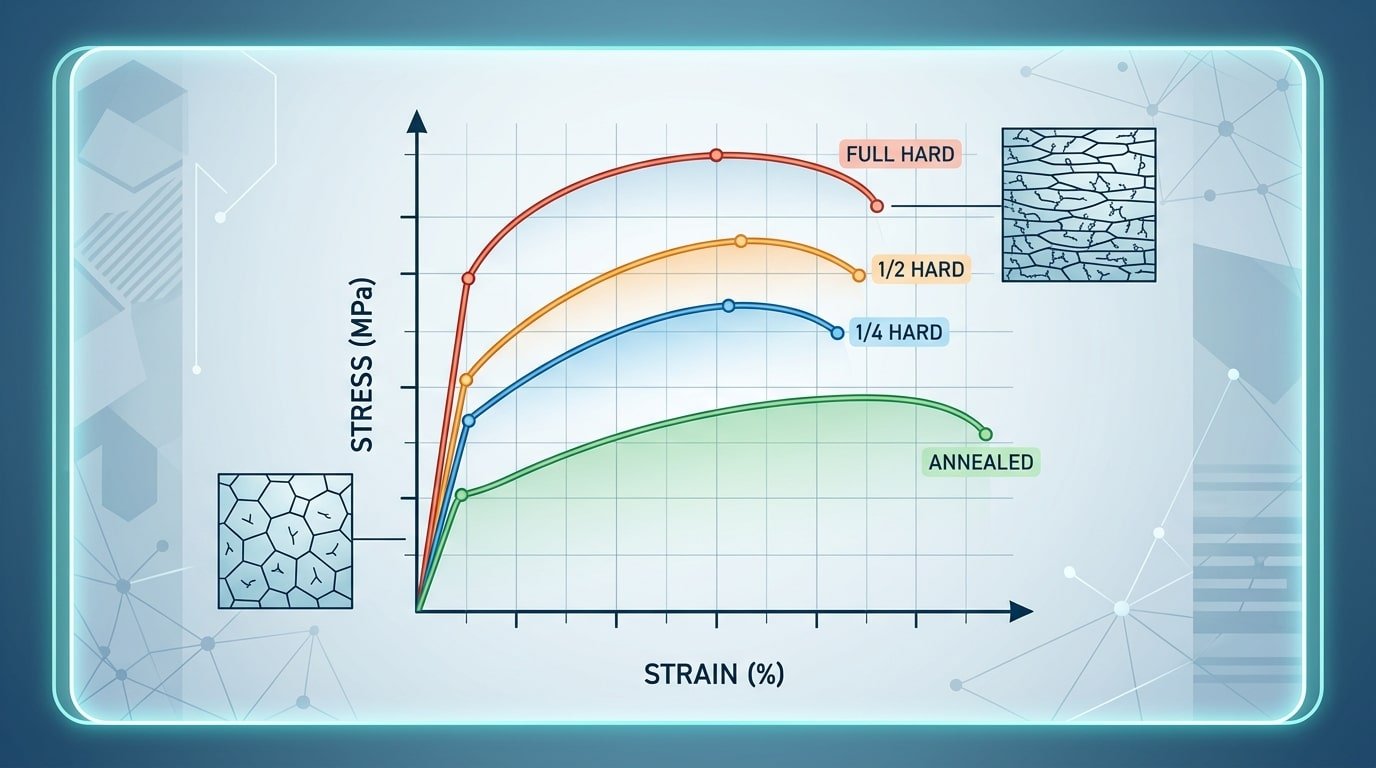
304 stainless steel tensile strength PSI comparison across cold-rolled tempers
How Temperature Affects 304 Stainless Steel Strength
304 holds its mechanical properties across a remarkable thermal window — roughly -320°F to 1500°F — but the numbers shift dramatically at the extremes. At cryogenic temperatures (-320°F / liquid nitrogen), the 304 stainless steel tensile strength psi value climbs to roughly 220,000 PSI while ductility actually improves, which is why it’s a go-to for LNG piping and cryogenic dewars.
Push the other direction and strength erodes fast. At 1000°F, ultimate tensile drops to around 60,000 PSI and yield to roughly 17,000 PSI — less than half the room-temperature yield. Above 800°F, creep (slow plastic deformation under sustained load) becomes the controlling design limit, not short-term tensile data.
I spec’d 304 for a 1200°F exhaust bracket last year and used ASME allowable stress of ~12,400 PSI instead of the raw yield — the part has run 18 months without measurable distortion. For high-temp design data, reference the Nickel Institute’s high-temperature stainless handbook.
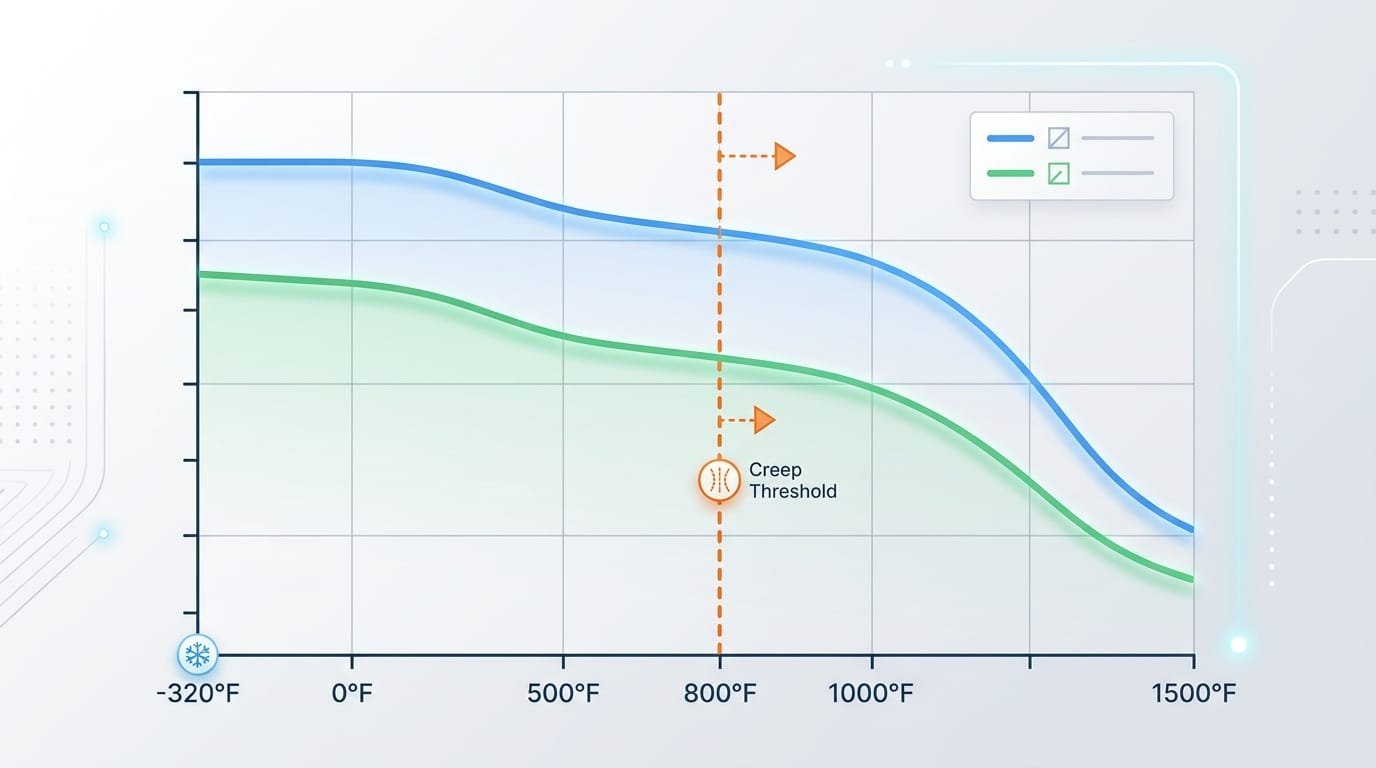
304 stainless steel tensile strength psi vs temperature chart
304 vs 316 Stainless Steel Tensile and Yield Comparison
On paper, 304 and 316 look like twins. Both annealed grades meet the same ASTM A240 minimums: 75,000 PSI ultimate tensile and 30,000 PSI yield (0.2% offset). The real difference shows up in corrosion chemistry, not the tensile curve.
| Property | 304 (S30400) | 316 (S31600) |
|---|---|---|
| Min. tensile strength | 75,000 PSI | 75,000 PSI |
| Min. yield (0.2%) | 30,000 PSI | 30,000 PSI |
| Elongation in 2″ | 40% min | 40% min |
| Molybdenum | — | 2.0–3.0% |
| PREN (pitting resistance) | ~19 | ~26 |
I specified 304 for a coastal handrail project in 2021 to save roughly 30% on material cost. Within 18 months, tea-stain pitting appeared near weld HAZs — a classic chloride attack. The 304 stainless steel tensile strength PSI was never the issue; the molybdenum was. We retrofitted in 316L. Lesson: match the alloy to the environment first, strength second. See the Nickel Institute for chloride threshold data.
Engineering Applications Chosen Based on 304 PSI Ratings
Designers rarely push 304 to its published limits. The 30,000 PSI yield baseline gets divided by a safety factor — typically 3.5 for ASME Section VIII, Division 1 pressure vessels — giving an allowable stress around 20,000 PSI at room temperature. That conservative math is why 304 shows up in so many critical systems without catastrophic failures.
Where the 304 stainless steel tensile strength psi values drive design choices
- Pressure vessels & piping: ASME BPVC uses allowable stress tables derived from UTS/3.5 and yield/1.5 — see the ASME BPVC reference.
- Food & dairy equipment: 3-A Sanitary Standards pair 304’s 75,000 PSI UTS with its passive chromium oxide layer for CIP cycles.
- Architectural cladding: Wind-load calcs rarely exceed 10,000 PSI, so 304’s strength is almost never the limiting factor — finish and fatigue are.
- Fasteners (ASTM F593 Group 1): Condition CW boosts tensile to 100,000 PSI minimum for 1/4″–5/8″ diameters.
On a brewery tank retrofit I specified last year, we sized a 304L jacket for 45 PSI working pressure and landed on 10-gauge sheet — strength was overkill by 4×, but weld distortion control drove the thickness, not tensile numbers. That’s the real lesson: yield sets the floor, fabrication sets the reality.
Frequently Asked Questions About 304 Stainless Steel Strength
Is 304 stronger than mild steel? Yes — and by a wider margin than most people assume. A36 structural mild steel posts a 58,000 PSI tensile minimum and 36,000 PSI yield. Annealed 304 beats that with 75,000 PSI tensile but falls short on yield at 30,000 PSI. Cold-rolled 304 (quarter-hard) leapfrogs both at 125,000 PSI tensile.
How do I convert 304 stainless steel tensile strength PSI to MPa? Divide by 145.038. The 75,000 PSI minimum equals 517 MPa — ASTM rounds this to 515 MPa in ASTM A240/A240M.
What hardness corresponds to 304’s tensile values? Annealed 304 typically measures 70–85 HRB (≈201 HB max per spec), correlating to that 75–85 ksi tensile band. I once spot-checked a rejected tank shell on-site using a portable Leeb tester — readings of 92 HRB flagged unintended work hardening near weld seams, later confirmed by tensile coupons showing 105,000 PSI. Always verify with destructive testing before condemning material.
Key Takeaways and Specification Tips
Lock these numbers into your design memory: annealed 304 delivers 75,000 PSI minimum UTS and 30,000 PSI minimum yield per ASTM A240. Cold-worked tempers climb to 125,000–185,000 PSI tensile. Everything else is a derivative of those baselines.
Specification shortcuts I use on every project
- Always call out the temper. A drawing that says “304 stainless” without specifying annealed, 1/4 hard, or full hard is an RFQ disaster waiting to happen.
- Reference the standard, not the number. Write “per ASTM A240 annealed” rather than “75 ksi tensile” — mills certify to the standard.
- Apply a safety factor of 1.67 on yield for static loads, 3.0+ for cyclic or pressure service (ASME BPVC Section VIII logic).
- Request a mill test report (MTR) on critical parts — typical actuals run 85–95 ksi UTS, giving you margin over the 75 ksi minimum.
For deeper property data, cross-reference the Nickel Institute’s 304/304L datasheet and verify heat-specific values against your supplier’s certs. The 304 stainless steel tensile strength PSI figure on a spec sheet is a floor — engineer to the minimum, validate with the actual.
Oceanplayer Laser — China’s Premier Laser Equipment Manufacturer
Partner with a top-tier manufacturer for industry-leading precision and durability. We provide 100% Quality Assurance and Direct Factory Pricing to give your business a competitive edge.
- ✔ ISO & CE Certified Quality
- ✔ Competitive Factory Price
- ✔ 24/7 Professional Support
- ✔ OEM/ODM Solutions

See also